Hubbry Logo
Gable roofGable roofMain
Open search
Gable roof
Community hub
Gable roof
logo
8 pages, 0 posts
0 subscribers
Be the first to start a discussion here.
Gable roof
Gable roof
from Wikipedia
Gable roof
A form of gable roof (Käsbissendach) on the tower of the church in Hopfen am See, Bavaria

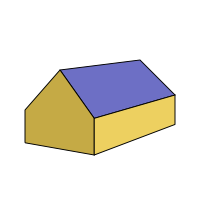
A gable roof[1] is a roof consisting of two sections whose upper horizontal edges meet to form its ridge. The most common roof shape in cold or temperate climates, it is constructed of rafters, roof trusses or purlins. The pitch of a gable roof can vary greatly.

Distribution

[edit]

The gable roof[2] is so common because of the simple design of the roof timbers and the rectangular shape of the roof sections. This avoids details which require a great deal of work or cost and which are prone to damage. If the pitch or the rafter lengths of the two roof sections are different, it is described as an 'asymmetrical gable roof'. A gable roof on a church tower (gable tower) is usually called a 'cheese wedge roof' (Käsbissendach) in Switzerland.

Its versatility means that the gable roof is used in many regions of the world.[3] In regions with strong winds and heavy rain, gable roofs are built with a steep pitch in order to prevent the ingress of water. By comparison, in alpine regions, gable roofs have a shallower pitch which reduces wind exposure and supports snow better, reducing the risk of an uncontrolled avalanche and more easily retaining an insulating layer of snow.[4]

Gable roofs are most common in cold climates. They are the traditional roof style of New England and the east coast of Canada. Nathaniel Hawthorne’s The House of the Seven Gables and Lucy Maud Montgomery’s Anne of Green Gables, the authors of which are from these respective regions, both reference this roof style in their titles.[5]

Pros and cons

[edit]

Gable roofs have several advantages.[6] They are:

  • Inexpensive
  • May be designed in many different ways.
  • Are based on a simple design principle.[7]
  • More weather-resistant than flat roofs
  • May allow an attic to be turned into living space if the pitch is sufficient to at least allow dormers. A steeper pitch will be sufficient on its own.

Disadvantages:

  • Gable roofs are more prone to wind damage than hip roofs.[8]

German terminology

[edit]

In German-speaking countries, the types of gable roof are referred to as:

  • Shallow gable roof (flaches Satteldach) with a pitch of ≤ 30°
  • New German (neudeutsches Dach) or angled roof (Winkeldach) with a pitch of 45°
  • When the pitch it greater than 62° it is called a Gothic (gotisches) or Old German roof (altdeutsches Dach)
  • If the roof has the shape of an equilateral triangle and 60° pitch it is called an Old Franconian (altfränkisches) (commonly found in the region of Franconia) or Old French roof (altfranzösisches Dach)[9]

See also

[edit]

References

[edit]
[edit]
Revisions and contributorsEdit on WikipediaRead on Wikipedia
from Grokipedia
A gable roof, also known as a pitched or peaked roof, is a roofing design consisting of two sloping planes that meet at a central , creating a triangular extension called a at one or both ends of the building. This configuration typically features a pitch of 3:12 or greater to facilitate water runoff, with the gable ends serving as vertical walls that enclose the space beneath the . Characterized by its simplicity and structural efficiency, the gable roof employs rafters or trusses for framing, sheathing such as or (OSB), and coverings like asphalt shingles or clay tiles, often with overhanging for added protection. Variations include open gables with exposed rafters for a modern aesthetic and closed gables with decorative bargeboards, enhancing architectural appeal while providing ample space compared to other roof types like hip roofs. Its advantages encompass cost-effective , effective drainage to prevent accumulation, and versatility in residential and historic applications, though gable ends can be vulnerable to wind uplift in high-wind areas without proper bracing. The has been a fundamental element in for centuries, appearing in historic structures and evolving into a staple of residential design, particularly in regions with precipitation where sloped roofs are essential for resistance. It remains prevalent in contemporary building due to its balance of functionality and aesthetic simplicity, often defining the silhouette of homes in various styles from Colonial Revival to modern vernacular.

Definition and Characteristics

Definition

A gable roof is a pitched roof structure featuring two sloping sides that meet at a central , creating a triangular end wall that is visible from the exterior. This design forms an "A"-shaped profile, with the representing the vertical, triangular portion of the end wall between the roof edges. The term "gable" derives from Old Norse gafl, meaning the end wall of a building, which entered Middle English via Old French gable; it originally referred to the forked or triangular shape resembling a gable end. Unlike flat roofs, which feature minimal or no and a horizontal plane, or hip roofs, where all sides without an exposed vertical gable face, the gable roof is distinguished by its prominent, perpendicular triangular end. Geometrically, the slopes of a gable roof typically range from 4:12 to 12:12 pitch, corresponding to angles of approximately 18° to 45°, with the oriented perpendicular to the ridge line for and aesthetic simplicity. Various configurations, such as cross-gables, build upon this basic form.

Key Features

The gable roof's sloped design facilitates effective load shedding, allowing rainwater and snow to slide off the inclines and preventing accumulation that could lead to structural damage or leaks. This feature is particularly beneficial in regions with heavy , as the pitch promotes rapid drainage and reduces the risk of ice dams in colder climates. However, the gable ends can be vulnerable to wind uplift in high-wind areas, requiring proper bracing to enhance stability; gable roofs are generally more susceptible to wind damage compared to hip roofs. Aesthetically, the gable roof imparts a sense of verticality and grandeur to buildings, with the prominent triangular end serving as a focal point that emphasizes height and . This end wall often incorporates windows to allow into the or upper levels, improving both functionality and visual appeal. Decorative elements such as bargeboards, which trim the roof edge along the gable, further enhance the ornamental quality, providing a polished finish that complements various architectural styles from traditional to modern. The configuration of a gable roof maximizes space utilization by creating a spacious area beneath the triangular frame, offering ample headroom along the central ridge for storage or habitable rooms. Unlike flatter or overhanging designs, this profile converts otherwise unused overhead volume into practical upper-floor space, making it ideal for expansions in residential construction. In terms of thermal performance and ventilation, the sloped surfaces of a gable roof support natural airflow through the incorporation of gable vents or ridge vents, which expel hot air and reduce heat buildup in the attic. This passive ventilation system helps regulate indoor temperatures, prevents moisture condensation, and extends the lifespan of roofing materials by minimizing thermal stress. The additional attic volume also accommodates insulation layers more effectively, improving energy efficiency without compromising the roof's structural integrity.

History

Ancient Origins

The gable roof, characterized by its triangular end walls formed by sloping roof planes meeting at a ridge, first emerged prominently in during the Archaic period, around the 8th to 6th centuries BCE. Early examples appear in temple constructions, where timber frameworks supported the sloping roofs, allowing for effective water shedding in the . These structures marked a shift from simpler thatched coverings to more durable systems, with the ends providing space for decorative elements. In classical Greek temples, such as the built in the 5th century BCE on the in , the gable roof's triangular became a key feature, often filled with sculpted friezes and statues depicting mythological scenes like the birth of . This design not only served structural purposes but also integrated aesthetic and narrative functions, elevating the roofline to emphasize the building's verticality and harmony with Doric, Ionic, or Corinthian orders. Timber rafters and purlins formed the frame, overlaid with terracotta tiles for weather resistance, while the itself was constructed of stone to support heavy sculptures. The Romans adopted and adapted gable roof in their from the 6th century BCE onward, using timber-framed versions in both public temples and private villas. For instance, in domestic settings like those at Pompeii, gable roofs covered atrium spaces, with wooden beams supporting tegula and imbrex tiles to protect against rain. In agrarian contexts across the empire, simpler thatched gable roofs prevailed, using reeds or straw over wooden frames for cost-effective shelter in rural homes and farm buildings. Stone-sloped adaptations appeared in some monumental structures, where the gable's incline was mimicked in for durability. Culturally, the gable roof symbolized stability and divine favor in these ancient societies, with its peaked form evoking mountains or the heavens—sacred motifs in Greek and . Pediments served as symbolic portals for gods, housing reliefs that conveyed narratives of protection and cosmic order, reinforcing the temple's role as a link between mortals and the divine. This significance persisted into Roman usage, where gable ends on villas signified prosperity and alignment with imperial ideals of harmony.

Medieval and Modern Developments

During the medieval period in , gable roofs became a hallmark of , particularly in grand cathedrals constructed from the onward. Structures like , begun in 1163, featured prominent gabled ends on transepts and facades, supported by intricate that allowed for expansive interiors while maintaining structural integrity. These roofs often employed steep pitches, typically exceeding 45 degrees, to facilitate snow shedding in northern climates, preventing collapse under heavy winter loads common in regions like and . Timber framing techniques were standardized during this era, using beams joined with mortise-and-tenon connections, enabling the construction of spans around 13 meters for the without intermediate supports. In the period, gable roofs evolved with classical influences, featuring less severe angles and decorative pediments, as seen in Italian and Northern European designs from the 15th to 16th centuries. This style spread to the American colonies in the 17th and 18th centuries through , where gable roofs were integrated into symmetrical homes, often paired with central chimneys for efficient smoke venting and windows to maximize attic space. Colonial examples, such as those in , adapted these roofs to local materials like cedar shingles, emphasizing simplicity and functionality in . The in the transformed gable roof construction through of cut nails and dimensioned , enabling framing that supported larger spans and faster assembly compared to traditional heavy timber methods. By the mid-1800s, these innovations reduced costs and labor, allowing gable roofs to proliferate in urban and suburban buildings across and . In the , prefabricated roof trusses, pioneered in the with metal plate connectors, further simplified builds by enabling off-site fabrication and on-site erection, ideal for housing booms. Contemporary adaptations of gable roofs emphasize sustainability and resilience, incorporating energy-efficient features like insulated rafters and integrated photovoltaic panels on south-facing slopes to optimize capture and reduce heating and cooling costs in suitable climates. Following major earthquakes in the 1970s, such as the 1971 San Fernando event, seismic reinforcements became standard, including braced gable ends, metal straps connecting rafters to walls, and shear walls to mitigate out-of-plane failures in high-risk zones. These modifications ensure gable roofs remain viable in modern seismic design codes, balancing aesthetic tradition with enhanced safety.

Design Elements

Primary Components

The primary components of a gable roof form its structural skeleton, ensuring stability against vertical loads from roofing materials and environmental forces like and . These elements work together to distribute weight from the peak to the building's walls, with the emphasizing load transfer through inclined members to prevent sagging or collapse. At the apex of the gable sits the ridge board, a horizontal beam that runs along the peak where the two sloping roof planes meet. This non-load-bearing member primarily serves to align and support the upper ends of the rafters, providing a nailing surface without directly carrying roof weight; instead, it maintains the roof's triangular and facilitates even load distribution to the walls below. The rafters constitute the sloping beams that extend from the ridge board down to the exterior walls, forming the main frame of the gable roof and directly transferring loads to the building . In common rafter systems, these are uniformly spaced inclined members that support the decking and sheathing, typically installed at 16- or 24-inch centers for balanced load-bearing. Principal rafter systems, used in larger or more complex setups, employ heavier primary rafters to support intermediate purlins, which in turn carry lighter common rafters, enhancing span capability in traditional framing. The gable end refers to the triangular portion of the exterior enclosed by the roof slopes and the eave line, providing vertical closure and weather protection below the roof overhang. This section is typically framed with vertical studs aligned to match the , creating a panel that resists lateral forces and integrates with the overall system for . Eaves form the lower horizontal edges of the gable roof where the rafters meet the walls, often extending into overhangs that project beyond the building face to shield walls from . These overhangs incorporate gutters to manage runoff, while soffits—enclosed undersides of the —promote ventilation by allowing airflow intake, reducing moisture buildup and heat accumulation. In terms of load-bearing mechanics, gable roofs can employ stick framing, where individual s are cut and assembled on-site for custom fits, or truss framing, using prefabricated triangular units that integrate , bottom chords, and webs for efficient force distribution across wider spans. Stick framing offers flexibility but requires precise calculations, with maximum unsupported rafter spans typically ranging from 10 to 22 feet for standard 2x6 to 2x10 (e.g., up to 14 feet for 2x6 and 22 feet for 2x10 at 12-inch centers), depending on , grade, spacing, deflection limits (L/180), and loads such as 20 psf live and 10-20 psf dead, per span tables. , by contrast, can achieve similar or greater spans with lighter materials due to engineered , though both methods prioritize connections like birdsmouth cuts at wall plates to ensure stability. Common materials for these components include dimensional graded for structural use.

Roofing Materials

Gable roofs are commonly covered with , which are the most affordable option and typically last 20 to 30 years with proper . These provide effective protection against moderate weather while being lightweight and easy to install on the sloped surfaces of gable designs. For greater and resistance, clay or tiles are frequently used, offering lifespans of 50 to 100 years but requiring structural due to their heavier weight. Metal sheets, such as standing seam panels, provide another robust choice with longevity up to 40 to 70 years, excelling in reflectivity and resistance to . Beneath these coverings, underlayments serve as a critical layer. Asphalt-saturated felt has long been standard for its affordability and ability to block , while synthetic membranes offer enhanced tear resistance and for better ventilation on gable roofs. In cold climates prone to ice dams, ice and water shields— membranes—are applied along and valleys to prevent leaks from melting ice. Historically, roofs were often thatched with reeds or before the , a material that provided natural insulation but was vulnerable to and rot. By the industrial era, shifts to , , and eventually asphalt and synthetics improved longevity and weatherproofing, aligning with and material innovations. Contemporary sustainability trends include recycled rubber shingles, made from up to 95% post-consumer tires for a 50-year lifespan, and green roofs with vegetation layers that enhance insulation on suitable structures. Material selection for roofs also depends on to optimize . In rainy regions, clay tiles paired with steeper pitches—often 4:12 or greater—facilitate rapid water shedding and reduce pooling risks. Conversely, in hurricane-prone zones, lighter metal roofing withstands winds up to 140 mph, minimizing uplift on the exposed gable ends compared to heavier tiles.

Variations

Simple Gable Roof

The simple gable roof features a symmetrical configuration with two sloping sides that meet at a single central , forming a triangular shape at the gable ends. This basic design creates two equal roof planes that extend from the ridge to the , making it well-suited for rectangular buildings such as traditional homes and barns. In applications, the simple gable roof is prevalent in rural and minimalist , where its straightforward form complements simple structures like farmhouses and sheds. The roof's pitch typically ranges from 4:12 to 12:12, allowing effective water and snow shedding while adapting to various climates and aesthetic needs. The simplicity of this roof type offers key advantages, including easier framing due to the minimal number of components and joints required during . It also facilitates superior ventilation through gable-end vents, promoting in attics and reducing buildup. Additionally, it remains cost-effective for spans of 24 to 40 feet, as the design minimizes material use and labor compared to more intricate roof forms. A notable example of an asymmetrical variation on the simple gable roof is the saltbox style, common in colonial homes, where one slope is steeper and longer than the other to accommodate added rear space.

Complex Gable Configurations

Complex gable configurations extend the basic gable roof principle by integrating multiple gable elements or hybrid forms to accommodate larger, irregular, or non-rectangular building footprints, such as L- or T-shaped structures. These designs maintain the triangular gable ends while introducing intersections that enhance architectural versatility but demand precise engineering for stability and weatherproofing. A cross gable roof features two or more sections oriented perpendicularly, where the ridges intersect at right angles to form valleys that channel water away from the building. This configuration is particularly suited for L- or T-shaped buildings, allowing the roof to follow the layout's extensions without compromising the gable's sloped profile. The resulting valleys act as natural drainage paths, directing rainwater to gutters or downspouts along the . The merges a traditional with a , featuring a small gable section at the peak that transitions into hipped slopes on the sides for partial enclosure of the roof space. This hybrid form provides the aesthetic appeal of exposed gable ends while incorporating the hip's sloped sides to reduce wind uplift and add volume. In contrast, the roof modifies the gable form with two distinct s per side—a steep lower slope nearly vertical for maximum height, and a flatter upper slope converging at the —while retaining open gable ends. Unlike the , which applies dual slopes to all four sides in a hipped manner, the gambrel's gable ends expose the triangular sections, making it ideal for elongated structures. Historically, this design gained prominence in barns, where the steep lower pitch facilitates hay storage by allowing taller loads to be hoisted into the loft without obstructing the . Implementing complex gable configurations introduces challenges, primarily at the intersections where multiple planes meet, creating potential leak points if not properly sealed. Valleys formed by gables or hybrid transitions require specialized valley flashing—typically metal or membrane underlayment—to direct water flow and prevent infiltration at these junctions. Adequate installation of flashing is essential to mitigate accumulation, as poor detailing can lead to structural deterioration over time.

Advantages and Disadvantages

Structural Benefits

Gable roofs provide effective weather resistance through their steep slopes, which facilitate efficient runoff of rainwater and , thereby minimizing the accumulation of on the roof surface and reducing the risk of , mold, and rot in the underlying . This promotes quick drainage, preventing prolonged exposure to that could lead to structural degradation over time. Additionally, when properly braced, standard gable roof constructions can withstand wind uplift forces associated with speeds up to 90 mph, as per common classifications for Class D roofing systems in moderate wind zones. The triangular profile of a gable roof enhances space efficiency by creating substantial volume, which can be utilized for storage, additional insulation, or even habitable expansions, offering more headroom and accessibility compared to flatter or more enclosed roof types. This configuration allows for the installation of insulation materials directly in the space, improving overall performance without compromising usable area. Furthermore, gable ends often incorporate windows or vents that introduce into the , enhancing visibility and ventilation while supporting energy-efficient design elements. In terms of cost and longevity, gable roofs typically require fewer materials than hip roofs due to their simpler and reduced number of structural components, resulting in lower expenses and faster installation times. With appropriate , such as periodic inspections and repairs, gable roofs constructed with durable materials like metal or can achieve an average lifespan of 40 to 70 years, providing long-term value through minimal upkeep needs. Gable roofs contribute to energy performance by leveraging their sloped surfaces to optimize passive , particularly in moderate climates where the orientation allows southern exposure to capture for natural heating during cooler months. This design reduces reliance on mechanical heating systems, potentially lowering by facilitating better solar penetration and thermal regulation within the .

Potential Drawbacks

Gable roofs exhibit notable vulnerability to forces, particularly at the exposed ends, where uplift pressures during storms or hurricanes can lead to structural failure if not adequately braced. These flat vertical surfaces create higher pressures compared to sloped designs like hip roofs, increasing the risk of detachment or wall collapse in high- regions. Mitigation typically involves installing hurricane ties or metal straps to anchor rafters and trusses to the walls, along with bracing for end walls over 4 feet in height to enhance resistance. In snowy climates, the steep pitches of gable roofs facilitate snow shedding, reducing overall accumulation compared to flatter designs, but they remain susceptible to ice dams where uneven roof temperatures cause melt-refreeze cycles at the eaves. Poor attic insulation or ventilation exacerbates this issue by allowing heat to escape from the interior, warming upper roof sections while edges remain cold. Effective prevention requires comprehensive attic ventilation systems, such as soffit and ridge vents, combined with adequate insulation to maintain uniform temperatures and minimize dam formation. Aesthetically, gable roofs often convey a traditional rather than modern appearance, with prominent vertical end walls that can appear stark or less integrated with . They also offer limited overhang protection on the gable ends, leaving side walls more exposed to and requiring additional siding or trim for durability, unlike the continuous slope coverage provided by hip roofs. Maintenance of gable roofs presents challenges due to the need for specialized access methods, such as -end ladders or , to reach the peaked areas safely without damaging the structure. Repairs to exposed end walls and gable vents can incur higher costs owing to their vulnerability to and wind-driven , often necessitating frequent inspections and protective coatings.

Construction and Applications

Building Techniques

The construction of a gable roof begins with a thorough planning phase to ensure structural integrity and compliance with applicable building codes. Load calculations are essential, encompassing dead loads from materials, live loads such as snow or maintenance personnel, and environmental forces like wind, as outlined in the International Building Code (IBC). For instance, minimum roof live loads are typically 20 psf (0.96 kN/m²) or less for most structures, with higher values required in areas prone to heavy snow or assembly use, per IBC Chapter 16. Pitch determination is influenced by climate; steeper pitches, such as 8/12 or greater, are recommended in regions with heavy snowfall to facilitate snow shedding and prevent accumulation, while flatter pitches around 3/12 suit hot, sunny climates to minimize heat gain. In addition to load calculations, determining the roof's surface area is crucial for estimating material quantities and costs. For a gable roof, the surface area is calculated by adjusting the building's footprint to include overhangs, then multiplying by a pitch multiplier, which accounts for the slope. The pitch multiplier is given by √((rise/12)^2 + 1), where rise is the vertical rise in inches over a 12-inch run. For a 12/12 pitch, rise/12 = 1, so the multiplier is √(1 + 1) = √2 ≈ 1.414. Overhangs, typically 1-2 feet for eaves and gable ends, are added to the length and width dimensions. For example, for a 20 ft by 40 ft footprint with 1 ft overhangs, the adjusted dimensions are 22 ft by 42 ft, yielding a footprint area of 924 sq ft; multiplying by 1.414 gives approximately 1,307 sq ft. With 2 ft overhangs, the adjusted dimensions are 24 ft by 44 ft, yielding 1,056 sq ft footprint and about 1,494 sq ft roof area. Depending on specific overhangs and adding 10% for waste, ridges, and hips, the total surface area ranges from approximately 1,400 to 1,600 sq ft. Framing follows a precise sequence to establish the roof's skeleton. The process starts with installing the ridge board at the roof's peak, secured to temporary supports or the building's top plates, providing alignment for subsequent members. Common rafters are then cut to the calculated length and pitch, placed symmetrically on either side of the ridge board, and nailed or hung in place, typically spaced 16 to 24 inches on for load distribution. Collar ties or ceiling joists are added next across opposing rafters near the top to resist outward thrust, followed by bracing—such as diagonal members or metal straps—to enhance stability during erection and counteract wind uplift, especially in high-wind zones. This sequence ensures even and prevents sagging. Once framing is complete, the covering installation protects the structure from weather. Roofing underlayment, such as synthetic sheets or felt, is laid over the sheathing starting from the eaves, with overlaps of at least 6 inches horizontally and doubled in valleys or eaves for waterproofing. or tiles are then applied from the bottom upward, aligning with chalk lines to maintain straight courses and nailing per manufacturer specifications, typically 4-6 nails per shingle. Flashing—metal strips of galvanized or aluminum—is installed at gable ends, ridges, and penetrations to seal joints and direct water away, preventing leaks at vulnerable edges. Safety protocols and appropriate tools are critical throughout gable roof to mitigate fall and injury risks. Scaffolding or elevated platforms must be erected per OSHA standards, capable of supporting four times the intended load and equipped with guardrails on open sides, particularly for pitches exceeding 4/12 where workers are exposed to heights over 6 feet. Pneumatic or cordless nail guns facilitate rapid fastening of rafters and sheathing but require sequential triggers to prevent accidental discharge, along with like harnesses and non-slip footwear. Modern prefabricated assemblies, engineered off-site, can significantly reduce on-site framing time compared to stick-built methods, minimizing exposure to hazards while accelerating the process.

Common Uses

Gable roofs are extensively employed in residential , serving as a standard design for single-family homes, especially in suburban settings where they represent one of the most frequently used roof types alongside hip roofs. This prevalence stems from their simplicity, cost-effectiveness, and ability to provide additional space for storage or insulation. In the United States, gable roofs dominate new construction and renovations for detached houses due to their compatibility with various building materials and aesthetic versatility. They are also commonly integrated into residential additions, such as attached garages, where the design maximizes vertical clearance for vehicle storage and overhead organization while aligning seamlessly with the main house structure. In commercial and agricultural contexts, gable roofs find practical application in structures requiring efficient airflow and structural simplicity. Agricultural barns frequently feature gable roofs to promote natural ventilation, as the sloped design allows wind to create suction over the , expelling warm, moist air from livestock enclosures and reducing humidity-related issues. This configuration is particularly valued in post-frame buildings for its support of open interiors without internal columns. In religious architecture, such as churches, gable roofs enhance verticality, with the triangular end walls often topped by steeples that symbolize spiritual elevation and direct the gaze upward toward the divine. Adaptive reuse projects leverage the inherent slope and space of existing roofs for modern features. Retrofitting with solar panels is common, as the angled surface optimizes sunlight capture, and engineering analyses indicate that panel configurations can even mitigate wind uplift on the host structure in designs. Similarly, roofs on older are repurposed into greenhouses by glazing the slopes, which improves light penetration and while preserving the original framework for cost-effective conversions. Gable roofs demonstrate strong suitability for temperate climates characterized by regular rainfall and snowfall, where the pitch efficiently sheds precipitation to prevent accumulation and water damage. In such environments, they outperform flat alternatives by facilitating drainage and reducing ice damming risks. Conversely, they are less prevalent in arid regions, where low-slope or flat roofs better manage intense solar heat gain and minimize wind vulnerability in open landscapes.

Regional and Cultural Aspects

Global Distribution

Gable roofs remain one of the most prevalent roof forms in , particularly in countries like the and , where pitched or sloped designs dominate traditional and modern residential due to their effectiveness in managing rainfall and providing space. In , pitched roofs are the most popular type, accounting for the highest turnover in roofing activities. Steeper gable configurations are especially common in alpine regions such as the , where they facilitate snow shedding to prevent accumulation and structural overload. In , gable roofs are ubiquitous in residential , forming the basis for the majority of single-family homes , often paired with asphalt shingles for cost-effectiveness and durability. Gabled designs experienced a revival in new builds across the region in the early , driven by aesthetic preferences and functional benefits like improved ventilation. In , adaptations include steeper pitches and reinforced framing to handle heavy snow loads, with simple gable shapes recommended to allow snow to slide off efficiently and reduce ice dam risks. Across , gable roofs are common in , where traditional designs feature flexible framing systems tied with ropes to absorb seismic forces during earthquakes, a practice refined over centuries for resilience in a high-risk zone. In contrast, the favors flat roofs over gable styles, as the arid climate eliminates snow concerns, and flat designs offer usable outdoor space, simpler , and better suitability for hot, dry conditions with minimal . Globally, and pitched roofs hold a significant in sloped roofing segments, though their use is declining in dense urban high-rises favoring flat or low-slope options for space efficiency. Conversely, they are rising in popularity in eco-friendly suburban developments, where sustainable materials and energy-efficient designs enhance their appeal in regions like and .

Terminology Variations

In English-language architectural contexts, a gable roof with a particularly steep pitch, often exceeding 45 degrees, is commonly referred to as an "A-frame" roof due to its triangular profile resembling the letter "A," where the roof slopes extend to form the primary exterior walls. In more technical or engineering discussions, the term "gable-end roof" emphasizes the presence of exposed triangular gable walls at the 's ends, distinguishing it from enclosed or variants. In German-speaking regions, the standard term for a gable roof is "Giebeldach," which directly translates to "gable roof" and highlights the prominent gable end. For simpler pitched designs without elaborate gables, "Satteldach" is used, meaning "" to evoke the shape's resemblance to a saddle's ridge and flanks. Relatedly, "Gaube" denotes a window protruding from the roof slope, with its etymology tracing to late "gūpe," likely referring to a small elevated projection or knoll-like structure on the . Other languages employ descriptive terms that underscore the roof's dual slopes and triangular form. In French, it is known as "toit en bâtière," literally "" or "duo-pitched roof," emphasizing the two inclining planes that shed water efficiently. The Spanish equivalent, "techo a dos aguas," translates to "roof of two waters," illustrating the division of runoff to opposite sides. In , the general term for is "yane," but a roof specifically is called "kirizuma yane," where "kirizuma" refers to the "cut gable" or triangular formed at the ends, a style prevalent in traditional structures like temples and farmhouses. Architectural glossaries and building codes reveal subtle terminological distinctions across standards. In the (ASCE) 7 standard, the term "gable roof" is explicitly defined for load calculations, focusing on roofs with vertical end walls forming and specifying zones based on slope angles. By contrast, the European Eurocode 1 (EN 1991-1-4) uses "duopitch roof" to describe the same configuration, particularly in and load provisions, where external coefficients are zoned (e.g., F, G, H) for the dual slopes without emphasizing the gable end. These variations reflect regional emphases: ASCE on structural exposure via gables, and Eurocode on pitch geometry for action effects.

References

Add your contribution
Related Hubs
User Avatar
No comments yet.