Hubbry Logo
DavidsoniaDavidsoniaMain
Open search
Davidsonia
Community hub
Davidsonia
logo
8 pages, 0 posts
0 subscribers
Be the first to start a discussion here.
Davidsonia
Davidsonia
from Wikipedia

Davidsonia
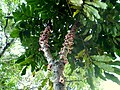
Davidsonia jerseyana
Scientific classification Edit this classification
Kingdom: Plantae
Clade: Tracheophytes
Clade: Angiosperms
Clade: Eudicots
Clade: Rosids
Order: Oxalidales
Family: Cunoniaceae
Genus: Davidsonia
F.Muell

Davidsonia is a genus containing three rainforest tree species native to Australia, commonly known as the Davidson plum or Davidson's plum.[1] The fruits superficially resemble the European plum, but are not closely related. All species have an edible sour fruit with burgundy-coloured flesh and are highly regarded as gourmet bushfood. The genus Davidsonia is named after John Ewen Davidson who claimed the land from which the tree was first botanically described.[2]

  • Davidsonia jerseyana, Davidson's plum or Mullumbimby plum, is a slender small tree, generally 5 metres high, native to lowland subtropical rainforests of New South Wales. It is considered an endangered species in the wild, but is widely cultivated for its pleasantly sour fruit that is used in jam, wine, ice-cream and sauces.
  • Davidsonia johnsonii, smooth Davidson's plum, is a small tree with a spreading canopy and smooth leaves, native to New South Wales and southeast Queensland. It is also considered an endangered species in the wild but is not widely cultivated because of its infertile seeds. It is propagated vegetatively from cuttings or root division.
  • Davidsonia pruriens, Ooray or Queensland Davidson's plum, is a taller tree than the other two species, reaching up to 12 metres high. It is also slender and has larger fruit which are produced in large clusters from the trunk or branches.

Small-scale plantations in New South Wales and Queensland supply the demand, mainly from Davidsonia jerseyana and Davidsonia pruriens.

[edit]

References

[edit]
[edit]
Revisions and contributorsEdit on WikipediaRead on Wikipedia
from Grokipedia
Davidsonia is a genus of three species of small to medium rainforest trees in the family Cunoniaceae, endemic to the subtropical and tropical rainforests of eastern Australia. The species are D. pruriens F. Muell., D. jerseyana (F. Muell. ex F.M. Bailey) G. Harden & J.B. Williams, and D. johnsonii J.B. Williams & G. Harden, each distinguished by variations in leaf size, pubescence, fruit morphology, and geographic range. Named after Queensland pioneer John Ewen Davidson, the genus was taxonomically revised in 2000, confirming its placement within Cunoniaceae based on DNA evidence and morphology. These trees typically grow 5–20 meters tall, with alternate, imparipinnate leaves featuring a winged rachis and new growth often pinkish and hairy. Flowers are small, reddish-brown, and borne in pendulous, cauliflorous or ramiflorous clusters during spring, leading to dark , plum-like drupes up to 50 mm in diameter that contain 2–3 pyrenes. D. pruriens is found from north-eastern , reaching up to 18 meters with larger leaves and fruits; D. jerseyana occurs in north-eastern , growing to 10 meters with smaller, more pubescent features; and D. johnsonii spans the border region, forming bushy, suckering plants 5–10 meters tall with narrower leaves and seedless fruits. The fruits, commonly known as Davidson's plums or ooray, are tart and high in antioxidants, , , and , traditionally used by and now commercially for jams, sauces, juices, and wines. Cultivation is possible in subtropical climates, with from or cuttings, though plants take 5–8 years to fruit and prefer moist, shaded conditions mimicking their native . The species are rare, with D. jerseyana and D. johnsonii listed as endangered due to habitat loss, highlighting their ecological significance in preserving Australia's ancient rainforest .

Description

Morphology

Davidsonia species are small to medium-sized trees, typically growing to heights ranging from 5 m in D. jerseyana to 18 m in D. pruriens, characterized by slender trunks and dense crowns that contribute to their to shaded environments. The leaves are compound and pinnate, featuring 7-17 leaflets with toothed margins, reaching lengths up to 1 m, and exhibiting a hue when young before maturing to dark green. Flowers are small and bisexual, colored dark pink to red, arranged in panicles measuring 30-80 cm long; they lack petals, possess 10 stamens, and include a superior . The fruits are plum-like drupes, 2-5 cm long, dark purple to black in color, containing 2-3 fibrous pyrenes each enclosing one , and featuring sour with high acidity. Notable anatomical features include irritant stinging hairs on the young leaves and stems of certain species, such as D. pruriens and D. jerseyana, which provide a defensive mechanism.

Reproduction

The genus Davidsonia exhibits varied reproductive strategies across its three , with flowering typically occurring in response to environmental cues such as rainfall and temperature, and inflorescences emerging from leaf axils or older leafless stems. In D. pruriens, flowering spans February to July in subtropical , with records from most months of the year, allowing for extended or near-continuous blooming that peaks during the warmer months. In contrast, D. jerseyana flowers from September to January in its New South Wales range, while D. johnsonii blooms primarily from October to November in northern rainforests. These pendent inflorescences, which can reach 30–80 cm in length, bear numerous small, dark pink to red flowers adapted for visitation, though detailed studies remain limited. Pollination in Davidsonia is primarily entomophilous, inferred from the minute flower size and structure, with native bees and flies as likely primary agents, though wind may play a supplementary role in D. pruriens. Self-pollination appears possible, as exclusion experiments indicate some fruit set without external pollinators, but self-incompatibility has been observed in isolated populations, potentially limiting gene flow. In D. pruriens, genetic analyses suggest up to 89% clonal progeny, hinting at apomixis or high selfing rates, while D. johnsonii flowers often lack viable pollen or reduced styles, further relying on vegetative means. No comprehensive pollinator censuses exist, but observations of small insects like bees and beetles on flowers support insect-mediated transfer. Fruit development follows rapidly, with drupes maturing in 3–6 months from initiation, forming clusters of 10–20 fruits per in a typical . For D. pruriens, fruits ripen from to October, often continuously at low levels, while D. jerseyana fruits peak from December to February, and D. johnsonii from February to April. These deep red to purple drupes, 2–5 cm long, feature acidic, edible mesocarp and are primarily dispersed by gravity beneath the parent , though birds such as king parrots and flying foxes, along with , contribute to occasional longer-distance dispersal by consuming or carrying fruits. Seeds within the drupes are large and laterally compressed, measuring 1–2 cm in length, with fibrous margins; each fruit typically contains 2-3 pyrenes, each with one , approximately 44% of which are viable in D. pruriens, while D. jerseyana seeds are similarly structured. In cultivated lines of D. johnsonii, seeds are infertile and pyrenes remain empty, with viable production rare overall. rates for viable fresh seeds in D. pruriens approach 100%, but drop below 20% for smaller or stored seeds due to physiological and short viability (about one month if kept wet). Seedlings emerge in 30–60 days under moist, warm conditions. Vegetative reproduction via root suckering is prominent across the genus, particularly in response to soil disturbance like slashing or fire, enabling clonal spread and clump formation. In D. johnsonii, this is the primary mode of propagation, with prolific suckers surrounding mature trees, while D. pruriens and D. jerseyana also produce suckers alongside , aiding persistence in fragmented habitats. This strategy supports rapid colonization of gaps but may reduce in isolated stands.

Taxonomy

Etymology

The genus Davidsonia was established by Ferdinand Jacob Heinrich von Mueller in 1867 within his Fragmenta Phytographiae Australiae, volume 6, in recognition of John Ewen Davidson (1841–1923), a London-born pioneer sugar planter and miller in northern whose property at Rockingham Bay facilitated the collection of initial specimens from Queensland rainforests. Davidson, son of a Scottish family, played a key role in the early and provided access to the site where collector John Dallachy gathered the first plants in 1863, directly leading to Mueller's description of the and its . The species epithets within Davidsonia reflect botanical characteristics, honorees, or localities. Davidsonia pruriens, the described by Mueller in 1867, derives its name from the Latin pruriens (present participle of prurire, meaning "to "), referring to the irritant stinging hairs on the young shoots, leaves, and stems that cause a pruritic sensation on contact. Davidsonia jerseyana, initially described as D. pruriens var. jerseyana by Frederick Manson Bailey in 1900 based on Mueller's unpublished notes from specimens collected in northern , was elevated to full species status in 2000; the jerseyana refers to its smaller size compared to the type variety. Davidsonia johnsonii, described as a new species in the same 2000 revision, honors Lawrence Alexander Sidney Johnson (1925–1997), the esteemed Australian botanist and former director of the Royal Botanic Garden Sydney (1972–1985), who first identified it as distinct from D. jerseyana during fieldwork in 1949.

Classification

Davidsonia was first described by in 1867 and initially classified within the family Saxifragaceae based on its floral and vegetative characteristics. Later, as the family Cunoniaceae was distinguished from Saxifragaceae, Davidsonia was transferred to Cunoniaceae due to shared morphological traits such as stipules, despite differences like alternate leaves. In 1952, H. H. Bange segregated Davidsonia into its own monogeneric family, Davidsoniaceae, citing differences in fruit structure and wood anatomy, a placement supported by subsequent taxonomists including Airy Shaw (1973), Dahlgren (1980), Takhtajan (1980), and Cronquist (1981). However, this separation was challenged by anatomical studies emphasizing similarities in structure to Cunoniaceae. Molecular phylogenetic analyses in the late and early 2000s, using chloroplast DNA sequences including the rbcL gene, resolved Davidsonia as nested within Cunoniaceae, refuting its isolation as a distinct family and highlighting affinities through shared genetic markers. The genus occupies a basal position in the family, with closest relatives including Ceratopetalum (such as the Australian Christmas bush) and other genera in the Schizomerieae tribe, supported by sequence similarities in rbcL and other regions. This evidence, combined with morphological revisions, prompted the family-level shift from Davidsoniaceae to Cunoniaceae, with no synonyms recognized at the genus level. The IV classification (2016) solidifies Davidsonia's placement in Cunoniaceae, within the order Oxalidales of the rosid clade, reflecting its evolutionary relationships based on comprehensive molecular data. A key taxonomic revision in 2000 by G. J. Harden and J. B. Williams confirmed the recognition of three species in the genus, integrating morphological and distributional evidence with emerging phylogenetic insights.

Species

Davidsonia jerseyana

Davidsonia jerseyana is a slender, understorey that typically reaches 6–10 m in , often with a single unbranched trunk or multiple stems arising from the base. Its compound leaves, measuring 35–80 cm long, consist of 11–17 oblong leaflets, each 6–30 cm long and 3–10 cm wide, covered in fine irritant hairs. The tree produces small, dark pink to red flowers in loose panicles 4–10 cm long along the trunk and older branches, followed by blue-black, pear- to oval-shaped fruits that are 33–45 mm long, 31–37 mm wide, and 27–35 mm deep, containing dark red acidic flesh and two fibrous seed cases; these fruits occur in small clusters directly on the stem. First referenced in botanical literature in 1895 by F.M. Bailey as a variety of Davidsonia pruriens, it was later elevated to species status in a 2000 taxonomic revision by G.J. Harden and J.B. Williams, distinguishing it from related taxa based on its hairy stems and fruits. Endemic to the coastal regions of north-eastern , particularly the and Brunswick River catchments, it inhabits edges of lowland subtropical and adjacent wet forest at elevations below 300 m, preferring sheltered south- or east-facing slopes on well-drained red or yellow podzolic soils derived from substrates like and . The species is listed as Endangered under both the Conservation Act 1995 and the Commonwealth Environment Protection and Biodiversity Conservation Act 1999, with its wild population fragmented across approximately 24 subpopulations at 118 known sites, though the total number of mature individuals remains uncertain and is believed to be small due to ongoing habitat loss from clearing, weed invasion, and grazing. Only two subpopulations occur within formal conservation reserves, such as and Billinudgel Nature Reserves, exacerbating vulnerability to threats like the collection of fruits and for the bush food trade. In cultivation, D. jerseyana is favored for orchards owing to its reliable ing and adaptability to subtropical conditions, with s reaching in 3–5 years and capable of yielding 4–13 kg of per annually when grown in fertile, well-drained soils with supplemental and fertilization; is straightforward via , which exhibit high rates up to 100% for viable stock.

Davidsonia johnsonii

Davidsonia johnsonii is a bushy, suckering small growing to 5–10 m tall, occasionally reaching 18 m, with smooth stems lacking stinging hairs and a dense leafy crown. The compound leaves measure 10–33 cm long, consisting of 5–9 pinnae, the terminal one 13–25 cm long. Flowers are small and dark pink, borne in terminal or subterminal axillary panicles that are loose and inconspicuous. The fruits are depressed-globose to somewhat elongated, 20–39 mm long and 25–60 mm wide, turning reddish-purple to purplish-black when ripe. The species was formally described in 2000 by J.B. Williams and G.J. Harden in a revision of the genus published in Telopea, based on specimens from north-eastern ; it honors Lawrence A.S. Johnson, a prominent Australian botanist and former director of the Royal Botanic Gardens Sydney. Earlier collections date to 1949 by Johnson himself, with the plant rediscovered in 1977 near . Populations are known from lowland sites in south-eastern and northern , including a disjunct occurrence at Gibraltar Range National Park. Davidsonia johnsonii inhabits margins of disturbed subtropical rainforests and wet sclerophyll forests at low elevations of 15–270 m, on podzolic soils derived from basalt or greywacke, often associated with trees such as Eucalyptus grandis and Lophostemon confertus. The Gibraltar Range population grows in cool temperate rainforest at higher elevations of approximately 800–1,200 m, within Nothofagus moorei-dominated forests. Reproduction presents significant challenges, as flowers are frequently sterile, featuring reduced or absent styles and anthers devoid of , with no viable recorded despite occasional production. is suspected to contribute to this infertility, limiting . The relies almost entirely on vegetative via prolific suckers, particularly following disturbance. In cultivation, cuttings are the primary method for due to unreliability. Conservation efforts focus on this , listed under the Biodiversity Conservation Act 2016, Queensland Nature Conservation Act 1992, and Commonwealth Environment Protection and Biodiversity Conservation Act 1999. The total known population comprises around 2,000 stems across 10–15 sites, though the clonal nature suggests fewer genetic individuals, potentially under 250 distinct clones in some estimates. Major threats include and loss from historical logging, invasion by weeds such as , road maintenance, and occasional illegal fruit collection. The small, isolated Gibraltar Range population heightens vulnerability to these pressures, with management emphasizing weed control and habitat protection.

Davidsonia pruriens

Davidsonia pruriens, commonly known as the Queensland Davidson's plum or ooray, is the most widespread species in the genus Davidsonia and the only one occurring in tropical regions. It is a slender valued for its large, fruits, which are commercially harvested for culinary uses such as jams, sauces, and beverages due to their high content and sour flavor. Unlike its southern relatives, D. pruriens features prominent stinging hairs on young growth, contributing to its distinct morphology within the genus. This species plays a key role in ecosystems and has shown promise in cultivation for sustainable production. The tree grows to a height of up to 18 m, with a single slender trunk and flaky brown to dark grey bark. Young parts, including new leaves and stems, are covered in long, irritant stinging hairs that can cause skin irritation upon contact. Leaves are compound, reaching 30–150 cm in length with 9–19 pinnae, the terminal pinna measuring 18–46 cm long and 8–16 cm wide. Flowers are small and reddish-brown, borne in pendulous, hairy inflorescences 12–80 cm long that emerge cauliflorously or ramiflorously on the trunk or older branches. Fruits are the largest in the genus, obovoid or ellipsoid, 38–55 mm long and 32–53 mm wide, dark purple when ripe, and produced in dense clusters of up to 50 per inflorescence. First described by in 1867 based on specimens collected by John Dallachy from Rockingham Bay (now Hinchinbrook area) in , D. pruriens was named for its itchy (pruriens) hairs. The lectotype is a specimen collected on 12 1866 (MEL 106575). The species was initially placed in its own family, Davidsoniaceae, but later revisions confirmed its position within Cunoniaceae. D. pruriens inhabits tropical lowland in north-eastern , from near Cardwell to Cooktown and inland to the Atherton Tablelands, at elevations from to over 1,000 m. It thrives in wet, primary rainforest environments, often in areas with high rainfall and humid conditions, though it is most abundant in lowland settings below 400 m. In cultivation, D. pruriens is fast-growing, reaching fruiting maturity in 3–5 years under suitable tropical or subtropical conditions with well-drained, fertile soil and protection from . It prefers partial shade during establishment but tolerates full sun once mature, producing fruits between February and June in its native range. Propagation is typically by seed, which germinates readily if fresh. for D. pruriens is Least Concern according to IUCN assessments, reflecting its relatively widespread distribution across protected areas such as Lake Eacham National Park and Bellenden Ker National Park. Populations remain stable overall, though fragmentation from agricultural clearing poses localized risks in some lowland habitats.

Distribution and habitat

Geographic range

The genus Davidsonia is endemic to eastern , with its natural distribution spanning approximately 1,500 km in latitude from the subtropical rainforests of northern to the tropical rainforests of north-eastern . The three species occupy discrete ranges within this overall area, with no known extralimital populations outside . Davidsonia jerseyana is restricted to coastal northern , primarily in the Tweed and Brunswick River catchments, from near in the south to the Tweed Valley and Chillingham in the north. Its occurrences are limited to elevations below 300 m, often on south- and east-facing slopes in fragmented lowland subtropical remnants. Davidsonia johnsonii has a narrower and more fragmented distribution, confined to the Queensland- border region, from the Tallebudgera and Numinbah Valleys in south-eastern Queensland south to Tintenbar and the Broken Head district near Ballina in northern , spanning about 120 km. This species occurs at altitudes of 15–270 m, typically in disturbed subtropical or on margins of wet . Davidsonia pruriens is the most northerly, found exclusively in north-eastern from Cardwell (near the southern end of its range) northward to Cooktown, with inland extensions to the Atherton Tablelands, at elevations from to over 1,000 m. Historically, the ranges of D. jerseyana and D. johnsonii were more extensive, covering larger areas of lowland subtropical prior to European settlement, but both have been significantly reduced through clearing for , urban development, and , leading to and isolated subpopulations. In contrast, D. pruriens maintains a relatively intact and widespread distribution within its habitats. All species are adapted to warm, humid climates transitioning from subtropical in the south to tropical in the north, with annual rainfall typically ranging from 1,200 to 2,000 mm supporting their environments.

Ecological role

Davidsonia species primarily occupy the layer of subtropical and tropical rainforests along eastern , where they contribute to habitat structure by casting shade that supports flora and potentially epiphytic growth on their trunks and branches. Their large, compound leaves are covered in fine irritant hairs that deter browsing by herbivores, including and larger mammals, providing a chemical and physical defense mechanism. The pendulous flowers of Davidsonia attract small native pollinators, such as bees, flies, and other insects, facilitating cross-pollination within these dense forest environments; for instance, native bees and flies are primary visitors for D. pruriens in Queensland rainforests. Fruits, which develop cauliflorously on trunks and older branches, serve as a food source for wildlife, including birds and mammals such as rodents and flying foxes, which aid in seed dispersal. In terms of nutrient cycling, Davidsonia thrives in well-drained, friable soils typical of understories, where decomposing leaf litter from their large pinnate leaves enriches and supports microbial activity essential for . These trees play a key role in as pioneers in disturbed habitats; they readily produce suckers following soil disruption, slashing, or flooding, enabling clonal regeneration and rapid recolonization of gaps in the canopy. As endemic rainforest specialists, the presence of Davidsonia populations often indicates relatively intact subtropical forest health, serving as a proxy for broader in these vulnerable ecosystems. , including altered rainfall patterns and temperatures, poses emerging threats to their rainforest habitats.

Conservation

Status and threats

The genus Davidsonia comprises three species, two of which are listed as Endangered under Australia's Environment Protection and Biodiversity Conservation Act 1999 (EPBC Act) and relevant state legislation, reflecting their restricted ranges and ongoing pressures in subtropical . Davidsonia jerseyana is classified as Endangered under the EPBC Act, the New South Wales Threatened Species Conservation Act 1995, and the Rare or Threatened Australian Plants (ROTAP) code 2ECi, indicating a geographic range under 100 km² with fewer than 1,000 individuals in reserves. Davidsonia johnsonii shares the same Endangered status under the EPBC Act, legislation, and 's Nature Conservation Act 1992, with its total known population estimated at approximately 2,000 stems as of 1999 (though a 2016 assessment identified only 27 known populations, with ongoing surveys seeking additional sites), primarily from clonal via root suckers, resulting in low numbers of genetically distinct mature individuals. In contrast, Davidsonia pruriens is not listed as threatened under federal or legislation, where it holds Least Concern status, though its populations are fragmented across tropical . Primary threats to Davidsonia species stem from anthropogenic habitat modification, with clearing for , urban development, and (such as upgrades) causing fragmentation and degradation of habitats; for D. jerseyana, this has reduced its occurrence to 118 documented point locations across 24 sub-populations in northern . Invasive weeds, including and Cinnamomum camphora, compete with seedlings and exacerbate habitat loss by altering conditions, particularly affecting D. johnsonii in southeast Queensland and northern . by livestock, native herbivores, and feral animals further impacts recruitment by damaging young plants, while inappropriate fire regimes and road maintenance activities pose additional risks to all species. For D. pruriens, general clearing for remains a concern, though its wider distribution buffers against immediate decline. Genetic vulnerabilities compound these threats across the , with remnant populations exhibiting low diversity due to historical fragmentation, , and reliance on clonal , which limits adaptability to environmental changes; this is especially acute for D. johnsonii, where isolation reduces and increases susceptibility to . Potential genetic from nearby cultivated D. pruriens or D. jerseyana hybrids threatens wild integrity, particularly for D. jerseyana sub-populations near human settlements. Although no recent quantitative decline rates are documented, ongoing habitat pressures suggest continued risk without intervention, with D. jerseyana and D. johnsonii facing elevated extinction probabilities in fragmented reserves like . Recent surveys, including those by Healthy Land and Water in southeast and northeast , aim to locate additional D. johnsonii populations to better inform conservation strategies.

Protection measures

All species of Davidsonia are protected under relevant Australian state legislation, with D. jerseyana and D. johnsonii additionally listed as Endangered under the federal Environment Protection and Biodiversity Conservation Act 1999 (EPBC Act). D. jerseyana is classified as Endangered under the Threatened Species Conservation Act 1995 (TSC Act). D. johnsonii is listed as Endangered under both the TSC Act and the Nature Conservation Act 1992. D. pruriens is classified as Least Concern under the Queensland Nature Conservation Act 1992, though it receives protection within reserved areas. Populations of Davidsonia species occur within several protected areas across their ranges. D. jerseyana is found in New South Wales national parks and nature reserves, including those in the Tweed and Brunswick River catchments such as Nightcap National Park. D. johnsonii inhabits Gibraltar Range National Park in New South Wales and various reserves in Queensland, such as Snows Gully Nature Reserve and Hogans Scrub Nature Reserve. D. pruriens is present in Queensland national parks, including Wooroonooran National Park and Lake Eacham National Park. Recovery plans have been developed to guide conservation efforts for the . The 2004 New South Wales recovery plan for D. jerseyana emphasizes restoration through and revegetation, alongside long-term population monitoring to track demographic trends and threats. Similarly, the 2004 national recovery plan for D. johnsonii outlines actions for , including to exclude and ongoing surveys. Seed banking supports these plans, with germplasm collections maintained at facilities like the Australian PlantBank as part of broader efforts to conserve Australian rainforest species. Ex situ conservation efforts include programs at botanic gardens. The Botanic Gardens of conducts cultivation and genetic research for D. johnsonii to support population recovery. Community-led planting initiatives contribute to habitat restoration, with organizations undertaking revegetation projects to enhance connectivity for D. jerseyana populations in since the early 2010s. Ongoing research focuses on genetic diversity to inform reintroduction strategies. Conservation genomics studies at Australian botanic gardens analyze D. johnsonii populations to guide translocation efforts, with preliminary trials demonstrating improved survival rates for propagated plants in restored habitats.

Cultivation and uses

Propagation and cultivation

Davidsonia species are propagated primarily through seeds, cuttings, or tissue culture to support cultivation for ornamental and culinary purposes. Seed propagation involves sowing fresh seeds in a well-draining mix kept moist, with high viability rates of approximately 80% and germination occurring within 3 weeks at 24°C without dormancy. Semi-hardwood cuttings from juvenile tissues, treated with indole-3-butyric acid (IBA) hormone, promote adventitious rooting, though success is higher in younger material compared to mature stems. Tissue culture techniques, including micropropagation of axillary shoots on half-strength Murashige-Skoog medium supplemented with 32.2 µM IBA for rooting, achieve over 80% rooting success for D. pruriens and D. jerseyana. Cultivation requires sites mimicking subtropical conditions, with partial shade to protect from intense sun, acidic soils (pH 5.5–6.0) rich in , and well-drained friable textures to prevent waterlogging. and annual rainfall exceeding 1,500 mm are essential, supplemented by in drier areas, while are frost-sensitive and require protection below 5°C to avoid damage. Upon planting, space trees 4–6 m apart to accommodate their multi-stemmed growth, apply such as leaf litter to retain moisture and suppress weeds, and fertilize sparingly with a low-phosphorus mix formulated for native Australian to maintain without promoting excessive vegetative growth. Common challenges include susceptibility to root rot caused by Phytophthora species in poorly drained soils, managed through improved drainage and cultural practices; neem oil applications provide some control against fungal pathogens and associated pests like psyllids, which can distort new growth. On a commercial scale, plantations in far north Queensland, such as those ranging from 50 to 5,000 trees, yield 4–13 kg of fruit per tree after 5 years under irrigated conditions, with mature trees reaching up to 13 kg depending on variety and management.

Culinary and commercial uses

The fruits of Davidsonia species, particularly D. jerseyana and D. pruriens, are characterized by a high nutritional profile that supports their culinary applications. They contain approximately 30 mg of per 100 g of flesh, contributing to immune health benefits, along with significant levels of anthocyanins (up to 691 mg per 100 g of pulp powder, primarily as 3-O-glucoside and 3-O-glucoside) and , which provide potent properties. The fruit's deep purple pigmentation stems from these anthocyanins, while its sour, taste—driven by high acidity—makes it unpalatable raw but ideal for processing into sweetened products. In Australian cuisine, Davidsonia fruits are transformed into jams, sauces, sorbets, and wines to balance their tartness with sweetness. For instance, Davidson plum sauce is commonly paired with native meats like or , enhancing flavors in savory dishes, while powdered or pureed forms are incorporated into desserts, beverages, and ice creams. These uses highlight the fruit's versatility in modern gourmet recipes, often combined with spices such as or to mellow its tang. Recent research as of 2024 has explored applications in functional foods, such as sorbets and meat preservatives using fruit extracts for benefits. Commercially, Davidsonia supports a small-scale industry in . In the 2010s, annual production was estimated at 6-7 tonnes from one source, with projections from 2012-2016 indicating an increase to 12-15 tonnes annually; no updated production figures are available as of 2025. Fruits are supplied to markets in forms like dehydrated powder, puree, or frozen packs, targeting health-conscious consumers for their status due to content. Demand for native Australian foods has driven industry growth. Beyond , Davidsonia fruits yield a pigment from their skins suitable for natural dyes in textiles and , while extracts rich in anthocyanins and show potential in pharmaceuticals as natural preservatives and agents—for example, in to extend . The plants also serve ornamental purposes in native gardens, adding aesthetic value with their slender trunks and elongated fruits.

References

Add your contribution
Related Hubs
User Avatar
No comments yet.