


Community hub
Recent from talks
Contribute something
Nothing was collected or created yet.
Northside High School (Houston)
View on Wikipedia
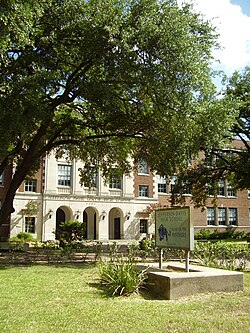
Northside High School, formerly Jefferson Davis High School, is a secondary school located at 1101 Quitman in the Near Northside neighborhood of Northside, Houston, Texas with a ZIP code of 77009. The school was previously named after Jefferson Davis, the only president of the Confederate States of America.[2]
Key Information


The school, which serves grades 9 through 12, is a part of the Houston Independent School District. The mascot of Northside is the Panther.[3]
The school also has a Hotel and Restaurant Management magnet program.
The HISD board voted to give the school its current name in 2016.[4]
History
[edit]Davis was previously reserved for white children but it desegregated by 1970, and white flight to the Houston suburbs began.
In 1993, project GRAD (Graduation Really Achieves Dreams) was founded at Davis High. The program provides scholarships to students as incentive to complete high school and enroll in college.[5]
Prior to 1996 it was renovated through the Renewal A bond program, which spent $5.5 million on Davis. In 1996 it had 1,800 students.[6]
Campus
[edit]In 1996 the school had terrazzo floors. At the time it had one temporary building used for classes and two others for other purposes; it had a fewer number compared to some other schools because it was not overcrowded. In 1996 Terry Kliewer of the Houston Chronicle praised the building's features and maintenance, and stated that it "exemplifies what is possible when an old building gets good maintenance and timely remodeling."[6]
Neighborhoods served by Northside
[edit]Northside High School serves[7] Near Northside,[8] Northside Village, Irvington,[citation needed] Lindale Park,[9] a portion of the Fifth Ward,[10] and most of Downtown Houston.
The school serves Irvington Village, a public housing unit and Fulton Village, a mixed-income unit, both of the Houston Housing Authority.[11][12] The school's boundary also includes the Four Seasons Hotel Houston residences,[13] Houston House Apartments,[14] One Park Place,[15] and The Rice.[16]
Student body
[edit]During the 2022-2023 school year, 1,168 students were enrolled at Northside. 94% of the students qualify for free or reduced lunch.
- 86.1% Hispanic American
- 12.8% African American
- 0.9% White American
- 0.1% Asian American
- 0.0% Native American
- 0.1% Multiracial
Extracurricular activities
[edit]The campus offers a variety of championship athletics
- Baseball
- Basketball
- Cross Country
- Football
- Soccer
- Softball
- Swim Team
- Tennis
- Track
- Volleyball
- Water Polo
- Wrestling
The campus also offers a variety of fine arts:
- Art
- Band
- Choir
- Orchestra
- Mariachi
- Pantherettes Dance Team
Feeder patterns
[edit]Elementary schools feeding into Davis include:[7]
Partial:
All of Marshall Middle School's attendance zone is within the Davis High School attendance zone.[27]
Middle schools that have portions of their attendance boundaries zoned to Davis include:
Notable alumni
[edit]- Frank Carswell - former Detroit Tigers outfielder and minor-league manager[32]
- Carl Crawford - Major League Baseball outfielder 2002-16, 4-time All-Star[33]
- James DeAnda - former federal judge of U.S. District Court for the Southern District of Texas[33]
- Gene Green - Democratic Party member of U.S. House of Representatives[33]
- Ricardo "Rocky" Juarez - 1999 World Champion boxer and Olympic silver medalist[33]
- Slater N. Martin - NBA Basketball player and Hall of Famer, played for Minneapolis Lakers (now Los Angeles Lakers), New York Knicks, and St. Louis Hawks (now Atlanta Hawks).[33]
- Kenny Rogers - country singer[33]
- Jesse Valdez - participant in 1972 Olympic Games[33]
See also
[edit]

References
[edit]- ^ a b c "NORTHSIDE H S". National Center for Education Statistics. Retrieved August 20, 2024.
- ^ "HISD approves name changes for seven schools". KTRK-TV. May 13, 2016. Retrieved April 24, 2019.
- ^ "Jefferson Davis High School". Houston Independent School District. Archived from the original on May 9, 2013. Retrieved September 9, 2008.
- ^ Clemons, Tracy. "HISD approves name changes for seven schools" (Archive). KTRK-TV. Thursday May 12, 2016. Retrieved on May 21, 2016.
- ^ Radcliffe, Jennifer (July 1, 2006). "Project GRAD Facing More Challenges". Houston Chronicle. Archived from the original on May 22, 2011. Retrieved September 9, 2008.
- ^ a b Kliewer, Terry (October 8, 1996). "Overcrowded, aging facilities a growing problem". Houston Chronicle. Archived from the original on October 8, 1999. Retrieved April 23, 2019.
- ^ a b "Northside High School Attendance Zone" (PDF). Houston Independent School District. Retrieved April 24, 2019.
- ^ Meeks, Flori. "Near Northside sees past as key to progress." Houston Chronicle. October 16, 2012. Retrieved on December 20, 2012. "Near Northside is bounded by Burnett Street to the south, Interstate 45 to the west, Hardy Street to the East and roughly Cavalcade to the north."
- ^ "Lindale Park Civic Club Bylaws" (PDF). Lindale Park Civic Club. December 29, 1991. p. 1. Retrieved June 2, 2020.
The Lindale Park Civic Club is generally bounded on[...]
- ^ Fifth Ward, Houston from the Handbook of Texas Online Retrieved on June 25, 2009.
- ^ "Fulton Village." Houston Housing Authority. Retrieved on January 2, 2018. "3300 Elser Street Houston, Texas 77009"
- ^ "Irvington Village." Houston Housing Authority. Retrieved on January 2, 2019. "2901 Fulton Houston, Texas 77009"
- ^ "Private Residences Houston". Four Seasons Hotels. Retrieved October 14, 2022. - This source establishes that the Four Seasons has permanent residences. Address is established here: "1300 Lamar Street, Houston, Texas 77010-3017, USA" - Compare the address to the school district boundary maps.
- ^ "Home". Houston House Apartments. Retrieved October 14, 2022.
1617 Fannin Houston, TX 77002
- ^ "Home". One Park Place. Retrieved October 14, 2022.
1400 McKinney Street HOUSTON, TX 77010
- ^ "Residents". The Rice. Retrieved October 15, 2022.
909 Texas Avenue Houston, TX 77002
- ^ "Ketelsen Elementary Attendance Zone." Houston Independent School District.
- ^ "Looscan Elementary Attendance Zone." Houston Independent School District.
- ^ "Clemente Martinez Elementary Attendance Zone." Houston Independent School District.
- ^ "Sherman Elementary Attendance Zone." Houston Independent School District.
- ^ "Crockett Elementary Attendance Zone." Houston Independent School District.
- ^ "Gregory-Lincoln Elementary Attendance Zone." Houston Independent School District.
- ^ "Herrera Elementary Attendance Zone." Houston Independent School District.
- ^ "Jefferson Elementary Attendance Zone." Houston Independent School District.
- ^ "Ross Elementary Attendance Zone Archived 2006-05-16 at the Wayback Machine." Houston Independent School District.
- ^ "Travis Elementary Attendance Zone." Houston Independent School District.
- ^ "Marshall Middle Attendance Zone." Houston Independent School District.
- ^ "Burbank Middle Attendance Zone." Houston Independent School District.
- ^ "Fleming Middle Attendance Zone." Houston Independent School District.
- ^ "Gregory-Lincoln Middle Attendance Zone." Houston Independent School District.
- ^ "Key Middle Attendance Zone." Houston Independent School District.
- ^ Frank Carswell Statistics and History. Baseball-Reference.com. Retrieved February 19, 2014.
- ^ a b c d e f g "Distinguished HISD Alumni". Houston Independent School District. Archived from the original on February 6, 2012.
Further reading
[edit]- Campos, Wendy, Cecilia Cruz, Stephen Martin, and Xochitl Vandiver-Rodríguez. "Jefferson Davis High School: The Past and the Present." history paper (for History 3394). May 17, 1994. In the possession of Professor Guadalupe San Miguel of the University of Houston. San Miguel cited the paper in his book, Brown, Not White: School Integration and the Chicano Movement in Houston.
External links
[edit]- Northside High School
- Davis High School at the Wayback Machine (archive index)
| Authority control databases: Geographic |
|---|

Northside High School (Houston)
View on GrokipediaHistory
Establishment and Early Development
Northside High School traces its origins to 1926, when it opened as Jefferson Davis High School in Houston's Near Northside neighborhood.[1] The institution was established by the Houston Independent School District (HISD) to address the educational needs of the expanding population in northern Houston, providing secondary education in an era of rapid urban growth.[1] [8] The original campus at 1101 Quitman Street featured a structure designed to support a growing student body, reflecting the architectural standards of the time for public schools.[8] Early operations focused on core academic programs typical of early 20th-century American high schools, including preparatory courses for college-bound students and vocational training amid Houston's industrial development.[9] By the late 1920s and 1930s, the school had begun producing its first graduating classes, fostering community ties in a diverse urban setting.[10] Initial enrollment figures and precise opening day records remain sparsely documented in available district archives, but the school's establishment marked a key expansion of HISD's high school network beyond the city's central areas.[1] This period laid the foundation for the institution's role in local education, with early yearbooks evidencing student activities such as sports and clubs that built school spirit.[10]Renaming Controversy and Transition
In early 2016, the Houston Independent School District (HISD) initiated a review of school names honoring figures associated with the Confederacy, prompted by national discussions following the 2015 Charleston church shooting and broader efforts to address historical symbols linked to slavery and secession.[11] Jefferson Davis High School, established in 1926 and named for the president of the Confederate States of America, became a focal point due to Davis's role in defending the institution of slavery during the Civil War.[12] The renaming process involved public hearings and board deliberations, reflecting divided community sentiments: proponents emphasized disassociating education from symbols of racial oppression, while opponents argued against erasing local history, incurring taxpayer costs for signage and materials estimated in the tens of thousands, and overriding neighborhood preferences for retaining the longstanding name.[13][14] On May 12, 2016, the HISD Board of Education voted 5-4 to approve renaming Jefferson Davis High School to Northside High School, drawing from the surrounding Near Northside neighborhood to maintain geographic identity without personal commemoration.[2] This decision was part of a larger package renaming seven schools with Confederate ties, amid heightened racial tensions and board divisions that included walkouts and legal threats from dissenting trustees. Critics, including alumni and some residents, contended that the change prioritized symbolic gestures over substantive educational improvements at the underperforming school, which had faced academic challenges; for instance, a 2016 community petition urged focusing resources on curriculum enhancements rather than rebranding.[15] Supporters, including civil rights advocates, viewed the action as a necessary step toward inclusivity in diverse urban districts.[16] The transition to the new name occurred seamlessly for the 2016-2017 academic year, with updated signage, uniforms, and official documents implemented by fall enrollment.[17] Despite the formal change, legacy attachments persisted among alumni groups, who continued referencing "Jeff Davis" in reunions and memorabilia, highlighting ongoing cultural resistance to the board's directive.[18] No significant disruptions to operations were reported, though the episode underscored broader debates in Houston over balancing historical preservation with contemporary values of equity.[19]Key Administrative Changes
In the late 20th century, Emily Cole assumed the role of principal at Jefferson Davis High School (later renamed Northside), serving for 13 years and implementing reforms that reversed chronic academic decline, reduced dropout rates, and fostered a culture of high expectations, earning her national recognition for the turnaround.[20][21] On September 14, 2017, Principal Steven Martinez and two assistant principals were abruptly removed from campus and reassigned elsewhere in Houston ISD after an investigation revealed the school had hired a convicted sex offender as a coach without adequate background checks; district officials stated no criminal allegations existed against the administrators themselves, but emphasized the hires violated policy.[22][23] Amid the Texas Education Agency's 2023 takeover of Houston ISD and the installation of Mike Miles as superintendent—which triggered district-wide reforms and over 177 principal turnovers by March 2025—Victor Garcia was appointed Northside's principal on August 1, 2023, bringing prior experience from other HISD campuses.[24][25] Garcia was replaced in November 2024 by Claudia Garza, with HISD scheduling a meet-and-greet but providing no details on the transition's rationale, consistent with opaque personnel shifts under Miles' tenure.[26]Campus and Facilities
Location and Architectural Features
Northside High School is located at 1101 Quitman Street in Houston, Texas, ZIP code 77009, within the Near Northside neighborhood.[27][28] The campus sits approximately two minutes north of downtown Houston, serving communities in the historic Northside area.[28] The school's architecture preserves historic elements from its origins as Jefferson Davis High School, including the facade along Quitman Street and an auditorium featuring ornate golden ceiling medallions.[29] A $67 million renovation and expansion project, funded through the Houston Independent School District's 2012 Bond Program, added facilities for culinary arts and fine arts, along with comprehensive interior remodeling and mechanical, electrical, and plumbing system upgrades.[30] This included a 265,283-square-foot addition completed around 2020, designed to modernize dated classrooms while maintaining the campus's historical character.[8][29]Expansions and Renovations
In 2012, Houston Independent School District voters approved a $1.89 billion bond program to address facility needs across 44 schools, including a comprehensive reconstruction and expansion at Northside High School with an allocated budget of $46.8 million, supplemented by an additional $19.6 million to reach approximately $67 million total.[31] [30] The project entailed demolishing outdated elements like the original front entrance, gutting and renovating interior spaces such as the second floor, and integrating new construction while preserving the historic façade of the 1926 building.[32] Key expansions included two new additions: one for culinary arts and another for fine arts, featuring specialized facilities for band, choir, mariachi band, dance team, and a second-floor science wing.[30] [29] Renovations modernized classrooms and labs, upgraded mechanical, electrical, and plumbing systems, replaced exterior windows, and added openings for increased natural light to enhance functionality without altering the structure's architectural integrity.[30] [8] Construction progressed through community input sessions starting in 2017, reaching 97% completion by November 2019 with final courtyard enhancements.[33] [34] The upgraded campus opened to students in August 2019, followed by a grand opening ceremony on December 3, 2019, marking the school's transition to contemporary standards while retaining its historical elements.[30]Academic Performance
Curriculum and Standardized Testing
Northside High School follows the Texas Essential Knowledge and Skills (TEKS) standards mandated by the Texas Education Agency, delivering core instruction in English language arts, mathematics, science, social studies, fine arts, health, and physical education as outlined in the Houston Independent School District (HISD) curriculum framework.[35] The school offers advanced academic pathways including Pre-Advanced Placement (Pre-AP), Advanced Placement (AP), and dual credit courses in partnership with local colleges, enabling students to earn college credits while meeting high school graduation requirements.[36] Elective options emphasize career and technical education, with robust programs in arts, audio-visual production, culinary arts, digital media, and hotel management through designated magnet pathways that require annual enrollment commitment for participants.[37] These magnet offerings integrate hands-on learning to prepare students for industry certifications or postsecondary pursuits in hospitality and media fields.[38] On standardized assessments, Northside High School students demonstrate below-state-average proficiency on the State of Texas Assessments of Academic Readiness (STAAR) end-of-course exams. In the most recent available data, approximately 24% of students achieved at least proficient (meets grade level or above) in mathematics, and 27% in reading, reflecting persistent challenges in core subject mastery compared to statewide averages exceeding 40% proficiency in both areas.[4] Detailed 2024 STAAR results show 73% of all students approaching grade level across subjects, with lower rates for meets grade level (e.g., 62% in reading/ELA), varying by subgroup: 65% for African American students, 73% for Hispanic students, and 55% for special education.[38] The school's average SAT score for 2022-2023 graduates was 871, trailing the HISD district average of 931 and the Texas statewide average of 978, indicating limited college readiness in verbal and quantitative reasoning.[3] These outcomes contribute to the school's overall B accountability rating from the Texas Education Agency, which weighs STAAR performance, graduation rates, and postsecondary preparation metrics, though domain scores in student achievement have hovered in the D range in prior years due to scaled adjustments aligning raw STAAR results to performance standards.[3][39]Graduation Rates and Post-Secondary Outcomes
The four-year cohort graduation rate at Northside High School for the Class of 2023 stood at 86.5%, meaning 86.5% of students received their high school diplomas within four years or earlier.[3] This figure aligns with other reports placing the rate at 86% to 87%.[40][41] The corresponding dropout rate for grades 9-12 during that period was 3.4%.[3] These metrics fall below the Texas state average of 90%.[40] Post-secondary outcomes reflect limited college readiness among graduates. Approximately 30% of graduates from recent cohorts pursue in-state college or vocational programs.[41] Indicators of preparedness include an average SAT score of 1020, based on student-reported data.[4] Advanced Placement participation reaches 52% of students, but the school's low national ranking (#13,001) suggests subdued performance on college-level assessments.[5] With 92% of students economically disadvantaged, these results occur amid broader district challenges in transitioning graduates to higher education or careers.[5] Specific college, career, and military readiness rates for the campus are not publicly rated in recent Texas Education Agency evaluations.[42]Factors Contributing to Performance Challenges
Northside High School serves a student population where 92% are economically disadvantaged, a factor strongly correlated with diminished academic outcomes due to associated challenges such as unstable home environments, limited access to educational resources outside school, and higher rates of absenteeism.[5][43] In high-poverty urban districts like Houston ISD, schools with over 75% low-income enrollment, which includes Northside, consistently underperform on standardized measures, as poverty impedes cognitive development and family support for learning from early grades onward.[44][45] The school's 99% minority enrollment, predominantly Hispanic and Black students, compounds these issues through elevated English language learner (ELL) populations and cultural factors that can hinder proficiency in core subjects without targeted interventions. STAAR end-of-course exam proficiency rates at Northside lag far behind state averages, with only 15% of students proficient in math compared to Texas's 44%, and similar gaps in reading and science, reflecting systemic barriers tied to socioeconomic status rather than inherent ability.[5][40] Economically disadvantaged students at such schools face five times the likelihood of attending high-poverty environments that perpetuate cycles of underachievement, including lower parental involvement and exposure to community stressors like neighborhood instability.[46] District-wide patterns in Houston ISD, where 76-80% of Black and Hispanic students attend high-poverty schools, further exacerbate Northside's challenges through resource strains and policy responses to state interventions, though the school's B accountability rating from the Texas Education Agency in recent years indicates modest progress amid persistent gaps in college readiness and graduation outcomes (86.5% on-time rate versus state targets).[47][3] These factors underscore causal links between concentrated poverty and educational deficits, independent of instructional quality alone, as evidenced by statewide data showing poverty as the dominant predictor of low ratings even after accounting for growth metrics.[44]Student Body
Demographics and Enrollment Trends
As of the 2023-2024 school year, Northside High School enrolled 1,141 students in grades 9 through 12, with a student-teacher ratio of 15:1.[43] The student body is 84% Hispanic, 14% African American, 1% White, and less than 1% Asian or other ethnicities, resulting in 99% minority enrollment overall.[43][40] Additionally, 92% of students are economically disadvantaged, and 73% are classified as at risk of dropping out, while 29.5% participate in bilingual or English as a second language programs.[3][5]| Demographic Category | Percentage (2023-2024) |
|---|---|
| Hispanic | 84% |
| African American | 14% |
| White | 1% |
| Asian/Other | <1% |
| Economically Disadvantaged | 92% |
Discipline Policies and Incidents
Northside High School adheres to the Houston Independent School District's (HISD) Student Code of Conduct, which establishes a districtwide discipline management plan applicable to all campuses, including behaviors on school grounds, within 300 feet of property, during sponsored activities, and certain off-campus or online actions affecting the school environment.[49] The code specifies expected student behaviors and categorizes misconduct ranging from minor disruptions to severe offenses such as fighting, violence, and property damage, with consequences escalating by severity, including in-school interventions, out-of-school suspensions, expulsions, or placement in alternative education programs.[49] Severe disciplinary offenses, per HISD policy, may trigger notification to law enforcement.[50] On November 28, 2023, a 16-year-old Northside High School student sustained a non-life-threatening gunshot wound to the arm during an altercation involving two other individuals just off campus near Fulton and Morris streets in north Houston.[51][52] Houston Police Department officers, patrolling nearby, heard gunshots around 1 p.m. and detained one suspect at the scene while seeking another; no ongoing threat to the school was reported.[53][54] In early February 2025, approximately 100 students participated in a walkout protesting federal immigration enforcement policies, during which HISD officials reported that a smaller subset engaged in disruptive activities violating the Student Code of Conduct, prompting the school to enter secure mode and noting potential property damage.[55] As a result, 45 students received three-day out-of-school suspensions, with affected individuals returning to classes by Thursday, February 13.[55] Parents and students protested the decisions, asserting the action was peaceful and protected under the First Amendment, while demanding video evidence of disruptions; the ACLU of Texas urged HISD Superintendent Mike Miles to repeal the suspensions, arguing they did not align with policy violations for such conduct.[6][56]Service Area
Neighborhoods Served
Northside High School serves a designated attendance zone in northern Houston, primarily encompassing the Near Northside community, a historic residential area located approximately two minutes north of downtown and nestled between Interstate Highway 45 (IH-45 North Freeway) and Interstate Highway 69 (Eastex Freeway).[28] This zone includes neighborhoods such as Northside Village, where the school is zoned to provide secondary education for local residents.[57] The boundaries, last revised on June 16, 2016, are delineated by a combination of streets, bayous, and railroads, extending southward near Buffalo Bayou and Interstate 10, westward along Little White Oak Bayou and White Oak Bayou, eastward to streets like N Main Street and Airline Drive, and northward toward Hirsch Road and Jensen Drive.[58] Key perimeter streets include Quitman Street (site of the school at 1101 Quitman), Elysian Street, Kelley Street, and Waco Street, incorporating a mix of older single-family homes, multi-family units, and some commercial pockets typical of the area's working-class heritage.[58][28] Eligibility for enrollment is determined by residential address within these limits, with overlaps possible from adjacent elementary and middle school zones feeding into Northside High School; families are advised to use the Houston Independent School District's official School Finder tool for precise verification, as minor adjustments may occur.[28] The zone's configuration reflects Houston ISD's efforts to align school capacities with population densities in this densely populated urban corridor.[58]Feeder Patterns from Middle Schools
Northside High School primarily draws students from designated middle schools within the Houston Independent School District (HISD) feeder pattern, determined by residential address boundaries established by the district.[59] The core middle schools feeding into Northside High School are Alexander Middle School, Fonville Middle School, and Stevens Middle School, with students progressing to the high school upon completion of 8th grade, barring transfers or choice program exceptions.[43] These feeder arrangements support a structured progression through HISD's zoned system, where attendance zones for middle schools align partially or fully with Northside's high school boundary to facilitate continuity in education.[59] For instance, portions of the Alexander Middle School zone, located in the Near Northside area, direct graduates to Northside, reflecting the school's historical role in serving adjacent neighborhoods.[43] Fonville Middle School, situated further north, contributes students from its attendance area, which overlaps with Northside's service zone amid ongoing district boundary adjustments.[43] Similarly, Stevens Middle School feeds students whose residences fall within compatible zones, ensuring a predictable pipeline despite periodic revisions to patterns for demographic or capacity reasons.[43][60] HISD maintains flexibility in feeder patterns, with updates published annually; families can verify current assignments via the district's School Finder tool, which maps addresses to specific schools.[61] This system aims to balance enrollment across schools like Northside, which has seen stable but challenged intake amid broader district reforms post-2023 state intervention.[62]Extracurricular Programs
Athletics
Northside High School participates in the University Interscholastic League (UIL) as part of Houston Independent School District, fielding teams in all sanctioned sports for its classification, including football, boys' and girls' basketball, baseball, softball, volleyball, track and field, soccer, tennis, golf, swimming, cross country, and wrestling.[63] The athletic programs operate under the Panthers mascot and emphasize broad participation, with coaching staff assigned to each discipline as detailed in the school's roster.[63] Football serves as a flagship sport, with the varsity team competing in UIL Class 4A Division I, Region III, District 11.[64] Recent performance includes a 28-24 victory over Kashmere High School on October 11, 2025, at Cowart Stadium, though overall records have been inconsistent, such as 2-4 in district play during prior seasons.[65] No state championships are recorded for the program. Track and field has produced notable individual performances, particularly in sprint events. School records include Trevon Alfred's 11.33 seconds in the boys' 100 meters set in 2012 and Braylon Williams' 53.30 seconds in the 400-meter hurdles achieved on April 3, 2025, at the UIL 6A District 18 meet.[66][67] Donovan Roberts ran 11.46 seconds (with 1.9 m/s wind) in the 100 meters in 2024, ranking second all-time.[66] The program competes in UIL Class 6A District 18 but has not secured team state titles.[67] Basketball and other team sports maintain active schedules without documented UIL state-level successes in available records. Athletic facilities are shared within Houston ISD, with home games hosted at venues like Cowart Stadium for football.[65] Participation aligns with district-wide efforts to promote student involvement, though specific metrics on athlete numbers or funding are not publicly detailed beyond UIL compliance.[63]Non-Athletic Activities and Clubs
Northside High School offers a variety of non-athletic clubs and organizations designed to develop students' interests, communication skills, and leadership abilities, with each group maintaining its own meeting schedules and guidelines.[68] Students are encouraged to contact sponsors for participation details.[68] The available clubs include:- Ambassadors, sponsored by Mr. Rodriguez, focusing on school representation and leadership.[68]
- Art Club, led by Ms. Brumfield, providing opportunities for creative expression through visual arts.[68]
- Black Student Union, sponsored by Ms. Davis, promoting cultural awareness and community among Black students.[68]
- Gaming Club, under Mr. Bryant, centered on video games and related strategy discussions.[68]
- Hispanic Honor Society, sponsored by Ms. McCollin, recognizing academic excellence among Hispanic students.[68]
- National Honor Society, emphasizing scholarship, service, leadership, and character.[68]
- Paw-sitive Impact Club, led by Mr. Levy, likely involving animal welfare initiatives.[68]
- Reading Club, dedicated to literary discussions and promotion of reading.[68]
- SABOR, sponsored by Mr. Rodriguez, a cultural or Hispanic-focused group.[68]
- STEM Club, under Ms. Gray, exploring science, technology, engineering, and mathematics projects.[68]
- Student Council, sponsored by Ms. Ford, representing student interests in school governance.[68]
- Woods Project, also led by Ms. Gray, involving hands-on environmental or construction activities using wood materials.[68]