Hubbry Logo
Cape DezhnyovCape DezhnyovMain
Open search
Cape Dezhnyov
Community hub
Cape Dezhnyov
logo
8 pages, 0 posts
0 subscribers
Be the first to start a discussion here.
Cape Dezhnyov
Cape Dezhnyov
from Wikipedia

Satellite image of Bering Strait. Cape Dezhnev, Russia is on the left while Cape Prince of Wales, USA is on the right.

Key Information

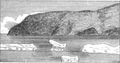
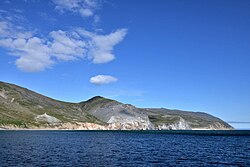
Headlands and islands of the Bering Strait as seen from a point 25 miles (40 km) south of the Diomede Islands. Cape Dezhnev on the far left.

Cape Dezhnyov or Cape Dezhnev (Russian: мыс Дежнёва; Eskimo–Aleut: Tugnehalha; Inupiaq: Nuuġaq),[1] formerly known as East Cape or Cape Vostochny, is a cape that forms the easternmost mainland point of Asia. It is located on the Chukchi Peninsula in the very sparsely populated Chukotka Autonomous Okrug of Russia. This cape is located between the Chukchi Sea and the Bering Strait, 82 kilometres (51 mi) across from Cape Prince of Wales in Alaska; the Bering Strait is delimited by the two capes. The Diomede Islands and Fairway Rock are located in the midst of the strait.[2]

Geography

[edit]

In 1898, the cape was officially renamed as Cape Dezhnev, replacing Captain James Cook's name, the "East Cape". It was named in honor of Semyon Dezhnev, the first recorded European to round its tip (in 1648). There is a large monument to Dezhnev on the seacoast.

The cape is the eastern tip of a high, rocky headland, about 20 kilometres (12 mi) from Uelen in the north to Cape Pe'ek in the south, connected to the mainland by a neck of lower-lying land peppered with swamps and shallow lakes. That low-lying land is so low in elevation that the cape appears as an island from a distance far to the south of it. The US Hydrographic Office publication Asiatic Pilot from 1909 gives the height of the headland as 2,521 feet (768 m), and the US Office of Coast Survey chart of 2000 shows the highest peak at 2,638 feet (804 m). The headland and the neck of low-lying land together form a peninsula. A well-established trail crossed the neck of land behind the headland in pre-historic and historic times, traversed by sleds in the winter and used as a portage in the summer to avoid traversing the strait. This route was important enough that, according to an analysis by linguist Michael Krauss, the Central Siberian Yupik language continued up the coast, un-interrupted by the Naukansky dialect spoken in the village of Naukan on the headland.

The Great Circle distance from Cape Dezhnev to the shore of the Bab-el-Mandeb strait in Yemen is about 10,855 kilometres (6,745 mi), which is the longest land distance of Asia.

History

[edit]
Detail of a USCGS chart from 1937 showing Cape Dezhnev (East Cape) with the historical villages Tunkan, Uelen (Ugelen), Naukan (Nuokan), Enmitahin, and Dezhnevo (Port Dezhnev) marked. The shape of the cape is somewhat distorted in this map.

The Cape Dezhnev (or East Cape, as it was then generally called) peninsula was a center for trade between American (and other) whalers and the fur traders and the native Yupik and Chukchi people of the coast in the late 19th and early 20th centuries. In the early years, ships would call at Uelen to trade for furs produced along the Arctic coast. Subsequently, trading stations were established at Uelen and Deshnevo (Keniskun in Chukchi, Kaniskak in Yupik). When a source of that period speaks of stopping or trading at East Cape, it can refer to either of these locations or to the Yupik village of Naukan on the southeast shore of the cape, which had less trade because it lacked a good anchorage. Sources from that period sometimes speak of a village called Emma-Town. Although this name may be derived from the nearby Yupik village of Enmitahin (Chukchi for "end of the cliff"), the name appears to refer to Keniskun (where the traders were) or perhaps to both villages together. Of the four historical villages on the cape itself, only Uelen is still inhabited. Naukan was evacuated in 1958 with most of the occupants relocated to Nunyamo near Saint Lawrence Bay, Chukotka, and Keniskun was merged with Uelen a little earlier.

In Josef Bauer's As Far as My Feet Will Carry Me (1955), Cape Deshnev is given as the site of a Gulag lead-mine camp from which German POW Clemens Forell (actual name: Cornelius Rost) escaped in 1949. Later research cast serious doubt on the book's accuracy; at the time of the supposed escape, no Cape Dezhnev Gulag camp lead mine existed.[3]

[edit]

See also

[edit]

References

[edit]
[edit]
Revisions and contributorsEdit on WikipediaRead on Wikipedia
from Grokipedia
Cape Dezhnyov (Russian: мыс Дежнёва) is a remote cape forming the easternmost point of mainland on the in Russia's . Positioned at 66°04′45″N 169°39′07″W, it separates the to the north from the to the south and lies approximately 82 kilometers across the strait from Cape Prince of Wales, —the westernmost point of mainland . Formerly known as East Cape to Europeans, it was renamed in honor of Cossack explorer , who in 1648 led the first documented European expedition to round the peninsula and traverse the , eighty years before Vitus Bering's voyage. The site hosts a lighthouse operational since the early for in the treacherous waters and a monument commemorating Dezhnev's achievement, set against a stark landscape of , cliffs rising to 740 meters, and relics of the abandoned indigenous Chukchi village of Naukan, forcibly relocated by Soviet authorities in 1958. As a strategic Arctic outpost, Cape Dezhnyov underscores the Bering Strait's role as a vital migratory corridor for marine mammals and a geopolitical chokepoint linking the Pacific and Arctic Oceans.

Geography

Location and Coordinates

Cape Dezhnyov constitutes the northeastern tip of the Chukchi Peninsula in Chukotka Autonomous Okrug, within the Russian Federation, at coordinates 66°04′45″N 169°39′7″W. This position establishes it as the easternmost mainland point of Eurasia. Positioned between the Chukchi Sea northward and the Bering Strait southward, the cape faces Cape Prince of Wales in Alaska across approximately 82 kilometers of water, delineating the separation between the continents of Asia and North America. Administratively, it falls under Russian sovereignty with no documented territorial disputes in official records.

Topography and Physical Features

Cape Dezhnyov constitutes an isolated, flat-topped mountain massif on the , elevating to a maximum height of approximately 740 meters above . The promontory's terrain includes steep slopes covered in vegetation, descending sharply to rocky cliffs that border the to the south and the to the north. Surrounding lowlands feature hills interspersed with swampy areas, enhancing the cape's rugged isolation. Geologically, the cape lies within the Anyui-Chukotka fold belt, a orogenic system comprising deformed to sedimentary, volcanic, and platform cover rocks overlying basement. Intrusive activity during the produced granitoids, including syenites at Cape Dezhnyov dated to about 109 million years ago, reflecting subduction-related magmatism along the Pacific margin. The coastal physical attributes are shaped by exposure to converging ocean currents in the , where Pacific inflow meets Arctic outflow, promoting wave-driven erosion that maintains the steep cliff profiles and restricts beach development to limited pebble accumulations at cliff bases.

Climate and Environment

Climatic Conditions

Cape Dezhnev lies within the zone (Köppen ET), marked by prolonged cold and short, cool summers, with its conditions shaped by exposure to the cold waters of the and . The annual average temperature hovers around -13°C, with monthly means ranging from -30.5°C in winter to 10.1°C in summer. temperatures typically average between -35°C and -15°C, with extremes dropping below -45°C, while July highs rarely surpass 10°C on average, though recorded maxima have reached +14°C in the broader Chukotka region. Precipitation is low, averaging 200-400 mm annually, predominantly as during the extended winter, contributing to persistent snow cover and ice formation. The area features continuous , with an active thawing layer limited to 20-40 cm in summer due to the shallow seasonal warmth. High winds are common, with coastal zones experiencing approximately 150 days of strong gusts per year, exacerbating the chill factor and contributing to conditions. Frequent prevails in June and July, driven by marine influences from adjacent seas. At , the cape endures extreme photoperiod variations, including continuous daylight (polar day) from late May to late July and from early December to early January, which intensify the thermal extremes by limiting solar heating in winter and maximizing it briefly in summer. These cycles, combined with oceanic moderation, result in rapid temperature fluctuations and persistent , underscoring the site's harsh environmental regime.

Flora, Fauna, and Ecological Role

The Arctic tundra vegetation at Cape Dezhnyov is characterized by sparse, low-growing communities adapted to , strong winds, and a brief frost-free period of 60-90 days, featuring dominant mosses ( spp., spp.), lichens ( spp., Cetraria spp.), and graminoids such as sedges ( spp.) and grasses (Dupontia fisheri). Dwarf shrubs including Arctic birch () and various willows (Salix polaris, Salix reticulata) form patchy cushions, alongside forbs like mountain avens ([Dryas octopetala](/page/Dryas octopetala)). Chukotka as a whole hosts over 900 species, with mosses and lichens comprising around 400 taxa that stabilize soil and retain moisture in this low-biomass ecosystem. Terrestrial fauna is limited by harsh conditions, including Arctic foxes (Vulpes lagopus) preying on lemmings (Lemmus trimucronatus, Dicrostonyx torquatus), while coastal and marine species predominate: Pacific walruses (Odobenus rosmarus divergens) aggregate at nearby haul-outs for molting and resting, ringed seals (Pusa hispida) and bearded seals (Erignathus barbatus) haul out on ice or shore, and polar bears (Ursus maritimus) forage along the fringes, with densities peaking during ice breakup. Migratory birds, exceeding 200 species regionally, nest in seabird colonies extending from Cape Dezhnyov along the coast, including eiders (Somateria spp.), guillemots (Cepphus spp.), and shorebirds that utilize wetlands for breeding. Ecologically, the cape functions as a transitional zone in , channeling migrations through the narrow —where marine mammal densities are among the highest globally—and supporting trophic links from primary producers like (via ) to top predators, with grazing on benthic invertebrates sustaining bear and fox populations. Long-term data indicate sea mammal populations, including walruses and seals near Chukotka, have fluctuated over millennia in response to extent and , underscoring the site's role in regional resilience to climatic shifts.

Human Habitation and Indigenous Peoples

Prehistoric and Traditional Chukchi Presence

Archaeological investigations on the reveal evidence of prehistoric human occupancy dating to the period, with stone artifacts and flakes indicating early adaptations to the local environment, including potential Late influences on higher terraces. Sites along the northeastern coast, proximate to Cape Dezhnyov, yield remains of semi-subterranean dwellings constructed with stone foundations, often associated with tools for processing marine mammals such as harpoons and lithic bifaces linked to the Chukchi Archaic tradition around 3,000 years ago. These artifacts, including notched bifaces, reflect specialized hunting technologies for and whales, evidencing long-term reliance on coastal resources without indications of dense, urbanized settlements. Petroglyphs distributed across Chukotka, including motifs near coastal areas, depict maritime hunting scenes with umiak-like boats, multiple paddlers, and toggling harpoons targeting whales and seals, originating no earlier than the first millennium B.C. Such imagery aligns with proto-Chukchi adaptations, combining terrestrial with mammal exploitation in a suited to the tundra-coast interface, as corroborated by excavated harpoons from contemporaneous Old layers. Dwelling remnants between and Cape Dezhnyov, including stone-lined structures at sites like Nykhsirak, further attest to seasonal or semi-permanent camps focused on resource extraction, with no archaeological signatures of large-scale pre-contact civilizations. Traditional Chukchi presence centered on maritime subgroups who practiced a semi-nomadic lifestyle, alternating between coastal hunting camps for whales, seals, and walrus using skin boats and umiaks, and inland movements tied to for sustenance and transport. Ethnographic records from early 20th-century observers, including Bogoraz's studies, document this continuity through oral histories of seasonal migrations and ritual practices, such as whalebones erected as structural supports in villages, confirming adaptations persisting into historical times without interruption from large external influences prior to Russian contact. Soviet-era ethnographies, on Vdovin's analyses, reinforce this , noting Eskimo-influenced elements in Chukchi maritime tools and shamanistic motifs traceable to prehistoric . Population densities remained historically low, with isolated family-based or small communal groups numbering in the dozens per site, constrained by the cape’s extreme isolation, severe , and resource variability, as evidenced by sparse settlement scatters and limited faunal remains indicating subsistence-scale rather than surplus economies. This pattern underscores adaptive resilience in small-scale societies, with no verifiable traces of expansive hierarchies or monumental architecture predating ethnographic records.

Cultural Practices and Adaptations

Coastal Chukchi populations around Cape Dezhnyov developed yarangas as primary dwellings, consisting of conical tents framed with driftwood or whalebone and covered in or skins to maximize insulation against subzero temperatures and high winds. These structures featured a central for multi-level heating, with smoke vents and layered coverings that retained internal temperatures significantly warmer than external conditions, enabling year-round habitation in the treeless . Subsistence relied on communal expeditions targeting marine mammals such as walruses, seals, and gray whales, conducted via skin-covered umiaks propelled by paddles and harpoons for collective pursuit and processing. Historical accounts document these groups harvesting up to dozens of whales annually in coastal villages, distributing , , and hides to sustain nutritional needs in an environment lacking terrestrial agriculture. provided essential high-calorie fats for energy conservation in cold, while supplied proteins; supplemented inland forays but dominated coastal diets, ensuring self-sufficiency through seasonal migrations aligned with animal patterns. Artistic and utilitarian crafts included carving by men, engraving tusks with depictions of hunts, legends, and daily scenes using stone or metal tools, a practice tracing back over 2,000 years to and practical objects like tips. Shamanistic beliefs underpinned adaptations, with shamans invoking spirits of animals, weather, and ancestors through and s to ensure hunt success and mitigate misfortunes attributed to imbalances, as recorded in ethnographic studies of Chukchi cosmology. These practices demonstrated empirical efficiency in exploiting Bering Strait resources, with communal labor and spiritual mediation fostering resilience against isolation and climatic extremes.

Exploration and Historical Discovery

Semyon Dezhnev's 1648 Voyage

In 1648, Russian Cossack Semyon Dezhnev joined merchant Fedot Alekseev Popov in an expedition aimed at navigating from the Kolyma River on the Arctic coast to the Anadyr River on the Pacific, primarily to exploit walrus rookeries for tusks and procure furs from uncharted territories. The venture reflected Cossack pragmatism in extending Russian influence eastward through empirical coastal exploration, building on prior attempts stymied by ice in 1647. On June 20, 1648, the group departed the Kolyma River mouth in six kochi—sturdy, single-decked vessels suited to Arctic conditions—with roughly 90 men, including crew, Cossacks, and promyshlenniki hunters. Sailing eastward, they contended with pack ice, fog, and currents; by September, a gale-force storm off the Chukchi Peninsula wrecked four boats, scattering survivors and cargo. Dezhnev's kochi alone rounded the "Great Stone Cape" (Bolshoi Kamennyi Nos, present-day Cape Dezhnev), sighting landmasses to the east—likely the Diomede Islands and Alaskan mainland—and confirming a strait separating Asia from America through direct passage, without relying on prior cartographic assumptions. This feat, achieved via adaptive seamanship amid shoals and gales, predated Vitus Bering's verification by 80 years and underscored the causal efficacy of trial-based navigation over theoretical conjecture. Dezhnev's vessel wrecked soon after entering the Pacific, stranding 25 of the original complement south of Anadyr Bay with scant provisions. The group trekked northward over 10 weeks, battling starvation, exposure, and skirmishes with Chukchi nomads, from whom they learned of "big-toothed people" on islands across the strait—likely Alaskan Eskimos distinguished by labrets. Reaching the Anadyr in October 1648, survivors established a winter camp, harvested tusks (yielding thousands of pounds), and dispatched reports to detailing the route's viability despite losses. Dezhnev's depositions, buried in Yakutsk voevoda archives amid routine Cossack petitions, evaded contemporary notice until Gerhard Friedrich Müller's 1736 rediscovery, which included navigational logs emphasizing surmounted perils like rogue waves and indigenous hostilities. This archival lag delayed recognition of the voyage's causal proof of continental separation—via physical rather than inference—highlighting how Russian frontier outpaced European efforts, unmarred by institutional delays or biases toward established paradigms.

Later Expeditions and Renaming

In 1728, Vitus Bering, leading the First Kamchatka Expedition under Russian imperial commission, navigated northward from Kamchatka aboard the St. Gabriel and reached the eastern tip of Asia—later Cape Dezhnyov—on August 15, confirming the narrow strait separating the continents as described by Dezhnev's earlier but lesser-known account. Bering's crew observed the land turning westward but sighted no American mainland, turning back after clashes with Chukchi inhabitants; this voyage established empirical evidence of Asia's northeastern extent and the passage's viability, though Western historiography often attributes the strait's primary discovery to Bering. During his third Pacific voyage, British explorer charted the cape from the southeast in 1778, designating it "East Cape" to denote Eurasia's easternmost continental point, a name that endured in Anglo-American maps for the subsequent 120 years despite Russian precedence. Russian hydrographic efforts in the , including surveys by naval officers like Otto von Kotzebue in 1816 near the , incrementally mapped the coastline and substantiated imperial claims to the region, culminating in the official redesignation of the feature as Cape Dezhnyov in 1898 by the to honor Dezhnev's 1648 circumnavigation over foreign nomenclature. Soviet commemorations of Dezhnev's achievement intensified post-World War II, marking the 300th anniversary of his voyage in 1948 amid efforts to emphasize Russian exploratory primacy; a monument featuring a bust of Dezhnev atop a lighthouse was installed at the cape in 1958, symbolizing state recognition of the site's historical significance.

Significance and Legacy

Geographical and Strategic Importance

Cape Dezhnev, positioned at coordinates 66°04′45″N 169°39′7″W, marks the easternmost mainland point of Eurasia on the Chukchi Peninsula. This promontory juts into the Bering Strait, a 82-kilometer-wide passage at its narrowest separating the continent from Alaska's Cape Prince of Wales. The site's configuration delineates the boundary between the Chukchi Sea of the Arctic Ocean to the north and the Bering Sea extending to the Pacific, channeling oceanographic exchanges that link these basins. Tectonically, Cape Dezhnev resides on the Eurasian Plate proximal to the North American Plate boundary across the strait, with the underlying Basin comprising from ancient , as evidenced by refraction seismology and geological modeling. Ocean currents through the strait predominantly direct nutrient-laden waters northward from the Pacific into the , comprising flows such as the Alaska Coastal Current, Summer Water, and Anadyr Stream, which modulate regional productivity and influence broader thermohaline dynamics. The cape's strategic vantage overlooks critical Bering Strait shipping lanes, a chokepoint for trans-Arctic voyages where large vessel transits averaged 576 annually from 2020 to 2023, peaking at 681 in 2023 amid expanded Northern Sea Route usage and resource extraction. Paleoclimatic reconstructions reveal the strait vicinity as part of Beringia, a subaerial land bridge during glacial maxima when sea levels fell over 100 meters, enabling faunal and human corridor connectivity between continents, corroborated by sediment cores and lowered sea level proxies dating to approximately 20,000 years ago.

Monuments, Commemorations, and Russian Exploration Achievements

A tetrahedral serving as a to was erected at Cape Dezhnev in 1955, commemorating his 1648 voyage as the first European to round the cape and navigate the . Positioned at an elevation of approximately 100 meters above , the structure highlights Soviet-era acknowledgment of Dezhnev's role in Russian , predating Vitus Bering's expedition by 80 years. The monument replaced earlier markers, including a wooden Orthodox cross installed around 1910 and a lighthouse built in 1928, emphasizing continuity in Russian veneration of Dezhnev's feats amid harsh environmental challenges. Dezhnev's expedition, launched from the Kolyma River with seven kochs, successfully circumnavigated the Chukchi Peninsula despite losing five vessels and most of the 90-man crew to storms and scurvy, demonstrating empirical resilience in uncharted Arctic waters that facilitated subsequent Russian fur trade routes to the Pacific. In 1898, the advocated renaming the cape from "East Cape" to Cape Dezhnev, formalizing its status as a enduring to his discovery of the strait separating from . This re-designation underscored Russian priority in proving the non-continuity of landmasses across the , contrasting with Bering's later mapping which confirmed rather than originated the passage. Soviet philatelic issues, such as stamps depicting the icebreaker , further propagated his legacy in narratives of national expansion and polar mastery.

Modern Access and Developments

Travel and Tourism Challenges

Access to Cape Dezhnyov is severely constrained by its isolation at the northeastern extremity of , reachable primarily from , Russia's easternmost village, via helicopter flights every two weeks or seasonal boat trips, followed by a demanding 10-kilometer trek across terrain. Alternative routes from involve off-road vehicles or additional helicopter legs, but all paths originate from Anadyr via limited domestic flights. Mandatory entry permits, known as propusk, are required for foreigners and restrict visits to specified settlements like , with applications processed through official channels or tour operators at least 30 to 50 days prior to travel to account for border zone regulations. These bureaucratic demands, combined with high costs for charters—often exceeding thousands of dollars per person—limit independent travel, funneling visitors into organized expeditions. Summer offers the primary window for boat access across the , but winter renders sea routes impassable due to pack ice and gale-force storms, while helicopter operations halt amid sub-zero temperatures and reduced visibility, confining access to rare all-terrain vehicle traverses over frozen ground. Chukotka's dearth of paved roads, highways, or rail links exacerbates these issues, forcing dependence on sporadic air services prone to cancellation from , blizzards, and polar lows, with travelers facing physical strains like multi-hour hikes in unpredictable weather akin to those endured by 17th-century explorers. , confined to small cohorts of 5-15 participants per trip, demands rigorous preparation for self-sufficiency in , food, and emergency evacuations, underscoring the frontier's unyielding demands over two decades after regional borders eased.

Contemporary Environmental and Geopolitical Considerations

Increased commercial shipping through the has risen in recent years, with an average of 576 large vessels transiting annually from 2020 to 2023, reaching a peak of 681 in 2023 according to U.S. Marine Exchange data. Russian authorities, through the Administration, monitor and regulate traffic to mitigate environmental risks, reporting no major vessel incidents or significant localized pollution at Cape Dezhnev itself despite broader Arctic concerns like noise disturbance and potential disruption to Pacific haul-outs in the region. Empirical observations indicate limited cape-specific ecological impacts from shipping, with indigenous Chukchi hunters continuing traditional practices amid traffic growth, underscoring over alarmist projections of widespread disruption. Russia maintains firm control over its (EEZ) in the adjacent to Cape Dezhnev, enforcing navigational regulations and rejecting unsubstantiated claims of foreign overreach in what it designates as internal or requiring permits. Geopolitical tensions with the persist over interpretations of versus Russia's sovereignty assertions, particularly amid broader Arctic militarization, yet bilateral incidents remain rare and Russian patrols ensure compliance without ceding influence. Chukchi indigenous representatives participate in decision-making via structures, including local self-governance bodies that integrate into , countering narratives of external dominance by affirming integrated Russian-indigenous oversight. Permafrost thaw in eastern Chukotka, including areas near Cape Dezhnev, shows active layer thickening at Circumpolar Active Layer Monitoring sites, with projections of up to several centimeters annual increase and risks by mid-century driven by regional warming. Data from long-term observations reveal no isolated catastrophic shifts attributable uniquely to the cape, with thaw rates consistent with Arctic-wide patterns influenced by factors such as solar variability, ocean-atmosphere interactions, and dynamics rather than singular anthropogenic primacy. Local environmental stability supports ongoing Chukchi adaptations, prioritizing evidence-based monitoring over exaggerated forecasts of irreversible .

References

Add your contribution
Related Hubs
User Avatar
No comments yet.