Hubbry Logo
DickiteDickiteMain
Open search
Dickite
Community hub
Dickite
logo
8 pages, 0 posts
0 subscribers
Be the first to start a discussion here.
Dickite
Dickite
from Wikipedia
Dickite
General
CategoryPhyllosilicate minerals
GroupKaolinite-Serpentine group, kaolinite subgroup
FormulaAl2Si2O5(OH)4
IMA symbolDck[1]
Strunz classification9.ED.05
Dana classification71.01.01.01
Crystal systemMonoclinic
Crystal classDomatic (m)
(same H-M symbol)
Space groupCc
Unit cella = 5.150, b = 8.940
c = 14.424 [Å]; β = 96.8°; Z = 4
Identification
ColorWhite, with coloration from impurities
Crystal habitPseudohexagonal crystals, aggregates of platelets and compact massive
CleavagePerfect on {001}
TenacityFlexible but inelastic
Mohs scale hardness1.5–2
LusterSatiny to pearly
StreakWhite
DiaphaneityTransparent
Specific gravity2.6
Optical propertiesBiaxial (+)
Refractive indexnα = 1.561 – 1.564 nβ = 1.561 – 1.566 nγ = 1.566 – 1.570
Birefringenceδ = 0.005 – 0.006
2V angleMeasured: 50° to 80°
References[2][3][4][5][6][7][8][9][10][11][12]

Dickite (Al2Si2O5(OH)4) is a phyllosilicate clay mineral named after the metallurgical chemist Allan Brugh Dick, who first described it. It is chemically composed of 20.90% aluminium, 21.76% silicon, 1.56% hydrogen and 55.78% oxygen. It has the same composition as kaolinite, nacrite, and halloysite, but with a different crystal structure (polymorph). Dickite sometimes contains impurities such as titanium, iron, magnesium, calcium, sodium and potassium.[3]

Dickite occurs with other clays and requires x-ray diffraction for its positive identification. Dickite is an important alteration indicator[clarification needed] in hydrothermal systems as well as occurring in soils and shales.

Dickite's type location is in Pant-y-Gaseg [cy], Amlwch, Isle of Anglesey, Wales, United Kingdom, where it was first described in 1888.[3] Dickite appears in locations with similar qualities and is found in China, Jamaica, France, Germany, United Kingdom, United States, Italy, Belgium and Canada.[12]

History

[edit]

In 1888, Allan Brugh Dick (1833–1926), a Scottish metallurgical chemist, was on the island of Anglesey to conduct research on kaolin. He performed various experiments describing the clay mineral.[8] It was not until 1931 that Clarence S. Ross and Paul F. Kerr looked closer at the mineral and concluded that it was different from the known minerals of kaolinite and nacrite. They named it after the first person to describe the mineral.

Composition

[edit]

Al2Si2O5(OH)4 is the chemical formula of dickite. The calculated percent abundances are very close when compared to other kaolin minerals.

Chemical composition of dickite:[7]

  • SiO2 46.54%
  • Al2O3 39.50%
  • H2O 13.96%

Dickite and other kaolin minerals are commonly developed by weathering of feldspars and muscovite.[7] Through its evolution, dickite, a phyllosilicate mineral, maintains the aluminium and silicon elements influencing the formation of hexagonal sheets common to clay minerals.

The problem of mistaken identity arises when comparing dickite to other kaolin minerals due to the fact that kaolinite, dickite, and nacrite all have the same formula but different molecular structures. The only way to determine the true identity of the mineral is through powder x-ray diffraction and optical means.

Geologic occurrence

[edit]

Dickite was first discovered in Almwch, Island of Anglesey, Wales, UK. Dickite is scattered across Wales forming occurrences in vein assemblages and as a rock-forming mineral. This area and others where dickite can be found all share similar characteristics. Pockets in phylloid algal limestones, in interstices of biocalcarenites and sandstone are a suitable environment for dickite. Very low pressure and high temperatures are the ideal environment for the formation of dickite. The more perfected crystallization of dickite occurs in porous algal limestones in the form of a white powder. The more disordered dickites can be found in less porous rocks.

Another occurrence spot, as indicated by Brindley and Porter of the American Mineralogists journal, is the Northerly dickite-bearing zone in Jamaica. The dickite in this zone ranges from indurate breccias containing cream to pinkish and purplish fragments composed largely of dickite with subordinate anatase set in a matrix of greenish dickite, to discrete veins and surface coatings of white, cream and translucent dickite. It appears that dickite in the northerly zone were formed by hot ascending waters from an uncertain origin.

Dickite is found worldwide in locations such as Ouray, Colorado, US; San Juanito, Chihuahua, Mexico, in a silicified zone among the rhyolite area; and in St. George, Utah, US, where the mineral is thought to be associated with volcanic rock.[11] An extensive study was done on dickite pertaining to its location in Pennsylvanian limestones of southeastern Kansas, US.

In the dickite deposits of southeast Kansas the distribution is dependent on the following: the stratigraphic alternation of limestones and shales, westward regional dip, thick deposits of highly porous algal limestones, and igneous intrusions. It was found that groundwaters substantially heated along with magmatic waters which made its way up-dip and through the intrusions in the conduit-like algal mounds which allowed the dickite to be deposited in this area and it might be conclusive to say that this trend follows elsewhere in other locations around the world.[9]

Physical properties

[edit]

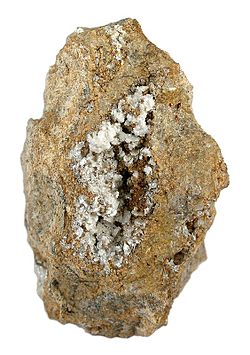
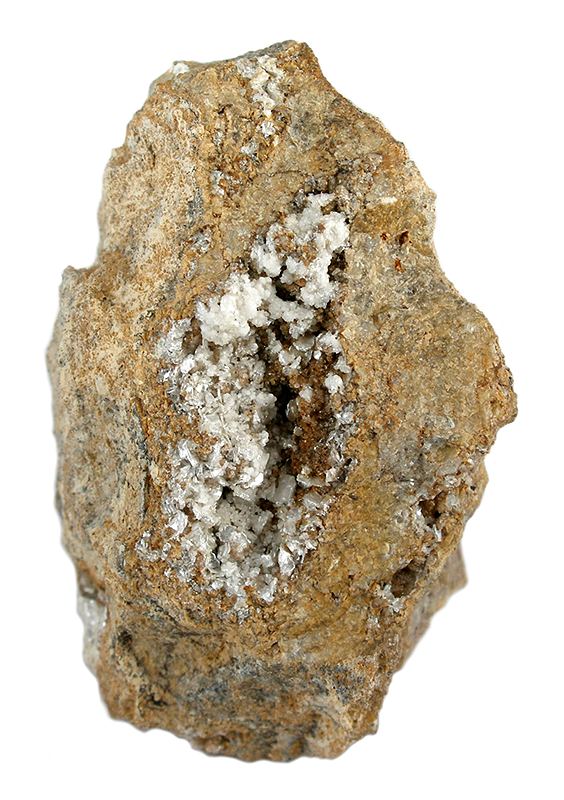
Dickite takes on the appearance of a white, brown earthy color and is often found embedded in many other minerals such as quartz.

Dickite has perfect cleavage in the (001) direction. Its color varies from blue, gray, white to colorless. It usually has a dull clay-like texture. Its hardness on the Mohs scale is 1.5–2, basically between talc and gypsum. This is attributed to its loose chemical bonds. It is held with hydrogen bonds, which are otherwise weak. It leaves a white streak and it has a pearly luster. It has a density of 2.6. Dickite is biaxial, its birefringence is between 0.0050–0.0090, its surface relief is low and it has no dispersion. The plane of the optical axis is normal to the plane of symmetry and inclined 160, rear to the normal to (0,0,1).

The atomic structure of dickite, being very similar to that of kaolinite and other kaolin type minerals, has a very specific arrangement that differs slightly enough to set its physical appearance and other physical properties apart from that of its family members kaolinite and nacrite. In a comparison of the family of minerals through experiments examined by Ross and Kerr the similarities between them are clearly evident and can, depending on the samples, be indistinguishable by optical means.[5]

The hexagonal structure and the stacking of the atoms influence the physical properties in many ways including the color, hardness, cleavage, density, and luster. Another important factor in influencing physical properties of minerals is the presence of bonding between atoms. Within dickite there exists dominant O-H bonding, a type of strong ionic bonding.[10]

Structure

[edit]

Dickite has a monoclinic crystal system and its crystal class is domatic (m). This crystal system contains two non-equal axes (a and b) that are perpendicular to each other and a third axis (c) that is inclined with respect to the a axis. The a and c axes lie in a plane. Dickite involves an interlayer bonding with at least 3 identifiable bonds: an ionic type interaction due to net unbalanced charges on the layers, Van der Waals forces between layers and hydrogen bonds between oxygen atoms on the surface of one layer and hydroxyl groups on the opposing surface. A hydrogen bond, as the term is used here, involves a long range interaction between hydrogen of a hydroxyl group coordinated to a cation and an oxygen atom coordinated to another cation. The reaction is predominantly electrostatic; hence an ionic bonding model is appropriate. Its axial ratio is a=0.576, b=1, c=1.6135.

The hexagonal network of Si-O tetrahedra along with the superimposed layer of Al-O, OH octahedra make up the kaolin layer found in dickite. Dickite is composed of regular sequences of one, two and six kaolin layers. Analysis of the dickite structure reveals the space group to be C4s-Cc. The a and c axis both lie on the glide plane of symmetry.[10] Dickite's structure is made up of a shared layer of corner-sharing tetrahedra filled by a plane of oxygens and hydroxyls along with a sheet of edge-sharing octahedra with every third site left empty.[7]

An experiment was conducted using a pseudo-hexagonal crystal of dickite to determine the unit cell information and the layers that exist within dickite. It was found that there are six layers within the kaolin layer within dickite. This is evidenced in the following findings. There is an oxygen atom from the all oxygen layer that lies at the center. The atoms of the O layer, the Si layer and the O, (OH) layer are situated for the ideal kaolin layer.[10]

X-ray experiments were performed by C. J. Ksanda and Tom F. W. Barth and it was concluded that dickite is composed of tiny layers of cations and anions which are parallel to the a-b plane stacked on top of one another which they found to be exactly as Gruner had described. It was also concluded that the two dimensional arrangement of some of the atoms are not as Gruner described.[6]

References

[edit]
Revisions and contributorsEdit on WikipediaRead on Wikipedia
from Grokipedia
Dickite is a in the , with the Al₂Si₂O₅(OH)₄. It is a polymorph of , nacrite, and halloysite, distinguished by its and formation primarily as a secondary mineral through hydrothermal alteration of aluminosilicates or as an authigenic phase in sedimentary deposits. Named after Scottish metallurgical chemist Allan Brugh Dick (1833–1926), dickite was first described in 1930 and is commonly intergrown with other , requiring X-ray diffraction for precise identification. Physically, dickite exhibits a hardness of 2–2.5 on the , a specific of 2.60, and perfect cleavage parallel to {001}, resulting in flexible but inelastic platelets or book-like aggregates. It typically appears white, occasionally tinted by impurities such as iron or , with a satiny luster and transparent to translucent transparency. Optically, it is biaxial positive with refractive indices ranging from α = 1.560–1.564 to γ = 1.566–1.570 and a 2V of 50°–80°. Chemically, it consists primarily of 46.14–46.86% SiO₂, 37.12–39.61% Al₂O₃, and 13.06–13.91% H₂O, with minor traces of Fe, Mg, Ca, Na, and . Dickite occurs worldwide in hydrothermal veins, often associated with , , , and , and in sedimentary settings like shales and soils. Notable localities include in (type locality), Pennsylvania and Wisconsin in the United States, Tintic district in , South Africa, Mexico, and Hungary. Due to its structural similarity to , dickite shares applications in ceramics, production, and as a filler in paints and rubber, leveraging its low abrasiveness, dispersibility in water, and thermal stability.

Etymology and history

Discovery

Dickite was first described in 1888 by Scottish metallurgical Allan Brugh Dick based on samples collected from the Pant-y-Gaseg mine in , Isle of Anglesey, . Dick's examination focused on specimens exhibiting a pearly luster and hexagonal plate-like forms, which he initially classified under the broader term due to prevailing mineralogical conventions at the time. His analysis employed early optical microscopy techniques to observe the mineral's and angles, noting values around 15° to 20° that hinted at subtle distinctions from common kaolin varieties. The mineral's identification faced early confusion with owing to their nearly identical macroscopic appearance and chemical similarities, leading to frequent misidentification in subsequent reports. Samples from , including those from Pant-y-Gaseg, were often lumped together with commercial kaolins, as the overlapped significantly under the microscopes available in the late . This ambiguity persisted until more refined optical studies in the early began to highlight dickite's unique positive optical character and interlayer behaviors, though full differentiation awaited advanced techniques.

Naming and type locality

Dickite was formally named in 1930 by Clarence S. Ross and Paul F. Kerr in their seminal work on kaolin minerals, honoring Allan Brugh Dick (1833–1926), a Scottish metallurgical who had collected and initially described the mineral from samples in , , around 1888. Prior to this formal naming, the mineral was provisionally regarded as a variety of based on early optical and chemical analyses, but Ross and Kerr's investigations using revealed distinct structural differences, establishing dickite as a separate polymorph within the kaolinite group. The type locality for dickite is Pant-y-Gaseg Mine, located at approximately 53° 25' 23" N, 4° 23' 24" W, near on the northern coast of the Isle of Anglesey, , . This site, part of historical 19th-century copper mining efforts in Lower volcanic rocks, features dickite as a hydrothermal alteration product in veins, occurring as colorless to white hexagonal plates up to 0.1 mm across on and dolomite matrices.

Chemical composition

Molecular formula

The molecular formula of dickite is \ceAl2Si2O5(OH)4\ce{Al2Si2O5(OH)4}. This ideal formula yields an elemental composition of 46.54% \ceSiO2\ce{SiO2}, 39.50% \ceAl2O3\ce{Al2O3}, and 13.96% \ceH2O\ce{H2O} by weight. Natural dickite samples often exhibit minor impurities including \ceTiO2\ce{TiO2}, \ceFe2O3\ce{Fe2O3}, \ceFeO\ce{FeO}, \ceMgO\ce{MgO}, \ceCaO\ce{CaO}, \ceNa2O\ce{Na2O}, and \ceK2O\ce{K2O}, which can cause stoichiometric deviations from the ideal, such as \ceAl2.02Si1.99O5(OH)4\ce{Al_{2.02}Si_{1.99}O5(OH)4} in specimens.

Relation to kaolinite group

Dickite belongs to the kaolinite group (also known as the kandite group) of clay minerals, which includes , nacrite, and halloysite as polymorphs, all characterized by the same ideal Al₂Si₂O₅(OH)₄ but distinguished by differences in their layer stacking sequences and resulting crystal structures. These structural variations lead to distinct formation conditions and stabilities, with dickite typically forming under higher-temperature hydrothermal or diagenetic environments compared to , which predominates in low-temperature settings. Thermodynamic studies suggest that dickite exhibits greater stability relative to at elevated temperatures, particularly in the range of 150–250 °C, where experimental measurements indicate a negative change (ΔG ≈ -2 to -10 kJ/mol) for the -to-dickite transformation, rendering metastable under these conditions. However, at ambient temperatures, kinetic barriers often favor the persistence of despite dickite's thermodynamic advantage, explaining its prevalence in surface environments. Recent calorimetric studies as of 2011 confirm 's metastability relative to dickite across a broader temperature range. This temperature-dependent stability influences dickite's occurrence in deeper burial or hydrothermal systems. Identifying dickite within the kaolinite group poses challenges, as optical microscopy fails to differentiate it from kaolinite or nacrite due to their similar refractive indices and morphologies, requiring advanced analytical methods. X-ray diffraction (XRD) is commonly used, revealing diagnostic basal spacing peaks at approximately 7.20 Å for dickite versus 7.15 Å for kaolinite, along with differences in hkl reflections (e.g., rational vs. irrational sequences). Infrared (IR) spectroscopy, particularly in the near- and mid-IR regions, detects subtle differences in OH stretching and combination bands around 3600–3700 cm⁻¹ (mid-IR) and 4500–4600 cm⁻¹ (near-IR), enabling quantification even in mixed samples; for example, dickite shows a secondary near-IR peak near 4588 cm⁻¹ compared to kaolinite's 4610 cm⁻¹. Raman spectroscopy provides additional confirmation through distinct OH vibrational modes. These techniques are essential for precise mineralogical characterization in geological and industrial contexts.

Crystal structure

Unit cell and symmetry

Dickite belongs to the and is described by the non-centrosymmetric Cc. This symmetry arises from the specific arrangement of its dioctahedral 1:1 layers, where a c-glide plane relates adjacent layers, contributing to the overall structural ordering. The ideal unit cell parameters for dickite are a=5.15a = 5.15 Å, b=8.94b = 8.94 Å, c=14.42c = 14.42 Å, and β=96.7\beta = 96.7^\circ. These dimensions reflect the conventional monoclinic setting, with the bb-axis aligned parallel to the silicate layer and the cc-axis perpendicular to it, encompassing two layers in the stacking direction. The cell volume VV is calculated using the formula for monoclinic unit cells: V=a×b×c×sinβ.V = a \times b \times c \times \sin \beta. First, compute sin96.70.993\sin 96.7^\circ \approx 0.993. Then, V=5.15×8.94×14.42×0.993660A˚3.V = 5.15 \times 8.94 \times 14.42 \times 0.993 \approx 660 \, \text{Å}^3. This volume corresponds to Z=4Z = 4 formula units of \ceAl2Si2O5(OH)4\ce{Al2Si2O5(OH)4} per unit cell, consistent with the structure.

Layer stacking and polymorphism

Dickite features a layered composed of alternating tetrahedral sheets dominated by Si-O tetrahedra and octahedral sheets centered on Al cations with O and OH ligands, maintaining a 1:1 tetrahedral-to-octahedral sheet ratio that defines the fundamental kaolin layer. These layers are approximately 7.1 thick and exhibit inherent misfit between the larger tetrahedral sheet and the smaller octahedral sheet, leading to rotational distortions of about 7.5° in the silica tetrahedra to facilitate bonding. The polymorphism of dickite arises primarily from variations in the stacking sequences of these 1:1 layers, which determine the overall and interlayer interactions. In dickite, the layers form a two-layer monoclinic where adjacent layers are related by a c-glide plane, with successive layers shifted and the octahedral vacancies alternating between B and C positions. This contrasts with the single-layer triclinic stacking in and the two-layer monoclinic stacking in nacrite, which has a different arrangement of vacancies. Among the 36 theoretically possible two-layer stacking positions, dickite's arrangement minimizes cation-cation repulsion and optimizes interlayer contacts, contributing to its relative stability. Interlayer cohesion in dickite is governed by hydrogen bonding between the inner surface hydroxyl groups of one layer and the basal oxygen atoms of the adjacent layer, with all three inner OH groups participating effectively due to their near-perpendicular orientation to the layer plane. These bonds feature O···O distances around 2.94–3.12 , shorter than the van der Waals limit of 2.60 for some contacts, enhancing bond strength and influencing the polymorphism by favoring specific stacking configurations that reduce electrostatic repulsion. Recent (DFT) calculations on kaolin polytypes, including dickite, confirm that these hydrogen-bonded structures yield nearly identical electronic properties—such as —across polymorphs despite stacking differences, underscoring the role of interlayer bonding in maintaining electronic uniformity under varying conditions like hydrostatic pressure.

Physical and optical properties

Macroscopic characteristics

Dickite most commonly appears in hand samples as fine-grained, earthy aggregates or compact masses composed of microscopic platy , often exhibiting a dull, clay-like texture. Rarely, it develops as well-formed pseudo-hexagonal plates, typically up to 2 mm across, stacked in booklets or rosettes. The is usually white or colorless, though impurities can impart tints ranging from pale yellow to gray or brown; iron-bearing contaminants, in particular, often produce subtle yellowish hues. Dickite displays perfect basal cleavage on {001}, rendering it soft and flexible in thin sheets, with a Mohs of 2–2.5 and a specific gravity of 2.60.

Mechanical and optical traits

Dickite displays biaxial positive , characteristic of its monoclinic , with refractive indices of nα = 1.560–1.564, nβ = 1.561–1.566, and nγ = 1.566–1.570, and a 2V angle of 50°–80°. The is low at δ = 0.005–0.006, resulting in subdued interference colors in thin sections under crossed polars. This low , combined with moderate surface relief, aids in distinguishing dickite from other kaolin group minerals during petrographic analysis. The mineral's luster ranges from satiny to pearly in crystalline forms, appearing earthy to dull in massive or fine-grained aggregates. In thin sections, dickite is typically transparent, depending on grain size and orientation relative to the basal plane. Mechanical properties of dickite have been explored through computational approaches, revealing an anisotropic elasticity tensor due to its layered silicate framework. Density functional theory calculations yield Young's modulus values of approximately 50–60 GPa in directions perpendicular to the layers (e.g., ~65 GPa along the c-axis), reflecting the mineral's relative stiffness in compression normal to the sheets. Poisson's ratio is estimated at ~0.3, consistent with values assumed in nanoindentation studies of clay minerals, indicating moderate lateral contraction under uniaxial stress. Recent simulations (2024) further confirm a bulk modulus of ~91 GPa and shear modulus of ~27 GPa, underscoring dickite's resistance to volumetric change compared to related polytypes like nacrite. These properties highlight dickite's role in controlling the deformability of clay-rich sediments under geological stresses.

Geological occurrence

Formation mechanisms

Dickite primarily forms through the hydrothermal alteration of minerals, such as feldspars and other framework silicates, under conditions of elevated temperature and relatively low pressure. This process typically occurs at temperatures ranging from 150 to 250°C, where hot, acidic fluids interact with primary rocks, leading to the breakdown of aluminosilicates and the precipitation of dickite as a secondary . A secondary formation mechanism involves the transformation of to dickite within during burial , driven by increasing temperature and fluid interactions. This conversion proceeds via a dissolution-reprecipitation process, where dissolves in pore fluids and dickite reprecipitates with a more ordered structure, often at depths exceeding 2,500 m and temperatures around 90–120°C. Dickite plays a key role in diagenetic evolution by filling secondary and influencing reservoir quality in sedimentary basins. As an indicator mineral, dickite signals hydrothermal activity in various geological settings, including algal limestones and volcanic tuffs, where its presence denotes fluid-rock interactions under moderate temperatures. Within the group, dickite exhibits greater stability relative to at higher temperatures, reflecting its formation in more evolved hydrothermal or diagenetic environments.

Distribution and notable sites

Dickite was first described from its type locality at Pant-y-Gaseg, near on the , , , where it occurs in hydrothermal veins associated with altered rhyolite. Notable occurrences of dickite are reported globally, often in sedimentary and hydrothermal settings. In , dickite is found in porous algal limestones, particularly in the St. Mary Parish region, where it forms as a white powder through alteration processes. In the United States, significant deposits exist in sandstones of the , including the in areas of and , such as Red Mountain near Ouray, , and the Mineral Mountain area near St. George, Washington County, . Hydrothermal dickite has been identified in , notably in the White Mountain gold deposit in Province, where it accompanies sulfide mineralization. In , dickite occurs in shales undergoing , with examples from sedimentary basins where it forms at burial depths influencing polymorph stability. A prominent Al-rich clay deposit in volcanic tuff in southeastern Korea features dickite as the dominant kaolin mineral, alongside minor and nacrite. Additional notable occurrences include the Pine Knot colliery in ; deposits in ; the Tintic district in ; Postmasburg in Province, ; San Juan de Sabinas in , ; and the Pécs district in , . Dickite commonly associates with quartz, pyrite, and kaolinite in these deposits, reflecting shared hydrothermal or diagenetic origins. Economic deposits of dickite are primarily in clay beds suitable for industrial extraction, such as those in kaolin-rich formations worldwide.

Significance and applications

Industrial uses

Dickite serves as a substitute for kaolin in several industrial applications, leveraging its structural similarity to other kaolin-group minerals and properties such as high whiteness, low reactivity, and fine . In the ceramics sector, it is used to produce whitewares, tiles, sanitary ware, and , where it imparts plasticity, strength, and desirable fired colors. Its low electrical conductivity and high dielectric constant also make it suitable for electrical insulators. In the paper industry, dickite functions as both a filler and material, enhancing , smoothness, gloss, opacity, and printability by filling interstices between fibers and paper surfaces. High-grade dickite requires a minimum of 85% (ISO scale) to meet specifications for premium coating applications. As a filler, it is incorporated into rubber to improve abrasion resistance and strength (e.g., in and tiles), paints as an extender for covering power, and plastics to enhance and stability, such as in PVC wire insulation. Specialized uses include refractories, where dickite's heat resistance (pyrometric cone equivalent up to 35) supports production of high-alumina materials, and muds, providing and borehole stability similar to other kaolin-group clays. It is often extracted from mixed kaolin deposits containing polymorphs like and nacrite, requiring beneficiation to achieve industrial purity levels. Economically, dickite-bearing deposits occur in Wales (type locality at Pant-y-Gaseg), where small-scale mining targets kaolin-group minerals for industrial processing, and in Jamaica (e.g., St. Mary parish). Global production remains limited compared to kaolinite-dominated sources. Purity requirements vary by application, with ceramic and refractory grades needing low iron content (<1-2%) to maintain whiteness after firing, while paper grades demand >90% kaolin-group content post-processing.

Research developments

Recent computational studies have advanced the understanding of dickite's electronic properties using (DFT). In a 2022 investigation, DFT calculations revealed that dickite's electronic under hydrostatic pressure shows similarities to other kaolin polytypes, with a high-pressure phase transformation occurring above 2 GPa, providing insights into its behavior in geological pressures. Building on this, a 2025 molecular simulation study computed dickite's mechanical properties at zero pressure, yielding a bulk modulus of 90.854 GPa and a shear modulus of 26.544 GPa, which align with prior experimental data and highlight its relative stiffness compared to nacrite. These results underscore dickite's potential stability in high-stress environments. In 2024, research on nacrite's elasticity, a related kaolin mineral, demonstrated pressure-induced transformations at 2-3 GPa leading to shear wave velocity reductions of up to 3%, with implications for dickite and kaolinite in subduction zones where such polytypes contribute to low-velocity layers and water transport. Despite these developments, dickite research lags behind more common kaolinites, with foundational experimental work largely predating 2000 and limited post-1978 updates in structural analyses. For instance, characterizations of Korean deposits using XRD and SEM date to 2004, revealing dickite as pseudo-hexagonal plates in hydrothermal contexts, but modern high-resolution equivalents remain scarce. Future directions include nanomaterial synthesis from dickite, such as exfoliation into ultrathin nanolayers (<5 nm thick) for zinc-ion battery anodes, shows promise for enhanced stability and energy storage applications.

References

Add your contribution
Related Hubs
User Avatar
No comments yet.