Hubbry Logo
Diffusion-limited enzymeDiffusion-limited enzymeMain
Open search
Diffusion-limited enzyme
Community hub
Diffusion-limited enzyme
logo
8 pages, 0 posts
0 subscribers
Be the first to start a discussion here.
Diffusion-limited enzyme
from Wikipedia
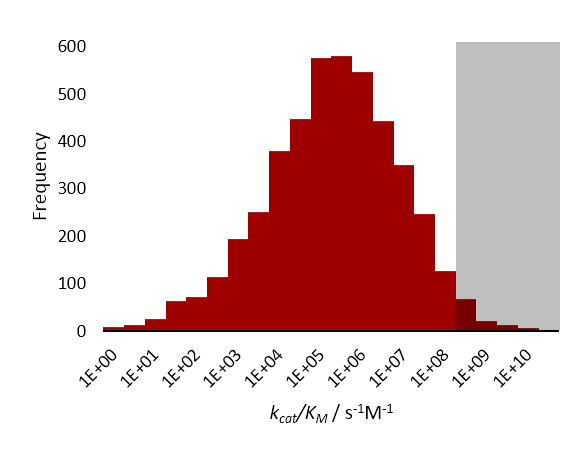
The distribution of known enzyme catalytic rates (kcat/KM). Most enzymes have a rate around 105 s−1M−1. The fastest enzymes in the dark box on the right (>108 s−1M−1) are constrained by the diffusion limit. (Data adapted from reference[1])

A diffusion-limited enzyme catalyses a reaction so efficiently that the rate limiting step is that of substrate diffusion into the active site, or product diffusion out.[2] This is also known as kinetic perfection or catalytic perfection. Since the rate of catalysis of such enzymes is set by the diffusion-controlled reaction, it therefore represents an intrinsic, physical constraint on evolution (a maximum peak height in the fitness landscape). Diffusion limited perfect enzymes are very rare. Most enzymes catalyse their reactions to a rate that is 1,000-10,000 times slower than this limit. This is due to both the chemical limitations of difficult reactions, and the evolutionary limitations that such high reaction rates do not confer any extra fitness.[1]

History

[edit]
An illustration to show (a) Alberty-Hammes-Eigen model, and (b) Chou's model, where E denotes the enzyme whose active site is colored in red, while the substrate S in blue.

The theory of diffusion-controlled reaction was originally utilized by R.A. Alberty, Gordon Hammes, and Manfred Eigen to estimate the upper limit of enzyme-substrate reaction.[3][4] According to their estimation,[3][4] the upper limit of enzyme-substrate reaction was 109 M−1 s−1.

In 1972, it was observed that in the dehydration of H2CO3 catalyzed by carbonic anhydrase, the second-order rate constant obtained experimentally was about 1.5 × 10¹⁰ M−1 s−1,[5] which was one order of magnitude higher than the upper limit estimated by Alberty, Hammes, and Eigen based on a simplified model.[3][4]

To address such a paradox, Kuo-Chen Chou and his co-workers proposed a model by taking into account the spatial factor and force field factor between the enzyme and its substrate and found that the upper limit could reach 1010 M−1 s−1,[6][7][8] and can be used to explain some surprisingly high reaction rates in molecular biology.[5][9][10]

The new upper limit found by Chou et al. for enzyme-substrate reaction was further discussed and analyzed by a series of follow-up studies.[11][12][13]

A detailed comparison between the simplified Alberty-Hammes-Eigen's model (a) and the Chou's model (b) in calculating the diffusion-controlled reaction rate of enzyme with its substrate, or the upper limit of enzyme-substrate reaction, was elaborated in the paper.[14]

Mechanism

[edit]

Kinetically perfect enzymes have a specificity constant, kcat/Km, on the order of 108 to 109 M−1 s−1. The rate of the enzyme-catalysed reaction is limited by diffusion and so the enzyme 'processes' the substrate well before it encounters another molecule.[1]

Some enzymes operate with kinetics which are faster than diffusion rates, which would seem to be impossible. Several mechanisms have been invoked to explain this phenomenon. Some proteins are believed to accelerate catalysis by drawing their substrate in and preorienting them by using dipolar electric fields. Some invoke a quantum-mechanical tunneling explanation whereby a proton or an electron can tunnel through activation barriers. Although the proton tunneling theory remains controversial,[15][16] it has been suggested to be the only possible mechanism in the case of the soybean lipoxygenase.[17]

Evolution

[edit]

There are not many kinetically perfect enzymes. This can be explained in terms of natural selection. An increase in catalytic speed may be favoured as it could confer some advantage to the organism. However, when the catalytic speed outstrips diffusion speed (i.e. substrates entering and leaving the active site, and also encountering substrates) there is no more advantage to increase the speed even further. The diffusion limit represents an absolute physical constraint on evolution.[1] Increasing the catalytic speed past the diffusion speed will not aid the organism in any way and so represents a global maximum in a fitness landscape. Therefore, these perfect enzymes must have come about by 'lucky' random mutation which happened to spread, or because the faster speed was once useful as part of a different reaction in the enzyme's ancestry.[citation needed]

Examples

[edit]

See also

[edit]

References

[edit]
Revisions and contributorsEdit on WikipediaRead on Wikipedia
from Grokipedia
A diffusion-limited enzyme is a highly efficient catalyst in which the overall reaction rate is governed by the physical process of substrate diffusion to the active site rather than by chemical transformation steps, achieving near-perfect catalytic proficiency where virtually every enzyme-substrate encounter leads to product formation. This efficiency is quantified by the specificity constant kcat/Kmk_{\text{cat}} / K_m, which approaches the theoretical diffusion-controlled upper limit of approximately 10810^8 to 10910^9 M1^{-1} s1^{-1} in aqueous solution at physiological temperatures. These enzymes represent an evolutionary benchmark for catalytic optimization, as their performance cannot be significantly improved without altering fundamental physical constraints like rates, which are influenced by factors such as solvent viscosity and . In practice, diffusion limitation ensures maximal throughput under subsaturating substrate concentrations typical in cellular environments, making these enzymes indispensable for rapid metabolic responses. Prominent examples include , which accelerates CO2_2 hydration with kcat/Km108k_{\text{cat}} / K_m \approx 10^8 M1^{-1} s1^{-1}, supporting respiratory ; triose phosphate isomerase, involved in with similar efficiency; and superoxide dismutase, which detoxifies at near-diffusion rates. Such enzymes are relatively rare, comprising only a small fraction of the , but their design often incorporates mechanisms like electrostatic steering or conformational gating to approach the diffusion barrier.

Fundamentals

Definition

Diffusion-limited enzymes are a class of enzymes in which the overall rate of the catalytic reaction is primarily constrained by the physical process of substrate to the enzyme's , rather than by the subsequent chemical transformation steps within the enzyme-substrate complex. In these highly efficient catalysts, every encounter between the enzyme and substrate results in a productive reaction, achieving the theoretical upper limit of enzymatic performance dictated by in solution. This contrasts with non-diffusion-limited enzymes, where the rate-limiting step occurs during the chemical phase, such as bond breaking or formation, which proceeds more slowly than substrate diffusion. Enzymes generally function as biological catalysts that accelerate biochemical reactions by stabilizing the and lowering the barrier, enabling reactions to occur at biologically relevant rates without being consumed in the process. Within the framework of Michaelis-Menten kinetics, diffusion-limited enzymes are identified by their catalytic efficiency parameter kcat/Km108k_{\text{cat}}/K_m \geq 10^8109M1s110^9 \, \mathrm{M^{-1} s^{-1}} in at , marking the point where imposes the bottleneck on reaction velocity.

Kinetic Parameters

The specificity constant, kcat/Kmk_{\text{cat}}/K_m, serves as the primary kinetic parameter for characterizing diffusion-limited , representing the second-order rate constant for the association of and substrate under conditions where substrate concentration is low relative to KmK_m. In the Michaelis-Menten framework, this parameter approximates the bimolecular rate constant k1k_1 for -substrate binding when the catalytic turnover kcatk_{\text{cat}} greatly exceeds the dissociation rate k1k_{-1}, such that kcat/Kmk1(kcat/(k1+kcat))k1k_{\text{cat}}/K_m \approx k_1 \cdot (k_{\text{cat}} / (k_{-1} + k_{\text{cat}})) \approx k_1. For diffusion-limited , this association step is constrained by the physical of molecules in solution, making kcat/Kmk_{\text{cat}}/K_m a direct measure of how closely the enzyme approaches the theoretical maximum encounter rate. The diffusion-limited encounter rate is described by the Smoluchowski equation, derived from the steady-state solution to the diffusion equation for the concentration c(r)c(\mathbf{r}) of substrate molecules around a spherical enzyme of radius RR. The diffusion equation in the absence of reaction is 2c=0\nabla^2 c = 0 (steady state, with diffusion coefficient DD), subject to boundary conditions c(R)=0c(R) = 0 (absorbing boundary at the enzyme surface) and c()=c0c(\infty) = c_0 (bulk concentration). The radial solution is c(r)=c0(1R/r)c(r) = c_0 (1 - R/r) for rRr \geq R. The inward flux at the surface is J=4πR2D(c/r)r=R=4πRDc0J = -4\pi R^2 D (\partial c / \partial r)|_{r=R} = 4\pi R D c_0, yielding the per-molecule rate constant kdiff=4πRDk_{\text{diff}} = 4\pi R D. To express this in molar units (M1^{-1} s1^{-1}), multiply by Avogadro's number NAN_A and convert volume from cm³ to L by dividing by 1000, assuming RR in cm and DD in cm²/s: kdiff=4πRDNA/1000k_{\text{diff}} = 4\pi R D N_A / 1000. For enzyme-substrate pairs, R=rE+rSR = r_E + r_S (sum of radii) and D=DE+DSD = D_E + D_S (sum of diffusion coefficients). In diffusion-limited cases, the Michaelis constant KmK_m approximates the equilibrium dissociation constant Kd=k1/k1K_d = k_{-1}/k_1, since kcatk1k_{\text{cat}} \gg k_{-1}, so Km=(k1+kcat)/k1k1/k1K_m = (k_{-1} + k_{\text{cat}})/k_1 \approx k_{-1}/k_1. The maximum velocity vmax=kcat[E]tv_{\max} = k_{\text{cat}} [E]_t is not directly limited by , but the overall at low substrate concentrations is governed by the diffusion-controlled association, with kcat/Kmk_{\text{cat}}/K_m setting the pace. The theoretical upper limit for kcat/Kmk_{\text{cat}}/K_m in bimolecular reactions in is approximately 10810^8 to 10910^9 M1^{-1} s1^{-1}, reflecting typical values for R15R \approx 152525 Å (sum of and substrate radii) and relative D105D \approx 10^{-5}10610^{-6} cm²/s for biomolecules in at . Factors such as electrostatic steering—long-range Coulombic interactions that guide oppositely charged substrates toward the —can enhance this limit by factors of 10–100, effectively increasing the capture radius beyond the physical size of the .

Mechanism

Diffusion Process

In diffusion-limited enzymes, substrate transport to the enzyme surface is primarily driven by , the random thermal fluctuations that cause molecules to collide and displace each other in solution. This stochastic process underlies the diffusive flux of substrates, as described by Fick's first law, which quantifies the rate of transport as proportional to the concentration gradient across the enzyme's vicinity. In biological aqueous media, where and temperature influence molecular mobility, this mechanism sets the upper limit on reaction rates, ensuring substrates arrive at the enzyme without being hindered by slower chemical steps. Upon reaching proximity, the substrate forms an encounter complex with the , a loose, transient association occurring when the substrate diffuses within the diffusion-limited radius, typically 10–100 from the enzyme surface. This complex arises from short-range interactions, such as electrostatic attraction or hydrophobic contacts, that temporarily halt diffusive separation before potential dissociation or progression to binding. The formation rate of this complex is diffusion-controlled, reflecting the inherent three-dimensional search of the substrate in solution. However, only a small of these encounters lead to productive binding at the , as proper enzyme-substrate orientation is required to overcome steric and energetic barriers. Steric hindrance from mismatched molecular geometries prevents many collisions from aligning the substrate correctly, while energetic barriers, including desolvation penalties, further select for compatible orientations. This orientation factor, often accounting for the limited reactive surface area of the , reduces the effective association rate below the theoretical maximum. Computational modeling of these processes relies on simulations, which propagate the probabilistic trajectories of substrates under thermal forces and enzyme potentials to predict diffusion-influenced rates. The foundational approach by Northrup et al. computes bimolecular rate constants by evaluating the probability of successful reaction upon short-range encounters, incorporating enzyme shape and surface reactivity. These simulations have been applied to enzyme systems, such as cytochrome c peroxidase, to reveal how electrostatic steering enhances substrate capture within the diffusion-limited regime.

Catalytic Efficiency

In diffusion-limited enzymes, the catalytic cycle begins with the bimolecular association of the free (E) and substrate (S) to form the enzyme-substrate complex (ES), a step governed by the rate of substrate diffusion to the active site. This association is rate-limiting, as subsequent steps—conversion of ES to the enzyme-product complex (EP) and release of product (P) to regenerate E—proceed much faster. The overall reaction can thus be represented as E + S → ES → EP → E + P, where the diffusion-controlled encounter determines the enzyme's throughput under physiological conditions. Enzymes achieving diffusion limitation exhibit "catalytic perfection," wherein substrate binding is nearly irreversible due to the catalytic rate constant (k_cat) vastly exceeding the dissociation rate constant (k_off) of ES, ensuring that product formation occurs in almost every binding event with efficiency approaching 100%. This optimization means that the enzyme's performance is constrained solely by the physical limit of substrate delivery, typically yielding second-order rate constants (k_cat/K_m) on the order of 10^8 to 10^9 M^{-1} s^{-1}, the upper bound set by three-dimensional diffusion in aqueous solution. To surpass naive diffusion rates and enhance k_cat/K_m, diffusion-limited enzymes employ steering mechanisms such as electrostatic guidance, where charged or polar surfaces create favorable potential fields that accelerate substrate approach and orientation toward the . Complementarily, hydrophobic steering leverages nonpolar regions to channel apolar substrates through desolvation effects, further increasing the effective association rate beyond isotropic . Under substrate-limiting conditions ([S] << K_m), the initial reaction velocity (v) simplifies to v = (k_cat / K_m) [E][S], underscoring that the bimolecular rate constant k_cat / K_m dictates overall efficiency as the diffusion-controlled step.

Historical Development

Early Discoveries

The foundational framework for understanding enzyme kinetics was laid by Leonor Michaelis and Maud Menten in 1913, who modeled reactions as reaching a maximum velocity limited by the chemical transformation of substrate to product, but their work did not explicitly address physical constraints like substrate diffusion. Early realizations that some enzymes could exceed expected chemical rates emerged in the mid-20th century, particularly with observations of exceptionally high turnover numbers in enzymes such as carbonic anhydrase. Studies in the 1940s, including work by Hans Krebs on its inhibition and physiological role, highlighted the remarkable catalytic efficiency of carbonic anhydrase, accelerating CO2 hydration by over a million-fold compared to the uncatalyzed rate, suggesting limits beyond typical chemical steps. By the 1960s, studies by researchers including Krebs and collaborators further emphasized these high rates, with kcat values for carbonic anhydrase approaching 10^6 s^{-1}, implying that substrate encounter rates could be rate-limiting in vivo. The theoretical basis for diffusion-limited kinetics was formalized in 1958 by Robert A. Alberty and Gordon G. Hammes, who applied diffusion-controlled reaction theory to , estimating an upper limit for the association rate constant (k1) of approximately 10^9 M^{-1} s^{-1} based on radial models to the . This model predicted that for enzymes with kcat/Km near this value, the reaction would be diffusion-controlled, as seen in where the second-order rate constant for CO2 hydration reached ~10^8 M^{-1} s^{-1}, close to the theoretical diffusion limit in . These 1960s observations marked the initial identification of as a potential bottleneck, prompting investigations into whether such enzymes had evolved to maximize encounter rates. In the and , Alan Fersht provided for diffusion control in tyrosyl-tRNA synthetases (from E. coli and later Bacillus stearothermophilus), showing association rate constants of ~10^8 M^{-1} s^{-1} consistent with limitation, with studies confirming the chemical step was not rate-limiting. Initial debates in the field centered on whether these high rates truly reflected diffusion limits or if alternative mechanisms, such as quantum tunneling of protons or substrates, could contribute to apparent efficiencies exceeding classical predictions, particularly for where proton transfer steps appeared faster than expected. These discussions underscored the need for integrated biophysical approaches to distinguish physical from chemical rate limitations in enzymatic perfection.

Key Theoretical Advances

In the 1980s, significant progress was made in modeling diffusion-limited enzyme kinetics through the development of simulations, which allowed for the computation of rate constants in diffusion-influenced bimolecular reactions. Northrup, Allison, and McCammon introduced a key algorithm that simulated the stochastic trajectories of substrates approaching active sites, accounting for hydrodynamic interactions and boundary conditions to predict association rates without assuming spherical symmetry. This approach built on earlier empirical observations from the but provided a theoretical framework for quantifying how barriers limit enzymatic turnover in solution. Pioneering work by Manfred Eigen in the 1950s on fast reaction techniques, including diffusion-controlled proton transfers, laid groundwork for these models by establishing upper limits for bimolecular rates in solution (~10^9 M^{-1} s^{-1}). During the 1990s and 2000s, theoretical models incorporated electrostatic interactions to explain enhancements in diffusion-controlled rates, introducing the concept of "steering factors" that guide substrates toward active sites via long-range Coulombic forces. Zhou and Szabo's work on stochastically gated diffusion reactions demonstrated how electrostatic potentials accelerate association by reducing the effective diffusion distance, with steering factors increasing rates by up to orders of magnitude in oppositely charged systems. Subsequent refinements by Zhou quantified these effects in protein-protein associations, showing that transient complexes stabilized by electrostatics further modulate the diffusion-limited regime. These advancements highlighted the interplay between electrostatics and diffusion, enabling more accurate predictions of catalytic efficiency in physiological conditions. Post-2010 advances leveraged molecular dynamics (MD) simulations to uncover how active site conformational fluctuations facilitate substrate diffusion, revealing dynamic gating mechanisms that transiently open pathways for ligand entry. MD studies of enzymes like flavoenzymes illustrated multiple funnel-shaped diffusion routes influenced by protein breathing motions, which lower energy barriers and enhance encounter rates beyond static models. A 2020 review by Astumian synthesized evidence for enhanced enzyme diffusion via chemotaxis, where catalytic turnover generates local gradients that propel enzymes toward substrates, effectively overcoming diffusion limitations in crowded cellular environments. By 2025, the integration of (AI) into design has enabled predictive modeling of diffusion-limited behavior, particularly in immobilized systems where restrictions impact kinetics. Generative AI models, such as diffusion-based networks, now optimize structures to minimize diffusional bottlenecks during immobilization, forecasting rate enhancements through simulated microenvironmental effects. Recent reviews emphasize AI's role in de novo design, where predicts how sequence variations influence diffusion-controlled rates, accelerating the creation of robust biocatalysts for industrial applications.

Evolutionary Perspectives

Selective Advantages

Diffusion-limited enzymes confer significant selective advantages by enabling maximal reaction rates at low substrate concentrations, which is crucial for biological processes involving scarce or transiently produced substrates. These enzymes achieve bimolecular rate constants (k_cat/K_M) near the theoretical limit of 10^8 to 10^9 M^{-1} s^{-1}, ensuring that nearly every enzyme-substrate collision results in . This efficiency is particularly beneficial in essential pathways such as reactive oxygen species detoxification, where substrates like superoxide radicals occur at nanomolar levels and rapid clearance prevents oxidative damage to cellular components. For instance, catalyzes the dismutation of at diffusion-limited rates, providing a strong evolutionary advantage by mitigating in aerobic environments and supporting the transition to oxygen-based metabolism. Another key benefit is energy efficiency in protein synthesis and . Once the catalytic mechanism reaches diffusion limitation, further enhancements to the chemical step yield , as the overall rate is constrained by substrate delivery rather than intrinsic reactivity. Evolutionary analyses indicate that diffusion-limited enzymes impose lower biosynthetic costs compared to slower counterparts, as the protein mass required for equivalent is reduced; this allows organisms to allocate resources toward other adaptive traits without compromising pathway performance. These enzymes also demonstrate robustness to environmental fluctuations, sustaining high throughput amid variations in cellular conditions. Since their kinetics are dominated by —a physical process with predictable responses to factors like or —their performance remains stable even when biochemical parameters shift, offering a fitness edge in heterogeneous or stressed habitats. However, this reliance on introduces trade-offs, including heightened sensitivity to in the , where high concentrations of biomolecules (up to 300–400 g/L) can slow substrate transport and attenuate rates more severely than for reaction-limited enzymes.

Evolutionary Mechanisms

The evolution of diffusion-limited enzymes often involves targeted in the that lower the Michaelis constant (K_m) by enhancing substrate binding affinity while preserving the (k_cat), thereby maximizing catalytic without compromising reaction speed. In (TIM), a prototypical diffusion-limited enzyme, the has been refined through selective that optimize the positioning of key residues such as Glu167, which acts as a proton shuttle, and Lys13, which stabilizes the enediolate intermediate via electrostatic interactions. These changes, accumulated over ary time, reduce K_m to the micromolar range and enable k_cat/K_m values approaching 10^9 M^{-1} s^{-1}, near the limit, by tightening the binding pocket and minimizing unproductive dissociation. Surface engineering represents another critical evolutionary strategy, where mutations introduce charged residues to create electrostatic fields that guide substrates toward the , accelerating association rates and achieving diffusion-limited performance. In superoxide dismutases (SODs), such as Cu,Zn-SOD, evolution has conserved positively charged residues like Lys136 and Arg143 around the , forming an electrostatic funnel that directs anionic (O_2^-) ions at rates up to 10^9 M^{-1} s^{-1}, compensating for the small size of the substrate and enabling near-perfect despite diverse metal cofactors across SOD families. This guidance mechanism, evident in structures from to eukaryotes, underscores how surface mutations enhance substrate capture without altering the core catalytic machinery. Gene duplication followed by divergence provides a mechanism for specialization, allowing paralogous enzymes to evolve enhanced diffusion-limited traits under relaxed selective constraints. Duplication events create redundant copies, enabling one paralog to accumulate mutations that optimize for high-efficiency in specific pathways, such as improving k_cat/K_m by orders of magnitude through refinement, while the other retains ancestral functions. For instance, in microbial pathways, duplicated hydrolases have diverged to achieve significantly improved catalytic efficiencies (e.g., up to 10^6 M^{-1} s^{-1}) via mutations that enhance substrate specificity and binding, facilitating adaptation to novel metabolic demands. In the 2020s, studies have highlighted (HGT) as an accelerator of diffusion-limited enzyme evolution in microbial populations facing pressures, particularly for β-lactamases. , including plasmid-mediated dissemination of β-lactamase genes such as those encoding class C enzymes like AmpC, rapidly spreads variants that operate at the diffusion limit for substrates (k_cat/K_m ~10^8 M^{-1} s^{-1}), with mutations amplifying gene copy number or promoter strength to boost expression and resistance. This process, observed in under ampicillin selection, enables quick adaptation by transferring pre-optimized alleles across strains, outpacing vertical mutation rates and contributing to the global rise of multidrug resistance. Recent studies as of 2024 have shown that ampC amplification in E. coli can involve transposon-mediated HGT under beta-lactam exposure, further illustrating rapid evolutionary responses.

Examples

Natural Enzymes

Natural diffusion-limited enzymes exemplify evolutionary optimization for rapid in critical physiological processes, where the rate of substrate diffusion to the active site governs overall reaction speed. These enzymes achieve specificity constants (k_cat/K_m) near the theoretical diffusion limit of approximately 10^8 to 10^9 M^{-1} s^{-1} in , enabling efficient handling of reactive intermediates in , defense against , and signaling pathways. Triose phosphate isomerase (TPI) is a key enzyme in and , catalyzing the reversible interconversion of (DHAP) and (GAP). With a k_cat/K_m of approximately 4 × 10^8 M^{-1} s^{-1}, TPI operates at diffusion-limited rates, ensuring rapid equilibration of these glycolytic intermediates to prevent metabolic bottlenecks. This efficiency is vital in energy-demanding tissues like muscle, where it supports high flux through the pathway. Superoxide dismutase (SOD) is a prominent example, functioning as a frontline defense enzyme in aerobic organisms by catalyzing the dismutation of superoxide anion radicals (O_2^-) into molecular oxygen (O_2) and hydrogen peroxide (H_2O_2), thereby mitigating oxidative stress that could damage cellular components like DNA, proteins, and lipids. This enzyme's extraordinary catalytic efficiency, with a k_cat/K_m value of about 10^9 M^{-1} s^{-1}, reflects its diffusion-limited nature, ensuring near-instantaneous reaction upon substrate encounter. SOD exists in multiple isoforms (Cu/Zn-SOD in cytoplasm, Mn-SOD in mitochondria, and Fe-SOD in prokaryotes), all contributing to redox homeostasis across species from bacteria to humans. Carbonic anhydrase (CA), particularly the cytosolic isoform CA II, plays a vital role in respiration, acid-base balance, and regulation by accelerating the reversible hydration of (CO_2) to (HCO_3^-) and protons (H^+), a reaction essential for CO_2 transport in and ion homeostasis in tissues. This zinc-dependent operates at diffusion-limited rates, with turnover numbers (k_cat) reaching 10^6 s^{-1}, allowing it to process up to a million substrate molecules per second per enzyme molecule and facilitating rapid adjustments in metabolic fluxes. Its efficiency is crucial in high-demand contexts like red blood cells, where it enhances the rate by approximately 10^7-fold compared to the uncatalyzed reaction. Catalase, localized primarily in peroxisomes, exemplifies diffusion-limited in peroxide detoxification, decomposing (H_2O_2) into water and oxygen via a two-step ping-pong mechanism involving its . With turnover rates up to 10^7 s^{-1}, this tetrameric enzyme processes H_2O_2 at rates approaching the diffusion limit, preventing accumulation of this toxic byproduct of aerobic metabolism and oxidative bursts in immune responses. Catalase's high efficiency is particularly important in liver and cells, where it handles substantial H_2O_2 loads from fatty acid beta-oxidation, maintaining cellular integrity against oxidative damage. Acetylcholinesterase (AChE) at synapses demonstrates diffusion-limited kinetics in , hydrolyzing the (ACh) into choline and to terminate signaling and allow receptor . Its k_cat/K_m of around 10^8 M^{-1} s^{-1} ensures swift clearance of ACh, with the enzyme's narrow gorge-shaped optimized for substrate access, achieving rates that match the timescales of synaptic events. This is essential for precise neural communication in the central and peripheral nervous systems, preventing overstimulation that could lead to conditions like when impaired.

Engineered and Synthetic Examples

Engineered diffusion-limited enzymes have been developed through and computational design to achieve catalytic efficiencies approaching or exceeding natural limits, often for applications in antibiotic resistance modeling and . One prominent example involves the of the β-lactamase OXA-48, where iterative error-prone PCR and selection on ceftazidime led to five key mutations (F72L, S212A, T213A, A33V, K51E) that shifted the rate-limiting step from substrate binding to the chemical step, resulting in an 800-fold increase in kcat/KM and 43-fold enhanced antibiotic resistance. These mutations, primarily near the and on surface-exposed loops, effectively pushed the enzyme's performance closer to diffusion-controlled binding rates, which typically limit kcat/KM to around 10^8–10^9 M⁻¹ s⁻¹. Recent advances in have leveraged AI for optimizing compartmentalized multi-enzyme systems in , particularly for production. The iMARS framework, a computational tool integrating for spatial arrangement, enables the design of cascades within synthetic compartments like scaffolds or cell-free systems, enhancing substrate channeling and overall efficiency in converting to biofuels such as . For instance, AI-driven optimization of metabolic pathways in microbial hosts has improved activities in compartmentalized setups, achieving up to 5-fold higher yields by minimizing barriers between sequential reactions. These systems prioritize proximity of enzymes to approach diffusion-limited kinetics in non-natural environments. Quantum dot-enhanced catalysis represents another synthetic approach from the 2015–2020 period, where nanoparticles steer substrates toward active sites to boost rates beyond intrinsic limits. In a key study, —a naturally diffusion-limited with kcat/KM near 10^8 M⁻¹ s⁻¹—was conjugated to quantum dots, resulting in a 3-fold catalytic enhancement due to nanoparticle-mediated orientation and reduced barriers. This "steering" effect, observed across and ranges, highlights how can artificially impose directional flux, making the process more efficient for and biocatalytic applications. De novo designed enzymes using the Rosetta software have also approached diffusion limits for non-natural reactions, exemplified by Kemp eliminases that catalyze the base-mediated ring opening of 5-nitrobenzisoxazole. A 2025 computational design workflow generated a Kemp eliminase variant with kcat/KM reaching 2.2 × 10^6 M⁻¹ s⁻¹, nearing the diffusion limit through optimized active-site geometry and substrate binding in a TIM-barrel scaffold derived from natural fragments. This design, refined via Rosetta's energy minimization and evolutionary simulations, demonstrates how fully synthetic proteins can achieve high specificity and rates for reactions absent in nature, with applications in organic synthesis.

Measurement and Factors

Experimental Methods

One primary experimental approach to identify diffusion-limited behavior in enzymes involves viscosity perturbation, where the solution is artificially increased using non-reactive additives known as viscosogens, such as or , to slow down substrate diffusion rates. By measuring the dependence of the catalytic rate constant (k_cat) or the (k_cat/K_m) on the relative viscosity (η_rel), researchers can determine if the scales inversely with viscosity, indicating that substrate encounter is rate-limiting. For instance, in studies of chorismate mutase from , addition of up to 44% increased η_rel to approximately 4, resulting in a proportional decrease in k_cat/K_m, confirming partial diffusion control without affecting the intrinsic chemical step. Polymeric viscosogens like (PEG) are often used as controls to distinguish effects from direct interactions with the enzyme, as they minimally perturb small-molecule diffusion. Another key method relies on kinetic isotope effects (KIEs), particularly primary KIEs (k_H/k_D), to probe whether the chemical transformation or substrate diffusion limits the overall rate. In diffusion-controlled enzymes, the chemical step occurs much faster than , leading to KIE values near unity (close to 1), as isotopic substitution does not significantly alter the rate-limiting process. This contrasts with chemically limited reactions, where k_H/k_D ratios typically range from 2 to 7 due to differences in zero-point energies. For example, in enzymes like triose phosphate isomerase, observed primary KIEs approaching 1 on k_cat/K_m support as the bottleneck. Measurements involve comparing reaction rates of protium- and -labeled substrates under steady-state conditions, often using spectrophotometric assays to monitor product formation. Recent advances in single-molecule techniques, such as single-entity (SEPE), enable direct observation of individual turnover events in diffusion-limited enzymes, providing insights into behavior and heterogeneity. In SEPE, enzymes like are immobilized or nano-impacted at an surface, where electrocatalytic currents from single enzyme molecules are recorded to track substrate binding and product release on the timescale. A 2025 study on demonstrated that individual enzymes are limited by H_2O_2 , with theoretical modeling confirming the diffusion barrier. This method bypasses ensemble averaging, revealing variations in activity due to conformational dynamics or local environments. Computational simulations, such as , complement experimental methods by modeling substrate to the and predicting encounter rates under various conditions, helping verify diffusion limitations without physical experiments. Stopped-flow is widely employed to capture pre-steady-state kinetics, allowing measurement of rapid enzyme-substrate association rates that may reflect diffusion limitations. In this technique, enzyme and substrate solutions are rapidly mixed (within 1-5 ms) and the reaction progress is monitored via or changes, enabling observation of transient intermediates or binding events before steady-state is reached. For diffusion-limited enzymes like human isozymes B and C, stopped-flow experiments revealed CO_2 hydration rates approaching 10^8 M^{-1} s^{-1}, consistent with diffusion-controlled encounter, as the observed pseudo-first-order rates matched theoretical diffusion limits without detectable chemical intermediates. This approach is particularly useful for quantifying on-rates (k_on) in the Michaelis-Menten framework, where k_on values near 10^8-10^9 M^{-1} s^{-1} indicate diffusion control.

Influencing Variables

Several environmental and molecular factors influence the rates of diffusion-limited enzymes by modulating the coefficient of substrates or the efficiency of their encounter with the enzyme . In cellular contexts, arises from high concentrations of macromolecules occupying 20–30% of the intracellular volume, leading to effects that restrict available space and increase effective . This typically reduces effective diffusion rates by 2- to 5-fold (corresponding to 50–80% reduction) for proteins and substrates, thereby slowing association kinetics and potentially shifting enzymes toward non-diffusion-limited behavior. Temperature and properties exert a strong influence on diffusion-limited rates through their impact on the substrate diffusion coefficient DD. In dilute aqueous solutions, DD follows an Arrhenius-like temperature dependence, as described by the Stokes-Einstein relation D=kBT/(6πηr)D = k_B T / (6 \pi \eta r), where η\eta () decreases with rising temperature, enhancing . However, in viscous or crowded media, this behavior becomes non-Arrhenius due to complex dynamics and structural changes in the medium, resulting in weaker temperature sensitivity and deviations from exponential rate increases. A 2024 biophysical investigation has revealed that activity itself can dynamically alter local in phase-separated droplets, providing a feedback mechanism to regulate . In experiments using (PEG)-induced with (BSA), enzymatic modified the shear of protein-rich droplets and the surrounding phase, thereby enhancing substrate mobility and self-regulating reaction rates. For instance, in systems involving enzymes, product accumulation reduced droplet by up to 20–30%, facilitating faster substrate access and illustrating how activity-induced microenvironment changes can optimize processes in compartmentalized cellular environments. Changes in and further modulate diffusion-limited kinetics by affecting electrostatic , where oppositely charged surfaces guide charged substrates toward the , accelerating association beyond neutral rates. At physiological , protonation states optimize these attractive potentials, but shifts to extreme alter surface charges, weakening and reducing rates. Similarly, higher screens electrostatic interactions via Debye-Hückel effects, diminishing efficiency by 2- to 10-fold in some cases and potentially transitioning the from diffusion-limited to chemically limited control, as observed in where rates drop markedly above 100 mM salt.

References

Add your contribution
Related Hubs
User Avatar
No comments yet.