Hubbry Logo
FumaraseFumaraseMain
Open search
Fumarase
Community hub
Fumarase
logo
8 pages, 0 posts
0 subscribers
Be the first to start a discussion here.
Fumarase
Fumarase
from Wikipedia

FH
Available structures
PDBOrtholog search: PDBe RCSB
Identifiers
AliasesFH, fumarate hydratase, HLRCC, LRCC, MCL, MCUL1, FMRD, Fumarate hydratase, HsFH
External IDsOMIM: 136850; MGI: 95530; HomoloGene: 115; GeneCards: FH; OMA:FH - orthologs
Orthologs
SpeciesHumanMouse
Entrez
Ensembl
UniProt
RefSeq (mRNA)

NM_000143

NM_010209

RefSeq (protein)

NP_000134

NP_034339

Location (UCSC)Chr 1: 241.5 – 241.52 MbChr 1: 175.43 – 175.45 Mb
PubMed search[3][4]
Wikidata
View/Edit HumanView/Edit Mouse
Fumarase
Identifiers
EC no.4.2.1.2
CAS no.9032-88-6
Databases
IntEnzIntEnz view
BRENDABRENDA entry
ExPASyNiceZyme view
KEGGKEGG entry
MetaCycmetabolic pathway
PRIAMprofile
PDB structuresRCSB PDB PDBe PDBsum
Gene OntologyAmiGO / QuickGO
Search
PMCarticles
PubMedarticles
NCBIproteins

Fumarase (or fumarate hydratase) is an enzyme (EC 4.2.1.2) that catalyzes the reversible hydration/dehydration of fumarate to malate. Fumarase comes in two forms: mitochondrial and cytosolic. The mitochondrial isoenzyme is involved in the Krebs cycle and the cytosolic isoenzyme is involved in the metabolism of amino acids and fumarate. Subcellular localization is established by the presence of a signal sequence on the amino terminus in the mitochondrial form, while subcellular localization in the cytosolic form is established by the absence of the signal sequence found in the mitochondrial variety.[5]

This enzyme participates in 2 metabolic pathways: citric acid cycle and reductive citric acid cycle (CO2 fixation), and is also important in renal cell carcinoma. Mutations in this gene have been associated with the development of leiomyomas in the skin and uterus in combination with renal cell carcinoma (HLRCC syndrome).

Nomenclature

[edit]

This enzyme belongs to the family of lyases, specifically the hydro-lyases, which cleave carbon-oxygen bonds. The systematic name of this enzyme class is (S)-malate hydro-lyase (fumarate-forming). Other names in common use include:

  • fumarase
  • L-malate hydro-lyase
  • (S)-malate hydro-lyase

Structure

[edit]

Gene

[edit]
Fumarase C tetramer, E.coli

In humans, the FH gene is localized to the chromosomal position 1q42.3-q43. The FH gene contains 10 exons.

Protein

[edit]

Crystal structures of fumarase C from Escherichia coli have been observed to have two dicarboxylate binding sites close to one another. These are known as the active site and the B site. These sites are connected by a series of hydrogen bonds and the access to either site is only through an opening near the enzyme surface near the B site.[6] Active site is made up of three domains. Even when no ligand is bound to the active site, the binding pocket created by surrounding residues is sufficient to bind water in its place.[6] Crystallographic research on the B site of the enzyme has observed that there is a shift on His129 between free and occupied states. It also suggests that the use of an imidazole-imidazolium conversion controls access to the allosteric B site.[6]

Subtypes

[edit]

There are two classes of fumarases, class I and class II.[7] Classification depends on the arrangement of their relative subunits, their metal ion requirement, and their thermal stability. Class I fumarases are change state or become inactive when subjected to heat or radiation, are sensitive to superoxide anion, are iron (Fe2+) dependent, and are dimeric proteins with each subunit consisting of around 120 kD. Class II fumarases, found in prokaryotes as well as in eukaryotes, are tetrameric enzymes with subunits of 200 kD that contain three distinct segments of significantly homologous amino acids. They are also iron-independent and thermally stable. Prokaryotes are known to have three different forms of fumarase: Fumarase A, Fumarase B, and Fumarase C. Fumarase A and Fumarase B from Escherichia coli are classified as class I, whereas Fumarase C is a part of the class II fumarases.[8]

Function

[edit]

Mechanism

[edit]
Figure 1: Conversion of fumarate to S-malate by fumarase through a carbanion intermediate.

Figure 1 depicts the fumarase reaction mechanism. Two residues catalyze proton transfer and the ionization state of these residues is in part defined by two forms of the enzyme, E1 and E2. In E1, the groups exist in an internally neutralized AH/B: state, while in E2, they occur in a zwitterionic A/BH+ state. E1 binds fumarate and facilitates its transformation into malate, and E2 binds malate and facilitates its transformation into fumarate. The two forms must undergo isomerization with each catalytic turnover.[9]

Figure 2: Conversion of fumarate to S-malate.

Despite its biological significance, the reaction mechanism of fumarase is not completely understood. The reaction itself can be monitored in either direction; however, it is the formation of fumarate from S-malate in particular that is less understood due to the high pKa value of the HR atom (Fig. 2) that is removed without the aid of any cofactors or coenzymes. The reaction from fumarate to S-malate is better understood, and involves a stereospecific hydration of fumarate to produce S-malate by trans-addition of a hydroxyl group and a hydrogen atom. Early research into this reaction suggested that the formation of fumarate from S-malate involved dehydration of malate to a carbocationic intermediate, which then loses the alpha proton to form fumarate. This led to the conclusion that the formation of S-malate proceeds as E1 elimination - protonation of fumarate to create a carbocation was followed by the addition of a hydroxyl group from H2O. However, more recent trials have provided evidence that the mechanism actually takes place through an acid-base catalyzed elimination by means of a carbanionic intermediate, meaning it proceeds as E1cB elimination (Figure 1).[9][10][11] This was investigated using isotopic labelling techniques, confirming a concerted mechanism[12]

Biochemical pathway

[edit]

The function of fumarase in the citric acid cycle is to facilitate a transition step in the production of energy in the form of NADH.[13] In the cytosol, the enzyme functions to metabolize fumarate, which is a byproduct of the urea cycle as well as amino acid catabolism. Studies have revealed that the active site is composed of amino acid residues from three of the four subunits within the tetrameric enzyme.[8][9][10][11]

Other substrates

[edit]

The main substrates for fumarase are malate and fumarate. However, the enzyme can also catalyze the dehydration of D-tartrate which results in enol-oxaloacetate. Enol-oxaloacetate can then izomerize into keto-oxaloacetate. Both Fumarase A and Fumarase B have essentially the same kinetics for the reversible malate to fumarase conversion, but Fumarase B has a much higher catalytic efficiency for the conversion of D-tartrate to oxaloacetate compared to Fumarase A.[14] This allows bacteria such as E. coli use D-tartrate for their growth; the growth of mutants with a disruptive gene fumB encoding Fumarase B on D-tartrate was severely impaired.[14]

Clinical significance

[edit]

Fumarase deficiency is characterized by polyhydramnios and fetal brain abnormalities. In the newborn period, findings include severe neurologic abnormalities, poor feeding, failure to thrive, and hypotonia. Fumarase deficiency is suspected in infants with multiple severe neurologic abnormalities in the absence of an acute metabolic crisis. Inactivity of both cytosolic and mitochondrial forms of fumarase are potential causes. Isolated, increased concentration of fumaric acid on urine organic acid analysis is highly suggestive of fumarase deficiency. Molecular genetic testing for fumarase deficiency is currently available.[7]

Fumarase is prevalent in both fetal and adult tissues. A large percentage of the enzyme is expressed in the skin, parathyroid, lymph, and colon. Mutations in the production and development of fumarase have led to the discovery of several fumarase-related diseases in humans. These include benign mesenchymal tumors of the uterus, leiomyomatosis and renal cell carcinoma, and fumarase deficiency. Germinal mutations in fumarase are associated with two distinct conditions. If the enzyme has missense mutation and in-frame deletions from the 3' end, fumarase deficiency results. If it contains heterozygous 5' missense mutation and deletions (ranging from one base pair to the whole gene), then leiomyomatosis and renal cell carcinoma/Reed's syndrome (multiple cutaneous and uterine leiomyomatosis) could result.[8][7]

Interactive pathway map

[edit]

Click on genes, proteins and metabolites below to link to respective articles. [§ 1]
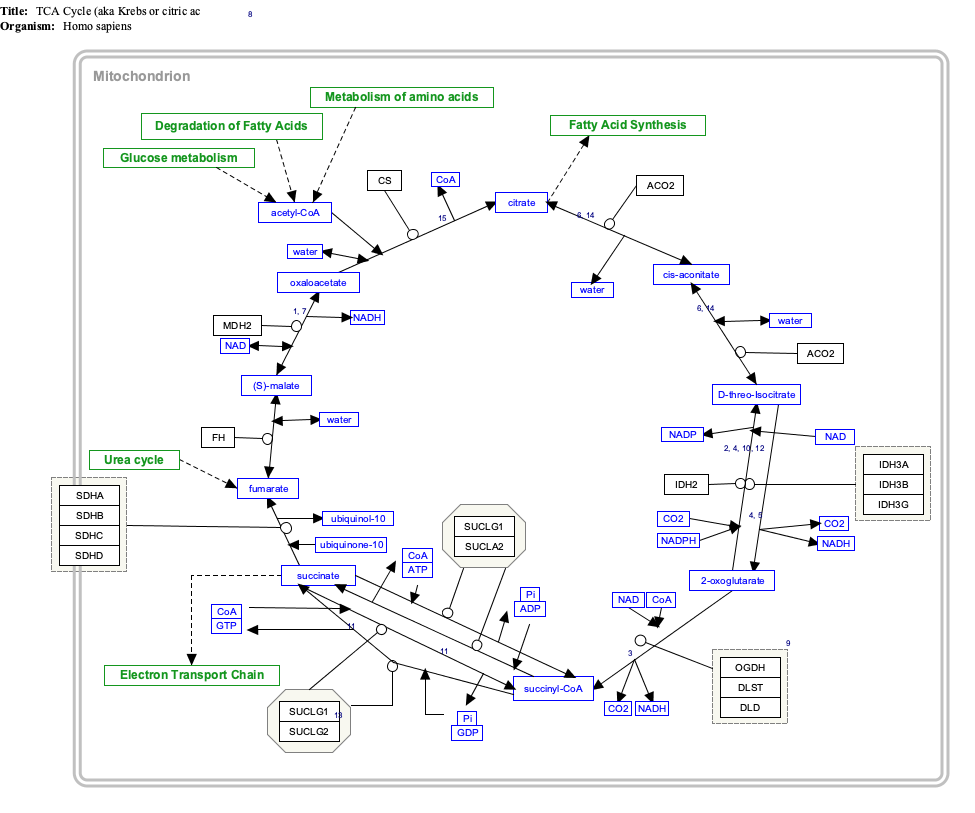
[[File:
TCACycle_WP78Go to articleGo to articleGo to articleGo to articleGo to HMDBGo to articleGo to articleGo to articleGo to HMDBGo to HMDBGo to articleGo to WikiPathwaysGo to articleGo to articleGo to articleGo to WikiPathwaysGo to articleGo to articleGo to articleGo to articleGo to articleGo to articleGo to articleGo to articleGo to articleGo to articleGo to articleGo to articleGo to articleGo to articleGo to articleGo to articleGo to articleGo to articleGo to articleGo to WikiPathwaysGo to articleGo to articleGo to articleGo to HMDBGo to articleGo to articleGo to articleGo to articleGo to articleGo to WikiPathwaysGo to articleGo to WikiPathwaysGo to HMDBGo to articleGo to WikiPathwaysGo to articleGo to HMDBGo to articleGo to articleGo to articleGo to articleGo to articleGo to articleGo to articleGo to articleGo to articleGo to article
[[
]]
[[
]]
[[
]]
[[
]]
[[
]]
[[
]]
[[
]]
[[
]]
[[
]]
[[
]]
[[
]]
[[
]]
[[
]]
[[
]]
[[
]]
[[
]]
[[
]]
[[
]]
[[
]]
[[
]]
[[
]]
[[
]]
[[
]]
[[
]]
[[
]]
[[
]]
[[
]]
[[
]]
[[
]]
[[
]]
[[
]]
[[
]]
[[
]]
[[
]]
[[
]]
[[
]]
[[
]]
[[
]]
[[
]]
[[
]]
[[
]]
[[
]]
[[
]]
[[
]]
[[
]]
[[
]]
[[
]]
[[
]]
[[
]]
[[
]]
[[
]]
[[
]]
[[
]]
[[
]]
[[
]]
[[
]]
[[
]]
[[
]]
[[
]]
[[
]]
[[
]]
[[
]]
[[
]]
[[
]]
TCACycle_WP78Go to articleGo to articleGo to articleGo to articleGo to HMDBGo to articleGo to articleGo to articleGo to HMDBGo to HMDBGo to articleGo to WikiPathwaysGo to articleGo to articleGo to articleGo to WikiPathwaysGo to articleGo to articleGo to articleGo to articleGo to articleGo to articleGo to articleGo to articleGo to articleGo to articleGo to articleGo to articleGo to articleGo to articleGo to articleGo to articleGo to articleGo to articleGo to articleGo to WikiPathwaysGo to articleGo to articleGo to articleGo to HMDBGo to articleGo to articleGo to articleGo to articleGo to articleGo to WikiPathwaysGo to articleGo to WikiPathwaysGo to HMDBGo to articleGo to WikiPathwaysGo to articleGo to HMDBGo to articleGo to articleGo to articleGo to articleGo to articleGo to articleGo to articleGo to articleGo to articleGo to article
|alt=TCACycle_WP78 edit]]
TCACycle_WP78 edit
  1. ^ The interactive pathway map can be edited at WikiPathways: "TCACycle_WP78".

See also

[edit]

References

[edit]
[edit]
Revisions and contributorsEdit on WikipediaRead on Wikipedia
from Grokipedia
Fumarase, also known as fumarate hydratase (FH), is an enzyme that catalyzes the reversible hydration of fumarate to L-malate, a critical step in the tricarboxylic acid (TCA) cycle that facilitates aerobic respiration and cellular energy production through the generation of reducing equivalents like NADH. Encoded by the FH gene on 1q43 in humans, fumarase is a highly conserved protein across eukaryotes, producing two isoforms via alternative transcription initiation that are dually localized to the and the , with roughly equal distribution in both compartments to support metabolic flexibility. This dual targeting arises from two translation products, one with a mitochondrial targeting sequence for import and the other lacking it for cytosolic retention, enabling fumarase to participate in both oxidative metabolism and non-mitochondrial pathways. Structurally, fumarase belongs to class II enzymes and forms a homotetrameric complex with a total molecular weight of approximately 200 , consisting of four identical subunits of about 50 each; it operates without requiring cofactors, relying instead on three catalytic residues from adjacent subunits to form the for stereospecific substrate binding. In the TCA cycle, mitochondrial fumarase ensures the continuity of the pathway by interconverting fumarate and malate, linking , , and to ATP synthesis, while cytosolic fumarase contributes to fumarate , function, and biosynthesis. Beyond metabolism, fumarase plays emerging roles in genomic stability: upon DNA double-strand breaks, it translocates to the nucleus, where its enzymatic production of fumarate locally inhibits histone demethylases like KDM2B and KDM4A, promoting chromatin modifications (e.g., H3K36 ) that facilitate via or . Mutations in the FH gene disrupt these functions, leading to fumarase deficiency—a severe autosomal recessive disorder characterized by , seizures, and early lethality due to impaired brain —and hereditary leiomyomatosis and renal cell cancer (HLRCC), an autosomal dominant where heterozygous loss promotes tumorigenesis through fumarate accumulation, pseudohypoxia via HIF-1α stabilization, and increased genomic instability. As a tumor suppressor, fumarase's cytosolic and nuclear activities underscore its integration of with DNA damage response, highlighting its broader implications in cancer predisposition and cellular homeostasis.

Nomenclature

EC Classification

Fumarase is officially classified under the Enzyme Commission (EC) number 4.2.1.2, identifying it as a lyase enzyme that catalyzes the reversible addition of water to a carbon-carbon double bond. This classification places it within the broader category of lyases (EC 4), specifically the subclass of carbon-oxygen lyases (EC 4.2). The systematic name for this enzyme is (S)-malate hydro-lyase (fumarate-forming), reflecting its role in the stereospecific dehydration of (S)-malate to fumarate. Additionally, it is assigned the Chemical Abstracts Service (CAS) registry number 9032-88-6. Within the lyase class, fumarase belongs to the hydro-lyase family (EC 4.2.1), which encompasses enzymes that facilitate the hydration or of unsaturated substrates via elimination or of across double bonds, without involving or phosphorolysis. This distinguishes hydro-lyases like fumarase from other hydratases, such as those in the isomerase class (EC 5) or synthases that may employ metal-dependent mechanisms for similar but non-lyase transformations.

Synonyms

Fumarase is commonly referred to by several alternative names in scientific literature, reflecting its enzymatic function and historical context. The most widely used synonym is fumarate hydratase, which emphasizes its role in the hydration of fumarate, while an older term, fumaric acid hydrase, was occasionally employed in early biochemical descriptions. The primary abbreviation for the enzyme is FH, approved by the Human Genome Nomenclature Committee for the corresponding gene; however, this acronym requires contextual distinction in biology, as it also denotes unrelated entities such as factor H (a regulator in the complement system) and familial hypercholesterolemia (a lipid disorder). The nomenclature of fumarase evolved during the elucidation of the tricarboxylic acid cycle in the early , with the term "fumarase" first documented in biochemical publications in 1931 by J. H. Quastel, predating the full description of the cycle by Hans Adolf Krebs in 1937.

Structure

Gene

The human FH gene, which encodes the enzyme fumarate hydratase, is located on the long arm of at cytogenetic band 1q43, spanning genomic coordinates 241497603–241519755 (GRCh38.p14 assembly). This positioning places it within a region associated with various genetic studies, though specific neighboring genes include those involved in metabolic processes. The FH gene structure comprises 10 exons distributed over approximately 22 kb of genomic DNA, with introns separating the coding regions to facilitate proper mRNA processing. The promoter region upstream of the first exon contains a CpG island and multiple transcription start sites, enabling a broad transcriptional initiation pattern that supports ubiquitous expression across tissues such as heart, liver, and kidney. Transcription produces a primary pre-mRNA that undergoes canonical splicing by the spliceosome to yield a mature mRNA of about 1.4 kb, which is then translated into the fumarase protein; alternative transcription initiation, resulting in mRNAs that utilize different translation start sites, contributes to the generation of isoforms. Orthologs of the human FH gene are well-conserved across species, reflecting its essential role in metabolism. In the bacterium Escherichia coli, fumarase activity is encoded by three genes: fumA and fumB (class I fumarases, which are iron-sulfur cluster-containing enzymes) and fumC (a class II fumarase lacking such clusters, serving as a stress-resistant backup). In the yeast Saccharomyces cerevisiae, the single ortholog FUM1 encodes a mitochondrial fumarase that shares structural and functional homology with the human protein. These orthologs have been instrumental in elucidating conserved mechanisms of fumarase function through genetic and biochemical studies in model organisms.

Protein

The human fumarase protein, encoded by the FH gene, comprises 510 residues and has a molecular weight of approximately 50 per subunit. Its secondary structure is predominantly α-helical, featuring a large number of α-helices with limited β-sheet elements integrated into the core domains. Specifically, the central domain (D2) consists of a five-helix bundle, while the peripheral domains (D1 and D3) incorporate mixed α-helices and β-sheets to form the overall scaffold. In terms of tertiary structure, each folds into a compact three-domain : D1 (residues 49–188) with β-α-β motifs, D2 (residues 189–439) as an all-α-helical bundle that mediates intersubunit contacts, and D3 (residues 440–510) featuring additional α-β elements. This arrangement creates a monomeric unit with a crevice-like pocket at the domain interfaces, involving conserved residues such as (e.g., His180), aspartate, and that coordinate substrate binding. High-resolution crystal structures have elucidated these features, including the tetrameric complex at 1.95 Å resolution (PDB ID: 3E04), which reveals the orthogonal arrangement of domains and the multi-subunit architecture. More recent structures, such as PDB ID: 7LUB (2021), have further elucidated interactions with inhibitors. Complementary models from Escherichia coli fumarase C (e.g., PDB ID: 1FUO) highlight conserved folding patterns across class II fumarases, with the human variant showing 54% sequence identity to the bacterial homolog. The protein typically assembles into a homotetramer, with each subunit contributing to four independent s formed at the interfaces of three monomers.

Isoforms

Fumarase enzymes are classified into two distinct classes based on their structural and biochemical properties. Class I fumarases, primarily found in prokaryotes, are Fe²⁺-dependent enzymes that contain a [4Fe-4S] cluster in their and form homodimers with a molecular weight of approximately 120 kDa. These enzymes are often oxygen-sensitive and exhibit high specificity for the reversible hydration of fumarate to L-malate. In contrast, Class II fumarases, which are predominant in eukaryotes and also present in some prokaryotes, are Mn²⁺-independent (though sometimes activated by Mn²⁺), lack metal cofactors, and assemble into homotetramers with a molecular weight of about 200 kDa. They are characterized by greater thermal stability and broader phylogenetic distribution compared to Class I. In eukaryotes, fumarase isoforms arise from a single gene through dual targeting mechanisms rather than alternative splicing, resulting in proteins localized to both the mitochondrial matrix and the cytosol (with some translocation to the nucleus under stress conditions). The mitochondrial isoform features an N-terminal targeting signal peptide that is cleaved upon import, yielding a mature protein identical in sequence to the cytosolic form at the N-terminus. This dual localization is conserved from yeast to humans, where the fumarate hydratase (FH) gene produces a single translation product that partitions post-translationally between compartments. The cytosolic/nuclear form supports non-canonical roles, such as involvement in DNA damage response. Class II fumarases, including eukaryotic isoforms, form tetramers through specific subunit interfaces that stabilize the oligomeric structure essential for activity. Each subunit consists of three domains—an N-terminal domain, a central five-helix bundle, and a C-terminal domain—with dimer interfaces primarily involving the central and C-terminal regions to create the functional tetrameric core. These interfaces, such as those between subunits A-D and C-D in the tetramer, contribute to the enzyme's overall stability and substrate binding. Species-specific variations in eukaryotic fumarase include differences in targeting and post-translational modifications. The core tetrameric assembly remains conserved across .

Function

Reaction Catalyzed

Fumarase, also known as fumarate hydratase, catalyzes the reversible hydration of fumarate to L-malate, a critical step in cellular . The reaction can be represented as: fumarate+H2O(S)-malate\text{fumarate} + \text{H}_2\text{O} \rightleftharpoons (S)\text{-malate} This transformation involves the addition of a molecule across the of fumarate, yielding the (S)- of malate with high . The of the reaction features a trans addition of the hydroxyl group and from to the trans of fumarate, ensuring the exclusive production of (S)-malate without forming the (R)-. This trans-specific mechanism is conserved across eukaryotic and prokaryotic fumarases, highlighting its evolutionary importance for precise chiral control in metabolic pathways. In vivo, the reaction predominantly proceeds in the direction of malate formation, particularly within the tricarboxylic acid (TCA) cycle under aerobic conditions, driven by the subsequent oxidation of malate to oxaloacetate. The equilibrium constant (K_eq) for the hydration reaction is approximately 4, favoring malate over fumarate by a ratio of about 4:1 at physiological pH and ionic strength. This bias ensures efficient flux through the TCA cycle despite the reversibility of the enzyme. Class II fumarases, which include the eukaryotic and most prokaryotic forms, operate independently of metal cofactors or prosthetic groups, relying solely on the protein's residues for . This cofactor-free nature distinguishes them from class I fumarases, which require iron-sulfur clusters, and underscores their thermal stability and broad distribution in organisms.

Mechanism

Fumarase catalyzes the reversible hydration of fumarate to L-malate through a base-catalyzed mechanism involving a carbanion intermediate. In the forward (hydration) direction, a water molecule bound in the active site is deprotonated by a histidine residue acting as a general base, generating a nucleophilic hydroxide ion. This hydroxide attacks the electrophilic C2 carbon of fumarate, leading to the addition across the trans double bond and formation of a carbanion at C3. The carbanion is subsequently protonated at C3 to yield L-malate, ensuring stereospecific anti addition. Key residues from multiple subunits of the tetrameric coordinate this process. In fumarase, His235 serves as the general base for deprotonating the or, in the reverse dehydration direction, abstracting the pro-R proton from C3 of malate to initiate formation. Asp232 and Lys324 contribute to stabilizing the intermediate through electrostatic interactions and hydrogen bonding within an extensive network that polarizes the substrate and lowers the barrier. Additional residues, such as Ser186 and Thr234, position the substrate and facilitate proton transfer. The also features a secondary B-site, distinct from the catalytic A-site, which binds fumarate or malate without participating in bond breaking or formation. This allosteric site enhances by accelerating substrate delivery to the and product release, thereby increasing overall reaction efficiency through conformational adjustments that promote rapid turnover.

Kinetic Properties

Fumarase follows Michaelis-Menten kinetics, with reported Km values of approximately 5 μM for fumarate and 25 μM for L-malate in mammalian enzymes such as pig heart fumarase. These low Km values indicate high substrate affinity, enabling efficient catalysis under physiological conditions where substrate concentrations are typically in the micromolar range. The maximum velocity (Vmax) and (kcat) for mammalian fumarase such as pig heart are approximately 800 s⁻¹, reflecting its high catalytic in the . This kcat value positions fumarase among the more efficient s, with a catalytic proficiency (kcat/Km) approaching the limit for fumarate hydration. The exhibits an optimal of 7.5–8.0, aligning with the slightly alkaline environment of mitochondria, and shows stability across a broad pH range (6.0–9.0). Class II fumarases, including the eukaryotic form, demonstrate thermal stability up to 70°C, though human variants have a lower around 51°C that can be enhanced by ligands. Succinate and phosphate act as competitive inhibitors, binding at the and increasing the apparent Km for substrates without affecting Vmax. This inhibition mode underscores the enzyme's specificity for trans-aconitate-like substrates in the cycle.

Metabolic Roles

Citric Acid Cycle

Fumarase occupies the seventh position in the tricarboxylic acid (TCA) cycle, catalyzing the reversible hydration of fumarate to L-malate following the oxidation of succinate by . This step integrates fumarate, produced upstream in the cycle, into malate, which subsequently serves as a substrate for to generate oxaloacetate and NADH for electron transport. The reaction maintains the cyclic flow of carbon intermediates essential for complete oxidation of derived from carbohydrates, fats, and proteins. In addition to its catabolic role, fumarase contributes to anaplerosis by facilitating the entry of fumarate generated from into the TCA cycle, thereby replenishing depleted intermediates. Specifically, the degradation of and via fumarylacetoacetate yields fumarate, which fumarase then converts to malate to sustain cycle flux during biosynthetic demands or high metabolic turnover. This anaplerotic function ensures the TCA cycle's capacity to support both energy production and the provision of precursors for and . The mitochondrial localization of fumarase is crucial for coupling TCA cycle activity to , as the enzyme resides in where it coordinates with the to maximize ATP yield. Disruption of this localization impairs the cycle's efficiency, leading to reduced NADH and FADH₂ production and consequently diminished proton gradient formation across the inner membrane. This compartmentalization underscores fumarase's role in aerobic respiration, linking substrate-level metabolism to the proton-motive force driving . Fumarase operates as a near-equilibrium in the TCA cycle, exhibiting rapid forward and reverse kinetics that minimize its contribution to control and prevent it from becoming rate-limiting under physiological conditions. The reaction's favors malate formation but allows bidirectional , enabling quick adjustments to metabolite concentrations without imposing bottlenecks on overall cycle throughput. This property contrasts with irreversible steps earlier in the cycle, ensuring efficient propagation of from upstream dehydrogenases to downstream energy-harvesting processes.

Other Pathways

Fumarase plays a key role in linking the to other metabolic processes by hydrating the fumarate byproduct generated from argininosuccinate cleavage. In the , argininosuccinate lyase catalyzes the breakdown of argininosuccinate into and fumarate, providing fumarate that fumarase subsequently converts to malate for further utilization in cellular metabolism.00645-6) Fumarate produced through serves as a supplier for synthesis pathways, where fumarase facilitates its conversion to support aspartate production essential for . During purine salvage, AMP deaminase generates fumarate as a side product, which fumarase hydrates to malate; this malate is then oxidized to oxaloacetate and transaminated to aspartate, a critical precursor for pyrimidine ring formation in UMP synthesis.51814-0/fulltext) In the , fumarase contributes to by locally generating fumarate that modulates demethylase activity. Upon DNA double-strand breaks, cytosolic fumarase accumulates at damage sites to produce fumarate, which competitively inhibits the α-ketoglutarate-dependent demethylase KDM2B, thereby increasing H3K36me2 marks and promoting repair. Fumarase also protects the mitochondrial cysteine desulfurase Nfs1 from inactivation, linking its activity to DNA damage response pathways, as demonstrated in 2021 yeast studies. In fumarase-deficient cells, Nfs1 undergoes modification and loses function, impairing iron-sulfur cluster biogenesis and ; however, Nfs1 overexpression restores repair efficiency, indicating fumarase's role in maintaining Nfs1 stability.

Regulation

Transcriptional Control

The FH gene, encoding fumarate hydratase, exhibits ubiquitous mRNA expression across human tissues, with notably higher levels observed in the liver, heart, skeletal muscle, and kidney, as well as moderate expression in the brain. This tissue-specific pattern supports the enzyme's role in central metabolic processes, particularly in organs with high energy demands. The promoter region of the FH gene is characterized by a broad structure that facilitates alternative transcription initiation sites, allowing for the production of multiple mRNA isoforms that direct the protein to both mitochondrial and cytosolic compartments. In contexts of metabolic stress, such as in nasopharyngeal carcinoma, the chromatin remodeling factor LSH binds directly to the FH promoter and represses gene expression by recruiting the histone methyltransferase G9a, leading to chromatin modifications that suppress transcription independently of DNA methylation. Regulatory motifs associated with the FH gene demonstrate evolutionary conservation across eukaryotes, mirroring the high sequence and functional preservation of the enzyme itself from yeast to mammals, which underscores the fundamental importance of fumarase in cellular .

Post-Translational Modifications

Fumarase undergoes post-translational processing during its into mitochondria, where the N-terminal presequence of the mitochondrial isoform is cleaved by the mitochondrial processing peptidase (MPP). This cleavage occurs after the precursor protein is translocated across the , generating the mature enzyme and enabling its tetrameric assembly within the matrix. The process ensures proper localization and activation, with studies showing that external MPP can access and cleave the presequence even during ongoing , highlighting the dynamic nature of this modification. Phosphorylation represents a key regulatory modification of fumarase, particularly at serine and residues, which modulates its enzymatic activity in response to metabolic stress. For instance, under glucose deprivation, (AMPK) phosphorylates human fumarase at Ser75, promoting its interaction with activating transcription factor 2 (ATF2) and facilitating a transcriptional response that enhances cell survival through changes. This event is mutually exclusive with O-GlcNAcylation at the same site by O-GlcNAc transferase (OGT), which predominates in nutrient-rich conditions and suppresses the AMPK-mediated pathway, as observed in cells where high OGT correlates with poor prognosis. Additional phosphorylation sites, such as Thr126, inhibit fumarase activity under basal conditions but are dephosphorylated during DNA damage, thereby increasing enzymatic output to support repair processes. Fumarase is also phosphorylated by the DNA-dependent protein kinase (DNA-PK) complex, which promotes its recruitment to DNA double-strand breaks. Covalent modifications like succinylation and further fine-tune fumarase function, especially in the context of DNA damage response. Succinylation on residues inhibits fumarase activity and impairs its role in both respiration and , but these marks are dynamically removed upon genotoxic stress, leading to a threefold increase in enzymatic activity. suppresses activity, and its reversal during DNA damage enhances fumarase's contribution to metabolic adaptation for repair. In , fumarase deficiency leads to accumulation of inactivating post-translational modifications on the desulfurase Nfs1p, such as deamidation at N128 and Q328 and oxidation at M244, which reduce iron-sulfur cluster biogenesis essential for enzymes; fumarase protects Nfs1p by direct binding and maintaining a reducing environment, thereby linking its unmodified state to efficient damage response. Acetylation of fumarase is regulated by histone deacetylase 6 (HDAC6), which interacts directly with the enzyme in mitochondrial networks to maintain its activity. Inhibition of HDAC6 with selective inhibitors like BAS-2 reduces fumarase activity, causing fumarate accumulation, increased protein succination, and elevated mitochondrial , ultimately disrupting mitochondrial structure and inducing in cells. This interaction, visualized via , positions HDAC6 as a modulator of fumarase's post-translational state, with deacetylation promoting optimal function in tumor .

Clinical Significance

Deficiency and Metabolic Disorders

Fumarase deficiency, also known as fumarate hydratase (FH) deficiency or fumaric aciduria, is a rare autosomal recessive metabolic disorder, although there is an unusually high incidence among members of the Fundamentalist Church of Jesus Christ of Latter Day Saints in the southwestern United States due to a founder effect, caused by biallelic pathogenic variants in the FH gene, leading to impaired activity of the fumarase enzyme in both mitochondrial and cytosolic compartments. This results in disruption of the citric acid cycle, particularly affecting energy production in high-demand tissues like the brain. Clinical manifestations typically emerge in the neonatal or early infantile period, presenting as severe progressive encephalopathy characterized by poor feeding, hypotonia, lethargy, and failure to thrive. Common neurological symptoms include intractable seizures in approximately 43% of cases, profound developmental delay, and structural brain abnormalities such as ventriculomegaly, polymicrogyria, and agenesis of the corpus callosum. Prenatal indicators often involve polyhydramnios in about 23% of affected pregnancies, alongside fetal brain malformations detectable by ultrasound. Biochemically, the disorder is marked by massive urinary excretion of (fumarate), often accompanied by elevations in other intermediates such as alpha-ketoglutarate and succinyladenosine, reflecting the enzymatic block at the conversion of fumarate to malate. These metabolites may also appear elevated in (CSF), contributing to the observed neurological deterioration, though and pyruvate elevation can occur variably. Systemic features may include neonatal , hepatosplenomegaly, and dysmorphic facial traits like prominent forehead, , and micrognathia, underscoring the multisystem impact. Diagnosis is confirmed through a combination of biochemical and , beginning with analysis of urine organic acids to detect the characteristic fumaric aciduria. Enzymatic assays in fibroblasts, leukocytes, or muscle tissue demonstrate severely reduced FH activity, often below 10-20% of normal levels. Molecular confirmation involves sequencing the FH gene to identify homozygous or compound heterozygous variants, which are essential for carrier screening in families. There is no curative treatment for fumarase deficiency; management remains supportive and multidisciplinary, focusing on symptom control and nutritional support. Seizures are managed with antiepileptic drugs such as or , while feeding difficulties may necessitate tube placement and to address . Emerging evidence from case reports suggests potential benefits from a high-fat, , which in one long-term study reduced urinary fumarate levels and mitigated metabolic without adverse effects, contrasting earlier contraindications for ketogenic approaches. Citrate supplementation has been explored in some protocols to bolster flux, though its efficacy remains unproven in large cohorts. The prognosis is generally poor, with most individuals succumbing in early childhood due to progressive and complications like ; however, rare cases with milder phenotypes and supportive interventions may survive into with moderate .

Role in Cancer and Other Diseases

Fumarase (FH), encoded by the FH gene, acts as a tumor suppressor, and its mutations are the primary cause of hereditary leiomyomatosis and renal cell cancer (HLRCC), an autosomal dominant disorder characterized by cutaneous and uterine leiomyomas as well as aggressive papillary type 2 . In HLRCC, FH inactivation leads to accumulation of fumarate, which induces a pseudohypoxic state by stabilizing hypoxia-inducible factor (HIF) through inhibition of prolyl hydroxylases, thereby promoting tumorigenesis via enhanced glycolytic flux and angiogenic signaling. This fumarate-mediated HIF stabilization mimics hypoxic conditions in normoxic environments, driving oncogenesis in renal and other tissues affected by HLRCC. As an oncometabolite, fumarate exerts protumorigenic effects by competitively inhibiting α-ketoglutarate (α-KG)-dependent dioxygenases, including histone and DNA demethylases as well as TET enzymes, leading to epigenetic alterations that favor cancer progression. These inhibitions disrupt normal cellular differentiation, promote genomic instability, and enhance inflammatory signaling, all of which contribute to the oncogenic phenotype in FH-deficient tumors. In various cancer models, fumarate's role as an oncometabolite has been linked to widespread hypermethylation and impaired DNA repair, underscoring FH loss as a driver of metabolic reprogramming in malignancy. In , FH functions as a tumor suppressor by negatively regulating (EGFR) signaling, thereby inhibiting and . Studies in cell lines demonstrate that FH overexpression suppresses EGFR activation and downstream pathways, reducing tumor growth, while FH knockdown enhances invasive potential. This mechanism highlights FH's role in preventing endometrial tumorigenesis through modulation of growth factor signaling. Beyond oncology, anti-fumarase antibodies serve as a serum biomarker predicting favorable responses to anti-vascular endothelial growth factor (anti-VEGF) therapy in patients with diabetic macular edema (DME), with higher baseline titers correlating with improved visual acuity gains. Additionally, inhibition of histone deacetylase 6 (HDAC6) alters FH activity and mitochondrial structure in cancer cells, potentially offering a therapeutic avenue by disrupting FH-dependent metabolic adaptations in tumors. Therapeutic strategies targeting FH restoration, such as gene overexpression in preclinical models, have shown promise in reversing tumorigenic effects; for instance, re-expression of wild-type FH in HLRCC-derived renal cancer cells reduces fumarate levels, normalizes HIF signaling, and impairs tumor growth. In models, FH restoration via suppresses EGFR-driven proliferation, suggesting potential for approaches in FH-deficient malignancies. These findings support exploring FH reconstitution as a targeted intervention to mitigate oncometabolite-driven cancers. Additionally, a phase II trial presented in 2025 demonstrated promising efficacy and safety of first-line plus in patients with advanced fumarate hydratase-deficient .

References

Add your contribution
Related Hubs
User Avatar
No comments yet.