Hubbry Logo
Diphylleia grayiDiphylleia grayiMain
Open search
Diphylleia grayi
Community hub
Diphylleia grayi
logo
8 pages, 0 posts
0 subscribers
Be the first to start a discussion here.
Diphylleia grayi
Diphylleia grayi
from Wikipedia

Skeleton flower
Scientific classification Edit this classification
Kingdom: Plantae
Clade: Tracheophytes
Clade: Angiosperms
Clade: Eudicots
Order: Ranunculales
Family: Berberidaceae
Genus: Diphylleia
Species:
D. grayi
Binomial name
Diphylleia grayi

Diphylleia grayi, also known as the skeleton flower, is a species of perennial plant in the family Berberidaceae. It is native to northern and central Japan.[2]

Other regions and languages have common names for this plant; In Japan, it is commonly referred to as Japanese: サンカヨウ, romanizedsankayō, lit.'lotus of mountain'. In China, it is commonly referred to as Chinese: 冰莲, romanizedbīng lián, lit.'ice lotus'.

Description

[edit]
Wet flowers with transparent petals

The plant grows up to 0.4 m (1.3 ft). The flowers are white, pedicellate, with six obovate petals and bloom from May to July.[3] After it flowers, it bears dark blue/purple fruit with a white powdery coating from June to August.[4] Its stems are terete and grow 30–60 cm (12–24 in) long. Its rhizomes are stout and knotty. The plant is known to have petals that become transparent when in contact with water, giving it its common name. After they dry, the petals return to their white coloration.[5]

Distribution and habitat

[edit]

The plant is distributed from north to central Honshu, Hokkaido, Mount Daisen, and Sakhalin. It grows in slightly moist places in the woods of high mountains.[6][7]

Medical uses

[edit]

In the 1960s, botanist Yanagi Kimura discovered that D. grayi crude extracts contain substances similar to but more powerful than podophyllin and colchicine. The extract had anti-tumor effects on transplantable animal tumors.[8]

[edit]

See also

[edit]

References

[edit]
[edit]
Revisions and contributorsEdit on WikipediaRead on Wikipedia
from Grokipedia
Diphylleia grayi (syn. Podophyllum grayi), commonly known as the skeleton flower, is a rhizomatous in the family , native to the temperate mountainous regions of northern and central , as well as and the . This species grows to a height of 30–60 cm (12–24 in), forming clumps from stout, knotty rhizomes, with bold, fuzzy, green, umbrella-like leaves that can span up to 40 cm across. It produces clusters of small, white, mayapple-like flowers from to , which are hermaphroditic and thrive in semi-shaded, moist woodland environments. The most distinctive feature of D. grayi is the translucency of its petals when exposed to : in dry conditions, the petals appear opaque due to air-filled intercellular spaces, but upon wetting—such as during —they become nearly transparent, revealing the underlying vein network and resembling a delicate . This optical effect, which typically develops after about one day of light and fades as the petals dry, is an suited to its humid and has earned the plant its . This phenomenon has been documented in D. grayi but is not known to occur in the other two species of the genus, D. sinensis (native to ) and D. cymosa (native to the ). In its natural range, D. grayi prefers cool, high-elevation forests with well-drained, loamy or sandy soils of neutral to mildly acidic , and it is hardy in USDA zones 4–9. Although not widely cultivated historically, its striking floral display has increased interest in ornamental gardening, where it requires consistent moisture and protection from direct sun to mimic its native conditions.

Taxonomy and nomenclature

Etymology and common names

The genus name Diphylleia derives from the Greek prefix di- (two) and phyllon (leaf), alluding to the two broad leaves typical of plants in this genus. The species epithet grayi commemorates (1810–1888), a pioneering 19th-century American botanist renowned for his contributions to and his role as a Harvard . In English, D. grayi bears common names such as skeleton flower—reflecting the petals' transformation to transparency when wet, exposing a skeletal vein pattern—umbrella plant, and Asian umbrella leaf. The plant's native Asian cultures assign evocative names emphasizing its habitat and unique traits: in Japan, sankayō (meaning "mountain lotus leaf"), and in China, bīng lián (meaning "ice lotus").

Classification

_Diphylleia grayi belongs to the kingdom Plantae, phylum Tracheophyta, class Magnoliopsida, order Ranunculales, family , genus Diphylleia, and species grayi. The , commonly known as the barberry family, encompasses approximately 15 genera and 570 of mostly herbaceous perennials characterized by rhizomatous growth, alternate leaves, and often medicinal properties derived from alkaloids. The genus Diphylleia, established by André Michaux in 1803, includes a small number of —typically recognized as two to three—distributed in disjunct temperate regions of eastern and eastern , with D. cymosa in the southeastern United States, D. sinensis in , and D. grayi in . It is closely related to other genera in the subfamily Podophylloideae, such as (mayapple) and Dysosma, sharing morphological features like large peltate leaves and rhizomatous habits, as well as phylogenetic placement within the tribe Podophylleae based on molecular and morphological evidence. These relationships highlight the genus's position in a of pharmacologically significant containing lignans. The species Diphylleia grayi was first described by Ferdinand von Schmidt in 1868, based on collections from , in the publication Mémoires de l'Académie Impériale des Sciences de Saint-Pétersbourg. Historical synonyms include Diphylleia cymosa var. grayi (F.Schmidt) Maxim. and Diphylleia cymosa subsp. grayi (F.Schmidt) Kitam., reflecting earlier classifications that treated it as a variety or of the North American D. cymosa. Although some recent taxonomic treatments, such as those in the Global Flora (2018), have transferred it to as P. grayi, many regional floras and phylogenetic studies maintain its placement in Diphylleia due to distinct morphological traits like its unique petal translucency when wet.

Description

Morphology

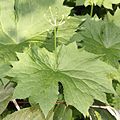
Diphylleia grayi is a that grows 30–60 cm tall, forming clumps from stout, knotty rhizomes that creep horizontally underground to facilitate vegetative spread. These rhizomes produce a single erect, unbranched stem per shoot, typically 30–60 cm high and about 10 mm in diameter, with scattered vascular bundles supporting the foliage. The features two large basal leaves arising from the stem apex, resembling an in shape due to their peltate structure. are reniform-orbicular, up to 40 cm across overall, divided into 5–9 deeply lobed segments in some variants, with doubly serrate margins and glabrous or sparsely pubescent surfaces. Flowers are arranged in terminal umbels of 2–5 (up to 16) white blooms, each 3–4 cm in diameter on pedicels 0.8–3.2 cm long. Each flower has four sepals—the outer pair 4–7.2 × 0.6–1.2 mm and the inner 4–9 × 3–5.4 mm—and six obovate petals measuring 1.5–2 cm, arranged in two whorls. A distinctive trait of these petals is their composition of thin, translucent cells containing air-filled gaps, which scatter light to appear opaque white when dry; upon wetting, water displaces the air, filling the gaps and matching the to render the petals transparent, reverting to white as they dry. The fruits form as an aggregate cluster of 6–12 to berries from the , each an to subglobose capsule 1–1.5 cm long containing 5–11 seeds, covered in a white powdery bloom () and borne on elongated pedicels up to 4 cm.

Diphylleia grayi, a , emerges from rhizomes in early spring, typically around in its native Asian range, initiating vegetative growth with large, umbrella-shaped leaves that form clumps up to 30-40 cm tall. Vegetative development continues through and May, supported by cool, moist conditions in shaded environments, before transitioning to reproductive phases. Flowering occurs from to , generally May through in native habitats, with inflorescences bearing small, white petals that open under cool, humid weather and last 1-2 weeks per cluster. Post-pollination, blue berries form and ripen from June to August, with occurring by late summer as the fruits mature and dehisce. In autumn, the above-ground parts die back, entering as the plant overwinters underground via its rhizomes, remaining hardy to USDA zone 5. Phenological events, such as emergence and blooming, are triggered by rising spring temperatures and adequate moisture, while or excessive heat can delay growth and flowering by stressing the rhizomatous system.

Distribution and habitat

Geographic range

Diphylleia grayi is native to eastern , with its primary distribution in the , including Island and the , and in , where it occurs across northern and central regions such as and , including specific sites like . The was first described in 1868 by Ferdinand Schmidt based on specimens from the region in the . Botanical surveys have confirmed its presence in these areas, with no recent discoveries of significant new populations reported post-2000, though ongoing monitoring highlights its localized distribution. Populations remain restricted to high-elevation wooded areas, and while not globally threatened, the is considered vulnerable in due to risks from habitat loss associated with development and pressures. The has not been assessed by the and is categorized as as of 2025. Outside its native range, D. grayi is cultivated as an ornamental in , including the and , where it is available through specialty nurseries; in , notably the and ; and in for garden settings. No naturalized populations have been documented as of 2025.

Environmental preferences

_Diphylleia grayi thrives in the moist, shaded of temperate forests situated on high mountain slopes at high elevations in mountainous regions. This habitat provides the cool, humid conditions essential for the plant's growth, mimicking the protected woodland environments of its native range in . The species is adapted to environments where constant moisture supports its lifecycle without excessive exposure to harsh elements. The preferred soil for D. grayi consists of well-drained, humus-rich loams that are acidic to neutral in , enriched with high to retain moisture while preventing waterlogging. These soils, often formed from leaf litter, maintain consistent critical for the plant's rhizomatous roots and foliage. In terms of , the species favors cool temperate regimes with annual of 1000–2000 mm, mild summers averaging 15–20°C, and cold winters dipping to -10°C or below, which align with the subalpine conditions of its habitats. requirements emphasize partial to full shade, as direct sunlight scorches the delicate leaves, rendering open or sunny exposures unsuitable. In the wild, D. grayi associates with ferns, mosses, and vegetation in forests dominated by trees such as Fagus () and Tsuga (), contributing to a diverse, humid . However, the plant faces threats from , which fragments its shaded habitats, and climate warming, potentially forcing upward range shifts to higher elevations as lower slopes become too warm or dry. These pressures exacerbate vulnerability in its restricted native locales, underscoring the need for .

Ecology

Pollination and reproduction

Diphylleia grayi exhibits entomophilous pollination, inferred from the spinose pollen grains and showy white flower clusters that are characteristic of the genus. The reproductive flower structure includes six antipetalous stamens with basifixed anthers that dehisce longitudinally, releasing pollen for insect transfer. The superior, ellipsoid ovary is unilocular with parietal placentation and 5–11 ovules, developing post-fertilization into a dark blue, glaucous berry approximately 1 cm in diameter. The hermaphroditic nature of the flowers supports potential self-pollination, but the breeding system favors outcrossing to promote genetic diversity, particularly in small populations. Seed production in D. grayi results in berries typically containing 3–7 (up to 10), with observed fruit set at around 60% and approximately 21% of ovules maturing into viable under natural conditions. These are black and exhibit high viability when subjected to cold stratification, often requiring in a soon after ripening to overcome and achieve , which can take a year or more. Asexual reproduction occurs through division of the extensive system, allowing formation of dense clones in suitable habitats, though this is less common than sexual via .

Fruit dispersal and interactions

Diphylleia grayi produces to subglobose berries that are dark in color, measuring 9–18 mm in length and 8–16 mm in width, each containing 3–7 ovoid to oblong approximately 6–6.5 mm long. These berries develop on pedicels 0.9–4 cm long following the flowering period and serve as the primary structure for . Seed dispersal in D. grayi occurs primarily through zoochory, with animals consuming the and sweet fruit pulp and subsequently excreting the intact at distant sites. This mechanism facilitates short-distance spread within moist habitats, contributing to the ' patchy distribution in mixed and coniferous woodlands. The play an ecological role by providing a source for , including potential frugivores that aid in maintaining within cool-temperate . Rhizomatous growth further supports colony formation, though herbivory on underground structures may influence in disturbed areas.

Cultivation and uses

Growing requirements

Diphylleia grayi thrives in cultivation when provided with conditions mimicking its native moist , requiring partial to full shade to prevent scorch and promote healthy growth. Ideal site selection involves planting in dappled light under trees or in shaded borders, spaced about 2 feet apart, with a layer of such as mold or to retain and suppress weeds while replicating the environment. Protection from harsh winds and direct afternoon sun is essential, particularly in warmer climates, to avoid wilting or fading foliage. Soil for Diphylleia grayi should be moist yet well-drained, loamy, and rich in to support its rhizomatous roots. A slightly acidic to neutral range of 4.5–7.0 is optimal, and amending heavy or clay soils with , leaf mold, or coarse improves drainage while enhancing . In nutrient-poor sites, incorporating organic amendments annually helps maintain the humus-rich conditions the plant prefers without risking compaction. Watering requirements emphasize consistent , as Diphylleia grayi is drought-sensitive and benefits from deep watering during dry periods, especially in summer. Aim for evenly moist conditions similar to its natural habitat, providing supplemental once or twice weekly for newly established plants, but ensure excess water drains away to prevent . or soaker hoses are recommended to deliver water directly to the roots without wetting foliage, which can exacerbate fungal issues in humid environments. This is suited to USDA hardiness zones 4–9, favoring cool temperate climates with humid air, cold winters for , and moderate summers. In hotter regions within its range, extra shade and protect against heat stress, while in colder zones, a winter layer insulates roots but should be removed in spring to avoid rot. Fertilization should be minimal and organic-focused to avoid promoting weak, leggy growth; apply a low-nitrogen, balanced slow-release formula or top-dressing in early spring if is low. Excess nutrients can lead to reduced flowering and increased susceptibility to environmental stress, so rely primarily on amendments rather than heavy feeding. Common cultivation challenges include pests like slugs and snails, which target the tender foliage in moist shade, and fungal diseases such as or powdery mildew in overly humid or poorly drained conditions. While generally pest-resistant, monitoring for these issues and maintaining proper site conditions—such as adequate airflow and balanced moisture—helps prevent problems.

Propagation methods

Diphylleia grayi is primarily propagated through seed sowing or rhizome division, with the latter being the more reliable method for home gardeners due to the plant's slow growth and specific requirements. Seed propagation begins with collecting seeds from the plant's ripe blue berries, which develop in clusters on reddish stalks in early autumn. These seeds require cold stratification to break dormancy, typically achieved by storing them in a moist medium in the refrigerator for 60 to 90 days at approximately 4°C. After stratification, seeds are sown in spring in a well-draining, humus-rich potting mix kept consistently moist but not waterlogged, with germination occurring over 4 to 8 weeks under cool, shaded conditions around 15 to 20°C. Success rates for seed propagation are generally low due to challenges such as poor initial viability without after-ripening and risks of fungal contamination in damp sowing media. Rhizome division offers higher success rates and is best performed in early spring after the last or in fall, when the is dormant. Clumps should be divided every 3 to 5 years to maintain vigor; gently dig up the , separate the thick underground into sections each with at least one growth using a sharp knife or spade, and replant immediately in prepared, shaded at the same depth, spacing divisions about 2 feet apart. This method leverages the 's natural rhizomatous structure for quick establishment without the delays associated with seeds. Seeds and rhizome divisions of Diphylleia grayi have been commercially available from specialty nurseries and botanical suppliers since the early , though stock often sells out quickly due to the plant's rarity and slow propagation pace.

Medicinal and ornamental applications

Research into its medicinal potential began in the 1960s with on extracts, which demonstrated anti-tumor activity against transplantable and tumors, comparable to that of due to shared cytotoxic mechanisms. The roots contain approximately 1.3% , a precursor to anticancer drugs like , contributing to its potential as a source of cytotoxic compounds. Despite these findings, as of 2025, no clinical trials have been conducted on D. grayi extracts, limiting their therapeutic development beyond preliminary and animal investigations. Due to the presence of , a known , ingestion or unsupervised medicinal use is not recommended and may pose health risks. Ornamentally, Diphylleia grayi has gained popularity since the for its distinctive white petals that turn translucent upon contact with water, revealing delicate veins and enhancing its appeal in shaded gardens. This unique hydrochromic effect makes it suitable for gardens and moist, humus-rich plantings, where it adds visual interest during wet conditions without requiring full sun. Culturally, the plant symbolizes transparency and purity in Japanese art and rituals, often featured in botanical exhibits and traditional depictions to evoke themes of impermanence and clarity. Commercially, seeds and live plants of D. grayi are available online through specialty nurseries and seed vendors, though its rarity and specific growing needs prevent it from holding a significant economic role in .

References

Add your contribution
Related Hubs
User Avatar
No comments yet.