



Community hub
Recent from talks
Contribute something
Nothing was collected or created yet.
Direct linear transformation
View on WikipediaDirect linear transformation (DLT) is an algorithm which solves a set of variables from a set of similarity relations:
- for


where and are known vectors, denotes equality up to an unknown scalar multiplication, and is a matrix (or linear transformation) which contains the unknowns to be solved.


This type of relation appears frequently in projective geometry. Practical examples include the relation between 3D points in a scene and their projection onto the image plane of a pinhole camera,[1] and homographies.
Introduction
[edit]An ordinary system of linear equations
- for

can be solved, for example, by rewriting it as a matrix equation where matrices and contain the vectors and in their respective columns. Given that there exists a unique solution, it is given by


Solutions can also be described in the case that the equations are over or under determined.
What makes the direct linear transformation problem distinct from the above standard case is the fact that the left and right sides of the defining equation can differ by an unknown multiplicative factor which is dependent on k. As a consequence, cannot be computed as in the standard case. Instead, the similarity relations are rewritten as proper linear homogeneous equations which then can be solved by a standard method. The combination of rewriting the similarity equations as homogeneous linear equations and solving them by standard methods is referred to as a direct linear transformation algorithm or DLT algorithm. DLT is attributed to Ivan Sutherland. [2]
Example
[edit]Suppose that . Let and be two known vectors, and we want to find the matrix such that





where is the unknown scalar factor related to equation k.

To get rid of the unknown scalars and obtain homogeneous equations, define the anti-symmetric matrix
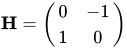
and multiply both sides of the equation with from the left

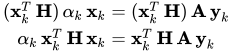
Since the following homogeneous equations, which no longer contain the unknown scalars, are at hand
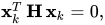
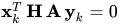
In order to solve from this set of equations, consider the elements of the vectors and and matrix :
- , , and
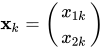
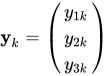
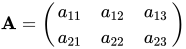
and the above homogeneous equation becomes
- for


This can also be written in the matrix form:
- for

where and both are 6-dimensional vectors defined as


- and
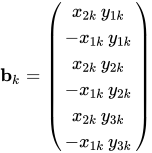
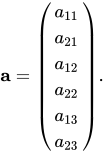
So far, we have 1 equation and 6 unknowns. A set of homogeneous equations can be written in the matrix form

where is a matrix which holds the known vectors in its rows. The unknown can be determined, for example, by a singular value decomposition of ; is a right singular vector of corresponding to a singular value that equals zero. Once has been determined, the elements of matrix can rearranged from vector . Notice that the scaling of or is not important (except that it must be non-zero) since the defining equations already allow for unknown scaling.


In practice the vectors and may contain noise which means that the similarity equations are only approximately valid. As a consequence, there may not be a vector which solves the homogeneous equation exactly. In these cases, a total least squares solution can be used by choosing as a right singular vector corresponding to the smallest singular value of

More general cases
[edit]The above example has and , but the general strategy for rewriting the similarity relations into homogeneous linear equations can be generalized to arbitrary dimensions for both and


If and the previous expressions can still lead to an equation

- for
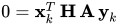
where now is Each k provides one equation in the unknown elements of and together these equations can be written for the known matrix and unknown 2q-dimensional vector This vector can be found in a similar way as before.


In the most general case and . The main difference compared to previously is that the matrix now is and anti-symmetric. When the space of such matrices is no longer one-dimensional, it is of dimension


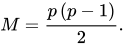
This means that each value of k provides M homogeneous equations of the type
- for and for


where is a M-dimensional basis of the space of anti-symmetric matrices.

Example p = 3
[edit]In the case that p = 3 the following three matrices can be chosen
- , ,
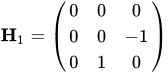
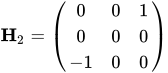
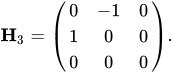
In this particular case, the homogeneous linear equations can be written as
- for
![{\displaystyle \mathbf {0} =[\mathbf {x} _{k}]_{\times }\,\mathbf {A} \,\mathbf {y} _{k}}](https://wikimedia.org/api/rest_v1/media/math/render/svg/9e810bc09ecb8a018bade6c65b568cf065195457)
where is the matrix representation of the vector cross product. Notice that this last equation is vector valued; the left hand side is the zero element in .
![{\displaystyle [\mathbf {x} _{k}]_{\times }}](https://wikimedia.org/api/rest_v1/media/math/render/svg/0ea8c85db44a753f6e1261e7eb6b7912be5ae590)

Each value of k provides three homogeneous linear equations in the unknown elements of . However, since has rank = 2, at most two equations are linearly independent. In practice, therefore, it is common to only use two of the three matrices , for example, for m=1, 2. However, the linear dependency between the equations is dependent on , which means that in unlucky cases it would have been better to choose, for example, m=2,3. As a consequence, if the number of equations is not a concern, it may be better to use all three equations when the matrix is constructed.
The linear dependence between the resulting homogeneous linear equations is a general concern for the case p > 2 and has to be dealt with either by reducing the set of anti-symmetric matrices or by allowing to become larger than necessary for determining
References
[edit]- ^ Abdel-Aziz, Y.I.; Karara, H.M. (2015-02-01). "Direct Linear Transformation from Comparator Coordinates into Object Space Coordinates in Close-Range Photogrammetry". Photogrammetric Engineering & Remote Sensing. 81 (2). American Society for Photogrammetry and Remote Sensing: 103–107. doi:10.14358/pers.81.2.103. ISSN 0099-1112.
- ^ Sutherland, Ivan E. (April 1974), "Three-dimensional data input by tablet", Proceedings of the IEEE, 62 (4): 453–461, doi:10.1109/PROC.1974.9449
- Richard Hartley and Andrew Zisserman (2003). Multiple View Geometry in computer vision. Cambridge University Press. ISBN 978-0-521-54051-3.
External links
[edit]- Homography Estimation by Elan Dubrofsky (§2.1 sketches the "Basic DLT Algorithm")
- A DLT Solver based on MATLAB by Hsiang-Jen (Johnny) Chien
Direct linear transformation
View on GrokipediaOverview
Definition and purpose
The Direct Linear Transformation (DLT) is a linear algorithm in computer vision and photogrammetry that estimates the parameters of a projective transformation matrix by solving a homogeneous linear system derived from a set of corresponding points between two coordinate systems.[2] Introduced originally for close-range photogrammetry, it has become a foundational method for computing transformations without requiring nonlinear iterative optimization, relying instead on direct algebraic solutions such as singular value decomposition.[1] The primary purpose of DLT is to determine mappings that align points across images or between 3D world points and 2D image projections, enabling applications like camera calibration and scene reconstruction by enforcing projective geometry constraints.[2] In the 2D-2D case, it computes a homography to relate planar scenes or image planes, while in the 3D-2D case, it estimates a camera projection matrix to model perspective projection.[2] This direct approach minimizes algebraic error in the transformation equations, providing an efficient initial estimate that can be refined by other techniques if needed.[2] Points in DLT are represented using homogeneous coordinates to facilitate the projective transformations it estimates.[2] The general form of the transformation is given by where is the transformation matrix—a 3×3 matrix for 2D homographies (with 8 degrees of freedom up to scale) or a 3×4 matrix for 3D-2D projections (with 11 degrees of freedom up to scale)—and denotes equality up to a scale factor.[2] To solve for , DLT requires a minimum of 4 point correspondences for homographies (yielding 8 independent equations) and 6 for projection matrices (yielding 11 independent equations).[2]Historical development
The direct linear transformation (DLT) was introduced in 1971 by Y. I. Abdel-Aziz and H. M. Karara as a method for camera calibration in close-range photogrammetry, enabling the transformation of comparator coordinates into object space coordinates using control points without requiring initial approximations or fiducial marks.[3] This approach, presented at the ASP/UI Symposium on Close-Range Photogrammetry, addressed the need for efficient stereo-photogrammetric techniques in non-metric camera setups, marking a foundational advancement in handling projective distortions through a linear system of equations.[4] DLT gained prominence in the 1980s and 1990s alongside the emergence of computer vision as a distinct field, where it became integral to estimating camera parameters and scene geometry from image correspondences.[5] It was prominently featured in Richard Hartley and Andrew Zisserman's influential textbook Multiple View Geometry in Computer Vision (first edition, 2000; subsequent editions in 2003 and 2004), which formalized DLT within the broader framework of projective geometry and multi-view reconstruction, solidifying its role in academic and practical computer vision workflows.[6] Key developments in the mid-1990s enhanced DLT's practicality; notably, Richard Hartley proposed a normalized variant in 1992 (later detailed in his 1997 journal publication) to improve numerical stability by preprocessing point coordinates through translation and scaling, mitigating issues with ill-conditioned matrices in the original formulation.[7] By the 2000s, DLT was routinely integrated into robust estimation frameworks, such as RANSAC (originally from 1981 but widely adapted for DLT-based solvers in this era), to handle outliers in real-world image data for tasks like homography and fundamental matrix computation.[8] DLT's influence extended to software ecosystems, establishing it as a standard tool in open-source and commercial libraries; OpenCV, released in 2000, incorporated DLT for camera calibration and homography estimation in its core modules.[9] Similarly, the MATLAB Computer Vision Toolbox adopted DLT-based algorithms for projection matrix estimation and pose recovery, facilitating its use in engineering and research applications since the early 2000s.Mathematical foundations
Homogeneous coordinates
Homogeneous coordinates provide a foundational representation for points in projective space, extending Euclidean geometry to include points at infinity and enabling linear algebraic operations for transformations. In this system, a point in n-dimensional projective space is represented by a vector of coordinates, defined up to a non-zero scalar multiple, such as for , where the colon notation emphasizes scale invariance: for any . This extra dimension, often denoted as , allows finite points in the plane to be expressed with , corresponding to Cartesian coordinates , while points at infinity (ideal points) have , representing directions rather than positions. Key properties of homogeneous coordinates include their scale invariance, which ensures that geometric entities like points and lines are preserved under multiplication by scalars, and the ability to represent projective transformations as linear matrix multiplications on these vectors. For instance, a projective transformation maps a point to , where is a non-singular matrix, and the result is again up to scale. This linearity simplifies computations in projective geometry, as operations like intersection and incidence (e.g., a point lying on a line satisfies ) become algebraic without special cases for infinity. Points at infinity form the projective line at infinity, such as in , which is crucial for handling parallel lines converging in perspective. Conversion between homogeneous and Cartesian coordinates is straightforward and reversible for finite points. To obtain homogeneous coordinates from Cartesian , append a scale factor of 1: . Dehomogenization reverses this by dividing the first coordinates by the last (scale) component, provided it is non-zero: from . If the scale is zero, the point cannot be represented in Cartesian space, corresponding to a direction at infinity. This bidirectional mapping maintains the projective structure while allowing integration with Euclidean computations. In imaging and computer vision, homogeneous coordinates are essential for modeling perspective projection, where parallel lines in 3D space appear to converge at vanishing points on the 2D image plane, a phenomenon not captured by Euclidean coordinates alone. The camera projection matrix (typically 3×4) maps a 3D homogeneous point to a 2D image point via , incorporating the scale and enabling the representation of the image plane at finite distance while treating the plane at infinity naturally. This framework underpins algorithms like direct linear transformation by linearizing nonlinear perspective effects.Projective transformations
Projective transformations represent a class of geometric mappings in projective space that are linear when points are expressed in homogeneous coordinates. In the 2D case, such a transformation is defined by a 3×3 matrix , up to an arbitrary scale factor, which maps a point to . For 3D-to-2D projections, the transformation is given by a 3×4 matrix , similarly up to scale, modeling the perspective projection from world to image coordinates via , where is a 3D homogeneous point.[10] These transformations preserve fundamental projective invariants such as collinearity and incidence, meaning straight lines map to straight lines and points lying on lines remain so after mapping. However, they do not preserve Euclidean properties like angles, lengths, or parallelism, which allows them to capture perspective distortions where parallel lines converge at vanishing points.[10] A 2D homography has 8 degrees of freedom, arising from the 9 elements of the 3×3 matrix minus one for the scale ambiguity. In contrast, a 3D-to-2D projection matrix possesses 11 degrees of freedom, from its 12 elements up to scale.[10] Projective transformations form a group under matrix multiplication, enabling composition of multiple such mappings and the existence of inverses for non-singular cases.[10] This group structure underpins their utility in chaining geometric operations in computer vision.[10]Formulations
2D-2D homography estimation
In the direct linear transformation (DLT) formulation for 2D-2D homography estimation, the goal is to compute a 3×3 homography matrix that maps points from one image plane to another, assuming the points lie on a common plane or the mapping is purely projective. Given corresponding points in the first image and in the second image (in homogeneous coordinates), the relationship is expressed as , where denotes equality up to a nonzero scale factor. This setup linearizes the nonlinear projective transformation, enabling a solution through a homogeneous linear system.[2] For each correspondence, the scale ambiguity leads to the constraint , where is the cross-product. This vector equation provides three components, but only two are independent due to the third being linearly dependent; thus, each point pair yields two linear equations in the nine unknown entries of . Stacking these for points forms a matrix , such that the system is , where is the 9×1 vectorized form of . The rows of are constructed from the cross-product components, for example: with similar forms for the other components omitted as redundant.[2] To obtain a unique solution up to scale, at least four point correspondences are required, providing eight independent equations to match the eight degrees of freedom of (a 3×3 matrix with one scale ambiguity). The points must be in general position, meaning no three are collinear, to ensure the matrix has full rank. The solution is unique up to scale, typically enforced by normalizing , which selects the appropriate vector from the null space of . For numerical stability, especially with more than four points or noisy data, coordinate normalization is applied beforehand, such as translating the point centroids to the origin and scaling so the root-mean-square distance from the origin is . This normalized DLT approach minimizes conditioning issues in the linear system.[2]3D-2D projection matrix estimation
In the 3D-2D projection matrix estimation using the direct linear transformation (DLT), the goal is to determine the 3×4 camera projection matrix from known correspondences between 3D world points and their 2D image projections . The perspective projection is modeled by the equation , where is a nonzero scale factor for each point, and encapsulates both the camera's intrinsic and extrinsic parameters in projective space.[11] This projection equation enforces that the image point lies on the ray from the camera center through the projected 3D point, leading to the cross-product constraint . The cross product yields three equations, but only two are linearly independent due to the overall scale ambiguity, providing two homogeneous linear constraints on the 12 elements of per correspondence pair. Stacking these constraints for all points forms a system , where is the vectorized form of . The matrix has 11 degrees of freedom (12 elements up to an arbitrary scale factor), so at least 6 general (non-degenerate) 3D points are required to yield an exact solution, providing 12 equations. For , the system is overdetermined and solved in the least-squares sense subject to .[11] While the estimated is a general projective transformation, it admits a decomposition into the 3×3 upper-triangular intrinsic matrix and the 3×4 extrinsic matrix (with orthogonal and the translation), but the DLT formulation initially ignores these nonlinear constraints to enable a purely linear solution.[11]Algorithm
Linear system construction
The Direct Linear Transformation (DLT) involves constructing a homogeneous linear system , where contains the unknown elements of the transformation matrix in vectorized form, by leveraging point correspondences to derive independent linear constraints. This process exploits the projective nature of the mapping, expressed in homogeneous coordinates as , with as the transformation matrix and as an arbitrary scale factor.[1] For each point correspondence , the scale factor is eliminated by computing the cross-product , which yields three equations linear in the elements of . Since the coordinates are homogeneous, only two of these equations are independent, providing two linear constraints per correspondence. These constraints are obtained from the components involving , , and the implicit third coordinate (often normalized to 1), ensuring the system remains linear without nonlinear optimization.[12] The matrix is assembled row-wise from the coefficients of these equations, with each correspondence contributing two rows corresponding to the relevant components. In the 2D-2D homography case, for instance, the rows include entries such as , , , and similar terms derived from expanding the cross-product, where and are from , and and from . The full thus has dimensions dependent on the formulation, such as 2n rows by 9 columns for homography estimation.[13] To incorporate multiple correspondences, the two-row blocks are stacked vertically, forming an overdetermined system when the number of points exceeds the minimum required for full rank (e.g., for 2D-2D). This stacking ensures the overall matrix captures all constraints, and the system exhibits rank deficiency (typically of 1) to permit a non-trivial solution up to scale.[1] For enhanced numerical conditioning, points may be centered by subtracting their mean prior to system construction, reducing sensitivity to large coordinate values; more advanced normalization is addressed in extensions of the method.[12]Solution techniques
The direct linear transformation (DLT) formulates the estimation of the homography matrix or projection matrix as a homogeneous linear system , where is constructed from point correspondences and is the vectorized form of the transformation matrix with 9 or 12 elements, respectively. The primary method to solve this underdetermined system is the singular value decomposition (SVD) of , which provides a numerically stable basis for the null space. Specifically, compute the SVD , where contains the right singular vectors; the solution is the column of corresponding to the smallest singular value, as this minimizes the algebraic error in the least-squares sense. For exact data with the minimum number of points—four for 2D-2D homography (8 degrees of freedom) or six for 3D-2D projection (11 degrees of freedom)—the matrix has rank deficiency, yielding a unique solution up to scale in the one-dimensional null space. In the presence of noise, SVD provides a least-squares approximation by selecting the singular vector associated with the smallest (but non-zero) singular value, ensuring robustness to perturbations in the correspondences.[5] Following SVD, enforce the scale ambiguity by normalizing , typically by dividing by the Euclidean norm, and reshape into the matrix form (3×3) or (3×4). Although alternatives such as QR decomposition can extract the null space basis by performing QR factorization on and selecting the last column of , SVD is preferred due to its superior numerical stability and ability to handle ill-conditioned matrices common in real-world data.[14] This direct algebraic approach via SVD remains the cornerstone of DLT implementations for its efficiency and reliability in computing the transformation parameters.Examples
2D point correspondence example
To illustrate the application of the direct linear transformation (DLT) for 2D-2D homography estimation, consider a scenario involving four corresponding points between two images of a planar surface, such as the corners of a square viewed under perspective distortion. The source points are chosen as the corners of a unit square for simplicity: , , , . The corresponding target points, generated from a known projective transformation, are , , , . These points are consistent with the homography matrix which introduces perspective effects through the third row.[10] The DLT constructs a homogeneous linear system , where is the 9×1 vector formed by stacking the columns of (up to scale), and is an 8×9 matrix with two rows per point correspondence. Each row pair for a correspondence is given by Using the points above (with fractions for exactness), the full matrix is| Row | Col1 | Col2 | Col3 | Col4 | Col5 | Col6 | Col7 | Col8 | Col9 |
|---|---|---|---|---|---|---|---|---|---|
| 1 | 0 | 0 | 1 | 0 | 0 | 0 | 0 | 0 | 0 |
| 2 | 0 | 0 | 0 | 0 | 0 | 1 | 0 | 0 | 0 |
| 3 | 1 | 0 | 1 | 0 | 0 | 0 | -5/6 | 0 | -5/6 |
| 4 | 0 | 0 | 0 | 1 | 0 | 1 | 0 | 0 | 0 |
| 5 | 0 | 1 | 1 | 0 | 0 | 0 | 0 | 0 | 0 |
| 6 | 0 | 0 | 0 | 0 | 1 | 1 | 0 | -5/6 | -5/6 |
| 7 | 1 | 1 | 1 | 0 | 0 | 0 | -5/7 | -5/7 | -5/7 |
| 8 | 0 | 0 | 0 | 1 | 1 | 1 | -5/7 | -5/7 | -5/7 |
3D camera calibration example
In 3D camera calibration, the Direct Linear Transformation (DLT) estimates the 3×4 projection matrix that maps homogeneous 3D world coordinates to homogeneous 2D image coordinates using known correspondences from a calibration setup, such as a rigid grid with control points. A minimal example employs six well-distributed 3D control points, like the vertices of a cube or a calibration plate, whose positions are precisely measured in world coordinates (e.g., via mechanical surveying), and their corresponding pixel locations in a single image. This provides exactly 12 independent equations for the 11 degrees of freedom in (up to scale). The seminal formulation for such close-range calibration uses non-metric photography without prior approximations, relying on least-squares solution of the linear system derived from the projective mapping .[10] Consider input data consisting of six 3D world points and their measured 2D image points , for to . For instance, a representative point might be projecting to , with other points at unit spacings along axes (e.g., , , etc.) to ensure linear independence. The process begins by constructing the 12×12 design matrix from the cross-product constraint , which yields two independent equations per correspondence. The rows of are (using row-major vectorization of , stacking its rows):[10] For the u-constraint per point: For the v-constraint per point: Stacking these for all six points forms , where is the 12×1 vectorized form of (row-major order). The solution is obtained via singular value decomposition (SVD) of , taking as the right singular vector corresponding to the smallest singular value (ensuring ). Reshape into , a matrix of the form where the left 3×3 submatrix approximates a scaled rotation (with translation in the fourth column), though uncalibrated for intrinsics here.[10] To validate, apply to additional test points not used in estimation, computing projected points (normalized by the third coordinate) and measuring reprojection errors as Euclidean distances . The root-mean-square (RMS) error, typically on the order of 0.5–2 pixels for sub-pixel accurate measurements, quantifies fit; values below 1 pixel indicate good calibration. Post-processing may enforce the projective scale (e.g., ) or decompose via RQ factorization to impose orthogonality on (determinant 1), though this is optional for basic DLT usage.Applications
Computer vision tasks
The Direct Linear Transformation (DLT) plays a central role in estimating homographies for aligning images in computer vision pipelines, particularly for tasks involving planar scenes. In image stitching for panorama creation, DLT computes the homography matrix from corresponding feature points between overlapping images within a RANSAC framework, enabling seamless blending by warping one image onto the other. This approach is foundational in systems like AutoStitch, where robust estimation using DLT handles perspective distortions effectively.[15] For augmented reality applications, DLT facilitates the registration of virtual objects onto real planar surfaces by deriving the homography that maps markers or detected planes from the camera view to a canonical frame. This allows real-time overlay of graphics, as seen in marker-based AR frameworks where at least four point correspondences suffice for the linear solution. Such computations ensure accurate pose alignment for rendering, minimizing parallax errors in planar contexts.[16] In structure-from-motion (SfM) pipelines, DLT is used for triangulating 3D points from 2D correspondences given known camera parameters, serving as an efficient linear method before further refinement. This step is crucial for incremental reconstruction where subsequent bundle adjustment corrects nonlinearities. Tools like COLMAP integrate DLT-based triangulation in their SfM workflow, achieving high accuracy on datasets like 1DSfM by combining it with robust feature matching. Recent advancements include robust DLT methods for Perspective-n-Point (PnP) problems in camera pose estimation, applied in real-time systems such as traffic surveillance.[17][18][19][20]Photogrammetry uses
In photogrammetry, the Direct Linear Transformation (DLT) was originally developed for close-range measurement systems, enabling the mapping of object space coordinates to image coordinates using surveyed control points. Introduced in 1971, this method addressed the need for precise transformations in non-metric camera setups, forming the foundation for accurate 3D reconstructions in controlled environments like industrial inspections and architectural surveys.[4] A primary application of DLT in photogrammetry is camera calibration, where it estimates projection matrices from correspondences between ground control points (GCPs) and their image projections. In aerial photogrammetry, DLT facilitates the alignment of overlapping images by solving for camera parameters using GCPs distributed across the surveyed area, achieving sub-pixel accuracy in large-scale mapping projects. Similarly, in close-range photogrammetry, it calibrates cameras for detailed measurements, such as in heritage documentation, by incorporating at least six non-coplanar GCPs to constrain the 11 degrees of freedom in the projection matrix. This linear approach ensures robust initial estimates, particularly when dealing with perspective distortions in oblique imagery.[21][22] DLT also serves as an initialization step for bundle adjustment in photogrammetric workflows, providing a linear approximation of camera poses and structure that bootstraps nonlinear optimization. This integration enhances overall reconstruction quality by mitigating errors from lens distortions and GCP inaccuracies early in the process. For stereo reconstruction, DLT is used in photogrammetric stereo setups, such as those with calibrated camera rigs for topographic surveys, to triangulate 3D points from corresponding image points using estimated projection matrices. This supports applications like volumetric analysis in mining or forestry inventory.[23]Extensions and limitations
Normalization and robust methods
Normalization techniques are essential for improving the numerical stability of the direct linear transformation (DLT) algorithm, particularly when dealing with ill-conditioned systems arising from disparate point coordinates. Hartley's normalization method, introduced in 1995, addresses this by first translating the centroids of both point sets to the origin and then applying an isotropic scaling such that the average distance of the points from the origin is , which effectively normalizes to unit variance.[7] This preprocessing step significantly reduces the condition number of the design matrix in the DLT linear system, leading to more accurate solutions even with floating-point arithmetic limitations.[7] To handle outliers and noisy correspondences common in real-world data, robust estimation methods integrate DLT with sampling techniques like RANSAC. The RANSAC algorithm, proposed by Fischler and Bolles in 1981, iteratively selects random minimal subsets of correspondences (e.g., four points for 2D homography), computes the DLT solution on each subset, and evaluates the consensus set of inliers based on a distance threshold to the model.[24] The process repeats until a sufficiently large inlier set is found or a maximum number of iterations is reached, after which DLT is refit on all inliers for the final model; this approach robustly discards outliers while preserving accuracy on clean data.[24] For scenarios where correspondence quality varies, weighted variants of DLT incorporate per-point weights to emphasize reliable matches. In implementations like OpenCV'sfindHomography function, weights derived from feature detector confidence (e.g., from SIFT or ORB descriptors) are applied during the least-squares solution of the DLT system, modifying the design matrix to where is a diagonal weight matrix. This weighted formulation prioritizes high-quality points, improving overall estimation robustness without requiring outlier rejection schemes in every case.
Post-estimation evaluation often employs the Gold Standard criterion, which measures performance via the symmetric transfer error to assess how well the DLT-derived transformation aligns observed points. Defined as the sum of squared distances over correspondences, where is the Euclidean distance to the projected line, this metric provides a geometrically meaningful benchmark for comparing DLT variants against optimal non-linear refinement.[2] In practice, normalized DLT followed by Gold Standard minimization yields near-optimal results, with symmetric transfer errors typically reduced by factors of 10-100 compared to unnormalized algebraic errors.[2]