Hubbry Logo
List of LCD games featuring MarioList of LCD games featuring MarioMain
Open search
List of LCD games featuring Mario
Community hub
List of LCD games featuring Mario
logo
7 pages, 0 posts
0 subscribers
Be the first to start a discussion here.
List of LCD games featuring Mario
from Wikipedia

Nintendo has released several Mario and Donkey Kong LCD video games for the Game & Watch series.

Game & Watch games

[edit]

Donkey Kong

[edit]
Nintendo Donkey Kong Game and Watch

Donkey Kong was developed by Nintendo R&D1 as part of the Game & Watch Multi Screen series, featuring two LCD screens. Released in 1982,[1] it is a port of the arcade game, where Mario is a carpenter attempting to rescue his girlfriend from an evil, or at least angry, ape. The device is Nintendo's earliest use of their cross-shaped D-pad.[2]

Like the arcade Donkey Kong, Mario must climb a building while avoiding barrels, but beating the game is different from the arcade version. The player must trigger a lever on the upper screen, activating a hook, which Mario must then jump and catch. If the player succeeds, a peg will be removed and Mario will return to the starting point, but if the player does not, Mario will fall to the ground and lose a life. Removing all available pegs in this manner will cause Donkey Kong's platform to collapse, and he will fall to the ground.

A remake of the game was later featured in Game & Watch Gallery 2 (1997) and 4 (2002).

Donkey Kong Jr.

[edit]
Nintendo Donkey Kong Jr. Game and Watch

In this 1982 game, the player controls Donkey Kong Jr. as he works to save his father, Donkey Kong, while watching out for obstacles like crocodiles, birds, and electric flashes. The game was released as part of the Mini-Classics series in 1998 (a set of four Game & Watch games ported to small keychain-bound handhelds), and was later included in Game & Watch Gallery 3 (2000) and 4 (2002), and as DSiWare game in 2010.[3]

In this game, Mario gives payback to Donkey Kong for stealing his girlfriend, Pauline, by locking him up in a cage.

Donkey Kong II

[edit]
Donkey Kong II

Donkey Kong II, which is similar to Donkey Kong Jr., was developed by Nintendo R&D1 and released as part of the Game & Watch Vertical Multi Screen series, featuring two LCD screens. It was released in 1983.[1] Donkey Kong Jr. must touch a key, which makes it move up to the top screen. He must then climb to the top screen while avoiding things such as electrical wires, crocodiles & birds. When he gets to the top screen, he must touch the key again, which makes it move right next to a keyhole below one of the chains. He must then climb up the rope below the keyhole, while avoiding birds. When he gets to the top of the rope, one of the chains will unlock. He must do this 4 times until he saves Donkey Kong. After that, the game will start over, at a somewhat faster pace. The game was later included in Game & Watch Gallery 3 (1999).

Donkey Kong Circus

[edit]

Donkey Kong Circus is a Game & Watch Panorama series game released in 1984 as an edit to an earlier Mickey Mouse game.[1] In this game, the player controls Donkey Kong, who is placed on a barrel while juggling pineapples and avoiding flames. This game is similar to Mario the Juggler, the last Game & Watch game, as they both involve a character juggling while avoiding objects.

Donkey Kong Hockey

[edit]

Donkey Kong Hockey was developed by Nintendo R&D1 and released in 1984 as part of the Game & Watch Micro Vs. series. The game features one LCD screen and two attached control pads. The hockey features Donkey Kong as one of the players and Mario as the other.

Mario Bros.

[edit]

Mario Bros. is a Game & Watch Multi Screen series game by Nintendo released on March 14, 1983.[4] Despite the title, it is unrelated in gameplay to the Mario Bros. arcade game. It is the first appearance of Luigi, as the Game & Watch version predates the arcade game by almost two weeks.

In this game, Luigi is on the left screen and Mario is on the right screen. The game's clamshell design is unusual in the series; it opens horizontally like a book (in the Japanese right to left reading order) and not vertically (like the Nintendo DS).[5] The brothers are working in a bottling plant, moving packages between the various levels of the bottling machine.

The only controls for the game are up and down buttons for each brother. Mario first gets a pallet out of the machine on the lowest level and puts in on the conveyor belt. Luigi then takes it from the other side and puts it on the belt above it. There are 3 points on each side the brothers must do this. Finally, once the package is filled Luigi tosses it onto the delivery truck. Once the truck is full, the brothers get a short break. If the brothers drop a pallet, they are yelled at by their bosses. If three pallets are dropped, the game will end.

A homebrew port and sequel, titled Mario Bros. II, was also released in 1987 by Thundersoft for the Commodore 64. It replaced the bottle factory with a cake factory.[6][7]

In the remakes of this game for Game & Watch Gallery 3 and 4,[3] Mario and Luigi are catching what becomes a cake, which is boxed and wrapped up for delivery (with Wario portraying the delivery man). The remakes add a new twist to the game by having Bowser, who waits at the top middle of the screen, cause the conveyor belt to reverse on occasion, forcing Mario and Luigi to correct it with switches placed at their sides.

Like nearly all Game & Watch titles, Mario Bros. features the standard Game A and tougher Game B.

Mario the Juggler

[edit]

Mario the Juggler is a Game & Watch New Wide Screen series game featuring Mario as the juggler in the very first Game & Watch game, Ball. Released by Nintendo in October 1991,[1] it was the final game to be released in the Game & Watch series.

Mario's Bombs Away

[edit]
Mario's Bombs Away

Mario's Bombs Away is a Game & Watch Panorama series game released in 1983.[1]

The game consists of a military-clad Mario delivering bombs from left to right, while keeping them away from flaming oil spills and enemy torches. It features a colour LCD screen without an internal back-light, which faces downward in order to expose the translucent rear to an external light source, e.g. daylight. The player views the action in a mirror that reflects the screen.

The game was later included in Game & Watch Gallery 4 (2002).

Mario's Cement Factory

[edit]
Mario's Cement Factory Tabletop

Mario's Cement Factory was a game developed by Nintendo R&D1 and first released in 1983 for the Game & Watch Tabletop series.[1] The game was soon after released as part of the Game & Watch New Wide Screen series, and also as part of the Mini-Classics series in 1998 (a set of four Game & Watch games ported to small keychain-bound handhelds). It was also remade as part of Game Boy Gallery and Game & Watch Gallery 4, and has a DSiWare release.[8]

In this game, the player assumes the role of Mario, working in a cement factory. The player must empty cement from the hoppers into the cement trucks below. A conveyor belt at the top moves cement into hoppers which can only hold three loads at a time. An alarm sounds when one has been filled to capacity. To move Mario around the screen, the player must use elevators located at the center. If the player moves to the center when an elevator is not present, Mario falls to the bottom and loses a life. Losing a life may also occur if the player stays on the elevator too long, in which case Mario will either fall or be crushed.

There are safe zones at the top and bottom of the elevators allowing Mario to hang without danger of being hurt.

The game includes two game modes, Game A and Game B. By selecting Game B, the player begins at a higher difficulty level than Game mode A. It was also the 7th Mario game.

Super Mario Bros.

[edit]
Super Mario Bros., New Wide Screen series variant

Super Mario Bros. was released in two different versions: YM-801 (Crystal Screen series, released June 1986) and YM-105 (New Wide Screen series, released March 1988).[1] Later the same game was repackaged into a yellow special edition Disk-Kun character case (YM-901-S), a character used to advertise the Famicom Disk System. This version was limited to 10,000 units, never sold in stores, and given away to winners of the Famicoms F-1 Grand Prix tournament.

The game plays like a scaled down version of the original NES game and features eight levels, which Mario must pass in order to rescue the princess. The game also features 1 Up Mushrooms, Stars, and the enemies Bullet Bill and Lakitu.

Each of the eight worlds feature Mario navigating a scrolling platformer. Mario must avoid getting trapped behind walls as the screen scrolls and navigate successful jumps which can lead to falling into the water below. The level progresses until Mario has moved all of the allotted "distance" points. Distance points are removed for each successful forward movement and added on for each successful backwards movement. Upon beating the eighth level, Mario receives a kiss from the princess, Bowser is thrown out of the castle, and then the game loops with longer distances.

Within the levels, 1-Up Mushrooms and Stars—staples of the Mario series—can be found by hitting the floor above Mario. When the mushroom is collected they will add a life (unless Mario has the maximum 3 reserved lives, in which case only points will be added); when the Star is collected Mario will be invincible for 10 seconds.

Game watches

[edit]

From the early mid-1980s to the late mid-1990s, Nelsonic Industries produced a line of multi-purpose wristwatches called Game Watches. These electronic devices employed an LCD to either tell the time or to allow players to play a game. In 1989, Nelsonic obtained licensing from Nintendo to produce a series of Game Watches based on popular Nintendo franchises such as Mario/Donkey Kong, The Legend of Zelda, and Star Fox. These games would enjoy limited inherited popularity based on the popularities of the original series, and they would periodically be re-released in a variety of colors. Originally retailing at moderate prices, these games have now become collector's items on the secondary market and fetch large prices at places like eBay.

The earliest of the Nintendo-licensed watches was Super Mario Bros., which was released in June 1989.[9][10] The Super Mario Bros. 2 Game Watch was released shortly after.[11] Subsequent to this Nelsonic released Game Watch versions of Super Mario Bros. 3 (1990),[12][13] Super Mario Bros. 4 (1991, based on Super Mario World),[12][13] and Super Mario Race (1992).[14] Additionally, Donkey Kong (1994) was released as a wristwatch, featuring Mario.[15]

Critics were generally pleased with the game watches and praised their stylishness as articles of clothing. Gameplay was roundly criticized as oversimplified, however, and the watches were considered to have been largely unsuccessful in evoking their original NES title namesakes. Super Mario Brothers 3 was described as "nothing like the NES game" and its single-screen layout resulted in play dynamics that were described as "boring".[16]

List of games in the Mario series for the
Nelsonic Game Watch line
Title Date of release Based on
Super Mario Bros. June 1989 Super Mario Bros.
Super Mario Bros. 2 1989 Super Mario Bros. 2
Super Mario Bros. 3 1990
1992 (UK)[16]
Super Mario Bros. 3
Super Mario Bros. 4 1991 Super Mario World
Super Mario Race 1992 Super Mario Kart
Donkey Kong 1994 Donkey Kong

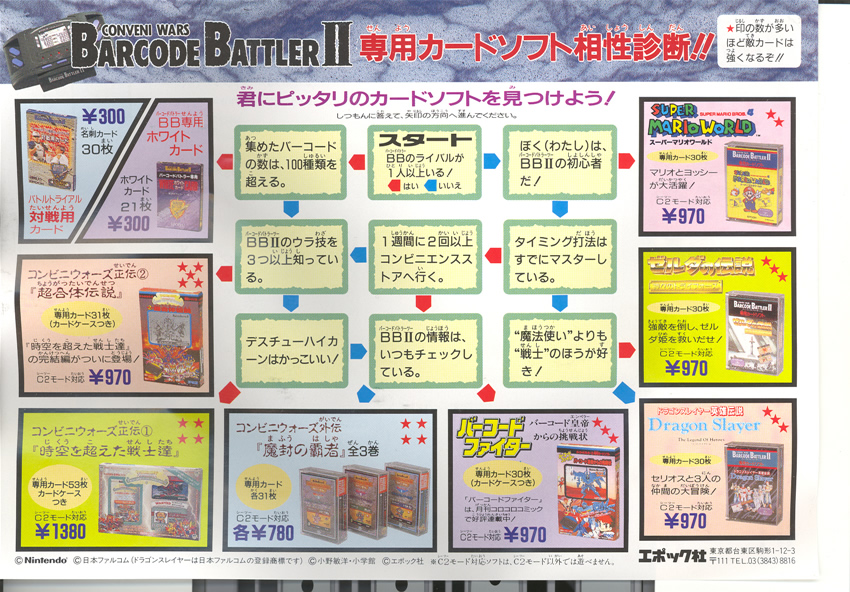
Barcode Battler II game

[edit]

In 1992, Epoch Co. was licensed to print a series of Nintendo-themed cards for their Barcode Battler II platform. Card sets were printed with both Mario and Zelda themes.[17][18] Functioning similarly to an LCD e-Reader, the Barcode Battler II required players to swipe barcodes printed on cards across a visual input in order to enter characters, enemies, items, and spells into the console. The Super Mario World: Super Mario Bros. 4 set features 30 software-only cards and is based on the SNES's original Super Mario World.[19][20][21]

See also

[edit]

References

[edit]
Revisions and contributorsEdit on WikipediaRead on Wikipedia
from Grokipedia
The list of LCD games featuring Mario comprises a collection of portable electronic handheld games that utilize liquid crystal display (LCD) technology and center on Nintendo's iconic character Mario (originally introduced as Jumpman in early titles), produced primarily between 1982 and 1992. These games, often characterized by their compact, battery-powered designs and simple mechanics such as jumping, collecting items, or avoiding obstacles, represent some of the earliest examples of dedicated portable gaming and were instrumental in popularizing Mario beyond arcade and home consoles. Key entries include Nintendo's Game & Watch series, which pioneered multi-screen LCD formats and featured titles like Donkey Kong (1982), where Mario navigates platforms to rescue Pauline from the ape antagonist; Mario Bros. (1983), a cooperative plumbing adventure with Luigi; Mario's Cement Factory (1983), involving factory management amid chaotic machinery; Mario's Bombs Away (1983), a defensive bomb-handling challenge; and Super Mario Bros. (1986), an abridged adaptation of the classic platformer. Additionally, the series incorporated Donkey Kong spin-offs such as Donkey Kong Jr. (1982), Donkey Kong Circus (1984), and Donkey Kong Hockey (1984), all retroactively tied to Mario's lore. Later Game & Watch releases like Mario the Juggler (1991) shifted to single-screen wide formats with juggling-based gameplay. Complementing these were licensed products from manufacturers like Nelsonic, who produced wristwatch-integrated LCD games starting in 1989, including Super Mario Bros. (1989), a simplified side-scroller; Super Mario Bros. 3 (1990), incorporating power-ups and Toadstool rescues; Super Mario World (1991), featuring and mechanics; and Super Mario Race (1992), a racing akin to early prototypes. These Nelsonic titles blended timekeeping functionality with bite-sized play sessions, appealing to on-the-go audiences. Overall, these LCD games highlight Mario's evolution from a secondary arcade to a portable , influencing later handheld innovations like the Game Boy, with approximately a core titles across formats that emphasize replayability through high-score challenges and escalating difficulty modes. While not as graphically advanced as cartridge-based systems, their affordability and made them cultural staples for gamers.

Nintendo Game & Watch series

Donkey Kong (1982)

Donkey Kong is a released by as part of its series, marking the debut appearance of the character later known as in an LCD format. Developed and published by , it was launched on June 3, 1982, in the Multi Screen series, featuring a distinctive with two vertically stacked LCD screens to simulate the structure of the 25m stage from the original . The gameplay centers on controlling Jumpman, Nintendo's iteration of , who navigates a construction site to rescue Pauline from the rampaging ape . Players guide Jumpman up ladders across four girder levels, dodging barrels rolled down by Donkey Kong, which follow predictable paths and can be avoided by or temporarily smashed using a power-up that appears periodically. Successful rescues advance the game, with increasing speed and barrel patterns across rounds, emphasizing precise timing and on the limited single-player format. This title holds historical significance as the first Game & Watch to feature Jumpman, establishing core elements of Mario's character design and platforming challenges that influenced subsequent entries in the series. It achieved commercial success, selling approximately 8 million units worldwide and contributing to the broader lineup of 60 distinct Game & Watch games produced by Nintendo from 1980 to 1991. Technically, the device utilizes two small LCD displays, each approximately 1.25 inches in diagonal measurement, driven by a Sharp SM510 microcontroller operating at 32.768 kHz for smooth animations of the 16 sprites. Sound effects are generated via a piezoelectric speaker, producing simple beeps for actions like jumps, barrel rolls, and collisions, enhancing the arcade-like feel without complex audio. The game's innovative dual-screen approach laid groundwork for later variants in the LCD series, evolving the rescue theme with added objectives and family dynamics.

(1982)

is a handheld electronic game in Nintendo's series, released on , 1982. Developed and published by , it serves as a direct sequel to the 1982 , reversing the roles with as the protagonist attempting to rescue his father. The game utilizes the New Wide Screen hardware format, featuring a single monochrome LCD screen housed in a silver-colored casing for enhanced visibility and portability. The core gameplay revolves around platforming and avoidance mechanics on a single vertical screen divided into climbing sections. Players control Donkey Kong Jr., who navigates by swinging across vines, climbing ropes, and leaping between platforms to collect keys that appear on the left side of the screen. The objective is to deliver the key to the lock on Donkey Kong's cage at the top right while evading enemies including Snapjaws (crocodile-like creatures that climb the vines), birds that fly horizontally, and electric balls hurled by the antagonist Jumpman () from the cage platform. Donkey Kong Jr. can counter enemies by grabbing fruit from six baskets at the top and throwing it downward to stun or eliminate threats, adding a strategic element to the rescue mission. Successful completion of three keys frees Donkey Kong, who then descends the vines to end the round. This title uniquely positions Jumpman, later known as , as the antagonist guarding the captive , marking an early inversion of character dynamics in the series. The New Wide Screen design provides a broader 1.3-inch display compared to earlier formats, allowing for more fluid vertical scrolling and vine-based action. Like other devices, it integrates timekeeping and alarm functions, powered by two LR44 button cell batteries that offer up to of and .

Donkey Kong II (1983)

Donkey Kong II is a handheld LCD developed and published by as part of the Game & Watch Multi Screen series, released on March 7, 1983. The device features a vertical for portability, enclosing two segmented LCD screens that display the action across upper and lower panels, powered by two LR44 button cell batteries. It utilizes a piezoelectric speaker to produce simple sound effects, such as beeps for actions and alerts. The incorporates elements from the earlier and Donkey Kong Jr. titles, blending platforming challenges in a compact format. In the game, the player controls , who must navigate obstacles on the lower screen to collect a key before ascending to the upper screen to insert it into one of four locks securing his father, , who is held captive by Jumpman (later known as ). involves climbing vines and chains, jumping over gaps, and avoiding enemies including Snapjaws (crocodile-like ), electric sparks that along wires, and birds that swoop from above, with contact resulting in loss of a . The objective repeats across four stages, each corresponding to a key and lock, after which the game resets for continuous play; scoring is awarded for successful jumps and key insertions, with Game A offering standard speed and Game B increasing difficulty through faster enemy movement. Controls consist of a directional pad for movement and buttons for jumping and other actions, emphasizing precise timing in the multi-screen layout to transition between panels seamlessly. Unique to the series at the time, supports two-player mode in Game B, where players alternate turns to compete for the highest score, adding a competitive element to the cooperative rescue theme. The title was re-released in 1989 as part of Nintendo's effort to revive games with updated packaging, maintaining the original Multi Screen hardware.

Donkey Kong Circus (1984)

Circus is a in Nintendo's series, released on September 6, . Developed and published by , it belongs to the series, featuring a distinctive wide, tiltable LCD screen that utilizes a reflective mirror to produce color variations through external . The device measures approximately 11.7 in width and includes model number MK-96. In the game, players control Donkey Kong, depicted as a circus-performing balancing atop a rolling barrel while three pineapples in a timing-based challenge. Button presses move Donkey Kong left and right across the screen to catch tossed pineapples from an unseen source and evade descending fireballs from overhead drums; failure to do so results in dropped items or burns, ending the round. Difficulty escalates with faster pacing and additional pineapples up to five, emphasizing rhythm and precision in a solo performance mode. Mario appears as the ringmaster on the sidelines, mocking Donkey Kong with laughter upon mistakes, adding a humorous antagonistic dynamic. This title uniquely casts Donkey Kong in the role of a circus animal executing tricks under Mario's supervision, incorporating ringmaster and performance-themed elements without multiplayer or sports mechanics. Its limited production run, with sales under 250,000 units, contributes to its rarity among Game & Watch titles. The hardware features a single piezoelectric speaker for beeps and sound cues, alongside an integrated digital clock and game timer for timekeeping functionality. It draws on the established character dynamics from prior Donkey Kong games in the series.

Donkey Kong Hockey (1984)

Donkey Kong Hockey is a developed and published by in 1984 as part of the Game & Watch Micro Vs. System series. The device features a single LCD screen measuring approximately 1.5 inches diagonally, with two detachable circular controllers connected via wires that store inside the elliptical casing when not in use. Powered by two AA batteries, it includes a digital clock function and tracks scores up to 10 goals per player on the display. In this versus sports title, players control either or as goalies in a simulated match, using directional buttons on their controllers to maneuver paddles and strike a puck toward the opponent's goal. The supports single-player mode against the CPU or simultaneous two-player , with the first to score 10 goals declared the winner; special "crazy shots" can unpredictably alter the puck's path, while referee barriers occasionally block shots to add strategic depth. This setup builds on the established rivalry between and from earlier arcade titles. As the final entry in the three-game Micro Vs. System lineup—following and —it represents one of Nintendo's early dedicated two-player competitive handhelds, emphasizing head-to-head action without shared controls. The characters function as both attackers and defenders, with Mario's agile movements contrasting Donkey Kong's more powerful but slower style, enhancing the versus dynamic on the compact hardware.

Mario Bros. (1983)

is a handheld LCD game released by on March 14, 1983, as part of the Game & Watch Multi Screen series. Developed and published by , it marks the debut of cooperative gameplay featuring both and Luigi in the series. The device utilizes a with two LCD screens to depict multi-level action in a bottling factory setting. In the game, players control and Luigi, who work together to transport packages of bottles from a production area to a waiting delivery truck. The dual screens represent upper and lower factory levels connected by ladders, with conveyor belts alternating directions to carry the packages. Players must carefully time movements to push packages onto the belts without dropping them; accumulating three dropped packages results in a game over. The objective is to score points by successfully loading as many packages as possible before time runs out or errors accumulate. This title introduced the Multi Screen format's innovative dual-display mechanic, allowing for vertical progression across screens, and was the first Game & Watch entry to star both Mario brothers as protagonists. Each screen measures approximately 0.9 inches, with simple segmented LCD graphics and piezoelectric effects for actions like package movements and alerts. It preceded subsequent solo Mario-focused games, emphasizing teamwork in its factory environment.

Mario's Bombs Away (1983)

Mario's Bombs Away is a developed and published by in 1983 as part of the Game & Watch series, specifically the Panorama Screen line. The device features a wide LCD screen measuring approximately 2.2 inches across, which uses a reflective mirror system to simulate color and create an illusion of horizontal movement across the jungle battlefield. It includes a single piezoelectric speaker for basic sound effects, such as alerts for enemy approaches or bomb ignitions. This title marks one of the early solo adventures for Mario outside ensemble games, sharing that protagonist focus with the contemporaneous Mario's Cement Factory. The gameplay centers on a military-themed evasion challenge set in a warzone, where appears in attire complete with and . Players control as he receives a lit fuse bomb from allied troops on the left side of the screen and must transport it across hazardous terrain to the right-side outpost without allowing it to be ignited. The path is obstructed by randomly appearing flaming oil spills that must jump over, while enemy s patrol with torches attempting to light the bomb's fuse; contact with either hazard causes an explosion, costing a life and resetting to the starting point. Successful deliveries earn points, and after five bombs are transported, a sequence triggers where the explosives detonate to clear hidden enemies behind trees, advancing the round. Core mechanics emphasize timing-based movement, with Mario able to walk at a fixed speed, jump to evade ground threats, and adjust position to dodge torch-wielding foes that move in predictable patterns. The wide Panorama screen enhances the sense of progression despite the static display, requiring quick reflexes to balance bomb transport with threat avoidance in increasingly faster rounds. A tabletop variant was also produced in 1983, adapting the portable design for stationary play with similar mechanics but a larger, upright form factor. The game's design highlights Mario's versatility in non-plumbing roles, demanding precise control to achieve high scores through chains of uninterrupted deliveries.

Mario's Cement Factory (1983)

Mario's Cement Factory is a developed and published by in 1983 as part of the Game & Watch series, specifically the Panorama (New Wide Screen) format. Released on June 8, 1983, it marks the second solo outing for Mario following Mario's Bombs Away, shifting focus to industrial in a setting. The game utilizes a compact LCD display integrated with a clock function, allowing players to alternate between gameplay and timekeeping modes. In the game, players control Mario as he oversees cement production in a multi-level factory, directing bags of wet cement from a central mixer down to waiting trucks via a network of conveyor belts, elevators, and chutes. The objective is to load the trucks efficiently while preventing overflows in the four side mixers and avoiding mishaps like bags falling to the ground or spilling. Mario can move left and right across platforms, call an elevator with a whistle control to reach upper levels, and operate levers or scoops with button presses to route the cement properly. The gameplay unfolds in real-time, with bags continuously dispensed from the mixer, requiring quick decisions to maintain factory operations. Two modes are available: Game A, a slower introductory version, and Game B, which ramps up the speed for greater challenge. The game's mechanics emphasize chaotic , with detailed LCD animations depicting moving elevators, tumbling cement bags, and filling trucks to convey the factory's bustle. This contributes to a steep , as the pace accelerates over time, demanding precise timing to juggle multiple elements without errors that end the round. Considered among the more intricate entries in the Game & Watch lineup due to its multi-path routing and risk management, it promotes replayability through high-score pursuits. The title has been re-released in various collections, including Game & Watch Gallery Advance for and as a DSiWare download, preserving the original's segmented LCD visuals and beeping sound effects.

Mario the Juggler (1991)

Mario the Juggler is a developed and published by as part of its New Wide Screen series. Released on October 14, 1991, it represents the final original entry in the long-running lineup, which spanned over a decade and 60 titles. The device features a custom LCD display typical of the New Wide Screen format, measuring approximately 2.45 inches diagonally, with improved contrast for clearer visuals during play. Additionally, it incorporates enhanced battery efficiency, allowing for longer sessions compared to earlier silver-screen models in the series. The core gameplay revolves around rhythm and timing, where players control Mario's hands to catch and toss falling objects, emphasizing his acrobatic abilities as seen in broader Mario lore. In Game A mode, Mario juggles three distinct items—a bomb, a heart, and a star—thrown sequentially from above; successful catches earn one point each, while dropping three items ends the round. Game B escalates the difficulty by introducing a fourth object, an apple, delivered by Lakitu and a Hammer Brother, with each catch worth ten points to encourage extended combos and higher scores. Button inputs must be precisely timed to align Mario's hands for catches and upward tosses, creating a skill-based challenge distinct from the puzzle-oriented mechanics of earlier Mario titles like Mario's Cement Factory. This title's release marked the culmination of Nintendo's dedicated LCD handheld experiments, tying into Mario's established persona as a versatile performer while showcasing refined hardware like the series' colorful faceplate and integrated clock-alarm functions.

Super Mario Bros. (1986)

Super Mario Bros. is a handheld LCD game developed and published by Nintendo as part of its Game & Watch series, released on June 25, 1986, in Japan. It serves as the inaugural title in the Crystal Screen lineup, characterized by a transparent case and LCD screen that allows ambient light to illuminate the display for improved visibility in various lighting conditions. This portable adaptation originates from the 1985 Nintendo Entertainment System title of the same name, simplifying the full console experience into a single-screen format suitable for on-the-go play. The gameplay focuses on side-scrolling platforming where Mario automatically advances to the right through eight distinct auto-scrolling levels modeled after the initial stages of World 1 from the NES version, including elements like pipes, platforms, and the end-of-level flagpole. Players control solely Mario's jumps using a single button to navigate obstacles, stomp on enemies such as Goombas and Koopas, collect coins for points, and avoid pitfalls that would cost a life. Hidden blocks can be struck from below to reveal power-ups, including the Starman for 10 seconds of invincibility against enemies and the 1-Up Mushroom for an extra life; there are no fire flower power-ups or shooting mechanics in this version. Upon completing the levels, the game loops nine times with progressively faster scrolling and heightened difficulty to test endurance, ending only when all lives are lost.) Notable for its ambitious translation of complex platformer elements to basic LCD constraints, the title features simple yet effective animations for character movements and enemy behaviors, with basic sound effects produced via integrated weak speakers. The device measures roughly 75 mm by 150 mm in size, powered by two UM-4/LR44 button cell batteries for extended play. A limited special edition of 10,000 units was produced in Japan in December 1987 as a promotional item, and the game saw a re-release in March 1988 under the New Wide Screen series with refined visuals and audio enhancements, later appearing in various compilation collections.)

Nelsonic Industries game watches

Super Mario Bros. (1989)

The (1989) is an LCD-based wristwatch developed and published by under official license from . Released in 1989, it marks the debut entry in Nelsonic's lineup of Nintendo-themed watches, blending everyday timekeeping with portable inspired by the NES classic. The device prioritizes convenience for on-the-go use, allowing users to check the time or play short sessions without removing it from the wrist. Gameplay centers on a simplified single-screen where must navigate hazards and enemies to rescue from Bowser's . Controls are constrained to a minimal set of buttons—typically one for jumping and another for running—suited to the watch's compact form factor, with the alarm function capable of initiating game modes during daily wear. This design emphasizes quick, bite-sized play sessions over complex progression, adapting core elements from earlier handheld versions like the 1986 edition into a wearable format. The watch incorporates practical features such as a , , and , all powered by reliable movement for precise timekeeping. Its water-resistant case enhances for , contributing to its status as a sought-after collectible among retro gaming enthusiasts due to limited original distribution.

Super Mario Bros. 2 (1989)

The Super Mario Bros. 2 LCD game watch was released in 1989 by under license from , featuring an LCD screen integrated into a wristwatch for portable play. This hardware combines timekeeping functionality with a simplified adaptation of the 1988 NES game , emphasizing the dream-world setting of Subcon through core mechanics like object-throwing combat. Known from as "Princess Toadstool's Run," the game is extremely rare, with on its exact gameplay available. It ties to the NES by incorporating Subcon-inspired designs. The device also allows pausing the game to view the current time without resetting . Technical feature a LCD display measuring approximately 1.5 inches diagonally, powered by a single button-cell battery lasting up to a year in normal use, with sound effects to simple beeps for jumps, throws, and defeats. Controls consist of four directional bezel switches and one action button, ensuring accessibility despite the compact form factor designed for everyday wear.

Super Mario Bros. 3 (1990)

The game watch was released in 1990 by under official license from , serving as a product following the success of the NES game in . This LCD wristwatch integrates timekeeping with interactive on an screen, allowing users to play while wearing it as an accessory. The device features six buttons—two for mode and set functions, and four directional controls—for navigating both watch settings and the game interface. In the game, players control in a simplified where he must rescue Princess Toadstool from the Koopa Dragon by traversing levels, jumping over obstacles, and avoiding enemies like Goombas and Koopa . Key mechanics include acquiring the Super Leaf power-up to transform into Raccoon Mario, enabling flight and after a running start to reach higher platforms or evade hazards. can also collect coins and other items for scoring points, with a maximum score of 1,999; the game offers four difficulty levels and starts players with four lives. Simplified elements from the source material, such as using a warp whistle obtained from specific bricks or pipes to advance quickly, add strategic depth to progression. An airship stage is incorporated as a challenging segment involving aerial navigation and enemy encounters. The watch's technical include a button-cell battery designed for prolonged use during extended play sessions, outperforming earlier models in duration. Its alarm function plays theme twice upon and can be linked to game modes for immersive notifications, enhancing the device's appeal as a portable tool. Released shortly after the NES title's U.S. launch, it captures core elements like the rescue objective while condensing the adventure for the watch format, contributing to its status as a sought-after item among retro gaming collectors today.

Super Mario World (1991)

Super Mario World is an LCD game watch developed by and licensed by , released in 1991 as a tie-in product for the console game. It continues the platforming tradition from prior watches in the line, emphasizing simple side-scrolling traversal. The gameplay centers on navigating through linear levels displayed on the watch's LCD screen, where players control his automatic forward movement while using buttons to jump over pits, Goombas, and other enemies or to avoid incoming fireballs. Key mechanics include hitting ?-blocks to reveal items like a cape feather power-up for flight and spinning attacks, and collecting stars or coins for scoring. Levels culminate in a castle confrontation with Bowser, defeated by jumping underneath him to hit him repeatedly until victory. The game promotes speed runs through repetitive play, with enemy and obstacle patterns accelerating after each completion to increase difficulty and encourage high scores. The hardware features a standard compact LCD watch design with side-mounted buttons for controls, including a headphone jack for audio beeps and effects, though the game is not intended for play while worn on the wrist due to its fiddly interface. Production runs were limited, contributing to its rarity among collectors today.

Super Mario Race (1992)

Super Mario Race is an LCD-based wristwatch released in , developed by under official license from . The hardware consists of a compact LCD display formatted to depict a racetrack, enabling portable within a watch form factor. The core mechanics center on a simplified racing simulation inspired by the Super NES title Kart, where players control Mario's vehicle to navigate tracks while dodging oncoming obstacles such as other cars by shifting left or right. Collisions deduct from a three-heart health system, and the objective is to survive the race without depleting all hearts; the game supports two difficulty modes—Game A for easier speeds and Game B for harder challenges—with play sessions intentionally brief to suit wristwatch use. Power-ups like mushrooms appear on the track, potentially aiding navigation or speed, contributing to lap-style progression and scoring based on endurance and avoidance. As an early adaptation of kart racing featuring Mario characters, Super Mario Race predates fuller iterations in the Mario Kart series while emphasizing vehicular competition over prior platforming elements. It briefly draws from the platforming roots seen in earlier Nelsonic Mario watches, such as Super Mario Bros. (1989), by incorporating character-driven action into a new genre.

Donkey Kong (1994)

The Donkey Kong LCD game watch, released in 1994, was developed by Nelsonic Industries under license from Nintendo as part of their series of video game-themed wristwatches. It features an advanced LCD display integrated into a functional quartz timepiece, allowing users to play while checking the time. In this adaptation, players control Jumpman () in a simplified version of stages 1 through 7 from the 1994 Game Boy of , with the of rescuing Pauline from atop a site that evolves into a pie factory environment. Core mechanics involve climbing ladders to ascend levels, dodging rolling barrels thrown by , and using a hammer power-up to smash obstacles or enemies like fireballs and tortoises. Players must also collect key items such as purses, umbrellas, and keys while navigating moving platforms and elevators, with simplified button controls limited to movement, jumping, and hammer activation due to the watch form factor. The game offers four difficulty levels, starting with three lives (expandable to four), where speed and enemy frequency increase progressively. As the final entry in Nelsonic's Mario-related game watch lineup, this title blends arcade action with puzzle-like elements from the Game Boy , such as strategic item placement, making it a notable collector's item among handheld enthusiasts today. It includes an optional electro-luminescent for low-light visibility and runs on a long-lasting battery, typically providing two years of operation before replacement.

Other third-party LCD games

Barcode Battler II: Super Mario World (1992)

Barcode Battler II: Super Mario World is a 1992 card set developed and published by Epoch Co. for the Barcode Battler II handheld LCD console, under license from Nintendo. Released exclusively in Japan, it integrates elements from the Super Mario World video game into the Barcode Battler system through a collection of themed barcode cards featuring heroes, enemies, and power-ups. The hardware consists of a compact Barcode Battler II unit equipped with an optical barcode scanner and a simple LCD screen that displays numerical stats rather than graphics. Gameplay centers on turn-based RPG-style battles where players scan cards to summon characters and assign stats such as attack power, defense, and special abilities. For example, scanning a card might load balanced offensive stats, while a card emphasizes high defense and powerful strikes; cards often provide support roles with agility bonuses. Players build teams by selecting warrior and wizard types from the cards, then engage in combats resolved by the console's random number generator, simulating fights without complex animations. The encourages strategic card collection and deck-building, with power-ups like mushrooms enhancing stats during battles. A is the II's output port, allowing connection to the Super Famicom (SNES) for hybrid modes that unlock in-game items or bonuses when linked with compatible software. This integration extends the LCD battles into the broader universe from the 1990 SNES title, blending portable card scanning with console interaction. The set promotes multiplayer versus modes between friends, fostering competitive play through shared card scanning and stat comparisons.

References

Add your contribution
Related Hubs
User Avatar
No comments yet.