


Community hub
Recent from talks
Contribute something
Nothing was collected or created yet.
Watch
View on Wikipedia


A watch is a timepiece carried or worn by a person. It is designed to maintain a consistent movement despite the motions caused by the person's activities. A wristwatch is worn around the wrist, attached by a watch strap or another type of bracelet, including metal bands or leather straps. A pocket watch is carried in a pocket, often attached to a chain. A stopwatch is a type of watch that measures intervals of time.
During most of their history, beginning in the 16th century, watches were mechanical devices, driven by clockwork, powered by winding a mainspring, and keeping time with an oscillating balance wheel. These are known as mechanical watches.[1][2] In the 1960s the electronic quartz watch was invented, powered by a battery and keeping time with a vibrating quartz crystal. By the 1980s it had taken over most of the watch market, in what became known as the quartz revolution (or the quartz crisis in Switzerland, whose renowned watch industry it decimated).[3][4] In the 2010s, smartwatches emerged, small wrist-worn computers with touchscreens and with functions that go far beyond timekeeping.
Modern watches often display the day, date, month, and year. Mechanical watches may have extra features ("complications") such as moon-phase displays and different types of tourbillon. Quartz watches often include timers, chronographs, and alarm functions. Smartwatches and more complicated electronic watches may even incorporate calculators, GPS[5] and Bluetooth technology or have heart-rate monitoring capabilities, and some use radio clock technology to regularly correct the time.
Most watches used mainly for timekeeping have quartz movements. But expensive collectible watches, valued more for their elaborate craftsmanship, aesthetic appeal, and glamorous design than for timekeeping, often have traditional mechanical movements, despite being less accurate and more expensive than their electronic counterparts.[3][4][6] As of 2019, the most expensive watch ever sold at auction was the Patek Philippe Grandmaster Chime for US$31.2 million.[7]
History
[edit]_-_Walters_5817_-_View_C.jpg)
Origins
[edit]The first timepieces to be worn were made in the 16th century in the German cities of Nuremberg and Augsburg, and these were transitional in size between clocks and watches.[8] Nuremberg clockmaker Peter Henlein (or Henle or Hele) (1485–1542) is often credited as the inventor of the watch.[9][10] However, other German clockmakers were creating miniature timepieces during this period, and there is no evidence Henlein was the first.[10][11]
Watches were not widely worn in pockets until the 17th century. One account suggests that the word "watch" came from the Old English word woecce – which meant "watchman" – because town watchmen used the technology to keep track of their shifts at work.[12] Another says that the term came from 17th-century sailors, who used the new mechanisms to time the length of their shipboard watches (duty shifts).[13]
Development
[edit]A rise in accuracy occurred in 1657 with the addition of the balance spring to the balance wheel, an invention disputed both at the time and ever since between Robert Hooke and Christiaan Huygens. This innovation significantly improved the accuracy of watches, reducing errors from several hours a day[14] to approximately 10 minutes per day,[15] which led to the introduction of the minute hand on watch faces in Britain around 1680 and in France by 1700.[16]
The increased accuracy of the balance wheel focused attention on errors caused by other parts of the movement, igniting a two-century wave of watchmaking innovation. The first thing to be improved was the escapement. The verge escapement was replaced in quality watches by the cylinder escapement, invented by Thomas Tompion in 1695 and further developed by George Graham in the 1720s. Improvements in manufacturing – such as the tooth-cutting machine devised by Robert Hooke – allowed some increase in the volume of watch production, although finishing and assembling was still done by hand until well into the 19th century.

A major cause of error in balance-wheel timepieces, caused by changes in elasticity of the balance spring from temperature changes, was solved by the bimetallic temperature-compensated balance wheel invented in 1765 by Pierre Le Roy and improved by Thomas Earnshaw (1749–1829). The lever escapement, the single most important technological breakthrough, though invented by Thomas Mudge in 1754[17] and improved by Josiah Emery in 1785,[18] only gradually came into use from about 1800 onwards, chiefly in Britain.[19]

The British predominated in watch manufacture for much of the 17th and 18th centuries, but maintained a system of production that was geared towards high-quality products for the élite.[20] The British Watch Company modernized clock manufacture with mass-production techniques and the application of duplicating tools and machinery in 1843. In the United States, Aaron Lufkin Dennison started a factory in 1851 in Massachusetts that used interchangeable parts, and by 1861 a successful enterprise operated, incorporated as the Waltham Watch Company.[21]
Keyless (crown) winding
[edit]Efforts to eliminate the separate winding key led to multiple keyless (pendant/crown) systems in the 19th century. In Britain, Thomas Prest patented a mechanism to wind a watch by the pendant in 1820 (UK patent no. 4501).[22]
In 1844 Adolphe Nicole patented a widely adopted keyless work in London (UK patent no. 10348); British Museum notes record that E. J. Dent & Co. acquired rights to Nicole’s system around 1846, and many mid-century keyless watches signed “Dent” use the Nicole work.[23] Early Dent keyless pieces from the 1840s are documented at auction.[24]
In France and Switzerland, Jean-Adrien Philippe presented his crown-winding and setting mechanism in 1842 (patent 1845), and Charles-Antoine LeCoultre patented a keyless system with a rocking bar and side push-button in 1847.[25][26]
See also: Dent (watchmaker), Edward John Dent.
Wristwatches
[edit]

The concept of the wristwatch goes back to the production of the very earliest watches in the 16th century. In 1571, Elizabeth I of England received a wristwatch, described as an "armed watch", from Robert Dudley.[27] 17th century French mathematician Blaise Pascal is said to have worn a watch on his left-wrist.[28] The oldest surviving wristwatch (then described as a "bracelet watch") is one made in 1806, and given to Joséphine de Beauharnais.[27] From the beginning, wristwatches were almost exclusively worn by women – men used pocket watches up until the early 20th century.[29] In 1810, the watch-maker Abraham-Louis Breguet made a wristwatch for the Queen of Naples.[30] The first Swiss wristwatch was made in the year 1868 by the Swiss watch-maker Patek Philippe for Countess Koscowicz of Hungary.[31][32]
Wristwatches were first worn by military men towards the end of the 19th century, having increasingly recognized the importance of synchronizing maneuvers during war without potentially revealing plans to the enemy through signaling. The Garstin Company of London patented a "Watch Wristlet" design in 1893, but probably produced similar designs from the 1880s. Officers in the British Army began using wristwatches during colonial military campaigns in the 1880s, such as during the Anglo-Burma War of 1885.[29] During the First Boer War of 1880–1881, the importance of coordinating troop movements and synchronizing attacks against highly mobile Boer insurgents became paramount, and the use of wristwatches subsequently became widespread among the officer class. The company Mappin & Webb began production of their successful "campaign watch" for soldiers during the campaign in the Sudan in 1898 and accelerated production for the Second Boer War of 1899–1902 a few years later.[29] In continental Europe, Girard-Perregaux and other Swiss watchmakers began supplying German naval officers with wristwatches in about 1880.[27]
Early models were essentially standard pocket-watches fitted to a leather strap, but by the early 20th century, manufacturers began producing purpose-built wristwatches. The Swiss company Dimier Frères & Cie patented a wristwatch design with the now standard wire lugs in 1903. In 1904, Louis Cartier produced a wristwatch to allow his friend Alberto Santos-Dumont to check flight performance in his airship while keeping both hands on the controls as this proved difficult with a pocket watch.[33][34][35] Cartier still markets a line of Santos-Dumont watches and sunglasses.[36]

In 1905, Hans Wilsdorf moved to London, and set up his own business, Wilsdorf & Davis, with his brother-in-law Alfred Davis, providing quality timepieces at affordable prices; the company became Rolex in 1915.[37] Wilsdorf was an early convert to the wristwatch, and contracted the Swiss firm Aegler to produce a line of wristwatches.[38]
The impact of the First World War of 1914–1918 dramatically shifted public perceptions on the propriety of the man's wristwatch and opened up a mass market in the postwar era.[39] The creeping barrage artillery tactic, developed during the war, required precise synchronization between the artillery gunners and the infantry advancing behind the barrage. Service watches produced during the war were specially designed for the rigors of trench warfare, with luminous dials and unbreakable glass. The UK War Office began issuing wristwatches to combatants from 1917.[40] By the end of the war, almost all enlisted men wore a wristwatch (or wristlet), and after they were demobilized, the fashion soon caught on: the British Horological Journal wrote in 1917, that "the wristlet watch was little used by the sterner sex before the war, but now is seen on the wrist of nearly every man in uniform and of many men in civilian attire."[41] By 1930, the wristwatch vastly exceeded the pocket watch in market share by a decisive ratio of 50:1.[citation needed]
Automatic watches
[edit]John Harwood invented the first successful self-winding system in 1923. In anticipation of Harwood's patent for self-winding mechanisms expiry in 1930, Glycine founder Eugène Meylan started development on a self-winding system as a separate module that could be used with almost any 8.75 ligne (19.74 millimeter) watch movement. Glycine incorporated this module into its watches in October 1930, and began mass-producing automatic watches.[42]
Electric watches
[edit]The Elgin National Watch Company and the Hamilton Watch Company pioneered the first electric watch.[43] The first electric movements used a battery as a power source to oscillate the balance wheel. During the 1950s, Elgin developed the model 725, while Hamilton released two models: the first, the Hamilton 500, released on 3 January 1957, was produced into 1959. This model had problems with the contact wires misaligning, and the watches returned to Hamilton for alignment. The Hamilton 505, an improvement on the 500, proved more reliable: the contact wires were removed and a non-adjustable contact on the balance assembly delivered the power to the balance wheel. Similar designs from many other watch companies followed. Another type of electric watch was developed by the Bulova company that used a tuning-fork resonator instead of a traditional balance wheel to increase timekeeping accuracy, moving from a typical 2.5–4 Hz with a traditional balance wheel to 360 Hz with the tuning-fork design.
Quartz watches
[edit]The commercial introduction of the quartz watch in 1969 in the form of the Seiko Astron 35SQ, and in 1970 in the form of the Omega Beta 21 was a revolutionary improvement in watch technology. In place of a balance wheel, which oscillated at perhaps 5 or 6 beats per second, these devices used a quartz-crystal resonator, which vibrated at 8,192 Hz, driven by a battery-powered oscillator circuit.[44] Most quartz-watch oscillators now operate at 32,768 Hz, though quartz movements have been designed with frequencies as high as 262 kHz. Since the 1980s, more quartz watches than mechanical ones have been marketed.[45]
Smart watches
[edit]The Timex Datalink wristwatch was introduced in 1994.[46][47][48] The early Timex Datalink Smartwatches realized a wireless data transfer mode to receive data from a PC. Since then, many companies have released their own iterations of a smartwatch, such as the Apple Watch, Samsung Galaxy Watch, and Huawei Watch.
Hybrid watches
[edit]A hybrid smartwatch is a fusion between a regular mechanical watch and a smartwatch.[49]
Parts
[edit]The movement and case are the basic parts of a watch. A watch band or bracelet is added to form a wristwatch; alternatively, a watch chain is added to form a pocket watch.[50]
The case is the outer covering of the watch.
The case back is the back portion of the watch's case. Accessing the movement (such as during battery replacement) depends on the type of case back, which are generally categorized into four types:
- Snap-off case backs (press-on case backs): the watch back pulls straight off and presses straight on.
- Screw-down case backs (threaded case backs): the entire watch back must be rotated to unscrew from the case. Often it has 6 notches on the external part of the case back.
- Screw back cases: tiny screws hold the case back to the case
- Unibody: the only way into the case involves prying the crystal off the front of the watch.
The crystal, also called the window or watch glass, is the transparent part of the case that allows viewing the hands and the dial of the movement. Modern wristwatches almost always use one of 4 materials:[51]
- Acrylic glass (plexiglass, hesalite glass): the most impact-resistant ("unbreakable"[52][53]), and therefore used in dive watches and most military watches. Acrylic glass is the lowest cost of these materials, so it is used in practically all low-cost watches.
- Mineral crystal: a tempered glass.
- Sapphire-coated mineral crystal
- Synthetic sapphire crystal: the most scratch-resistant; it is difficult to cut and polish, causing watch crystals made of sapphire to be the most expensive.
The bezel is the ring holding the crystal in place.[54]
The lugs are small metal projections at both ends of the wristwatch case where the watch band attaches to the watch case.[54] The case and the lugs are often machined from one solid piece of stainless steel.[55]
Movement
[edit]


The movement of a watch is the mechanism that measures the passage of time and displays the current time (and possibly other information including date, month, and day).[57] Movements may be entirely mechanical, entirely electronic (potentially with no moving parts), or they might be a blend of both. Most watches intended mainly for timekeeping today have electronic movements, with mechanical hands on the watch face indicating the time.
Mechanical
[edit]Compared to electronic movements, mechanical watches are less accurate, often with errors of seconds per day; are sensitive to position, temperature,[58] and magnetism;[59] are costly to produce; require regular maintenance and adjustments; and are more prone to failures. Nevertheless, mechanical watches attract interest from consumers, particularly among watch collectors. Skeleton watches are designed to display the mechanism for aesthetic purposes.
A mechanical movement uses an escapement mechanism to control and limit the unwinding and winding parts of a spring, converting what would otherwise be a simple unwinding into a controlled and periodic energy release. The movement also uses a balance wheel, together with the balance spring (also known as a hairspring), to control the gear system's motion in a manner analogous to the pendulum of a pendulum clock. The tourbillon, an optional part for mechanical movements, is a rotating frame for the escapement, used to cancel out or reduce gravitational bias. Due to the complexity of designing a tourbillon, they are expensive, and typically found in prestigious watches.
The pin-lever escapement (called the Roskopf movement after its inventor, Georges Frederic Roskopf), which is a cheaper version of the fully levered movement, was manufactured in huge quantities by many Swiss manufacturers, as well as by Timex, until it was replaced by quartz movements.[60][61][62]
Introduced by Bulova in 1960, tuning-fork watches use a type of electromechanical movement with a precise frequency (most often 360 Hz) to drive a mechanical watch. The task of converting electronically pulsed fork vibration into rotary movements is done via two tiny jeweled fingers, called pawls. Tuning-fork watches were rendered obsolete when electronic quartz watches were developed.
Traditional mechanical watch movements use a spiral spring called a mainspring as its power source that must be rewound periodically by the user by turning the watch crown. Antique pocket watches were wound by inserting a key into the back of the watch and turning it. While most modern watches are designed to run 40 hours on a winding, requiring winding daily, some run for several days; a few have 192-hour mainsprings, requiring once-weekly winding.
Automatic watches
[edit]

A self-winding or automatic watch is one that rewinds the mainspring of a mechanical movement by the natural motions of the wearer's body. The first self-winding mechanism was invented for pocket watches in 1770 by Abraham-Louis Perrelet,[63] but the first "self-winding", or "automatic", wristwatch was the invention of a British watch repairer named John Harwood in 1923. This type of watch winds itself without requiring any special action by the wearer. It uses an eccentric weight, called a winding rotor, which rotates with the movement of the wearer's wrist. The back-and-forth motion of the winding rotor couples to a ratchet to wind the mainspring automatically. Self-winding watches usually can also be wound manually to keep them running when not worn or if the wearer's wrist motions are inadequate to keep the watch wound.
In April 2013, the Swatch Group launched the sistem51 wristwatch. It has a mechanical movement consisting of only 51 parts,[64] including 19 jewels and a novel self-winding mechanism with a transparent oscillating weight.[65] Ten years after its introduction, it is still the only mechanical movement manufactured entirely on a fully automated assembly line, including adjustment of the balance wheel and the escapement for accuracy by laser.[66] The low parts count and the fully automated assembly make it an inexpensive automatic Swiss watch.[67]
Electronic
[edit]
Electronic movements, also known as quartz movements, have few or no moving parts, except a quartz crystal which is made to vibrate by the piezoelectric effect. A varying electric voltage is applied to the crystal, which responds by changing its shape so, in combination with some electronic components, it functions as an oscillator. It resonates at a specific highly stable frequency, which is used to accurately pace a timekeeping mechanism. Most quartz movements are primarily electronic but are geared to drive mechanical hands on the face of the watch to provide a traditional analog display of the time, a feature most consumers still prefer.[citation needed]
In 1959 Seiko placed an order with Epson (a subsidiary company of Seiko and the 'brain' behind the quartz revolution) to start developing a quartz wristwatch. The project was codenamed 59A. By the 1964 Tokyo Summer Olympics, Seiko had a working prototype of a portable quartz watch which was used as the time measurements throughout the event.[citation needed]
The first prototypes of an electronic quartz wristwatch (not just portable quartz watches as the Seiko timekeeping devices at the Tokyo Olympics in 1964) were made by the CEH research laboratory in Neuchâtel, Switzerland. From 1965 through 1967 pioneering development work was done on a miniaturized 8192 Hz quartz oscillator, a thermo-compensation module, and an in-house-made, dedicated integrated circuit (unlike the hybrid circuits used in the later Seiko Astron wristwatch). As a result, the BETA 1 prototype set new timekeeping performance records at the International Chronometric Competition held at the Observatory of Neuchâtel in 1967.[68] In 1970, 18 manufacturers exhibited production versions of the beta 21 wristwatch, including the Omega Electroquartz as well as Patek Philippe, Rolex Oysterquartz and Piaget.

The first quartz watch to enter production was the Seiko 35 SQ Astron, which hit the shelves on 25 December 1969, swiftly followed by the Swiss Beta 21, and then a year later the prototype of one of the world's most accurate wristwatches to date: the Omega Marine Chronometer. Since the technology having been developed by contributions from Japanese, American and Swiss,[69] nobody could patent the whole movement of the quartz wristwatch, thus allowing other manufacturers to participate in the rapid growth and development of the quartz watch market. This ended – in less than a decade – almost 100 years of dominance by the mechanical wristwatch legacy. Modern quartz movements are produced in very large quantities, and even the cheapest wristwatches typically have quartz movements. Whereas mechanical movements can typically be off by several seconds a day, an inexpensive quartz movement in a child's wristwatch may still be accurate to within half a second per day – ten times more accurate than a mechanical movement.[70]
After a consolidation of the mechanical watch industry in Switzerland during the 1970s, mass production of quartz wristwatches took off under the leadership of the Swatch Group of companies, a Swiss conglomerate with vertical control of the production of Swiss watches and related products. For quartz wristwatches, subsidiaries of Swatch manufacture watch batteries (Renata), oscillators (Oscilloquartz, now Micro Crystal AG) and integrated circuits (Ebauches Electronic SA, renamed EM Microelectronic-Marin). The launch of the new SWATCH brand in 1983 was marked by bold new styling, design, and marketing. Today, the Swatch Group maintains its position as the world's largest watch company.
Seiko's efforts to combine the quartz and mechanical movements bore fruit after 20 years of research, leading to the introduction of the Seiko Spring Drive, first in a limited domestic market production in 1999 and to the world in September 2005. The Spring Drive keeps time within quartz standards without the use of a battery, using a traditional mechanical gear train powered by a spring, without the need for a balance wheel either.
In 2010, Miyota (Citizen Watch) of Japan introduced a newly developed movement that uses a 3-pronged quartz crystal that was exclusively produced for Bulova to be used in the Precisionist or Accutron II line, a new type of quartz watch with ultra-high frequency (262.144 kHz) which is claimed to be accurate to +/− 10 seconds a year and has a smooth sweeping second hand rather than one that jumps each second.[71]

Radio time signal watches are a type of electronic quartz watch that synchronizes (time transfers) its time with an external time source such as in atomic clocks, time signals from GPS navigation satellites, the German DCF77 signal in Europe, WWVB in the US, and others. Movements of this type may, among others, synchronize the time of day and the date, the leap-year status and the state of daylight saving time (on or off). However, other than the radio receiver, these watches are normal quartz watches in all other aspects.
Electronic watches require electricity as a power source, and some mechanical movements and hybrid electronic-mechanical movements also require electricity. Usually, the electricity is provided by a replaceable battery. The first use of electrical power in watches was as a substitute for the mainspring, to remove the need for winding. The first electrically powered watch, the Hamilton Electric 500, was released in 1957 by the Hamilton Watch Company of Lancaster, Pennsylvania.
Watch batteries (strictly speaking cells, as a battery is composed of multiple cells) are specially designed for their purpose. They are very small and provide tiny amounts of power continuously for very long periods (several years or more). In most cases, replacing the battery requires a trip to a watch-repair shop or watch dealer; this is especially true for watches that are water-resistant, as special tools and procedures are required for the watch to remain water-resistant after battery replacement. Silver-oxide and lithium batteries are popular today; mercury batteries, formerly quite common, are no longer used, for environmental reasons. Cheap batteries may be alkaline, of the same size as silver-oxide cells but providing shorter life. Rechargeable batteries are used in some solar-powered watches.
Some electronic watches are powered by the movement of the wearer. For instance, Seiko's kinetic-powered quartz watches use the motion of the wearer's arm: turning a rotating weight which causes a tiny generator to supply power to charge a rechargeable battery that runs the watch. The concept is similar to that of self-winding spring movements, except that electrical power is generated instead of mechanical spring tension.
Solar powered watches are powered by light. A photovoltaic cell on the face (dial) of the watch converts light to electricity, which is used to charge a rechargeable battery or capacitor. The movement of the watch draws its power from the rechargeable battery or capacitor. As long as the watch is regularly exposed to fairly strong light (such as sunlight), it never needs a battery replacement. Some models need only a few minutes of sunlight to provide weeks of energy (as in the Citizen Eco-Drive). Some of the early solar watches of the 1970s had innovative and unique designs to accommodate the array of solar cells needed to power them (Synchronar, Nepro, Sicura, and some models by Cristalonic, Alba, Seiko, and Citizen). As the decades progressed and the efficiency of the solar cells increased while the power requirements of the movement and display decreased, solar watches began to be designed to look like other conventional watches.[72]
A rarely used power source is the temperature difference between the wearer's arm and the surrounding environment (as applied in the Citizen Eco-Drive Thermo).
Display
[edit]Analog
[edit]

Traditionally, watches have displayed the time in analog form, with a numbered dial upon which are mounted at least a rotating hour hand and a longer, rotating minute hand. Many watches also incorporate a third hand that shows the current second of the current minute. In quartz watches this second hand typically snaps to the next marker every second. In mechanical watches, the second hand may appear to glide continuously, though in fact it merely moves in smaller steps, typically one-fifth to one-tenth of a second, corresponding to the beat (half period) of the balance wheel. With a duplex escapement, the hand advances every two beats (full period) of the balance wheel, typically 1⁄2-second; this happens every four beats (two periods, 1 second), with a double duplex escapement. A truly gliding second hand is achieved with the tri-synchro regulator of Spring Drive watches. All three hands are normally mechanical, physically rotating on the dial, although a few watches have been produced with "hands" simulated by a liquid-crystal display.
Analog display of the time is nearly universal in watches sold as jewelry or collectibles, and in these watches, the range of different styles of hands, numbers, and other aspects of the analog dial is very broad. In watches sold for timekeeping, analog display remains very popular, as many people find it easier to read than digital display; but in timekeeping watches the emphasis is on clarity and accurate reading of the time under all conditions (clearly marked digits, easily visible hands, large watch faces, etc.). They are specifically designed for the left wrist with the stem (the knob used for changing the time) on the right side of the watch; this makes it easy to change the time without removing the watch from the wrist. This is the case if one is right-handed and the watch is worn on the left wrist (as is traditionally done). If one is left-handed and wears the watch on the right wrist, one has to remove the watch from the wrist to reset the time or to wind the watch.
Analog watches, as well as clocks, are often marketed showing a display time of approximately 1:50 or 10:10. This creates a visually pleasing smile-like face on the upper half of the watch, in addition to enclosing the manufacturer's name. Digital displays often show a time of 12:08, where the increase in the number of active segments or pixels gives a positive feeling.[73][74]
Tactile
[edit]Tissot, a Swiss luxury watchmaker, makes the Silen-T wristwatch with a touch-sensitive face that vibrates to help the user to tell time eyes-free. The bezel of the watch features raised bumps at each hour mark; after briefly touching the face of the watch, the wearer runs a finger around the bezel clockwise. When the finger reaches the bump indicating the hour, the watch vibrates continuously, and when the finger reaches the bump indicating the minute, the watch vibrates intermittently.[75]
Eone Timepieces, a Washington D.C.–based company, launched its first tactile analog wristwatch, the "Bradley", on 11 July 2013 on the Kickstarter website. The device is primarily designed for sight-impaired users, who can use the watch's two ball bearings to determine the time, but it is also suitable for general use. The watch features raised marks at each hour and two moving, magnetically attached ball bearings. One ball bearing, on the edge of the watch, indicates the hour, while the other, on the face, indicates the minute.[76][77]
Digital
[edit]A digital display shows the time as a number, e.g., 12:08 instead of a short hand pointing towards the number 12 and a long hand 8/60 of the way around the dial. The digits are usually shown as a seven-segment display.
The first digital mechanical pocket watches appeared in the late 19th century. In the 1920s, the first digital mechanical wristwatches appeared.
The first digital electronic watch, a Pulsar LED prototype in 1970, was developed jointly by Hamilton Watch Company and Electro-Data, founded by George H. Thiess.[78] John Bergey, the head of Hamilton's Pulsar division, said that he was inspired to make a digital timepiece by the then-futuristic digital clock that Hamilton themselves made for the 1968 science fiction film 2001: A Space Odyssey. On 4 April 1972, the Pulsar was finally ready, made in an 18-carat gold case and sold for $2,100. It had a red light-emitting diode (LED) display.
Digital LED watches were very expensive and out of reach to the common consumer until 1975, when Texas Instruments started to mass-produce LED watches inside a plastic case. These watches, which first retailed for only $20,[79] reduced to $10 in 1976, saw Pulsar lose $6 million and the Pulsar brand sold to Seiko.[80]

An early LED watch that was rather problematic was The Black Watch made and sold by British company Sinclair Radionics in 1975. This was only sold for a few years, as production problems and returned (faulty) product forced the company to cease production.
Most watches with LED displays required that the user press a button to see the time displayed for a few seconds because LEDs used so much power that they could not be kept operating continuously. Usually, the LED display color would be red. Watches with LED displays were popular for a few years, but soon the LED displays were superseded by liquid crystal displays (LCDs), which used less battery power and were much more convenient in use, with the display always visible and eliminating the need to push a button before seeing the time. Only in darkness would a button needed to be pressed to illuminate the display with a tiny light bulb, later illuminating LEDs and electroluminescent backlights.[81]
The first LCD watch with a six-digit LCD was the 1973 Seiko 06LC, although various forms of early LCD watches with a four-digit display were marketed as early as 1972 including the 1972 Gruen Teletime LCD Watch, and the Cox Electronic Systems Quarza. The Quarza, introduced in 1972 had the first Field Effect LCD readable in direct sunlight and produced by the International Liquid Crystal Corporation of Cleveland, Ohio.[82] In Switzerland, Ebauches Electronic SA presented a prototype eight-digit LCD wristwatch showing time and date at the MUBA Fair, Basel, in March 1973, using a twisted nematic LCD manufactured by Brown, Boveri & Cie, Switzerland, which became the supplier of LCDs to Casio for the CASIOTRON watch in 1974.[83]
A problem with LCDs is that they use polarized light. If, for example, the user is wearing polarized sunglasses, the watch may be difficult to read because the plane of polarization of the display is roughly perpendicular to that of the glasses.[84][85] If the light that illuminates the display is polarized, for example if it comes from a blue sky, the display may be difficult or impossible to read.[86]
From the 1980s onward, digital watch technology vastly improved. In 1982, Seiko produced the Seiko TV Watch[87] that had a television screen built-in,[88] and Casio produced a digital watch with a thermometer (the TS-1000) as well as another that could translate 1,500 Japanese words into English. In 1985, Casio produced the CFX-400 scientific calculator watch. In 1987, Casio produced a watch that could dial telephone numbers (the DBA-800) and Citizen introduced one that would react to voice. In 1995, Timex released a watch that allowed the wearer to download and store data from a computer to their wrist. Some watches, such as the Timex Datalink USB, feature dot matrix displays. Since their apex during the late 1980s to mid-1990s high technology fad, digital watches have mostly become simpler, less expensive timepieces with little variety between models.
-
 Cortébert digital mechanical pocket watch (1890s)
 -
 Cortébert digital mechanical wristwatch (1920s)
 -

-
 A Timex digital watch with an always-on display of the time and date
 -
 A digital LCD watch with electroluminescent backlight
 -
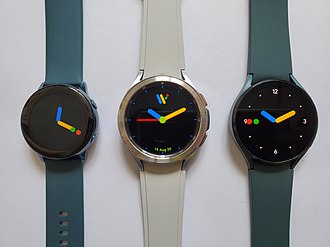 Samsung Galaxy Watch series smartwatches with OLED displays


.jpg)

Illuminated
[edit] | This subsection needs additional citations for verification. (June 2014) |

Many watches have displays that are illuminated, so they can be used in darkness. Various methods have been used to achieve this.
Mechanical watches often have luminous paint on their hands and hour marks. In the mid-20th century, radioactive material was often incorporated in the paint, so it would continue to glow without any exposure to light. Radium was often used but produced small amounts of radiation outside the watch that might have been hazardous.[89] Tritium was used as a replacement, since the radiation it produces has such low energy that it cannot penetrate a watch glass. However, tritium is expensive – it has to be made in a nuclear reactor – and it has a half-life of only about 12 years so the paint remains luminous for only a few years. Nowadays, tritium is used in specialized watches, e.g., for military purposes (see Tritium illumination). For other purposes, luminous paint is sometimes used on analog displays, but no radioactive material is contained in it. This means that the display glows soon after being exposed to light and quickly fades.
Watches that incorporate batteries often have electric illumination in their displays. However, lights consume far more power than electronic watch movements. To conserve the battery, the light is activated only when the user presses a button. Usually, the light remains lit for a few seconds after the button is released, which allows the user to move the hand out of the way.


In some early digital watches, LED displays were used, which could be read as easily in darkness as in daylight. The user had to press a button to light up the LEDs, which meant that the watch could not be read without the button being pressed, even in full daylight.[90][91]
In some types of watches, small incandescent lamps or LEDs illuminate the display, which is not intrinsically luminous. These tend to produce very non-uniform illumination.
Other watches use electroluminescent material to produce uniform illumination of the background of the display, against which the hands or digits can be seen.
Speech synthesis
[edit]Talking watches are available, intended for the blind or visually impaired. They speak the time out loud at the press of a button. This has the disadvantage of disturbing others nearby or at least alerting the non-deaf that the wearer is checking the time. Tactile watches are preferred to avoid this awkwardness, but talking watches are preferred for those who are not confident in their ability to read a tactile watch reliably.
Handedness
[edit]Wristwatches with analog displays generally have a small knob, called the crown, that can be used to adjust the time and, in mechanical watches, wind the spring. Almost always, the crown is located on the right-hand side of the watch so it can be worn of the left wrist for a right-handed individual. This makes it inconvenient to use if the watch is being worn on the right wrist. Some manufacturers offer "left-hand drive", aka "destro", configured watches which move the crown to the left side[92] making wearing the watch easier for left-handed individuals.
A rarer configuration is the bullhead watch. Bullhead watches are generally, but not exclusively, chronographs. The configuration moves the crown and chronograph pushers to the top of the watch. Bullheads are commonly wristwatch chronographs that are intended to be used as stopwatches off the wrist. Examples are the Citizen Bullhead Change Timer[93] and the Omega Seamaster Bullhead.[94]
Digital watches generally have push-buttons that can be used to make adjustments. These are usually equally easy to use on either wrist.
Functions
[edit]


Customarily, watches provide the time of day, giving at least the hour and minute, and often the second. Many also provide the current date, and some (called "complete calendar" or "triple date" watches) display the day of the week and the month as well. However, many watches also provide a great deal of information beyond the basics of time and date. Some watches include alarms. Other elaborate and more expensive watches, both pocket and wrist models, also incorporate striking mechanisms or repeater functions, so that the wearer could learn the time by the sound emanating from the watch. This announcement or striking feature is an essential characteristic of true clocks and distinguishes such watches from ordinary timepieces. This feature is available on most digital watches.
A complicated watch has one or more functions beyond the basic function of displaying the time and the date; such a functionality is called a complication. Two popular complications are the chronograph complication, which is the ability of the watch movement to function as a stopwatch, and the moonphase complication, which is a display of the lunar phase. Other more expensive complications include Tourbillon, Perpetual calendar, Minute repeater, and Equation of time. A truly complicated watch has many of these complications at once (see Calibre 89 from Patek Philippe for instance). Some watches aimed at Muslims can both indicate the direction of Mecca[95] and have alarms that can be set for all daily prayer requirements.[96] Among watch enthusiasts, complicated watches are especially collectible. Some watches include a second 12-hour or 24-hour display for UTC or GMT. A physicians watch was used for measuring pulse, administering medication or measuring anesthesia.[97]
The similar-sounding terms chronograph and chronometer are often confused, although they mean altogether different things. A chronograph is a watch with an added duration timer, often a stopwatch complication (as explained above), while a chronometer watch is a timepiece that has met an industry-standard test for performance under pre-defined conditions: a chronometer is a high quality mechanical or a thermo-compensated movement that has been tested and certified to operate within a certain standard of accuracy by the COSC (Contrôle Officiel Suisse des Chronomètres). The concepts are different but not mutually exclusive; so a watch can be a chronograph, a chronometer, both, or neither.

Electronic sports watches, combining timekeeping with GPS and/or activity tracking, address the general fitness market and have the potential for commercial success (Garmin Forerunner, Garmin Vivofit, Epson,[5] announced model of Swatch Touch series[98]).
Braille watches have analog displays with raised bumps around the face to allow blind users to tell the time. Their digital equivalents use synthesised speech to speak the time on command.
Fashion
[edit]
Wristwatches and antique pocket watches are often appreciated as jewelry or as collectible works of art rather than just as timepieces.[99] This has created several different markets for wristwatches, ranging from very inexpensive but accurate watches (intended for no other purpose than telling the correct time) to extremely expensive watches that serve mainly as personal adornment or as examples of high achievement in miniaturization and precision mechanical engineering.
Traditionally, dress watches appropriate for informal (business), semi-formal, and formal attire are gold, thin, simple, and plain, but increasingly rugged, complicated, or sports watches are considered by some to be acceptable for such attire. Some dress watches have a cabochon on the crown or faceted gemstones on the face, bezel, or bracelet. Some are made entirely of faceted sapphire (corundum).
Many fashions and department stores offer a variety of less-expensive, trendy, "costume" watches (usually for women), many of which are similar in quality to basic quartz timepieces but which feature bolder designs. In the 1980s, the Swiss Swatch company hired graphic designers to redesign a new annual collection of non-repairable watches.
Trade in counterfeit watches, which mimic expensive brand-name watches, constitutes an estimated US$1 billion market per year.[100]
Space
[edit]
The zero-gravity environment and other extreme conditions encountered by astronauts in space require the use of specially tested watches.
The first-ever watch to be sent into space was a Russian "Pobeda" watch from the Petrodvorets Watch Factory. It was sent on a single orbit flight on the spaceship Korabl-Sputnik 4 on 9 March 1961. The watch had been attached without authorisation to the wrist of Chernuchka, a dog that successfully did exactly the same trip as Yuri Gagarin, with exactly the same rocket and equipment, just a month before Gagarin's flight.[101]
On 12 April 1961, Gagarin wore a Shturmanskie (a transliteration of Штурманские which actually means "navigator's") wristwatch during his historic first flight into space. The Shturmanskie was manufactured at the First Moscow Factory. Since 1964, the watches of the First Moscow Factory have been marked by the trademark "Полёт", transliterated as "POLJOT", which means "flight" in Russian and is a tribute to the many space trips its watches have accomplished. In the late 1970s, Poljot launched a new chrono movement, the 3133. With a 23 jewel movement and manual winding (43 hours), it was a modified Russian version of the Swiss Valjoux 7734 of the early 1970s. Poljot 3133 were taken into space by astronauts from Russia, France, Germany and Ukraine. On the arm of Valeriy Polyakov, a Poljot 3133 chronograph movement-based watch set a space record for the longest space flight in history.[102]

Through the 1960s, a large range of watches was tested for durability and precision under extreme temperature changes and vibrations. The Omega Speedmaster Professional was selected by NASA, the U.S. space agency, and it is mostly known thanks to astronaut Buzz Aldrin who wore it during the 1969 Apollo 11 Moon landing. Heuer became the first Swiss watch in space thanks to a Heuer Stopwatch, worn by John Glenn in 1962 when he piloted the Friendship 7 on the first crewed U.S. orbital mission. The Breitling Navitimer Cosmonaute was designed with a 24-hour analog dial to avoid confusion between AM and PM, which are meaningless in space. It was first worn in space by U.S. astronaut Scott Carpenter on 24 May 1962 in the Aurora 7 Mercury capsule.[103]
Since 1994 Fortis is the exclusive supplier for crewed space missions authorized by the Russian Federal Space Agency. China National Space Administration (CNSA) astronauts wear the Fiyta[104] spacewatches. At BaselWorld, 2008, Seiko announced the creation of the first watch ever designed specifically for a space walk, Spring Drive Spacewalk. Timex Datalink is flight certified by NASA for space missions and is one of the watches qualified by NASA for space travel. The Casio G-Shock DW-5600C and 5600E, DW 6900, and DW 5900 are Flight-Qualified for NASA space travel.[105][106]
Various Timex Datalink models were used both by cosmonauts and astronauts.
Scuba diving
[edit]
Watch construction may be water-resistant. These watches are sometimes called diving watches when they are suitable for scuba diving or saturation diving. The International Organization for Standardization (ISO) issued a standard for water-resistant watches which also prohibits the term "waterproof" to be used with watches, which many countries have adopted. In the United States, advertising a watch as waterproof has been illegal since 1968, per Federal Trade Commission regulations regarding the "misrepresentation of protective features".[107][108][109]
Water-resistance is achieved by the gaskets which forms a watertight seal, used in conjunction with a sealant applied on the case to help keep water out. The material of the case must also be tested in order to pass as water-resistant.[110]
None of the tests defined by ISO 2281 for the Water Resistant mark are suitable to qualify a watch for scuba diving. Such watches are designed for everyday life and must be water-resistant during exercises such as swimming. They can be worn in different temperature and pressure conditions but are under no circumstances designed for scuba diving.[111]
The standards for diving watches are regulated by the ISO 6425 international standard. The watches are tested in static or still water under 125% of the rated (water) pressure, thus a watch with a 200-metre rating will be water-resistant if it is stationary and under 250 metres of static water. The testing of the water-resistance is fundamentally different from non-dive watches, because every watch has to be fully tested. Besides water resistance standards to a minimum of 100-metre depth rating, ISO 6425 also provides eight minimum requirements for mechanical diver's watches for scuba diving (quartz and digital watches have slightly differing readability requirements). For diver's watches for mixed-gas saturation diving two additional ISO 6425 requirements have to be met.
Watches are classified by their degree of water resistance, which roughly translates to the following (1 metre = 3.281 feet):[112]
| Water-resistance rating | Suitability | Remarks |
|---|---|---|
| Water Resistant or 30 m | Suitable for everyday use. Splash/rain resistant. | Not suitable for diving, swimming, snorkeling, water-related work, or fishing. |
| Water Resistant 50 m | Suitable for swimming, white-water rafting, non-snorkeling water related work, and fishing. | Not suitable for diving. |
| Water Resistant 100 m | Suitable for recreational surfing, swimming, snorkeling, sailing, and water sports. | Not suitable for diving. |
| Water Resistant 200 m | Suitable for professional marine activity and serious surface water sports. | Suitable for diving. |
| Diver's 100 m | Minimum ISO standard for scuba diving at depths not requiring helium gas. | Diver's 100 m and 150 m watches are generally old(er) watches. |
| Diver's 200 m or 300 m | Suitable for scuba diving at depths not requiring helium gas. | Typical ratings for contemporary diver's watches. |
| Diver's 300+ m helium safe | Suitable for saturation diving (helium-enriched environment). | Watches designed for helium mixed-gas diving will have additional markings to indicate this. |
Some watches use bar instead of meters, which may then be multiplied by 10, and then subtract 10 to be approximately equal to the rating based on metres. Therefore, a 5 bar watch is equivalent to a 40-metre watch. Some watches are rated in atmospheres (atm), which are roughly equivalent to bar.[citation needed]
Dosimeter
[edit]
Watches with built-in geiger counters exist for contractors working in the nuclear industry and military personnel specializing in nuclear ordnance. The first known example was the Raketa Atom of 1954.[113] A geiger counter watch was famously used in the 1965 James Bond movie Thunderball where Sean Connery's character uses a modified Breitling Top Time to find stolen nuclear warheads. Polimaster, Huatec, MTM Special Ops manufacture dosimeter watches.
Navigation
[edit]There is a traditional method by which an analog watch can be used to locate north and south. The Sun appears to move in the sky over a 24-hour period while the hour hand of a 12-hour clock face takes twelve hours to complete one rotation. In the northern hemisphere, if the watch is rotated so that the hour hand points toward the Sun, the point halfway between the hour hand and 12 o'clock will indicate south. For this method to work in the southern hemisphere, the 12 is pointed toward the Sun and the point halfway between the hour hand and 12 o'clock will indicate north. During daylight saving time, the same method can be employed using 1 o'clock instead of 12. This method is accurate enough to be used only at fairly high latitudes.
See also
[edit]- Boule de Genève
- Clock
- Coin watch
- Complication
- List of 24-hour watch brands
- List of most expensive watches sold at auction
- List of watch manufacturers
- Marine chronometer
- Movado Ermeto watch
- Pocket watch
- Shock-resistant watch
- Smart watch
- Tachymeter (watch)
- Talking clock
- The Holy Trinity
- Trench watch
- Watchmaker
- Obrey (watches)
References
[edit]- ^ "CWorld | Christopher Ward | QUARTZ VS AUTOMATIC". www.christopherward.com. Archived from the original on 27 November 2018. Retrieved 27 November 2018.
- ^ "What is a Watch Movement? Quartz vs Automatic vs Manual vs Kinetic | Est.1897". est1897.co.uk. Archived from the original on 27 November 2018. Retrieved 27 November 2018.
- ^ a b "Four Revolutions: Part 1: A Concise History Of The Quartz Revolution - HODINKEE". HODINKEE. Archived from the original on 30 May 2019. Retrieved 27 November 2018.
- ^ a b "A Concise History of the Quartz Watch Revolution". Bloomberg.com. 16 November 2017. Archived from the original on 27 November 2018. Retrieved 27 November 2018.
- ^ a b "Epson announces world's lightest GPS watch". The Verge. 21 February 2012. Archived from the original on 26 April 2012. Retrieved 14 April 2012.
- ^ "Mechanical Watches Almost Disappeared Forever. Here's How They Didn't". Bloomberg.com. 4 January 2018. Archived from the original on 18 November 2018. Retrieved 27 November 2018.
- ^ Kahle, Laurie (11 November 2019). "Patek Philippe's $31 Million Grandmaster Chime Becomes Most Expensive Watch Ever Sold". Barrons. Archived from the original on 17 July 2020. Retrieved 17 July 2020.
- ^ Milham, Willis I. (1945). Time and Timekeepers. New York: MacMillan. p. 213. ISBN 0-7808-0008-7.
{{cite book}}: ISBN / Date incompatibility (help) - ^ Carlisle, Rodney P. (2004), Scientific American Inventions and Discoveries, USA: John Wiley & Sons, pp. 143, ISBN 0471244104,
watch clock henlein.
- ^ a b Usher, Abbot Payson (1988). A History of Mechanical Inventions. Courier Dover. p. 305. ISBN 0-486-25593-X. Archived from the original on 3 July 2023. Retrieved 19 December 2022.
- ^ Dohrn-van Rossum, Gerhard (1997). History of the Hour: Clocks and Modern Temporal Orders. Univ. of Chicago Press. p. 121. ISBN 0-226-15510-2. Archived from the original on 3 July 2023. Retrieved 23 January 2023.
- ^ "Watch". The New Encyclopædia Britannica, 15th Edition. Vol. 4. Encyclopædia Britannica, Inc. 1983. pp. 746–747. ISBN 0-85229-400-X. Retrieved 3 June 2012.
- ^ Haven, Kendall F. (2006). 100 Greatest Science Inventions of All Time. Libraries Unlimited. p. 65. ISBN 1-59158-264-4. Archived from the original on 3 July 2023. Retrieved 29 October 2020.
- ^ Milham 1945, p.226
- ^ "A Revolution in Timekeeping". A Walk Through Time. National Institute of Standards and Technology. 2004. Archived from the original on 13 October 2022. Retrieved 13 October 2022.
- ^ Acta Eruditorum. Leipzig. 1737. p. 123. Archived from the original on 3 July 2023. Retrieved 5 June 2018.
- ^ Forster, Jack. "The Tourbillon Chronicles: Birth Of The Tourbillon". www.the1916company.com. Retrieved 2 October 2023.
- ^ "Timeline of Clocks and Watches". History of Watch. Retrieved 2 October 2023.
- ^ Bajpai, Neha S. "An introduction to British watchmaking". WristCheck. Retrieved 2 October 2023.
- ^ Glasmeier, Amy (2000). Manufacturing Time: Global Competition in the Watch Industry, 1795–2000. Guilford Press. ISBN 9781572305892. Archived from the original on 3 July 2023. Retrieved 7 February 2013.
- ^ Roe, Joseph Wickham (1916), English and American Tool Builders, New Haven, Connecticut: Yale University Press, LCCN 16011753, archived from the original on 3 July 2023, retrieved 12 November 2015. Reprinted by McGraw-Hill, New York and London, 1926 (LCCN 27-24075); and by Lindsay Publications, Inc., Bradley, Illinois, (ISBN 978-0-917914-73-7).
- ^ David Boettcher. "Keyless work (history and mechanisms)". VintageWatchStraps. Retrieved 23 September 2025.
- ^ "Half-hunter watch by E. J. Dent (No. 1958,1201.983) — note on Nicole's keyless patent". The British Museum. Retrieved 23 September 2025.
- ^ "E. J. Dent — early keyless winding duplex watch, 1848 (Lot 70)". Sotheby’s. 2016. Retrieved 23 September 2025.
- ^ "Jean-Adrien Philippe". Fondation de la Haute Horlogerie. Retrieved 23 September 2025.
- ^ "Crown (watchmaking) — historical overview". Fondation de la Haute Horlogerie. Retrieved 23 September 2025.
- ^ a b c Bruton, Eric (2000). The History of Clocks & Watches. Little, Brown and Company. p. 183. ISBN 0316853550.
- ^ Caws, Mary Ann (2017). Blaise Pascal: Miracles and Reason. Reaktion Books. p. 147.
- ^ a b c "The Evolution of the Wristwatch". Archived from the original on 8 December 2013. Retrieved 8 December 2013.
- ^ "First wristwatch". Breguet. Archived from the original on 24 November 2020. Retrieved 30 December 2020.
- ^ "Company | History". Patek Philippe. Archived from the original on 28 July 2012. Retrieved 30 December 2020.
- ^ Belcher, David (23 October 2013). "Wrist Watches: From Battlefield to Fashion Accessory". The New York Times. Archived from the original on 23 October 2021. Retrieved 30 December 2020.
- ^ "The History of Cartier". InterWatches. Archived from the original on 26 August 2016. Retrieved 23 August 2016.
- ^ "Aviation Pioneer Scored A First in Watch-Wearing." The New York Times, 25 October 1975. Retrieved: 21 July 2009.
- ^ 100 Designs/100 Years: A Celebration of the 20th Century (aka 100 Designs/100 Years: Innovative Designs of the 20th Century) (with Arlette Barré-Despond), Hove, UK: RotoVision, 1999 | ISBN 2-88046-442-0
- ^ Cartier sunglasses. "Cartier rimmed sunglasses" (English). Archived 6 August 2012 at the Wayback Machine cartier.com. Retrieved: 9 December 2012.
- ^ Rolex Jubilee Vade Mecum published by the Rolex Watch Company in 1946.
- ^ Brozek, John E. "The History and Evolution of the Wristwatch". International Watch Magazine. Archived from the original on 11 June 2010. Retrieved 4 March 2011.
- ^ Choi, David (May 2016). "WWI vets popularized the most important accessory in a gentleman's wardrobe". Business Insider. Archived from the original on 24 June 2021. Retrieved 24 June 2021.
- ^ Hoffman, Paul (2004). Wings of Madness: Alberto Santos-Dumont and the Invention of Flight. Hyperion Press. ISBN 0-7868-8571-8.
- ^ Ordnance Maintenance Wrist Watches, Pocket Watches, Stop Watches and Clocks. Read Books Ltd. 1945. ISBN 978-1-5287-6620-3. Archived from the original on 3 July 2023. Retrieved 9 September 2021.
{{cite book}}: ISBN / Date incompatibility (help) - ^ Foskett, Stephen (19 July 2021). "Eugène Meylan, Glycine, and the Fight Over the First Automatic Watch". Grail Watch. Archived from the original on 1 July 2022. Retrieved 15 August 2022.
- ^ "Hamilton Electric: the Race to Create the World's First Battery-Powered Watch". wornandwound.com. 31 May 2018. Archived from the original on 2 July 2022. Retrieved 1 June 2022.
- ^ Frei, Armin H. (6 February 2020). "First-Hand: The First Quartz Wrist Watch". Engineering and Technology History Wiki (ETHW). Archived from the original on 5 December 2021. Retrieved 5 December 2021.
- ^ Mondschein, Kenneth C. (15 September 2020). On Time: A History of Western Timekeeping. Johns Hopkins University Press. p. 166. ISBN 978-1-4214-3827-6.
- ^ Farion, Christine (31 October 2022). The Ultimate Guide to Informed Wearable Technology: A hands-on approach for creating wearables from prototype to purpose using Arduino systems. Packt Publishing Ltd. p. 6. ISBN 978-1-80324-447-1.
- ^ Research & Development (Information not visible in web-based source.). Vol. 37. Chicago: Technical Publishing Company. 1 July 1995. p. 24.
- ^ "Timex and Microsoft Team Up on a Watch". BUSINESS TECHNOLOGY. The New York Times. Reuters. 22 June 1994. p. 5. Retrieved 1 October 2024.
- ^ Advances in Electronics and Electron Physics. Academic Press. 1 September 1980. p. 257. ISBN 978-0-08-057716-6.
- ^ United States International Trade Commission. "Report to the Committee on Ways and Means on Watches and Parts Therefor" Archived 26 April 2023 at the Wayback Machine. 1977. p. 3
- ^ "Mineral or Sapphire Glass – What is the Difference Between Watch Glasses?" Archived 26 September 2022 at the Wayback Machine.
- ^ "Unbreakable Crystals" section of "A General History of Horology" Archived 27 March 2023 at the Wayback Machine. 2022. p. 486
- ^ Oren Hartov. "Military Watches of the World: Great Britain Part 1—The Boer War Through The Second World War" Archived 26 September 2022 at the Wayback Machine.
- ^ a b Katelyn Fogle. "10 Parts of a Watch You Should Actually Know" Archived 23 October 2021 at the Wayback Machine.
- ^ Japan Clock & Watch Association. "What are the part names of watches?" Archived 26 September 2022 at the Wayback Machine.
- ^ "Juan F. Déniz, The first transparent watch. Antiquarian Horology Journal" (PDF). Archived from the original (PDF) on 16 March 2018. Retrieved 7 April 2018.
- ^ Silicon Compounds—Advances in Research and Application: 2013 Edition. ScholarlyEditions. 21 June 2013. p. 723. ISBN 978-1-4816-9238-0.
- ^ "Temperature". Advice on Your Timepiece. Tag Heuer. Archived from the original on 3 March 2011. Retrieved 4 March 2011.
- ^ "Magnetism". Advice on Your Timepiece. Tag Heuer. Archived from the original on 3 March 2011. Retrieved 4 March 2011.
- ^ "The original pin-pallet". Archived from the original on 5 February 2012. Retrieved 27 May 2012.
- ^ "The Roskopf Watch". Musketeer.ch. Archived from the original on 1 April 2012. Retrieved 27 May 2012.
- ^ "Buffat The Roskopf watch". Watkinsr.id.au. Archived from the original on 12 March 2018. Retrieved 28 October 2017.
- ^ "Watchmaking in Europe and China: Watches & Wonders". Richemont. Worldtempus. Archived from the original on 11 October 2012.
- ^ Monika Schramm (29 June 2014). "Vollautomatisch vom Band". Frankfurter Allgemeine Zeitung (in German). Retrieved 24 September 2024.
- ^ Brice Goulard (4 May 2016). "Reviewing the Swatch Sistem51". WatchTime. Retrieved 23 September 2024.
- ^ Gisbert L. Brunner (19 October 2023). "Swatch Sistem51 – ein Uhrwerk mit System". uhrenkosmos.com (in German). Retrieved 23 September 2024.
- ^ Stephen Pulvirent (30 April 2013). "An Exclusive Look At The Swatch Sistem51, A Revolutionary Mechanical Watch". hodinkee.com. Retrieved 23 September 2024.
- ^ "Milestones: Pioneering Work on the Quartz Electronic Wristwatch, 1962–1967". ETHW. 31 December 2015. Archived from the original on 4 December 2021. Retrieved 4 December 2021.
- ^ "In the late 1960s teams of engineers working independently in Japan, Switzerland, and the United States used newly created electronic components to completely reinvent the wristwatch" (PDF). IEEE. 2000. Archived from the original (PDF) on 13 October 2015. Retrieved 7 June 2016.
- ^ Quartz mechanisms usually have a resonant frequency of 32768 Hz, chosen for ease of use (being 215). Using a simple 15 stage divide-by-two circuit, this is turned into a 1 pulse per second signal responsible for the watch's timekeeping.
- ^ "Bulova introduces the most accurate watch in the world, the Precisionist". Crunch gear. 23 March 2010. Archived from the original on 10 March 2011. Retrieved 8 July 2012.
- ^ "History of the Solar Wristwatch". Soluhr.com. Archived from the original on 12 August 2007. Retrieved 17 January 2007.
- ^ "Why Time Stands Still for Watchmakers". The New York Times. 28 November 2008. Archived from the original on 16 April 2009. Retrieved 28 November 2008.
- ^ Barbara Mikkelson (13 May 2011). "The Ten Ten Tenet". Snopes.com. Barbara and David P. Mikkelson. Archived from the original on 3 July 2023. Retrieved 14 July 2013.
- ^ "Tissot Silen-T User's Manual" (PDF). Support.tissot.ch. Archived from the original (PDF) on 3 March 2016. Retrieved 28 October 2017.
- ^ Anita Li (14 July 2013). "Innovative Tactile Watch Helps You 'Feel What Time it Is'". Mashable. Archived from the original on 16 July 2013. Retrieved 14 July 2013.
- ^ Callum Borchers (12 July 2013). "Thanks to Kickstarter, tactile watch debuts". The Boston Globe. Archived from the original on 14 July 2013. Retrieved 14 July 2013.
- ^ "All in Good Time: HILCO EC director donates prototype of world's first working digital watch to Smithsonian". Texas Co-op Power. February 2012. Archived from the original on 9 February 2013. Retrieved 21 July 2012.
- ^ ""TI $20 Watch", The Jerome and Dorothy Lemelson Center for the Study of Invention and Innovation, [Smithsonian Institution]". Invention.smithsonian.org. Archived from the original on 18 August 2011. Retrieved 28 October 2017.
- ^ "Nerd Watch - Vintage Electronics Have Soul – The Pocket Calculator Show Website". Pocketcalculatorshow.com. Archived from the original on 29 October 2017. Retrieved 28 October 2017.
- ^ U.S. patent 4,096,550: Walter Boller, Marco Donati, Juerg Fingerle, Peter Wild, Illuminating Arrangement for a Field-Effect Liquid-Crystal Display as well as Fabrication and Application of the Illuminating Arrangement, filed 15 October 1976.
- ^ "Casio TA-1000 Electronic Clock & Calculator". Magical Gadgets, Sightings & Brags. Pocket Calculator Show. Archived from the original on 15 April 2012. Retrieved 17 January 2007.
- ^ Peter J. Wild. "First-Hand:Liquid Crystal Display Evolution - Swiss Contributions". ETHW. Archived from the original on 3 July 2017. Retrieved 23 October 2011.
- ^ Ostdiek, Vern; Bord, Donald (2012). Inquiry into Physics. Cengage Learning. p. 343. ISBN 978-1-133-71150-6. Extract of page 343
- ^ Breithaupt, Jim (2001). Physics (illustrated ed.). Nelson Thornes. p. 151. ISBN 0-7487-6243-4. Extract of page 151
- ^ Ge, Zhibing; Wu, Shin-Tson (2010). Transflective Liquid Crystal Displays. John Wiley & Sons. pp. 39–40. ISBN 978-0-470-68906-6. Extract of page 39-40
- ^ "The Seiko TV Watch". HighTechies.com. Archived from the original on 6 October 2014. Retrieved 23 July 2014.
- ^ "T001 Instruction Manual" (PDF). Archived (PDF) from the original on 30 October 2012. Retrieved 27 May 2012.
- ^ "Alan's Vintage Watches". Radium Watch Dial Pattern. Archived from the original on 24 September 2015. Retrieved 16 April 2015.
- ^ Finlay Renwick (18 November 2020). "The Digital Watch Turns 50: A Definitive History". Esquire.
There were no hands, instead it featured an LED "time screen" made of synthetic ruby with 27 diodes in each digit that displayed the time for 1.25 seconds when the wearer pushed a button on the front.
- ^ Benj Edwards (17 October 2018). "The Digital Watch: A Brief History". PC Mag.
The display, produced by a complex 25-chip circuit, was so power-hungry that it lit up only temporarily when the user pushed a button on the front of the unit.
- ^ "A Guide to "Destro": Watches from Sinn, Mühle, Citizen, and More - Worn & Wound". Wornandwound.com. 10 May 2016. Archived from the original on 23 August 2017. Retrieved 28 October 2017.
- ^ CITIZEN "BULLHEAD" CHALLENGE TIMER
- ^ "Hands-On: With The Omega Seamaster Bullhead (Live Pics + Pricing)". Hodinkee.com. Archived from the original on 2 August 2017. Retrieved 28 October 2017.
- ^ "Muslim watches". Watchismo. Archived from the original on 28 September 2015. Retrieved 14 April 2012.
- ^ "Islamic Watch & Clock". ALFAJR. Archived from the original on 4 April 2012. Retrieved 14 April 2012.
- ^ "Men's 1940 Hamilton D37 Fairchild Gun Timer Watch | Strickland Vintage Watches". stricklandvintagewatches.com. Retrieved 4 August 2025.
- ^ Hug, Daniel : Swatch lanciert 2015 eine intelligente Uhr. In: NZZ am Sonntag, 27 July 2014, page 26 (German)
- ^ Nazanin Lankarani (21 January 2013). "Buying Back a Forgotten Chinese Heritage". The New York Times. Archived from the original on 5 November 2020. Retrieved 22 January 2013.
We try to explain why it makes sense to spend $500,000 on a watch.
- ^ "Havocscope Counterfeit Watches Market Value: $1 billion". Archived from the original on 6 May 2011. Retrieved 23 March 2011.
- ^ Burgess, Colin; Dubbs, Chris (2007). Animals in Space: From Research Rockets to the Space Shuttle (illustrated ed.). Springer Science & Business Media. p. 213. ISBN 978-0-387-49678-8. Extract of page 213
- ^ "Russian Space Watches History". Netgrafik.ch. Archived from the original on 12 December 2020. Retrieved 27 May 2012.
- ^ "Navitimer, the aviator favourite watch". Breitling. Archived from the original on 4 April 2018. Retrieved 17 January 2007.
- ^ "Fiyta.com.cn". Fiyta. Archived from the original on 15 January 2007. Retrieved 17 January 2007.
- ^ "NASAexplores 5-8 Article: What Time is It?". 14 November 2006. Archived from the original on 14 November 2006. Retrieved 23 October 2011.
- ^ "NASAexplores - Express Lessons and Online Resources". 4 March 2008. Archived from the original on 4 March 2008. Retrieved 23 October 2011.
- ^ The Timex Blog. "WHAT MAKES A WATCH WATER-RESISTANT?". Timex. Archived from the original on 27 December 2021. Retrieved 27 December 2021.
- ^ Federal Trade Commission (16 June 1997). "FTC's Guides for Advertising and Marketing Watches Up for Review". FTC.gov. Archived from the original on 27 December 2021. Retrieved 27 December 2021.
- ^ Code of Federal Regulations (1 January 1997). "16 CFR 245.5 - Misrepresentation of protective features" (PDF). govinfo.gov. Archived (PDF) from the original on 27 December 2021. Retrieved 27 December 2001.
- ^ "Watch Industry Questions and Answers: Water-Resistance". Europa Star. VNU eMedia Inc. Archived from the original on 18 February 2007. Retrieved 17 January 2007.
- ^ "What you need to know about water resistance". The Watch Pages. 29 July 2020. Retrieved 14 November 2023.
- ^ "Watches". Jwnz.co.nz. Archived from the original on 15 July 2017. Retrieved 28 October 2017.
- ^ "1954年にソビエトで作られたラケタ(Ракета/Raketa)のガイガーカウンター付腕時計 - ガイガーカウンターカタログ". geigercounter001.blog.fc2.com. Retrieved 4 August 2025.
Further reading
[edit]- Beckett, Edmund, A Rudimentary Treatise on Clocks, Watches and Bells, 1903, from Project Gutenberg
- Berner, G.A., Illustrated Professional Dictionary of Horology, Federation of the Swiss Watch Industry FH 1961–2012
- Daniels, George, Watchmaking, London: Philip Wilson Publishers, 1981 (reprinted 15 June 2011)
- De Carle, Donald, (Illustrations by E. A. Ayres), Practical Watch Repairing, 3rd edition, New York : Skyhorse Pub., 2008. ISBN 978-1-60239-357-8. Significant information on watches, their history, and inner workings.
- Denn, Mark, "The Tourbillon and How It Works," IEEE Control Systems Magazine, June 2010, IEEE Control Systems Society, DOI 10.1109/MCS.2010.936291.
- Donzé, Pierre-Yves. "Dynamics of innovation in the electronic watch industry: a comparative business history of Longines (Switzerland) and Seiko (Japan), 1960-1980." Essays in Economic & Business History 37.1 (2019): 120-145. online
- Donzé, Pierre-Yves (2022). The business of time: A global history of the watch industry. Manchester University Press.
- Grafton, Edward, Horology, a popular sketch of clock and watch making, London: Aylett and Jones, 1849
- American and Swiss Watchmaking in 1876 by Jacques David
- The Watch Factories of America Past and Present by Henry G. Abbott (1888)
- Federation of the Swiss Watch Industry FH
- UK patent GB218487, Improvements relating to wrist watches Archived 8 May 2008 at the Wayback Machine, 1923 patent resulting from John Harwood's invention of a practical self-winding watch mechanism.
External links
[edit] Media related to Watches at Wikimedia Commons
 Budget Watch Collecting at Wikibooks


| Key concepts | |||||||||
|---|---|---|---|---|---|---|---|---|---|
| Measurement and standards |
| ||||||||
| Philosophy of time | |||||||||
| Human experience and use of time | |||||||||
| Time in science |
| ||||||||
| Related | |||||||||

| International | |
|---|---|
| National | |
| Other | |


Watch
View on GrokipediaHistory
Origins and Early Timepieces
The earliest known timekeeping devices emerged in ancient civilizations as precursors to mechanical watches, relying on natural phenomena to divide the day. Around 1500 BCE, the sundial was invented in Egypt, consisting of a simple upright stick or gnomon casting a shadow onto a semicircular base marked into 12 sections to approximate hours based on the sun's position.[10] This basic shadow clock, often made from materials like green schist, allowed Egyptians to measure daylight hours for practical purposes such as work shifts.[11] Sundials evolved in Babylonian culture through the use of obelisks, where elongated shadows divided the day into two parts, enhancing communal time awareness in urban settings.[12] Greek advancements further refined the design by the 3rd century BCE, incorporating geometric adjustments for seasonal variations and latitude, as seen in portable hemispherical models that improved portability and precision over earlier fixed versions.[10] Water clocks, or clepsydrae, addressed the limitations of sundials by functioning in low-light conditions, with significant developments occurring in Hellenistic Alexandria. In the 3rd century BCE, the engineer Ctesibius of Alexandria pioneered the first self-regulating clepsydra around 250 BCE, using a three-tier system where a large reservoir fed water into the main vessel to maintain a constant level, preventing fluctuations in flow rate.[13] This outflow-type mechanism involved water dripping from a calibrated orifice at the base, driving a float connected to a pointer that indicated elapsed time on a scale; an inflow variant with an overflow tank stabilized levels for even greater accuracy.[14] Ctesibius's key innovation was a feedback control system incorporating flow-regulating valves and the siphon effect to ensure consistent discharge, often calibrated against a sundial for precision—this made the device suitable for applications like timing legal speeches or medical pulse counts, remaining the most accurate timekeeper until the 14th century CE.[14][13] Mechanical clocks marked a pivotal shift toward escapement-driven timekeeping in medieval Europe, building on earlier weight-and-gear principles. The first recorded mechanical clocks appeared in the late 13th century, with the Augustinian Canons of Dunstable Priory installing one in 1283 to strike hours audibly for monastic routines, followed by installations at Exeter Cathedral in 1284 and other sites like Norwich and Ely by 1290.[15] English mathematician and abbot Richard of Wallingford advanced horology in the early 14th century by designing an elaborate astronomical clock for St. Albans Abbey around 1330, featuring gears that displayed solar and lunar positions, eclipse predictions, and variable celestial speeds, though it was likely unfinished at his death in 1335.[15] The introduction of striking mechanisms culminated in 1335 with the clock at the Church of San Gottardo in Milan, Italy—one of the earliest to automatically ring a bell 24 times daily using a clapper, as described by chronicler Galvano Fiamma, enabling public time signaling without human intervention.[16][17] The transition to portable timepieces began in the early 16th century with spring-driven innovations in Germany. Around 1505, locksmith and clockmaker Peter Henlein of Nuremberg developed the first compact, wearable spring-driven clock, known as the pomander watch, which resembled a spherical perfume container (pomander) and could be hung from a chain.[18] These early devices used a mainspring to power a fusee mechanism for even torque, encased in iron or brass, though accuracy was limited to about 15-minute errors per day due to primitive escapements.[19] Henlein's work, often called "Nuremberg eggs" for their egg-like shape, laid the groundwork for personal timekeeping by miniaturizing clockwork principles, influencing subsequent European watchmakers despite the devices' initial ornamental rather than precise function.[18]Development of Portable Watches
The development of portable watches began in the early 16th century when Peter Henlein, a German locksmith from Nuremberg, around 1510, created the first portable spring-driven pocket watches using the existing verge escapement mechanism. This mechanism, consisting of a crown wheel and vertical verge with pallets, allowed for the creation of the first true pocket watches, known as "Nuremberg eggs" due to their egg-shaped design. These early timepieces marked a significant step toward portability, freeing timekeeping from stationary clocks, but they suffered from severe accuracy limitations inherent to the verge escapement, which was highly sensitive to motion and temperature changes, resulting in daily errors of up to 15 minutes.[20][9] A major advancement came in 1675 when Dutch scientist Christiaan Huygens introduced the balance spring, or hairspring, which regulated the oscillation of the balance wheel in portable watches. This innovation provided isochronous oscillations, making the timepiece less affected by varying amplitudes and improving precision dramatically from the verge escapement's inconsistencies. Watches equipped with Huygens' balance spring achieved accuracy within about 10 minutes per day, a leap that enabled more reliable personal timekeeping and laid the foundation for future horological refinements.[21] In the mid-18th century, English clockmaker John Harrison addressed the challenges of extreme accuracy required for maritime navigation through his series of marine chronometers developed between 1735 and the 1760s. His fourth iteration, H4, completed in 1759, was a compact pocket-watch-sized device that incorporated innovative temperature compensation via a bimetallic strip and a thermometer curb to counteract thermal expansion effects on the balance spring. This breakthrough solved the longstanding longitude problem by maintaining time to within seconds per day even under the rigors of sea voyages, earning Harrison a substantial reward from the British Board of Longitude and revolutionizing global navigation.[22][23] By the 19th century, the focus shifted to mass production, which democratized access to pocket watches in Switzerland and the United States. In Switzerland, the cottage industry model evolved in regions like the Jura Mountains, where ébauche (unfinished movements) were produced in large quantities by specialized workers, enabling affordable, high-volume output of mechanical watches. Concurrently, in the U.S., Aaron Lufkin Dennison pioneered the American System of Watch Manufacturing in the 1850s through the Waltham Watch Company, introducing interchangeable parts, precision machinery, and assembly-line techniques inspired by armory practices, which reduced costs and improved consistency for widespread consumer adoption.[24][25]Transition to Wristwatches
The transition to wristwatches began in the early 1900s, initially as a novelty for women, with designs evolving from decorative bracelets to more functional pieces. In 1904, Louis Cartier created the first purpose-built men's wristwatch, the Santos, for his friend, Brazilian aviator Alberto Santos-Dumont, who needed a timepiece that could be easily consulted during flight without fumbling for a pocket watch.[26] This square-cased watch, featuring a leather strap and buckle, marked a shift from pocket watches and was mass-produced starting in 1911 in collaboration with watchmaker Edmond Jaeger.[26] Men's adoption accelerated during World War I, when British and Allied officers turned to "trench watches" for practical timing in combat, as pocket watches proved cumbersome in the trenches.[27] These early wristwatches, often purchased privately by officers, incorporated durable features like screw-down cases and were essential for coordinating attacks.[27] By war's end, returning veterans had normalized wristwatches for men, transforming them from a feminine accessory to a masculine essential.[27] Post-World War I, wristwatch production standardized around sizes of 28 to 32 mm for round cases, with rectangular models at 26 to 29 mm, facilitating mass manufacturing and broader appeal.[28] Military demands led to common features like luminous radium-painted dials for low-light readability and unbreakable celluloid crystals, which persisted into civilian designs.[27] In the 1920s, aviation and sports further popularized wristwatches, as pilots relied on legible, reliable timepieces like the Santos for navigation, while athletes in golf and tennis adopted them for timing precision.[29] A landmark innovation was the Rolex Oyster in 1926, the first waterproof wristwatch, with its hermetically sealed screw-down case and crown, enhancing durability for active pursuits.[30] The Great Depression of the 1930s initially strained the industry, but manufacturers responded with cost-cutting innovations, including streamlined designs and mechanized production, which lowered prices and made wristwatches affordable for everyday civilians.[31] By the decade's end, wristwatch sales had surpassed pocket watches, driven by their convenience and growing cultural acceptance among the middle class.[32]Modern Technological Shifts
The introduction of electronic timekeeping marked a pivotal shift in watch technology during the mid-20th century. In 1960, Bulova launched the Accutron, the world's first electronic wristwatch, invented by Swiss engineer Max Hetzel. This innovation utilized a battery-powered tuning fork vibrating at 360 Hz to drive the timekeeping mechanism, achieving an accuracy of within one minute per month—far surpassing traditional mechanical watches.[33][34] The Accutron's high-frequency oscillation reduced errors from positional variations and temperature changes, setting a new standard for precision and influencing subsequent electronic developments.[35] The 1970s brought the quartz crisis, a disruptive period that reshaped the global watch industry. Seiko introduced the Astron 35SQ in December 1969, the first commercial quartz wristwatch, which employed a quartz crystal oscillator vibrating at 8,192 Hz to deliver accuracy of ±5 seconds per month. This breakthrough enabled mass production of highly precise, affordable timepieces, leading to rapid adoption by Japanese manufacturers. By the early 1980s, Swiss firms, reliant on mechanical watches, saw their global market share plummet from over 50% in the 1960s to around 24% by 1978, with production halving between 1974 and 1983 as over 1,000 Swiss companies failed.[36][37][38] The crisis forced industry consolidation and a pivot toward quartz technology, though mechanical traditions persisted in luxury segments.[39] The late 20th and early 21st centuries saw the emergence of smartwatches, integrating computing and connectivity into wearable timepieces. The IBM Simon Personal Communicator, released in 1994, served as an early precursor to smart devices with its touchscreen, email, and PDA features, laying groundwork for multifunctional wearables. Apple's Watch, launched in April 2015, accelerated mainstream adoption by incorporating health sensors for heart rate monitoring, ECG, and activity tracking, quickly capturing over 50% of the global smartwatch market by 2016. By 2025, AI integration has advanced smartwatch capabilities, enabling predictive features such as schedule optimization and health alerts based on user patterns, with devices like the Apple Watch Series 10 and Samsung Galaxy Watch 7 using machine learning for real-time insights.[40] Hybrid watches have bridged traditional aesthetics with smart functionality, appealing to consumers seeking both style and utility. The Withings ScanWatch, introduced in 2020, exemplifies this trend by combining an analog mechanical dial with embedded sensors; it received FDA clearance in 2021 for ECG detection of atrial fibrillation and SpO2 monitoring, allowing clinical-grade health assessments in a classic design. These hybrids, often featuring up to 30 days of battery life, represent ongoing evolution, blending heritage craftsmanship with digital innovation up to 2025.[41][42]Design and Components
External Features
The dial, also known as the watch face, serves as the primary visual interface for reading time and is typically composed of hour markers, hands, and sometimes sub-dials. Hour markers, or indices, are positioned around the perimeter of the dial to indicate the 12 hours; these can take the form of Arabic or Roman numerals, dots, batons, or geometric shapes for aesthetic and functional readability.[43][44] The hands—consisting of the shorter hour hand, longer minute hand, and slender seconds hand—rotate over the dial to point to these markers, with the hour hand completing a full cycle every 12 hours and the minute hand every 60 minutes.[44][45] In chronograph watches, sub-dials appear as smaller secondary displays within the main dial, often at the 3, 6, and 9 o'clock positions, to track elapsed time for minutes, hours, and running seconds during stopwatch functions.[43][44][46] The bezel encircles the dial and crystal, providing both protective and functional elements to the watch's exterior. Fixed bezels remain stationary and primarily serve decorative purposes or hold reference scales like tachymeters for speed calculations, often crafted from stainless steel or precious metals.[47] In contrast, rotating bezels allow manual adjustment; unidirectional versions, common in dive watches, turn only counterclockwise to safely track elapsed dive time without accidental overestimation, while bidirectional bezels rotate both ways for versatile timing in pilot or navigation contexts.[47] Materials such as ceramic are favored for rotating bezels due to their high scratch resistance and color retention, enhancing durability in demanding environments.[47][48] Protecting the dial from damage, the crystal is the transparent cover made from various materials chosen for clarity and resilience. Sapphire crystal, synthesized from corundum, ranks 9 on the Mohs hardness scale, offering superior scratch resistance compared to mineral glass, which scores 5-7 and provides better impact absorption but is more prone to scratches.[49][50] Many modern crystals incorporate anti-reflective coatings, typically applied to the inner surface, to minimize glare and improve legibility under varying light conditions, though this can slightly increase production costs.[49] The crown and pushers enable user interaction with the watch's functions from the exterior. The crown, usually positioned at the 3 o'clock location, allows time-setting by pulling it out to engage gears for adjusting the hands and date, and in mechanical watches, it winds the mainspring when turned.[43][46] Screw-down crowns feature threaded designs that tighten into the case with a gasket seal, enhancing water resistance to depths of at least 100 meters by preventing water ingress.[51][46] Adjacent pushers, found on chronograph models, activate complications such as starting, stopping, and resetting the timer, with some designs incorporating screw-down mechanisms for added protection in water-resistant cases.[43][52][46]Internal Parts
The main plate forms the foundational base of a watch movement, providing a stable mounting surface for gears, wheels, and other components. Typically crafted from brass for its machinability and corrosion resistance, or German silver (an alloy of copper, nickel, and zinc) for enhanced durability and a premium finish in high-end models, the main plate ensures precise alignment and supports the overall structural integrity of the internal assembly.[53][54] Its surface is often decorated with finishes like perlage or Geneva stripes to improve aesthetics and reduce friction during operation. Bridges are elevated plates secured to the main plate, creating a rigid frame that holds and positions the movement's delicate parts, such as the balance wheel and gear train. Made from the same materials as the main plate—brass or German silver—these components prevent flexing and vibration, contributing to the watch's accuracy and longevity. In complex movements, bridges may be multi-level or sculpted for better access during assembly and servicing.[54][55] Jewels, primarily synthetic rubies due to their exceptional hardness (Mohs scale 9) and low friction properties, serve as bearings at pivot points to minimize wear between rotating metal parts. These precisely drilled holes and flat surfaces support axles, reducing energy loss and extending the lifespan of the mechanism; a standard mechanical watch uses about 17 jewels, while high-end models with complications can incorporate up to 30 or more for optimal performance.[56][57] Jewels are integral to mechanical movements, where they directly influence precision. The barrel, a cylindrical drum usually constructed from brass or nickel silver, houses the mainspring and acts as the primary energy reservoir by enclosing the coiled spring within its walls. The mainspring, a thin strip of high-carbon steel or specialized alloys like Nivaflex, stores potential energy when wound, gradually releasing it to drive the gear train. To safeguard against damage in self-winding automatics, slipping mainsprings feature a bridle mechanism that allows controlled slippage once fully tensioned, preventing overwinding and excessive stress on the components.[58][59] The escapement assembly includes the pallet fork and escape wheel, key elements that facilitate controlled energy transfer within the movement. The escape wheel, with its precisely angled teeth, meshes intermittently with the pallet fork's jewels or faces, which alternately lock and release the wheel to maintain rhythmic impulses. This interaction ensures consistent timing without delving into the full dynamics of regulation.[60][61]Case and Strap
The case of a watch serves as the primary protective housing for its internal components, enclosing the movement and dial while contributing to the overall aesthetics and durability. Common case shapes include the round form, which remains the most prevalent due to its timeless symmetry and compatibility with circular dials, as seen in classic designs from brands like Rolex and Omega.[62] Tonneau shapes, resembling a barrel with curved, elongated sides and rounded corners, offer a distinctive, ergonomic profile popularized in early 20th-century luxury watches such as those by Cartier.[63] Square cases, with their bold, geometric lines, provide a modern alternative, often featured in Art Deco-inspired models for a structured appearance.[64] Materials for watch cases prioritize durability, corrosion resistance, and comfort, with stainless steel in the 316L grade being the standard choice for its hypoallergenic properties—often called "surgical steel"—and ability to withstand everyday wear without tarnishing.[65] Gold alloys, typically 18k for a balance of softness and strength, are used in high-end pieces for their luster and prestige, though they require careful handling to avoid scratches.[66] Titanium offers a lightweight alternative, approximately 40% lighter than steel while maintaining comparable strength and hypodermic biocompatibility, making it ideal for sports watches where extended wear is essential.[67] These materials not only shield the internals from impacts and environmental factors but also influence the watch's weight and tactile feel on the wrist. Water resistance is a critical aspect of case design, governed by standards like ISO 22810 for general wristwatches, which tests resistance to static pressure, condensation, and thermal shocks to ensure suitability for splashes or light immersion.[68] For diving models, ISO 6425 mandates at least 100m resistance, with 200m ratings common for professional use, achieved through screw-down crowns, robust gaskets that seal joints against water ingress, and reinforced case backs.[69] Advanced features like helium escape valves, one-way mechanisms that release trapped gases during saturation diving decompression, further enhance safety in extreme pressurized environments without compromising the seal.[70] The strap or bracelet attaches the case to the wrist, affecting comfort, style, and functionality. Leather straps, often crafted from calfskin or exotic alligator for luxury appeal, provide a supple, breathable fit that ages gracefully but requires protection from moisture.[71] Metal bracelets, such as the Oyster-style with its three-link configuration and concealed clasp, offer durability and adjustability, originating from Rolex's 1931 design for robust, seamless integration.[72] Rubber straps, introduced in the 1960s for diving applications, excel in sports contexts due to their flexibility, water resistance, and hypoallergenic nature.[73] Quick-release systems, popularized in the 2010s, allow tool-free swapping of straps via spring-loaded bars, enhancing versatility for users seeking multiple looks.[74] By 2025, case sizes reflect diverse preferences, with dress watches trending toward 38mm diameters for refined, understated proportions that suit narrower wrists and formal attire.[75] In contrast, sports models often feature 42-44mm diameters to accommodate larger bezels and enhanced legibility, aligning with ergonomic advancements that balance presence and wearability.[76] This evolution underscores a broader shift toward personalized sizing, blending vintage subtlety with modern utility.[77]Movements
Mechanical Movements
Mechanical movements in watches operate through a system of gears and springs that store and release energy to maintain timekeeping, without relying on batteries or electronic components. The core components include the going train, escapement, and balance wheel, which work together to regulate the passage of time with precision. The going train comprises a series of gear wheels that transmit the stored energy from the mainspring to the escapement at a controlled rate.[78] The escapement, which controls the release of this energy in discrete increments, is most commonly the lever type, invented by Thomas Mudge around 1755 and widely adopted in the 19th century for its reliability and ease of manufacture.[79] At the heart of the regulation is the balance wheel, a weighted wheel that oscillates back and forth, typically at a frequency of 28,800 vibrations per hour, equivalent to 4 Hz, ensuring consistent time intervals.[80] In manual-winding mechanical movements, the wearer tensions the mainspring by turning the crown, which stores enough energy to power the watch for a typical power reserve of 40 to 72 hours, depending on the movement's design and efficiency.[81] This process directly engages the keyless works, a set of gears that couples the crown's rotation to the mainspring barrel, gradually building tension until fully wound.[82] Once wound, the mainspring uncoils steadily through the going train, driving the escapement and balance wheel to advance the hands. Automatic, or self-winding, mechanical movements incorporate a rotor—a semicircular weighted component that pivots freely on the movement's axis and spins in response to the wearer's wrist motion, thereby winding the mainspring without manual intervention. This innovation was first developed by Swiss watchmaker Abraham-Louis Perrelet in 1777, using an oscillating weight to harness kinetic energy from the wearer's movements.[83] The concept was significantly refined by Rolex in 1931 with the introduction of the patented Perpetual rotor, a bidirectional system that efficiently winds in both clockwise and counterclockwise directions by employing a central oscillating mass and a series of gears with ratchets to capture motion regardless of direction.[84] Modern bidirectional winding systems, such as those using a reversible gear train or pawl mechanisms, enhance efficiency by converting subtle arm movements into rotational energy, often achieving full power reserve with minimal activity.[85] The accuracy of mechanical movements is influenced by several factors, including certification standards and environmental conditions. Chronometer certification by the Contrôle Officiel Suisse des Chronomètres (COSC) requires movements larger than 20 mm in diameter to maintain precision within -4 to +6 seconds per day across various positions and amplitudes, establishing a benchmark for high-quality timekeeping.[86] Temperature variations affect the balance spring's elasticity and length; for instance, rising temperatures cause expansion, slowing the oscillation rate and potentially gaining or losing several seconds daily, while modern alloys like Nivarox minimize these effects through low thermal coefficients.[87]Electronic Movements
Electronic movements in watches represent a significant advancement in timekeeping precision, utilizing electrical oscillations rather than purely mechanical components to achieve superior accuracy with fewer moving parts. These movements typically rely on battery power or alternative energy sources to drive an oscillator, which generates a stable frequency converted into time signals for hand or digital display advancement. Pioneered in the mid-20th century, electronic movements revolutionized the industry by offering reliability far exceeding traditional mechanical systems, with ongoing innovations focusing on sustainability and connectivity.[88] One of the earliest electronic movements was the electromechanical tuning fork design introduced by Bulova in the Accutron watch in 1960. This system employed a tuning fork vibrating at 360 Hz, controlled by transistor circuits to produce a consistent timing frequency, which drove a mechanical escapement with minimal friction. The Accutron achieved an accuracy of within one minute per month, a remarkable improvement over contemporary mechanical watches that often varied by several minutes weekly.[34][89] The quartz movement, the most prevalent electronic type today, builds on principles developed by Warren Marrison at Bell Laboratories, who invented the first quartz crystal clock in 1927 using the piezoelectric properties of quartz to create a stable oscillator. In wristwatches, a small quartz crystal is electrically stimulated to oscillate at precisely 32,768 Hz; this high-frequency signal is then divided down through binary counters—typically a series of flip-flop circuits—to produce one pulse per second, which powers a stepping motor to advance the hands. Commercial quartz wristwatches debuted in 1969 with Seiko's Astron 35SQ, marking the start of widespread adoption due to their accuracy of seconds per month and low production costs.[90][91][88] To address battery dependency, variants like solar and kinetic movements emerged in the late 20th century. Citizen's Eco-Drive, launched in 1976 as the Crystron Solar Cell, was the first analog quartz watch powered by photovoltaic cells that convert any light source into electrical energy, stored in a secondary battery for continuous operation. Similarly, Seiko's Kinetic system, prototyped in 1986, generates electricity via a rotor similar to mechanical automatics, converting the wearer's motion into charge for the quartz circuit, eliminating routine battery replacements.[92][93] As of 2025, advancements in electronic movements emphasize eco-friendliness and smart features, with rechargeable batteries in solar models lasting over 10 years without replacement and low-power Bluetooth Low Energy (BLE) integration enabling time syncing and smartphone connectivity in hybrid designs. For instance, Citizen's Eco-Drive Bluetooth series combines light-powered quartz with BLE for automatic adjustments, maintaining traditional aesthetics while enhancing functionality. These developments prioritize environmental sustainability and user convenience in an era of increasing digital integration.[92][94]Displays
Analog Displays
Analog displays in watches feature a circular dial with rotating hands to indicate hours, minutes, and seconds in a continuous, analog format that mimics the motion of the sun across the sky. These displays rely on visual cues from hand positions relative to fixed markers, providing an intuitive reading of time through proportional angles, where each hour represents 30 degrees of the 360-degree dial. Traditional analog layouts prioritize elegance and readability, with variations in design influencing both aesthetics and functionality.[95] Watch hands, or indicators, come in distinct configurations that define the style and era of a timepiece. Dauphine hands, characterized by a faceted, triangular shape with a pointed tip, originated as a variation of Breguet hands and are commonly used in dress watches for their refined, symmetrical appearance. Sword hands, featuring a broader, blade-like form often with a luminous center stripe, offer enhanced visibility and are prevalent in pilot and military watches. Breguet hands, with their curved, teardrop profile and delicate scrolling at the base, represent classical French horology and appear on high-end complications. The seconds hand can be positioned centrally, overlapping the hour and minute hands for a unified dial, or in a sub-seconds register at the 6 o'clock position, which provides a smaller, more discreet scale typically in dress watches to maintain dial symmetry.[95][96][97] Index markers on the dial periphery serve as reference points for the hands, varying from elaborate numerals to minimalist shapes. Roman numerals, with their serifed, classical lettering, evoke vintage luxury and are often applied at key positions like 12, 3, 6, and 9 o'clock. Arabic digits provide direct numerical readability in a straightforward Western format, commonly filling the full dial for everyday utility. Baton markers, simple elongated rectangles or lines, promote a clean, modern aesthetic and are favored in sports and minimalist designs for unobstructed hand movement. A frequent complication integrated into analog displays is the date window, typically positioned at 3 o'clock to align with the crown for quick adjustment, revealing the calendar day through a magnified aperture without dominating the dial.[98][99][100] For accessibility, some analog watches incorporate tactile features to aid visually impaired users, using raised elements on the dial and hands for touch-based time reading. Raised dots or notches at hour positions, such as three at 12 o'clock and two at 3, 6, and 9 o'clock, allow finger-tracing to determine positions without visual cues. Braille adaptations embed standardized raised dots representing numbers directly on the dial. These designs trace back to 1940s military applications, where over 1,000 braille watches were produced and distributed to wounded soldiers by December 1945, enabling discreet timekeeping in low-visibility conditions like combat or rehabilitation.[101][102] The seconds hand in analog displays often exhibits a sweeping motion, gliding continuously across the dial rather than jumping discretely. This smooth progression results from high-beat mechanical movements, such as those operating at 28,800 beats per hour, creating the illusion of fluid rotation observable under magnification. In contrast, quartz-driven analogs typically feature a ticking seconds hand that advances once per second, though some high-end quartz variants emulate sweeping through stepper motors. Analog displays may incorporate illumination techniques, such as luminous paints on hands and markers, to ensure readability in low-light environments.[103][104]Digital Displays
Digital displays in watches utilize electronic segments or pixels to present time and information numerically, offering precise readouts without the need for interpretive hands. These displays emerged in the 1970s as part of the shift to quartz-based timekeeping, enabling compact, battery-efficient designs that revolutionized horology.[105] Liquid crystal display (LCD) technology forms the backbone of most modern digital watch screens, operating through twisted nematic liquid crystals that align to control light transmission. When no voltage is applied, the rod-shaped liquid crystal molecules twist approximately 90 degrees between two polarizing filters, blocking light and creating dark segments; applying voltage untwists the molecules, allowing light to pass and forming visible numerals.[106] The first commercial LCD wristwatch was introduced by Seiko in 1973 as the LC VFA 06LC, a waterproof six-digit model with calendar function that marked a significant advancement over earlier LED designs by consuming far less power—typically in the microwatt range—allowing for always-on visibility without frequent battery activation.[107] LCDs excel in low-power efficiency, drawing minimal energy since they rely on ambient or backlight illumination rather than self-emission, but early models suffered from limited contrast in low light and required backlighting for nighttime use; in bright sunlight, reflective LCD variants provide excellent legibility by bouncing external light off the surface.[105] By the 1980s, LCDs dominated digital watches due to their thin profile and cost-effectiveness, powering iconic models like the Timex Ironman series.[108] Light-emitting diode (LED) displays, an earlier pioneer in digital watch technology, consist of semiconductor diodes that emit light when an electric current passes through them, directly illuminating segmented numerals for high visibility. The Hamilton Pulsar P1, released in 1972, was the world's first production digital wristwatch featuring red LED digits activated by a side button, priced at $2,100 for its luxury gold case variant and celebrated for its futuristic appeal in films like Pulp Fiction.[109] While LEDs offered superior brightness and clarity in any lighting—outshining LCDs in dim conditions—they consumed significantly more power, often draining batteries in months and necessitating manual activation to conserve energy, which limited their practicality for continuous use.[110] This higher power draw, typically in the milliwatt range per activation, contrasted sharply with LCDs, leading to LEDs' decline by the late 1970s as LCD adoption grew.[105] Advancements in the 1980s introduced dot-matrix LCDs, allowing for alphanumeric text, graphics, and multi-function readouts beyond simple seven-segment digits, as seen in early Casio databanks. By 2025, organic light-emitting diode (OLED) and active-matrix OLED (AMOLED) technologies have become standard in smartwatches, enabling flexible, high-resolution screens with vibrant colors, true blacks via self-emissive pixels, and always-on display modes that update selectively to extend battery life up to two days.[111] These displays, as in the Apple Watch Series 11 and Samsung Galaxy Watch 8, support customizable watch faces, touch interactions, and variable refresh rates up to 60 Hz, though they trade some sunlight visibility for deeper contrasts compared to transflective LCDs.[112][113] Flexible AMOLED variants, curved to fit wrist ergonomics, represent a key evolution, reducing bezels and enhancing immersion for fitness tracking and notifications.[114] Hybrid analog-digital watches combine traditional hour and minute hands with a digital sub-dial or window for supplemental data like seconds, date, or chronograph readouts, blending aesthetic familiarity with precise digital utility. Casio G-Shock models, such as the GA-2100 series, exemplify this approach with a small LCD window at the 6 o'clock position displaying digital metrics alongside analog hands, offering shock resistance and multifunctionality for rugged use.[115] These designs, powered by quartz movements, provide the exactness of digital timing within a conventional watch face, appealing to users seeking versatility without full digital aesthetics.[116]Illumination Methods
Illumination methods in watches enhance visibility in low-light conditions, evolving from radioactive materials to safer, non-toxic alternatives and electronic backlighting systems. These techniques apply to both analog and digital displays, addressing the need for readability during nighttime or underwater use, often originating from military requirements for reliable timekeeping in the dark.[117] Early 20th-century watches employed radium-based luminous paint, known as radium lume, which provided self-luminous glow without external power. Introduced around 1914 in the United States for watch dials and hands, radium mixed with zinc sulfide phosphors emitted light through radioluminescence, making markings visible for hours after exposure. However, radium's alpha radiation posed severe health risks, including bone cancer and anemia, as evidenced by the "Radium Girls" factory workers who suffered radiation poisoning in the 1920s from ingesting the paint via lip-pointing brushes. Due to these dangers, radium lume was phased out and banned in the 1960s, with regulations prohibiting its use in consumer products.[118][117][119] Tritium replaced radium as a radioactive but safer illumination option, particularly in gaseous tritium light sources (GTLS) developed in the late 1990s. GTLS involves sealing tritium gas in sealed glass tubes coated with phosphor, producing a continuous beta-induced glow without external charging; the tubes are embedded in dials or hands for constant low-level illumination lasting up to 25 years before significant dimming. Tritium's 12.3-year half-life ensures gradual brightness reduction, typically retaining 50% intensity after 12 years, and it is non-toxic at the microcurie levels used in watches, emitting only low-energy beta particles that do not penetrate skin. This technology remains popular in military and dive watches for its reliability without batteries.[120][121][122] Photoluminescent paints offer a non-radioactive alternative, absorbing ambient light and re-emitting it as a glow. Super-LumiNova, patented in 1993 by Japan's Nemoto & Co., uses strontium aluminate crystals doped with europium and dysprosium for enhanced afterglow, providing visibility for over eight hours after a 10-minute charge under standard light. This material outperforms earlier LumiNova by up to five times in luminosity and duration, making it ideal for professional divers' watches where ISO 6425 standards require legible time in total darkness for at least 25 minutes. Super-LumiNova is applied as a pigment in paints or compounds on hands, indices, and bezels, with variants like X1 grade offering blue-green emission for broad compatibility.[123][124][121] Electronic backlighting provides on-demand illumination powered by the watch's battery. In digital watches with LCD displays, LEDs positioned behind or at the edges of the screen create backlighting, activated by a button to flood the panel with light for seconds; this method, common since the 1970s LCD era, ensures even illumination without affecting battery life significantly during intermittent use. For analog watches, electroluminescent (EL) films serve as backlights, consisting of thin phosphor layers sandwiched between conductive sheets that glow uniformly when voltage is applied, as pioneered by Timex's Indiglo technology in 1992. EL backlighting covers the entire dial evenly, enhancing legibility of hands and markers, though it consumes more power than LED alternatives and requires periodic replacement in high-use scenarios.[110][125]Special Features
Speech Synthesis
Speech synthesis in watches enables audible time announcements, providing accessibility for visually impaired users and convenience for others who prefer hands-free operation. This feature relies on electronic components to convert digital time data into spoken words, evolving from basic synthesized voices to advanced natural language processing. Early talking watches emerged in the late 1970s and early 1980s, coinciding with the widespread adoption of quartz movements that powered compact voice synthesis chips. The first commercial talking wristwatch was Seiko's A966, released in 1984. Seiko produced quartz-based talking watches from the 1980s through the 1990s, targeting blind and low-vision users with models that announced the time upon button activation.[126][127] These devices used microchips to store and combine phonemes—fundamental speech sound units—to generate robotic but intelligible announcements in 12- or 24-hour formats, with accuracy tied to the underlying quartz oscillator's precision of about 20 seconds per month.[128] The core technology in these pioneering watches involved dedicated integrated circuits that linked stored phonemes into words and sentences, a method derived from earlier telephone speaking clocks but miniaturized for wristwear. Digital electronic movements, which provided stable timing signals, were essential for triggering these synthesizers on demand, distinguishing talking watches from purely mechanical timepieces.[127] By the 2020s, speech synthesis in smartwatches like the Apple Watch has advanced to cloud-assisted AI, enabling conversational queries such as "Hey Siri, what time is it?" for immediate, natural-sounding responses in multiple languages. This integration, available since watchOS updates in the mid-2010s, leverages neural networks for prosody and intonation, far surpassing early phoneme synthesis in realism and supporting features like time zone conversions.[129] Speech synthesis features have been pivotal for accessibility, offering a practical alternative to Braille watches, whose raised markers require manual exploration and have seen limited adoption due to design constraints. Voice output is favored by blind users for its speed and discretion.[127]Handedness and Ergonomics
Watch design traditionally accommodates the predominant right-handed population, which constitutes approximately 90% of individuals worldwide, by positioning the crown at the 3 o'clock location on the case. This placement allows right-handed users to easily wind or adjust the timepiece when worn on the non-dominant left wrist, aligning with ergonomic principles for accessibility during daily activities.[130][131] For the roughly 10% of left-handed users, manufacturers offer "destro" models with the crown relocated to the 9 o'clock position, enhancing comfort by preventing the crown from pressing against the inner wrist or palm during right-wrist wear. Notable examples include the Tudor Pelagos LHD, launched in 2016 with its left-side crown for improved handling, and similar adaptations from various brands emerging in the 2010s to address this niche market.[132] Some left-handed watches incorporate mirror-image dials, featuring reversed numerals and markers to maintain legibility when viewed from the right wrist, though such designs remain rare and are typically found in custom luxury pieces like those from Azimuth. These inverted layouts ensure intuitive reading without cognitive adjustment, prioritizing user-specific visual ergonomics over standard conventions.[133][131] Beyond handedness, broader ergonomic considerations influence overall wearability, including lug angles that optimize strap curvature for a secure yet flexible fit against the wrist contour—steeper angles providing stability during movement, while shallower ones enhance comfort for extended wear. Weight distribution is another key factor, with ideal timepieces maintained under 100 grams to minimize fatigue, achieved through balanced case designs and lightweight materials that evenly disperse mass across the wrist. Hypoallergenic options, such as titanium or 316L stainless steel, further promote skin health by reducing irritation risks, particularly for sensitive users during prolonged contact.[134][135][136] In 2025, smartwatches advance handedness ergonomics through configurable digital interfaces that allow users to adjust for the dominant hand, setting screen orientations and control layouts for left- or right-wrist use—as seen in models like the Apple Watch Series 10 and Samsung Galaxy Watch7. These adjustments are made via settings menus.[137]Additional Complications
A perpetual calendar is a watch complication that automatically adjusts for the varying lengths of months and accounts for leap years according to the Gregorian calendar, adding an extra day to February every four years while skipping century years not divisible by 400.[138] This mechanism ensures the calendar remains accurate without manual intervention until the year 2100, when the next adjustment is required due to 2100 not being a leap year.[139] Patek Philippe has produced renowned models featuring this complication, such as the Ref. 5327R-001, which integrates a perpetual calendar with moon phases precise to within one day every 122 years.[140] The chronograph serves as an integrated stopwatch function within a watch, allowing precise measurement of elapsed time independent of the main timekeeping.[141] It typically employs a central seconds hand for timing seconds and subdials for minutes and hours, with a common configuration including a 30-minute counter at the 3 o'clock position and a 12-hour counter at the 6 o'clock position; some variants extend the minute counter to 60 minutes for longer durations.[142] The complication was invented in 1821 by French watchmaker Nicolas Rieussec, who created the first device to record elapsed time using ink-dropping markers on a rotating dial, earning it the name "chronograph" from the French Academy of Sciences.[143] GMT and world time functions enable the display of multiple time zones, facilitating timekeeping for international travelers.[144] These are achieved through an additional 24-hour hand that completes one rotation per day, paired with a rotatable bezel marked in 24-hour increments to indicate a second time zone relative to local time shown by the standard hour hand.[145] The Rolex GMT-Master, introduced in the 1950s in collaboration with Pan American Airways, popularized this feature with its distinctive two-tone bezel, allowing pilots to track home and destination times simultaneously.[144] Alarm and timer complications provide audible, vibrating, or silent alerts at preset times, distinct from basic timekeeping. In mechanical watches, these are powered by a dedicated mainspring separate from the primary barrel to ensure the alarm's energy does not interfere with the watch's operation, with a hammer striking a gong or membrane to produce sound upon activation by a cam mechanism.[146] Quartz-based alarms and timers, conversely, integrate into the electronic circuit driven by the quartz oscillator, using digital counters to trigger a buzzer, vibrator, or LED at the designated time without mechanical components.[147] Vibrating variants, such as those in pilot watches like the Zeno-Watch Classic Pilot Vibration-Alarm, employ a motor-driven mechanism for discreet notifications, ideal for low-noise environments.[148]Applications
Fashion and Collectibility
Luxury watches from brands such as Rolex, Omega, and Patek Philippe have long served as prominent status symbols in fashion and society, embodying wealth, precision, and timeless elegance.[149] The Rolex Submariner, introduced in 1953 as a practical dive watch, evolved into an iconic model synonymous with adventure and achievement, often worn by celebrities and professionals to signal success.[150][151] Similarly, Patek Philippe's intricate complications and Omega's heritage in chronometry position these brands as pinnacles of horological prestige, with pieces frequently displayed as subtle yet unmistakable markers of refined taste.[152] Limited-edition watches amplify their collectibility, commanding extraordinary prices at auctions and becoming investment assets for enthusiasts. A prime example is the Patek Philippe Grandmaster Chime Ref. 6300A, a unique stainless-steel piece with 20 complications, which fetched a record CHF 31 million (approximately $31 million) at the 2019 Only Watch charity auction in Geneva, underscoring the market's appetite for rarity and craftsmanship.[153] Such sales highlight how limited editions not only preserve brand legacies but also drive economic value, with collectors viewing them as heirlooms that appreciate over time. Vintage watch collecting thrives on the allure of historical styles, contrasting the geometric elegance of 1920s Art Deco designs—characterized by sleek lines, symmetry, and luxurious materials—with the bold, oversized trends of the 1970s that embraced larger cases and sporty aesthetics, as seen in models like the Patek Philippe Nautilus with its 42mm cushion-shaped case.[154][155] Collectors authenticate these pieces through serial numbers engraved on the caseback, which can be cross-referenced against manufacturer databases to verify production dates and originality, ensuring provenance in a market rife with counterfeits.[156] As of 2025, fashion trends in watches continue to emphasize sustainability, with brands like Breitling using ECONYL® yarn—derived from regenerated nylon waste collected from seas and landfills—for straps, aligning luxury with environmental responsibility.[157] This shift reflects broader market demands for eco-conscious materials, blending style with ethical production to appeal to modern collectors.[158]Specialized Uses
Watches designed for space exploration must endure extreme conditions, including vacuum, rapid temperature fluctuations, and high acceleration. The Omega Speedmaster became the first watch certified by NASA for manned space missions in 1965, following rigorous testing that confirmed its ability to operate in a vacuum without lubricant evaporation, withstand thermal extremes from -18°C to +93°C, and survive acceleration forces up to 40g during shock tests.[159] Its thermal insulation features, such as a robust case and specialized lubricants, prevented fogging and ensured functionality during missions like Apollo 11.[160] For underwater professionals, particularly scuba divers, specialized watches adhere to ISO 6425 standards, which mandate at least 100m water resistance, legibility in low light, and a unidirectional bezel for elapsed time tracking, with many models exceeding 200m for saturation diving.[161] The Rolex Sea-Dweller, introduced in 1967, pioneered the helium escape valve to release accumulated helium gas during decompression in hyperbaric chambers, maintaining integrity at depths up to 610m without compromising the seal.[162] This valve, developed in collaboration with COMEX divers, remains a hallmark of professional dive watches.[70] Watches for nuclear-era workers and military personnel, such as Soviet Pobeda variants issued to radiation forces in the 1950s, featured luminous dials for low-light visibility in contaminated areas. True radiation detection was typically handled by separate dosimeters rather than integrated into wristwatches. Modern smartwatches incorporate apps for detecting electromagnetic fields (EMF) and non-ionizing radiation using device sensors, such as the Radex app on Wear OS devices, providing alerts for environmental hazards like 5G signals without true Geiger functionality for ionizing radiation.[163] Navigation watches, including marine chronometers, enable precise celestial fixes by providing accurate time for calculating longitude via star observations. Traditional chronometers, certified to within 0.5 seconds per day, were essential for maritime navigation until GPS; modern equivalents like pocket chronometers from Waltham were adapted for shipboard use.[164] In 2025, the Casio Pro Trek series integrates GPS with smartphone connectivity, alongside built-in altimeters and barometers for real-time elevation, pressure, and route tracking during outdoor expeditions.[165] Health and fitness monitoring in specialized watches relies on advanced sensors for vital signs. Optical heart rate monitors, using photoplethysmography with green LEDs and photodiodes, received FDA clearance as Class II devices in 2018 for detecting irregular rhythms like atrial fibrillation.[166] The Apple Watch Series 4 and later models feature electrocardiogram (ECG) capabilities via electrical sensors on the digital crown and back crystal, cleared by the FDA in 2018 for single-lead ECG recordings to identify sinus rhythm or AFib.[167] These features support continuous monitoring for users in high-risk professions or with cardiac conditions.[168]Types of Watches
Watches are classified by their design, functionality, and intended applications, spanning fashion, collectibility, and specialized uses. Common types include:- Dive watches: Engineered for underwater activities, these feature water resistance ratings of at least 200 meters, unidirectional bezels for tracking dive times, and highly legible dials with luminous markers to ensure readability in low-light conditions.[169]
- Pilot watches: Designed for aviation professionals, they emphasize legibility with large cases, bold Arabic numerals, and often include chronograph or GMT functions for timing flights and tracking multiple time zones.[170]
- Dress watches: Tailored for formal and professional settings, these are characterized by slim profiles, minimalist aesthetics, and elegant details such as Roman numerals or guilloché dials, prioritizing sophistication over ruggedness.[171]
- Field watches: Inspired by military specifications, these durable timepieces offer robust construction, simple analog displays, and sometimes tritium illumination, making them suitable for outdoor and tactical applications.[169]
- Chronograph watches: Equipped with stopwatch capabilities, these allow precise measurement of elapsed intervals and are popular in sports timing, racing, and professional chronometry tasks.[170]