


Community hub
Recent from talks
Contribute something
Nothing was collected or created yet.
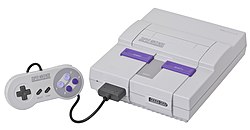
Super Nintendo Entertainment System
View on Wikipedia
  | |
  Top: North American Super NES Bottom: Japanese Super Famicom Other variations are pictured in Casing section. | |
| Also known as | |
|---|---|
| Developer | Nintendo R&D2 |
| Manufacturer | Nintendo |
| Type | Home video game console |
| Generation | Fourth |
| Release date | |
| Introductory price |
|
| Discontinued | |
| Units sold |
|
| Media | SNES Game Pak |
| CPU | Ricoh 5A22 @ 3.58 MHz 65C816 (SA1) @ 10.74 MHz |
| Memory |
|
| Sound | Nintendo S-SMP |
| Online services |
|
| Best-selling game |
|
| Predecessor | Nintendo Entertainment System |
| Successor | Nintendo 64 |
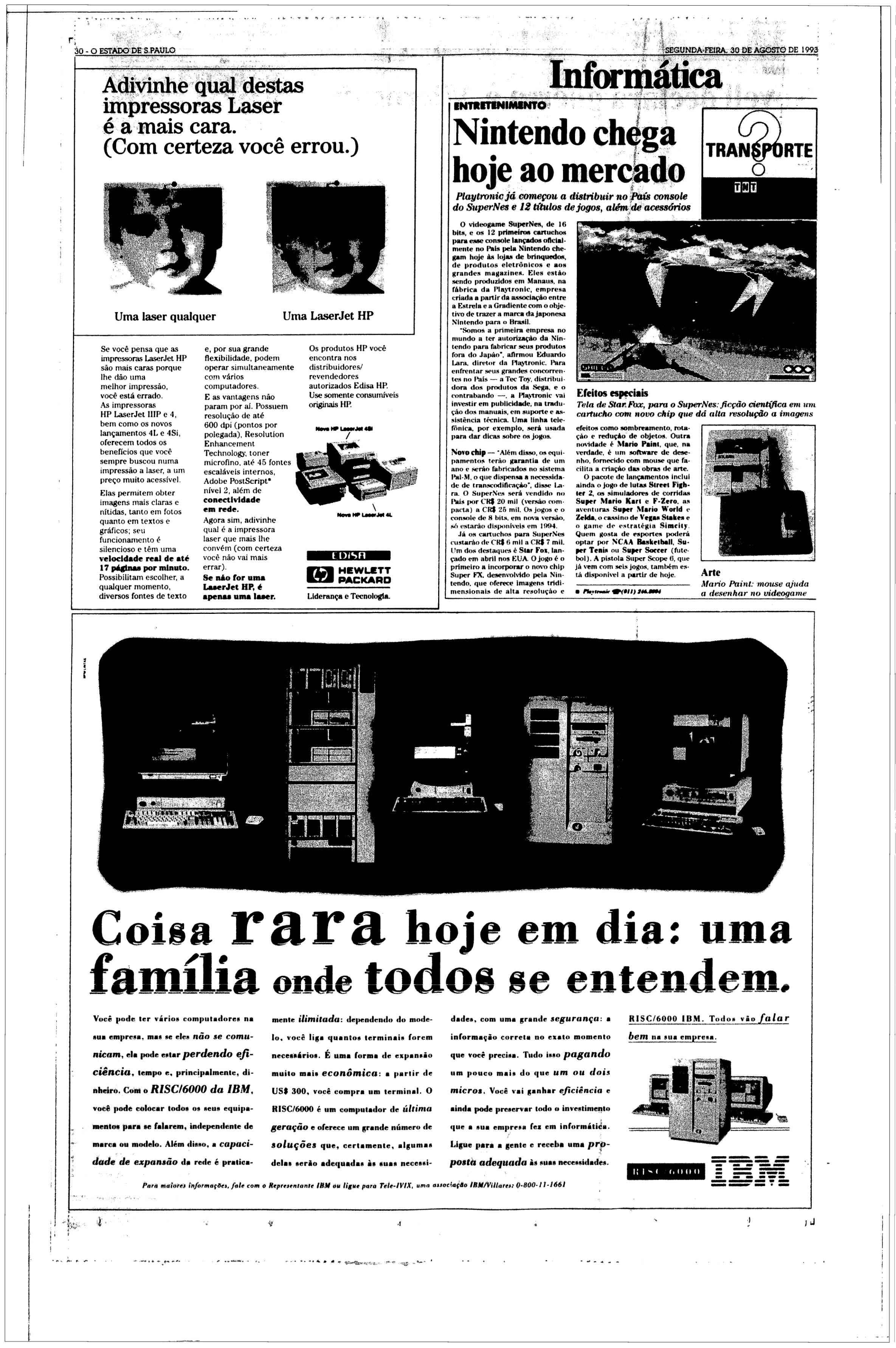
The Super Nintendo Entertainment System, commonly shortened to Super Nintendo,[b] Super NES or SNES,[c] is a 16-bit home video game console developed by Nintendo that was released in 1990 in Japan, 1991 in North America, 1992 in Europe and Oceania and 1993 in South America. In Japan, it is called the Super Famicom (SFC).[d] In South Korea, it is called the Super Comboy[e] and was distributed by Hyundai Electronics.[18] The system was released in Brazil on August 30, 1993,[19][20] by Playtronic. In Russia and CIS, the system was distributed by Steepler from 1994 until 1996. Although each version is essentially the same, several forms of regional lockout prevent cartridges for one version from being used in other versions.
The Super NES is Nintendo's second programmable home console, following the Nintendo Entertainment System (NES). The console introduced advanced graphics and sound capabilities compared with other systems at the time. It was designed to accommodate the ongoing development of a variety of enhancement chips integrated into game cartridges to be more competitive into the next generation.
The Super NES received largely positive reviews and was a global success, becoming the best-selling console of the 16-bit era after launching relatively late and facing intense competition from Sega's Genesis/Mega Drive console in North America and Europe. Overlapping the NES's 61.9 million unit sales, the Super NES remained popular well into the 32-bit era, with 49.1 million units sold worldwide by the time it was discontinued in 2003. It continues to be popular among collectors and retro gamers, with new homebrew games and Nintendo's emulated rereleases, such as on the Virtual Console, the Super NES Classic Edition, Nintendo Classics; as well as several non-console emulators which operate on a desktop computer or mobile device, such as Snes9x.
History
[edit]Background
[edit]To compete with the popular Family Computer in Japan, NEC Home Electronics launched the PC Engine in 1987, and Sega followed suit with the Mega Drive in 1988. The two platforms were later launched in North America in 1989 as the TurboGrafx-16 and the Sega Genesis respectively. Both systems were built on 16-bit architectures and offered improved graphics and sound over the 8-bit NES. It took several years for Sega's system to become successful.[21]
Bill Mensch, the co-creator of the 8-bit MOS Technology 6502 microprocessor and founder of the Western Design Center (WDC), gave Ricoh the exclusive right to supply 8-bit and 16-bit WDC microprocessors for Nintendo's new system.[22] Meanwhile, Sony engineer Ken Kutaragi reached an agreement with Nintendo to design the console's sound chip without notifying his supervisors, who were enraged when they discovered the project; although Kutaragi was nearly fired, then-CEO Norio Ohga intervened in support of the project and gave him permission to complete it.[23]
Development
[edit]On September 9, 1987, then-Nintendo president Hiroshi Yamauchi revealed the development of the Super Famicom in the newspaper Kyoto Shimbun. On August 30, 1988, in an interview with TOUCH Magazine, Yamauchi announced the development of Super Mario Bros. 4, Dragon Quest V, three original games, and he projected sales of 3 million units of the upcoming console. In that same interview, Yamauchi pointed out that sales of the Famicom were slowing dropping ever since it hit its peak about two years earlier, and that if they continued supporting it, players would eventually "get bored" and move on in favor of better-quality games, which would be "a dangerous situation" for them. Famicom Hissyoubon magazine speculated that Yamauchi's early announcement was probably made to forestall Christmas shopping for the PC Engine, and relayed Enix's clarification that it was waiting on sales figures to select either PC Engine or Super Famicom for its next Dragon Quest game. The magazine and Enix both expressed a strong interest in networking as a standard platform feature.[24][25] The console was demonstrated to the Japanese press on November 21, 1988, and again on July 28, 1989.[26][27] During the second demonstration, Nintendo also announced that they were forced to delay the release of the Super Famicom to the fall of 1990, as a result of problems such as a distinct lack of software for third-party developers and a global chip shortage – due to a new generation of semiconductor and chip technology that forced manufacturers to split production capacity, which also drove prices up considerably.[28]
The final design of the Super Famicom unveiled at the second Shoshinkai show, which was held between August 28–29, 1990.[28] This included late prototypes of Super Mario World and F-Zero. The demonstration garnered positive results by the public in terms of gameplay.[29] It gained so much popularity that Nintendo received 1.5 million pre-orders for the Super Famicom from wholesalers, making them worried that launch day would get a little chaotic. To solve this, they encouraged retailers to install a reservation system when selling the console. On November 20, the day before launch, Nintendo loaded 100 trucks with boxes of Super Famicom consoles, alongside cartridges of F-Zero and Super Mario World early in the morning. In that same day, Nintendo executed "Operation: Midnight Shipping" by sending these orders late at night, in the hopes of warding off thieves.[28]
Launch
[edit]

Designed by Masayuki Uemura, the designer of the original Famicom, the Super Famicom was released in Japan on Wednesday, November 21, 1990, for ¥25,000 (equivalent to ¥27,804 in 2019).[30] It was an instant success. Nintendo's initial shipment of 300,000 units sold out within hours. This gained the attention of the yakuza criminal organizations, so the devices were shipped at night to avoid robbery.[31]
With the Super Famicom quickly outselling its rivals, Nintendo reasserted itself as the leader of the Japanese console market.[32] Nintendo's success was partially due to the retention of most of its key third-party developers, including Capcom, Konami, Tecmo, Square, Koei, and Enix.[33]
Nintendo released the Super Nintendo Entertainment System, a redesigned version of the Super Famicom, in North America for US$199 (equivalent to $460 in 2024). It began shipping in limited quantities on August 23, 1991,[a][39] with an official nationwide release date of September 9, 1991.[40] The Super NES was released in the United Kingdom and Ireland in April 1992 for £150 (equivalent to £390 in 2023).[41]
Most of the PAL region versions of the console use the Japanese Super Famicom design, except for labeling and the length of the joypad leads. The Playtronic Super NES in Brazil, although PAL-M, uses the North American design.[42] Both the NES and Super NES were released in Brazil in 1993 by Playtronic, a joint venture between the toy company Estrela and consumer electronics company Gradiente.[43]
The Super NES and Super Famicom launched with few games, but these games were well received. In Japan, only two games were initially available: Super Mario World and F-Zero.[44] Bombuzal was released during the launch week.[45] In North America, Super Mario World was launched as a bundle with the console; other launch games include F-Zero, Pilotwings (both of which demonstrate the console's Mode 7 pseudo-3D rendering), SimCity, and Gradius III.[46]
Console wars
[edit]The rivalry between Nintendo and Sega was described as one of the most notable console wars in video game history,[47] in which Sega positioned the Genesis as the "cool" console, with games aimed at older audiences, and aggressive advertisements that occasionally attacked the competition.[48] Nintendo scored an early public-relations advantage by securing the first console conversion of Capcom's arcade hit Street Fighter II for Super NES, which took more than a year to make the transition to the Genesis. Though the Genesis had a two-year lead to launch time, a much larger library of games, and a lower price point,[49] it only represented an estimated 60% of the American 16-bit console market in June 1992,[50] and neither console could maintain a definitive lead for several years. Donkey Kong Country is said to have helped establish the Super NES's market prominence in the latter years of the 16-bit generation,[51][52][53][54] and for a time, maintain against the PlayStation and Saturn.[55] According to Nintendo, the company had sold more than 20 million Super NES units in the U.S.[56] According to a 2014 Wedbush Securities report based on NPD sales data, the Super NES outsold the Genesis in the U.S. market by 1.5 million units and gained its lead in the US/North American 16 bit market.[57]
Changes in policy
[edit]During the NES era, Nintendo maintained exclusive control over games released for the system – the company had to approve every game, each third-party developer could only release up to five games per year (but some third parties got around this by using different names, such as Konami's "Ultra Games" brand), those games could not be released on another console within two years, and Nintendo was the exclusive manufacturer and supplier of NES cartridges. Competition from Sega's console brought an end to this practice; in 1991, Acclaim Entertainment began releasing games for both platforms, with most of Nintendo's other licensees following suit over the next several years; Capcom (which licensed some games to Sega instead of producing them directly) and Square were the most notable holdouts.[58]
Nintendo continued to carefully review submitted games, scoring them on a 40-point scale and allocating marketing resources accordingly. Each region performed separate evaluations.[59] Nintendo of America also maintained a policy that, among other things, limited the amount of violence in the games on its systems. The surprise arcade hit Mortal Kombat (1992), a gory fighting game with huge splashes of blood and graphically violent fatality moves, was heavily censored by Nintendo.[f] Because the Genesis version allowed for an uncensored version via cheat code,[60] it outsold the censored Super NES version by a ratio of nearly three to one.[61]
U.S. Senators Herb Kohl and Joe Lieberman convened a Congressional hearing on December 9, 1993, to investigate the marketing of violent video games to children.[g] Though Nintendo took the high ground with moderate success, the hearings led to the creation of the Interactive Digital Software Association and the Entertainment Software Rating Board and the inclusion of ratings on all video games.[60][61] With these ratings in place, Nintendo decided its censorship policies were no longer needed.[61]
32-bit era and beyond
[edit]While other companies were moving on to 32-bit systems, Rare and Nintendo proved that the Super NES was still a strong contender in the market. In November 1994, Rare released Donkey Kong Country, a platform game featuring 3D models and textures pre-rendered on Silicon Graphics workstations. With its detailed graphics, fluid animation, and high-quality music, Donkey Kong Country rivals the aesthetic quality of games that were being released on newer 32-bit CD-based consoles. In the last 45 days of 1994, 6.1 million copies were sold, making it the fastest-selling video game in history to that date. This game conveyed that early 32-bit systems had little to offer over the Super NES, and proved the market for the more advanced consoles of the near future.[62][63] According to TRSTS reports, two of the top five bestselling games in the U.S. for December 1996 are Super NES games.[64]
In October 1997, Nintendo released a redesigned model of the Super NES (the SNS-101 model referred to as "New-Style Super NES") in North America for US$99 (equivalent to $200 in 2024), with some units including the pack-in game Super Mario World 2: Yoshi's Island.[65][66] Like the earlier New-Style NES (model NES-101), this is slimmer and lighter than its predecessor,[66] but it lacks S-Video and RGB output, and it is among the last major Super NES-related releases in the region. A similarly redesigned Super Famicom Jr. was released in Japan at around the same time.[67] The redesign stayed out of Europe.
Nintendo ceased production of the Super NES in North America in 1999,[7] about two years after releasing Kirby's Dream Land 3 (its final second-party game in the US) on November 27, 1997, and one year after releasing Frogger (its final third-party game in the US) in 1998. In Japan, Nintendo continued production of both the Family Computer and the Super Famicom until September 25, 2003,[9] and new games were produced until the year 2000, ending with the release of Metal Slader Glory Director's Cut on November 29, 2000.[68]
Many popular Super NES games were ported to the Game Boy Advance, which has similar video capabilities. In 2005, Nintendo announced that Super NES games would be made available for download via the Wii's Virtual Console service.[69] On October 31, 2007, Nintendo Co., Ltd. announced that it would no longer repair Family Computer or Super Famicom systems due to an increasing shortage of the necessary parts.[70] On March 3, 2016, Nintendo Co., Ltd. announced that it would bring Super NES games to the New Nintendo 3DS and New Nintendo 3DS XL (and later the New Nintendo 2DS XL) via its eShop download service.[71] At the Nintendo Direct event on September 4, 2019, Nintendo announced that it would be bringing select Super NES games to the Nintendo Switch Online classic games library, later renamed Nintendo Classics.[72][73]
Hardware
[edit]

Technical specifications
[edit]The 16-bit design of the Super NES[74] incorporates graphics and sound co-processors that perform tiling and simulated 3D effects, a palette of 32,768 colors, and 8-channel ADPCM audio. These base platform features, plus the ability to dramatically extend them all through substantial chip upgrades inside of each cartridge, represent a leap over the 8-bit NES generation and some significant advantages over 16-bit competitors such as the Genesis.[75]
CPU and RAM
[edit]
The CPU is a Ricoh 5A22, a derivative of the 16-bit WDC 65C816 microprocessor. In NTSC regions, its nominal clock speed of 3.58 MHz will slow to either 2.68 MHz or 1.79 MHz when accessing some slower peripherals.[76]
This CPU has an 8-bit data bus and two address buses. The 24-bit "Bus A" is designated for general accesses, and the 8-bit "Bus B" can access support chip registers such as the video and audio co-processors.
The WDC 65C816 supports an 8-channel DMA unit, an 8-bit parallel I/O port a controller port interface circuits allowing serial and parallel access to controller data, a 16-bit multiplication and division unit, and circuitry for generating non-maskable interrupts on V-blank and IRQ interrupts on calculated screen positions.[76]
Early revisions of the 5A22 used in SHVC boards are prone to spontaneous failure which can produce a variety of symptoms including graphics glitches in Mode 7, a black screen on power-on, or improperly reading the controllers.[77] The first revision 5A22 has a fatal bug in the DMA controller that can crash games; this was corrected in subsequent revisions.[78]
The console contains 128 KB of general-purpose "work" RAM, which is separate from the 64 KB dedicated to the video subsystem and the 64 KB dedicated to the audio subsystem.[79]
Video
[edit]
The Picture Processing Unit (PPU) consists of two closely tied IC packages. It contains 64 KB of SRAM for video data, 544 bytes of object attribute memory (OAM) for sprite data, and 256 × 15 bits of color generator RAM (CGRAM) for palette data. This CGRAM provisions up to 256 colors, chosen from the 15-bit RGB color space, from a palette of 32,768 colors. The PPU is clocked by the same signal as the CPU and generates a pixel every two or four cycles.[74]
Audio
[edit]

The S-SMP audio subsystem consisted of a 16-bit digital signal processor (DSP) to mix the sample sequences, an 8-bit SPC700 CPU to drive the DSP, and 64 KB of dedicated PSRAM.[79] It was designed by Ken Kutaragi and produced by Sony[80] and is completely independent from the rest of the system. It is clocked at a nominal 24.576 MHz in both NTSC and PAL systems. It is capable of stereo sound, composed from eight voices generated using 16-bit audio samples compressed using BRR and capable of applying effects such as echo.[81] On early revisions of the motherboard the S-SMP audio system was spread across four chips: the DSP, the CPU, and two RAM modules. On later revisions, the sound hardware consolidated to a single chip, the S-APU.[82]
Regional lockout
[edit]
Bottom: Japanese/PAL Super FX-enhanced cartridge
Nintendo employed several types of regional lockout, including both physical and hardware incompatibilities.
Physically, the cartridges are shaped differently for different regions. North American cartridges have a rectangular bottom with inset grooves matching protruding tabs in the console, and other regions' cartridges are narrower with a smooth curve on the front and no grooves. The physical incompatibility can be overcome with the use of various adapters, or through modification of the console.[83][84]
Internally, a regional lockout chip (CIC) within the console and in each cartridge prevents the PAL region games from being played on Japanese or North American consoles and vice versa. The Japanese and North American machines have the same region chip. This can be overcome through the use of adapters, typically by inserting the imported cartridge in one slot and a cartridge with the correct region chip in a second slot. Alternatively, disconnecting one pin of the console's lockout chip will prevent it from locking the console; hardware in later games can detect this situation, so it became common to install a switch to reconnect the lockout chip as needed.[85]
PAL consoles face another incompatibility when playing out-of-region cartridges: the NTSC video standard specifies video at 60 Hz but PAL operates at 50 Hz, resulting in an approximately 16.7% slower framerate. PAL's higher resolution results in letterboxing of the output image.[83] Some commercial PAL region releases exhibit this same problem and, therefore, can be played in NTSC systems without issue, but other games will face a 20% speedup if played in an NTSC console. To mostly correct this issue, a switch can be added to place the Super NES PPU into a 60 Hz mode supported by most newer PAL televisions. Later games will detect this setting and refuse to run, requiring the switch to be thrown only after the check completes.[86]
Casing
[edit]-
 Japanese SHVC-001 model
(1990–1998) -
 North American SNS-001 model
(1991–1997) -
 PAL-region SNSP-001A model
(1992–1998) -
 New-Style Super NES SNS-101
(1997–1999) -
 Japanese SHVC-101 model
(1998–2003) -
 South Korean SNSN-001 model
 -
 Nintendo Super System controller


All models of the Super NES control deck are predominantly gray, of slightly different shades. The North American version, designed by Nintendo of America industrial designer Lance Barr[87] (who previously redesigned the Famicom to become the NES),[88] has a boxy design with purple sliding switches and a dark gray eject lever. The loading bay surface is curved, both to invite interaction and to prevent food or drinks from being placed on the console and spilling as with the flat-surfaced NES.[87] The original Japanese version, which shares its design with the European version, is more rounded with darker gray accents and buttons.
All versions incorporate a top-loading slot for game cartridges, although the shape of the slot differs between regions to match the different shapes of the cartridges. The MULTI OUT connector (later used on the Nintendo 64 and GameCube) can output composite video, S-Video and RGB signals, as well as RF with an external RF modulator.[89][90] Original versions additionally include a 28-pin expansion port under a small cover on the bottom of the unit and a standard RF output with channel selection switch on the back;[91] the redesigned models output composite video only, requiring an external modulator for RF.[90]
The Nintendo Super System (NSS) is an arcade system for retail preview of 11 particular Super NES games in the United States, similar to the PlayChoice-10 for NES games. It consists of slightly modified Super NES hardware with a menu interface and 25-inch monitor, that allows gameplay for a certain amount of time depending on game credits.[92][93] Manufacturing of this model was discontinued in 1992.[94][95]
Redesigned model
[edit]A cost-reduced version of the console, referred to as the New-Style Super NES[90] (model SNS-101)[96] in North America and as the Super Famicom Jr.[h][97] in Japan, was released late in the platform's lifespan; designed by Barr,[96] it incorporates design elements from both the original North American and Japanese/European console models[96][98] but in a smaller form factor.[99][100] Unlike the original console models, the redesigned model is virtually identical across both regions save for the color palette (the North American model receiving purple buttons and the Japanese model receiving grey buttons).[100] The redesign did not receive a release in Europe.[101]
Externally, the power and reset buttons were moved to the left-hand side of the console while the cartridge eject button and power LED indicator were omitted.[99][102] Internally, the redesigned model consolidates the console's hardware into a system-on-chip (SoC) design.[103] The redesigned console lacks the bottom expansion slot, rendering it incompatible with the Japan-exclusive Satellaview add-on.[100]
For AV output, the redesigned console features the same multi-out port used on the original models.[89][104] Unlike the latter models, the former's AV port only supports composite video output natively as support for RGB video and S-Video was disabled internally; however, they can be restored via a "relatively simple" modification.[96][104] The internal RF modulator was also removed, requiring an external one for such output if needed.[90][99] Due to the SoC design, it is highly sought after by Super NES/Famicom enthusiasts since its RGB video quality (if restored) is improved over earlier internal revisions of the console.[103]
The redesigned console first released in October 1997 in North America, where it originally retailed for US$99.95 in a bundle with Super Mario World 2: Yoshi's Island;[99] it was subsequently released in Japan on March 27, 1998, where it retailed for ¥7,800.[97][105] Nintendo marketed it as an entry-level gamer's system for consumers who were apprehensive about the higher price of newer systems such as the Nintendo 64.[106][107] Nintendo also introduced a slightly altered controller for it, with the console's logo replaced by an embossed Nintendo logo.[99]
Yellowing
[edit]
The acrylonitrile butadiene styrene plastic used in the casing of some older Super NES and Super Famicom consoles is particularly susceptible to oxidation with exposure to air. This, along with the particularly light color of the original plastic, causes affected consoles to quickly become yellow; if the sections of the casing came from different batches of plastic, a "two-tone" effect results.[108] This issue may be reversed with a method called Retrobrighting, where a mixture of chemicals is applied to the case and exposed to UV light.[109]
Game cartridge
[edit]Super NES games are distributed on ROM cartridges, officially referred to as Game Pak in most Western regions,[110] and as Cassette (カセット, Kasetto) in Japan and parts of Latin America.[111] Though the Super NES can address 128 Mbit,[i] only 117.75 Mbit are actually available for cartridge use. A fairly normal mapping could easily address up to 95 Mbit of ROM data (48 Mbit at FastROM speed) with 8 Mbit of battery-backed RAM. Most available memory access controllers only support mappings of up to 32 Mbit. The largest games released (Tales of Phantasia and Star Ocean) contain 48 Mbit of ROM data,[112][113] and the smallest games contain only 2 Mbit.
Cartridges may also contain battery-backed SRAM to save the game state, extra working RAM, custom coprocessors, or any other hardware that will not exceed the maximum current rating of the console.
Games
[edit]1757 Super NES games were officially released: 717 in North America (plus 4 championship cartridges), 521 in Europe, 1,448 in Japan, 231 on Satellaview, and 13 on Sufami Turbo. Many Super NES games have been called some of the greatest video games of all time, such as Super Mario World (1990), The Legend of Zelda: A Link to the Past (1991), Final Fantasy VI (1994), Donkey Kong Country (1994), EarthBound (1994), Super Metroid (1994), Chrono Trigger (1995) and Yoshi's Island (1995).[114][115][116] Many Super NES games have been rereleased several times, including on the Virtual Console, Super NES Classic Edition, and the Nintendo Classics service on Nintendo Switch Online. All Game Boy games are playable with the Super Game Boy add-on.
Peripherals
[edit]
The Super NES controller design expands on that of the NES, with A, B, X, and Y face buttons in a diamond arrangement, and two shoulder buttons. Lance Barr created its ergonomic design, and he later adapted it in 1993 for the NES-039 "dogbone" controller.[87][88] The Japanese and PAL region versions incorporated the four colors of the face buttons into the system's logo. The North American version's buttons were colored to match the redesigned console; the X and Y buttons are lavender with concave faces, and the A and B buttons are purple with convex faces. Several later controller designs have elements from the Super NES controller, including the PlayStation, Dreamcast, Xbox, and Wii Classic Controller.[117][118][119] This face button layout is on future Nintendo systems since the Nintendo DS.
Several peripherals add to the functionality of the Super NES. Some are required by certain games, such as the Super Scope light gun, and the Super NES Mouse for a point and click interface. Hudson Soft released the Super Multitap in conjunction with Super Bomberman, a multi-player adapter for the Super NES that allows up to four additional controllers to be connected into the control deck's second controller port for up to five possible simultaneous players in supported titles. Many other peripheral manufacturers would follow suit with their own multi-player adapters for the Super NES, both officially licensed and off-brand, such as the Super Links by Bulletproof Software (based on the Hori Multitap by Hori in Japan) and the Super 5-Play by Performance. All Super NES titles that support the Super Multitap or its compatible derivatives feature a "Super NES Multi-Player Adapter" logo on their packaging or cartridge label. Japanese Super Famicom titles used a Multiplayer 5 (マルチプレイヤー5) logo instead, which was Nintendo's generic name for the Super Multitap and its compatible derivatives.
Various specialized joypad and joystick controllers were created by third-party companies such as Asciiware (the AsciiPad and the Super Advantage), Capcom (the Capcom Fighter Power Stick and the Capcom Pad Soldier), Hudson Soft (Super Joy Card), Hori (Super Commander and the SGB Commander) and Konami (the Hissatsu Command Controller), among others. Unusual controllers include the BatterUP baseball bat, the Life Fitness Entertainment System (an exercise bike controller with built-in monitoring software),[120] the TeeV Golf golf club,[121][122] and the Justifier (a revolver-shaped light gun made by Konami for Lethal Enforcers).

Though Nintendo never released an adapter for playing NES games on the Super NES, the Super Game Boy adapter cartridge allows games designed for Nintendo's portable Game Boy system to be played on the Super NES. The Super Game Boy touts several feature enhancements over the Game Boy, including palette substitution, custom screen borders, and access to the Super NES console's features by specially enhanced Game Boy games.[123] Japan also saw the release of the Super Game Boy 2, which adds a communication port to enable a second Game Boy to connect for multiplayer games.
Like the NES before it, the Super NES has unlicensed third-party peripherals, including a new version of the Game Genie cheat cartridge designed for use with Super NES games.
Soon after the release of the Super NES, companies began marketing backup devices such as the Super Wildcard, Super Pro Fighter Q, and Game Doctor.[124] These devices create a backup of a cartridge, and can be used to play illicit ROM images or to copy games, violating copyright laws in many jurisdictions.

The Japan-only Satellaview is a satellite modem attached to the Super Famicom's expansion port and connected to the St.GIGA satellite radio station from April 23, 1995, to June 30, 2000. Satellaview subscribers could download gaming news and specially designed games, which were frequently either remakes of or sequels to older Famicom games, and released in installments.[125] In the United States, the relatively short-lived XBAND allowed users to connect to a network via a dial-up modem to compete against other players around the country.
Nintendo attempted partnerships with Sony and later Philips to develop CD-ROM-based peripherals, aiming to compete with add-ons like the TurboGrafx-CD and Sega CD. Sony's effort resulted in a prototype known as the PlayStation, a Super NES with a built-in CD-ROM drive, which never reached the market but laid the groundwork for Sony's later independently produced console. The Philips project was canceled before a prototype was produced. However, under the original development agreement, Nintendo had granted Philips the rights to use certain franchises for games intended for the planned peripheral. After the project's cancellation, Philips retained these rights and used them to develop Mario and Zelda titles for its CD-i multimedia system.[126][127]
Enhancement chips
[edit]
As part of the overall plan for the Super NES, rather than include an expensive CPU that would still become obsolete in a few years, the hardware designers made it easy to interface special coprocessor chips to the console, just like the MMC chips used for most NES games. This is most often characterized by 16 additional pins on the cartridge card edge.[128][129]
The Super FX is a RISC CPU designed to perform functions that the main CPU can not feasibly do. The chip is primarily used to create 3D game worlds made with polygons, texture mapping and light source shading. The chip can also be used to enhance 2D games.[130]
The Nintendo fixed-point digital signal processor (DSP) chip allowed fast vector-based calculations, bitmap conversions, both 2D and 3D coordinate transformations, and other functions.[131] Four revisions of the chip exist, each physically identical but with different microcode. The DSP-1 version, including the later 1A and 1B bug fix revisions, is used most often; the DSP-2, DSP-3, and DSP-4 are used in only one game each.[132]
Similar to the 5A22 CPU in the console, the SA-1 chip contains a 65C816 processor core clocked at 10.7 MHz, a memory mapper, DMA, decompression and bitplane conversion circuitry, several programmable timers, and CIC region lockout functionality.[130]
In Japan, games could be downloaded cheaper than standard cartridges, from Nintendo Power kiosks onto special cartridges containing flash memory and a MegaChips MX15001TFC chip. The chip manages communication with the kiosks to download ROM images and has an initial menu to select a game. Some were published both in cartridge and download form, and others were download only. The service closed on February 8, 2007.[133]
Many cartridges contain other enhancement chips, most of which were created for use by a single company in a few games.[132]
Reception and legacy
[edit]
Approximately 49.1 million Super NES consoles were sold worldwide, with 23.35 million of those units sold in the Americas and 17.17 million in Japan.[10] Although it could not quite repeat the success of the NES, which sold 61.91 million units worldwide,[10] the Super NES was the best-selling console of its era.
In 2007, GameTrailers named the Super NES as the second-best console of all time (only behind the PlayStation 2) in their list of top ten consoles that "left their mark on the history of gaming", citing its graphics, sound, and library of top-quality games.[134] In 2015, they also named it the best Nintendo console of all time, saying, "The list of games we love from this console completely annihilates any other roster from the Big N."[135] Technology columnist Don Reisinger proclaimed "The SNES is the greatest console of all time" in January 2008, citing the quality of the games and the console's dramatic improvement over its predecessor;[136] fellow technology columnist Will Greenwald replied with a more nuanced view, giving the Super NES top marks with his heart, the NES with his head, and the PlayStation (for its controller) with his hands.[137] GamingExcellence also gave the Super NES first place in 2008, declaring it "simply the most timeless system ever created" with many games that stand the test of time and citing its innovation in controller design, graphics capabilities, and game storytelling.[138] At the same time, GameDaily rated it fifth of the ten greatest consoles for its graphics, audio, controllers, and games.[139] In 2009, IGN named the Super NES the fourth-best video game console, complimenting its audio and number of AAA games.[117]
Emulation
[edit]SNES emulation began with VSMC in 1994, and Super Pasofami became the first working emulator in 1996.[140] During that time, two competing emulation projects, Snes96 and Snes97, merged to form Snes9x.[130] In 1997, ZSNES development began.[141] In 2004, Bsnes development began with the goal of preservation through maximal accuracy and compatibility, and was later renamed to Higan.
Nintendo of America maintained its stance against the distribution of SNES ROM image files and the use of emulators, as it had with the NES before, saying they represent copyright infringement.[142] Emulation proponents assert that the discontinued hardware production constitutes abandonware status, the owners' right to make a personal backup, space shifting for private use, the development of homebrew games, the frailty of ROM cartridges and consoles, and the lack of certain foreign imports. Nintendo designed a hobbyist development system for the SNES, but never released it.[143]
Unofficial SNES emulation is available on virtually all platforms, including Android,[144] iOS,[145][146] game consoles, and PDAs.[147] Individual games have been bundled with official dedicated emulators on some GameCube discs, and Nintendo's Virtual Console service for the Wii introduced diverse and officially licensed SNES emulation.
The Super NES Classic Edition was released in September 2017 following the NES Classic Edition. This emulation-based mini-console, which is physically modeled after the North American and European versions of the SNES, is bundled with two SNES-style controllers and 21 games, including the unreleased Star Fox 2.[148]
Notes
[edit]- ^ a b Kent says that September 1 was planned but later rescheduled to September 9.[34] Newspaper and magazine articles from late 1991 report that the first shipments were in stores in some regions on August 23,[35][36] and it arrived in other regions at a later date.[37] August 23 is also the release date officially recognized by Nintendo of America.[38]
- ^ Though the use of "Super Nintendo" is common in colloquial speech and Nintendo of Europe's website,[15] Nintendo of America's official guidelines discourage it, preferring instead the shorthand "Super NES", as written on many of its products such as Super NES Control Deck, Super NES Controller, Super NES Mouse, and Super NES Multi-Player Adapter.[16]
- ^ The name "SNES" can be pronounced by English speakers as an acronym (one word, like "NATO") with various pronunciations, an initialism (a string of letters, like "IBM"), or as a hybrid, like "JPEG". In written English, the choice of indefinite article ("a" or "an") is therefore problematic.[17]
- ^ Japanese: スーパーファミコン, Hepburn: Sūpā Famikon; officially adopting the abbreviated name of its predecessor, the Famicom
- ^ Korean: 슈퍼 컴보이; RR: Syupeo Keomboi
- ^ In both The Ultimate History of Video Games and Purple Reign: 15 Years of the SNES, the disparity in sales is directly attributed to the Super NES version lacking the excessive blood which was recolored grey and described as "sweat", and lacking some of the more gruesome finishing moves. See the Talk page for details.
- ^ Some contend that Nintendo orchestrated the Congressional hearings of 1993, but Senator Lieberman and NOA's Senior Vice President (later Chairman) Howard Lincoln both refute these allegations.[61]
- ^ Japanese: スーパーファミコン ジュニア, Hepburn: Sūpā Famikon Junia
- ^ Unless otherwise specified, kilobyte (KB), megabyte (MB), and megabit (Mbit) are used in the binary sense in this article, referring to quantities of 1024 or 1,048,576.
References
[edit]- ^ "Retro Diary: 08 November – 05 December". Retro Gamer. No. 122. December 13, 2013. p. 11.
- ^ a b "Super Nintendo Entertainment System (Platform)". Giant Bomb. Archived from the original on March 30, 2019. Retrieved August 16, 2019.
- ^ "History | Corporate". Nintendo. Archived from the original on September 4, 2012. Retrieved February 24, 2013.
- ^ C. Portilla (November 21, 2015). "Los juegos más recordados a 25 años del lanzamiento de la Super Nintendo". La Tercera. Archived from the original on January 21, 2022. Retrieved January 20, 2022.
- ^ "Nintendo chega hoje ao mercado". O Estado de S. Paulo. August 30, 1993. Archived from the original on February 27, 2014. Retrieved May 6, 2018.
- ^ "Соглашение Steepler и Nintendo". November 1994. Archived from the original on April 27, 2019. Retrieved December 7, 2022.
- ^ a b Reisinger, Don (January 21, 2009). "Does the Xbox 360's 'Lack of Longevity' Matter?". CNET. Archived from the original on December 8, 2015. Retrieved October 23, 2015.
- ^ Wolf, Mark J. P. (November 21, 2018). The Routledge Companion to Media Technology and Obsolescence. Routledge. ISBN 978-1-315-44266-2. Archived from the original on August 1, 2020. Retrieved August 16, 2019.
- ^ a b Niizumi, Hirohiko (May 30, 2003). "Nintendo to end Famicom and Super Famicom production". GameSpot. Archived from the original on January 22, 2012. Retrieved July 15, 2007.
- ^ a b c "Consolidated Sales Transition by Region" (PDF). Nintendo. Archived (PDF) from the original on June 13, 2018. Retrieved October 25, 2017.
- ^ "Any idea what this is?". Archived from the original on March 29, 2019. Retrieved May 20, 2025.
- ^ "BT Joins Forces with Nintendo". Telecompaper. June 28, 1995. Archived from the original on February 23, 2020. Retrieved May 20, 2025.
- ^ "The Nintendo Years: 1990". Edge. June 25, 2007. p. 2. Archived from the original on August 20, 2012. Retrieved June 27, 2007.
- ^ "Platinum Titles". Capcom. Archived from the original on June 5, 2011. Retrieved August 21, 2010.
- ^ Nintendo of Europe. "Super Nintendo". nintendo.co.uk. Archived from the original on August 20, 2020. Retrieved March 3, 2019.
- ^ "SNES Development Manual" (PDF). Archived (PDF) from the original on February 6, 2016. Retrieved February 5, 2016.
- ^ "Do you say NES or N-E-S?". Nintendo NSider Forums. Archived from the original on May 5, 2008. Retrieved September 23, 2007. Additional archived pages: 2 3 4 5 8 9 ; "Pronouncing NES & SNES". GameSpot forums. Archived from the original on February 14, 2012. Retrieved May 16, 2007.
- ^ Brian Byrne, Brian (2017). History of the Super Nintendo (SNES): Ultimate Guide to the SNES Games & Hardware. Console Gamer Magazine. p. 5. ISBN 978-1-5498-9956-0.
- ^ Brian Byrne, Brian (2017). History of the Super Nintendo (SNES): Ultimate Guide to the SNES Games & Hardware. Console Gamer Magazine. p. 4. ISBN 978-1-5498-9956-0.
- ^ Coelho, Victor (November 24, 2014). "Super Nintendo completa 24 anos" [Super Nintendo turned 24 years old]. Exame (in Portuguese). Archived from the original on November 6, 2018. Retrieved June 3, 2018.
- ^ Sheff (1993), pp. 353–356. "The Genesis continued to flounder through its first couple of years on the market, although Sega showed Sisyphean resolve.... [By mid-1991] Sega had established itself as the market leader of the next generation."
- ^ Mensch, William David Jr. (November 10, 2014). "Oral History of William David "Bill" Mensch, Jr" (PDF) (Interview). Interviewed by Stephen Diamond. Mountain View, California: Computer History Museum. Archived (PDF) from the original on September 20, 2015. Retrieved July 19, 2023.
- ^ Fahey, Rob (April 27, 2007). "Farewell, Father". Eurogamer. Retrieved October 6, 2023.
- ^ Covell, Chris. "Super Famicom: August 1988". Archived from the original on May 1, 2021. Retrieved March 13, 2021.
- ^ "スーパーファミコン発売前夜". Niconico (in Japanese). August 1, 2013. Archived from the original on July 9, 2021. Retrieved March 13, 2021.
- ^ Covell, Chris. "The First Super Famicom Demonstration". Archived from the original on April 21, 2021. Retrieved March 13, 2021.
- ^ Covell, Chris. "The Second SFC Demonstration". Archived from the original on February 24, 2021. Retrieved March 13, 2021.
- ^ a b c Gaming Historian (May 6, 2022). The Story of Super Mario World. YouTube.
- ^ "Japanese Secrets!". chrismcovell.com. Archived from the original on February 21, 2020. Retrieved January 9, 2017.
- ^ Kent (2001), pp. 422–431.
- ^ Sheff (1993), pp. 360–361.
- ^ Kent (2001), pp. 431–433. "Japan remained loyal to Nintendo, ignoring both Sega's Genesis and NEC's PC Engine (the Japanese name for TurboGrafx).... Unlike the Japanese launch in which Super Famicom had outsold both competitors combined in presales alone, Super NES would debut against an established product."
- ^ Kristan Reed (January 19, 2007). "Virtual Console: SNES". Eurogamer. Archived from the original on March 4, 2016. Retrieved February 12, 2009.
- ^ Kent (2001), p. 432.
- ^ Campbell, Ron (August 27, 1991). "Super Nintendo sells quickly at OC outlets". The Orange County Register.
Last weekend, months after video-game addicts started calling, Dave Adams finally was able to sell them what they craved: Super Nintendo. Adams, the manager of Babbages in South Coast Plaza, got 32 of the $199.95 systems Friday.
Based on the publication date, the "Friday" mentioned would be August 23, 1991. - ^ "Super Nintendo It's Here!!!". Electronic Gaming Monthly. No. 28. Sendai Publishing Group. November 1991. p. 162.
The long awaited SNES is finally available to the U.S. gaming public. The first few pieces of this fantastic unit hit the store shelves on August 23, 1991. Nintendo, however, released the first production run without any heavy fanfare or spectacular announcements.
- ^ O'Hara, Delia (August 27, 1991). "New products put more zip into the video-game market". Chicago Sun-Times. Archived from the original (abstract) on November 3, 2012. Retrieved March 5, 2010.
On Friday, area Toys R Us stores […] were expecting SNES, with a suggested retail price of $199.95, any day, said Brad Grafton, assistant inventory control manager for Toys R Us.
Based on the publication date, the "Friday" mentioned would be August 23, 1991. - ^ Nintendo of America [@NintendoAmerica] (August 23, 2021). "On this day 30 years ago, the Super..." (Tweet) – via Twitter.
- ^ Campbell, Ron (August 27, 1991). "Super Nintendo sells quickly at OC outlets". The Orange County Register.
Super Nintendo began showing up in Southern California stores Wednesday, nearly three weeks before the official Sept. 9 release date. ... Until the official nationwide release Sept. 9, availability will be limited.
- ^ "COMPANY NEWS; Super Nintendo Now Nationwide". The New York Times. September 10, 1991. Archived from the original on August 28, 2016. Retrieved August 23, 2016.
- ^ Phillips, Tom (April 11, 2012). "SNES celebrates 20th birthday in UK". Eurogamer. Archived from the original on May 14, 2019. Retrieved September 13, 2020.
- ^ "Playtronic SNES Games". SNES Central. Archived from the original on August 9, 2014. Retrieved February 9, 2015.
- ^ "Nintendo Brasil" (in Portuguese). Nintendo. Archived from the original on July 17, 2007. Retrieved August 2, 2007.
- ^ Sheff (1993), p. 361.
- ^ "Big in Japan: Nintendo 64 Launches at Last". Next Generation. No. 21. September 1996. pp. 14–16.
- ^ Jeremy Parish (November 14, 2006). "Out to Launch: Wii". 1UP.com. Archived from the original on August 4, 2011. Retrieved July 3, 2007.
- ^ Kent (2001), p. 431. "Sonic was an immediate hit, and many consumers who had been loyally waiting for Super NES to arrive now decided to purchase Genesis.... The fiercest competition in the history of video games was about to begin."
- ^ Kent (2001), pp. 448–449.
- ^ Kent (2001), p. 433.
- ^ Hisey, Pete (June 1, 1992). "16-bit games take a bite out of sales — computer games". Discount Store News.
- ^ Kent (2001), p. 496–497. "The late November release of Donkey Kong Country stood in stark contrast to the gloom and doom faced by the rest of the video game industry. After three holiday seasons of coming in second to Sega, Nintendo had the biggest game of the year. Sega still outperformed Nintendo in overall holiday sales, but the 500,000 copies of Donkey Kong Country that Nintendo sent out in its initial shipment were mostly sold in preorder, and the rest sold out in less than one week. It (Donkey Kong Country) established the SNES as the better 16-bit console and paved the way for Nintendo to win the waning years of the 16-bit generation."
- ^ "Game-System Sales". Newsweek. January 14, 1996. Archived from the original on May 13, 2013. Retrieved January 21, 2012.
- ^ Greenstein, Jane (1997). "Don't expect flood of 16-bit games". Video Business.
1.4 million units sold during 1996
- ^ "Sega farms out Genesis". Television Digest. March 2, 1998. "Sega of America sold about 400,000 16-bit consoles in N. America last year, based on estimates extrapolated from NPD Group's Toy Retail Statistical Tracking Service. That compares with just over one million Super Nintendo Entertainment Systems (SNES) sold by Nintendo of America."
- ^ Danny Allen (December 22, 2006). "A Brief History of Game Consoles, as Seen in Old TV Ads". PC World. Archived from the original on May 8, 2008. Retrieved July 15, 2007.
- ^ "Classic Systems: SNES". Nintendo. Archived from the original on December 9, 2003. Retrieved January 21, 2012.
- ^ Pachter, Michael; McKay, Nick; Citrin, Nick (February 11, 2014). "Post Hoc Ergo Propter Hoc; Why the Next Generation Will Be as Big as Ever". Wedbush Equity Research. p. 36. Archived from the original on March 4, 2016. Retrieved November 9, 2015.
- ^ Kent (2001), pp. 308, 372, 440–441.
- ^ Reeder, Sara (November 1992). "Why Edutainment Doesn't Make It In A Videogame World". Computer Gaming World. p. 128. Archived from the original on January 10, 2020. Retrieved July 5, 2014.
- ^ a b Ray Barnholt (August 4, 2006). "Purple Reign: 15 Years of the SNES". 1UP.com. p. 4. Archived from the original on November 2, 2012. Retrieved July 13, 2007.
- ^ a b c d Kent (2001), pp. 461–480. "nearly three to one".
- ^ Kent (2001), pp. 491–493, 496–497.
- ^ Doug Trueman. "GameSpot Presents: The History of Donkey Kong". GameSpot. p. 4. Archived from the original on May 15, 2012. Retrieved July 13, 2007.
- ^ "Nintendo Boosts N64 Production". Electronic Gaming Monthly. No. 93. Ziff Davis. April 1997. p. 22.
- ^ Chris Johnston (October 29, 1997). "Super NES Lives!". GameSpot. Archived from the original on January 24, 2012. Retrieved June 14, 2007.
- ^ a b "Classic System Gets New Shell". Electronic Gaming Monthly. No. 102. Ziff Davis. January 1998. p. 22.
- ^ Yutaka Ohbuchi (January 16, 1998). "Super Fami Gets Face-Lift". GameSpot. Archived from the original on January 18, 2012. Retrieved June 14, 2007.
- ^ "スーパーファミコン (Super Famicom)" (in Japanese). Nintendo Japan. Archived from the original on August 28, 2019. Retrieved May 19, 2007.
- ^ "E3 2005: Nintendo's E3 2005 Press Conference". IGN. May 17, 2005. Archived from the original on February 14, 2012. Retrieved April 14, 2007.
- ^ "Nintendo's classic Famicom faces end of road". AFP. October 31, 2007. Archived from the original (Reprint) on May 27, 2013. Retrieved November 9, 2007.
- ^ Gwaltney, Javy. "Super Nintendo Games Are Coming To New Nintendo 3DS". Game Informer. Archived from the original on October 18, 2018. Retrieved January 21, 2019.
- ^ "Nintendo Direct - 09.04.2019". www.nintendo.com. Archived from the original on September 4, 2019. Retrieved September 10, 2019.
- ^ "NES and Super NES – Nintendo Switch Online – Nintendo Switch Official site". www.nintendo.com. Archived from the original on September 9, 2019. Retrieved September 10, 2019.
- ^ a b "Fullsnes – Nocash SNES Specs". Archived from the original on January 2, 2015. Retrieved February 6, 2015.
- ^ Jeremy Parish (September 6, 2005). "PS1 10th Anniversary retrospective". 1UP.com. Archived from the original on May 23, 2011. Retrieved May 27, 2007.
- ^ a b Nintendo (1993). "SNES Development Manual - Book I, Section 4 "Super NES CPU Data"". Nintendo. Archived from the original on November 28, 2018. Retrieved September 11, 2018.
- ^ "NA » Need help » SNES Gen 1 Video Repair more than 50 units". Archived from the original on March 31, 2019. Retrieved March 31, 2019.
- ^ "Is the SNES a realible console?". Archived from the original on August 17, 2018. Retrieved September 13, 2020.
- ^ a b Copetti, Rodrigo (June 28, 2019). "Super Nintendo Architecture - A Practical Analysis". Retrieved November 14, 2024.
- ^ Hayward, Andrew (March 12, 2017). "The Nintendo PlayStation is the coolest console never released". TechRadar. Archived from the original on September 12, 2018. Retrieved September 12, 2018.
Nintendo and Sony first linked up for the Super Nintendo itself, as Sony produced the S-SMP sound chip for the iconic 16-bit console.
- ^ Nintendo (1993). "SNES Development Manual - Section 3, Super NES Sound". Nintendo. Archived from the original on November 28, 2018. Retrieved September 11, 2018.
- ^ "SNES Model Differences". ConsoleMods Wiki. Retrieved November 15, 2024.
- ^ a b Nintendo Life (July 6, 2013). "Soapbox: Why Region Locking Is A Total Non-Issue". Nintendo Life. Archived from the original on September 5, 2015. Retrieved October 24, 2015.
- ^ "The Ultimate Retro Console Collectors' Guide". Eurogamer.net. May 6, 2012. Archived from the original on August 22, 2015. Retrieved October 24, 2015.
- ^ Mark Knibbs (December 27, 1997). "Disabling the SNES/Super Famicom "Lockout Chip"". Archived from the original on January 21, 2003. Retrieved April 14, 2007.
- ^ Mark Knibbs (January 25, 1998). "Super NES/Super Famicom 50/60 Hz Switch Modification". Archived from the original on May 2, 2001. Retrieved April 14, 2007.
- ^ a b c "Super Nintendo Entertainment System". Nintendo Power. Vol. 25. Redmond, Washington: Nintendo of America. June 1991. pp. 45–46.
- ^ a b Margetts, Chad; Ward, M. Noah (May 31, 2005). "Lance Barr Interview". Nintendojo. Archived from the original on July 22, 2016. Retrieved March 2, 2013.
- ^ a b "Nintendo Support: Super Nintendo AV to TV Hookup". Nintendo. Archived from the original on August 5, 2016. Retrieved March 2, 2010.
- ^ a b c d "Nintendo Support: New-Style Super NES RF to TV Hookup". Nintendo. Archived from the original on May 20, 2010. Retrieved June 30, 2010.
- ^ "Nintendo Support: Original-Style Super NES RF to TV Hookup". Nintendo. Archived from the original on March 10, 2010. Retrieved February 28, 2010.
- ^ "Nintendo Super System: The Future Takes Shape". Arcade Flyers Archive. Archived from the original on December 3, 2019. Retrieved April 19, 2008.
- ^ "Nintendo Super System on SNES Central". Archived from the original on December 3, 2019. Retrieved December 3, 2019.
- ^ "Nintendo Will No Longer Produce Coin-Op Equipment". Cashbox. September 5, 1992. Retrieved December 8, 2019.
- ^ "Nintendo Stops Games Manufacturing; But Will Continue Supplying Software". Cashbox. September 12, 1992. Retrieved December 8, 2019.
- ^ a b c d Lane, Gavin (July 12, 2021). "Nintendo Hardware Refreshes Through The Ages". Nintendo Life. Archived from the original on May 31, 2022. Retrieved July 8, 2023.
- ^ a b "Super Famicom Jr". Nintendo. Archived from the original on December 26, 2008. Retrieved February 21, 2009.
- ^ Goulter, Tom (December 3, 2012). "The history of console redesigns". GamesRadar+. Archived from the original on May 1, 2023. Retrieved July 8, 2023.
- ^ a b c d e Johnston, Chris (October 29, 1997). "Super NES Lives!". GameSpot. Archived from the original on November 3, 2012. Retrieved February 21, 2009.
- ^ a b c Plant, Logan (July 7, 2021). "A History of Nintendo Console Redesigns". IGN. Archived from the original on July 9, 2023. Retrieved July 8, 2023.
- ^ McFerran, Damien (July 27, 2012). "Nintendo's History of Hardware Revisions". Eurogamer. Archived from the original on May 23, 2022. Retrieved January 5, 2024.
- ^ Byford, Sam (July 11, 2019). "A brief history of cutdown game consoles". The Verge. Archived from the original on February 25, 2021. Retrieved July 10, 2023.
- ^ a b Buxton, Matt (October 31, 2017). "Powering Up Super Power - Finding The Ultimate SNES Console". Nintendo Life. Archived from the original on July 9, 2023. Retrieved July 9, 2023.
- ^ a b Petty, Jared (August 23, 2016). "27 Sexy Console Redesigns". IGN. Archived from the original on July 9, 2023. Retrieved July 8, 2023.
- ^ "任天堂、家庭用で 4月に「GBライト」発売 新製品を次々と" (PDF). Game Machine. No. 561. Amusement Press. April 1, 1998. p. 14.
- ^ Ohbuchi, Yutaka (January 16, 1998). "Super Fami Gets Face-Lift". GameSpot. Archived from the original on November 3, 2012. Retrieved February 21, 2009.
- ^ "Playing with Power: The Super Nintendo 25 Years On". Retro Gamer. No. 148. Imagine Publishing. November 2015. p. 58. ISSN 1742-3155.
- ^ Edwards, Benj (January 12, 2007). "Why Super Nintendos Lose Their Color: Plastic Discoloration in Classic Machines". Vintagecomputing.com. Archived from the original on January 1, 2012. Retrieved August 19, 2009.
- ^ Dziezynski, James (October 24, 2013). "Retrobright Restoration Project". www.mountainouswords.com. Archived from the original on October 24, 2019. Retrieved October 24, 2019.
- ^ "Game Pak Troubleshooting". Customer Service. Nintendo of America, Inc. Archived from the original on August 14, 2010. Retrieved August 23, 2010.
- ^ ゼルダの伝説 神々のトライフォース 取扱説明書. Nintendo Co., Ltd. November 21, 1991. p. 1.
- ^ Ogasawara, Nob (November 1995). "Future Fantasies from overseas". GamePro. Vol. 7, no. 11. San Mateo, CA: Infotainment World. p. 126. ISSN 1042-8658.
- ^ "Star Ocean". Nintendo Power. No. 86. Redmond, WA: Nintendo of America. July 1996. pp. 60–61. ISSN 1041-9551.
- ^ Top 100 SNES Games of All Time - IGN.com, retrieved August 11, 2023
- ^ "50 Best Super Nintendo (SNES) Games Of All Time". Nintendo Life. January 30, 2023. Retrieved August 11, 2023.
- ^ "The 15 Greatest SNES Games of All Time". Destructoid. February 19, 2023. Retrieved August 11, 2023.
- ^ a b "Top 25 Videogame Consoles of All Time". IGN. September 4, 2009. Archived from the original on March 4, 2010. Retrieved October 24, 2010.
- ^ Sud Koushik (January 30, 2006). "Evolution of Controllers". Advanced Media Network. Archived from the original on February 7, 2009. Retrieved May 25, 2007.
- ^ Chris Kohler (September 13, 2005). "Controller's History Dynamite". 1UP.com. p. 4. Archived from the original on September 29, 2012. Retrieved May 25, 2007.
- ^ "Use Your Super Nintendo to Play Your Way to Perfect Health". Electronic Gaming Monthly. No. 67. Ziff Davis. February 1995. p. 54.
- ^ Super Nintendo ( SNES ) Controller – TeeV Golf by Sports Sciences. August 22, 2015. Archived from the original on March 17, 2016. Retrieved October 24, 2015 – via YouTube.
- ^ "Popular Mechanics". google.com. Hearst Magazines. March 1995. Archived from the original on May 5, 2016. Retrieved October 24, 2015.
- ^ Eric Levenson (April 21, 2014). "Feature: Remembering the Super Game Boy". The Atlantic. Archived from the original on October 25, 2017. Retrieved July 13, 2017.
- ^ "SNES Backup Units". RED #9. Archived from the original on June 26, 2007. Retrieved September 17, 2007.
- ^ Bivens, Danny (October 27, 2011). "Nintendo's Expansion Ports Satellaview". Archived from the original on January 27, 2016. Retrieved January 22, 2016.
- ^ Edge staff (April 24, 2009). "The Making Of: PlayStation". Edge. Future Publishing. Archived from the original on May 16, 2012. Retrieved March 7, 2012.
- ^ "History of the PlayStation". IGN. August 27, 1998. Archived from the original on February 18, 2012. Retrieved March 8, 2012.
- ^ "SNES Development--Schematics, Ports, and Pinouts" Archived May 4, 2015, at the Wayback Machine "Many carts connect only to pins 5-27 and 36-58, as the remaining pins are mainly useful only if the cart contains special chips."
- ^ "Super Nintendo Architecture | A Practical Analysis". The Copetti site. June 28, 2019. Retrieved August 11, 2023.
- ^ a b c (2007-05-01) Snes9x readme.txt v1.51. Snes9x. Snes9x. Retrieved on July 3, 2007.
- ^ Overload (May 29, 2006). "Digital Signal Processing". Overload's Puzzle Sheet. Archived from the original on March 11, 2007. Retrieved May 9, 2007. Refer to the command summaries for all four DSP versions.
- ^ a b Nach; Moe, Lord Nightmare. "SNES Add-on Chip information". Archived from the original on July 8, 2007. Retrieved May 9, 2007.
- ^ Robinson, Andy (February 8, 2007). "Nintendo Closes Nintendo Power". Computer and Video Games. Archived from the original on May 9, 2013. Retrieved May 9, 2015.
- ^ Top Ten Consoles. GameTrailers. April 19, 2007. Event occurs at 9:00. Archived from the original (Flash video) on October 1, 2021. Retrieved September 14, 2017.
- ^ Top Ten Nintendo Systems (Flash video). Gametrailers. March 28, 2015. Event occurs at 10:48. Archived from the original on March 29, 2015. Retrieved March 29, 2015.
- ^ Reisinger, Don (January 25, 2008). "The SNES is the greatest console of all time". CNET Blog Network. Archived from the original on February 19, 2012. Retrieved October 24, 2010.
- ^ Greenwald, Will (January 28, 2008). "The greatest game console of all time?". CNET Blog Network. Archived from the original on February 19, 2012. Retrieved October 24, 2010.
- ^ Sztein, Andrew (March 28, 2008). "The Top Ten Consoles of All Time". GamingExcellence. Archived from the original on May 10, 2012. Retrieved October 24, 2010.
- ^ Buffa, Chris (March 5, 2008). "Top 10 Greatest Consoles". GameDaily. Archived from the original on March 9, 2008. Retrieved October 24, 2010.
- ^ Altice, Nathan (May 2015). I Am Error. MIT Press. ISBN 978-0-262-02877-6. Archived from the original on April 28, 2016. Retrieved October 24, 2015.
- ^ "ZSNES v1.51 Documentation". ZSNES. Archived from the original on January 19, 2016. Retrieved July 16, 2007.
- ^ "Legal Information (Copyrights, Emulators, ROMs, etc.)". Nintendo of America. Archived from the original on June 18, 2016. Retrieved June 14, 2007.
- ^ "What Does This... Have to Do with This?". Electronic Gaming Monthly. No. 94. Ziff Davis. May 1997. p. 22.
- ^ Head, Chris (August 12, 2010). "Android: A Gamer's Guide". PCWorld. Archived from the original on March 9, 2012. Retrieved August 22, 2010.
- ^ Sorrel, Charlie (January 23, 2008). "SNES Emulator for iPhone". Wired. Archived from the original on March 17, 2012. Retrieved August 22, 2010.
- ^ Sorrel, Charlie (June 9, 2010). "Video: SNES for iPad, Controlled by iPhone". Wired. Archived from the original on January 13, 2012. Retrieved August 22, 2010.
- ^ Werner Ruotsalainen (May 10, 2007). "The definitive guide to playing SNES games on Windows Mobile (and Symbian)". Expert Blogs. Smartphone & Pocket PC Magazine. Archived from the original on January 11, 2012. Retrieved February 12, 2009.
- ^ "Nintendo Announces SNES Mini, and it'll Include Star Fox 2". Kotaku UK. Archived from the original on June 27, 2017. Retrieved June 26, 2017.
Bibliography
[edit]- Kent, Steven L. (2001). The Ultimate History of Video Games: The Story Behind the Craze that Touched our Lives and Changed the World. Roseville, California: Prima Publishing. ISBN 0-7615-3643-4.
- Sheff, David (1993). Game Over: How Nintendo Zapped an American Industry, Captured Your Dollars, and Enslaved Your Children (First ed.). New York: Random House. ISBN 0-679-40469-4.
External links
[edit]
- Official website (in Japanese)
- Official European website (in English)
 Super NES Programming at Wikibooks



Super Nintendo Entertainment System
View on GrokipediaHistory
Origins and Development
The development of the Super Famicom, Nintendo's successor to the Famicom, was led by Masayuki Uemura, general manager of the company's Research & Development 2 (R&D2) division, who had previously overseen the original Famicom's creation.[7] [8] Following the Famicom's market dominance in Japan, internal discussions in the mid-1980s emphasized enhancing graphics capabilities to extend the platform's lifespan amid emerging competition from 16-bit arcade systems and rival consoles like NEC's PC Engine.[7] Uemura's team prioritized hardware evolution while retaining familiar ergonomics, debating options such as merging two Famicom units or building a standalone system, ultimately opting for the latter to achieve superior performance without excessive complexity.[7] On September 9, 1987, Nintendo president Hiroshi Yamauchi disclosed the project's existence in an interview with the Kyoto Shimbun newspaper, confirming work on a "Super Famicom" capable of 16-bit processing to counter arcade advancements and sustain Nintendo's lead.[9] Early prototypes incorporated features like backward compatibility with Famicom cartridges via a CPU supporting 6502 emulation mode and a built-in headphone jack, reflecting ambitions to leverage the existing library while introducing new media formats.[10] [7] However, full backward compatibility was abandoned due to incompatibilities arising from varied Famicom ROM configurations and custom chips in third-party games, which complicated emulation efforts and risked performance bottlenecks.[7] A functional prototype was publicly demonstrated to Japanese press on November 21, 1988—exactly two years before launch—highlighting improved sprite handling, color depth, and sound synthesis that showcased its potential against competitors.[11] Development involved close collaboration with Ricoh for custom chips, including the 5A22 CPU based on the 65C816 processor, to balance power efficiency with advanced audiovisual features like Mode 7 scaling effects.[4] These iterations addressed initial skepticism within Nintendo about whether graphical upgrades alone justified a new console, ultimately affirming the need for a robust 16-bit architecture to maintain market control.[7] The project culminated in the Super Famicom's Japanese release on November 21, 1990, after refinements ensured manufacturability and developer accessibility.[12]Launch and Regional Variations
The Super Famicom, the Japanese variant of the console, launched on November 21, 1990, priced at ¥25,000.[13][14] This initial release included 300,000 units, bundled with games such as Super Mario World and F-Zero.[12] The system's debut in Japan capitalized on the established Famicom market, achieving rapid sales amid competition from NEC's PC Engine.[12] In North America, the Super Nintendo Entertainment System (SNES) became available in limited quantities starting August 23, 1991, at a retail price of $199, with a full nationwide rollout following shortly thereafter.[12][15] Launch titles included Super Mario World, which sold over 20 million copies worldwide, driving early adoption despite ongoing antitrust scrutiny from the Sega Genesis rivalry.[12] The PAL regions in Europe and Australia saw the SNES launch on April 11, 1992, adopting a hardware configuration optimized for 50 Hz video output to match regional broadcast standards, which slightly altered game frame rates and colors compared to NTSC versions.[12][15] European models retained the Super Famicom's external design, differing from the boxier North American casing, while incorporating region-specific power supplies and AV connectors.[16] Regional hardware distinctions enforced compatibility lockout through physical cartridge variations: Japanese Super Famicom cards featured protruding tabs fitting the console's slots, while North American SNES cartridges had corresponding notches, preventing cross-play without modification.[17] South Korea received a licensed version, the Hyundai Super Comboy, which mirrored Japanese hardware but included localized labeling and distribution.[18] These design choices stemmed from Nintendo's market segmentation strategy, prioritizing controlled licensing over universal compatibility.[16]Market Competition
The Super Nintendo Entertainment System entered a 16-bit console market initially dominated by Sega's Genesis (branded as Mega Drive outside North America), which benefited from an earlier release and aggressive positioning against Nintendo's aging 8-bit NES. The Mega Drive launched in Japan on October 29, 1988, and as the Genesis in North America on August 14, 1989, allowing Sega to capture early market share through lower pricing—initially $190 versus the SNES's $199 launch price—and broader third-party support by relaxing Nintendo's strict licensing policies from the NES era.[19][20] The SNES debuted in Japan on November 21, 1990, and North America on August 23, 1991, facing Sega's established ecosystem bolstered by hits like Sonic the Hedgehog, released in 1991 to counter Nintendo's Mario franchise.[19] Sega's marketing strategy emphasized technological superiority and a "cooler" image for teens, using direct attacks like the slogan "Genesis does what Nintendon't" in ads highlighting faster processing and edgier content, such as bloodier versions of Mortal Kombat in 1993's "Mortal Monday" push, where Genesis outsold SNES versions on launch day. Nintendo countered with a focus on polished first-party exclusives like Super Mario World (pack-in title selling millions) and The Legend of Zelda: A Link to the Past (1992), leveraging brand loyalty from the NES era while gradually adopting bolder tactics, including the 1994 "Play It Loud" campaign to broaden appeal.[19][21] Sega's openness to ports and arcade adaptations drew developers, but quality inconsistencies and add-ons like the underperforming Sega CD (late 1992 launch, fewer than 2 million units sold) diluted focus.[19] In the U.S., NPD sell-through data shows the SNES edging the Genesis 20 million to 18.5 million units, despite Sega's early lead and 65% share of the 16-bit market by January 1992. Globally, the SNES sold approximately 49 million units, outperforming the Genesis's 30.75 million (per Sega figures, excluding later regional variants), with Nintendo dominating Japan (17.16 million SNES vs. weaker Mega Drive sales) and Europe due to deeper penetration and exclusive titles.[22][23][24] NEC's TurboGrafx-16 (PC Engine in Japan), launching in North America on August 29, 1989, posed limited threat outside niche CD-ROM expansions, selling under 2.5 million U.S. units amid poor marketing and library depth. The rivalry drove innovation but ended with Nintendo's victory by mid-1990s, as Sega shifted to 32-bit Saturn amid internal challenges, while SNES sustained via strong software attach rates exceeding 6 games per console.[19][20]Policy Evolution and Support Changes
Nintendo maintained rigorous licensing policies for third-party developers during the Super Nintendo Entertainment System's lifecycle, requiring approval as an "Authorized Software Developer" prior to cartridge production and mandating compliance with technical specifications outlined in official development manuals. These policies included royalties on each unit sold, purchase of lockout chips to prevent unauthorized games, and submission of prototypes for quality assurance, extending the quality control measures from the NES era that limited developers to no more than five titles annually to avoid market saturation.[25][26] Facing intensified competition from Sega's Genesis, which offered more lenient developer terms, Nintendo selectively approved high-profile third-party games to strengthen its library, such as Capcom's Street Fighter II in 1992, which sold over 6.3 million copies in North America and helped reverse early market share losses. However, content guidelines enforced by Nintendo of America remained stringent, prohibiting depictions of death, religious symbols, or excessive violence, often necessitating revisions and resubmissions that delayed releases. Antitrust scrutiny from prior NES practices, culminating in a 1991 FTC settlement where Nintendo agreed to $25 million in consumer rebates for enforced pricing, indirectly pressured the company to moderate some exclusivity clauses but did not significantly alter cartridge-based royalty structures.[27][28] Support for the SNES evolved from robust peripheral expansions in the mid-1990s, including the Super Game Boy adapter released on July 21, 1994, in Japan for Game Boy compatibility, to a gradual decline following the Nintendo 64's September 1996 launch. New game approvals tapered off as resources shifted to the successor, with North American production ceasing on November 30, 1999, after approximately 49 million units sold globally. In Japan, official support persisted longer, with cartridge manufacturing ending September 25, 2003, and repair services available until that date, reflecting regional market differences where the Super Famicom retained popularity amid delayed N64 adoption.[29][30][5]Discontinuation and Aftermath
Nintendo ceased manufacturing the Super Nintendo Entertainment System in North America in 1999, following its 1991 launch, while production of the Japanese Super Famicom variant continued until 2003.[30][31] The final officially licensed North American title, Frogger, released on October 6, 1998, marking the effective end of new software development for the platform in that region, though unlicensed games appeared sporadically thereafter.[32] By discontinuation, the console had sold approximately 49 million units worldwide, outperforming Sega's Genesis by a margin of about 30% despite the latter's earlier market entry in 1988.[31] The transition to the Nintendo 64 in 1996 accelerated the SNES's decline, but persistent developer preference for the SNES's lower-cost 2D cartridge production—compared to the N64's expensive 3D-focused media—prolonged support, with titles like Frogger bridging the gap amid the N64's sluggish adoption.[33] This overlap sustained Nintendo's market dominance into the late 1990s, as the SNES's library of over 1,700 games, emphasizing Mode 7 graphics and RPG depth, retained consumer loyalty against emerging 32-bit competitors. In Japan, peripherals like the Satellaview extended viability through online downloads until around 2000, reflecting regional differences in gaming infrastructure.[12] Post-discontinuation, the SNES's legacy manifested in a robust secondary market, where aging hardware faced issues like battery corrosion but commanded collector premiums due to its cultural impact on franchises such as The Legend of Zelda and Super Mario World. Nintendo's 2017 SNES Classic Edition, a miniaturized re-release with pre-loaded titles, sold over 2 million units by late 2017, demonstrating enduring demand and influencing modern retro gaming trends, though production halted in 2018 amid supply constraints. The console's emphasis on precise controls and sprite-based visuals informed subsequent Nintendo hardware philosophy, prioritizing accessibility over raw power, which aided recovery from the N64's relative underperformance.[34]Technical Specifications
Processor and Memory Architecture
The Super Nintendo Entertainment System employs the Ricoh 5A22 microprocessor, internally designated as the S-CPU, as its central processing unit. This chip is a customized implementation of the Western Design Center 65C816, an enhanced 16-bit extension of the MOS Technology 6502 architecture, capable of operating in both 8-bit emulation mode for compatibility with prior Nintendo systems and native 16-bit mode.[4][35] The 65C816 core features a 16-bit internal data path and ALU, but interfaces with an 8-bit external bus to the system memory, which contributes to performance constraints despite the internal capabilities.[4] The S-CPU's clock is derived from a master oscillator of 21.47727 MHz in NTSC regions, divided to yield effective bus speeds of 3.58 MHz during normal operation, dropping to 2.68 MHz or 1.79 MHz when accessing slower peripherals such as the picture processing unit or expansion ports to synchronize data transfers and prevent timing conflicts.[4][36] This variable clocking mechanism optimizes overall system performance by balancing processing speed with peripheral access latency, though it results in an average effective speed lower than the peak due to frequent slowdowns. The processor includes built-in direct memory access (DMA) channels, enabling efficient transfers of up to 64 KB per operation between main RAM, video RAM, and cartridge ROM without CPU intervention, which is critical for handling graphics and audio data streams.[4] Memory architecture centers on a 24-bit address space managed by the S-CPU, divided into distinct regions: 128 KB of fast work RAM (WRAM) for general-purpose computation and game logic, accessible at full speed; 64 KB of video RAM (VRAM) dedicated to the graphics subsystem for storing tile data, palettes, and screen maps; and cartridge ROM mapped directly into the address space, typically ranging from 256 KB to 6 MB depending on the game.[4][36] WRAM is mirrored across multiple address banks for flexible access, while slower ROM reads occur via the divided clock, enforcing careful programming to mitigate bottlenecks. The system lacks cache memory, relying instead on DMA and optimized code to achieve efficient data flow, which underscores the engineering trade-offs prioritizing cost and cartridge-based expandability over raw speed.[4]Graphics Capabilities
The Super Nintendo Entertainment System (SNES) employs a Picture Processing Unit (PPU), a 16-bit graphics processor divided into PPU1 for tile-based rendering and transformations, and PPU2 for effects such as windows and mosaics, collectively known as the Super PPU (S-PPU).[4][37] The PPU utilizes 64 KB of Video RAM (VRAM) to store tile data, tilemaps, and object attribute memory (OAM) for sprites.[37] Graphics are rendered in real-time scanline by scanline, supporting standard resolutions of 256×224 pixels for NTSC regions and 256×240 for PAL, with higher resolutions available in specific modes like Mode 5 at 512×224 pixels (or 512×448 with interlacing).[4][37] The system supports eight graphics modes (0 through 7), each defining combinations of background layers, color depths, and special effects.[4] Backgrounds use up to four independently scrollable planes, composed of 8×8 or 16×16 pixel tiles stored in VRAM at 2–8 bits per pixel depths, with tilemaps enabling effective layer sizes up to 1024×1024 pixels.[4] Color handling draws from a 15-bit palette accommodating 32,768 possible colors stored across 512 entries in Color RAM (CGRAM), with up to 256 colors displayable on-screen depending on the mode (e.g., Mode 0 supports one background with 16 colors, while Mode 3 allows 256 colors total plus a 16-color sprite layer).[37][4] Sprites provide overlay capabilities for dynamic elements, supporting up to 128 sprites total with a per-scanline limit of 32, in sizes ranging from 8×8 to 64×64 pixels (composed of 1×1 to 4×4 tiles).[37][4] Each sprite uses 16 colors (including transparency) from one of eight dedicated palettes, with attributes for horizontal/vertical flipping, priority relative to backgrounds (determining draw order), and X/Y positioning; exceeding scanline limits causes overflow handling where lower-priority sprites are clipped.[4][38] Advanced features include Mode 7, which enables affine transformations (rotation, scaling, shearing) on a single 128×128 tile background for pseudo-3D effects, as demonstrated in titles like Star Fox.[4] Other capabilities encompass mosaic effects for pixelated blurring across layers or sprites, color addition/subtraction for blending, and clipping windows to mask portions of the screen or objects.[4] These elements, combined with hardware scrolling in horizontal, vertical, or diagonal directions, allowed the SNES to achieve visually complex scenes within its hardware constraints.[37][38]Audio System
The Super Nintendo Entertainment System's audio system is powered by the S-SMP coprocessor, a Sony-designed chip integrating an 8-bit SPC-700 CPU clocked at 1.024 MHz with a 16-bit S-DSP digital signal processor.[4] This dedicated audio subsystem operates independently from the main Ricoh 5A22 CPU, receiving commands and sample data via I/O ports to enable complex sound processing without taxing the primary processor.[4] The S-SMP includes 64 KB of PSRAM for storing compressed audio samples, supporting up to 8 simultaneous channels.[37] Audio samples are encoded in BRR (Bit Rate Reduction) format, a form of ADPCM compression that achieves a 32:9 ratio when applied to 16-bit source material, effectively yielding 9-bit resolution per sample after decoding.[39] The S-DSP mixes these channels at a fixed output sample rate of 32 kHz, allowing for features such as programmable pitch shifting (in semitone increments), ADSR envelope generators for amplitude control, and Gaussian interpolation for reverb and echo effects with up to 8 delay lines.[39] Noise generation and direct volume modulation further enhance synthesis capabilities, enabling emulation of FM-like timbres through sample manipulation.[4] The SPC-700 executes custom assembly code uploaded by the main CPU to sequence music and effects, handling tasks like sample triggering, looping, and DSP register updates at its native clock speed.[4] Output is directed to a stereo DAC, with left and right channels supporting independent panning per voice.[37] In hardware revisions post-1995, such as the 1-chip set, the S-SMP and S-DSP functionalities were consolidated into the S-APU integrated circuit, reducing component count while preserving audio performance and compatibility.[40] This evolution addressed manufacturing efficiencies without altering the core 8-channel, 32 kHz architecture.[40]Input and Connectivity
The Super Nintendo Entertainment System (SNES) incorporates two controller input ports positioned on the front panel of the console, each utilizing a proprietary 7-pin connector that supports serial data communication for button states and latch signals.[41] These ports enable connection of the standard SNES controller, featuring a directional pad for movement, four primary action buttons labeled A, B, X, and Y arranged in a diamond layout, two digital shoulder buttons (L and R), and Start and Select buttons for pausing and menu navigation.[42] The controller's input protocol polls buttons sequentially via data lines, allowing detection of up to 12 simultaneous inputs per controller without additional hardware.[43] For multiplayer functionality, Nintendo offered the SNES Multitap accessory, which connects to one of the controller ports and expands support to four controllers simultaneously, facilitating games designed for multiple players such as Bomberman or Super Mario Kart.[44] The system also accommodates specialized input devices via the same ports, including the SNES Mouse for pointer-based games like Mario Paint and analog-compatible controllers in select titles, though these require software-specific polling routines.[45] Beneath a removable panel on the underside lies the expansion port, a 60-pin interface originally intended for add-on peripherals and enhancements, such as the Japanese Satellaview satellite adapter for downloading games and the unreleased CD-ROM peripheral prototype.[46] This port provided access to system buses for custom hardware integration, including light gun inputs for the Super Scope and fitness peripherals like the Power Pad extension, though its utilization was limited outside Japan due to regional accessory availability.[47] Connectivity for display and power includes a rear multi-out AV port delivering composite video at 256x224 resolution (NTSC) or 256x240 (PAL), alongside stereo audio output, with an included RF modulator switch selectable to channel 3 or 4 for connection to older televisions lacking direct AV inputs.[4] The power input jack accepts a 10V DC supply rated at 850mA, with polarity center-positive, ensuring stable operation of the console's 16-bit processor and custom chips.[48] Later console revisions, such as the SNES2 and Super Famicom Jr., retained these specifications while streamlining the chassis design without altering port layouts.[49]Physical Design and Hardware Features
Console Casing and Variants
The original Japanese Super Famicom, model SHVC-001, utilized a curved plastic casing in white and gray hues, incorporating a recessed eject button on the top panel for cartridge removal.[40] This design emphasized compactness and ergonomic integration of controls and ports.[50]
In North America, the Super Nintendo Entertainment System (SNS-001) featured a distinct angular casing predominantly in gray plastic, with purple accents on the sliding power and reset switches and a partially shrouded eject lever.[40] The boxier form contrasted the Japanese model's smoother contours, adapting to regional manufacturing and aesthetic preferences.[51]
PAL region consoles, including European models, largely mirrored the Super Famicom's exterior design, with variations limited to labeling, controller cable lengths, and power input adaptations for 50 Hz standards.[29] Later production runs introduced cost-reduced redesigns to extend lifecycle viability. The New-Style Super NES (SNS-101), released October 20, 1997, adopted a smaller footprint with simplified casing, omitting the eject button, expansion port, and RF modulator while retaining the AV multi-out connector for composite video output.[52][40] Relocated buttons and a revised controller shell further streamlined manufacturing without altering core functionality.[53]
Japan received the equivalent Super Famicom Jr. (SHVC-101) on March 27, 1998, sharing the compact casing traits, including no power LED or S-Video support, at a retail price of ¥7,800.[54] These variants maintained compatibility with existing software and peripherals, prioritizing reduced material costs and production efficiency.[40]
Licensed regional adaptations, such as South Korea's Hyundai Super Comboy, employed similar gray casings but incorporated localized power supplies and branding while preserving Nintendo's core enclosure layout.[16]
Regional Lockout Mechanism
The regional lockout mechanism of the Super Nintendo Entertainment System combined physical and electronic barriers to enforce compatibility restrictions between regional variants. North American consoles incorporated plastic tabs within the cartridge slot to block insertion of Japanese Super Famicom cartridges, which featured a rounded edge profile, while North American cartridges adopted a blockier shape that prevented fitting into Japanese slots.[16] This physical differentiation ensured that hardware from one NTSC region could not readily interface with media from another without modification.[16] Electronically, NTSC systems, including both Japanese Super Famicom and North American SNES models, utilized the F411 Checking Integrated Circuit (CIC) lockout chip in both consoles and cartridges; a matching protocol between the console's "lock" chip and the cartridge's "key" chip allowed booting only upon verification, though Japanese and North American variants proved compatible once physical obstacles were removed.[16] PAL-region consoles, by contrast, employed the incompatible F413 CIC chip, which detected mismatches and perpetually asserted the CPU reset line, halting execution of NTSC software.[55] Certain titles further implemented software-level region detection, triggering lockout messages or operational failure independent of hardware CIC compatibility.[55] Nintendo designed these lockouts to segment global markets, facilitating independent pricing strategies and release timelines; the Super Famicom debuted in Japan on November 21, 1990, at ¥25,000, while the SNES arrived in North America over nine months later on August 23, 1991, at $199, averting gray-market imports of costlier early Japanese titles and aligning with region-specific licensing and distribution controls.[14][56] The approach mirrored Nintendo's prior NES strategies but adapted to cartridge form factors, prioritizing revenue optimization over universal accessibility amid varying economic conditions and content approval processes.[57]Cartridge Design and Compatibility
The Super Nintendo Entertainment System (SNES) utilized ROM cartridges housed in plastic shells with an exposed edge connector for interfacing with the console's cartridge slot. These cartridges featured a 62-pin configuration, with pins 1 through 31 oriented toward the front of the console and pins 32 through 62 toward the rear when inserted.[58] [59] The design allowed for ROM capacities ranging from 2 to 48 megabits, supplemented by optional SRAM for save data, often backed by a battery to retain progress between sessions.[60] Many cartridges incorporated printed circuit boards (PCBs) that included additional components such as the Checksum Integrated Circuit (CIC) for copy protection, which communicated with a counterpart chip in the console to verify authenticity and prevent unauthorized reproductions.[60] Regional variations in cartridge design enforced compatibility restrictions through physical and electronic means. North American cartridges adopted a taller, rectangular shape with a protruding tab, measuring approximately 88 mm in height and 136 mm in width, while Japanese Super Famicom and European PAL versions used shorter, rounded shells around 86 mm high and 130 mm wide.[17] These shape differences physically prevented cross-regional insertion without modification, as North American cartridges were too tall for Japanese or European slots, and vice versa.[16] Furthermore, region-specific CIC variants, such as the F411 series in North American consoles and corresponding cart chips, locked out incompatible cartridges by failing authentication checks, rendering foreign games unplayable even if physically adapted.[16] PAL region cartridges often featured adjusted timings and resolutions to match 50 Hz video standards, causing NTSC consoles to display them incorrectly, though some games included dual-mode support.[4] To extend the base hardware's capabilities beyond standard ROM-based games, select cartridges integrated enhancement chips that offloaded processing tasks from the console's CPU. Notable examples include coprocessors like the Super FX (GSU-1), which handled polygon rendering and enabled pseudo-3D graphics in titles such as Star Fox, released in 1992.[60] Other chips provided decompression for larger assets, as in the S-DD1 used for Star Ocean, or digital signal processing for enhanced effects in racing simulations via DSP variants.[60] These proprietary additions bypassed limitations in the SNES's 16-bit architecture, such as Mode 7 affine transformations, without requiring console revisions, though they increased manufacturing costs and were licensed exclusively by Nintendo.[4] The SNES lacked native backward compatibility with Nintendo Entertainment System (NES) cartridges, as the architectures differed fundamentally—the SNES employed a 16-bit 65c816 processor incompatible with NES's 8-bit 6502 without emulation or adapters.[61] Early prototypes explored NES support via dual slots or compatibility modes, but Nintendo prioritized a clean architectural shift, abandoning such features in the final design released in 1990 for Japan and 1991 for North America.[61] Third-party adapters emerged later to enable NES playthrough software emulation, but these were unofficial and not endorsed by Nintendo.[62] Forward compatibility with later systems like the Nintendo 64 was also absent, confining the ecosystem to SNES-specific media.Reliability Issues and Aging Effects
Early Super Nintendo Entertainment System models, such as the SNS-001 and SHVC-CPU-01 variants released in 1990-1991, commonly experience hardware degradation due to the failure of electrolytic capacitors. These components, which regulate voltage and filter signals, degrade over time as their liquid electrolyte evaporates or breaks down, typically after 15-20 years of age even if unused.[63] [64] This aging process can lead to capacitance loss, swelling, or leakage of corrosive electrolyte onto the motherboard, causing short circuits, corrosion of traces and solder joints, and intermittent functionality.[65] [66] Affected units often exhibit symptoms including wavy video lines, darkened or distorted colors, reduced audio volume, or complete power failure.[67] [68] Leakage from failed capacitors poses a risk of permanent damage if not addressed promptly, as the acidic electrolyte etches circuit paths and undermines solder connections. Repair involves desoldering and replacing the faulty capacitors—often those rated 100µF or higher—with modern solid electrolytic or polymer alternatives, which resist drying and leakage better under prolonged stress.[69] [70] Cleaning the board with isopropyl alcohol removes residue to prevent further corrosion. While not all units fail catastrophically—some merely lose capacitance without leaking—preventative replacement extends operational life, particularly for consoles stored in humid environments where degradation accelerates.[71] [72] Later revisions, including the 1CHIP models introduced around 1995, integrate multiple discrete chips into fewer components, reducing the number of capacitors and points of failure, though remaining electrolytics still age similarly.[73] Beyond capacitors, isolated reports note CPU or APU malfunctions in high-use or arcade-derived units after decades, often from heat stress or manufacturing variances, but these occur less frequently than capacitor issues in consumer consoles.[74] [75] Overall, the SNES demonstrates robust longevity for 1990s hardware, with many units remaining functional after 30+ years barring neglect or environmental exposure.[76]Software Ecosystem
Game Library Composition
The Super Nintendo Entertainment System (SNES) game library, encompassing both its North American/PAL iterations and the Japanese Super Famicom, totaled over 1,700 licensed releases worldwide, with substantial regional disparities in volume and content focus. North America received 721 licensed titles between August 13, 1991 (launch with Super Mario World), and November 27, 1997 (final first-party release, Kirby's Dream Land 3), reflecting a curated selection emphasizing broad appeal genres.[77] [78] The Japanese Super Famicom library exceeded 1,400 licensed games from November 21, 1990, to September 22, 2000, incorporating a wider array of niche titles unavailable elsewhere due to localization challenges, cultural preferences, and publisher decisions.[79] PAL regions mirrored North America's scale with approximately 725 releases, often featuring delayed ports, censored variants, or Europe-specific exclusives like The Firemen (1994), but fewer unique entries overall.[80] Third-party developers and publishers dominated the library, accounting for the vast majority of titles across regions, while Nintendo's first-party output—limited to around 20-30 core releases like The Legend of Zelda: A Link to the Past (1991) and Super Metroid (1994)—provided flagship experiences emphasizing technical innovation and family-oriented gameplay.[81] Prominent third-party contributors included Capcom (e.g., Street Fighter II series, 1992 onward), Konami (Contra III: The Alien Wars, 1992), Square (Final Fantasy series ports and originals), and Enix (Dragon Quest titles, primarily Japan-exclusive), enabling diverse output from arcade ports to original IP. Second-party support from affiliates like Rare (Donkey Kong Country, 1994) augmented Nintendo's efforts but remained selective.[82] Genre composition varied by market: Western releases prioritized action-platformers (e.g., Super Mario World, Sonic unlicensed clones), sports simulations (e.g., Madden NFL series, NBA Jam, 1993), and fighting games, comprising roughly 40-50% action-oriented titles amid licensed adaptations from movies and TV.[83] Japanese titles skewed toward RPGs (over 100 releases, including Chrono Trigger, 1995), shoot 'em ups, and adventure games, reflecting domestic demand for narrative depth and replayability, with fewer Western-style sports or kid-targeted licenses.[84] Cross-regional overlaps totaled about 295 titles, but Japan exclusives—often RPGs or adult-oriented content—highlighted lockout mechanisms' impact on global access, fostering import scenes.[17]| Region | Licensed Releases | Key Genre Emphases |
|---|---|---|
| Japan (Super Famicom) | >1,400 | RPGs, shoot 'em ups, adventures |
| North America | 721 | Platformers, action, sports |
| PAL | ~725 | Similar to NA, with regional ports |
Notable Games and Commercial Performance
The Super Nintendo Entertainment System sold 49.1 million units worldwide, with approximately 23 million units in North America, 17 million in Japan, and the remainder in other regions.[85] This figure surpassed the Sega Genesis, which sold around 30-35 million units globally, despite the Genesis launching two years earlier in North America and benefiting from aggressive marketing emphasizing faster processing capabilities.[85] The SNES's success was bolstered by strong first-party titles and a library exceeding 1,700 games, though it fell short of the Nintendo Entertainment System's 61.9 million units due to market saturation and the rise of personal computers.[85] Super Mario World, bundled as the pack-in game in most regions upon launch, became the system's best-seller with 20.6 million copies sold, driving initial adoption through its refined platforming mechanics and expansive level design.[86] Other top-selling titles included Super Mario All-Stars (10.5 million units), a compilation remastering classic Mario games with enhanced visuals, and Donkey Kong Country (9.1 million units), which utilized pre-rendered 3D graphics to achieve unprecedented sales late in the console's lifecycle.[86] Street Fighter II: The World Warrior followed with 6.3 million units, popularizing competitive fighting games through its precise controls and arcade-perfect port.[86] Critically acclaimed titles highlighted the SNES's technical strengths in storytelling and gameplay depth. Chrono Trigger earned praise for its innovative time-travel narrative and multiple endings, ranking highly in retrospective lists for its replayability and ensemble cast.[87] The Legend of Zelda: A Link to the Past received acclaim for expanding the series' top-down adventure formula with a non-linear world and dual-realm structure, influencing subsequent action-adventure games.[87] Super Metroid was lauded for pioneering the Metroidvania genre through interconnected exploration and atmospheric isolation, while Final Fantasy VI stood out for its epic scope, character-driven plot, and operatic finale in the role-playing genre.[87] These games, often developed by Nintendo's internal teams or trusted partners like Square, exemplified the console's ability to deliver polished experiences that prioritized quality over raw hardware speed.[87]Enhancement Chips and Advanced Features
The Super Nintendo Entertainment System incorporated a cartridge slot design that facilitated the inclusion of enhancement chips, allowing developers to extend the console's processing, graphics, and memory capabilities beyond its native hardware limits of a 3.58 MHz Ricoh 5A22 CPU, 128 KB main RAM, and fixed-function PPU. These chips, often proprietary and manufactured by Nintendo or licensees, enabled features such as real-time 3D polygon rendering, vector mathematics for pseudo-3D effects, data decompression for larger effective ROM sizes, and auxiliary CPU processing, which were essential for competitive performance against systems like the Sega Genesis.[88][89] The Super FX (GSU-1) and its upgraded Super FX-2 (GSU-2) variants served as programmable RISC coprocessors clocked at 10.74 MHz for the former and up to 21 MHz for the latter, each paired with 32–64 KB of fast SRAM accessible by both the chip and the main CPU. Designed primarily as graphics accelerators, they handled polygon transformations and rasterization via custom microcode, producing textured 3D models at resolutions up to 128x112 pixels and frame rates around 10–20 FPS in games like Star Fox (1993) and Super Mario World 2: Yoshi's Island (1995). Limitations included high latency in transferring rendered bitmaps to the SNES PPU's VRAM and restricted polygon counts due to the chip's fixed-point math and memory bandwidth.[90][91] DSP-series chips, such as the DSP-1 (NEC μPD77C25 at 8 MHz with 512 bytes RAM and 16-bit multiply-accumulate per cycle), functioned as fixed-function math coprocessors for vector rotations, projections, and bitmap manipulations, offloading complex Mode 7 affine transformations— the console's built-in feature for scaling and rotating 128x128 tilemaps to simulate 3D environments. DSP-1 appeared in approximately 16 titles, including Pilotwings (1991) for flight simulation curves and Super Mario Kart (1992) for track rendering, while rarer DSP-2, -3, and -4 variants handled specialized tasks like AI pathfinding in Dungeon Master (1993) and graphics decompression in Top Gear 3000 (1995). These chips augmented Mode 7's native capabilities, which relied on the PPU's matrix multipliers for basic effects seen in F-Zero (1990), by providing faster trigonometric computations without altering the console's core architecture.[88] The SA-1 (RF5A123), a 65C816-compatible coprocessor at 10.74 MHz with 2 KB internal RAM and support for up to 128 KB battery-backed BW-RAM, operated in parallel with the main CPU to manage decompressed graphics, enhanced DMA transfers, and bitmap-to-tile conversions, effectively doubling processing throughput for large sprite sets and maps. Deployed in 33–35 games, it powered titles like Super Mario RPG: Legend of the Seven Stars (1996) for real-time battle animations and Kirby's Dream Land 3 (1997) for extensive bitmap handling, though many underutilized its full potential due to development constraints. Additional features included a hardware multiplier/divider (16-bit operations in 5 cycles) and variable bitstream decoding for efficient data packing.[89][92] Other specialized chips included the S-DD1 for real-time decompression, enabling Star Ocean (1996) to fit 48 Mbit of graphical data into a 15 Mbit cartridge via mode-based algorithms; the Cx4 for floating-point trigonometry in advanced Mode 7 variants, as in Mega Man X2 (1994); and the SPC7110 for sample-based audio expansion and data compression in Far East of Eden Zero (1995). These enhancements, while increasing cartridge costs by 20–50%, allowed the SNES to sustain graphical parity into its late lifecycle (1990–1999), though compatibility required exact hardware emulation for preservation.[88]| Chip | Primary Function | Clock Speed | Key Games |
|---|---|---|---|
| Super FX | Polygon rasterization, 3D transformations | 10.74–21 MHz | Star Fox (1993), Vortex (1993) |
| DSP-1 | Vector math, Mode 7 acceleration | 8 MHz | Super Mario Kart (1992), Pilotwings (1991) |
| SA-1 | Auxiliary CPU, RAM expansion, DMA | 10.74 MHz | Super Mario RPG (1996), Kirby Super Star (1996) |
| S-DD1 | ROM decompression | N/A | Star Ocean (1996) |
Peripherals and Accessories
Official Nintendo Peripherals
The Super NES Mouse (SNS-016), bundled with the 1992 release of Mario Paint, featured a two-button design with a trackball mechanism for cursor control, enabling drawing, animation, and music composition functionalities within the game.[93] It connected via the standard controller port and supported limited titles beyond Mario Paint, such as Mario Artist: Paint Studio on the 64DD peripheral, though adoption remained niche due to the era's controller-centric design paradigm.[94] The Super Scope, an infrared light gun peripheral launched in North America in early 1992 and Europe in 1993, utilized a separate sensor bar placed atop the television for target detection in supported titles.[95] Bundled with Super Scope 6, which included six mini-games across Blastris (Tetris-like puzzles) and LazerBlazer (shooting galleries) modes, it emphasized wireless operation powered by six AA batteries, though its effectiveness diminished on larger screens or in bright lighting conditions.[96] Compatible games like Battle Clash and Yoshi's Safari leveraged its precision for rail-shooter mechanics, with over a dozen titles developed before support waned by the mid-1990s.[97] The Super Game Boy adapter, released in June 1994, inserted as a cartridge to enable playback of Game Boy and compatible Game Boy Color titles on the SNES, applying custom color palettes, scaled borders with animations, and enhanced audio output via the host console's capabilities. It supported over 1,000 Game Boy games, with select titles receiving palette optimizations (e.g., Pokémon versions rendering towns in thematic colors), though monochrome originals displayed in simulated grayscale unless enhanced.[98] A Japan-exclusive Super Game Boy 2 variant, introduced in 1998, added link cable emulation for two-player modes and corrected emulation speed inaccuracies present in the original.[99] In Japan, the Satellaview (SHVC-032), a satellite modem peripheral debuted in April 1995, connected to the Super Famicom via an expansion port and received data broadcasts from St.GIGA's communication satellite, allowing downloads of exclusive games, magazines, and real-time events into its 1 MB ROM and 512 KB RAM.[100] Priced at approximately 14,000 yen (around $140 USD at launch exchange rates), it supported titles like The Legend of Zelda: Ancient Stone Tablets with scheduled voice-acted episodes and multiplayer quizzes, distributing over 100 unique broadcasts before service ended in 2000 due to declining subscriptions and technological shifts.[101][102] The official SNES Multitap adapter, enabling up to four additional controllers for five-player total support, was released primarily for multiplayer-focused games such as Bomberman and Super Bomberman 2, plugging into controller port 2 while retaining port 1 functionality.[103] It facilitated local competitive modes without latency issues inherent to later online alternatives, though compatibility required specific game implementations of its protocol.[104]Third-Party and Unofficial Expansions
Third-party manufacturers developed numerous peripherals for the Super Nintendo Entertainment System (SNES), expanding input options, multiplayer capabilities, and connectivity beyond Nintendo's official offerings. These devices, often compatible with specific games, included alternative controllers with turbo functions, specialized motion controllers, and network adapters, reflecting the competitive accessory market of the early 1990s.[105] Cheat cartridges represented a prominent category of third-party expansions, enabling gameplay modifications without altering original software. The Game Genie, distributed by Galoob, permitted users to enter alphanumeric codes that modified game parameters such as lives or abilities, with the SNES version supporting up to three codes simultaneously and priced around $40 at launch in 1994.[106][107] Datel's Pro Action Replay offered more advanced features, including direct RAM editing, slow-motion playback, and code databases for over 200 titles, primarily targeted at PAL regions but used internationally.[108] Connectivity hardware included the XBAND modem from Catapult Entertainment, released in 1995, which connected via the cartridge slot and telephone line to facilitate online multiplayer in games like NBA Jam TE and Doom, supporting head-to-head matches and chat functions across up to 20,000 subscribers at peak.[109] Specialized input devices encompassed the BatterUP bat controller by Sports Sciences, a 24-inch foam-covered peripheral for swing-based gameplay in titles such as Super Batter Up, detecting motion through internal sensors.[110] Epoch's Barcode Battler adapter linked the handheld scanner to the SNES, allowing barcode inputs from everyday products to generate stats and attacks in strategy games like Conveni Wars Barcode Battler Senki, released in 1993.[111] Multiplayer adapters, exclusively third-party, extended controller ports for simultaneous play. Hudson Soft's Super Multitap supported up to five players via pass-through design, essential for Bomberman series lobbies and other party games.[112] Unofficial expansions primarily involved aftermarket modifications and bootleg hardware, such as region-unlocking chips and cartridge copiers, which proliferated in gray markets but lacked standardized documentation or manufacturer support during the console's active lifecycle.[113] These often circumvented Nintendo's lockout mechanisms, enabling cross-regional compatibility at the risk of hardware instability. Modern reproductions and open-source variants have since enhanced preservation efforts for such devices.Reception and Critical Analysis
Sales and Market Performance
The Super Nintendo Entertainment System (SNES) recorded lifetime hardware sales of 49.10 million units worldwide.[114] In Japan, where it launched as the Super Famicom on November 21, 1990, it sold 17.16 million units, achieving 369,000 units within its first four days on the market.[24] North America accounted for the largest regional share at 23.35 million units following its debut on August 23, 1991, with an additional 8.58 million units sold elsewhere.[24] The platform's software ecosystem drove further revenue, with 379.06 million game cartridges sold globally.[114] Despite the Sega Genesis/Mega Drive entering the market two years earlier in 1988 and securing an early lead—capturing up to 55% U.S. market share by 1991 through aggressive marketing—the SNES overtook it in North American unit sales by approximately 1.5 to 2 million units based on revised NPD Group data.[20][115] This reversal stemmed from Nintendo's emphasis on exclusive titles like Super Mario World and The Legend of Zelda: A Link to the Past, which bolstered long-term attachment rates, contrasted with Sega's fragmentation via add-ons such as the Sega CD and 32X.[20] Globally, the SNES maintained dominance in Japan while competing effectively against the Genesis's stronger European foothold, contributing to Nintendo's overall fourth-generation console leadership.[22]Critical Acclaim and Technical Evaluations
Upon its North American launch on August 23, 1991, the Super Nintendo Entertainment System garnered positive critical reception, particularly for its visual and auditory innovations relative to contemporaries like the Sega Genesis. Reviewers praised the console's ability to produce crisp, colorful graphics with smooth scrolling and layered backgrounds, which impressed gamers transitioning from 8-bit systems.[116] Launch titles such as Super Mario World were highlighted for demonstrating these capabilities effectively, contributing to early acclaim despite a limited initial library.[117] Electronic Gaming Monthly awarded the system a score of 7 out of 10 in its 1991 holiday console roundup, noting potential for improvement with expanded software support, a view that aligned with broader sentiment as subsequent releases elevated its standing.[118] Technical evaluations of the SNES hardware emphasized its custom-designed components, which prioritized graphical effects and sound quality over raw processing speed. The core processor, a Ricoh 5A22 (a customized 65C816 core), operated at variable clock speeds of 1.79 MHz, 2.68 MHz, or 3.58 MHz, enabling 16-bit operations but lagging behind the Genesis's 7.6 MHz Motorola 68000 in computational throughput.[4] The Picture Processing Units (PPU1 and PPU2) supported resolutions up to 256x224 pixels, a 15-bit color palette yielding 32,768 hues, and up to 128 sprites per frame, with Mode 7 enabling rotational and scaling effects for pseudo-3D visuals in games like Super Mario Kart.[4] Audio was handled by the S-SMP chip, featuring an 8-channel Sony SPC700 processor with DSP for ADPCM sample synthesis, delivering high-fidelity soundscapes that outperformed the Genesis's FM synthesis in depth and expressiveness according to hardware comparisons.[119] Comparisons with the Genesis revealed trade-offs: while the SNES excelled in sprite quantity (up to 32 on-screen versus Genesis's 20) and background layering (up to seven planes), its slower CPU often required optimization techniques, such as cycle stealing by the PPU, leading to bottlenecks in complex scenes.[119] Analysts noted that Nintendo's architecture favored artistic rendering over velocity, with enhancement chips in cartridges (e.g., Super FX for polygon rendering in Star Fox) extending capabilities beyond base hardware limits.[4] These elements were credited for enabling critically lauded titles, though some evaluations critiqued the system's DMA constraints and reliance on custom silicon for achieving competitive performance.[120] Overall, the SNES's design was deemed innovative for its era, balancing cost-effective production with advanced multimedia features that influenced subsequent console architectures.[4]Consumer Experiences and Criticisms
Consumers widely praised the Super Nintendo Entertainment System (SNES) for its ergonomic controller design, which featured a comfortable layout with six buttons and a responsive D-pad that facilitated precise inputs during gameplay, contributing to its enduring popularity in multiplayer sessions.[121][122] The system's top-loading cartridge mechanism reduced dust accumulation compared to front-loading predecessors like the NES, minimizing insertion-related failures when maintained properly.[123] Many users reported high reliability, with original units often remaining functional after decades of use, provided cartridges and contacts were cleaned periodically to address oxidation or debris buildup.[124][76] However, some consumers encountered intermittent hardware glitches, such as controller port malfunctions where specific buttons like Y or B failed to register consistently, often requiring cleaning or replacement of membrane switches.[125] Cartridge-related issues were common, including games freezing mid-play due to faulty contacts or degraded pins, which users mitigated by rubbing edges with erasers or isopropyl alcohol, though persistent problems sometimes indicated console pin wear.[126][127] Battery-backed saves in games posed a long-term criticism, as lithium cells typically lasted 20-30 years before depleting, leading to lost progress in titles like The Legend of Zelda: A Link to the Past unless proactively replaced, a process involving soldering that deterred casual owners.[128][129][130] Regional lockout mechanisms drew significant frustration from import enthusiasts, as mechanical differences in cartridge shapes and embedded CIC lockout chips prevented North American or PAL consoles from natively playing Japanese Super Famicom titles without adapters or modifications, limiting access to exclusive content and inflating costs for global play.[131][132] Early parental criticisms framed the SNES as a "money-grabbing scam" due to the need for proprietary cartridges incompatible with prior systems, exacerbating perceived obsolescence despite the console's technical advancements.[133] While aging units occasionally suffered from capacitor degradation causing intermittent power failures, the overall durability exceeded many contemporaries, with failures often attributable to environmental factors rather than inherent design flaws.[124]Legacy and Ongoing Influence
Cultural and Industry Impact
The Super Nintendo Entertainment System (SNES) solidified Nintendo's dominance in the 16-bit era, selling over 49 million units worldwide and outselling Sega's Genesis by a significant margin of approximately 30 million units, which intensified marketing efforts and technological competition known as the console wars.[134] This rivalry, peaking in the early 1990s, drove innovations in advertising—such as Sega's provocative "Genesis does what Nintendon't"—and expanded video game awareness beyond niche audiences, embedding consoles into mainstream household entertainment.[135][19] The SNES library advanced genres like role-playing games in Western markets, with ports and originals such as Final Fantasy VI (released in Japan as Final Fantasy III on April 2, 1994) and Chrono Trigger (March 11, 1995, in Japan) introducing complex narratives, character development, and strategic combat to broader audiences, laying groundwork for the genre's expansion.[136][34] Fighting games also gained home prominence through Street Fighter II (June 10, 1992, in North America), which adapted arcade precision to console controls, influencing competitive play and esports precursors.[19] Nintendo's Seal of Quality program enforced rigorous third-party standards, capping annual releases per publisher (typically five) and mandating hardware compatibility, which maintained output quality but frustrated developers like those at Square and Enix, prompting some to explore alternatives amid the system's late North American launch on August 23, 1991.[137][138] Culturally, the SNES embedded franchises like Super Mario World (November 21, 1990, in Japan) and The Legend of Zelda: A Link to the Past (November 21, 1991, in Japan) into pop culture, spawning merchandise, animated adaptations, and references in global events—such as Japanese Prime Minister Shinzo Abe's Super Mario appearance at the 2016 Rio Olympics closing ceremony—while fostering fan communities through magazines like Nintendo Power.[134][137] Its 16-bit capabilities, including Mode 7 scaling for pseudo-3D effects in titles like Super Mario Kart (August 27, 1992, in Japan), influenced visual storytelling and inspired later indie pixel art revivals, ensuring enduring influence on game design and nostalgia-driven markets.[134][30]Emulation, Preservation, and Legal Debates
Emulation of the Super Nintendo Entertainment System (SNES) emerged in the mid-1990s, with early efforts including VSMC in 1994 and subsequent projects like ESNES and NLKSNES, which introduced sound emulation capabilities.[139] By 1997, a competitive "emulation war" spurred rapid advancements, leading to influential software such as ZSNES, which prioritized speed and compatibility over cycle-accurate simulation, and Snes9x, developed by Gary Henderson and Jeremy Koot starting from earlier prototypes like Snes96.[140] Later emulators like bsnes, released in 2004 by byuu (David Kirkland), emphasized hardware-level accuracy, achieving near-perfect replication of SNES behavior through reverse engineering.[139] These tools have enabled playability on modern devices, but their development relied on undocumented hardware details obtained via disassembly and testing. Preservation of SNES software and hardware faces physical degradation, such as battery leakage causing corrosion in consoles and cartridges, alongside fading demand for official repairs since Nintendo ceased support decades ago.[141] Efforts include community-driven archiving of game ROMs and peripherals, with projects like "Playing Every SNES Game" documenting binaries, packaging, and gameplay to verify completeness across the library of over 1,700 titles.[142] Emulation serves as a key preservation method, allowing execution without original hardware, though challenges persist from proprietary formats and lost source code, with estimates suggesting up to 87% of pre-2010 games at risk of unplayability due to obsolescence.[143] Legally, SNES emulation software is permissible, as reverse engineering for interoperability falls under fair use doctrines in jurisdictions like the United States, provided no copyrighted BIOS or firmware is infringed—SNES cartridges operate without such requirements.[144] Dumping ROMs from personally owned cartridges for backup purposes is widely regarded as lawful, akin to personal archiving, though Nintendo's terms prohibit downloaded ROMs and has not explicitly endorsed even self-ripped copies for emulation.[145] Nintendo has pursued aggressive enforcement against ROM distribution sites, exemplified by its 2018 lawsuit against LoveROMS and LoveRetro.co, alleging mass copyright infringement and seeking millions in damages for hosting SNES and other classic game files without authorization, resulting in site shutdowns and precedent for holding operators liable.[146] [147] Debates center on balancing preservation with intellectual property rights, where advocates argue emulation and ROM archiving qualify as fair use for cultural heritage, especially for out-of-print titles Nintendo rarely re-releases digitally.[143] Critics, including Nintendo, contend such practices facilitate piracy, undermining incentives for official virtual console ports, and have influenced DMCA exemptions, with the U.S. Copyright Office rejecting remote digital access for preserved games in 2024 to prevent recreational misuse beyond onsite research.[148] Nintendo's stance prioritizes control, reporting emulator sites alongside ROM hosts as piracy enablers, despite emulation's role in scholarly analysis and no successful lawsuits against emulator developers alone.[145] This tension highlights broader industry reluctance to extend copyrights or support archival access, complicating long-term SNES legacy safeguarding.[141]Modern Re-releases, Homebrew, and Hardware Recreation
Nintendo issued the Super NES Classic Edition on September 29, 2017, consisting of a downsized console housing 21 built-in titles such as Super Mario World and the unreleased Star Fox 2, connected via HDMI for modern displays.[149][150] The device replicated original hardware behaviors including scanline effects but lacked expansion ports and cartridge compatibility.[149] The Nintendo Switch Online service incorporated SNES emulation starting September 5, 2019, initially offering 20 titles like Super Mario Kart and The Legend of Zelda: A Link to the Past, accessible via subscription with cloud save functionality and online multiplayer for select games.[151][152] The library has since expanded through regular additions, reaching dozens of games by 2025, with features like customizable controls introduced in August 2025.[153][154] Homebrew development for the SNES persists through enthusiast communities employing assemblers such as ca65 and hardware like EverDrive flash carts for testing and distribution.[155] Developers produce original titles, including platformers like Nightmare Busters (2019) and Socks the Cat Rocks the Hill (2018), often manufactured in limited physical runs via third-party cartridge producers.[156][157] Annual events such as the SNESDEV game jam on itch.io foster new projects, emphasizing constraints like the system's 128 KB RAM and 64 KB VRAM.[158][159] Hardware recreations leverage field-programmable gate arrays (FPGAs) to replicate SNES circuitry at the logic gate level, bypassing software emulation for reduced latency and enhanced video output. The Analogue Super Nt, launched February 7, 2018, accepts authentic cartridges and delivers 1080p HDMI scaling while preserving cycle-accurate timing and support for enhancement chips like Super FX.[160][161] The open-source MiSTer platform, utilizing a DE10-Nano board, runs an SNES core capable of emulating LoROM/HiROM mappings, DSP enhancements, and recent additions like save states implemented in 2024.[162][163][164] Budget clones and FPGA variants from third parties provide similar functionality, though with varying fidelity to original timings.[165]References
- https://handwiki.org/wiki/Engineering:New-Style_Super_NES