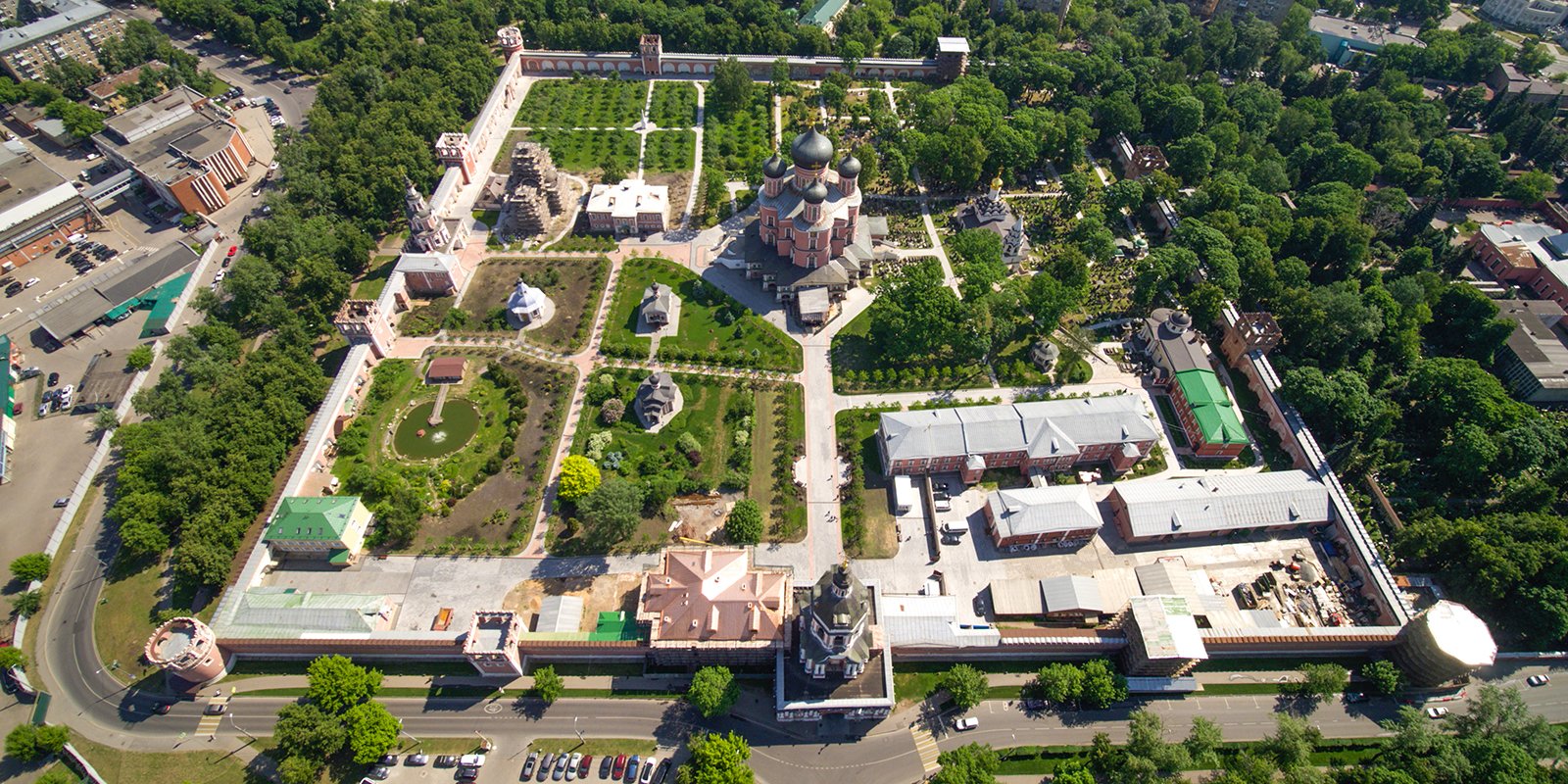
Donskoy Monastery
Donskoy Monastery
Main page
1995553

Donskoy Monastery

logo
Community Hub0 subscribers
Read side by side
from Wikipedia

Donskoy Monastery (Russian: Донско́й монасты́рь) is a major monastery in Moscow, founded in 1591[1] in commemoration of Moscow's deliverance from the threat of an invasion by the Crimean Khan Kazy-Girey. Commanding a highway to the Crimea, the monastery was intended to defend southern approaches to the Moscow Kremlin.

Key Information

History

[edit]

Muscovite period

[edit]
Our Lady of the Don, by Theophanes the Greek

The monastery was built on the spot where Boris Godunov's mobile fortress and Sergii Radonezhsky's field church with Theophan the Greek's icon Our Lady of the Don had been located. Legend has it that Dmitry Donskoy had taken this icon with him to the Battle of Kulikovo in 1380. The Tatars left without a fight and were defeated during their retreat.

Initially, the cloister was rather poor and numbered only a few monks. As of 1629, the Donskoy Monastery possessed 20 wastelands and 16 peasant households (20 peasants altogether). In 1612, it was taken for one day by the Polish-Lithuanian commander Jan Karol Chodkiewicz. In 1618, the Battle of Donskoy Monastery [uk] took place between Russian Cavalry and Ukrainian Cossacks of Petro Konashevych, which ended in Cossack victory.

In the mid-17th century the monastery was attached to the Andreyevsky Monastery. In 1678, however, its independence was reinstated and the cloister received rich donations, including more than 1,400 peasant households. In 1683, the Donskoy Monastery was elevated to the archmandrite level and given 20 desyatinas of the nearby pasturelands. Vidogoshchsky, Zhizdrinsky, Sharovkin, and Zheleznoborovsky monasteries were attached to the Donskoy Monastery[2] between 1683 and 1685.

Imperial period

[edit]

Since 1711, the Great Cathedral's vault was used for burials of Georgian tsarevichs of the Bagrationi family and Mingrelian dukes of the Dadiani family.

In 1724, the monks and the property of the Andreyevsky Monastery were transferred to the Donskoy Monastery. By 1739, it had already possessed 880 households with 6,716 peasants, 14 windmills, and a few fisheries. In 1747, the authorities wanted to transfer the Slavic Greek Latin Academy to the Donskoy Monastery, but the cloister confined itself to paying salaries to the academic staff from its own treasury.

Archbishop Ambrose (Zertis-Kamensky) was killed within the monastery walls during the Plague Riot in 1771. In 1812, the French army ransacked the Donskoy Monastery,[3] the most valuable things having been moved to Vologda prior to that. There had been 48 monks and 2 novices in the monastery by 1917.

Soviet period and beyond

[edit]
The Bagrationi burial vault contains the remains of Archil of Imereti and Vakhushti of Kartli

After the October Revolution, the Donskoy Monastery was closed. In 1922–1925, Patriarch Tikhon was detained in this cloister after his arrest. He chose to remain in this monastery after his release. Saint Tikhon's relics were discovered following his canonization in 1989. They are exhibited for veneration in the Great Cathedral in summer and in the Old Cathedral in winter.

The Soviet authorities moved remnants of many monasteries and cathedrals they had destroyed or used for other purposes to the Donskoy Monastery. The items came from various places in the Soviet capital: the dynamited Cathedral of Christ the Savior, the Church of Saint Nicholas the Wonderworker in Stolpy, the Church of the Assumption on Pokrovka Street, the Sukharev Tower, and others.

In 1924, some of the facilities of the Donskoy Monastery were occupied by a penal colony for children. A more notorious use was the unmarked burial of those shot and cremated by the secret police between 1934 and the 1950s. Only after 1985 were such unmarked burials remains finally marked.[4]

After the collapse of communism and the establishment of the Russian Federation, the Monastery was returned to the Russian Orthodox Church in 1992. Over the next ten years full lists were finally compiled of those buried in the monastery graveyard and other locations in and around the Russian capital.[5]

Architecture

[edit]

When the monastery was established, Boris Godunov personally laid the foundation stone of its cathedral, consecrated in 1593 to the holy image of Our Lady of the Don. This diminutive structure, quite typical for Godunov's reign, has a single dome crowning three tiers of zakomara. In the 1670s, they added two symmetrical annexes, and a refectory leading to a tented belltower. Its iconostasis, executed in 1662, formerly adorned one of Moscow churches demolished by the Communists. From 1930 to 1946, the cathedral was closed for services and housed a factory.

The New (or the Great) Cathedral, also dedicated to the Virgin of the Don, was started in 1684 as a votive church of Tsarevna Sophia Alekseyevna. After she fell into disgrace, its construction was funded by private donations. The masons and artisans were invited from Ukraine, which explains some of the cathedral's unusual features. For the first time in Moscow, the five domes were arranged according to the four corners of the Earth (as was the Ukrainian custom). The Old Believers felt offended by this and called the cathedral "Antichrist's Altar". Eight tiers of its ornate baroque iconostasis were carved by Kremlin masters in 1688–1698. The iconostasis' central piece is a copy of the Virgin of the Don, as painted in the mid-16th century. The cathedral frescoes are the first in Moscow to be painted by a foreigner. They were executed by Antonio Claudio in 1782–1785.

After the monastery lost its defensive importance, its walls were reshaped in the red-and-white Muscovite baroque style, reminiscent of the Novodevichy Convent. Eight square and four circular towers with red-blood crowns were put up in 1686–1711. The Holy Gates of the monastery (1693) are topped with the Tikhvin church (1713–1714), noted for its wrought iron grille. A lofty belfry was erected over the western gates from 1730–1753 after designs sometimes attributed to Pietro Antonio Trezzini.

Necropolis

[edit]
Old necropolis of the Donskoy Monastery.

Several families of high aristocracy chose the Donskoy monastery as location of their burial vaults. The Alexander Svirsky Church, for instance, was constructed in 1796–1798 as a sepulchre of Princes Zubov. Princes Galitzine were buried in the Archangel Church (1714–1809), whereas the Church of St. John Chrysostom (1881–1891) marks the Pervushin family vault.

The old necropolis in the south-eastern part of the monastery is remarkable for its ornate tombs, executed by some of the best Russian sculptors. They mark the graves of the poets Mikhail Kheraskov and Alexander Sumarokov, the philosophers Pyotr Chaadaev and Ivan Ilyin, the historians Mikhail Shcherbatov and Vasily Klyuchevsky, the critic Vladimir Odoyevsky, the architect Osip Bove, the painter Vasily Perov, the courtier Alexander Dmitriev-Mamonov, the notorious murderer Daria Saltykova, and the aviator Nikolay Zhukovsky. Tikhon of Moscow is interred underneath the old katholikon. Some of the tombs were transferred by Soviet authorities to the Shchusev Museum of Architecture, where no one can see them now.

Since no Communists were buried in the old necropolis inside the monastery, the relatives of some notable Russian Whites decided to move their remains from foreign cemeteries to the Donskoy Monastery. Among the notable people reburied in this way are Ivan Shmelyov (2000), Vladimir Kappel (2007), Anton Denikin (2005), and Ivan Ilyin (2005). Soviet dissident Aleksandr Solzhenitsyn also asked to be buried there, rather than at the Novodevichy Cemetery, with its Communist associations.

A large new necropolis was inaugurated in 2010 just outside the monastery walls. It contains three mass graves of the cremated ashes of executed political prisoners from Joseph Stalin's Great Purge. See New Donskoy Cemetery for details.

References

[edit]
[edit]
Revisions and contributorsEdit on WikipediaRead on Wikipedia
from Grokipedia
The Donskoy Monastery is a fortified monastery of the Russian Orthodox Church in southern Moscow, founded between 1591 and 1593 by Tsar Feodor I at the location where Russian defenders successfully repelled an assault by Crimean Khan Ghazi II Giray during his 1591 campaign against the city.[1][2] Established initially as a repository for the Icon of Our Lady of the Don—a revered image associated with earlier Russian military victories, including those of Grand Prince Dmitry Donskoy—the monastery served defensive purposes with its high brick walls and towers, contributing to Moscow's southern fortifications.[3][4] From the 17th century onward, it developed into a major necropolis for Russian nobility and clergy, preserving ornate tombs crafted by prominent sculptors and remaining one of the largest intact burial grounds of its kind in the city despite Soviet-era pressures; notable interments include writer Alexander Solzhenitsyn.[5][6] The architectural ensemble includes the five-domed Great Cathedral of the Theotokos of the Don in red-and-white Muscovite Baroque style, alongside smaller churches and gate structures, underscoring its enduring role as a spiritual and historical landmark.[2][7]

History

Founding and Muscovite Origins (1591–17th Century)

In 1591, Moscow faced an imminent invasion by the forces of Crimean Khan Ghazi II Giray, prompting Tsar Fyodor I Ioannovich to organize a procession bearing the revered Icon of the Theotokos of the Don around the city's walls, after which the Tatar horde retreated without engaging in major battle.[8] [9] To commemorate this deliverance, Fyodor I established the Donskoy Monastery in 1593 on the "wild field" site where Russian troops had encamped in defense, naming it after Grand Prince Dmitry Donskoy, victor at the Battle of Kulikovo in 1380, whose legacy was invoked through the icon's protective role.[8] [1] The monastery initially featured a temporary wooden church dedicated to St. Sergius of Radonezh, housing the Don Icon, followed by the construction of the stone Small Cathedral of the Theotokos of the Don, begun shortly after founding and possibly overseen by master builder Fyodor Kony.[8] Conceived as a fortified outpost, the Donskoy Monastery formed part of Moscow's ring of defensive religious institutions, guarding the southern approaches along the Kaluga road against steppe raiders.[8] During the Time of Troubles in the early 17th century, Polish forces under Hetman Khodkevich overran and looted the site, leading to temporary abandonment, though by 1629 it held modest lands including 20 wastelands and 16 peasant households.[8] [4] Revival occurred in the 1620s under Tsars Mikhail Fyodorovich and Alexei Mikhailovich, who supported repairs and restoration, restoring its role as a spiritual and military bastion.[8] By mid-century, the monastery experienced administrative subordination to the Andreyevsky Monastery but regained independence in 1678, enhancing its autonomy amid growing Muscovite centralization.[3] Late 17th-century developments under Tsarevna Sophia Alekseyevna elevated its prominence, with construction of the large five-domed New (Big) Cathedral of the Theotokos of the Don commencing in 1684 and completing by 1699, alongside initial fortification efforts that included brick walls and towers modeled after those of the Novodevichy Convent.[8] [10] These expansions underscored the monastery's enduring defensive function and integration into the Tsardom of Muscovy's strategic landscape, transitioning from frontier watchpost to a key ecclesiastical center by century's end.[8]

Imperial Expansion and Prominence (17th–Early 20th Century)

During the 17th century, the Donskoy Monastery underwent significant expansion and fortification amid Moscow's defensive needs. In the mid-17th century, it was temporarily attached to the Andreyevsky Monastery but regained independence in 1678, receiving enhanced privileges.[11] Construction of the Bolshoy Sobor (Big Cathedral) of the Don Icon of the Mother of God commenced in 1684 under the patronage of Regent Sophia Alekseyevna, completing around 1698 in Moscow Baroque style, featuring a six-tier carved iconostasis.[8] [12] Between 1686 and 1711, robust stone walls and towers were erected, modeled after those of the Novodevichy Convent, strengthening the monastery's role as a southern bastion against Tatar incursions.[8] The monastery emerged as a site of imperial prominence, attracting pilgrimages from Tsars Mikhail Fyodorovich and Alexei Mikhailovich in the 1620s and serving as a royal spiritual center.[8] In 1705, Peter I designated it a hub for Russo-Georgian relations, leading to the burial of approximately 150 Georgian royals and nobles, including in the Sretensky Church mausoleum.[8] Granted stavropegial status in 1745 by Empress Elizabeth, it underscored direct subordination to the patriarch, elevating its ecclesiastical stature. By the late 18th century, its necropolis had become a primary repository for Moscow's nobility, amassing wealth through endowments and interments, particularly after the 1771 plague.[8] [13] The 19th century saw continued significance as a fortified necropolis and religious landmark, surviving damage from Napoleon's 1812 occupation with most structures intact.[8] It ranked among Moscow's wealthiest monasteries by century's end, hosting burials of prominent figures and maintaining defensive walls that symbolized imperial resilience. Into the early 20th century, the monastery retained its prestige until the 1917 Revolution; Patriarch Tikhon was confined there from 1923 until his death on April 7, 1925, and interred in the Maly Sobor.[8]

Soviet Suppression and Secularization (1917–1991)

Following the October Revolution, the Donskoy Monastery was closed by Bolshevik authorities in 1917 as part of the broader campaign against religious institutions, which legally ceased its operations in 1918 while monastic life persisted informally into the late 1920s.[11][14] The site's religious functions were curtailed through expulsions of clergy and laity, arrests beginning in March 1922, and the repurposing of structures for secular use, reflecting the Soviet state's enforcement of militant atheism via GPU surveillance and restrictions on worship.[14] Patriarch Tikhon of Moscow, detained amid escalating persecution, was confined under house arrest at the monastery from May 1922 until his death on April 7, 1925, under armed guard with limited religious activities permitted; he was interred in an unmarked grave on the grounds.[11][14] By 1927, one of the monastery's churches was converted into Moscow's first Soviet crematorium, further eroding its ecclesiastical role.[15] In 1934, the complex was transferred to the Museum of Architecture under the Academy of Architecture of the USSR, serving as a repository for salvaged fragments from demolished pre-revolutionary churches, including reliefs from Christ the Savior Cathedral and sculptures such as the Angel of Joy memorial, effectively transforming it into an "architectural necropolis" while suppressing active monasticism.[16][15] Limited religious services resumed in the Maly (Old) Cathedral in 1946, continuing daily with a choir until the 1960s, after which Khrushchev-era pressures reduced them to holidays following a parish merger.[11][16] In 1964, it became a branch of the Shchusev State Museum of Architecture, prioritizing preservation of artifacts over restoration of worship amid ongoing state control.[16] This partial continuity spared the monastery from total destruction—unlike many Orthodox sites razed during the 1930s purges—but entrenched its secularization until the USSR's dissolution.[15]

Post-Soviet Revival and Continuity (1991–Present)

Following the dissolution of the Soviet Union, the Donskoy Monastery was returned to the Russian Orthodox Church in 1991, marking the beginning of its revival after decades of secularization and closure. In 1990, the Moscow Soviet executive committee had already transferred seven of the monastery's churches to ecclesiastical control, enabling the resumption of monastic life from 1991 onward, with the first abbot appointed to oversee the restoration efforts. Divine services recommenced on November 21, 1991, in one of the main churches, restoring the site's role as an active Orthodox religious center.[17][18] The revival process included significant archaeological and restorative milestones, such as the 1992 discovery of the relics of Patriarch Tikhon, who had resided at the monastery during his 1923 detention by Soviet authorities, underscoring the site's historical continuity with pre-revolutionary Orthodox leadership. However, challenges arose early, including an arson attack in early 1992 that severely damaged the interior of the Small Cathedral of the Theotokos of the Don, necessitating extensive repairs. Ongoing restoration has focused on the monastery's fortifications, with Moscow government initiatives in 2019 allocating funds for repairing the walls and towers, preserving the 17th-century defensive structures amid broader efforts to rehabilitate dozens of cultural monuments on the grounds.[19][20][21] Today, the monastery maintains continuity as a stavropegial institution under direct patriarchal jurisdiction, hosting active monastic communities, liturgical services, and preservation of its historic necropolises, which include old and new burial grounds with notable interments. Recent renovations have enhanced the site's accessibility and aesthetic integrity, with major works continuing into the 2020s to restore the ensemble's original appearance distorted by wartime damage and Soviet-era neglect. This revival reflects broader post-1991 trends in Russia's religious restitution, where over 20,000 church properties were returned, reinvigorating Orthodox monastic traditions while adapting to contemporary preservation standards.[8][22][21]

Architecture and Fortifications

Core Religious Structures

The core religious structures of Donskoy Monastery center on the cathedrals dedicated to the Icon of Our Lady of the Don, a revered 14th-century image credited with aiding Russian victories, including the Battle of Kulikovo in 1380. These buildings embody the monastery's foundational role in commemorating Moscow's defense against Crimean Tatar incursions in 1591. The primary edifices include the Small and Great Cathedrals of Our Lady of the Don, supplemented by gate churches integral to the site's liturgical and defensive functions.[2][1] The Small Cathedral of Our Lady of the Don, erected between 1591 and 1593 shortly after the monastery's founding under Tsar Feodor I, serves as the original temple housing the eponymous icon transferred from the Kremlin in 1592. Possibly designed by the architect Fyodor Kon, who was active in Moscow during this period, it exemplifies early Muscovite stone architecture with a single dome crowned by a pyramid of ornate kokoshnik gables. Its modest scale and elegant proportions distinguish it amid later Baroque expansions, preserving an unadorned interior focused on the icon's veneration.[1][2] The Great Cathedral of Our Lady of the Don, constructed from 1684 to 1698, represents the monastery's architectural pinnacle in the Naryshkin Baroque style, featuring five onion domes, red-brick walls accented with white stone, and a surrounding roofed gallery added in 1717. This larger structure accommodated growing pilgrim numbers and monastic needs, boasting a six-tier carved iconostasis in elaborate Moscow Baroque detailing. It now contains relics of Patriarch Tikhon of Moscow and a copy of the original Don icon, relocated to the Tretyakov Gallery in the 20th century.[1][2] The Gate Church of the Theotokos of Tikhvin, positioned above the northern holy gates and completed in 1713–1714, integrates liturgical space with access control in an octagon-on-cube form typical of the era. Dedicated to another miraculous icon of the Virgin, it facilitated processions and entry rites, underscoring the monastery's blend of piety and fortification.[1][2]

Defensive Walls and Towers

The defensive walls and towers of Donskoy Monastery were erected between 1686 and 1711, forming a fortified enclosure around the complex with 12 towers comprising four corner towers and eight intermediate ones along the perimeter.[1][23] These structures replaced earlier wooden fortifications and were designed in accordance with Russian defensive traditions, incorporating loopholes for archery and musket fire, banquettes for standing defenders, and covered combat walkways atop the walls to enable movement and sustained resistance against assaults.[24][25] Architecturally, the towers exhibit a mix of square and octagonal forms at the corners and intermediates, topped with decorative brick crowns resembling those of contemporary Muscovite fortifications, such as the walls of Novodevichy Convent, which share identical stylistic elements including patterned brickwork and machicolations.[26][27] The walls themselves, constructed from brick with stone dressings, averaged 2-3 meters in thickness at the base, providing substantial resistance to siege engines of the era, and originally included a central semi-tower on the eastern facade that was demolished in 1804 to facilitate urban expansion.[28] This fortification system underscored the monastery's strategic role in safeguarding Moscow's southern approaches against incursions, particularly from Crimean Tatar raids, aligning with its founding purpose as a bulwark near key invasion routes.[4] During the Napoleonic invasion of 1812, the walls sustained damage from French artillery but were subsequently repaired, preserving their defensive integrity into the 19th century.[1] Major restorations occurred in the mid-20th century following Soviet-era neglect, with targeted work on individual towers continuing into the 21st century, including tower No. 12 on the western wall completed by 2020 to address weathering and structural decay while retaining original defensive features.[25][29]

Auxiliary Buildings and Grounds

The auxiliary buildings of Donskoy Monastery encompass service and residential structures supporting monastic operations, distinct from core religious edifices and fortifications. A refectory was constructed in 1679, adjoining a tent-roofed bell tower erected over the western gate in the same year, with the bell tower's completion extending into the 18th century through phased additions.[30][24][2] These elements facilitated communal dining and signaling functions within the monastery's daily rhythm. In the mid-18th century, expansions included the archimandrite's chambers built between 1745 and 1750, alongside a seminary building and stables to accommodate educational and logistical needs.[31] The abbot's house, exemplifying mid-18th-century Moscow residential architecture, forms part of a usadba-style complex with an integrated garden and a kitchen originally functioning as a bathhouse.[18] The monastery's grounds occupy a substantial enclosed territory, incorporating landscaped gardens adjacent to administrative buildings and expansive areas that historically buffered the complex amid Moscow's urban growth.[2] These spaces, preserved within the fortified perimeter, continue to serve contemplative and maintenance purposes, with ongoing restorations addressing wear from centuries of use.[21]

Necropolis

Origins and Old Necropolis

The old necropolis of the Donskoy Monastery originated in the late 17th century, initially serving as a burial site adjacent to the monastery's religious structures for monks and select lay individuals associated with the institution.[32] By the early 18th century, extra-temple burials expanded, attracting Moscow's nobility who began constructing family vaults and tombs within the grounds, establishing it as a prestigious necropolis. This development coincided with the monastery's role in fostering Russo-Georgian cultural and diplomatic ties, leading to the creation of a distinct Georgian section featuring ornate graves of Georgian nobility and clergy resettled in Russia under Peter the Great's policies.[33] A pivotal phase began in 1771 amid the Moscow plague epidemic, when Empress Catherine II issued a decree banning burials within city limits to curb disease spread, redirecting interments to suburban sites like the Donskoy Monastery cemetery.[34] This resulted in rapid expansion, with the necropolis filling with graves of aristocrats, military officers, and cultural figures; families such as the Golitsyns, Volkonskys, Obelenskys, and Naryshkins built elaborate stone mausolea and crypts, often adorned with neoclassical sculptures and inscriptions reflecting imperial-era aesthetics. By the early 19th century, historian Nikolay Karamzin documented it in his History of the Russian State as a prominent Moscow cemetery, underscoring its status among the elite.[32] The old necropolis, encompassing roughly half the monastery's territory, preserved over 200 noble tombs by the 20th century, featuring diverse architectural styles from Baroque vaults to Empire-style monuments, though many suffered damage during Soviet secularization when the site was repurposed for storage and mass graves.[32] Its aristocratic character stemmed from high burial costs and exclusivity, limiting access to high-ranking families until space constraints in the late 19th century prompted expansions beyond the walls.[35] Preservation efforts post-1991 have focused on restoring these vaults, revealing inscriptions and artifacts that document lineages tied to Russia's imperial history.[36]

New Necropolis and 19th-Century Expansions

The necropolis within Donskoy Monastery expanded significantly during the 19th century, driven by its growing reputation as Moscow's premier burial ground for nobility, merchants, and cultural elites following restrictions on intra-city interments after the 1771 plague.[34] Burials accelerated as aristocratic families commissioned elaborate tombs and chapels, transforming the site into the largest preserved noble necropolis of the 18th–19th centuries in the city, occupying nearly half the monastery's territory with over 2,000 documented graves by century's end.[32] Space constraints within the fortified walls prompted the creation of the New Donskoy Cemetery (Novoye Donskoye Kladbishche) in the late 19th century, immediately south of the monastery as a direct extension for ongoing interments.[37] [38] This new necropolis, initially developed to alleviate overcrowding, incorporated family plots and monumental sculptures akin to the old section, hosting burials of notable figures such as descendants of literary icons and military officers.[39] Architectural enhancements tied to funerary needs included minor 19th-century modifications to existing structures, such as the addition of sepulchral elements to churches like the Alexander Svirsky Church (originally built 1796–1798 but adapted for ongoing use), underscoring the monastery's evolving role in accommodating elite commemorative practices without major new constructions. By the early 20th century, the new cemetery's inauguration around 1910 formalized this expansion, enabling sustained growth until Soviet-era repurposing.[39][40]

Notable Interments and Preservation Challenges

The necropolis of Donskoy Monastery encompasses burials from noble families such as the Golitsyns and Zubovs, who constructed private chapels starting in the late 18th century following Catherine II's 1771 edict prohibiting intra-city cemeteries.[41] Among the most prominent 20th-century interments is Patriarch Tikhon of Moscow, who died on April 7, 1925, and was buried in an unmarked grave within the monastery grounds during his detention by Soviet authorities from 1923 to 1924.[41] Post-Soviet reinterments include anti-communist figures repatriated from abroad: General Anton Denikin and philosopher Ivan Ilyin in 2005, and General Vladimir Kappel on January 13, 2007, reflecting the site's role in honoring White Army leaders from the Russian Civil War.[42][41] Other notable graves feature cultural and scientific luminaries, such as writer Alexander Solzhenitsyn, interred on August 6, 2008; artist Vasily Perov; and Nikolai Zhukovsky, regarded as the father of Russian aerodynamics, alongside his family.[42][41] These burials underscore the necropolis's evolution from an aristocratic site to a repository for dissidents and émigrés, with historians and restorers credited for safeguarding many pre-1917 graves against Bolshevik-era demolitions.[42] Preservation efforts faced severe setbacks during the Soviet period (1917–1991), when the monastery was secularized, closed as a religious institution, and repurposed as a museum, leading to partial neglect and loss of historical context for the necropolis.[36] Monumental stone sculptures—crafted from marble, limestone, sandstone, and granite—suffer ongoing degradation from exposure to acidic and alkaline atmospheric conditions, accelerating erosion in the open-air environment.[36] Comprehensive restorations from 2013 to 2021 addressed these issues through scientific methods, including repairs to artistic tombstones in the Don Necropolis (functioning as an open-air museum), the Old Cathedral, and associated chapels, while integrating archival research on architectural styles.[36] Despite progress, challenges persist in maintaining structural integrity amid urban pollution and the need for continuous funding to prevent further deterioration of irreplaceable 18th–19th-century memorials.[36]

Religious and Historical Significance

Association with the Donskoy Icon and Orthodox Tradition

The Donskoy Icon, formally known as the Don Icon of the Mother of God, is an ancient wonderworking image painted by the Byzantine master Theophanes the Greek in the late 14th century.[43] This icon, depicting the Virgin Mary holding the Christ Child in a variant of the Hodegetria type, first achieved renown during the Battle of Kulikovo on September 8, 1380, when Don Cossacks presented it to Grand Prince Dmitry Ivanovich (later titled Donskoy) on the eve of the engagement.[44] Carried into battle by Dmitry, the icon is credited in Orthodox tradition with inspiring Russian forces to decisively defeat the Tatar army under Khan Mamai, marking a pivotal moment in the liberation from Mongol overlordship and earning Dmitry his epithet "Donskoy."[44] The victory, coinciding with the Feast of the Nativity of the Theotokos, reinforced the icon's status as a heavenly patroness of Russian arms.[45] In 1591, as Crimean Khan Nurredin approached Moscow with a vast horde, Tsar Fyodor I ordered the Donskoy Icon processionally carried atop the city's walls, beseeching divine protection; remarkably, the invaders withdrew without mounting an assault, dispersing amid reports of internal discord and omens.[46] This event prompted the foundation of the Donskoy Monastery in 1592 at the precise location where the icon had been positioned during the defense, under the patronage of Fyodor and regent Boris Godunov, as an act of thanksgiving for the Theotokos's perceived intercession.[46] The monastery thus became intrinsically linked to the icon, housing it as its chief relic and constructing the Great Cathedral of the Theotokos of the Don (1593–1596) as its spiritual heart, where the image resides and miracles are attributed to it.[2] Within Russian Orthodox tradition, the Donskoy Icon embodies protective maternal intercession against existential threats, with its feast observed on August 19 (Old Style September 1), commemorating both its revelation and subsequent deliverances.[46] Pilgrims and faithful invoke it for victory over adversaries, drawing on hagiographic accounts of its role in repelling invasions, and the monastery serves as a center for liturgical veneration, including akathists and molebens dedicated to the icon's wonderworking power.[44] This association underscores the monastery's enduring significance as a bastion of Orthodox piety, intertwining historical memory with devotional practice unbound by later secular reinterpretations.

Role in Russian Military and National Identity

The Donskoy Monastery was established between 1591 and 1593 by order of Tsar Feodor I at the site where Russian forces successfully repelled an invasion by Crimean Khan Ğazı II Giray on July 4, 1591, thereby commemorating Moscow's deliverance from a southern Tatar threat.[1] Designed as a fortified outpost commanding the highway to Crimea, the monastery served to bolster the defense of Moscow's southern approaches to the Kremlin, integrating religious architecture with military functionality through robust walls, towers, and strategic positioning.[4] Throughout its history, it contributed to the protection of Moscow's borders against recurrent incursions, underscoring the Orthodox Church's role in supporting Russia's martial endeavors.[3] Its nomenclature and core iconography link directly to Grand Prince Dmitry Donskoy (1350–1389), who carried the revered icon of Our Lady of the Don into the Battle of Kulikovo on September 8, 1380, where Russian forces achieved a decisive victory over the Golden Horde under Mamai, marking a turning point in the erosion of Mongol dominance over Rus' principalities.[11] According to Orthodox tradition, the icon's presence inspired the troops and ensured triumph, embedding the monastery within narratives of divine patronage for Russian military success.[47] This association elevated Dmitry Donskoy to sainthood as a defender of Orthodoxy, symbolizing the fusion of faith, princely leadership, and national resilience against foreign overlords. In the broader tapestry of Russian national identity, the monastery embodies the historical interplay between Orthodox spirituality and state defense, portraying military victories as providential affirmations of Moscow's destiny as the Third Rome.[48] The 1591 foundation reinforced this by echoing Kulikovo's themes of repulsion of steppe nomads, fostering a collective memory of endurance and territorial sovereignty. In the 20th century, the 2005 reburial of White Army General Anton Denikin at the monastery's necropolis highlighted its enduring role as a repository for national military heroes, bridging imperial, civil war, and post-Soviet eras in reclaiming a unified Russian heritage.[49]

Cultural and Artistic Legacy

The Donskoy Monastery's artistic legacy centers on its ecclesiastical art, particularly the iconostases and icons in its principal cathedrals, which exemplify late 17th-century Muscovite Baroque craftsmanship blended with traditional Russian iconography. The Great Cathedral of the Theotokos of the Don features a monumental eight-tiered carved iconostasis from the 17th century, adorned with icons in the Fryazhsky style—a Russian icon-painting tradition incorporating Western European influences such as enhanced realism and perspective.[6] This iconostasis, restored in stages including major work in 2011, remains a key example of ornate wooden carving and gilded detailing typical of pre-Petrine Russian sacred art.[50] The monastery's namesake relic, the Don Icon of the Mother of God, originally housed in the Great Cathedral, represents a cornerstone of its cultural patrimony; this 14th-century image, linked to Dmitry Donskoy's victory at Kulikovo in 1380, embodies Orthodox veneration of protective icons and was relocated to the Tretyakov Gallery for preservation, with replicas maintaining its liturgical role.[2] Wall frescoes in the Great Cathedral, executed between 1782 and 1785 by the Italian artist Antonio Claudio (also known as A.I. Claudio), mark the first instance of foreign-painted frescoes in Moscow, introducing neoclassical elements to Russian ecclesiastical decoration while adhering to Orthodox thematic conventions of saints and scriptural scenes.[11] During the Soviet era, the monastery's conversion into a repository for displaced artifacts in 1934—establishing it as the Museum of Russian Antiquities—safeguarded significant cultural treasures, including high-relief sculptures from the demolished Cathedral of Christ the Saviour and decorative elements from historic Moscow churches, preventing their destruction amid widespread iconoclasm.[51] Post-1991 restorations, such as the 1996 refurbishment of frescoes and iconostases in auxiliary churches, have revived these elements, underscoring the site's enduring role in preserving and displaying Russian Orthodox artistic traditions amid 20th-century upheavals.[52] The ensemble's architecture, with its fortified walls, domed cathedrals, and gated complexes, further contributes to Moscow's skyline as a testament to 17th-18th century defensive-monastic design, influencing later Russian ecclesiastical aesthetics.[2]

References

User Avatar
No comments yet.