Hubbry Logo
Doughoregan ManorDoughoregan ManorMain
Open search
Doughoregan Manor
Community hub
Doughoregan Manor
logo
8 pages, 0 posts
0 subscribers
Be the first to start a discussion here.
Doughoregan Manor
Doughoregan Manor
from Wikipedia

Doughoregan Manor
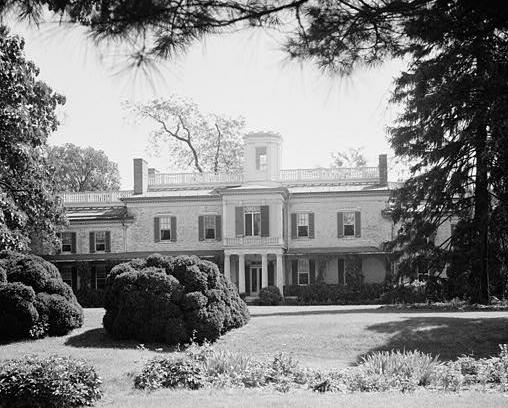
Doughoregan Manor, 1936
Doughoregan Manor is located in Maryland
Doughoregan Manor
Doughoregan Manor is located in the United States
Doughoregan Manor
LocationManor Lane, Ellicott City, Maryland
Coordinates39°16′36″N 76°53′35″W / 39.27667°N 76.89306°W / 39.27667; -76.89306
Area900 acres (360 ha) (landmarked area)
Builtest. 1727[2]
Architectural styleGreek Revival
NRHP reference No.71000376[1]
Significant dates
Added to NRHPNovember 11, 1971
Designated NHLNovember 11, 1971

Doughoregan Manor (door-AY-gen) is a plantation house and estate located on Manor Lane west of Ellicott City, Maryland, United States. Established in the early 18th century as the seat of Maryland's prominent Carroll family, it was home to Founding Father Charles Carroll, a signer of the United States Declaration of Independence, during the late 18th century. A portion of the estate, including the main house, was designated a National Historic Landmark on November 11, 1971. It remains in the Carroll family as a private working farm. The estate and Manor Lane are closed to the public as of 2025.[citation needed]

History

[edit]
Doughoregan Slave Quarters
Carriage House circa 1940

Doughoregan Manor is a colonial manor house built in the early 18th century.[3] The slave plantation was founded on 7,000 acres patented to Charles Carroll I as "Doughoreagan" (sometimes spelled Doororegan) named for a family estate in Ireland, in 1702, and expanded to 10,000 acres as "Doughoreagan Manor" in 1717.[4][5][6] The Georgian brick plantation house, built by Charles Carroll II around 1727, was enlarged and remodeled in 1832 by Charles Carroll V in the Greek Revival style.

From 1766 to 1832, Doughoregan Manor was the country home of Charles Carroll of Carrollton, (Charles Carroll III) last surviving signer of the Declaration of Independence. He lies buried in the chapel attached to the north end of the mansion. Notable guests that have visited the manor include George Washington, Thomas Jefferson, John Adams, John Hancock, Benjamin Franklin, James Monroe, and Marquis de Lafayette.[7] In 1861, the manor became the home of John Lee Carroll, who became Governor of Maryland.[8]

In its current configuration the Manor is a brick, two-storied, U-shaped building. The roof is in gabled sections, some with balustraded decks, and in the center is an octagonal cupola. The front center entrance has a one-story tetrastyle Doric portico and is similar to the rear portico. The chapel and kitchen are attached to the main block by hyphens.

The private chapel attached to the manor house was built at a time when the founding of Roman Catholic parish churches was prohibited in the colony. The chapel served as the primary meeting place for the local Catholic community until as late as 1855 when nearby parishes were founded. The chapel continued to be open to the public on Sunday mornings for Mass until the 1990s.

A vineyard was planted by Charles Carroll of Annapolis in 1770 with four types of grapes. The vineyard was maintained into 1796, becoming one of the longest surviving colonial vineyards in the United States.[9] A postal office served the manor from 18 September 1876 to 31 August 1907.[10] The manor became the site for the yearly Howard County Horse Show through the 1930s, attracting thousands.[11] The "Manor Dairy" opened in 1962 providing milk and dairy products.[12]

The Carroll family were enthusiastic horse breeders and raced thoroughbreds, competing with other well-to-do families at annual racing events, which also formed an important part of the social and political life of the colony. Charles Carroll of Annapolis's horse was beaten in 1743 by George Hume Steuart's "Dungannon" in the Annapolis Subscription Plate, established that year.

In 1830, Emily Caton MacTavish donated 253 acres to build St. Charles College, Maryland, After a fire in 1911, Carroll family heirs sued to sell the property and divide the proceeds among the family.[13]

During the Civil war, the manor served as a hub for munitions for Southern supporters, also using nearby Mt. Pleasant as a substation.[14] By 1931, the manor estate consisted of the mansion, overseer's house, horse stable, bank barn, 3 silos, corn house, 11 tenant houses, wash house, sheep house, coach house, brick barn and two barracks.[15]

Members of the Carroll family still own and live in the manor, which sits at the center of an 892-acre (3.61 km2; 1.394 sq mi) of the original 13,361.5-acre (54.072 km2; 20.8773 sq mi) estate. Land was divided among the heirs each generation, sold for subdivisions, with at least 2,800-acre (11 km2; 4.4 sq mi) owned by the family as late as 1971 and 2,400-acre (9.7 km2; 3.8 sq mi) by 1977. According to a newspaper article: "As one family member put it a few years ago, 'Only God, the Indians and the Carrolls have owned this land.'"[16]

The estate and Manor Lane are closed to the public.

Tax credits and development plans

[edit]

In 1971, the owner, Phillip Carroll, did not want to commit all 2,042 acres to landmark status, preferring to leave part of it for future development, so about 900 acres were designated landmark status, according to the National Register of Historic Places inventory sheet. However, with the 1976 Tax Reform Act, the owner changed his mind and requested the landmark status encompass all the acreage, which was granted.[17]

The 30-year tax credit and Maryland Historical Trust's easement expired in 2007.[18] In an attempt to keep the majority of the property in the hands of the Carroll family, they struck a deal in 2008 with Erickson Retirement Communities to sell 150 acres, but the deal fell through the following year. Camilla Carroll, co-owner of the estate, insisted that "...there is no money now to restore anything, and historic buildings are falling down as we speak."[19]

The County Commissioners voted in 2010 to pay the Carroll family about 19 million dollars over twenty years to place 500 acres in Howard County's Agricultural Preservation program.[20] The council approved paying to expand the public water and sewer system to the development and the Carrolls would donate 34 acres to expand a county park. 221 acres of Doughoregan Manor were rezoned to allow 325 single-family homes to be built on the north-east side of the property. Many neighbors were concerned with the plans and a petition was filed in circuit court for judicial review of the zoning decision.[21]

In 2015, tax credits were awarded for work on an outbuilding at Doughoregan as one of the nine buildings listed in the 2015 Sustainable Communities Tax Credits of $10 million.[22]

Description

[edit]

The house was originally a 1+12-story brick house, about 30 feet deep and 66 feet wide, with a gambrel roof. A detached brick chapel stood to the north, while a brick kitchen stood to the south. The dependent buildings were incorporated into the main structure in the 1830s by Charles Carroll V, raising the main house's roof to make a two-story structure. The new roof was topped by a balustraded deck with an octagonal cupola. The front (east) facade gained a one-story portico with doric columns. A similar portico to the road was built with a room above, while a marble-floored veranda with iron columns extended to each side. The chapel's roof was raised and it was joined to the main house by a two-story passage, as was the kitchen. The work resulted in a Palladian style five-part house extending almost 300 feet (91 m).[23][24]

The house's interior has a center-hall plan, with the oak-paneled main hall extending the full depth (30 feet) of the house. Stairs are located in a small side hall on the north side. A library, large parlor, small parlor and dining room occupy the first floor, with bedrooms on the second.[23]

See also

[edit]

References

[edit]
[edit]
Revisions and contributorsEdit on WikipediaRead on Wikipedia
from Grokipedia
Doughoregan Manor is an 18th-century estate house located in , serving as the ancestral seat of the prominent Carroll family and the longtime residence of Charles Carroll III of Carrollton, the Maryland delegate who signed the and the last surviving signer at his death in 1832. Constructed around 1727 by Charles Carroll II on land originally patented to the family in the early 1700s, the manor originally featured a Georgian-style brick structure with a roof and end chimneys, later expanded to include a notable attached Catholic chapel for private worship amid Maryland's historical restrictions on Catholic practices. The estate, encompassing thousands of acres at its peak and operated as a self-sufficient reliant on enslaved labor, remains privately owned by Carroll descendants and is preserved as a rare intact example of colonial-era architecture and Revolutionary War-era heritage, listed on the since 1971. Carroll's gravesite lies within the manor chapel, underscoring its role in American founding history, though public access is limited and preservation efforts have involved family-led restorations amid suburban development pressures.

Founding and Early Development

Land Acquisition and Original Construction

Charles Carroll I, known as "the Settler," acquired the original 10,000 acres comprising Doughoregan Manor in 1717 through land grants in Baltimore County (now Howard County), Maryland. This tract formed the core of the estate, though portions trace back to earlier warrants issued to Carroll as early as 1699 for approximately 7,000 acres. The acquisition established a proprietary manor system, reflecting the colonial land distribution practices under the Calvert proprietors, with Carroll leveraging his status as an early Irish Catholic immigrant and planter to secure extensive holdings for agricultural development. The original manor house construction occurred under Charles Carroll II (Charles of Annapolis), son of the Settler, circa 1727, though exact details remain undocumented and subject to historical uncertainty. The structure was built primarily of stone, measuring about 66 feet long and 30 feet deep, with a design suited to a rural residence including living quarters and functional spaces for estate management. This initial build predated major expansions and emphasized durability for the plantation's operations, which included cultivation and early dependencies on enslaved labor.

Colonial Era Expansions and Adaptations

Charles Carroll II, son of the estate's founder Charles Carroll I, oversaw the initial construction of the main around 1727, transforming the raw 10,000-acre acquired by his father in 1717 into a functional Georgian-style residence. The structure featured a one-and-a-half-story with a roof, two pairs of interior end chimneys, and dimensions of approximately 66 feet in length by 30 feet in depth, including principal rooms such as a , large parlor, small parlor, and . This build represented an adaptation to colonial life, emphasizing durable construction suited to 's climate and the family's Catholic practices amid religious restrictions. Further expansions under Charles II around 1750 included a small one-story attached to the north end and a detached wing with to the south, enhancing the estate's self-sufficiency for domestic operations and private worship. These additions supported the manor's role as a working focused on and , reliant on enslaved labor for maintenance and expansion of farmland. Historical records note uncertainties in exact construction dates and builders, with some accounts varying slightly on timelines due to limited surviving documentation from the period. ![Slave quarters at Doughoregan Manor, illustrating colonial-era outbuilding adaptations][float-right]
The , in particular, adapted to the Carrolls' devout Catholicism by providing a secluded space for , bypassing public church bans under colonial penal laws. Outbuildings like these facilitated the estate's evolution from wilderness tract to productive manor, though major enlargements occurred later.

The Carroll Family Legacy

Charles Carroll of Carrollton and Revolutionary Period


Charles Carroll of Carrollton (1737–1832), born in Annapolis on September 19, 1737, inherited and expanded the family estate at Doughoregan Manor following his education abroad in France and England. His father, Charles Carroll of Annapolis, had acquired the land in 1717 and constructed the original brick manor house around 1727, which Carroll III began using as his principal country residence from 1766. By 1782, upon his father's death, Carroll controlled approximately 10,000 acres at Doughoregan, including a plantation worked by 300 enslaved laborers whom he managed with policies aimed at family unity and religious instruction.
As tensions with Britain escalated, Doughoregan Manor functioned as a stable base for burgeoning political involvement, enabling his focus on advocacy despite anti-Catholic restrictions barring him from elective office. Writing under the "First Citizen" in the Maryland Gazette from 1773, Carroll critiqued the and royal authority, arguing that taxation without representation violated fundamental English and paving the way for broader calls for . He hosted gatherings tied to 's committees and conventions from 1774 to 1776, leveraging the estate's resources to support colonial resistance efforts. In July 1776, Carroll contributed to drafting Maryland's state Declaration of Rights and served as a delegate to the Continental Congress, signing the federal on August 2. Concurrently, he joined the ill-fated diplomatic mission to to secure alliance against Britain and sat on the , while overseeing Doughoregan's agricultural operations, which emphasized grain production for wartime sustenance. The manor's financial self-sufficiency, derived from its vast holdings, insulated Carroll from economic pressures that constrained less affluent patriots, allowing sustained commitment to the cause through 1778. He undertook estate expansions in the , adapting structures to bolster productivity amid supply disruptions.

19th and 20th Century Ownership

Upon the death of in 1832, Doughoregan Manor passed to his grandson, Colonel Charles Carroll V (1801–1862), son of his predeceased son Charles Carroll Jr., who assumed residence and became the first family member styled "of Doughoregan." Carroll V, who had married Mary Digges Lee in 1826, oversaw the estate during a period of agricultural operations reliant on enslaved labor, though the property faced financial strains common to large Southern-style plantations in the antebellum era. He died on September 22, 1862, leaving the manor to his heirs amid the disruptions of the Civil War. Following Charles V's death, his son John Lee Carroll (1839–1914) managed the plantation as executor of the estate, continuing operations that included over 100 enslaved individuals emancipated by 1864 in line with Maryland's constitutional abolition. In 1876, John Lee Carroll acquired full ownership by purchasing the manor from his brother Charles Carroll for an undisclosed sum, consolidating family control during his tenure as Maryland's governor from 1876 to 1880. Under his stewardship, the estate functioned as a working farm producing crops and livestock, with Carroll residing there until his death on March 20, 1914; during this era, the property spanned approximately 13,000 acres, though gradual sales reduced its size. In the early , ownership transferred to John Lee Carroll's son, Colonel Philip Acosta Carroll (1879–1957), a New York attorney who maintained the manor as a private agricultural operation while documented in Historic American Buildings Survey photographs of outbuildings in and 1940. After Philip's death in 1957, the estate remained in the hands of Carroll descendants, including divisions among heirs such as Nina E. Carroll's children by the late , with portions preserved as farmland amid encroaching suburban development in Howard County. By the 2000s, direct descendants continued private ownership of roughly 800–900 acres, operating it as a working farm closed to the public and resisting development pressures to retain its historic integrity.

Architectural Description

Main House Design and Features

The main house of Doughoregan Manor originated as a one-and-a-half-story structure built circa 1727 by Carroll II, measuring 66 feet in length and 30 feet in depth, featuring a roof and two pairs of end chimneys in the Georgian style. This design reflected typical Chesapeake , with the house serving as the core of the . In the 1830s, Charles Carroll V significantly expanded and remodeled the house, raising it to two full stories and replacing the roof with a topped by a flat deck, balustrade, and octagonal , incorporating Greek Revival elements. The expansions connected the main block to an adjacent via a two-story passageway on the north and to kitchen and servants' quarters on the south, unifying the complex under wooden walkways and a central . Exterior features include a one-story on the west facade supported by four Doric columns, while the east elevation boasts a with an upper room, flanked by one-story verandas featuring iron columns and marble floors. The brick construction remains prominent, with the remodeled form emphasizing and classical proportions characteristic of Greek Revival influences overlaid on the original Georgian framework. Interior layout follows a center hall plan, comprising an oak-paneled main hall, a side hall with , , large and small parlors, and dining room on the ground floor; second-floor bedrooms underwent renovation around 1915. These spaces highlight the house's evolution from a modest colonial to a grand residence accommodating the Carroll family's status.

Outbuildings, Chapel, and Grounds

The at , a one-story brick structure erected around 1780, was originally detached from the main house and served as a private site for Catholic worship amid legal restrictions on the faith in colonial . It later became integrated with the mansion's north end, underwent refurbishment in the 1830s, and hosted the funeral of following his death on November 14, 1832, with his remains interred there. For decades, the chapel opened to the surrounding Catholic community for Sunday services despite prevailing prohibitions. Outbuildings include a detached and , also built circa 1780 in brick, supporting the estate's domestic operations. Surviving structures encompass stone slave quarters dating to the era, when up to 200 enslaved individuals resided and labored on the property. Additional dependencies feature an overseer's cottage, possible laundry house, blacksmith shops, barns, and various farm buildings essential to the agricultural enterprise. These elements reflect the manor's self-sufficient layout, with documented examples preserved through Historic American Buildings Survey photography from the 1930s and 1940s. The grounds span roughly 3,000 acres of working farmland, maintained as a private family estate without public access. Encompassing fields, woodlands, and infrastructural remnants from centuries of cultivation, the landscape underscores Doughoregan's role as a productive agrarian complex rather than a purely ornamental . Approximately 900 acres fall within a designated , preserving key features amid ongoing farm use.

Historical and Cultural Significance

Connection to American Founding

Charles Carroll of Carrollton (1737–1832), inheritor of Doughoregan Manor from his father Charles Carroll of Annapolis, emerged as a pivotal figure in the American Founding through his political activism and financial backing rooted in the estate's vast holdings. Returning to in 1765 after education abroad, Carroll assumed management of the approximately 10,000-acre property in what became Howard County, leveraging its agricultural output—primarily and grain from enslaved labor—to amass wealth estimated at the time to exceed that of any other signer of the Declaration of Independence. This economic foundation enabled his outspoken advocacy for colonial rights against British policies, including authorship of influential essays under the pseudonym "First Citizen" in Maryland's Maryland Gazette from 1773, arguing for representative government and economic self-determination. As tensions escalated, Carroll's residence at Doughoregan served as a base for his revolutionary involvement; elected to Maryland's Provincial Congress in 1775, he pushed for independence despite prevailing anti-Catholic sentiments that barred Catholics from voting and office-holding in the colony until 1776. Delegated to the Second , he arrived in in July 1776 and signed the Declaration of Independence on August 2, becoming the sole Catholic among the 56 signers—a bold act given the document's implicit Protestant framing and the risks of for , which threatened of estates like Doughoregan. His signature, placed last alphabetically, symbolized Maryland's commitment, facilitated by Carroll's persuasion of the state's initially cautious delegation; post-signing, British forces targeted his properties, though Doughoregan escaped direct destruction. Doughoregan's enduring tie to the Founding reflects post-war contributions from the manor, including service in the U.S. Senate (1789–1792), where he championed the Constitution's ratification in —the first state to approve it—and advocated for religious liberty clauses amid debates over Catholic disenfranchisement. The estate hosted family and political gatherings that reinforced ideals, with Carroll educating descendants in republican virtues; he died at Doughoregan on November 14, 1832, the last surviving signer, and was interred in the manor's private chapel, underscoring the property's role as a living emblem of sacrificial patriotism amid religious adversity.

Architectural and Religious Importance

Doughoregan Manor's main house exemplifies , characterized by its elongated 300-foot facade, an octagonal , and a one-story Doric . The structure originated in the early with elements, including stone construction in outbuildings featuring fine quoining, projecting sills, and flat lintels, later adapted with neoclassical additions during the . These features reflect the estate's evolution from a colonial to a monumental residence suited to the Carroll family's status. The attached chapel holds significant religious importance as a private Catholic worship space constructed amid Maryland's anti-Catholic penal laws, which restricted public religious practice for Catholics after the Calvert proprietorship's fall. Built by , it served not only the family but also local Catholics seeking Mass, functioning as the area's primary until at least 1838. , the sole Catholic signer of of Independence, was interred in this chapel upon his death in 1832, underscoring its role in preserving Catholic traditions during a period of discrimination. The chapel's allowance under penal codes for house-attached worship highlights the Carrolls' strategic navigation of legal constraints to maintain their faith.

Preservation and Modern Stewardship

National Recognition and Landmark Status

Doughoregan Manor, encompassing the main house and select portions of the surrounding estate, received designation as a on November 11, 1971, by the U.S. Department of the Interior, acknowledging its exceptional national significance tied to , the sole Catholic signer of the Declaration of Independence, who resided there from 1766 until his death in 1832. This status highlights the property's retention of 18th-century architectural integrity and its role as a rare surviving example of a colonial-era plantation estate linked directly to the American founding era. The landmark designation automatically included Doughoregan Manor in the , maintained by the , which catalogs properties of historical importance at local, state, or national levels; however, the NHL distinction elevates it for its direct association with pivotal events and figures in U.S. history, including Carroll's contributions to the Revolutionary War and early republic. Unlike many contemporaneous sites, the manor remains privately held by Carroll descendants, preserving its original context without public access or federal ownership. No further national-level recognitions, such as status or additional federal awards, have been conferred, though its preservation underscores ongoing federal interest in Revolutionary-era heritage sites.

Tax Incentives and Restoration Efforts

The Carroll family, as private stewards of Doughoregan Manor, has pursued ongoing restoration efforts to maintain the estate's historic structures, including extensive interior and exterior work on the main house and replacement of original windows. These private initiatives have been supplemented by state-level incentives aimed at preserving certified historic properties. In December 2014, awarded $60,000 in state tax credits for the rehabilitation of the Doughoregan Manor Work House, a outbuilding, as part of a $300,000 project converting it to residential use. This funding fell under 's Historic Revitalization Tax Credit program, which provides credits for qualified rehabilitation expenditures on certified historic structures. Earlier proposals in considered allocating millions of dollars alongside tax credits to support broader preservation of the 892-acre estate, reflecting state interest in safeguarding its status amid maintenance challenges. Howard County further aids such efforts through local credits, including those for increased assessed values post-rehabilitation and for installing sprinkler systems in historic sites, though specific applications to Doughoregan Manor beyond state awards remain undocumented in . These incentives underscore a collaborative approach between private ownership and public policy to balance preservation with fiscal viability.

Development Proposals and Local Debates

In the mid-2000s, the Carroll family, stewards of the Doughoregan Manor estate, faced financial pressures from maintenance costs and property taxes on the remaining 892 acres, prompting proposals to develop portions of the land to fund preservation of the historic core. In September 2007, they sought approval for an expansive on part of the estate, envisioning age-restricted housing integrated with the rural character to generate revenue while limiting broader suburban sprawl. By 2009, the focus shifted to a clustered residential for approximately 325 homes on 221 acres, rezoned from rural conservation-density overlay (RC-DEO) to residential-estate (R-ED), with the remainder—over 500 acres—earmarked for permanent agricultural preservation under Howard County's program. This approach aimed to concentrate building in one corner of the property, away from the and key historic structures, while transferring development rights to enable easements on the undeveloped land. The Howard County Planning Board unanimously approved the zoning amendment in February 2010, citing compatibility with county growth policies and preservation incentives. Local debates centered on balancing heritage protection against economic realities, with opponents—including advocates—testifying in June 2010 against the plan, arguing it risked eroding the estate's integrity as a tied to Charles Carroll of Carrollton's legacy, despite safeguards like clustered density and no subdivision of farmland parcels. Proponents, including family representatives, emphasized that without targeted development, the entire estate could face piecemeal sales or tax-driven divestment, as seen in earlier 2001 efforts to sell peripheral tracts potentially allowing up to 135 homes under existing zoning. The Howard County Council approved the deal unanimously in July 2010, adding 500 acres to preservation status and highlighting the tension between strict no-growth stances and pragmatic easements that have conserved over 75 additional acres via developer transfers of rights. Subsequent arrangements, such as a agreement preserving 75 acres by leveraging Doughoregan's unused development rights on a separate property, underscored ongoing negotiations favoring conservation over full development, though critics noted the cumulative impact of such compromises on the once-80,000-acre colonial domain. No major new proposals have advanced since, reflecting stabilized stewardship under preservation easements.

References

Add your contribution
Related Hubs
User Avatar
No comments yet.