Hubbry Logo
Draycote WaterDraycote WaterMain
Open search
Draycote Water
Community hub
Draycote Water
logo
8 pages, 0 posts
0 subscribers
Be the first to start a discussion here.
Draycote Water
Draycote Water
from Wikipedia

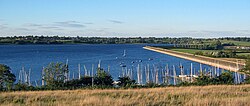
Draycote Water is a 240-hectare (590-acre) reservoir and country park near the village of Dunchurch, 3.75 miles (6 km) south of Rugby in Warwickshire, England, owned and operated by Severn Trent Water. It draws its water from the River Leam, and supplies drinking water to Rugby and Coventry. It is named after the nearby hamlet of Draycote and is the largest body of water within Warwickshire.

Key Information

The reservoir was created in the 1960s and was opened in 1970, with a new pipe and pump installed in 2012. It has a capacity of up to 5 billion gallons (23 million m³) and a maximum depth of 70 feet (21 m).

It is a site for birdwatching and has a bird hide, with a feeding station sponsored by the West Midland Bird Club. Severn-Trent manage an adjacent 20 acres (8 ha) country park. Draycote is used by cyclists, runners, windsurfers, fly fishers and for boating. Fishing is for brown trout and rainbow trout from the banks or from boats. A farm to the north east of the site has a herd of alpacas.

Description

[edit]
The water inlet of Draycote Water

Draycote Water is an artificial reservoir, which supplies water to southern and eastern Warwickshire, in particular Rugby (via Barby Storage Reservoir[1]) and Coventry.[2] Owned and managed by Severn Trent Water,[3] it is located just to the south of the M45 motorway in the hamlet of Draycote, which is close to Dunchurch.[4] It is accessed from the A426 road, at grid reference SP450690. The reservoir has no natural inlets, its water being obtained by pumping from the nearby River Leam and from nearby Stanford Reservoir which obtains its water from the River Avon.[2] It has an area of approximately 240 hectares (590 acres), with a maximum depth of 70 feet (21 m) and a capacity of 5 billion gallons (23 million m³).[2] The shoreline of the reservoir is a mixture of concrete and natural embankment.[5]

Draycote Water was built between 1967 and 1969, to cope with rising demand in eastern and southern Warwickshire, and opened in 1970.[2] In early 2012 the reservoir had to be closed temporarily, as record-low rainfall during the winter months had caused its level to reduce to less than 50% of capacity.[6] Severn Trent responded by reversing the flow of water in an existing pipeline between Draycote Water and Welches Meadow Reservoir adjacent to the River Leam in Leamington Spa.[7] This development required a short length of new pipe at the Draycote end and a new pump at Leamington.

Flora and fauna

[edit]

The reservoir features many bird species. This includes the great northern diver, which makes a prolonged visit during the winter months, along with kittiwake and small numbers of Mediterranean and little gulls. There are several species of diving duck with the tufted duck the most common, numbering around 1,200 individuals. The most common bird at the site is the black-headed gull, which forms the majority of a gull roost of more than 50,000 individuals. A number of waders visit Draycote in the autumn, including the ringed and little ringed plover.[5]

The reservoir's fish include the brown trout and rainbow trout, some with a mass in excess of 5 kilograms (11 lb). These are fished for sport, both from boats and from the banks.[8]

To the north east of the reservoir is Toft Farm,[9] which features a herd of alpacas.[10]

Sport and leisure

[edit]
Sailing boats at Draycote Water.

Draycote Water has a country park on its southern shore, which extends across 21 acres (8.5 ha). The park has facilities for bird watching and fishing, as well as several nature trails and a visitor centre. A track around the perimeter allows cyclists and walkers to circumnavigate the reservoir, a total distance of 5 miles (8 km).[11] The Draycote Water Sailing Club is situated on the shoreline and offers dinghy sailing and windsurfing as well as races.[12]

The reservoir's owner, Severn Trent Water, warns the public not to swim in the reservoir, citing the large depth, potentially cold temperatures, and the risk of currents caused by the pumps which supply the water.[3]

See also

[edit]

References

[edit]
[edit]
Revisions and contributorsEdit on WikipediaRead on Wikipedia
from Grokipedia
Draycote Water is a 240-hectare (590-acre) and country park situated near the village of Dunchurch in , , approximately 6 km southwest of Rugby and 15 km east of . Constructed primarily to meet growing water demands in south and east , it draws water from the River Leam and other Severn Trent reservoirs, storing up to 5 billion gallons at a maximum depth of 70 feet to supply to Rugby and . Managed by Water since its opening, the site also serves as a major recreational area, featuring a 5-mile perimeter and supporting diverse activities amid scenic countryside. The reservoir's construction began in 1967 on former agricultural land, involving the creation of six dams that linked five small hills and a ridge, with completion in 1969 and official opening to the public in 1970; it reached full capacity in 1972. A key addition came in 2012 with a connecting it directly to the River Leam at Willes for enhanced water . As of 2025, a £10 million is underway to increase the reservoir's capacity by 1.4 million cubic metres through embankment raising and deepening, with completion expected in autumn 2026. This development transformed the landscape into a vital resource for both utility and , balancing water with environmental conservation. As of November 2025, Draycote Water is renowned for its recreational offerings, including walking and along a tarmac path that forms part of Sustrans National Cycle Route 41, though sections are partially closed due to ongoing upgrade works until autumn 2026; from dedicated hides with sightings of rare species, and watersports such as and . It is also a premier fishing destination, with facilities for boat hires and , alongside family-friendly amenities like a 24-acre country park, playground, visitor hub shop, and Waterside Restaurant. features, including smooth paths suitable for wheelchairs and pushchairs, make it a popular spot for inclusive outdoor pursuits, drawing visitors for its natural beauty and .

Location and Physical Features

Geographical Setting

Draycote Water is located in Warwickshire, England, approximately 3.7 miles (6 km) southwest of Rugby and about 9.3 miles (15 km) east of Coventry, near the village of Dunchurch. Its precise position is at coordinates 52°19′N 1°20′W, placing it within the heart of the county's rural expanse. This positioning integrates the reservoir seamlessly into the local topography, serving as a prominent feature in the landscape visible from surrounding areas. The reservoir is nestled in the gentle countryside of the River Leam valley, characterized by low hills, open farmlands, and undulating fields typical of southern . It is bordered by agricultural land and lies adjacent to the River Leam, which feeds into it, enhancing its role within the valley's natural contours. Nearby villages such as Thurlaston, Toft, Dunchurch, and the hamlet of Draycote frame the site, contributing to its intimate connection with the rural community and providing scenic backdrops of pastoral scenery. Accessibility to Draycote Water is facilitated by its proximity to major transport routes, including the A45 and M45 motorways, which connect it efficiently to Rugby and . Visitors can reach the site via the B4453 from the A45 interchange or directly from the M45 at junction 17 of the M1, underscoring its status as a convenient local for and exploration in the region.

Reservoir Specifications

Draycote Water covers a surface area of hectares (593 acres), making it one of the larger in the region. The reservoir reaches a maximum depth of 21 meters (70 feet), which supports its storage function while allowing for ecological diversity in the . Its shoreline forms a perimeter of approximately 5 miles (8 kilometers), providing an extensive boundary that enhances its recreational appeal. Structurally, the reservoir is impounded by six earth embankment dams, featuring granular drainage zones and substantial berms on both upstream and downstream sides for stability and safety. A fully accessible perimeter path encircles the reservoir, constructed with a flat tarmac surface suitable for walking and .
SpecificationValue
Surface Area240 hectares (593 acres)
Maximum Depth21 meters (70 feet)
Perimeter5 miles (8 km)
Dam TypeEarth embankment (six structures)

History and Construction

Planning and Building Phase

The development of Draycote Water was initiated in response to escalating water demands in eastern and southern during the , driven by and industrial expansion in the region. Local authorities identified the need for a major new to secure reliable supplies for urban centers like Rugby and , as existing sources proved insufficient amid post-war demographic shifts. Planning efforts, including site surveys and core drilling, began as early as 1963 under the oversight of the Rugby Water Board, which coordinated geological assessments to evaluate the suitability of the proposed basin near the villages of Thurlaston and Dunchurch. Construction commenced in 1967 and was completed by 1969, with the Rugby Water Board—predecessor to Water—managing the project to address the acute regional water shortage. The board, responsible for water infrastructure in the Rugby area, secured necessary approvals and funding through channels, ensuring the reservoir would augment supplies from the River Avon system. This timeline reflected the urgency of the demand, allowing the facility to become operational shortly after completion, though public access was limited initially to prioritize water storage functions. Engineering works involved constructing an system of six interconnected earthfill barriers using locally sourced materials to link five small hills and a , impounding the site on former without relying on natural inflows, making it a pumped-storage facility. Complementing this, engineers installed an initial and drawing from the River Leam approximately 5 kilometers away, enabling during periods of adequate river flow to fill the . These elements ensured the project's efficiency in capturing and storing water for distribution, setting the foundation for long-term supply reliability.

Opening and Subsequent Developments

Draycote Water was officially opened to operations in 1970, following the completion of its construction as a vital component of the regional water infrastructure in . The reservoir, managed by Water, began its role in supplying to nearby urban areas, including Rugby and , thereby integrating into the broader that supports south and east . This activation addressed growing demand for reliable water resources in the post-war period, with the site also designated as a country park to balance utility with public access. In its early years, the reservoir underwent initial filling primarily through pumped abstractions from the River Leam at Eathorpe, a process that continued until it reached full capacity for the first time in 1972. This method established the pumped storage system central to its operations, with no natural inlets contributing to the water levels. Concurrently, Draycote Water was linked to the regional grid via supplementary pipelines from upstream reservoirs, such as Stanford Reservoir and Brownsover, allowing for flexible transfers to maintain supply stability during varying seasonal conditions. These connections ensured the reservoir's water could be augmented as needed, supporting distribution to over 300,000 residents in the connected locales. A significant modification occurred in , when Water installed a new 9-mile and pump system to bolster supply reliability amid increasingly dry weather patterns. Costing £500,000, this infrastructure directly connected Draycote Water to the River Leam at Willes Meadow near , enabling the pumping of up to 12.5 million litres of water per day over elevations of up to 50 meters. The upgrade addressed vulnerabilities exposed by low levels—reaching just 50% capacity earlier that year—and facilitated faster refilling rates of approximately 1% per week, enhancing overall resilience in the regional water management framework. In October 2025, Water initiated a £10 million project to enhance the reservoir's drawdown capability and deepen parts of it within the embankments, aiming to add 1.4 billion litres of additional storage capacity by autumn 2026 to meet growing demands from drier conditions and . The works, including installation of siphons for improved discharge and excavation in select areas, will involve temporary partial closures of the perimeter path for safety.

Hydrology and Operations

Water Sources and Supply Role

Draycote Water serves as a critical pumped storage reservoir, with its primary water input sourced from the River Leam through an underground pipeline that pumps abstracted river water into the reservoir. This system enables controlled replenishment, drawing from the Leam at locations such as Eathorpe to maintain storage levels without relying on natural inflows. Additionally, supplementary water is provided via pipeline from Stanford Reservoir, enhancing the reservoir's reliability as a supply source. The reservoir plays a vital role in public water supply, abstracting and treating water at the adjacent Draycote Water Treatment Works to provide primarily to residents in Rugby, , and surrounding areas. This distribution supports domestic and commercial needs in these urban centers, contributing to the broader regional supply managed by Water. The treatment process ensures compliance with standards before distribution through the local network. Operations are structured seasonally to optimize resource use and environmental impact, with refilling primarily occurring during winter months via from the River Leam. This timing allows accumulation of water when river flows are higher, minimizing flood risks in the Leam catchment while ensuring adequate reserves for peak summer demand when abstraction licenses may be restricted due to lower river levels. Such practices balance supply security with sustainable river management.

Capacity and Management Practices

Draycote Water has a total storage capacity of 23 million cubic meters, equivalent to approximately 5 billion imperial gallons, enabling it to serve as a key raw resource for the region. This capacity supports the supply needs of surrounding areas, primarily through controlled drawdown operations that release to meet demand from the adjacent treatment works. Management practices at the reservoir include continuous monitoring of water levels by Water, with data published regularly to track storage against capacity and inform operational decisions. To maintain , growth is controlled using methods such as barley straw deployment, which effectively suppresses blue-green blooms across 's reservoirs, including Draycote. Drawdown for supply is managed through enhanced outlet structures that allow for a minimum rate of 0.8 meters per day, ensuring reliable extraction while preserving structural integrity. Additionally, as a pumped storage reservoir, water is pumped from the River Leam and other sources to refill it, balancing regional supply demands during periods of high usage. Sustainability measures emphasize , with abstraction limited to winter months to safeguard river flows and prevent ecological disruption. Severn Trent's monitoring systems provide real-time data on levels and inflows, supporting that aligns reservoir operations with seasonal variations and regulatory requirements. These protocols ensure the reservoir's long-term viability as a vital component of the regional network.

Ecology and Biodiversity

Aquatic and Avian Life

Draycote Water supports a diverse , primarily through stocked populations of that form the basis of its fishery. The reservoir is regularly stocked with (Oncorhynchus mykiss), which thrive in the open water and provide a key component of the . (Salmo trutta) are also present, with individuals growing to significant sizes due to the nutrient-rich environment. These fish populations are sustained by natural aquatic invertebrates, including larvae of insects such as mayflies and , which serve as primary food sources and maintain the ecological balance. The avian life at Draycote Water is particularly notable for its winter visitors and resident breeding species, attracted to the reservoir's expansive open water habitats. Winter visitors include the great northern diver (Gavia immer), which has been recorded overwintering in the reservoir, utilizing the deep waters for diving and foraging. The (Rissa tridactyla) appears occasionally as a vagrant during colder months, drawn to the site's gull roosts. Among resident and breeding birds, the (Aythya fuligula) is abundant, with counts reaching up to 1,251 individuals in peak winter periods, favoring the open water zones for diving. Large roosting flocks of (Chroicocephalus ridibundus) form significant aggregations, exceeding 38,500 birds during winter surveys, contributing to the site's importance for wetland birds. The reservoir's features, including its broad open water areas up to 70 feet deep, provide ideal conditions for such as tufted ducks and great northern divers, supporting their behaviors. A dedicated bird hide, known as the Look Out, offers visitors a vantage point for observing these species without disturbance, enhancing the site's value for avian monitoring. Water management practices, such as controlled drawdown levels, indirectly influence these habitats by exposing marginal areas seasonally.

Terrestrial Flora and Conservation Efforts

The terrestrial flora around Draycote Water encompasses marginal wetland plants and grasses along the reservoir's 5-mile perimeter, contributing to a transitional habitat between aquatic and terrestrial ecosystems. Adjacent to the reservoir, Draycote Meadows SSSI supports unimproved neutral grassland characterized by diverse wildflowers including cowslip (Primula veris), yellow rattle (Rhinanthus minor), meadow vetchling (Lathyrus pratensis), and buttercups (Ranunculus spp.), alongside rarer species such as the green-winged orchid (Anacamptis morio) and moonwort (Botrychium lunaria), the latter representing the sole known Warwickshire locality for this fern. More than 20 grass species thrive here, interspersed with vibrant floral displays, while streamside zones feature wetland-adapted plants like brooklime (Veronica beccabunga), lesser water-parsnip (Berula erecta), and meadowsweet (Filipendula ulmaria). Hedgerows encircling the meadows include shrubs and trees such as English elm (Ulmus procera), blackthorn (Prunus spinosa), wild privet (Ligustrum vulgare), ivy (Hedera helix), dog-rose (Rosa canina), oak (Quercus robur), ash (Fraxinus excelsior), and wild cherry (Prunus avium), enhancing habitat connectivity for pollinators and invertebrates. Conservation at Draycote Water is overseen by Water, designating the site as a priority area in recovered condition and pursuing Local Wildlife Site status, integrated into the company's Biodiversity Strategy and Action Plan. This framework commits to restoring habitats, controlling invasive non-native through risk assessments and mitigation, and achieving favorable condition for all associated SSSIs by 2030, with specific actions including volunteer-led and woodland maintenance to bolster terrestrial flora resilience. For the neighboring Draycote Meadows SSSI, management employs traditional low-intensity farming—hay cutting in late July followed by cattle grazing from August to December—to sustain floral diversity and suppress coarser grasses, complemented by enhancement projects like green hay spreading and over 2,000 native plantings since 2014. As a designated Coronation Meadow since 2013, the site exemplifies national efforts to preserve species-rich grasslands amid . Access to sensitive northern areas is restricted to organized events to minimize disturbance to rare plants. Monitoring and collaborative initiatives form a core component of these efforts, with Severn Trent rangers and volunteers conducting regular assessments of habitat health and species presence, often partnering with local organizations to log observations and maintain feeding stations that indirectly support pollinator-friendly through enhanced balance. These activities align with Warwickshire's Local for lakes and reservoirs, emphasizing removal—such as Himalayan balsam ()—and habitat restoration to safeguard marginal and meadow vegetation against climate pressures and land-use changes.

Recreation and Visitor Access

Watersports and Fishing

Draycote Water serves as a hub for organized watersports, with and primarily hosted by the Draycote Water Sailing Club, an RYA-approved training center established to promote accessible water-based . The club provides introductory taster sessions lasting about two hours, allowing newcomers to experience or under professional guidance, as well as progressive courses tailored for juniors starting from age eight and adults at beginner to advanced levels, covering skills like rigging, maneuvering, and capsize recovery. Competitive racing events are a key feature, featuring fleets such as ILCA, Solo, and Flying Fifteen dinghies, with regular club races and open regattas held throughout the year to foster a competitive . Stand-up is also offered, with equipment hire available for sessions that emphasize balance and paddling techniques on the reservoir's calm waters. Fly fishing for rainbow and brown trout is another prominent activity, managed by Anglian Water Parks in partnership with Severn Trent Water as the site's dedicated fishery operator; the fishery reopened on May 1, 2025, after an 18-month closure, with the season running until January 31, 2026, attracting anglers seeking the reservoir's stocked populations in its 6.5-kilometer shoreline. Participants can secure day permits starting at £38 for up to eight fish plus unlimited catch-and-release or opt for seasonal tickets like the Gold permit at £1,300, which caps the annual take at 500 fish while allowing unlimited returns to support sustainability. Boat hires are readily available, with full-day rentals at £30 accommodating up to two anglers (or three including a non-fishing guest), equipped with mandatory lifejackets and subject to wind speed limits of 25 mph for safety; bank fishing is permitted in designated areas but excludes the dam walls and sailing club frontage to minimize interference with other users. Stringent regulations govern all water use at Draycote Water to prioritize safety, ecological protection, and operational integrity as a supply . Swimming and paddling are strictly prohibited due to hazards like sudden depth changes, cold temperatures, and potential contamination risks, with Water emphasizing that reservoirs are not designed for bathing. Unauthorized , such as personal kayaks or inflatables, are not permitted, and all vessels must be launched from approved slipways to prevent ecological disruption from or . Activities are confined to designated zones—for instance, boats cannot within 100 yards of pontoons or the sailing club, and is limited to allocated areas—to safeguard and habitats while allowing controlled access for permitted pursuits.

Walking, Cycling, and Facilities

Draycote Water features a 5-mile (8 km) flat tarmac perimeter path known as the Reservoir Trail, which encircles the reservoir and provides an accessible route for walking and . This smooth, level surface accommodates pushchairs, wheelchairs, and cyclists, offering scenic views of the water and surrounding countryside. The trail forms part of Sustrans National Cycle Route 41, connecting Draycote Water to broader regional networks for longer journeys. Adjacent to the lies a 24-acre country park on the southern side, equipped with dedicated spaces for picnics, games, and outdoor relaxation. The visitor hub includes a shop stocking snacks, toys, and ice creams, alongside accessible toilets for all users. The Waterside Restaurant, operated within the hub, serves hot meals and drinks with panoramic views over the . A children's , recently refurbished and reopened in October 2025, caters to families with inclusive play equipment suitable for various ages and abilities. Event spaces in the country park support gatherings, with pay-and-display parking available on-site and annual permits offered for frequent visitors. Seasonal events enhance the recreational offerings, including guided walks along the trails and wildlife spotting days that highlight local and . These activities, often family-oriented, promote engagement with the natural environment while adhering to standards, such as level paths and disabled facilities throughout the site.

Ownership and Future Plans

Administrative Management

Draycote Water has been fully owned by since 1974, following the nationalization of regional water authorities under the Water Act 1973, which created the Water Authority and transferred ownership from the prior Rugby Water Authority. This ownership structure places the reservoir under the operational control of , a focused on and within the Group. Day-to-day administration is handled by a dedicated team of site rangers employed by Water, who serve as the primary point of contact for visitors and oversee operations at the 240-hectare site. Their responsibilities include ensuring public safety through health and safety checks, maintaining estate infrastructure such as paths and facilities, and facilitating controlled public access to balance recreational use with the site's role in regional . The rangers also enforce compliance with regulations from the , including requirements under the Reservoirs Act 1975 for safety inspections, discharge consents, and environmental permits to protect water quality and prevent risks like flooding or contamination. To safeguard both the supply and recreational areas, Water implements strict visitor policies, including a on barbecues and open fires due to fire risks in the dry and environments. Drone usage requires prior permission through a formal application process, with a £350 fee for approvals, to avoid interference with operations and . Access rules further restrict dogs from the Reservoir Trail to minimize disturbance to and avian habitats, while permitting them in designated Country Park areas, ensuring the site's dual function as a supply asset and public amenity.

Recent and Planned Projects

In October 2025, Water initiated a £10 million deepening project at Draycote Water to enhance the reservoir's storage capacity by excavating the embankments and adding clay for waterproofing. The works also include improvements to the inlet structure and overflow weir, allowing for an additional 1.4 million cubic meters of —equivalent to approximately 560 Olympic-sized pools—with completion anticipated by autumn 2026. The project involves phased disruptions to visitor access, prioritizing during . Phase 1, lasting about 12 weeks from 13 October 2025, closes sections of the circular route from Farborough Bank to Toft Bank, including the stretch between the Visitor Hub and Memorial Garden, with users required to turn back and retrace their paths as temporary reroutes. Phase 2 will affect additional embankments near the Sailing Club and along Hensborough, Saddle, Barn, and Draycote Banks up to the Valve Tower, with further footpath and lower road closures scheduled for early 2026, limited to weekdays from 7:30 a.m. to 4:30 p.m. To mitigate impacts, has reduced parking tariffs during the works. This initiative aligns with Severn Trent's 2025-2030 business plan, which commits £12.9 billion overall—including £5 billion in enhancements—to bolster against projected drier summers and droughts, while targeting a 16% reduction in leakage from 346 megalitres per day in 2024/25 to 290 megalitres per day by 2029/30. The Draycote project contributes to these goals by addressing a supply-demand deficit and supporting sustainable , as part of broader schemes like storage expansions.

References

Add your contribution
Related Hubs
User Avatar
No comments yet.