


Community hub
Recent from talks
Contribute something
Nothing was collected or created yet.
County of Apulia and Calabria
View on Wikipedia
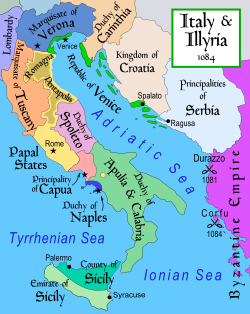
The County of Apulia and Calabria (Latin: Comitatus Apuliae et Calabriae), later the Duchy of Apulia and Calabria (Latin: Ducatus Apuliae et Calabriae), was a Norman state founded by William of Hauteville in 1043, composed of the territories of Gargano, Capitanata, Apulia, Vulture, and most of Campania. It became a duchy when Robert Guiscard was raised to the rank of duke by Pope Nicholas II in 1059.
Key Information


The duchy was disestablished in 1130, when the last duke of Apulia and Calabria, Roger II, became King of Sicily. The title of duke was thereafter used intermittently as a title for the heir apparent to the Kingdom of Sicily.
Creation
[edit]William I of Hauteville returned to Melfi in September 1042 and was recognized by all the Normans as supreme leader. He turned to Guaimar IV, Prince of Salerno, and Rainulf Drengot, Count of Aversa, and offered both an alliance. With the unification of the Norman families of Altavilla and Drengot, Guaimar gave official recognition to the Norman conquests. At the end of the year and extending into 1043, William and Rainulf met in an assembly at Melfi with the Norman barons and the Lombards.
In the meeting, Guaimar IV of Salerno ensured the Hauteville dominance over Melfi. William of Hauteville formed the second core of his possessions and differentiated himself from Rainulf I of Aversa, head of the territories of Campania. All the barons present offered a tribute as a vassal to Guaimar, which recognized William I of Hauteville as the first to receive the title of Count of Apulia. To tie it to himself, he offered to marry Guaimar's niece Guide, daughter of Guy, Duke of Sorrento. Guaimar reconfirmed the title of count to Rainulf as well, which created the County of Puglia.
In 1047, Drogo of Hauteville was made "count" of Apulia and Calabria by Emperor Henry III, with territories lost by Guaimar IV of the Principality of Salerno.[1][2]
Duchy of Apulia and Calabria
[edit]
In 1043, the prince of Salerno, Guaimar IV, had been acclaimed Duke of Apulia and Calabria although the legitimacy of this title (as it was not officially recognized by any universal power) could be considered juridically doubtful; in fact, in 1047, the emperor Henry III intervened to claim the ducal title.[3]
However, after 1059, the county was officially named Ducato di Puglia e Calabria ("Duchy of Apulia and Calabria"), because Robert Guiscard was named a "duke" by Pope Nicholas II.
Salerno was conquered in 1077 by the Normans, and these territories were added to the Duchy of Apulia and Calabria and with this conquest, the Normans controlled all of continental southern Italy, with the exception of the small Duchy of Naples. The next year, the capital was moved from Melfi to Salerno, and the Normans began to focus on completing the conquest of Sicily. They gradually created, until 1091, the precursor of the Kingdom of Sicily, the first unified state in southern Italy that was founded in 1130.
Salerno remained the capital of this southern Italian political entity for half a century (from 1078 to 1130), the city flourished with the Schola Medica Salernitana, the first medical school in Europe.
List of counts and dukes
[edit]Azzo of Spoleto (Duke of Calabria)
[edit]| Name | Portrait | Birth | Reign | Marriage | Notes | |
|---|---|---|---|---|---|---|
| Start | End | |||||
| Azzo of Spoleto (circa 969–983) | ||||||
Azzo of Spoleto |
? | 969 |
circa 983 |
? | Of Langobard origins, he was named Duke by Otto the Great. He disappeared under dubious circumstances, at the time in which Byzantines recaptured Calabria.[4] | |
Melus of Bari (Duke of Apulia)
[edit]| Name | Portrait | Birth | Reign | Marriage | Notes | |
|---|---|---|---|---|---|---|
| Start | End | |||||
| Melus of Bari (1015–1020) | ||||||
Melus of Bari |
circa 970 |
1015 |
1020 |
Maralda 1 son |
Of Langobard origins, but of Greek culture, he rebelled against the byzantines. Emperor Henry II gave him the title of Duke. | |
Guaimar of Salerno (Duke of Apulia and Calabria)
[edit]| Name | Portrait | Birth | Reign | Marriage | Notes | |
|---|---|---|---|---|---|---|
| Start | End | |||||
| Guaimar (1043–1047) | ||||||
Guaimar |
 |
1013 circa |
1043 |
1047 |
Gemma of Capua 1 son, 3 daughters |
He was the first son of Guaimar III of Salerno and Gaitelgrima of Benevento. In 1042-43 at Melfi, by approving the election of William of Hauteville as Count of Apulia, he obtained the Duchy of Apulia and Calabria. |
William is usually considered the first count of Apulia and Calabria, but he was never recognized as such by the emperor. In 1047, Holy Roman Emperor Henry III took away Guaimar's ducal title. He christened William's successor (and brother) Drogo Dux et Magister Italiae comesque Normannorum totius Apuliae et Calabriae and made him a direct vassal of the empire.
- Counts
- William I Iron Arm 1043–46
- Drogo 1046–51
- Humphrey 1051–57
- Robert Guiscard 1057–59
- Dukes
- Robert Guiscard 1059–85
- Roger I Borsa 1085–1111
- William II 1111–27
In 1127 the duchy passed to the count of Sicily. It was thereafter used intermittently as a title for the heir apparent.
- Roger II 1127–34, also king of Sicily (1130–54)
- Roger III 1134–48, son of previous, opposed by . . .
- Ranulf 1137–39, candidate of Pope Innocent II and Lothair II, Holy Roman Emperor
- William III 1148–54, also king of Sicily (1154–66)
- Roger IV 1154–61, son of previous
The title was left vacant after the death of Roger IV. It may have been revived for a short-lived son of William II:
- Bohemond 1181
It was revived by King Tancred for his eldest son in 1189:
- Roger V 1189–93
References
[edit]- ^ Loud, Graham (10 July 2014). The Age of Robert Guiscard: Southern Italy and the Northern Conquest. Routledge. ISBN 978-1-317-90022-1 – via Google Books.
- ^ Houben, Hubert (4 April 2002). Roger II of Sicily: A Ruler Between East and West. Cambridge University Press. ISBN 978-0-521-65573-6 – via Google Books.
- ^ Enciclopedia Italiana (1933). Michelangelo Schipa (ed.). "GUAIMARIO V, principe di Salerno" (in Italian).
- ^ Nicola Lafortuna (1881). I duchi di Calabria dal 969 al 1154. A. Norcia. pp. 57–63.
- Chalandon, Ferdinand. Histoire de la domination normande en Italie et en Sicile. Paris: 1907.
- Houben, Hubert (translated by Graham A. Loud and Diane Milburn). Roger II of Sicily: Ruler between East and West. Cambridge: Cambridge University Press, 2002.
- Matthew, Donald. The Norman Kingdom of Sicily. Cambridge: Cambridge University Press, 1992.
- Norwich, John Julius. The Normans in the South 1016–1130. London: Longman, 1967.
- Norwich, John Julius. The Kingdom in the Sun 1130–1194. London: Longman, 1970.
- Takayama, Hiroshi. The Administration of the Norman Kingdom of Sicily. BRILL, 1993.
External links
[edit]| Provinces |  | |
|---|---|---|
| Places | ||
| History | ||
| Politics and government | ||
| Culture | ||

County of Apulia and Calabria
View on GrokipediaHistorical Background
Pre-Norman Southern Italy
In the 9th and 10th centuries, Apulia and Calabria formed a patchwork of territories under divided Byzantine and Lombard rule, reflecting the legacy of earlier conquests and ongoing power struggles. The Byzantine Empire exerted control over coastal Apulia, including key ports like Bari, and significant portions of Calabria, administered through the Catepanate of Italy established circa 965 as a consolidated province to counter Arab incursions and Lombard encroachments.[1] Inland regions, however, fell under the sway of autonomous Lombard principalities that splintered from the former Duchy of Benevento following its weakening in the 9th century; these included Benevento itself, Capua—which briefly conquered Benevento in 866 under Atenulf I—and Salerno, which separated from Benevento amid civil wars after 839.[4] This duality fostered chronic tensions between Greek-speaking Byzantine officials and Latin-rite Lombard nobility, with ethnic divisions reinforcing political fragmentation across ethnic mixes of Greco-Roman, Germanic Lombard, and residual indigenous populations. The Principality of Salerno emerged as a focal point of Lombard ambition, its rulers claiming broader dominion amid the disarray. Guaimar IV, who acceded in 1027, adopted the grandiose title of Duke of Apulia and Calabria in official charters as late as 1047, positioning himself as nominal overlord of southern Italian lands despite lacking substantive authority over Byzantine-held coasts or rival principalities.[1] Such titles masked the reality of localized feudal structures, where counts and gastaldi wielded de facto power, perpetuating inter-principality rivalries and weakening collective defense. This internal discord, compounded by the absence of unified leadership, left the region vulnerable to external pressures and opportunistic alliances. Socioeconomic instability amplified the political malaise, with Arab naval raids devastating coastal economies from the 9th century onward; in Calabria, sustained attacks from 840 to circa 856 targeted settlements and trade routes, eroding agricultural productivity and fostering a cycle of fortified refuges.[5] Lombard revolts against Byzantine overlordship further exposed these fissures, as exemplified by the 1009 uprising led by Melus of Bari, a local noble who seized Bari and expanded into inland Apulia, rallying discontented Lombards before suppression in 1011 by imperial forces under Basil Mesardonites.[1] These events underscored the reliance on hired mercenaries to quell unrest, highlighting the causal interplay of feudal disunity, ethnic animosities, and economic predation that precluded stable governance and invited foreign adventurers.Norman Mercenaries and Initial Incursions
The Normans first entered southern Italy around 1017 as pilgrims visiting the shrine of Saint Michael the Archangel at Monte Gargano in Apulia, where they encountered opportunities for military service amid local conflicts.[6] These early arrivals, drawn from landless adventurers in Normandy, initially served as mercenaries for Lombard rebels like Melus of Bari, who sought to overthrow Byzantine control in Apulia and Calabria.[7] Joining Melus's forces, a small contingent of about 300 Normans fought alongside Lombards at the Battle of Cannae in 1018, where they were decisively defeated by Byzantine troops under Catepan Basil Boioannes, though their heavy cavalry tactics impressed local rulers.[8] Subsequent waves of Normans capitalized on the fragmented political landscape, hiring out to various Lombard princes against Byzantine garrisons and Arab incursions from Sicily, gradually transitioning from transient fighters to recipients of land grants.[7] A pivotal foothold came in 1030 when Rainulf Drengot, a Norman leader who had arrived with a band of kin including his brothers, received the county of Aversa from Lombard allies, including Duke Guaimar IV of Salerno and Pandulf IV of Capua, as reward for service against Capuan rivals; this marked the first Norman territorial possession in Italy, centered on the fortified town near Naples.[9] By the late 1030s, Norman bands exploited ongoing revolts, such as those in Apulian towns against Byzantine tax burdens, forming opportunistic alliances that emphasized their value as shock troops rather than large-scale invaders. Around 1035, William "Iron Arm" of Hauteville arrived in Italy with his brother Drogo, leading a group of about 40-50 knights that quickly gained prominence through service to Lombard lords in Apulia.[10] William's forces participated in skirmishes against Byzantine forces, earning his nickname from feats like shattering enemy lances with his arm during combat near Siponto circa 1038-1040, which bolstered Norman reputation for ferocity.[11] This period saw Normans shift toward settlement by securing initial bases through betrayal and rapid strikes, culminating in the capture of Melfi in March 1041 after its Byzantine commander defected; the town, strategically located on Apulia's mountainous frontier, became a key Norman stronghold for further raids into Byzantine-held territories.[1] These incursions, often numbering fewer than 1,000 men, relied on mobility and local defections rather than overwhelming numbers, setting the stage for deeper entrenchment without formal conquest doctrines.[12]Establishment of the County
Founding under William Iron Arm
In September 1042, Norman mercenaries and local Lombard leaders assembled at Melfi to formalize their conquests in Apulia amid the weakening of Byzantine and Lombard control, electing William "Iron Arm" Hauteville—the eldest surviving son of Tancred de Hauteville—as the first Count of Apulia. This election marked the creation of the County of Apulia as a distinct Norman polity, with William granted authority to distribute lands and create baronies as territories were secured.[3][13] William pledged vassalage to Prince Guaimar IV of Salerno, who endorsed the arrangement and received acclamation as overlord with the titular rank of Duke of Apulia and Calabria, providing a measure of legitimacy within the fragmented southern Italian feudal structure. Melfi, a strategic hilltop fortress, became the county's initial capital, with early holdings confined to northern Apulian strongholds such as Ascoli Satriano and Venosa, from which the Normans launched raids to consolidate power.[3][1] Under William's command, the Normans intensified operations against remaining Byzantine outposts, including skirmishes around Bari that pressured its defenses and foreshadowed further gains, though full control eluded them during his tenure. Holy Roman Emperor Henry III withheld formal recognition of William's county amid ongoing imperial claims to southern Italy, but following appeals—including from papal quarters—Henry confirmed Norman land grants in Apulia to William's successors in 1047. William's death in early 1046 from illness precipitated temporary disarray among the Norman factions, exposing vulnerabilities before stabilization under fraternal leadership.[1][3]Succession of Early Counts
Upon the death of William Iron Arm in 1046, his half-brother Drogo de Hauteville succeeded as Count of Apulia, assuming leadership of the Norman forces that had been consolidating control over the region from Lombard and Byzantine authorities.[1] Drogo, born around 1010 as a son of Tancred de Hauteville and his second wife Moriella, focused on fortifying Norman holdings, including the capture of Bovino in 1045 and joint administration of Benevento with Rainulf II in 1047.[1] He navigated external pressures from Byzantine forces seeking to reclaim Apulia and sporadic papal distrust of Norman encroachments, while fostering unity among the Hauteville brothers to counter local Lombard resistance and maintain feudal levies from dispersed Norman knights.[1] This period marked initial stabilization, though Drogo's rule ended abruptly on 10 August 1051 when he was murdered by Waszo, Count of Naples, at Monte Ilaro, an act reflecting underlying tensions with southern Italian potentates amid broader anti-Norman intrigue.[1] Drogo's brother Humphrey de Hauteville, also born circa 1010 to Tancred and Moriella, immediately succeeded as Count in 1051, inheriting a fragmented territory prone to revolts.[1] Humphrey, previously granted the lordship of Lavello by Drogo, prioritized expansion by defeating a papal army led by Pope Leo IX at the Battle of Civitate on 17 June 1053, which temporarily subdued ecclesiastical opposition and affirmed Norman dominance in Apulia.[1] He collaborated closely with his half-brother Robert Guiscard, leveraging familial ties to coordinate military efforts, capture key sites like Oria, Nardon, and Lecce by 1055, and integrate local feudal structures despite ongoing Byzantine threats and internal dissent from non-Norman lords.[1] Humphrey's death in spring 1057, likely from illness, left the county vulnerable but with strengthened brotherly alliances that preserved cohesion among the Hautevilles.[1] Robert Guiscard, the youngest prominent Hauteville brother (born circa 1015 to Tancred and Fressenda), assumed the countship in August 1057 following Humphrey's demise, prioritizing the management of feudal obligations and suppression of unrest to solidify Norman authority.[1] Facing a rebellion in 1058 led by his nephew Abelard and other kin, Robert quelled the uprising through decisive action, relying on loyal vassals and the dispersed Norman knightly class bound by oaths rather than centralized command.[1] This brief tenure emphasized internal unity against local revolts and external Byzantine incursions, without yet extending formal control over Calabria, laying the administrative groundwork for enhanced titles while navigating papal wariness post-Civitate.[1] By 1059, Robert's effective leadership had stabilized the county, transitioning the Hautevilles from opportunistic mercenaries to entrenched rulers.[1]Expansion into Calabria
Military Campaigns
Following the death of his brother Humphrey in 1057, Robert Guiscard concentrated his efforts on subduing Calabria, a region characterized by rugged mountainous terrain that favored defensive Byzantine garrisons and a predominantly Greek-speaking population with lingering loyalties to Constantinople.[14] These campaigns, spanning the late 1050s to 1060s, involved systematic assaults on fortified towns, leveraging Norman mobility to overcome natural barriers that had long shielded Byzantine control.[12] Guiscard's forces employed heavy cavalry charges, a hallmark Norman innovation involving couched lances and armored knights, to shatter enemy formations in open engagements and support sieges by disrupting relief efforts.[15] This tactical edge enabled rapid advances despite numerical disadvantages, as seen in the capture of strategic points like Cariati in 1059 during ongoing operations around Cosenza. Alliances with disaffected Italo-Greek and Lombard elements, who resented Byzantine taxation and cultural impositions, provided intelligence and local levies, prompting defections from Byzantine strongholds such as those in the Sila massif.[12] However, Norman success relied heavily on intimidation through scorched-earth policies and extortionate tribute demands, as chronicled by Geoffrey Malaterra, who describes Guiscard accepting ransoms only to raze villages afterward, slaughtering inhabitants to deter resistance and compel submissions.[12] Such brutality, including the devastation of agricultural lands to starve garrisons, contrasted with the Normans' disciplined use of feudal contingents but drew contemporary criticism for its excess, even as it accelerated the collapse of organized Byzantine defenses. By 1060, Reggio Calabria fell, marking a pivotal breach, with subsequent operations reducing remaining garrisons amid sporadic revolts.[14] These efforts culminated in the effective neutralization of Byzantine military presence in Calabria by the early 1070s, though isolated holdouts persisted until the broader fall of Bari in 1071 eliminated the empire's Italian foothold.[16]Administrative Integration
Following the military conquests, the Norman leaders integrated Calabrian territories into the County of Apulia and Calabria by subdividing them into feudal fiefs granted to loyal knights and followers, who received lands in exchange for military service and oaths of fealty. This system rewarded participants in the campaigns and ensured a network of vassals to maintain control over the rugged terrain. In a division formalized around 1062, Robert Guiscard assigned oversight of Calabria to his brother Roger Hauteville, establishing him as the region's primary count and integrating it administratively under the county's feudal hierarchy while allowing Roger autonomy in local governance.[17][18] Pragmatic retention of select Byzantine administrative elements, such as aspects of the thematic tax collection modeled on provincial judges (kritai), facilitated continuity in revenue extraction from a predominantly Greek-speaking population accustomed to imperial structures. Efforts to Latinize governance proceeded incrementally, introducing Frankish-style feudal oaths and Latin documentation, yet Greek Orthodox clergy were often tolerated if they pledged loyalty to the Roman pope, avoiding wholesale replacement of bishops where local resistance was strong. This approach blended Norman feudalism with enduring Byzantine and Lombard customs, fostering a hybrid model that prioritized stability over uniform assimilation.[19][20][21] Integration faced resistance from Greek inhabitants, including uprisings in the 1060s amid the fall of key strongholds like Reggio Calabria in 1060, which were suppressed through targeted reprisals and fortified garrisons. These revolts underscored ethnic and religious tensions but ultimately reinforced the hybrid governance, as Normans co-opted local elites (archontes) into vassal roles while curbing Byzantine loyalist networks. Norman oversight stabilized coastal trade routes, mitigating prior disruptions from Saracen piracy and Arab incursions, thereby enhancing economic viability through secured maritime access linking Calabria to Apulian ports.[22][23]Elevation to Duchy
Council of Melfi and Papal Investiture
The Council of Melfi, convened in August 1059 under Pope Nicholas II, marked a decisive papal endorsement of Norman authority in southern Italy. Held in the Norman-controlled town of Melfi, the synod culminated in the Treaty of Melfi on 23 August 1059, whereby Robert Guiscard, a Hauteville leader, was invested with the ducal title over Apulia, Calabria, and—prospectively—Sicily upon its conquest from Muslim rulers.[24][1] In parallel, Richard I of Capua received princely investiture for his territories, but the elevation of Guiscard's holdings from comital to ducal status consolidated Hauteville preeminence by sidelining competing Norman lords and Lombard claimants.[25][1] This investiture required Guiscard's oath of vassalage to the Holy See, including annual tribute payments, military aid against ecclesiastical enemies, and recognition of papal overlordship without imperial interference.[24][25] The arrangement reflected the papacy's strategic pivot away from Holy Roman Imperial dominance, following Emperor Henry III's earlier, more fragmented recognitions of Norman gains in 1053 and 1056; Nicholas II's decree effectively nullified those by asserting supreme papal lay investiture rights, a stance that foreshadowed broader church-state tensions.[1][26] The treaty's anti-imperial orientation empowered the Normans as papal allies, granting legitimacy to their conquests and rights to expand into Sicily, thereby transforming the County of Apulia and Calabria into the Duchy of Apulia—a stable polity under Guiscard's command despite ongoing Byzantine and internal rivalries.[24][1] This papal backing proved instrumental in enabling sustained Norman campaigns southward, as the dual grant of temporal authority and spiritual sanction deterred unified opposition from fragmented Italian principalities.[25]Robert Guiscard's Reforms
Upon his investiture as duke in 1059, Robert Guiscard introduced governance measures to consolidate authority over the fragmented Norman conquests in Apulia and Calabria, blending feudal vassalage with ducal oversight to forge a cohesive polity. He enforced loyalty oaths from subordinate counts and knights, granting lands in fief while retaining ultimate suzerainty, which curbed the autonomy of earlier warlords and channeled military resources toward sustained expansion.[27] This system privileged capable kin in administrative and military roles, such as entrusting his son Bohemond with command of key campaigns in the Balkans during the 1080s, ensuring familial allegiance underpinned territorial control.[28] A pivotal reform involved resolving internal familial tensions to affirm ducal primacy, notably in the 1061–1062 partition with his brother Roger I. Following disputes over Calabrian spoils, Guiscard conceded Sicily and additional Calabrian territories to Roger as a fief, formalizing Roger's role as count of Sicily under ducal overlordship; this arrangement subordinated Roger's conquests to Guiscard's authority, preventing fragmentation while leveraging Roger's prowess for joint endeavors like the Sicilian invasion launched from Messina in 1061.[1] [29] Such partitions emphasized hierarchical feudal bonds, with Guiscard appointing lieutenants for local oversight in distant regions, thereby maintaining centralized decision-making amid rapid territorial gains. Guiscard's ecclesiastical patronage further stabilized rule by cultivating Norman legitimacy and cultural integration. He commissioned the Basilica of San Nicola in Bari shortly after its 1071 conquest, with construction commencing around 1081 to house anticipated relics of the popular saint, whose cult bridged Latin and Byzantine traditions; this initiative, completed under his auspices before the relics' 1087 arrival, elevated Bari's status and symbolized Norman piety, fostering a hybrid identity that reconciled conquerors with local populations.[30] [31] These foundations not only secured clerical support but also projected ducal patronage, reinforcing governance through symbolic and institutional ties across the duchy.[32]Rulers and Governance
Counts of Apulia (1042–1059)
William Iron Arm, eldest of the Hauteville brothers to lead Norman forces in southern Italy, was elected count of Apulia in 1042 by fellow Norman leaders, with backing from Lombard prince Guaimar IV of Salerno, establishing Melfi as the primary base for operations against Byzantine and local Lombard resistance.[3][26] His rule emphasized military stabilization in central Apulia, leveraging alliances with Italian princes to counter imperial and eastern threats, until his death in 1046.[33] Drogo of Hauteville, full brother to William, succeeded him as count, broadening Norman territorial claims through campaigns that incorporated additional Apulian fiefs and securing formal recognition as a vassal of Holy Roman Emperor Henry III in 1047, which granted him authority over Apulia and parts of Calabria.[3] His expansion efforts faced mounting opposition from native Italian nobility, culminating in his assassination on August 10, 1051, at Montiglio amid coordinated plots by disaffected Lombard counts.[3] Humphrey of Hauteville, known as Abagelard and another brother, assumed the countship in 1051, prioritizing consolidation of gains in northern Apulia, including his lordship of Lavello, while navigating rivalries among Norman kin and external pressures from papal and imperial authorities.[3] His tenure maintained fragile unity among the Normans until his death in August 1057, leaving the county vulnerable to internal succession disputes.[33] Robert Guiscard, a younger half-brother from the Hauteville line, emerged victorious in the ensuing power struggle and became count in 1057, focusing on fortifying Norman positions in Apulia as a prelude to broader ambitions, holding the title until 1059.[10]Dukes of Apulia and Calabria (1059–1130)
The ducal title of Apulia and Calabria, granted by papal investiture in 1059, marked the consolidation of Norman authority over southern Italy under the Hauteville family, emphasizing feudal loyalty to the Papacy amid conquests and internal divisions.[1] This period saw the expansion of Norman holdings through military campaigns, while successions often involved fraternal rivalries that fragmented control without fully undermining papal suzerainty.[27] Robert Guiscard ruled as the first duke from 1059 until his death on 17 July 1085.[1] Invested by Pope Nicholas II at the Synod of Melfi, he oversaw the conquest's zenith, including the capture of Bari on 16 April 1071, which ended Byzantine dominance in Apulia.[27][34] His campaigns extended Norman influence into Calabria and Sicily, reinforcing the duchy as a papal vassal state.[1] Roger Borsa, Robert's son, succeeded in 1085 and reigned until 22 February 1111.[1] His rule was marked by internal strife with half-brother Bohemond I, who challenged ducal authority and secured principalities such as Taranto by 1089, resulting in a de facto partition of Apulian territories.[34][35] Despite these divisions, Roger maintained core ducal lands with support from Sicilian Normans, upholding the expanded scope tied to papal recognition.[1] William II, Roger Borsa's son, held the duchy from 1111 to his death on 25 July 1127 without issue.[1] His minority prompted a regency under his mother Adela of Flanders from 1111 to 1114, during which rebellions like that of Jordan of Ariano tested stability.[1] By 1125, concessions of Palermo, Messina, and parts of Calabria to Roger II of Sicily signaled waning central authority and momentum in the duchy.[1] Roger II, count of Sicily, assumed the ducal title in 1127 following William's death, ruling until 1130.[1] Acclaimed at a council in Reggio Calabria, he unified Norman principalities under his oversight, leveraging familial claims and papal ties to consolidate power across Apulia, Calabria, and Sicily as a prelude to further elevation.[1]External Relations and Conflicts
Ties with the Papacy
The County of Apulia and Calabria was established as a vassal territory of the Papacy through the Treaty of Melfi in 1059, when Pope Nicholas II invested Robert Guiscard with the ducal titles over Apulia, Calabria, and the promise of Sicily, in exchange for an oath of fealty that obligated the Normans to protect the Holy See, render annual tribute of twelve pence per plough, and support papal reforms without interference in ecclesiastical matters.[36] This arrangement formalized the Normans' conquests under papal suzerainty, providing legitimacy against rival claimants like the Byzantines and Lombards, while granting the Papacy a powerful military ally in southern Italy amid its struggles for independence from secular powers.[37] Relations deepened under Pope Gregory VII (r. 1073–1085), who, facing excommunication and siege by Holy Roman Emperor Henry IV in 1081–1084, relied on Guiscard's forces to counter imperial incursions; Guiscard renewed his oath of fealty on June 29, 1080, pledging unwavering loyalty to the pope and his successors against all enemies except the Normans' own holdings. In May 1084, Guiscard marched on Rome with approximately 30,000 troops, including Norman knights and Muslim mercenaries, liberating Gregory from the Castel Sant'Angelo after Henry's withdrawal, though the subsequent three-day sack of the city by Norman forces—triggered by riots against the "foreign" rescuers—drew sharp papal condemnation for its destruction and looting.[14] Despite this breach, Gregory forgave Guiscard, escorting him to Salerno under Norman protection, recognizing the duke's indispensable role in thwarting imperial dominance and preserving papal authority.[38] Over the longer term, successive papal investitures reinforced Hauteville rule, with popes like Urban II (r. 1088–1099) confirming Norman titles in 1089 and 1098 to prioritize ecclesiastical oversight over territorial rivals, ensuring the duchy served as a buffer against northern imperial ambitions while extracting oaths that embedded the Papacy's feudal claims.[39] This vassalage yielded mutual strategic gains—Norman expansion secured papal influence in the south post-Great Schism of 1054, while papal endorsements shielded the counts and dukes from excommunication threats or alliances with anti-papal factions—though underlying tensions persisted from the Normans' occasional encroachments on papal enclaves like Benevento.[40]Clashes with the Holy Roman Empire and Byzantines
In 1047, Holy Roman Emperor Henry III granted Drogo de Hauteville, leader of the Normans in Apulia, the titles of dux et magister Italiae and count of all Normans in Apulia and Calabria, nominally recognizing their conquests as imperial vassalage while demanding homage during his visit to southern Italy.[6][3] This arrangement quickly eroded amid Norman encroachments on Lombard and papal territories, prompting Henry III to back Pope Leo IX's coalition against them; Swabian forces under Rudolf of Benevento, representing imperial interests, joined the papal-Lombard army.[41][26] On June 18, 1053, at the Battle of Civitate near modern San Paolo di Civitate, an outnumbered Norman force of about 3,000 under Humphrey de Hauteville and Robert Guiscard decisively defeated the coalition's 6,000 troops, with Norman heavy cavalry shattering the Swabian contingent and killing or capturing most leaders.[7][6] The victory, costing the Normans around 500 cavalry but inflicting 1,500 casualties on the allies, nullified immediate imperial threats to Apulia and Calabria, allowing unchecked Norman consolidation despite underlying HRE claims to southern Italian overlordship.[6] Norman aggression extended to Byzantine holdings after securing Apulia's interior, targeting coastal enclaves like Bari, the empire's last major stronghold in Italy, which fell after a three-year siege on April 16, 1071, ending Byzantine direct control over the region.[22] Emboldened, Robert Guiscard launched a major invasion of Byzantine Illyria in May 1081, landing 10,000 troops at Dyrrhachium (modern Durrës, Albania) with papal sanction for his imperial ambitions, capturing the city after a siege and defeating Alexios I Komnenos's army in the subsequent Battle of Dyrrhachium on October 18, 1081.[42][43] However, overextension, disease, and Alexios's Varangian reinforcements led to Norman defeats, including at Larissa in 1082; Robert's death in 1085 and his son Bohemond's continued but faltering campaign ended with a retreat by 1085, though the incursion temporarily disrupted Byzantine western defenses and highlighted Norman overreach beyond Italy.[44][45] These conflicts underscored the Normans' expansionist drive, yielding defensive successes in Italy—such as repelling imperial incursions at Civitate and ousting Byzantines from Apulia-Calabria—but exposing vulnerabilities like logistical strains in overseas campaigns, which diverted resources from internal stabilization and invited retaliatory Byzantine diplomacy with local rebels.[41][44] While no formal treaty resolved hostilities with the HRE by 1130, the 1053 triumph deterred direct interventions; Byzantine-Norman tensions persisted in skirmishes, with underlying enmity fueling later clashes under successors, as seen in Manuel I's failed 1155-1156 push into Apulia before a 1158 peace.[46]Dissolution and Legacy
Merger into the Kingdom of Sicily
Following the death of William II, Duke of Apulia and Calabria, on 25 July 1127 without legitimate heirs, Roger II of Sicily—grandson of Robert Guiscard and first cousin once removed to the deceased duke—advanced his hereditary claim to the duchy.[1] Despite papal efforts by Honorius II to thwart this succession by investing rival claimants, Roger II launched military expeditions, capturing key strongholds such as Taranto in 1128 and consolidating control over Apulia and Calabria by armed diplomacy and conquest.[47][48] To formalize the unification of his Sicilian county with the mainland territories, Roger II secured investiture as king from Antipope Anacletus II, who crowned him on 25 December 1130 in Palermo Cathedral, thereby absorbing the ducal titles of Apulia and Calabria into the newly elevated Kingdom of Sicily.[49] This royal elevation marked the end of the Duchy of Apulia and Calabria as a distinct entity, integrating its lands administratively under the Sicilian crown.[1] Baronial resistance persisted, fueled by local nobles opposed to centralized Norman rule; Roger II suppressed these revolts through decisive campaigns, recapturing rebel-held cities like Amalfi in 1131 and Bari by 1132, often employing harsh measures to enforce loyalty.[48][50] While preserving elements of prior ducal governance, such as feudal tenures and local customs, Roger II initiated a shift toward royal centralization by appointing loyal justiciars to oversee justice and taxation uniformly across the realm, diminishing baronial autonomy and enhancing fiscal efficiency through innovations like the duana treasury system.[51] This administrative evolution, though contested, laid the foundation for the kingdom's bureaucratic sophistication, blending Norman, Byzantine, and Arab influences without fully disrupting existing structures.[52]
Long-term Impact on Southern Italy
The administrative innovations of the County of Apulia and Calabria laid essential groundwork for the Kingdom of Sicily's multicultural governance model, where rulers synthesized Lombard customary law, Byzantine administrative practices, and emerging Islamic influences into cohesive codes, culminating in the Assizes of Ariano issued by Roger II in the 1140s.[53] These reforms centralized judicial authority under the monarchy while accommodating diverse ethnic groups through tolerance of local customs, multilingual administration (including Greek, Arabic, and Latin), and the appointment of non-Norman officials, such as Muslim administrators, to maintain stability across heterogeneous populations.[53] This framework promoted economic recovery by securing trade routes and ports, with Bari emerging as a key Mediterranean entrepôt under Norman oversight, handling commerce in grains, silks, and spices that linked Europe to Byzantine and Arab markets.[54] Architecturally, Norman patronage in Apulia and Calabria produced enduring Romanesque structures fusing local Byzantine and Lombard motifs, exemplified by the Basilica of San Nicola in Bari, construction of which began in 1087 and drew pilgrims whose visits stimulated regional exchange.[55] Militarily, the county's emphasis on fortified castles and cavalry tactics influenced broader European campaigns; Bohemond of Taranto, son of Robert Guiscard and prince of Taranto from 1089, applied these methods to seize Antioch in June 1098 during the First Crusade, establishing a Norman principality in the Levant and disseminating southern Italian strategic expertise.[56] These legacies reinforced a synthesis of cultures that briefly positioned southern Italy as a prosperous crossroads until dynastic transitions eroded centralized control. Critics of Norman rule highlight the feudal system's exploitative elements, including land reallocations to Norman barons and demands for tribute, oaths, and military levies from towns like Troia and Bari, enforced via raids from new fortifications that provoked uncoordinated local revolts over pillaging and fiscal impositions, as recorded in Calabrian and Sicilian uprisings around Troina and Gerace.[12] Such policies displaced segments of Greek Orthodox and Lombard communities through settler grants, fostering ethnic tensions despite eventual assimilation. Post-1130, the kingdom's feudal baronial networks contributed to fragmentation after the Hohenstaufen accession in 1194, with subsequent Angevin interventions from 1266 imposing intensified taxation that exacerbated disparities, hindering sustained revival in the Mezzogiorno.[12]References
- https://en.wikisource.org/wiki/The_Normans_in_European_History/Chapter_7