
Recent from talks
Quince cheese
Knowledge base stats:
Talk channels stats:
Members stats:
Quince cheese
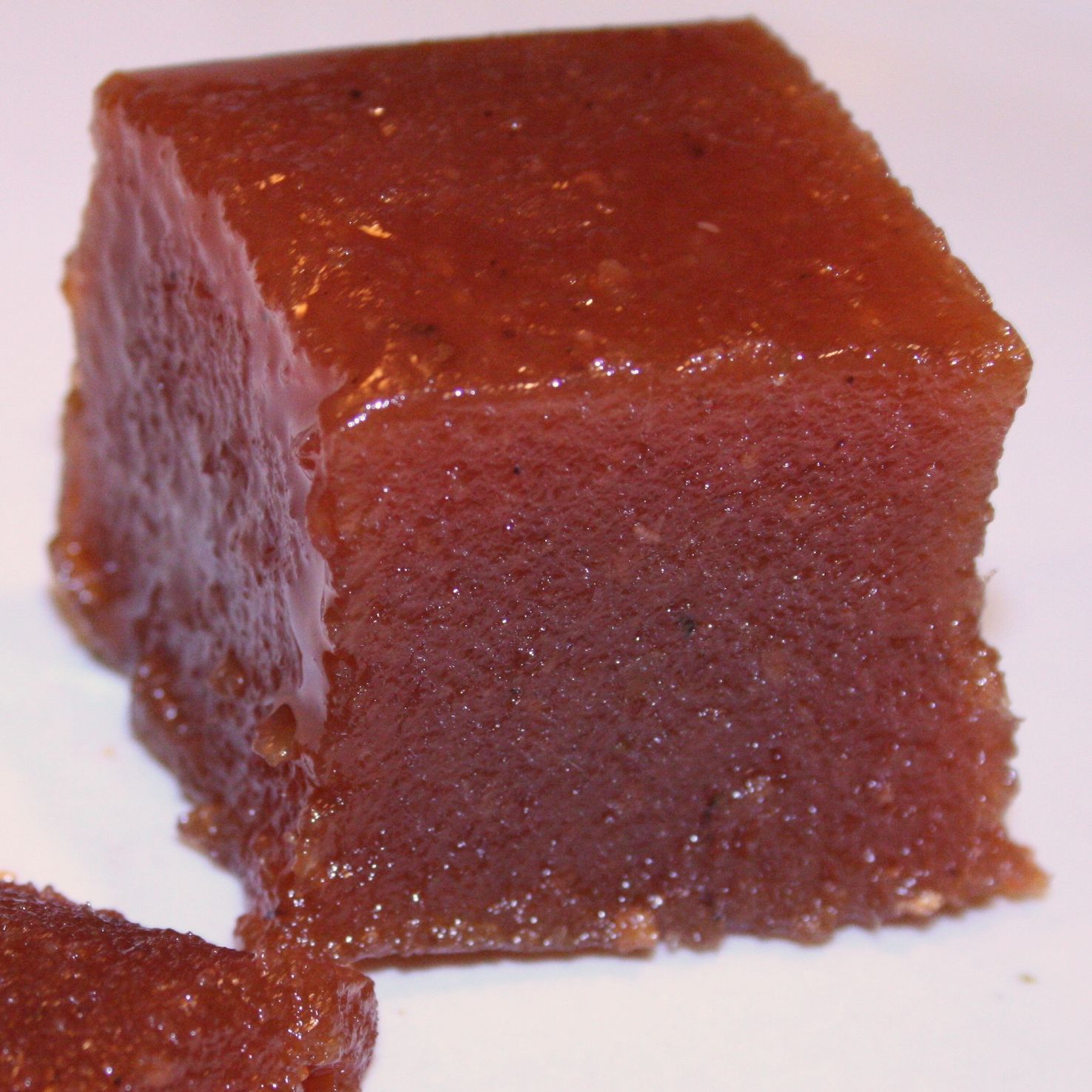
Quince cheese (also known as quince paste) is a sweet and tart, thick jelly made of the pulp of the quince fruit. It is a common confection in several countries.
In the Iberian Peninsula, this traditionally Mediterranean food is known by various names: ate, dulce de membrillo or carne de membrillo in Spanish, marmelada or doce de marmelo in Portuguese, marmelo in Galician, marmiellu in Asturian, irasagarra in Basque and codonyat in Catalan. It is a firm, sticky, sweet reddish hard paste made from the quince fruit (Cydonia oblonga). Similar preparations are popular across different cultures, such as birsalmasajt in Hungary, kitnikez in Serbia, pâte de coing in French-speaking regions, and cotognata in Italy. It is also enjoyed in Mexico, Colombia, Argentina, Uruguay, Paraguay, and Chile as ate or dulce de membrillo, and known as machacado de membrillo in Peru, ממבריו (membrio) in Israel, ayva peltesi in Turkey, and marmeladă de gutui in Romania. Puente Genil, in Spain, is the main world producer, being the set place of El Quijote, the most important global factory in terms of quince cheese production.
Quince cheese is also a traditional food in France, served during Christmas, and is a common food in Italy.
Quince came from the Minoan port of Kydonia. The recipe for quince cheese is probably of ancient origin; the ancient Greeks were great quince producers and made quince cheese, sweetening it with honey. The Roman cookbook of Apicius, a collection of Roman cookery recipes compiled in the late 4th or early 5th century AD, also gives recipes for stewing quince with honey. In later centuries, the dense preparation style of ancient quince recipes led to the general classification of such solid fruit pastes as fruit cheese.
Historically, marmalade was made from quince. The English word "marmalade" comes from the Portuguese word marmelada, meaning "quince preparation" (and used to describe quince cheese or quince jam; "marmelo" = "quince"). The word ultimately comes from Latin melimelum, itself from the Greek melimelon (Greek: μελίμηλον) meaning "honey apple" or "sweet apple".
Nowadays (in English), "A marmalade is a jellied fruit product which holds suspended within it all or part of the fruit pulp and the sliced peel. It is prepared from pulpy fruits, preferably those that contain pectin. Citrus fruits are especially desirable because of their flavor and pectin content."
Quince cheese is prepared with quince fruits. The fruit is peeled and cored, and cooked with a teaspoon of water and from 500 to 1000 g sugar per kg of quince pulp, preferably in a pressure cooker, but it can also be left for longer (40 minutes–1 hour) in a regular pot, in this case with a little more water (which will then evaporate). It turns a light brick colour in the pressure cooker and on a regular pot, after a long cooking time, dark brick colour. After leaving it to set for a few days on earthenware/clay bowls (preferable), topped with parchment paper rounds, it becomes a relatively firm quince paste/cheese, dense enough to hold its shape. The taste is sweet but slightly astringent (depending on the amount of sugar used), and it is similar in consistency, flavor and use to guava cheese or guava paste.
Quince jelly is made with the skins and core, including pips, that were discarded when preparing quince cheese. They are cooked until halved in volume and the water is then sieved. For every 1000 ml water, 500 g sugar is added and the concoction is again boiled, until thread point is achieved.[citation needed]
Hub AI
Quince cheese AI simulator
(@Quince cheese_simulator)
Quince cheese
Quince cheese (also known as quince paste) is a sweet and tart, thick jelly made of the pulp of the quince fruit. It is a common confection in several countries.
In the Iberian Peninsula, this traditionally Mediterranean food is known by various names: ate, dulce de membrillo or carne de membrillo in Spanish, marmelada or doce de marmelo in Portuguese, marmelo in Galician, marmiellu in Asturian, irasagarra in Basque and codonyat in Catalan. It is a firm, sticky, sweet reddish hard paste made from the quince fruit (Cydonia oblonga). Similar preparations are popular across different cultures, such as birsalmasajt in Hungary, kitnikez in Serbia, pâte de coing in French-speaking regions, and cotognata in Italy. It is also enjoyed in Mexico, Colombia, Argentina, Uruguay, Paraguay, and Chile as ate or dulce de membrillo, and known as machacado de membrillo in Peru, ממבריו (membrio) in Israel, ayva peltesi in Turkey, and marmeladă de gutui in Romania. Puente Genil, in Spain, is the main world producer, being the set place of El Quijote, the most important global factory in terms of quince cheese production.
Quince cheese is also a traditional food in France, served during Christmas, and is a common food in Italy.
Quince came from the Minoan port of Kydonia. The recipe for quince cheese is probably of ancient origin; the ancient Greeks were great quince producers and made quince cheese, sweetening it with honey. The Roman cookbook of Apicius, a collection of Roman cookery recipes compiled in the late 4th or early 5th century AD, also gives recipes for stewing quince with honey. In later centuries, the dense preparation style of ancient quince recipes led to the general classification of such solid fruit pastes as fruit cheese.
Historically, marmalade was made from quince. The English word "marmalade" comes from the Portuguese word marmelada, meaning "quince preparation" (and used to describe quince cheese or quince jam; "marmelo" = "quince"). The word ultimately comes from Latin melimelum, itself from the Greek melimelon (Greek: μελίμηλον) meaning "honey apple" or "sweet apple".
Nowadays (in English), "A marmalade is a jellied fruit product which holds suspended within it all or part of the fruit pulp and the sliced peel. It is prepared from pulpy fruits, preferably those that contain pectin. Citrus fruits are especially desirable because of their flavor and pectin content."
Quince cheese is prepared with quince fruits. The fruit is peeled and cored, and cooked with a teaspoon of water and from 500 to 1000 g sugar per kg of quince pulp, preferably in a pressure cooker, but it can also be left for longer (40 minutes–1 hour) in a regular pot, in this case with a little more water (which will then evaporate). It turns a light brick colour in the pressure cooker and on a regular pot, after a long cooking time, dark brick colour. After leaving it to set for a few days on earthenware/clay bowls (preferable), topped with parchment paper rounds, it becomes a relatively firm quince paste/cheese, dense enough to hold its shape. The taste is sweet but slightly astringent (depending on the amount of sugar used), and it is similar in consistency, flavor and use to guava cheese or guava paste.
Quince jelly is made with the skins and core, including pips, that were discarded when preparing quince cheese. They are cooked until halved in volume and the water is then sieved. For every 1000 ml water, 500 g sugar is added and the concoction is again boiled, until thread point is achieved.[citation needed]
Recent media