Hubbry Logo
DunaddDunaddMain
Open search
Dunadd
Community hub
Dunadd
logo
8 pages, 0 posts
0 subscribers
Be the first to start a discussion here.
Dunadd
Dunadd
from Wikipedia

Dunadd (Scottish Gaelic Dún Ad, "fort on the [River] Add", Old Irish Dún Att) is a hillfort in Argyll and Bute, Scotland, dating from the Iron Age and early medieval period and is believed to be the capital of the ancient kingdom of Dál Riata.[1][2] Dal Riata was a Gaelic kingdom spanning the northern Irish coast to Argyll and the Scottish islands in the early centuries AD, possibly after the Romans had abandoned Southern Britain and at the time when the Anglo-Saxons were crossing the North Sea to counter incursions over Hadrian's Wall by the Picts and Dalriadan Scots.

Key Information

Description

[edit]

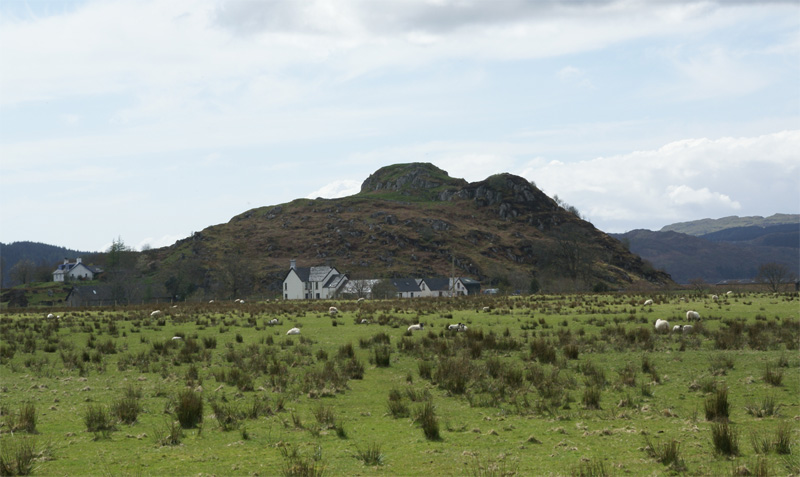
Dunadd is a rocky crag that may have been one time an island and now lies inland near the River Add, from which it takes its name, a little north of Lochgilphead (NR 836 936). The surrounding land, now largely reclaimed, was formerly boggy and known as the Mòine Mhòr ("Great Moor") in Gaelic. This no doubt increased the defensive potential of the site.[3] Detailed analysis of sea-level changes in the region argue that the Dun was an island or promontory into historic times, and that receding sea levels left the fortification open to siege and seizure in the 6th to 7th centuries.[4]

History

[edit]
Boar carving in rock near top of the hill fort.
Pictish boar carving in rock near the top of the hill.

Originally occupied in the Iron Age, the site later became a seat of the kings of Dál Riata. It is known for its unique stone carvings below the upper enclosure, including a footprint and basin thought to have formed part of Dál Riata's coronation ritual. On the same flat outcrop of rock is an incised boar in Pictish style, and an inscription in the ogham script. The inscription is read as referring to a Finn Manach and is dated to the late 8th century or after.[3]

Dunadd is mentioned twice in early sources. In 683 the Annals of Ulster record: "The siege of Dún At and the siege of Dún Duirn" without further comment on the outcome or participants. In the same chronicle the entry for 736 states: "Aengus son of Fergus, king of the Picts, laid waste the territory of Dál Riata and seized Dún At and burned Creic and bound in chains two sons of Selbach, i.e., Donngal and Feradach."[5]

The site was occupied after 736, at least into the 9th century. It is mentioned twice in later sources, suggesting that it retained some importance. In 1436, it is recorded that "Alan son of John Riabhach MacLachlan of Dunadd" was made seneschal of the lands of Glassary; the chief place of residence of the MacLachlans of Dunadd lay below the fort. In June 1506, commissioners appointed by James IV, including the earl and bishop of Argyll, met at Dunadd to collect rents and resolve feuds.[3]

The site is an ancient monument, under the care of Historic Scotland, and is open to the public (open all year; no entrance charge).[6]

Excavations

[edit]

Because Dunadd is mentioned in early sources, and is readily identifiable, it has been excavated on several occasions (1904–1905, 1929, and 1980) and has one of the most important ensembles of finds from any early medieval site in Scotland. Finds range from the 6th to the 8th centuries AD. These include tools, weapons, quernstones, imported pottery and motif-pieces and moulds for the manufacture of fine metalwork (especially jewellery).[3]

Bruach An Druimein connection

[edit]

Seven kilometres to the north of Dunadd is the site of Bruach An Druimein. Excavated in the 1960s in advance of gravel quarrying, archaeologists discovered the remains of a Bronze Age cists cemetery, two round houses from the Iron Age, and a number of artefacts from the early medieval period that were contemporary with Dunadd. Two medieval glass beads were found that have similar chemical compositions to those found at Dunadd, leading the archaeologists to believe that the beads came from Dunadd and that the site was associated with, or controlled by Dunadd.[7]

In fiction

[edit]

In Rosemary Sutcliff's 1965 novel The Mark of the Horse Lord the Dal Riada undergo an internal struggle for control of royal succession, with Dun Monaidh central to the conflict, including a depiction of royal coronation and use of carved footprint. Dunadd is the location for Claire R. McDougall's novel "Veil of Time," in which a modern-day woman is transported back to Dunadd's heyday in the 8th century. All the features of Dunadd, including the footprint, the boar, the well and the tumble down ruins are features of the story, as are the modern farm and cottages . Other ancient sites in the Kilmartin Valley also play a part in the narrative.

Files

[edit]

See also

[edit]

Notes

[edit]
[edit]
Revisions and contributorsEdit on WikipediaRead on Wikipedia
from Grokipedia
Dunadd is a rocky overlooking the Add valley in , , that functioned as a principal stronghold and ceremonial center for the Gaelic kingdom of from roughly the 5th to 9th centuries AD. Originally fortified during the , the site gained prominence in the early medieval period as a hub of political authority, evidenced by defensive earthworks, high-status artifacts, and rock-cut features including a carved , basin, and boar relief thought to relate to royal inauguration rites. Archaeological findings, such as imported and ceramics, highlight Dunadd's connections to Mediterranean and continental trade networks, affirming its economic and symbolic importance amid the consolidation of Gaelic power in western . The footprint carving, positioned on a prominent , symbolizes the territorial claim and legitimacy of Dál Riata's rulers, who likely stood in it during ceremonies to affirm sovereignty over the land. Adjacent carvings, including an inscription and a basin possibly used for libations, further suggest functions tied to kingship, blending Gaelic traditions with local prehistoric elements. Though abandoned by the late amid shifting political dynamics, Dunadd remains a key testament to the origins of medieval Scotland's .

Location and Physical Characteristics

Geographical Position and Topography


Dunadd hillfort occupies a rocky crag in Argyll and Bute, western Scotland, at coordinates approximately 56°02′23″N 5°27′11″W, positioned at the southern end of Kilmartin Glen adjacent to the boggy expanse of Moine Mhor and near Crinan Moss. The site's elevation reaches about 80 meters above the surrounding flat, waterlogged terrain, which consists primarily of peat moss and marshland that impedes easy access from multiple directions.
The topography is characterized by a steep, stepped rock with natural cliffs on its western and southern flanks, dropping sharply into the , while gentler slopes on the east allow for a single main approach path. These features create inherent defensibility, as the marshy basin isolates the crag, limiting invasion routes to narrow, controllable corridors and providing vantage points for monitoring the and nearby waterways such as the River Add and coastal inlets. The proximity to ancient land routes through the and short distances to sea lochs facilitated oversight of potential trade and migration paths across the narrow strait to .

Site Features and Defenses

Dunadd comprises a rocky fortified as a multi-terraced , with a series of enclosures at varying levels separated by ramparts constructed from stone and earth. The site's features steep slopes on most sides, providing inherent defensive advantages that were enhanced through human , including terracing and leveling within enclosures to create usable spaces. The defenses include three principal ramparts, the innermost being the most substantial and enclosing the summit citadel, while outer ramparts incorporate ditches for added protection. Access to the upper enclosures is restricted by narrow, steep paths, some stone-lined, which channel approaches and exploit the crag's natural contours to deter attackers. These modifications transform the natural hill into a with defined defensive tiers.

Early Occupation and Development

Prehistoric Use and Iron Age Fortification

Archaeological excavations at Dunadd have uncovered evidence of occupation predating its early medieval prominence, with layers of activity including settlement debris and structural remains beneath later fortifications. Investigations in the 1980s, led by Alan Lane and Ewan Campbell, confirmed deposits, such as fragments and possible post-hole structures, indicating human presence on the hilltop during this period. Earlier digs in 1904 and 1929 also noted prehistoric materials, though interpretation focused more on confirming pre-Dál Riata use rather than extensive sequencing. The site's defenses reflect Iron Age hillfort traditions in western Scotland, featuring a compact, multivallate enclosure on a naturally defensible rocky outcrop overlooking the Add estuary. This "nuclear fort" morphology—small summit enclosures with multiple earthen and stone ramparts, often under 1 hectare—provided strategic control over coastal routes and resources, typical of late prehistoric fortified sites in Argyll. While precise construction dates for these ramparts remain tentative without dedicated radiocarbon assays from basal layers, comparable nuclear forts elsewhere in date to the mid- to late , around 500 BC to AD 100. The hill's vitrified wall segments, potentially from Iron Age phases, suggest intensive construction or conflict-related firing, enhancing defensibility against raids. Artifacts from the are sparse, limited to nondescript ceramics and occasional lithics, pointing to intermittent or seasonal exploitation rather than dense, permanent occupation. This paucity contrasts with the site's later medieval density and implies Dunadd functioned primarily as a refuge or assembly point during periods of instability in the regional Iron Age landscape. No evidence indicates it held exceptional status in the Iron Age, unlike its role in subsequent eras, underscoring a continuity of topographic appeal for over millennia.

Transition to Early Medieval Period

Archaeological at Dunadd indicates Iron Age fortifications and occupation, including pottery sherds and structural remains dating to the middle and late (c. 400 BC–AD 200), followed by a period of reduced activity or abandonment typical of many Scottish hillforts in the post-Roman era. Subsequent phasing reveals re-fortification with a dún constructed around the 4th–5th centuries AD, marked by new techniques and layout adaptations that overlay earlier features without evidence of continuous dense settlement. This shift reflects broader patterns in western where Iron Age sites were sporadically reused amid changing social and economic conditions, rather than unbroken habitation. The timing of this reoccupation aligns with the expansion of , a Gaelic kingdom originating from settlers in northeastern Ireland's , whose migrations to Scotland's region are attested in early Irish annals compiled from the 6th century onward. These sources, including entries from the and Annals of Tigernach, reference leaders and conflicts by AD 563, implying prior establishment linked to kin-groups (cenéla) crossing the North Channel around the 5th century AD. While archaeological evidence for mass migration remains debated, with some continuity in material culture, the introduction of Irish-style settlement patterns and place-names supports Gaelic influence coinciding with Dunadd's revitalization as a defensible stronghold. Environmental changes likely facilitated this transition, as isostatic rebound from post-glacial uplift caused the Dunadd crag to emerge from estuarine conditions between AD 460 and 770, per radiocarbon-dated sediments in adjacent Crinan Moss. Concurrent accumulation in the surrounding Moine Mhòr , driven by wetter climatic phases and expansion, transformed lowland accessibility, isolating the hilltop and enhancing its strategic defensibility amid migrating groups seeking elevated, naturally fortified positions. These landscape alterations, rather than solely human agency, provided causal preconditions for reoccupation, underscoring how geophysical dynamics shaped settlement viability in early medieval .

Association with Dál Riata Kingdom

Historical Context of Dál Riata

Dál Riata was a Gaelic-speaking kingdom that occupied territories in northeastern Ireland, particularly County Antrim, and western Scotland, centered on Argyll, from roughly the fifth to the ninth centuries AD, with its political core shifting toward Scotland by the seventh century. The kingdom's origins are tied to Irish Gaels, with genealogical traditions linking its ruling lineages to the Dál Fiatach of the Ulaid province in Ireland, though archaeological evidence for a large-scale population migration remains absent, suggesting instead elite movements or cultural diffusion facilitated Gaelic dominance in the region. Traditional foundation narratives center on Fergus Mór mac Eirc, purportedly a king who crossed from Ireland to establish Scottish Dál Riata around 498–501 AD, but this account derives from medieval annals like the Annals of Tigernach and first appears in Scottish contexts circa 800 AD, absent from earlier records such as those from the 730s–740s, rendering it more legendary than verifiable. The kingdom's structure revolved around kin-based overgroups known as cenéla, including the Cenél Loairn in northern Argyll, the Cenél nGabráin in the south, and the Cenél nÓengusa, which provided successive overkings documented in Irish annals; for instance, the record the death of Áed Find, king of , in 778 AD during conflicts with the . Politically, engaged in expansionist raids and defensive wars against neighboring Britons in , to the north and east, and Northumbrian Angles, achieving peak influence in the sixth and seventh centuries under rulers like Áedán mac Gabráin (died circa 609 AD), whose campaigns against the Angles at Degsastan in 603 AD marked a failed bid for broader , as noted in Bede's Ecclesiastical History. Internal divisions among the cenéla and external pressures, including Viking incursions from the late eighth century, eroded Irish holdings by circa 800 AD, confining effective control to Scottish territories. By the mid-ninth century, the kingdom faced existential threats, culminating in the rise of Cináed mac Ailpín (Kenneth MacAlpin), a Dál Riata king from the Cenél nGabráin, who seized Pictish kingship following the annihilation of multiple Pictish rulers—possibly in battle or through treachery—in 839 AD, as inferred from the pattern of recorded deaths in the Annals of Ulster, enabling his consolidation of power by 843 AD and the formation of a unified realm ancestral to medieval Scotland. This unification, detailed retrospectively in the tenth-century Chronicle of the Kings of Alba, involved Cináed's transfer of Gaelic institutions and relics northward, effectively supplanting Pictish monarchy with Dál Riata's, though the precise mechanisms remain debated due to the scarcity of Pictish written records and reliance on later Gaelic-centric sources. Dál Riata thus transitioned from a cross-sea entity to the nucleus of the Kingdom of Alba, dissolving as a distinct polity by the late ninth century amid Norse-Gaelic disruptions.

Evidence for Dunadd as a Royal Center

Dunadd's status as a high-status stronghold in the kingdom of is supported by limited textual references in early medieval , which first mention the site in AD 683 during a period of conflict involving the Cenél Loairn kindred, indicating its role as a contested power base rather than an unequivocally designated capital. The Senchus fer n-Alban, a seventh-century of 's obligations and kin groups, outlines the kingdom's structure without naming a fixed royal seat, though later traditions and the site's prominence in Gaelic lore infer Dunadd's centrality among multiple fortified centers like Dunollie and Dunaverty. Archaeological assemblages from excavations reveal concentrations of imported luxury goods consistent with elite sponsorship of long-distance trade, including E-ware amphorae from southwestern —used for olive oil, wine, and nuts—and fragments of high-quality vessels likely from the or Mediterranean workshops, dated primarily to the sixth through eighth centuries AD. These imports, exceeding those at comparable regional sites, suggest Dunadd functioned as a redistribution hub under royal oversight, though quantities remain modest and do not prove exclusivity to a single ruler. The fort's topography, elevated on a rocky outcrop above the Add Estuary and Crinan Peninsula, provided oversight of vital sea lanes linking and western , with rock-cut fortifications—including cisterns, ditches, and vitrified ramparts—enhanced for sustained defense, as evidenced by structural adaptations post-dating initial phases. This positioning aligns with Dál Riata's maritime-oriented polity, enabling control over crossings and resources, yet inferences of "royal center" status rely on contextual patterns rather than direct epigraphic confirmation, allowing for itinerant kingship models prevalent in early Gaelic societies.

Ritual and Symbolic Elements

The Footprint Carving and Inauguration Practices

The footprint carving at Dunadd features a single right foot impression, approximately 25 cm long, incised into a schistose located in the lower enclosure of the . This dates to the core period of Dál Riata's prominence, circa the 6th to 7th centuries AD, aligning with the site's peak archaeological layers containing high-status artifacts indicative of royal activity. Archaeologists interpret the carving as a ritual fixture for the of kings, wherein the sovereign-to-be would stand within the impression to ritually claim over the territory, embodying a physical assertion of . This standing rite symbolized the king's integration with the land, paralleling Irish inauguration customs where rulers enacted a symbolic to the figure—often a representing the realm's and prosperity—to legitimize their rule through oaths of protection and stewardship. Such practices drew from shared Gaelic traditions, including elements of tanistry where eligible heirs underwent ceremonial affirmation, potentially involving anointing or verbal pledges at sacred topographical features to affirm territorial bonds. While no contemporary texts explicitly document the footprint's role at Dunadd, the motif fits empirical patterns of Celtic kingship emphasizing embodied claims over land, as evidenced by analogous footprint stones at Irish royal sites like Tara and . The interpretation rests on comparative rather than direct attestation, given the paucity of written records from 6th– Argyll; Dál Riata's oral and prioritized symbolic acts tying rulership to landscape control, underscoring causal links between physical ritual and political legitimacy in pre-literate societies.

Ogham Inscription, Boar Symbol, and Basin

Near the summit of Dunadd, an outcrop of rock bears an inscription consisting of linear notches in the early medieval Irish script, typically used for personal names or short formulas between the 4th and 9th centuries. The text, weathered and partially legible, has been interpreted by some scholars as referring to "Finn Manach," possibly denoting a "fair " or a specific individual, though epigraphic analysis notes challenges in precise transcription due to erosion. The script's style aligns with broader ogham usage in and during the early medieval period, potentially from the 6th to 8th centuries in the site's context. Adjacent to the inscription is an incised carving of a boar, executed in a style recognizable as Pictish, featuring a stylized wild pig with prominent bristles. In Pictish and broader Celtic iconography, the boar symbol frequently evokes themes of ferocity and martial strength, serving as a totemic emblem associated with warriors and tribal identity. This motif appears on symbol stones across northern Britain, suggesting cultural exchange or shared symbolic repertoires between Pictish and Gaelic elites at sites like Dunadd. A circular basin, cut directly into the living rock approximately 11 inches (28 cm) in and adjacent to these carvings, constitutes a verifiable rock-cut feature without direct archaeological of specific use. While hypotheses propose ritual functions such as holding libations or facilitating oaths during ceremonies, these remain interpretive, grounded solely in the feature's form and proximity to other symbolic elements rather than excavated residues or textual corroboration. The basin's integration with the outcrop underscores a deliberate modification of the natural rock for potentially ceremonial purposes in the early medieval era.

Archaeological Excavations and Findings

Initial Excavations (1904–1929)

The first systematic investigations at Dunadd occurred between 1904 and 1905 under David Christison, secretary of the , as part of a regional survey of 's hillforts. Christison's work emphasized the site's defensive structures, identifying multi-phase ramparts constructed from stone and earth, with evidence of in some sections indicating high-temperature exposure possibly from deliberate firing. These efforts, however, employed early 20th-century methods that prioritized surface-level exposure over detailed stratigraphic recording, limiting insights into depositional sequences and chronological layering. A subsequent excavation in 1929, led by J. Hewat Craw, also secretary of the , spanned 24 days and targeted interior areas of the fort, particularly lower terraces. Craw recovered metalwork artifacts such as iron spearheads, knives, and shears, alongside a silver ring and bronze disc, pointing to the activities of a or class equipped for and craftsmanship. Additional finds included jet beads and armlets, hammerstones, and quern fragments, but many contexts showed disturbance from earlier probing and natural , complicating artifact associations and precise phasing. These limitations underscored the preliminary nature of both campaigns, which yielded suggestive but inconclusive evidence for the site's early medieval occupation without robust chronological controls.

1980s Investigations and Key Artifacts

The 1980–1981 excavations at Dunadd, directed by Alan Lane of the University of Cardiff, targeted key enclosures and rampart sequences to establish a precise and assess early medieval occupation layers. These small-scale investigations built on prior work by examining stratified deposits within the hillfort's interior and defenses, revealing structural phases associated with activity. Pottery assemblages from the digs included substantial quantities of imported sherds, notably E-ware fine tablewares from western and amphorae fragments linked to Mediterranean wine and oil , underscoring Dunadd's role in Atlantic exchange networks during the 5th–8th centuries AD. Additional finds comprised iron tools such as shears and knives, suggestive of on-site crafting or butchery, alongside gaming pawns indicative of elite leisure activities. These artifacts collectively point to organized feasting and high-status functions, with animal refuse supporting periodic assemblies. Radiocarbon analysis of organic remains and of ceramic and structural materials refined the site's primary occupation to the 5th–8th centuries AD, aligning with documentary references to Dál Riata's royal centers and confirming continuity from foundations into the early medieval period. The pottery's wheel-thrown nature and exotic origins further distinguish these layers from local prehistoric traditions.

Post-Excavation Analysis and Preservation Issues

Post-excavation studies of artifacts recovered from the excavations, including imported glass vessels, enameled horse fittings, and high-status metalwork, have reinforced associations between Dunadd's and early medieval rituals, as these prestige items cluster in areas near symbolic carvings, suggesting ceremonial deposition patterns consistent with royal practices. The Dunadd Digital Archive, maintained by the since the early 2000s, facilitates ongoing re-analysis of stratigraphic data, finds catalogs, and contextual photographs, allowing researchers to cross-reference artifact distributions with features for refined interpretations of site use without further physical disturbance. Preservation efforts face ongoing threats from unauthorized activities, exemplified by a 2022 incident where two metal detectorists illegally excavated at the , causing damage that prompted their sentencing to 180 hours of unpaid community work by Oban District Court. This event, occurring despite Dunadd's protected status under the Ancient Monuments and Archaeological Areas Act 1979, underscores gaps in on-site enforcement and surveillance, as remote locations limit proactive monitoring by . To address visitor-induced , a replica of the footprint was installed over the original carving in the late , with the protective fibreglass or concrete cover confirmed publicly in to deter direct contact and weathering from repeated foot placements during tourist interactions. The underlying original, shielded since installation, preserves the 6th-century feature's integrity amid annual site visits exceeding thousands, balancing public access with long-term conservation priorities.

Scholarly Debates and Controversies

Questions on Capital Status and Dating

The identification of Dunadd as the primary capital of relies on circumstantial archaeological evidence rather than explicit confirmation in contemporary , which mention the site primarily in the context of its capture by the in 736 CE but do not designate it as the singular royal seat. reference multiple fortified duns associated with kingship, including Dunaverty, Dunollie, and Tarbert, suggesting a network of regional power centers rather than centralized primacy at one location. This distribution aligns with the decentralized structure of early Gaelic lordship, where control over trade routes and coastal defenses could be maintained through several strongholds, as evidenced by high-status imports like E ware pottery found at Dunadd but paralleled in lesser quantities at other sites. Alternative sites such as Dunollie have been proposed as comparable royal centers, with its sharing morphological similarities to Dunadd's nuclear fort layout and historical associations with Cenél Loairn kindreds that vied for dominance within . Excavations at Dunollie reveal early medieval occupation layers with defensive enhancements, indicating it functioned as a key stronghold, potentially rivaling Dunadd during periods of internal fragmentation following events like the 736 Pictish incursion. Trade evidence, including glass and metalwork, underscores economic power at Dunadd but does not preclude parallel capabilities elsewhere, as 's maritime orientation favored multiple accessible ports over exclusive reliance on one inland . Debates over Dunadd's center on its as a "nuclear fort," a compact type with inner enclosures typically dated to the 7th–8th centuries CE based on stratified artifact assemblages and radiocarbon dates from associated deposits. While some earlier interpretations linked vitrified ramparts at similar sites to origins, re-examination of Dunadd's defenses attributes —if present—to localized burning episodes rather than primary construction techniques, supporting a post-Roman development phase rather than pre-Gaelic continuity. Pictish military pressures, culminating in the 736 sack, likely prompted upgrades, complicating a purely Gaelic narrative of unbroken occupation and highlighting hybrid influences on site evolution. These temporal uncertainties underscore that Dunadd's prominence may reflect interpretive bias toward artifact-rich sites, rather than unequivocal evidence of unchallenged capital status across Dál Riata's 5th–9th century span.

Footprint Authenticity and Site Connections

In 2007, disclosed that the visible footprint carving at Dunadd, long associated with royal inauguration rituals of kings, is a fibreglass installed to protect the original sandstone carving from ongoing caused by weather exposure and potential vandalism by visitors. The original, dated to the early medieval period around the 6th to 8th centuries AD based on contextual archaeological evidence from the site, remains buried beneath the replica under a protective cover to preserve its integrity, as repeated foot placement and had accelerated wear since the site's recognition as a key power center. This protective measure, implemented progressively from the late 1970s with initial concrete coverings evolving to fibreglass by the 2000s, underscores authenticity concerns not about the carving's historical validity—which is supported by its integration with other site features like the adjacent basin and inscriptions—but rather about public misrepresentation of the exposed artifact as the genuine article. Scholarly disputes extend to proposed topographic and functional connections between Dunadd and nearby sites, such as Bruach an Druimein, a approximately 7 kilometers north excavated in the 1960s ahead of extraction, where some researchers have suggested shared practices or extended landscapes based on landscape surveys and proximity to territories. However, these links lack direct archaeological corroboration, such as matching artifacts or inscriptions, relying instead on speculative alignments of elevation and visibility, which do not conclusively demonstrate coordinated use for royal ceremonies over singular reliance on Dunadd's summit features. Broader controversies highlight an overreliance on Dunadd as the mythic cradle of Scottish nationhood, a amplified in popular accounts but contradicted by evidence of Dál Riata's fragmented , comprising multiple kindred territories with alternative elite centers like Dunollie and Dunaverty rather than a centralized capital. Archaeological data indicate Dunadd functioned as one interfacial stronghold among several from circa to 800, with power distributed across Gaelic-speaking regions rather than embodying a unified "birth" of , a construct critiqued in recent for conflating localized royal symbolism with anachronistic national origins. This empirical perspective prioritizes patterns and artifact distributions over romanticized singularity, revealing how the footprint's role, while verifiable in contexts akin to Irish traditions, does not substantiate overarching foundational myths without additional .

Cultural and Modern Legacy

Representations in Fiction and Media

Dunadd features prominently in Claire R. McDougall's Veil of Time series, beginning with Dunadd: A Veil of Time (2014), a time-travel where the modern protagonist, Maggie, experiences 8th-century at the . The narrative centers Dunadd as a hub of Gaelic power, incorporating the footprint carving and inauguration rituals into a plot blending epilepsy-induced visions with ancient , portraying the site as a liminal space bridging eras. In Paula de Fougerolles' Chronicles of Iona series, Dunadd appears as the royal stronghold of kings like (r. c. 574–609), depicted amid interactions with St. Columba and early Christian influences, emphasizing its role in 6th–7th-century political and religious dynamics within a biographical format. These works often amplify Dunadd's aura of Celtic mysticism, framing the carvings and as symbols of innate and otherworldly authority, which echoes romanticized 19th–20th-century interpretations of Gaelic heritage rather than strictly adhering to archaeological of pragmatic, multi-phase occupation from the onward. Broader fiction remains niche, with no major adaptations in film, television, or mainstream video games; an obscure reference occurs in the fan-created Medieval Unlimited setting as a Celtic kingdom, but lacks commercial prominence.

Contemporary Significance and Protection Efforts

Dunadd Fort holds contemporary significance as a tangible emblem of Dál Riata's early medieval Gaelic kingship, underscoring the kingdom's role in fusing Irish settler traditions with indigenous Scottish elements from approximately AD 500 to 800, thereby anchoring narratives of Scotland's formative political and cultural identity. Managed by Historic Environment Scotland (HES), the site draws visitors to its rocky outcrop amid the Moine Mhor bog, fostering public engagement with Scotland's pre-Norman heritage through free year-round access and on-site interpretive materials that highlight its strategic and ceremonial functions. As a designated under the Ancient Monuments and Archaeological Areas Act 1979 (SM90108), Dunadd receives legal protection prohibiting unauthorized activities such as metal detecting or excavation, with scheduled monument consent required for any repairs or works. HES maintains access trails carved through the terrain and interpretive signage mapping the site's features, balancing educational outreach with conservation to mitigate erosion from foot traffic in this bog-surrounded, steep-sloped environment. Protection efforts intensified following a June 2020 incident where two individuals illegally used metal detectors, resulting in 28 to 35 dug holes and the removal of up to 22 metal artifacts, causing irreversible damage to this nationally important site protected since . The perpetrators, Andrejs Grisulis and Matthew Madden, received community payback orders, equipment , and a nationwide ban from protected heritage sites upon sentencing in June , demonstrating enforcement's deterrent value against illicit activities that threaten archaeological . HES emphasized the need for robust legal frameworks to safeguard such power centers, where high-status artifacts underscore Dál Riata's historical prominence. Ongoing challenges include visitor-induced wear on paths and terraces, compounded by the site's exposure in a peat-rich vulnerable to climatic shifts affecting bog preservation, necessitating HES's adaptive strategies for sustainable access without compromising .

References

Add your contribution
Related Hubs
User Avatar
No comments yet.