


Community hub
Recent from talks
Contribute something
Nothing was collected or created yet.
Dutee Chand
View on Wikipedia
Dutee Chand (born 3 February 1996) is an Indian former sprinter who specialized in the women's 100 m and 200 m events.[4][5][6][7] She is the third Indian woman ever to qualify for the women's 100 m event at the Olympics, and has represented India at the 2016 and 2020 Olympic Games.[8][9][10]
Key Information


Early life
[edit]The third of seven children, Chand was born on February 3, 1996 into a below-poverty-line weaver's family in Chaka Gopalpur, a small village in Jajpur district in the state of Odisha, one of the poorest areas in India.[6][11][12][13] Her older sister Saraswati, a state-level runner, was her source of inspiration.[13] At the age of four, Chand began engaging in workouts along with Saraswati on their village's local track. In 2006, when Chand was 10 year old, they were enrolled in a government sports hostel.[14] Chand was no longer living at home and was training in a national program three hours away where she practiced track. This national program enabled her to send financial support to her family, allowing them to move from their two-room, bathroomless house.[15] In 2013, she enrolled in the KIIT University to study law.[16]
Career
[edit]2012–2013
[edit].jpg)
In 2012, Chand became a national champion in the under-18 category, when she clocked 11.85 seconds in the national youth junior athletic championships.[17] In fact, following the rule by the International Association of Athletics Federations states that Chand could only be allowed to compete again if she lowers her testosterone levels that falls under beneath the male range. Chand states that "I feel that its wrong to have to change your body for sport participation" then she follows it with "I'm not changing for anyone."[18]
In 2013, she enrolled in the KIIT University to study law.[19] As of 2016, she is employed as an executive officer in the state PSU The Odisha Mining Corporation Ltd.[20] Clocking 23.811 seconds, Chand won the bronze in the Women's 200 metres event at the 2013 Asian Athletics Championships at Pune. The year also saw her become the first Indian to reach the final of a global athletics 100 metres final, when she reached the final in the 2013 World Youth Championships.[5] In the same year, she became the national champion in 100 metres and 200 metres when she won the events clocking 11.73 s in the final in 100 metres and a career-best 23.73 s in 200 metres at the National Senior Athletics Championships at Ranchi.
2014-2015 hyperandrogenism controversy
[edit]In June 2014, Chand won two gold medals at Asian Junior Athletics Championships in 200 metres and 4 × 400 m relays. In the 200m event she improved her previous timing to 23.74 seconds and hoping to qualify for the Commonwealth Games but Chand was dropped from the 2014 Commonwealth Games contingent at the last minute after the Athletic Federation of India declared her ineligible to compete as a female athlete due to hyperandrogenism.[21][22] Following the Commonwealth Games she was also excluded from the Indian contingent for the 2014 Asian Games. There was no suggestion that Chand was involved in cheating or doping, and the decision was widely criticized by intersex advocates.[23][24]
Chand appealed to the Court of Arbitration for Sport (CAS). The Canadian law firm Davies, Ward, Philips & Vineberg, LLP represented her on a pro bono basis. The IAAF policy on hyperandrogenism, or high natural levels of testosterone in women, was suspended following the case of Dutee Chand v. Athletics Federation of India (AFI) & The International Association of Athletics Federations (IAAF), in the Court of Arbitration for Sport, decided in July 2015.[25] The ruling found that there was a lack of evidence provided that testosterone increased female athletic performance and notified the IAAF that it had two years to provide the evidence.[26][27][28] This ruling effectively lifted Chand's suspension, clearing her to compete again.[29]
The process of determining Chand's eligibility to compete with women caused her significant suffering, including invasive medical examinations and humiliating public scrutiny.[30] [neutrality is disputed] Santhi Soundarajan, an Indian middle-distance runner, extended her support to Chand, saying that Chand should not be "victimized". She said that steps should be taken to ensure Chand's return to the track.[31] Commenting in 2018 on the case of the intersex runner Caster Semenya, Chand expressed her pain and struggle of four years, when she was controversially not allowed to compete in any international events due to hyperandrogenism. "These four years have been extremely tough for me. The negativity, fear of my career ending prematurely, insensitive comments about my body, I have faced them all. I am extremely relieved that I can run fearlessly again, knowing that now my battle exists only on the track and not off it."[32]
2016
[edit]Following the hyperandrogenism rule change, Chand resumed competing and participated in 60 metres at the 2016 Asian Indoor Athletics Championships, where she set the Indian national record of 7.28 seconds in the qualification round and went on to win the bronze medal in the final with a time of 7.37 seconds.
Chand clocked 11.33 seconds in women's 100m dash to win the gold and erase Rachita Mistry's 16-year-old earlier national record of 11.38 s in the 2016 Federation Cup National Athletics Championships in New Delhi. However, she missed the Rio Olympics qualification norm of 11.32 s by one-hundredth of a second.[4][33] On 25 June 2016, Chand broke the same national record twice in one day after clocking 11.24 at the XXVI International Meeting G Kosanov Memorial at Almaty, Kazakhstan, thereby qualifying for the Olympic Games. "I am really happy at the moment, it has been a tough year for me and I am so happy that my coach... and my hard work has paid off. I would like to thank all the people in India who were praying for me to qualify. Your wishes have paid off."[34]

At Rio 2016 Olympics, she became the third Indian woman to participate in the Women's 100 metres, though she did not move beyond the heats, where she clocked 11.69 seconds.
Since Rio, Chand has been training at Hyderabad with young athletes, most notable among them Indian Badminton Star P. V. Sindhu.
In 2016, Chief Minister Naveen Patnaik appointed Chand as assistant manager of Odisha Mining Corporation, explaining that the government's decision to directly employ athletes was to reward their achievements and provide them with financial stability.[35]
2017−2019
[edit]
In 2017, at the Asian Athletics Championships she clinched two bronze medals, one in the Women's 100 metres, another in the Women's 4 × 100 m relay with Srabani Nanda, Merlin K Joseph, and Himashree Roy at Bhubaneswar.[36] At the 2018 Asian Games in Jakarta, Chand in the Women's 100 metres finals, won the silver medal, her first Asian games medal, clocking 11.32 seconds on 26 August.[37] Again on 29 August, she bagged her second silver at the Asian games in the Women's 200 metres final.[38] Her silver in 100 m, was India's silver medal in this category after 32 years since P.T.Usha won in 1986 and Chand's first medal in the Asian games as she was banned in 2014 and her 200 m silver is after 16 years for India since Saraswati Saha's gold in 2002 at Busan.[39]
As she won these two medals after a long court battle, she expressed her concern about her future saying, "My legal team helped me to come back. But nobody could guarantee what will happen in the future." Citing Caster Semenya's ongoing fight, she said, "Caster Semenya is still fighting. There is always fear but you need to overcome it."[40][30][41]
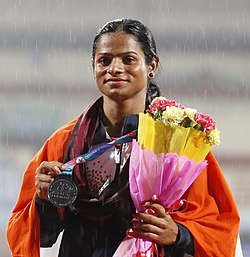
At the 2019 Summer Universiade in Napoli, Chand won gold in the 100m race, becoming the first Indian woman sprinter to win gold at the Universiade. She finished the sprint in 11.32 seconds.[8][9][42] She was also the flag-bearer during the opening ceremony of the event.[43]
In August 2019, prominent sportswear brand Puma signed Chand for two years to endorse their products.[44]
2021–2024
[edit]In 2021 Chandra competed at the delayed Tokyo 2020 Olympic Games in the Women's 100m and 200m events, having qualified due to her world rankings as she did not meet the events' entry requirements (minimum times). In the initial heats she posted times of 11.54 and 23.85 seconds, respectively, well outside of the range required to progress to the semi-final rounds.[45]
She was one of the athletes whose cases were profiled in Phyllis Ellis's 2022 documentary film Category: Woman.[46]
On 18 January 2023 it was announced that Chand had tested positive for three different prohibited substances.[47]
In 2024 Chand announced her decision to retire from sport after the 2024 Paris Olympics. She explained: "I'm growing old, I'm not as fast as I used to be".[7]
International competitions
[edit]


Legend
- H − Heats/qualification rounds
- SF − Semi-finals
- FL − Finals
- NR − National record
- PB − Personal best
Awards and honours
[edit]- ₹3 crore (equivalent to ₹4.0 crore or US$470,000 in 2023) from the Government of Orissa for winning two silver medals at the 2018 Asian Games.[48]
- Arjuna Award (2020)
Personal life
[edit]In 2019, Chand became India's first athlete to openly come out as a member of the LGBTQ+ community, as she publicly revealed that she was in a same-sex relationship.[49][50][51][52][53][54] Chand stated that the 2018 Indian Supreme Court decision to decriminalize gay sex empowered her to speak openly about her sexuality. Chand's announcement was met with mixed reactions. While she received widespread support on social media and from the LGBTQ+ community, she also faced severe backlash from her home village, where residents disavowed her remarks and called them "humiliating".[55] Her eldest sister threatened to expel her from the family.[51]
See also
[edit]
- Rashmi Rocket, Indian sports drama film about sex verification in sports
- Caster Semenya
- Santhi Soundarajan
- Maria José Martínez-Patiño
References
[edit]- ^ "Dutee Chand celebrates her birthday". Orissa Diary. 3 February 2020. Archived from the original on 24 October 2020. Retrieved 20 September 2020.
- ^ "Arjuna Award Would Motivate Me to Breach Olympic Qualification Mark: Dutee Chand". News 18. 23 August 2020. Archived from the original on 28 February 2021. Retrieved 20 September 2020.
- ^ "Dutee Chand". asiangames2018.id. Archived from the original on 4 September 2018. Retrieved 4 September 2018.
- ^ a b "Anirudha, Dutee emerge fastest; Jyothi settles for silver medal". Deccan Herald. 8 September 2013. Archived from the original on 4 March 2016. Retrieved 9 September 2013.
- ^ a b "Dutee Chand is the first Indian sprinter in World 100m final". drinksbreak. Archived from the original on 4 October 2013. Retrieved 9 September 2013.
- ^ a b Slater, Matt (28 July 2015). "Sport & gender: A history of bad science & 'biological racism'". BBC Sport. Retrieved 30 August 2024.
- ^ a b "'Not as fast as I used to be,' Dutee Chand to retire after Paris 2024 Olympics". Olympics.com. Archived from the original on 21 February 2021. Retrieved 4 May 2024.
- ^ a b "Dutee Chand wins 100m gold in World Universiade, creates history". The Times of India. 10 July 2019. Archived from the original on 11 July 2019. Retrieved 10 July 2019.
- ^ a b "Dutee Chand wins 100m gold at World University Games". India Today. 10 July 2019. Archived from the original on 10 July 2019. Retrieved 10 July 2019.
- ^ Rayan, Stan (11 October 2019). "Dutee Chand breaks national record, wins gold at National Championships". Sportstar. Retrieved 18 February 2021.
- ^ Harper, Joanna (2020). Sporting gender: the history, science, and stories of transgender and intersex athletes. Lanham: Rowman and Littlefield. ISBN 978-1-5381-1297-7.
- ^ "Sprinter Dutee Chand set to realise Olympic dream – Times of India". The Times of India. 30 July 2016. Archived from the original on 17 August 2016. Retrieved 19 August 2016.
- ^ a b Das, Tanmay (25 June 2016). "Undeterred Dutee Chand sticks to her track, makes it to Rio Olympics in 100 meters category". The New Indian Express. Archived from the original on 29 August 2016. Retrieved 19 August 2016.
- ^ Bisoyi, Sujit Kumar (30 July 2016). "Dutee Chand: Sprinter Dutee Chand set to realise Olympic dream". The Times of India. Archived from the original on 27 February 2021. Retrieved 18 February 2021.
- ^ Macur, Juliet (6 October 2014). "Fighting for the Body She Was Born With". The New York Times. ISSN 0362-4331. Retrieved 18 April 2024.
- ^ "Rousing welcome to Dutee Chand in KIIT". Odisha Live. 13 September 2013. Archived from the original on 4 October 2013. Retrieved 2 October 2013.
- ^ "Dutee Chand breaks 100m record". The Hindu. 14 July 2012. Archived from the original on 17 September 2013. Retrieved 9 September 2013.
- ^ Macur, Juliet (6 October 2014). "Fighting for the Body She Was Born With". The New York Times. ISSN 0362-4331. Retrieved 30 April 2024.
- ^ "Rousing welcome to Dutee Chand in KIIT". Odisha Live. 13 September 2013. Archived from the original on 4 October 2013. Retrieved 2 October 2013.
- ^ "disha Govt Gives Appointment To Sprinters Dutee Chand, Srabani Nanda". OdishaTv. Archived from the original on 26 August 2018. Retrieved 26 August 2018.
- ^ Slater, Matt (28 July 2015). "Sport & gender: A history of bad science & 'biological racism'". BBC Sport. Archived from the original on 21 July 2015. Retrieved 28 July 2015.
- ^ "Caster Semenya expected to be affected by IAAF rule changes". BBC Sport. Archived from the original on 23 June 2019. Retrieved 26 April 2018.
- ^ "Commonwealth Games sprinter's disqualification shows Australian athletes could face 'gender testing'". Star Observer. August 2014. Archived from the original on 3 September 2014. Retrieved 29 August 2014.
- ^ "Gender struggles for women to find equality in sport". 6th IWG World Conference on Women andSport. Archived from the original on 2 October 2018. Retrieved 29 August 2014.
- ^ Court of Arbitration for Sport (July 2015). CAS 2014/A/3759 Dutee Chand v. Athletics Federation of India (AFI) & The International Association of Athletics Federations (IAAF) (PDF). Court of Arbitration for Sport. Archived from the original (PDF) on 4 July 2017. Retrieved 26 August 2018.
- ^ Branch, John (27 July 2016). "Dutee Chand, Female Sprinter With High Testosterone Level, Wins Right to Compete". The New York Times. Archived from the original on 14 August 2016. Retrieved 22 May 2016.
The Court of Arbitration for Sport, based in Switzerland, questioned the athletic advantage of naturally high levels of testosterone in women and therefore immediately suspended the practice of 'hyperandrogenism regulation' by track and field's governing body, the International Association of Athletics Federations. It gave the organization, known as the I.A.A.F., two years to provide more persuasive scientific evidence linking 'enhanced testosterone levels and improved athletic performance'.
- ^ "Government explores CAS option in Dutee case". The Times of India. 19 August 2014. Archived from the original on 22 August 2014. Retrieved 29 August 2014.
- ^ Branch, John (27 July 2015). "Dutee Chand, Female Sprinter With High Testosterone Level, Wins Right to Compete". The New York Times. The New York Times. Archived from the original on 30 July 2015. Retrieved 27 July 2015.
- ^ "Dutee Chand cleared to race as IAAF suspends 'gender test' rules". BBC News Online. 27 July 2015. Archived from the original on 28 July 2015. Retrieved 27 July 2015.
- ^ a b Pape, Madeleine (2019). "Expertise and Non-binary Bodies: Sex, Gender and the Case of Dutee Chand". Body & Society. 25 (4): 3–28. doi:10.1177/1357034X19865940. ISSN 1357-034X.
- ^ "Santhi Urges Establishment to Help Sidelined Dutee". The New Indian Express. Archived from the original on 1 June 2016. Retrieved 26 August 2018.
- ^ "I have offered Caster Semenya my legal team: Dutee Chand". Archived 27 August 2018 at the Wayback Machine. The Indian Express (27 April 2018). Retrieved on 2018-09-04.
- ^ "National Open Athletics: Golden double for Dutee, Surya". The Times of India. 11 September 2013. Archived from the original on 4 October 2013. Retrieved 19 September 2013.
- ^ a b "Indian sprinter Dutee Chand defies the odds to make Rio 100m". Reuters. 25 June 2016. Archived from the original on 26 August 2018. Retrieved 26 August 2018.
- ^ "disha Govt Gives Appointment To Sprinters Dutee Chand, Srabani Nanda". OdishaTv. Archived from the original on 26 August 2018. Retrieved 26 August 2018.
- ^ "Dutee, Srabani sprint to relay bronze | Orissa Post". www.orissapost.com. 8 July 2017. Archived from the original on 11 July 2017. Retrieved 14 July 2017.
- ^ "Asian Games 2018: India's Dutee Chand wins silver in Women's 100m Final event". 26 August 2018. Archived from the original on 26 August 2018. Retrieved 26 August 2018.
- ^ "Asian Games: Dutee Chand bags second medal, wins 200m silver". The Times of India. 29 August 2018. Archived from the original on 29 August 2018. Retrieved 29 August 2018.
- ^ "Asian Games 2018: Dutee Chand wins silver in women's 200m, her second medal from the Asiad". 29 August 2018. Archived from the original on 30 August 2018. Retrieved 30 August 2018.
- ^ "Asian Games 2018: Double silver medalist Dutee Chand fearful of future, says could be made to 'suffer' again". 29 August 2018. Archived from the original on 30 August 2018. Retrieved 30 August 2018.
- ^ Bull, Andy (23 January 2018). "Caster Semenya and Dutee Chand run ragged by IAAF's moving goalposts". The Guardian. ISSN 0261-3077. Retrieved 30 August 2024.
- ^ "Dutee Chand First Indian Woman To Win 100m Gold In World Universiade". NDTVSports.com. Archived from the original on 10 July 2019. Retrieved 10 July 2019.
- ^ "Napoli 2019 Opening Ceremony - As it happened!". FISU. 3 July 2019. Archived from the original on 11 June 2020. Retrieved 11 June 2020.
- ^ "Sprinter Dutee Chand signs two-year deal with Puma". www.businesstoday.in. 9 August 2019. Archived from the original on 10 August 2019. Retrieved 18 February 2021.
- ^ "Tokyo Olympics 2020: Dutee Chand finishes last in heat, fails to qualify for 200m semifinals". The Times of India (India ed.). 2 August 2021. Retrieved 3 June 2023.
- ^ Elisabetta Bianchini, "'Category: Woman' documentary calls out the human rights violation of defining a woman in sports". Yahoo! News, May 9, 2022.
- ^ The Times of India (18 January 2023). "Dutee Chand tests positive for prohibited substances". The Times of India. Retrieved 21 January 2023.
- ^ Chand appeared in India's most famous TV show conducted by actor Amitabh Bachhann called Kaun Banega Crorepati on 1st Nov 2019. Cash awards by state governments for Asian Games medal winne | Asian Games 2018 News Archived 6 September 2018 at the Wayback Machine. Times of India (31 August 2018). Retrieved on 2018-09-04.
- ^ "Dutee Chand's Biography, Records and Age". 21 February 2021. Archived from the original on 21 February 2021. Retrieved 26 April 2024.
- ^ "Dutee Chand becomes first openly gay Indian athlete". BBC News. 19 May 2019. Archived from the original on 22 May 2019. Retrieved 18 February 2021.
- ^ a b "Dutee Chand becomes first openly gay Indian athlete". BBC News. 19 May 2019. Archived from the original on 22 May 2019. Retrieved 25 May 2019.
- ^ "Dutee Chand on same sex relation: SC gave me belief that we aren't wrong". Sportstar.thehindu.com. 19 May 2019. Archived from the original on 22 November 2019. Retrieved 20 May 2019.
- ^ "Dutee Chand: India's first openly gay athlete". aljazeera.com. Aljazeera. Archived from the original on 25 May 2019. Retrieved 25 May 2019.
- ^ "Sprinter Dutee Chand becomes India's first openly gay athlete". The Guardian. 19 May 2019. Archived from the original on 24 May 2019. Retrieved 25 May 2019.
- ^ Dhillon, Amrit (5 June 2019). "'It's humiliating for us': village disowns Dutee Chand, India's first openly gay athlete". The Guardian. ISSN 0261-3077. Archived from the original on 5 June 2019. Retrieved 5 June 2019.
External links
[edit]
| International | |
|---|---|
| National | |
| People | |
World University Games champions in women's 100 metres | |
|---|---|
|


Dutee Chand
View on GrokipediaDutee Chand (born 3 February 1996) is an Indian sprinter specializing in the 100 metres and 200 metres.[1] She has secured silver medals in both events at the 2018 Asian Games in Jakarta, including India's first such medal in the women's 100 m since 1998.[2] Chand also claimed gold in the 100 m at the 2019 Summer Universiade, becoming the first Indian woman to do so.[3] Her career highlights include participation in the 2016 and 2020 Summer Olympics, as well as multiple bronze medals at Asian Championships.[1] In 2014, Chand was barred from women's competition by the Athletics Federation of India due to hyperandrogenism resulting in naturally high testosterone levels exceeding regulatory thresholds.[4] She challenged the International Association of Athletics Federations' (IAAF) Hyperandrogenism Regulations at the Court of Arbitration for Sport, which in 2015 issued an interim award suspending the rules pending proof of a performance advantage from elevated testosterone in non-cheating athletes.[5] This ruling enabled her return to elite competition without mandatory hormone suppression.[6]
Early Life and Background
Family and Upbringing in Odisha
Dutee Chand was born on February 3, 1996, in Chaka Gopalpur, a small handloom weaving village in Jajpur district, Odisha, to Chakradhar Chand and Akhuji Chand, both of whom worked as weavers to support the family.[7][8][9] As the third of seven children, she grew up in a below-poverty-line household that relied solely on the parents' earnings from traditional handloom weaving, an occupation yielding minimal income in rural Odisha.[10][11][12] The family endured severe economic deprivation, residing in a single cramped room shared by all nine members and frequently facing shortages of basic necessities such as food, which underscored the daily struggles of subsistence in their thatched rural setting.[13][14] These hardships, including the constant pressure of poverty in a resource-scarce environment, cultivated resilience from an early age, with limited opportunities beyond familial labor shaping her formative years.[15][12] An older sister, Saraswati, introduced her to the world of sports through her own involvement, providing initial glimpses of athletics as a potential escape from the family's constrained circumstances despite the absence of financial or infrastructural support.[15][10]Initial Involvement in Athletics
Dutee Chand's entry into athletics was inspired by her elder sister Saraswati, a national-level sprinter, whose practices along the banks of the River Brahmani in their native Odisha captivated the young Chand. Around age 11, Chand began running barefoot around a local lake, demonstrating an innate talent for speed that distinguished her from peers despite the absence of formal coaching or equipment. This informal start reflected the rudimentary conditions of her impoverished weavers' family background, where athletics initially served as both recreation and a potential escape from hardship.[2][14] Transitioning to organized school competitions, Chand quickly earned accolades for her performances, showcasing explosive acceleration and endurance honed through self-motivated practice. These local successes secured her a sports scholarship to a government school in Bhubaneswar, providing access to better facilities and marking her shift from casual running to structured participation. Under her sister's guidance at the Bhubaneswar Sports Hostel, she focused on core sprint mechanics—starts, strides, and finishes—amid basic training setups that emphasized repetition over advanced technology.[14][15] By 2013, at age 17, Chand enrolled at KIIT University in Bhubaneswar to pursue studies while leveraging its stadium for early professional-level drills under modest conditions, including limited track access and manual timing methods. This phase solidified her fundamentals, preparing her for broader competitive exposure without relying on elite resources, and underscored her self-reliant approach amid institutional support gaps in Indian grassroots athletics.[2]Athletic Achievements
Junior and Early Competitions (2012-2013)
In 2012, at the ninth National Youth Athletics Championships held at Sree Kanteerava Stadium in Bangalore from July 14 to 16, Dutee Chand, competing in the under-18 girls' category for Odisha, won the gold medal in the 100m event with a time of 11.85 seconds, shattering the previous national youth record of 11.98 seconds set by Srabani Nanda in 2009.[16][17] The following day, she secured another gold in the 200m, clocking 24.49 seconds to equal the national youth record held by Archana Gupta since 2002.[18][19] These victories marked her emergence as the dominant sprinter in India's youth category, with her 100m time already competitive against some senior national standards.[20] Building on this success, Chand transitioned to junior (under-20) competitions in late 2012 and 2013, winning triple gold medals in the 100m, 200m, and 400m at the Junior National Inter-State Athletics Championships in Lucknow from October 27 to 31, 2012, where she also set meet records in the sprints.[21][22] Her performances earned her selection for international junior events and recognition as India's fastest female junior sprinter, with personal bests in the 100m dipping below 12 seconds and approaching elite senior times like the 11.70 national senior record at the time.[21][20] In July 2013, at the World Youth Championships (under-18) in Donetsk, Ukraine, Chand became the first Indian athlete to reach the women's 100m final, finishing sixth in 11.99 seconds amid strong winds affecting times.[23] She also claimed bronze in the 200m event, further solidifying her status as a prodigy capable of global contention.[23] These results qualified her for subsequent Asian Junior Championships and highlighted her rapid progression, as her sprint times began rivaling those of established Indian senior athletes.[24]National Records and Domestic Successes
Chand demonstrated early dominance in domestic competitions, winning the women's 100m and 200m titles at the National Championships in 2013, marking her emergence as India's top sprinter.[3] She followed with multiple victories at the Federation Cup Senior Athletics Championships, securing 100m golds in editions from 2015 onward and maintaining a streak until 2020, often clocking times under 11.5 seconds that outpaced rivals like Archana Suseendran and Tintu Luka.[25] [26] At the 21st Federation Cup in 2017, she claimed gold in the 100m while earning silver in the 200m, contributing to her Railways team's strong showing.[27] Chand's performances peaked at the 59th National Open Athletics Championships in Ranchi in October 2019, where she won the 100m gold after setting a then-national record of 11.22 seconds in the semifinals with a legal wind reading.[28] She completed a sprint double by taking the 200m title in 23.20 seconds, reinforcing her status as the preeminent figure in Indian women's sprinting during this period.[29] These achievements, characterized by consistent sub-11.5-second 100m runs in national finals—such as 11.24 seconds at the 2019 National Open final—highlighted her technical edge and speed endurance over domestic peers, even amid training disruptions.[30] Her records and titles from 2013 to 2019 established benchmarks that elevated standards in Indian athletics.[27]International Medals and Olympic Participation
Dutee Chand made her Olympic debut at the 2016 Rio de Janeiro Games in the women's 100 metres event, where she competed in the heats and finished seventh in her heat with a time of 11.69 seconds, placing 50th overall and failing to advance to the semifinals.[31] She qualified for the 2020 Tokyo Olympics via world rankings for both the 100 metres and 200 metres but was hampered by a quadriceps strain sustained during national trials; she participated only in the 200 metres heats, finishing last in her heat with 23.91 seconds and not advancing.[32][33][34] Chand's international medals came primarily from Asian competitions following her 2015 Court of Arbitration for Sport ruling. At the 2018 Asian Games in Jakarta, she secured silver medals in both the women's 100 metres (11.32 seconds) and 200 metres (23.20 seconds), with the 100 metres silver marking India's first in that event at the Games.[2][35][36]
| Year | Event | Discipline | Medal | Performance |
|---|---|---|---|---|
| 2017 | Asian Athletics Championships (Bhubaneswar) | Women's 100 metres | Bronze | 11.49 seconds[7][11] |
| 2017 | Asian Athletics Championships (Bhubaneswar) | Women's 4 × 100 metres relay | Bronze | 44.31 seconds[7][11] |
| 2019 | Asian Athletics Championships (Doha) | Women's 200 metres | Bronze | 23.24 seconds[37][38] |