


Community hub
Recent from talks
Contribute something
Nothing was collected or created yet.
EV-E301 series
View on Wikipedia
| EV-E301 series | |
|---|---|
 Set V1 in service in October 2023 | |
| Manufacturer | J-TREC |
| Built at | Yokohama |
| Family name | Accum |
| Replaced | KiHa 40 series |
| Constructed | 2014 |
| Entered service | 15 March 2014 |
| Number built | 8 vehicles (4 sets) |
| Number in service | 8 vehicles (4 sets) |
| Formation | 2 cars per trainset |
| Fleet numbers | V1–V4 |
| Capacity | 265 per set |
| Operators | JR East |
| Depots | Oyama |
| Lines served | Karasuyama Line, Tohoku Main Line |
| Specifications | |
| Car length | 20,000 mm (65 ft 7+3⁄8 in) |
| Width | 2,800 mm (9 ft 2+1⁄4 in) |
| Floor height | 1,130 mm (3 ft 8+1⁄2 in) |
| Doors | 3 pairs per side |
| Maximum speed |
|
| Traction system | Mitsubishi IGBT-VVVF |
| Acceleration | 2.0 km/(h⋅s) (1.2 mph/s)[1] |
| Deceleration | 3.6 km/(h⋅s) (2.2 mph/s) |
| Electric system(s) | 1,500 V DC overhead line |
| Current collection | Pantograph |
| Bogies | DT79 (motored), TR255D (trailer) |
| Safety system(s) | ATS-P |
| Track gauge | 1,067 mm (3 ft 6 in) |
The EV-E301 series (EV-E301系) is a two-car battery electric multiple unit (BEMU) train type operated by East Japan Railway Company (JR East) on the Karasuyama Line and Tohoku Main Line since 15 March 2014.[2] The train is branded as "Accum" (Akyumu).[3]
Overview
[edit]Developed from the experimental "Smart Denchi-kun" battery railcar tested on the Karasuyama Line in 2012, the two-car EV-E301 series train operates as an electric multiple unit (EMU) under the 1,500 V DC overhead wire of the Tohoku Main Line between Utsunomiya and Hōshakuji, and on battery power over the 20.4 km (12.7 mi) non-electrified Karasuyama Line. It can also be recharged via its pantographs at a recharging facility specially built at Karasuyama Station.[3]
The two-car trainsets are equipped with 190 kWh lithium-ion storage batteries,[3] and the train has a maximum design speed of 100 km/h (62 mph), although it normally runs at up to 65 km/h (40 mph) at service.[4]
-
 Set V1 running under overhead wires on the Tohoku Line in March 2014
 -
 Set V1 being recharged at Karasuyama Station in March 2014


Formation
[edit]The two-car trains are formed as shown below, with car 1 at the Utsunomiya end.[3]
| Car No. | 1 | 2 |
|---|---|---|
| Designation | Mc' | Mc |
| Type | EV-E300 | EV-E301 |
| Weight (t) | 37.7 | 40.2 |
| Passenger capacity (seated/total) | 48/133 | 48/133 |
The Mc car has two PS38 single-arm pantographs.[3]
Interior
[edit]Internally, the train uses LED lighting throughout.[3] Seating accommodation consists of longitudinal bench seating.[3] The train is not equipped with a toilet.[4]
-
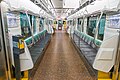 View of the interior
 -
 Priority seating
 -
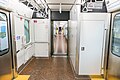 Equipment room and free space
 -
 Driver's cab
 -
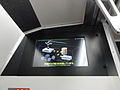 LCD display


Bogies
[edit]Each car is mounted on a TR255D non-powered trailer bogie at the outer end, and a DT79 motored bogie at the inner end.[3]
-
 TR233D trailer bogie
 -
 DT79 motor bogie


History
[edit]
The first set, V1, was delivered from the Japan Transport Engineering Company (J-TREC) factory in Yokohama on 21 January 2014.[5] Test running commenced on 23 January, on the Utsunomiya Line, including running on battery power with the pantographs lowered.[6] It entered revenue service on the Karasuyama Line from the start of the revised timetable on 15 March 2014.[2]
In May 2015, the EV-E301 series was awarded the 2015 Laurel Prize, presented annually by the Japan Railfan Club.[7] A presentation ceremony was held at Karasuyama Station on 26 September 2015.[8]
A further three two-car EV-E301 series trainsets were delivered to Utsunomiya from the J-TREC factory in Yokohama in February 2017.[9] These entered service from the start of the revised timetable on 4 March 2017, replacing the remaining diesel multiple-unit trains operating on the Karasuyama Line.[10]
See also
[edit]- Smart BEST, a self-charging BEMU train developed by Kinki Sharyo in 2012
- BEC819 series, an AC BEMU introduced by JR Kyushu in 2016
- EV-E801 series, an AC BEMU introduced by JR East on the Oga Line in 2017
References
[edit]
- ^ Karkosinki, Dariusz. "Electric Multiple Units With Energy Storage – Alternative to Electrification of New Lines in Three City" (PDF). Index Copernicus. Epismo Power Engineering. Retrieved 29 May 2024.
- ^ a b "烏山線でEV-E301系が営業運転を開始" [EV-E301 series enters revenue service on Karasuyama Line]. Japan Railfan Magazine Online (in Japanese). Japan: Koyusha Co., Ltd. 16 March 2014. Retrieved 17 March 2014.
- ^ a b c d e f g h "EV-E301系蓄電池駆動電車" [EV-E301 series battery EMU]. Japan Railfan Magazine. Vol. 54, no. 638. Japan: Koyusha Co., Ltd. June 2014. pp. 54–59.
- ^ a b "烏山線用EV-E301系" [Karasuyama Line EV-E301 series]. Japan Railfan Magazine. Vol. 54, no. 636. Japan: Koyusha Co., Ltd. April 2014. pp. 62–64.
- ^ "EV-E301系「ACCUM」が甲種輸送される" [EV-E301 series "Accum" delivered]. Japan Railfan Magazine Online (in Japanese). Japan: Koyusha Co., Ltd. 22 January 2014. Retrieved 22 January 2014.
- ^ "EV-E301系「ACCUM」が宇都宮線で試運転" [EV-E301 series "Accum" test-run on the Utsunomiya Line]. Japan Railfan Magazine Online (in Japanese). Japan: Koyusha Co., Ltd. 24 January 2014. Retrieved 24 January 2014.
- ^ ブルーリボン賞・ローレル賞 選定車両一覧 [Blue Ribbon Award & Laurel Prize Winner List] (in Japanese). Japan: Japan Railfan Club. 21 May 2015. Archived from the original on 23 January 2016. Retrieved 19 December 2016.
- ^ EV-E301系 ローレル賞を受賞 [EV-E301 series receives Laurel Prize]. RM News (in Japanese). Japan: Neko Publishing. 1 October 2015. Retrieved 1 October 2015.
- ^ EV-E301系が甲種輸送される [EV-E301 series delivered]. Japan Railfan Magazine Online (in Japanese). Japan: Koyusha Co., Ltd. 22 February 2017. Archived from the original on 22 February 2017. Retrieved 22 February 2017.
- ^ JR烏山線のディーゼル車「キハ40形」 「たらこ色」の車両ラストラン [Last run on JR Karasuyama Line for red KiHa 40 diesel cars]. Sankei News (in Japanese). Japan: The Sankei Shimbun & Sankeu Digital. 4 March 2017. Archived from the original on 4 March 2017. Retrieved 4 March 2017.
 Multiple-units of East Japan Railway Company Multiple-units of East Japan Railway Company | |||||||||||||||||||||||||||||||||||||||||||||||||||||||||
|---|---|---|---|---|---|---|---|---|---|---|---|---|---|---|---|---|---|---|---|---|---|---|---|---|---|---|---|---|---|---|---|---|---|---|---|---|---|---|---|---|---|---|---|---|---|---|---|---|---|---|---|---|---|---|---|---|---|
| Current / active |
| ||||||||||||||||||||||||||||||||||||||||||||||||||||||||
| Future |
| ||||||||||||||||||||||||||||||||||||||||||||||||||||||||
| Retired / withdrawn |
| ||||||||||||||||||||||||||||||||||||||||||||||||||||||||
| Experimental | |||||||||||||||||||||||||||||||||||||||||||||||||||||||||