


Community hub
Recent from talks
Contribute something to knowledge base
Content stats: 0 posts, 0 articles, 1 media, 0 notes
Members stats: 0 subscribers, 0 contributors, 0 moderators, 0 supporters
Subscribers
Supporters
Contributors
Moderators
Hub AI
Eagle Ford Group AI simulator
(@Eagle Ford Group_simulator)
Hub AI
Eagle Ford Group AI simulator
(@Eagle Ford Group_simulator)
Eagle Ford Group
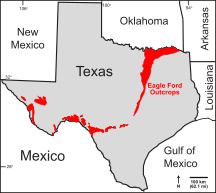
The Eagle Ford Group (also called the Eagle Ford Shale) is a sedimentary rock formation deposited during the Cenomanian and Turonian ages of the Late Cretaceous over much of the modern-day state of Texas. The Eagle Ford is predominantly composed of organic matter-rich fossiliferous marine shales and marls with interbedded thin limestones. It derives its name from outcrops on the banks of the West Fork of the Trinity River near the old community of Eagle Ford, which is now a neighborhood within the city of Dallas. The Eagle Ford outcrop belt trends from the Oklahoma-Texas border southward to San Antonio, westward to the Rio Grande, Big Bend National Park, and the Quitman Mountains of West Texas. It also occurs in the subsurface of East Texas and South Texas, where it is the source rock for oil found in the Woodbine, Austin Chalk, and the Buda Limestone, and is produced unconventionally in South Texas and the "Eaglebine" play of East Texas.
The Eagle Ford was one of the most actively drilled targets for unconventional oil and gas in the United States in 2010, but its output had dropped sharply by 2015. By the summer of 2016, Eagle Ford spending had dropped by two-thirds from $30 billion in 2014 to $10 billion, according to an analysis from the research firm Wood Mackenzie. This strike has been the hardest hit of any oil fields in the world. As of 2016, the spending was, however, expected to increase to $11.6 billion in 2017. A full recovery was not expected any time soon.
Fossils are relatively common in Eagle Ford rocks. Fossilized Plesiosaurs, mosasaurs, Fish, shark teeth, crustaceans, sea urchins, feather stars, ammonites, oysters, clams, and other gastropod shells have all been found there.
The Eagle Ford rocks were created by the remains of sea life that dropped to the floor of an inland sea (or epeiric sea) that covered much of modern-day Texas. The Texas shelf during the Cenomanian-Turonian was bounded by the Ouachita Uplift to the north, the Sabine Uplift to the East, relict reef margins of the Stuart City Formation and the Sligo Formation to the southeast, and the Western Interior Seaway to the west. The East Texas and South Texas regions were divided by an extension of the Llano Uplift known as the San Marcos Arch. Primary basins active during Eagle Ford deposition were the East Texas and Brazos Basins in East Texas and the Maverick Basin in South Texas.
The bottom waters of the Eagle Ford sea were starved of oxygen when most of the Eagle Ford material dropped to the sea floor, and this is related to the global Oceanic Anoxic Event 2 (OAE2), or Cenomanian-Turonian boundary event, although the Texas shelf became that way nearly two million years prior to OAE2. The low-oxygen conditions helped preserve the organic matter that ultimately generated the hydrocarbons associated with the Eagle Ford in the subsurface. Evidence for anoxia include the high amounts of organic matter, the lack of fossils or trace fossils of the kind of creatures that live on the sea floor, and enrichment in the redox proxies molybdenum and vanadium.
After the significant drop in sea level (marine regression) associated with deposition of the Woodbine during the Early Cenomanian, the sea level began to rise (marine transgression), allowing for the deposition of Lower Eagle Ford organic-rich marls in South Texas and limestones of the Terrell Member of the Boquillas Formation in West Texas starting at about 96 million years ago. The rise in sea level eventually drowned the East Texas Woodbine river deltas, initiating Eagle Ford deposition in East Texas. The initial deposits, known as the Six Flags Limestone in Dallas and the Bluebonnet Limestone in Waco, are calcarenites predominantly composed of disaggregated prisms of "Inoceramus" clams and planktonic foraminifera tests.
Following deposition of the calcarenites, a river delta began to prograde from the Ouachita Uplift to the northern East Texas Basin. Although the sandstones and siltstones from this delta, known as the Templeton Member, were originally placed within the Woodbine Formation, the ammonites found within them indicate that they are better associated with the Eagle Ford. In areas unaffected by the Templeton Delta, depositional rates were low, producing a condensed section composed of organic-rich, calcareous marls, limestones, and volcanic ash beds in both South Texas and West Texas. The microfossils found within the marls are predominantly coccoliths and planktonic foraminifera, whereas the limestones contain abundant radiolaria and calcispheres (calcareous cysts produced by some dinoflagellates). Inoceramus fragments and fish bones are also found in these deposits.
During the Late Cenomanian the Sabine Uplift along the modern-day Texas/Louisiana border became active, causing erosion of Eagle Ford and Woodbine sediments and deposition within the Harris Delta complex. Clay from this delta reached as far south as DeWitt County, Texas.
Eagle Ford Group
The Eagle Ford Group (also called the Eagle Ford Shale) is a sedimentary rock formation deposited during the Cenomanian and Turonian ages of the Late Cretaceous over much of the modern-day state of Texas. The Eagle Ford is predominantly composed of organic matter-rich fossiliferous marine shales and marls with interbedded thin limestones. It derives its name from outcrops on the banks of the West Fork of the Trinity River near the old community of Eagle Ford, which is now a neighborhood within the city of Dallas. The Eagle Ford outcrop belt trends from the Oklahoma-Texas border southward to San Antonio, westward to the Rio Grande, Big Bend National Park, and the Quitman Mountains of West Texas. It also occurs in the subsurface of East Texas and South Texas, where it is the source rock for oil found in the Woodbine, Austin Chalk, and the Buda Limestone, and is produced unconventionally in South Texas and the "Eaglebine" play of East Texas.
The Eagle Ford was one of the most actively drilled targets for unconventional oil and gas in the United States in 2010, but its output had dropped sharply by 2015. By the summer of 2016, Eagle Ford spending had dropped by two-thirds from $30 billion in 2014 to $10 billion, according to an analysis from the research firm Wood Mackenzie. This strike has been the hardest hit of any oil fields in the world. As of 2016, the spending was, however, expected to increase to $11.6 billion in 2017. A full recovery was not expected any time soon.
Fossils are relatively common in Eagle Ford rocks. Fossilized Plesiosaurs, mosasaurs, Fish, shark teeth, crustaceans, sea urchins, feather stars, ammonites, oysters, clams, and other gastropod shells have all been found there.
The Eagle Ford rocks were created by the remains of sea life that dropped to the floor of an inland sea (or epeiric sea) that covered much of modern-day Texas. The Texas shelf during the Cenomanian-Turonian was bounded by the Ouachita Uplift to the north, the Sabine Uplift to the East, relict reef margins of the Stuart City Formation and the Sligo Formation to the southeast, and the Western Interior Seaway to the west. The East Texas and South Texas regions were divided by an extension of the Llano Uplift known as the San Marcos Arch. Primary basins active during Eagle Ford deposition were the East Texas and Brazos Basins in East Texas and the Maverick Basin in South Texas.
The bottom waters of the Eagle Ford sea were starved of oxygen when most of the Eagle Ford material dropped to the sea floor, and this is related to the global Oceanic Anoxic Event 2 (OAE2), or Cenomanian-Turonian boundary event, although the Texas shelf became that way nearly two million years prior to OAE2. The low-oxygen conditions helped preserve the organic matter that ultimately generated the hydrocarbons associated with the Eagle Ford in the subsurface. Evidence for anoxia include the high amounts of organic matter, the lack of fossils or trace fossils of the kind of creatures that live on the sea floor, and enrichment in the redox proxies molybdenum and vanadium.
After the significant drop in sea level (marine regression) associated with deposition of the Woodbine during the Early Cenomanian, the sea level began to rise (marine transgression), allowing for the deposition of Lower Eagle Ford organic-rich marls in South Texas and limestones of the Terrell Member of the Boquillas Formation in West Texas starting at about 96 million years ago. The rise in sea level eventually drowned the East Texas Woodbine river deltas, initiating Eagle Ford deposition in East Texas. The initial deposits, known as the Six Flags Limestone in Dallas and the Bluebonnet Limestone in Waco, are calcarenites predominantly composed of disaggregated prisms of "Inoceramus" clams and planktonic foraminifera tests.
Following deposition of the calcarenites, a river delta began to prograde from the Ouachita Uplift to the northern East Texas Basin. Although the sandstones and siltstones from this delta, known as the Templeton Member, were originally placed within the Woodbine Formation, the ammonites found within them indicate that they are better associated with the Eagle Ford. In areas unaffected by the Templeton Delta, depositional rates were low, producing a condensed section composed of organic-rich, calcareous marls, limestones, and volcanic ash beds in both South Texas and West Texas. The microfossils found within the marls are predominantly coccoliths and planktonic foraminifera, whereas the limestones contain abundant radiolaria and calcispheres (calcareous cysts produced by some dinoflagellates). Inoceramus fragments and fish bones are also found in these deposits.
During the Late Cenomanian the Sabine Uplift along the modern-day Texas/Louisiana border became active, causing erosion of Eagle Ford and Woodbine sediments and deposition within the Harris Delta complex. Clay from this delta reached as far south as DeWitt County, Texas.
Recent media
Recent media