



Community hub
Recent from talks
Contribute something
Nothing was collected or created yet.
Economic order quantity
View on WikipediaEconomic order quantity (EOQ), also known as financial purchase quantity or economic buying quantity,[citation needed] is the order quantity that minimizes the total holding costs and ordering costs in inventory management. It is one of the oldest classical production scheduling models. The model was developed by Ford W. Harris in 1913, but the consultant R. H. Wilson applied it extensively, and he and K. Andler are given credit for their in-depth analysis.[1]
Overview
[edit]The EOQ indicates the optimal number of units to order to minimize the total cost associated with the purchase, delivery, and storage of a product.
EOQ applies only when demand for a product is constant over a period of time (such as a year) and each new order is delivered in full when inventory reaches zero. There is a fixed cost for each order placed, regardless of the quantity of items ordered; an order is assumed to contain only one type of inventory item. There is also a cost for each unit held in storage, commonly known as holding cost, sometimes expressed as a percentage of the purchase cost of the item. Although the EOQ formulation is straightforward, factors such as transportation rates and quantity discounts factor into its real-world application.
The required parameters to the solution are the total demand for the year, the purchase cost for each item, the fixed cost to place the order for a single item and the storage cost for each item per year. Note that the number of times an order is placed will also affect the total cost, though this number can be determined from the other parameters.
Variables
[edit]- = total annual inventory cost
- = purchase unit price, unit production cost
- = order quantity
- = optimal order quantity
- = annual demand quantity
- = fixed cost per order, setup cost (not per unit, typically cost of ordering and shipping and handling. This is not the cost of goods)
- = annual holding cost per unit, also known as carrying cost or storage cost (capital cost, warehouse space, refrigeration, insurance, opportunity cost (price x interest), etc. usually not related to the unit production cost)


Total cost function and derivation of EOQ formula
[edit]The single-item EOQ formula finds the minimum point of the following cost function:
Total Cost = purchase cost or production cost + ordering cost + holding cost
Where:
- Purchase cost: This is the variable cost of goods: purchase unit price × annual demand quantity. This is .
- Ordering cost: This is the cost of placing orders: each order has a fixed cost , and we need to order times per year. This is
- Holding cost: the average quantity in stock (between fully replenished and empty) is , so this cost is


- .
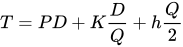
To determine the minimum point of the total cost curve, calculate the derivative of the total cost with respect to Q (assume all other variables are constant) and set it equal to 0:
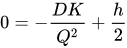
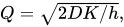
Solving for Q gives Q* (the optimal order quantity):
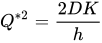
Therefore:
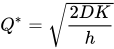
Q* is independent of P; it is a function of only K, D, h.
The optimal value Q* may also be found by recognizing that

where the non-negative quadratic term disappears for which provides the cost minimum

Example
[edit]- Annual requirement quantity (D) = 10000 units
- Cost per order (K) = 40
- Cost per unit (P)= 50
- Yearly carrying cost per unit = 4
- Market interest = 2%
Economic order quantity = = 400 units

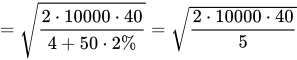
Number of orders per year (based on EOQ)
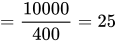
Total cost

Total cost

If we check the total cost for any order quantity other than 400(=EOQ), we will see that the cost is higher. For instance, supposing 500 units per order, then
Total cost

Similarly, if we choose 300 for the order quantity, then
Total cost

This illustrates that the economic order quantity is always in the best interests of the firm.
Extensions
[edit]Quantity discounts
[edit]An important extension to the EOQ model is to accommodate quantity discounts. There are two main types of quantity discounts: (1) all-units and (2) incremental.[2][3] Here is a numerical example:
- Incremental unit discount: Units 1–100 cost $30 each; Units 101–199 cost $28 each; Units 200 and up cost $26 each. So when 150 units are ordered, the total cost is $30*100 + $28*50.
- All units discount: an order of 1–1000 units costs $50 each; an order of 1001–5000 units costs $45 each; an order of more than 5000 units costs $40 each. So when 1500 units are ordered, the total cost is $45*1500.
In order to find the optimal order quantity under different quantity discount schemes, one should use algorithms; these algorithms are developed under the assumption that the EOQ policy is still optimal with quantity discounts. Perera et al. (2017)[4] establish this optimality and fully characterize the (s,S) optimality within the EOQ setting under general cost structures.
Design of optimal quantity discount schedules
[edit]In presence of a strategic customer, who responds optimally to discount schedules, the design of an optimal quantity discount scheme by the supplier is complex and has to be done carefully. This is particularly so when the demand at the customer is itself uncertain. An interesting effect called the "reverse bullwhip" takes place where an increase in consumer demand uncertainty actually reduces order quantity uncertainty at the supplier.[5]
Backordering costs and multiple items
[edit]Several extensions can be made to the EOQ model, including backordering costs[6] and multiple items. In the case backorders are permitted, the inventory carrying costs per cycle are:[7]
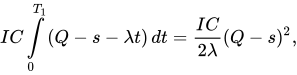
where s is the number of backorders when order quantity Q is delivered and is the rate of demand. The backorder cost per cycle is:

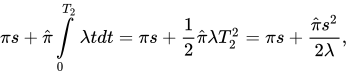
where and are backorder costs, , T being the cycle length and . The average annual variable cost is the sum of order costs, holding inventory costs and backorder costs:



![{\displaystyle {\mathcal {K}}={\frac {\lambda }{Q}}A+{\frac {1}{2Q}}IC(Q-s)^{2}+{\frac {1}{Q}}[\pi \lambda s+{\frac {1}{2}}{\hat {\pi }}s^{2}]}](https://wikimedia.org/api/rest_v1/media/math/render/svg/11559846b39de6384880cc4ef33e3dbfb3c1f877)
To minimize impose the partial derivatives equal to zero:

![{\displaystyle {\frac {\partial {\mathcal {K}}}{\partial Q}}=-{\frac {1}{Q^{2}}}\left[{\lambda }A+{\frac {1}{2}}IC(Q-s)^{2}+\pi \lambda s+{\frac {1}{2}}{\hat {\pi }}s^{2}\right]+{\frac {IC}{Q}}(Q-s)=0}](https://wikimedia.org/api/rest_v1/media/math/render/svg/aa7466bafb1e62c05d83300693bf480d87a39c86)

Substituting the second equation into the first gives the following quadratic equation:
![{\displaystyle [{\hat {\pi }}^{2}+{\hat {\pi }}IC]s^{2}+2\pi {\hat {\pi }}\lambda s+(\pi \lambda )^{2}-2\lambda AIC=0}](https://wikimedia.org/api/rest_v1/media/math/render/svg/dd5845f37fabaad3e004a198c86bb49a6b1eccfa)
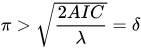
If either s=0 or is optimal. In the first case the optimal lot is given by the classic EOQ formula, in the second case an order is never placed and minimum yearly cost is given by . If or is optimal, if then there shouldn't be any inventory system. If solving the preceding quadratic equation yields:




![{\displaystyle s^{*}=[{\hat {\pi }}+IC]^{-1}\left(-\pi \lambda +\left[(2\lambda AIC)\left(1+{\frac {IC}{\hat {\pi }}}\right)-{\frac {IC}{\hat {\pi }}}(\pi \lambda )^{2}\right]^{1/2}\right)}](https://wikimedia.org/api/rest_v1/media/math/render/svg/3f60909cf6953fe251453c3f5ff7d8771832a510)
![{\displaystyle Q^{*}=\left[{\frac {{\hat {\pi }}+IC}{\hat {\pi }}}\right]^{1/2}\left[{\frac {2\lambda A}{IC}}-{\frac {(\pi \lambda )^{2}}{IC({\hat {\pi }}+IC)}}\right]^{1/2}}](https://wikimedia.org/api/rest_v1/media/math/render/svg/2791c925ddd2295f3f3eec75d64b75c34991f45f)
If there are backorders, the reorder point is: ; with m being the largest integer and μ the lead time demand.


Additionally, the economic order interval[8] can be determined from the EOQ and the economic production quantity model (which determines the optimal production quantity) can be determined in a similar fashion.
A version of the model, the Baumol-Tobin model, has also been used to determine the money demand function, where a person's holdings of money balances can be seen in a way parallel to a firm's holdings of inventory.[9]
Malakooti (2013)[10] has introduced the multi-criteria EOQ models where the criteria could be minimizing the total cost, Order quantity (inventory), and Shortages.
A version taking the time-value of money into account was developed by Trippi and Lewin.[11]
Imperfect quality
[edit]Another important extension of the EOQ model is to consider items with imperfect quality. Salameh and Jaber (2000) were the first to study the imperfect items in an EOQ model very thoroughly. They consider an inventory problem in which the demand is deterministic and there is a fraction of imperfect items in the lot and are screened by the buyer and sold by them at the end of the circle at discount price.[12]
Implementation
[edit]Dave Piasecki identifies two ways in which use of an EOQ approach may be implemented:
- a spreadsheet method, whereby the EOQ for each stock item is calculated and recorded manually
- entry of the EOQ formula into a new or existing inventory management system.
He suggests that a system-based implementation would be beneficial where the number of stock-keeping units is over around 2000. Annual updating of data and formulae are recommended. A hybrid system would involve downloading data into a spreadsheet for calculation purposes and then re-applying this data within the inventory system.[13]
Criticisms
[edit]The EOQ model and its sister, the economic production quantity model (EPQ), have been criticised for "their restrictive set[s] of assumptions.[14] Guga and Musa make use of the model for an Albanian business case study and conclude that the model is "perfect theoretically, but not very suitable from the practical perspective of this firm".[15] However, James Cargal notes that the formula was developed when business calculations were undertaken "by hand", or using logarithmic tables or a slide rule. Use of spreadsheets and specialist software allows for more versatility in the use of the formula and adoption of "assumptions which are more realistic" than in the original model.[16][self-published source]
See also
[edit]References
[edit]- ^ Hax, AC; Candea, D. (1984), Production and Operations Management, Englewood Cliffs, NJ: Prentice-Hall, p. 135, ISBN 9780137248803
- ^ Nahmias, Steven (2005). Production and operations analysis. McGraw Hill Higher Education.[page needed]
- ^ Zipkin, Paul H., Foundations of Inventory Management, McGraw Hill 2000[page needed]
- ^ Perera, Sandun; Janakiraman, Ganesh; Niu, Shun-Chen (2017). "Optimality of (s,S) policies in EOQ models with general cost structures". International Journal of Production Economics. 187: 216–228. doi:10.1016/j.ijpe.2016.09.017.
- ^ Altintas, Nihat; Erhun, Feryal; Tayur, Sridhar (2008). "Quantity Discounts Under Demand Uncertainty". Management Science. 54 (4): 777–92. doi:10.1287/mnsc.1070.0829. JSTOR 20122426.
- ^ Perera, Sandun; Janakiraman, Ganesh; Niu, Shun-Chen (2017). "Optimality of (s,S) policies in EOQ models with general cost structures". International Journal of Production Economics. 187: 216–228. doi:10.1016/j.ijpe.2016.09.017.
- ^ T. Whitin, G. Hadley, Analysis of Inventory Systems, Prentice Hall 1963
- ^ Goyal, S.K. (1987). "A simple heuristic method for determining economic order interval for linear demand". Engineering Costs and Production Economics. 11: 53–57. doi:10.1016/0167-188X(87)90025-5.
- ^ Caplin, Andrew; Leahy, John (2010). "Economic Theory and the World of Practice: A Celebration of the (s, S) Model". The Journal of Economic Perspectives. 24 (1): 183–201. CiteSeerX 10.1.1.730.8784. doi:10.1257/jep.24.1.183. JSTOR 25703488.
- ^ Malakooti, B (2013). Operations and Production Systems with Multiple Objectives. John Wiley & Sons. ISBN 978-1-118-58537-5.[page needed]
- ^ Trippi, Robert R.; Lewin, Donald E. (1974). "A Present Value Formulation of the Classical Eoq Problem". Decision Sciences. 5 (1): 30–35. doi:10.1111/j.1540-5915.1974.tb00592.x.
- ^ Salameh, M.K.; Jaber, M.Y. (March 2000). "Economic production quantity model for items with imperfect quality". International Journal of Production Economics. 64 (1–3): 59–64. doi:10.1016/s0925-5273(99)00044-4. ISSN 0925-5273.
- ^ Piasecki, D., Optimizing Economic Order Quantity (EOQ), published initially in the January 2001 issue of "Solutions", accessed on 22 February 2025
- ^ Tao, Z., A. L. Guiffrida, and M. D. Troutt, "A green cost based economic production/order quantity model", in Proceedings of the 1st Annual Kent State International Symposium on Green Supply Chains, Canton, Ohio, US, 29–30 July 2010
- ^ Guga, E. and Musa, O. (2015) in Inventory Management through EOQ Model, International Journal of Economics, Commerce & Management, Vol. III, Issue 12, December 2015, accessed 9 February 2024
- ^ Cargal, J. M. (2003), The EOQ Formula, Troy University, accessed 9 February 2024
Further reading
[edit]- Harris, Ford W. Operations Cost (Factory Management Series), Chicago: Shaw (1915)
- Harris, Ford W. (1913). "How many parts to make at once". Factory, the Magazine of Management. 10: 135–136, 152.
- Camp, W. E. "Determining the production order quantity", Management Engineering, 1922
- Wilson, R. H. (1934). "A Scientific Routine for Stock Control". Harvard Business Review. 13: 116–28.
- Plossel, George. Orlicky's Material Requirement's Planning. Second Edition. McGraw Hill. 1984. (first edition 1975)
- Erlenkotter, Donald (2014). "Ford Whitman Harris's economical lot size model". International Journal of Production Economics. 155: 12–15. doi:10.1016/j.ijpe.2013.12.008. S2CID 153794306.
- Perera, Sandun; Janakiraman, Ganesh; Niu, Shun-Chen (2017). "Optimality of (s,S) policies in EOQ models with general cost structures". International Journal of Production Economics. 187: 216–228. doi:10.1016/j.ijpe.2016.09.017.
- Perera, Sandun; Janakiraman, Ganesh; Niu, Shun-Chen (2018). "Optimality of (s, S) Inventory Policies under Renewal Demand and General Cost Structures". Production and Operations Management. 27 (2): 368–383. doi:10.1111/poms.12795. hdl:2027.42/142450.
- Tsan-Ming Choi (Ed.) Handbook of EOQ Inventory Problems: Stochastic and Deterministic Models and Applications, Springer's International Series in Operations Research and Management Science, 2014. doi:10.1007/978-1-4614-7639-9.
- Ventura, Robert; Samuel, Stephen (2016). "Optimization of fuel injection in GDI engine using economic order quantity and Lambert W function". Applied Thermal Engineering. 101: 112–20. doi:10.1016/j.applthermaleng.2016.02.024.
- Renewal Demand and (s, S) Optimality by Perera, Janakiraman, and Niu [1]
External links
[edit]- The EOQ Model
- Piasecki, D., Inventory Operations Consulting documents
| Authority control databases: National |
|---|

Economic order quantity
View on GrokipediaFundamentals
Definition and Assumptions
The Economic Order Quantity (EOQ) is the ideal order size that minimizes the combined costs of ordering and holding inventory in a continuous review system, where inventory levels are monitored constantly to trigger replenishment when they reach a reorder point. This model serves as a foundational tool in inventory management, balancing the trade-off between frequent small orders, which incur high ordering expenses, and infrequent large orders, which lead to elevated holding costs due to excess stock.[4] The EOQ concept originated with Ford W. Harris, a production engineer, who introduced it in his 1913 paper "How Many Parts to Make at Once," published in Factory: The Magazine of Management. Harris's work laid the groundwork for the model, though it remained relatively obscure for decades. Independently, R.H. Wilson, a management consultant, derived a similar model and extensively applied it in the 1930s, popularizing it through practical implementations and contributing to its formalization within the emerging field of operations research.[5][6] The EOQ model operates under a set of simplifying assumptions that idealize the inventory environment as deterministic, enabling a tractable mathematical solution without stochastic elements:- Demand occurs at a constant, known rate over time, unaffected by external fluctuations.[4]
- Lead time—the duration between placing an order and receiving it—is fixed and known in advance.
- Replenishment is instantaneous, meaning the entire order arrives at once with no production or delivery delays.[4]
- No quantity discounts are offered, so the purchase price per unit remains constant regardless of order size.[4]
- Shortages are not permitted; inventory must meet demand without backorders or stockouts.
- Ordering costs are fixed per order and independent of quantity, while holding costs are constant per unit per time period.[4]
Variables and Notation
The Economic Order Quantity (EOQ) model utilizes a standardized set of variables to represent its key parameters, enabling consistent mathematical formulation across analyses. These variables are defined as follows:- : the annual demand rate, expressed in units per year, representing the constant rate at which inventory is depleted over time.[7]
- : the fixed ordering cost per order, measured in dollars per order, encompassing expenses such as administrative processing, transportation, and setup that do not vary with the quantity ordered.[8]
- : the holding (or carrying) cost per unit per year, in dollars per unit per year, which includes costs for storage, insurance, spoilage, and opportunity costs associated with tied-up capital.[7]
- : the order quantity, in units per order, denoting the size of each replenishment batch placed with the supplier.[8]
EOQ Formula Derivation
The economic order quantity (EOQ) model seeks to determine the optimal order size that minimizes the sum of ordering and holding costs in an inventory system. The derivation begins with the formulation of the total relevant cost function, TC(Q), which captures these two primary components as a function of the order quantity Q. The annual ordering cost is given by (D/Q)K, where D represents the annual demand rate and K is the fixed cost per order; this reflects the number of orders placed per year multiplied by the cost per order. The annual holding cost is (Q/2)h, where h is the holding cost per unit per year and Q/2 is the average inventory level under the assumption of instantaneous replenishment and constant demand. Thus, the total relevant cost is TC(Q) = (D/Q)K + (Q/2)h.[9][10] To find the minimizing Q, denoted Q*, the total cost function is differentiated with respect to Q and set to zero. The first derivative is dTC/dQ = -(DK)/Q² + h/2. Setting this equal to zero yields -(DK)/Q² + h/2 = 0, which rearranges to (DK)/Q² = h/2. Solving for Q gives Q² = (2DK)/h, so Q* = √(2DK/h). This closed-form solution provides the EOQ.[10] An alternative perspective on the derivation emphasizes the trade-off between costs: at the optimum, the marginal increase in holding cost from ordering a larger quantity equals the marginal savings in ordering cost from fewer orders. This balance occurs when the annual holding cost (Q/2)h equals the annual ordering cost (D/Q)K, leading to the same condition (Q/2)h = (D/Q)K and thus Q* = √(2DK/h).[9] To confirm that this critical point represents a minimum, the second derivative of the total cost function is examined: d²TC/dQ² = (2DK)/Q³. For Q > 0, this value is positive, indicating that TC(Q) is convex and the solution is indeed a global minimum.[10]Basic Example
To illustrate the application of the economic order quantity (EOQ) model, consider a hypothetical scenario for a retailer managing inventory of a standard product, such as office supplies. The annual demand is 1,000 units (D = 1,000), the fixed cost per order is $50 (K = $50), and the annual holding cost per unit is $2 (h = $2). These parameters represent typical values in basic inventory scenarios where demand is constant and known, ordering costs include administrative and shipping expenses, and holding costs encompass storage, insurance, and opportunity costs.[11] The optimal order quantity Q* is calculated using the EOQ formula: Substituting the values: This is typically rounded to the nearest integer for practical implementation, yielding Q* = 223 units per order. The number of orders per year is then D / Q* ≈ 1000 / 223 ≈ 4.48, or approximately 4.5 orders annually.[5] The total annual cost (TC) under the EOQ model is the sum of ordering costs (D/Q * K) and holding costs (Q/2 * h), excluding purchase costs which are constant. For Q* = 223:- Ordering cost ≈ 4.48 × $50 = $224
- Holding cost = (223 / 2) × $2 ≈ $223
- TC ≈ $447
- Ordering cost = (1000 / 100) × $50 = $500
- Holding cost = (100 / 2) × $2 = $100
- TC = $600 (33% higher than EOQ)
- Ordering cost ≈ (1000 / 300) × $50 ≈ $167
- Holding cost = (300 / 2) × $2 = $300
- TC ≈ $467 (4% higher than EOQ)