


Community hub
Recent from talks
Contribute something
Nothing was collected or created yet.
Edinburgh Trams
View on Wikipedia
| Edinburgh Trams | |||||||||||||||||||||||||||||||||||||||||||||||||||||||||||||||||||||||||||||||||||||||||||||||||||||||||||||||||||||||||||||||||||||||||||||||||||||||||||||||||||||||||||||||||||||||||||||||||||||||||||||||||||||
|---|---|---|---|---|---|---|---|---|---|---|---|---|---|---|---|---|---|---|---|---|---|---|---|---|---|---|---|---|---|---|---|---|---|---|---|---|---|---|---|---|---|---|---|---|---|---|---|---|---|---|---|---|---|---|---|---|---|---|---|---|---|---|---|---|---|---|---|---|---|---|---|---|---|---|---|---|---|---|---|---|---|---|---|---|---|---|---|---|---|---|---|---|---|---|---|---|---|---|---|---|---|---|---|---|---|---|---|---|---|---|---|---|---|---|---|---|---|---|---|---|---|---|---|---|---|---|---|---|---|---|---|---|---|---|---|---|---|---|---|---|---|---|---|---|---|---|---|---|---|---|---|---|---|---|---|---|---|---|---|---|---|---|---|---|---|---|---|---|---|---|---|---|---|---|---|---|---|---|---|---|---|---|---|---|---|---|---|---|---|---|---|---|---|---|---|---|---|---|---|---|---|---|---|---|---|---|---|---|---|---|---|---|---|
 | |||||||||||||||||||||||||||||||||||||||||||||||||||||||||||||||||||||||||||||||||||||||||||||||||||||||||||||||||||||||||||||||||||||||||||||||||||||||||||||||||||||||||||||||||||||||||||||||||||||||||||||||||||||
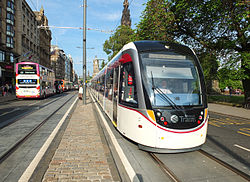
 A tram on Princes Street in May 2014 | |||||||||||||||||||||||||||||||||||||||||||||||||||||||||||||||||||||||||||||||||||||||||||||||||||||||||||||||||||||||||||||||||||||||||||||||||||||||||||||||||||||||||||||||||||||||||||||||||||||||||||||||||||||
| Overview | |||||||||||||||||||||||||||||||||||||||||||||||||||||||||||||||||||||||||||||||||||||||||||||||||||||||||||||||||||||||||||||||||||||||||||||||||||||||||||||||||||||||||||||||||||||||||||||||||||||||||||||||||||||
| Owner | Transport for Edinburgh | ||||||||||||||||||||||||||||||||||||||||||||||||||||||||||||||||||||||||||||||||||||||||||||||||||||||||||||||||||||||||||||||||||||||||||||||||||||||||||||||||||||||||||||||||||||||||||||||||||||||||||||||||||||
| Locale | Edinburgh | ||||||||||||||||||||||||||||||||||||||||||||||||||||||||||||||||||||||||||||||||||||||||||||||||||||||||||||||||||||||||||||||||||||||||||||||||||||||||||||||||||||||||||||||||||||||||||||||||||||||||||||||||||||
| Transit type | Light rail/Tram | ||||||||||||||||||||||||||||||||||||||||||||||||||||||||||||||||||||||||||||||||||||||||||||||||||||||||||||||||||||||||||||||||||||||||||||||||||||||||||||||||||||||||||||||||||||||||||||||||||||||||||||||||||||
| Number of lines | 1 | ||||||||||||||||||||||||||||||||||||||||||||||||||||||||||||||||||||||||||||||||||||||||||||||||||||||||||||||||||||||||||||||||||||||||||||||||||||||||||||||||||||||||||||||||||||||||||||||||||||||||||||||||||||
| Number of stations | 23 | ||||||||||||||||||||||||||||||||||||||||||||||||||||||||||||||||||||||||||||||||||||||||||||||||||||||||||||||||||||||||||||||||||||||||||||||||||||||||||||||||||||||||||||||||||||||||||||||||||||||||||||||||||||
| Annual ridership | 12.2 million (2025)[1] | ||||||||||||||||||||||||||||||||||||||||||||||||||||||||||||||||||||||||||||||||||||||||||||||||||||||||||||||||||||||||||||||||||||||||||||||||||||||||||||||||||||||||||||||||||||||||||||||||||||||||||||||||||||
| Headquarters | 1 Myreton Drive Edinburgh EH12 9GF | ||||||||||||||||||||||||||||||||||||||||||||||||||||||||||||||||||||||||||||||||||||||||||||||||||||||||||||||||||||||||||||||||||||||||||||||||||||||||||||||||||||||||||||||||||||||||||||||||||||||||||||||||||||
| Website | edinburghtrams | ||||||||||||||||||||||||||||||||||||||||||||||||||||||||||||||||||||||||||||||||||||||||||||||||||||||||||||||||||||||||||||||||||||||||||||||||||||||||||||||||||||||||||||||||||||||||||||||||||||||||||||||||||||
| Operation | |||||||||||||||||||||||||||||||||||||||||||||||||||||||||||||||||||||||||||||||||||||||||||||||||||||||||||||||||||||||||||||||||||||||||||||||||||||||||||||||||||||||||||||||||||||||||||||||||||||||||||||||||||||
| Began operation | 31 May 2014 | ||||||||||||||||||||||||||||||||||||||||||||||||||||||||||||||||||||||||||||||||||||||||||||||||||||||||||||||||||||||||||||||||||||||||||||||||||||||||||||||||||||||||||||||||||||||||||||||||||||||||||||||||||||
| Operator(s) | Edinburgh Trams Ltd. | ||||||||||||||||||||||||||||||||||||||||||||||||||||||||||||||||||||||||||||||||||||||||||||||||||||||||||||||||||||||||||||||||||||||||||||||||||||||||||||||||||||||||||||||||||||||||||||||||||||||||||||||||||||
| Number of vehicles | 27 CAF Urbos 3 | ||||||||||||||||||||||||||||||||||||||||||||||||||||||||||||||||||||||||||||||||||||||||||||||||||||||||||||||||||||||||||||||||||||||||||||||||||||||||||||||||||||||||||||||||||||||||||||||||||||||||||||||||||||
| Train length | 42.8 m (140 ft 5 in) | ||||||||||||||||||||||||||||||||||||||||||||||||||||||||||||||||||||||||||||||||||||||||||||||||||||||||||||||||||||||||||||||||||||||||||||||||||||||||||||||||||||||||||||||||||||||||||||||||||||||||||||||||||||
| Headway | 7–10 minutes | ||||||||||||||||||||||||||||||||||||||||||||||||||||||||||||||||||||||||||||||||||||||||||||||||||||||||||||||||||||||||||||||||||||||||||||||||||||||||||||||||||||||||||||||||||||||||||||||||||||||||||||||||||||
| Technical | |||||||||||||||||||||||||||||||||||||||||||||||||||||||||||||||||||||||||||||||||||||||||||||||||||||||||||||||||||||||||||||||||||||||||||||||||||||||||||||||||||||||||||||||||||||||||||||||||||||||||||||||||||||
| System length | 18.5 km (11.5 mi) | ||||||||||||||||||||||||||||||||||||||||||||||||||||||||||||||||||||||||||||||||||||||||||||||||||||||||||||||||||||||||||||||||||||||||||||||||||||||||||||||||||||||||||||||||||||||||||||||||||||||||||||||||||||
| Track gauge | 1,435 mm (4 ft 8+1⁄2 in) standard gauge | ||||||||||||||||||||||||||||||||||||||||||||||||||||||||||||||||||||||||||||||||||||||||||||||||||||||||||||||||||||||||||||||||||||||||||||||||||||||||||||||||||||||||||||||||||||||||||||||||||||||||||||||||||||
| Electrification | Overhead line, 750 V DC | ||||||||||||||||||||||||||||||||||||||||||||||||||||||||||||||||||||||||||||||||||||||||||||||||||||||||||||||||||||||||||||||||||||||||||||||||||||||||||||||||||||||||||||||||||||||||||||||||||||||||||||||||||||
| Top speed | 70 km/h (43 mph) | ||||||||||||||||||||||||||||||||||||||||||||||||||||||||||||||||||||||||||||||||||||||||||||||||||||||||||||||||||||||||||||||||||||||||||||||||||||||||||||||||||||||||||||||||||||||||||||||||||||||||||||||||||||
| |||||||||||||||||||||||||||||||||||||||||||||||||||||||||||||||||||||||||||||||||||||||||||||||||||||||||||||||||||||||||||||||||||||||||||||||||||||||||||||||||||||||||||||||||||||||||||||||||||||||||||||||||||||


Edinburgh Trams is a tramway in Edinburgh, Scotland, operated by Edinburgh Trams Ltd. It is an 18.5-kilometre (11.5 mi) line between Newhaven and Edinburgh Airport, with 23 stops.[2][3][4]
A modern tram network for Edinburgh was proposed by Edinburgh Council in 1999, with detailed design work being performed over the next decade. Construction of the first phase, linking Edinburgh Airport with Newhaven, began in June 2008, but encountered substantial delays and cost overruns. During 2009, a 15-year contract held by Transdev to operate and maintain the tram network was cancelled. By mid-2010, cancellation of the whole project was being publicly considered; during the following year it was announced that the length of the tram network would be drastically curtailed. Prior to August 2011, the project was overseen by Transport Initiatives Edinburgh (TIE), a company wholly owned by Edinburgh Council; TIE was disbanded largely due to its failings on the project's delivery. The troubled construction of the Edinburgh Tram was subject to a lengthy formal inquiry, chaired by Lord Hardie, which concluded that failings by Edinburgh Council and its arms-length companies were largely to blame for the delays in construction.
On 31 May 2014, the tramway was officially opened to the public, but only between the airport and York Place. The service is operated by Edinburgh Trams Ltd., a wholly owned subsidiary of Transport for Edinburgh, in which the City of Edinburgh Council has a controlling interest. The service is equipped with 27 CAF Urbos 3 vehicles. It runs at a seven-minute interval for most of the day, seven days per week. Fares and ticketing are integrated with Lothian Buses, with the same fares charged on both systems, except for services to the airport where the tram is more expensive. In May 2025, contactless payment was introduced for the trams, with a 'tap on, tap off' scheme.
Since the original opening of the tramway, various changes have been implemented. In December 2016, the Edinburgh Gateway tram stop, between Gyle Centre and Gogarburn, was opened to provide an interchange between Edinburgh Trams and the Fife Circle Line and Edinburgh to Aberdeen Lines. Following the council's approval for an extension of the line to Newhaven in March 2019, construction work commenced that November, and was completed on schedule in June 2023, despite being delayed for three months by the coronavirus pandemic.
In August 2025, a public consultation was launched for an additional extension serving the north–south axis of the city. This could link Granton in the north via either the Roseburn Path to Murrayfield or via Orchard Brae and Dean Bridge to the west end of Princes Street. There are also proposals to run trams over North Bridge and South Bridge to Cameron Toll then along Old Dalkeith Road to the Royal Infirmary and BioQuarter. The cost is estimated at between £2bn and £2.9bn.[5][6]
History
[edit]Background
[edit]Edinburgh and Leith were originally served by horse-drawn coaches, and then from 1871 various companies and corporations ran trams that were horse-drawn, then cable driven and finally electric. The municipal Edinburgh Corporation Tramways ran from 1919 until 16 November 1956.[7][8] After that date, public transport consisted of buses and a limited network of commuter rail lines.
Towards the end of the 20th century, there was revived interest in trams in the United Kingdom and networks were reintroduced in Birmingham, Croydon, Manchester, Nottingham and Sheffield.[9][10] Proposals for a network in Edinburgh were made in the 1990s, and a plan to build a line along Princes Street and Leith Walk to Newhaven was proposed in 1999 by the City of Edinburgh Council, Lothian and Edinburgh Enterprise and the New Edinburgh Tramways Company.[11][12]
Initial proposals and agreement
[edit]A 2001 proposal envisaged three routes, lines 1, 2 and 3. The first was a circular route around the northern suburbs, and the others were radial routes to Newbridge in the west and Newcraighall in the south.[13] All lines would have passed through the city centre. In May 2004, a 15-year operating contract was awarded to Transdev, to operate and maintain the tram network.[14][15] This contract was cancelled in 2009.[16]
Two bills to reintroduce a tram network were passed by the Scottish Parliament in March 2006.[17][18] Lines 1 and 2 received parliamentary permission, but funding the entire network was deemed impossible. Line 3, to be paid for by a proposed Edinburgh congestion charge, was scrapped when the charge was heavily defeated in a referendum and construction of the remaining two lines was split into four phases:
- Phase 1a 18.5-kilometre (11.5 mi) from Newhaven to Edinburgh Airport via Princes Street, combining parts of lines 1 and 2
- Phase 1b 5.6-kilometre (3.5 mi) from Haymarket to Granton Square via Crewe Toll, comprising most of the remainder of line 1
- Phase 2 linking Granton Square and Newhaven, completing the line 1 loop
- Phase 3 extending the airport line to Newbridge, completing line 2

The future of the scheme came under threat in 2007, when the Scottish National Party (SNP) published its manifesto for the Scottish Parliamentary election. The party made clear its intention to cancel the scheme, along with the Edinburgh Airport Rail Link, to save £1.1 billion.[19][10]
Following a lost vote in the Scottish Parliament, the SNP-led minority Scottish Government agreed to continue the line from the airport to Leith on condition that no more public money would be supplied. A report by Audit Scotland, commissioned by the Scottish Government, confirmed that the cost projections were sound.[20][21][22] The cost of the scheme in 2003 was estimated at £498 million, £375 million in funding from the Scottish Government and £45 million from Edinburgh Council.[23][24]
On 25 October 2007, the council approved the final business case.[25] Approval was given on 22 December 2007 for TIE to sign contracts with CAF to supply vehicles and BBS (a consortium of Bilfinger Berger and Siemens) to design and construct the network.[26][27] Contract negotiations finished in April 2008, and construction started in June 2008. By this stage the cost of the project was estimated at £521 million. Funding problems and political disputes led to the scaling back of the original plans. In April 2009, the council cancelled phase 1b, citing revenue shortfall created by the Great Recession to save an estimated £75 million.[28] The Granton extension was also cancelled for the same purpose.[29][10]
Construction: 2007–2012
[edit]
Until August 2011, the project was overseen by Transport Initiatives Edinburgh (TIE), a company wholly owned by the City of Edinburgh Council, who were responsible for project-managing the construction of the tramway.[30]
After the draft business case was accepted by the Scottish Government in March 2007,[31] initial construction work commenced in July 2007, with the diversion of underground utilities in preparation for track-laying in Leith.[32] These works followed a plan by System Design Services (SDS), a joint design team led by Parsons Brinckerhoff and Halcrow Group.
In May 2008, final contracts to build the tram system were awarded to BSC, a consortium of Bilfinger Berger, Siemens and Spanish tram builder Construcciones y Auxiliar de Ferrocarriles (CAF).[33]
The tramway uses a mix of street running and segregated off-road track, with conventional tram stop platforms.[34] Stops are fitted with shelters, ticket machines, lighting and CCTV. The network is operated from a depot in Gogar, close to the A8 roundabout, immediately west of Edinburgh Gateway tram stop.[35]
The route of the line required the construction of bridges to cross railway lines at Edinburgh Park and Stenhouse, and a tunnel under the A8 near the Gogar roundabout. A bridge at Balgreen was widened.[36] Works to build a tram interchange at Haymarket station involved the demolition of a Category C(S) listed building, the former Caledonian Alehouse on Haymarket Terrace.[37]
Some on-street track was laid in a special foundation with cobbled road surfacing designed to be sympathetic with the style of Edinburgh streets but was removed in many places due to objections from cyclists.[38] The trams are powered by overhead cables attached to purpose-built poles or mounted on the sides of buildings.[39] Nine electrical sub-stations were planned for the line to Newhaven, both underground and above-ground[40] but only five were built after the line was truncated at York Place.[41]
Revisions and delays
[edit]In 2008 and 2009, the project met with delays to work on tramway infrastructure. Phase 1b of the project was cancelled because of a funding shortfall in April 2009.[28] Contractual disputes delayed track-laying in the city centre. In December 2009, media reported that the project budget was running over £545 million, and the system was unlikely to come into operation until February 2012 or later.[42] The operating contract with Transdev was cancelled in December 2009 to reduce costs and it was announced that the trams would be operated by Edinburgh Trams Limited, a subsidiary of Transport for Edinburgh.[16][43] During March 2010, Bilfinger Berger announced that the estimated completion date would be in 2014.[44][45]
Contractual disputes
[edit]In February 2009, work on the Princes Street section stopped due to contractual disagreements between TIE and BSC after the latter submitted a request for an additional £80 million of funding.[46][47] Edinburgh Council believed the contractors' claims were unjustified as they had agreed to fixed-price contracts.[48] After negotiations, BSC agreed to commence construction in March 2009 within the original budget, although disagreements remained.[49] Work restarted and line construction went ahead.
In August 2009, TIE began legal proceedings against the BSC consortium over delays to the project,[50] and track-laying on Leith Walk, Shandwick Place and Haymarket was suspended. At issue were alleged changes to BSC's work specification, including track works on Princes Street and £5 million additional costs for foundation work near Murrayfield Stadium. The BSC consortium alleged that TIE had not diverted the underground utilities in time for track-laying to begin, breaching contractual agreements and costing the consortium additional staffing expenditure.[51]
In January 2010, the independent arbiter found in favour of TIE on some points, but on most of the disputed issues ruled in favour of BSC and awarded the consortium 90% of its additional costs, estimated to be up to £80 million.[52]
Delays in track laying and depot construction affected vehicle testing. By September 2009, construction was reported to be nine months behind schedule, and CAF was due to deliver the first trams from its factory in Spain. With key project dependency out of synchronisation, TIE held discussions with Transport for London about delivering the trams to Croydon to conduct operational tests on the Tramlink network.[53][54] Tram vehicle testing commenced in March 2010 on the Siemens test track in Wildenrath, Germany.[55] The tests included recreating the steep gradients of Leith Walk, and using weights to simulate the heavy passenger load expected during a Murrayfield match day.[56][57]
Funding crisis
[edit]
Following further disputes and delays, it was reported in March 2010 that Edinburgh Council was considering cancelling the contract with Bilfinger Berger.[58] By June 2010, the project's cost had risen to £600 million.[59] Council project managers were reported to be in crisis talks, considering options including: borrowing £55 million to fund the increased costs; phasing the introduction of the tram line, so that trams would initially run between the airport and Haymarket; and terminating the contract with Bilfinger Berger.[60] The council asked TIE to draw up costs for truncating the line at four places: Haymarket station, York Place, the foot of Leith Walk or Ocean Terminal.[61]
Work resumed in May 2011 at priority locations, Haymarket Yards and Gogar, while the project's future was decided by the council. In August 2011 it was announced TIE would be disbanded and consultants Turner & Townsend would manage the project.[62][63]
On 30 June 2011, Edinburgh Council voted to continue the line between Edinburgh Airport and St Andrew Square. Costs rose to an estimated £770 million, leaving the council with a shortfall of more than £200 million.[64][65] The option to scrap the project was considered, but rejected.[66] On 25 August 2011, the council voted to cut the line to run between the airport and Haymarket, reducing the expected cost to £715 million.[67] A week later, after the Scottish Government threatened to withhold £72 million of funding,[68] the council reversed its decision, restoring the terminus at St Andrew Square.[64] On 29 November 2011, it was announced that the eastern terminus would be at York Place instead of St Andrew Square; the intention had been to build the tracks to a reversing point at York Place (without a stop for passengers). Extending passenger services from St Andrew Square to York Place would enable Broughton Street, Picardy Place and the surrounding area to be better served at comparatively little additional cost.[69]
The first electric wires were energised in October 2011 within the depot at Gogar. Testing trams began in December 2011 near the depot at Gogar, on a 500-metre (550 yd) length of track.[70][71] On 15 December 2011, the contractors handed the depot to the City of Edinburgh Council.[72] The first completed section of line, between the depot and Edinburgh Airport, was used to test a tram at full speed on 19 December 2012.[73]
With extra interest payments factored in, the cost of the line was expected to exceed £1 billion despite the decreased scope of the network.[74][10]
Criticism
[edit]
Delays in construction were criticised by businesses, who claimed their income was damaged by long-term road closures in the centre of the city, and also by some residents.[48][75][76]
Cycling groups voiced safety concerns after people were injured as their bicycle wheels became caught in the track. They reported the road surface around the tracks was crumbling, raising further safety problems. In response, TiE promised to carry out repairs and Edinburgh Trams agreed to fund special training for cyclists.[77] During 2017, a woman was crushed to death by a passing bus when her bicycle wheel was caught in the tracks.[78] Further safety concerns were raised by residents along the routes about the suspension of overhead electric cables from residential buildings, and some property owners refused permission for cables to be attached.[56]
To remedy crumbling tarmac along the tracks on Princes Street, the road was closed in September 2011 and remained closed for ten months.[79][80] A road closure between Haymarket and Shandwick Place in March 2012 led to complaints from businesses and residents. It remained closed until October 2013. Originally to open as Shandwick Place tram stop, it was renamed West End - Princes Street prior to opening at the request of local traders, who felt the new name had greater associations to the city centre and would encourage more tourists to get off there. The stop was renamed again in August 2019 as West End.[81][82][83][84]
Completion: 2013–2014
[edit]From late 2012, work continued mostly on schedule.[85] More than 150 metres (160 yd) of flawed concrete trackbed had to be replaced between Shandwick Place and Haymarket.[86][87] In June 2013, overhead electric wires were installed on the city centre portion of the route. This was considered the last major step in the construction process.[88]
Originally, it was planned that concessionary travel, that is the ability of those with a Scottish National Entitlement Card to travel on public transport free of charge, was not going to be offered on the tramway. This was despite the fact that Edinburgh Trams is to be run by Lothian Buses, who are mandated to offer free travel to those with concession cards on all their bus routes.[89] This revelation quickly caused city leaders to support an Edinburgh Evening News campaign to ensure that concessionary travel would be offered on the new tramway. City transport convener Lesley Hinds stated "People in Edinburgh have paid through their council tax and their taxes for the trams to get up and running and it would be wrong for a large proportion of the population not to be allowed to use their concessionary bus pass".[89]

Despite this, the Scottish Government refused to pay for concessionary travel for the tram scheme, as it does for all bus routes in Scotland. Talks between the Scottish Government and Edinburgh Council eventually decided that concession cards should be valid for tram travel, but that they should be paid for by the Council instead of the Government.[90] It was revealed on 15 August 2013 that the cards would be valid, and that travel would be paid for by Edinburgh Council. However, only people with cards issued in Edinburgh would be able to use them.[91] This compromise upset many people in the Lothians, who often commute or travel into Edinburgh.[92]
Works were two months ahead of schedule by September 2013, when Edinburgh Council announced the tramway would open by May 2014.[93] All tram and road works were completed by 19 October[82] with testing of the trams between the depot and Edinburgh Park commencing on 8 October 2013. This was followed by the energising of tram wires from Bankhead tram stop to York Place on 19 November, marking the first time that the route was completely energised.[94] Testing along the full length of the route began on 5 December.[95][96][97]
The tramway opened to passengers on 31 May 2014.[98][99]
Public inquiry
[edit]In June 2014, shortly after the opening of the line, the then First Minister Alex Salmond announced a non-statutory public inquiry into the project's delays and cost overruns.[100] The inquiry, which was headed by the former Lord Advocate, Andrew Hardie, Baron Hardie, was later upgraded to a statutory inquiry to ensure that key personnel would provide evidence.[101]
The inquiry was itself subject to considerable delays. It finally published its report in August 2023. The report concluded that failings by Edinburgh Council, its arms-length companies and the Scottish Government were to blame for the delays,[102] with much of the criticism being directed against TIE. Lord Hardie made 24 recommendations in the report, and also provided a figure of £835.7m for the final cost of the project.[103]
Extension from city centre to Newhaven
[edit].jpg)
Edinburgh Council stated on 17 March 2014 that works would be conducted along Leith Walk to prepare it for a possible future extension of tram service.[104] In December 2014, Edinburgh Council ordered a detailed business case for extending the line to Leith.[105] The council said in July 2015 that three options for an extension to Leith had been costed. These were a £144.7 million extension to Newhaven, a £126.6 million extension to Ocean Terminal, or a £78.7 million extension to the Foot of Leith Walk.[106]
During 2017, the business case to extend the system to Newhaven was approved.[107][10]
In June 2018, Colin Beattie, the MSP for Midlothian North and Musselburgh, and others, suggested that the system should be extended to Musselburgh to relieve traffic congestion on the approaches to the City Bypass.[108]
In March 2019, Edinburgh Council approved extending the system from York Place to Newhaven, with the line due to be operational by early 2023.[109] Preliminary works to Constitution Street and Leith Walk started in November 2019.[110] Work was suspended in March 2020 due to the coronavirus pandemic[111] but was restarted in June 2020.[112]
In February 2022, the eastern terminating York Place stop was permanently closed for demolition and to enable connection to the Newhaven extension which relocated the York Place stop to Picardy Place.[113] Services initially terminated at the West End stop between February and April 2022, and then the St Andrew Square stop before June 2023; however, trams still ran to York Place to turn back.[114]
On 13 March 2023, following completion of tracklaying and the installation of overhead power lines, test trams began running during the night between Picardy Place and Newhaven, becoming the first tram to run in Leith since the closure of the original tramway system.[115] The first test trams ran at walking pace, but their speed was later increased to 20 miles per hour (32 km/h). Daytime testing commenced on 19 April 2023, with 40 newly recruited drivers under training.[116] After an announcement on 25 May 2023, revenue service on the full route began on 7 June 2023.[117][118]
In June 2024, the Trams to Newhaven project won an award from the Local Government Chronicle in its Future Places category, with the citation praising "[t]he deep collaboration between the council and private sector partners".[119]
Further north to south extension
[edit]During the early 2020s, plans were being prepared for a new line which would connect Granton in the north of the city with the Bioquarter in the south east, and possibly further onto either Dalkeith[120] or Queen Margaret University or Shawfair.[121] At a meeting on 1 February 2024, City of Edinburgh Council voted to put the proposed north–south extension to public consultation; by this point, it had an estimated construction cost of £2bn.[122]
In August 2025, a 12-week public consultation was launched for this extension serving the north–south axis of the city. This could link Granton in the north to Crewe Toll, then either via the Roseburn Path to Murrayfield or via Orchard Brae and Dean Bridge to the west end of Princes Street. To the south, the proposals would see trams run over North Bridge and South Bridge, through Newington to Cameron Toll along Lady Road, then along Old Dalkeith Road to the Royal Infirmary and BioQuarter. A lift connecting the North Bridge tram stop to Waverley railway station below is also proposed. The cost is estimated at between £2bn and £2.9bn depending on the option considered.[5][6]
Future extensions beyond into the city region could link to Queen Margaret University and East Lothian or to Shawfair and Midlothian.[5]
Annual patronage
[edit]| Estimated passenger journeys made on Edinburgh Trams by financial year (to 31 March) | |||||
|---|---|---|---|---|---|
| Year | Passenger journeys |
Year | Passenger journeys |
Year | Passenger journeys |
| 2014–15 | 4.1M | 2022–23 | 5.3M | ||
| 2015–16 | 5.3M | 2023–24 | 10.1M | ||
| 2016–17 | 5.8M | 2024–25 | 12.2M | ||
| 2017–18 | 6.8M | 2025–26 | |||
| 2018–19 | 7.5M | 2026–27 | |||
| 2019–20 | 7.1M | 2027–28 | |||
| 2020–21 | 0.9M | 2028–29 | |||
| 2021–22 | 2.8M | 2029–30 | |||
| Estimates from the Department for Transport[1] | |||||
Current line
[edit]Route
[edit]
The single, 18.5-kilometre (11.5 mi) route begins running on-street at Newhaven, and then, via an 8 stop extension which opened in June 2023, from the port of Leith[123][115] to York Place (now served by Picardy Place) in the city centre.[124][125] It turns into North St Andrew Street, crosses St Andrew Square. From the square, it heads southeast into Princes Street, and west along the street toward Haymarket, via Shandwick Place, Atholl Place and West Maitland Street.[126] At Haymarket, the route heads onto a segregated track parallel to the Glasgow to Edinburgh mainline. It follows the railway line west for about 6.8 kilometres (4.2 mi), to Edinburgh Park railway station. There, it leaves the railway line on a segregated track and heads north to Gogar Roundabout from where it heads northwest via Ingliston Park and Ride to Edinburgh Airport, where it terminates.[126]
An additional tram stop was opened in December 2016, between Gyle Centre and Gogarburn.[127] This stop, called Edinburgh Gateway, is situated alongside the Edinburgh Gateway railway station which opened at the same time. The station provides an interchange between Edinburgh Trams and the Fife Circle Line and Edinburgh to Aberdeen Lines.[128] After this stop opened, crews changed here rather than at the special short platform which had been constructed alongside the nearby Gogar depot. Thus, the additional stop at Edinburgh Gateway did not affect the end-to-end running time between the Airport and York Place.[129]

Stops
[edit]


.jpg)


.jpg)
.jpg)
.jpg)
.jpg)
.jpg)

.jpg)

.jpg)
.jpg)
.jpg)
Former stops
[edit]| Image | Tram stop | Location | Transport interchange | Served | Comments |
|---|---|---|---|---|---|

|
York Place | 55°57′23″N 3°11′19″W / 55.9565°N 3.1887°W |  Lothian Buses Lothian Buses
|
Broughton Street and neighbourhood Omni Centre Edinburgh Playhouse St Mary's Cathedral (RC) |
Permanently closed in February 2022 due to the Newhaven extension. York Place was replaced by Picardy Place when the extension opened in 2023 |
Frequencies and journey times
[edit]Approximate journey times from the airport are ten minutes to Gyle Centre, 30 minutes to the city centre (Princes Street) and 55 minutes to Newhaven. The journey from the city centre to Newhaven takes approximately 25 minutes.
Services run every seven to ten minutes. As of 7 June 2023[update], the first service of the day leaves Gyle Centre for Newhaven at 04:26. The first service leaves Newhaven at 05:20 and the airport at 06:26. The last service of the day leaves the airport at 22:48 and Newhaven at 23:50. The timetable is broadly the same every day of the week, except for a slightly reduced early morning frequency on Saturdays and Sundays.[130]
As the first scheduled flight leaves Edinburgh at approximately 06:00, it is not currently possible to use the tram to get to the airport in time for security and departure. Conversely it is also not possible to use the tram on later arriving flights at Edinburgh Airport.
There are often later services on Friday and Saturday nights during the Edinburgh Festival and Fringe. The service interval is often reduced to three minutes before and after major events at Murrayfield Stadium.[131]
Rolling stock
[edit]Current fleet
[edit]Edinburgh Trams currently operates a fleet of 27 trams, as follows:[132]
| Class | Image | Type | Top speed | Length metres |
Capacity | In service |
Orders | Fleet numbers |
Routes operated |
Built | Years operated | ||||
|---|---|---|---|---|---|---|---|---|---|---|---|---|---|---|---|
| mph | km/h | Std | Sdg | W | Total | ||||||||||
| CAF Urbos 3 | .jpg)
|
Tram | 43 | 70 | 42.8 | 78 | 170 | 2 | 250 | 27 | — | 251-277 | All lines | 2010–2012 | 2014–present |
| Total | 27 | — | |||||||||||||
CAF Urbos 3
[edit]A £40 million contract to build 27 Urbos 3 trams, sufficient for phase 1a and (unbuilt) 1b lines, was awarded to CAF. When the line was cut back to York Place, only 17 trams would be needed.[133] An unsuccessful attempt was made in 2011 to lease ten trams to Transport for London for use on Tramlink.[134]
The trams are bi-directional, 42.8 metres (140 ft 5 in) long and with low-floor access to meet UK Rail Vehicle Access Regulations for disabled people.[135][136]
In April 2010, the first tram was delivered and displayed at the Princes Street stop at the bottom of The Mound,[137] before being moved to open storage in Broxburn.[138] The 27th tram was delivered in December 2012.[139] The trams have wrapped advertisements for promoting local events and commercial advertising.[140]
Fares and ticketing
[edit]Fare structure
[edit]Ticketing and fares are integrated with Lothian Buses. A proof of payment system applies. The single fare within the city zone is the same as on Lothian Buses (£2, with effect from 1 April 2023); day tickets and Ridacards are equally valid on trams and buses. As an exception, the tram fare from the city zone to the airport is £7.50 one-way compared to £5.50 for the bus.[141][142]
The "Ridacard" is a smartcard season ticket issued by Transport for Edinburgh; it is valid on both Edinburgh Trams and Lothian Buses (available for one week, four weeks or annually). On 1 September 2014, a rechargeable pre-paid smartcard for single journeys on both buses and trams, called "Citysmart", was introduced.
Free travel is available to holders of City of Edinburgh Council-issued Scottish National Entitlement Cards which are eligible for concessionary travel, and for a companion travelling with the cardholder of National Entitlement Cards with a companion entitlement. Passengers with National Entitlement Cards eligible for concessionary travel but issued by other local authorities are not offered any fare concession, with the exception of blind or visually impaired cardholders.[92][143][144] This is due to the free travel for local residents being funded by the City Council rather than the government.
An "onboard fare" of £10 is charged to passengers who have not pre-purchased a ticket or validated either a Ridacard, a National Entitlement Card or an m-ticket before boarding.[144][145]
Ticket machines
[edit]
At the request of Lothian Buses, installation of 30 ticket machines at key bus stops began in 2007. Passengers had to purchase tickets before boarding the bus, reducing dwell times,[146] but the machines were not popular with users and were scrapped in 2011. Consideration was given to installing similar on-street ticket machines,[147] and new, advanced machines (capable of reading smartcards and accepting credit/debit cards) were installed in early 2014 at each tram stop. The new ticket machines are the Galexio-Plus type supplied by Flowbird Transport Ltd.[148] Ticket machines do not accept banknotes or give change. The minimum spend for a card transaction was originally £3 which was more than the cost for a single ticket.[149] The minimum spend was scrapped in September 2019, following complaints from customers and negative press comments.[150][151]
On 19 May 2025, Edinburgh trams introduced contactless payment, with a 'tap on, tap off' (TOTO) scheme, to account for the more expensive airport zone. If passengers fail to tap off at a stop, they will be charged the full Airport Zone fare of £7.90. However, fares on both Lothian Buses and the trams have daily and weekly caps.[152]
Services
[edit]Services run every seven minutes throughout the entire line, between St Andrew Square and Edinburgh Airport. On 7 June 2023, the services extended north from St Andrew Square to Newhaven, connecting Leith more quickly than bus services from the city centre, for the first time in almost 70 years.[123]
Bicycle policy
[edit]In May and June 2015, cyclists were allowed to board the trams with their bikes, during a trial period which was supported by cycle campaign groups Spokes and Pedal on Parliament. Following this, Edinburgh trams became the first modern tram network in the UK to permit the carriage of bikes on a permanent basis, with up to two bicycles being allowed per tram outwith peak hours (7.30 am to 9.30 am, and 4 pm to 6.30 pm) and excluding the period of the Edinburgh Festival and the Festival Fringe (usually 3+1⁄2 weeks during August) and other large events.[153][154]
Corporate affairs
[edit]Ownership and structure
[edit]Edinburgh Trams Limited is a wholly owned subsidiary company of Transport for Edinburgh Limited. By virtue of its controlling interest in the parent's equity capital, the City of Edinburgh Council is the ultimate controlling party.[155]
Business trends
[edit]The key trends for Edinburgh Trams Limited since it commenced operations in May 2014 are (years ending 31 December):
.jpg)
| 2014 | 2015 | 2016 | 2017 | 2018 | 2019 | 2020 | 2021 | 2022 | 2023 | |
|---|---|---|---|---|---|---|---|---|---|---|
| Turnover (£m) | 12.99 | 15.81 | 16.75 | 5.19 | 6.28 | 13.60 | 23.81 | |||
| Operating profit (£m) | −0.45 | −0.25 | 0.25 | 1.60 | −9.40 | −7.88 | −7.68 | −7.21 | −11.59 | −10.62 |
| Net profit after tax (£m) | 1.29 | −7.62 | −8.99 | −8.87 | −8.76 | −10.89 | −10.33 | |||
| Number of employees (average) | 130 | 163 | 189 | 210 | 218 | 207 | 245 | 292 | ||
| Number of passengers (m) | 2.95 | 5.20 | 5.59 | 6.67 | 7.30 | 7.45 | 2.25 | 2.59 | 4.78 | 9.18 |
| Number of trams (at year end) | 27 | 27 | 27 | 27 | 27 | 27 | 27 | 27 | 27 | 27 |
| Notes/sources | [156] [155] |
[157] [155] |
[155] | [155] | [155] | [158] | [159] | [160] | [161] | [162] |
Edinburgh Trams made a pre-tax profit of £252,000 for 2016, against a predicted loss of £170,000, which meant that profitability had been achieved two years ahead of schedule.[163] This was based on excluding maintenance and infrastructure costs. Including these, as has been done since 2018 when these costs were shifted to Edinburgh Trams, the small operating profit (£3 million) has turned to a large operating loss (e.g. £9.4 million in 2018).[155] It has not achieved an operating profit since full costing.[155]
Staffing
[edit]Fifty-two ticket inspectors have been recruited to prevent fare dodging. Edinburgh Council is aiming for a 3% fare evasion rate, lower than any other tramway in Britain. Thirty-two drivers were employed, after passing psychological tests designed to eliminate risk-takers.[164][165]
Accidents and incidents
[edit]Frequent accidents involving cyclists and the tramway have been reported since the opening of the system in 2014. These are typically caused by bicycle wheels getting stuck in the rails or by bikes skidding on the rails.[166] A study published in 2018 found that, up to April 2016, 191 cyclists in Edinburgh had suffered tramway-related accidents serious enough to require hospital treatment.[167] In September 2022, using Freedom of Information (FoI) data, the BBC reported that there had been 422 accidents involving cyclists on the tram tracks, as a result of which 196 cyclists had made successful claims against Edinburgh City Council, resulting in nearly £1.3 million being paid in damages.[168] Following a further FoI request in September 2024, it was reported there had been 112 collisions between trams and other road vehicles since 2014, as well as four collisions involving cyclists (not including incidents involving cyclists and trams tracks).[169]
Noteworthy accidents include:
- On 29 August 2014, a bus and tram collided in the West End of Edinburgh, causing severe traffic congestion.[170]
- On 31 May 2017, a medical student was killed in Princes Street when she fell into the path of a minibus after her bike wheels may have become stuck in the tram rails.[78] However, the exact cause of her fall is not known.[171]
- On 13 June 2018, a bus and tram collided near Edinburgh Airport, seriously injuring the bus driver.[172]
- On 11 September 2018, a pedestrian was killed by a tram on a crossing near Saughton tram stop. The Rail Accident Investigation Branch determined that the tram's warning bell was not loud enough, and that Edinburgh Trams should better monitor risks at crossings.[173][174] The tram company was subsequently fined £240,000 for breaches of health and safety regulations.[175] In May 2025, a fatal accident inquiry at the Edinburgh Sheriff Court ruled that steps could have been taken by the tram operators that might have prevented the accident. These included ensuring that warning bells on trams were loud enough to be heard above the background noise, improving the design and layout of the crossing to make it more obvious to pedestrians that they were in an area of higher risk, and providing additional signs to warn tram drivers of the last emergency braking point before this type of crossing.[176] The tram company has since replaced the horns on Edinburgh trams and have redesigned the crossing where the accident occurred.[177]
See also
[edit]
References
[edit]- ^ a b "Passenger journeys on light rail and trams and undergrounds by system: Great Britain - annual from 1983/84" (downloadable .ods OpenDocument file). Department for Transport. Retrieved 18 October 2024.
- ^ "New Edinburgh Gateway interchange opens in capital". BBC News. 11 December 2016. Archived from the original on 8 November 2020. Retrieved 16 February 2021.
- ^ "Closure of York Place stop marks tram project milestone". edinburghtrams.com. 1 February 2022.
- ^ "Inauguration in Edinburgh: Trams reach Newhaven". Urban Transport Magazine. 7 June 2023. Retrieved 7 June 2023.
- ^ a b c "Edinburgh trams: Public to be consulted over extension". BBC News. 25 August 2025. Retrieved 30 August 2025.
- ^ a b "Trams from Granton to Edinburgh BioQuarter and Royal Infirmary of Edinburgh and Beyond - City of Edinburgh Council - Citizen Space". consultationhub.edinburgh.gov.uk. Retrieved 30 August 2025.
- ^ "History of Trams in Edinburgh". edinburgh-history.co.uk. Archived from the original on 10 February 2012. Retrieved 15 September 2013.
- ^ Mullay, Sandy (1996). The Edinburgh Encyclopedia. Mainstream Publishing. pp. 348–351. ISBN 1851587624.
- ^ Bowen, David (17 March 1996). "Trams hit cost barrier". The Independent. Retrieved 17 September 2013.
- ^ a b c d e Erdal, Inge (14 March 2021). ""Hell on wheels": The Miserable History of the Edinburgh Trams project, 2001 to the Present". retrospectjournal.com.
- ^ "Capital on track to see return of the trams". The Herald. 4 June 1999. Retrieved 13 January 2010.
- ^ "Scottish Light Rail : is it a "U" Turn?". Light Rail Transit Association. Archived from the original on 20 July 2011. Retrieved 13 January 2010.
- ^ "Tram Facts 8" (PDF). City of Edinburgh Council. 2006. Archived from the original (PDF) on 6 October 2011. Retrieved 2 April 2014.
- ^ "Edinburgh trams Interim report". Auditor General for Scotland. February 2011. Retrieved 18 February 2013.
- ^ "'French firm to be axed' in major Edinburgh tram savings drive". The Scotsman. 17 September 2009. Retrieved 18 September 2013.
- ^ a b "Transdev loses Edinburgh tram contract as council seeks to scale down scheme's costs". Transport Xtra. 21 December 2009. Retrieved 15 January 2010.
- ^ "Edinburgh Tram (Line One) Act 2006". legislation.gov.uk. National Archives. 29 March 2006. Retrieved 13 January 2010.
- ^ "Edinburgh Tram (Line Two) Act 2006". legislation.gov.uk. National Archives. 22 March 2006. Retrieved 13 January 2010.
- ^ "Manifesto of the Scottish National Party" (PDF). Scottish National Party. p. 19. Archived from the original (PDF) on 5 October 2013. Retrieved 13 September 2013.
- ^ "Edinburgh transport projects review" (PDF). Audit Scotland. June 2007.
- ^ "Climbdown after transport defeat". BBC News. 27 June 2007. Retrieved 21 May 2010.
- ^ Macdonell, Hamish (28 June 2007). "Trams given green light". The Scotsman. Retrieved 21 May 2010.
- ^ Docherty, Iain; Shaw, Jon (2008). Traffic jam: ten years of 'sustainable' transport in the UK. The Policy Press. p. 111. ISBN 978-1-84742-072-5.
- ^ Marshall, Chris (13 May 2011). "Tram spend so far hits £440m". The Scotsman. Retrieved 16 May 2011.
- ^ "City chiefs give go-ahead to £498m tram line". The Scotsman. 25 October 2007. Retrieved 21 May 2010.
- ^ "Construction consortium for Edinburgh tram contract". Builder & Engineer. 23 October 2007. Archived from the original on 25 May 2014.
- ^ "City leaders back the final case for trams". The Scotsman. 22 December 2007. Retrieved 21 May 2010.
- ^ a b "Funding concerns for tram project". BBC News. 24 April 2009. Retrieved 11 January 2010.
- ^ Johnson, Simon (19 November 2008). "Edinburgh tram network falls victim to credit crunch". The Daily Telegraph. Retrieved 11 January 2010.
- ^ Henderson, Damien (26 August 2011). "After eight years of chaos, city's £700m trams project is stopped in its tracks". The Herald. Retrieved 15 September 2013.
- ^ "£60m released for Edinburgh trams". BBC News. 16 March 2007. Retrieved 21 May 2010.
- ^ "Work begins on city tram project". BBC News. 9 July 2007. Retrieved 18 October 2013.
- ^ Rowson, Jessica (16 May 2008). "Final contracts awarded for Edinburgh Tram". New Civil Engineer. Archived from the original on 6 February 2015. Retrieved 21 May 2010.
- ^ "The tram service – About the service and the project". City of Edinburgh Council. Archived from the original on 28 August 2013. Retrieved 17 September 2013.
- ^ "Edinburgh Tramway Depot". Barr Construction. 2011. Archived from the original on 28 April 2012. Retrieved 18 September 2013.
- ^ Chapter Six - Land Use: Edinburgh Tram (Line One) Bill (PDF). Edinburgh: Scottish Parliament. 2004.
- ^ "Edinburgh Tram (Line One) Bill Environmental Statement" (PDF). Scottish Parliament. Retrieved 14 January 2010.
- ^ "Prior Approval 12/00915/PA at York Place – Edinburgh". City of Edinburgh Council. Archived from the original on 5 March 2016. Retrieved 17 September 2013.
- ^ "Tram wires on buildings keep the clutter down". The Scotsman. 10 August 2013. Retrieved 17 September 2013.
- ^ "Tram work to close Princes Street". BBC News. 24 April 2008. Retrieved 17 September 2013.
- ^ "Edinburgh Tram Info". Edinburgh Trams. Archived from the original on 31 August 2013. Retrieved 15 September 2013.
- ^ Henderson, Damien (12 December 2009). "Edinburgh trams saga is far from over". The Herald. Retrieved 15 January 2010.
- ^ "Company no SC451434 Edinburgh Trams Limited". Companies House. Retrieved 14 May 2024.
- ^ "Tram project 'could be delayed'". BBC News. 10 March 2010. Retrieved 11 March 2010.
- ^ "Edinburgh tram firm 'at risk of lacking skills'". BBC News. 2 February 2011. Retrieved 24 May 2011.
- ^ Cramb, Auslan (20 February 2009). "£512m Edinburgh tram project in disarray". The Daily Telegraph. Retrieved 11 January 2010.
- ^ "Business dispute slams brakes on Edinburgh trams". STV News. 21 February 2009. Archived from the original on 4 March 2016. Retrieved 11 January 2010.
- ^ a b Winifred Robinson (5 March 2009). "Tram scheme hits hard times". You and Yours. BBC. Radio 4.
- ^ McLaughlin, Mark (21 March 2009). "Princes Street works to start at last as deal ends tram row". The Scotsman. Retrieved 11 January 2010.
- ^ Gray, Sadie (14 August 2009). "Engineers face legal action over Edinburgh tram delay". The Times. Archived from the original on 4 June 2011. Retrieved 13 January 2010.(subscription required)
- ^ Wright, Robert (16 February 2010). "Extra cost of Edinburgh tram line fuels dispute". Financial Times. Retrieved 17 February 2010.(subscription required)
- ^ Henderson, Damien (16 January 2010). "Council loses crucial trams dispute". The Herald. Archived from the original on 9 August 2014. Retrieved 16 January 2010.
- ^ "City's first tram stop unveiled.. in Croydon". The Scotsman. 8 September 2009. Retrieved 13 January 2010.
- ^ "Scottish trams diverted to Croydon". This is Local London. 9 September 2009. Retrieved 13 January 2010.
- ^ Edinburgh Trams being tested in Germany. YouTube. 2010. Archived from the original on 21 December 2021.
- ^ a b Marshall, Chris (4 March 2010). "Trams shocker: Residents face window washing ban over electrocution fears". The Scotsman. Retrieved 4 March 2010.
- ^ "Transport chiefs 'want Edinburgh tram network'". BBC News. 4 March 2010. Retrieved 4 March 2010.
- ^ "Trams firm faces axe as it reveals Edinburgh work may take until 2014". STV News. 10 March 2010. Archived from the original on 4 March 2016. Retrieved 11 March 2010.
- ^ Leask, David (19 June 2010). "Tram chiefs admit: we have no idea what final bill will be". The Herald. Archived from the original on 27 December 2013. Retrieved 19 June 2010.
- ^ Carrell, Severin (18 June 2010). "Edinburgh trams project in crisis as sacking of key contractor is considered". The Guardian. Retrieved 19 June 2010.
- ^ Ferguson, Brian (19 June 2010). "Soaring costs may force Edinburgh tram line to be cut short". The Scotsman. Retrieved 19 June 2010.
- ^ "Edinburgh trams project to be managed by new firm". BBC News. 18 August 2011. Retrieved 2 September 2011.
- ^ "Turner & Townsend to manage Edinburgh Tram". New Civil Engineer. 22 August 2011. Archived from the original on 13 July 2015.
- ^ a b "Edinburgh trams: Council backs St Andrew Square option". BBC News. 2 September 2011. Retrieved 2 September 2011.
- ^ "Exclusive: Trams set to stop at York Place". The Scotsman. 23 June 2010. Retrieved 17 September 2013.
- ^ "Edinburgh trams: Councillors vote to continue project". BBC News. 30 June 2011. Retrieved 30 June 2011.
- ^ "Running trams to Princes Street £60m cheaper". The Herald. 27 August 2011. Retrieved 27 August 2011.
- ^ "Ministers withhold Edinburgh trams funding". BBC News. 30 August 2011. Retrieved 20 March 2012.
- ^ "Additional stop planned". The Herald. 29 November 2011. Archived from the original on 24 May 2015. Retrieved 10 April 2012.
- ^ "First tram arrives at Gogar depot in Edinburgh". BBC News. 17 October 2011. Retrieved 17 September 2013.
- ^ "Edinburgh trams on track for test trials at Gogar". BBC News. 12 December 2011. Retrieved 18 September 2013.
- ^ "Depot handover marks major milestone for Edinburgh Trams". City of Edinburgh Council. 15 December 2011. Archived from the original on 2 February 2013. Retrieved 17 September 2013.
- ^ "Full speed tram tests mark the end of successful 2012". City of Edinburgh Council. 19 December 2012. Archived from the original on 2 February 2013. Retrieved 17 September 2013.
- ^ "Council to borrow £231m for Edinburgh trams project". BBC News. 19 August 2011. Retrieved 19 August 2011.
- ^ "Traders create tram action group". BBC News. 29 April 2008. Retrieved 11 January 2010.
- ^ "Traders unhappy as Shandwick Place to close for 18 months". The Scotsman. 22 December 2009. Retrieved 16 January 2010.
- ^ "Edinburgh tram lines throw cyclists off track". BBC News. 7 December 2009. Retrieved 11 January 2010.
- ^ a b "Medical student killed on Princes Street was 'bright star'". Edinburgh Evening News. 2 June 2017. Retrieved 13 August 2025.
- ^ "Tram repair crews out to fix 'botched' roadworks". The Scotsman. 9 March 2011. Retrieved 20 November 2011.
- ^ "Edinburgh tram line repair works get under way". BBC News. 17 September 2011. Retrieved 18 November 2011.
- ^ "Trams: Shandwick Place stop renamed Princes Street". Archived from the original on 29 September 2013.
- ^ a b "Edinburgh trams: Shandwick Place to reopen after works". BBC News. 18 October 2013. Retrieved 18 October 2013.
- ^ "Latest tram works due to start as Mound reopens". City of Edinburgh Council. 1 March 2012. Archived from the original on 2 February 2013. Retrieved 15 September 2013.
- ^ "Shandwick Place to reopen next month". The Scotsman. 13 September 2013. Retrieved 17 September 2013.
- ^ "Line may be open for Christmas". The Scotsman. 3 July 2013. Retrieved 17 September 2013.
- ^ "Section of track to be ripped up". The Scotsman. 31 May 2013. Retrieved 17 September 2013.
- ^ "Contractors admit concrete blunder". The Scotsman. 9 August 2013. Retrieved 17 September 2013.
- ^ "Edinburgh wires go up". RailStaff. 21 June 2013. Retrieved 17 September 2013.
- ^ a b "Call to give elderly free travel on city trams". The Scotsman. 14 January 2013. Retrieved 17 September 2013.
- ^ "Free tram travel for the elderly". The Scotsman. 8 February 2013. Retrieved 17 September 2013.
- ^ "Passengers to use one ticket for both Edinburgh trams and buses". STV News. 15 August 2013. Archived from the original on 4 March 2016. Retrieved 17 September 2013.
- ^ a b "Anger at Edinburgh trams ticket plans". The Scotsman. Retrieved 26 August 2013.
- ^ "Edinburgh trams: Services 'will be running by next May". BBC News. 17 September 2013. Retrieved 17 September 2013.
- ^ "Tram wires power up". City of Edinburgh Council. 19 November 2013. Archived from the original on 22 April 2017. Retrieved 19 November 2013.
- ^ Miller, Dale (9 October 2013). "Slow tram test flanked by 21 contractors". Edinburgh Evening News. Retrieved 10 October 2013.
- ^ McCann, David (17 September 2013). "Edinburgh trams on Princes Street by Christmas". Edinburgh Evening News. Retrieved 17 September 2013.
- ^ Ross, Shân (5 December 2013). "Edinburgh tram back on Princes St after 57 years". The Scotsman. Retrieved 5 December 2013.
- ^ "Edinburgh's trams roll into action". BBC News. Retrieved 31 May 2014.
- ^ "Welcome on board". Edinburgh Trams. 31 May 2014. Archived from the original on 4 March 2016. Retrieved 31 May 2014.
- ^ "Edinburgh tram inquiry announced". BBC News. 5 June 2014. Retrieved 14 December 2014.
- ^ "Edinburgh Tram Inquiry" (Press release). Scottish Government. 7 November 2014. Archived from the original on 4 March 2016. Retrieved 28 March 2015.
- ^ Swanson, Ian (19 September 2023). "Edinburgh tram inquiry: Lord Hardie's report blames Edinburgh council, TIE and Scottish Government". Edinburgh Evening News.
- ^ "'Litany of avoidable failures' in Edinburgh tram project". BBC News. 29 September 2023. Retrieved 28 September 2023.
- ^ "City chiefs to get Leith prepared for tram line". Edinburgh Evening News. 17 March 2014. Retrieved 20 March 2014.
- ^ O'Leary, David (5 December 2014). "Council calls for Edinburgh tram extension report". The Scotsman. Retrieved 19 April 2015.
- ^ "Edinburgh Trams: Options for line extension revealed". BBC News. Retrieved 18 June 2015.
- ^ "Trams to Newhaven". edinburgh.gov.uk. Retrieved 23 April 2018.
- ^ "Calls to tackle Edinburgh Bypass gridlock as tram system to Musselburgh mooted". East Lothian Courier. 17 June 2018. Retrieved 14 April 2019.
- ^ "Councillors approve extension to Edinburgh's tram line". BBC News. 14 March 2019. Archived from the original on 15 December 2020. Retrieved 16 February 2021.
- ^ Garriock, Rory. "Constitution Street". edinburgh.gov.uk. Retrieved 24 July 2021.
- ^ Prior, Gareth (26 March 2020). "Trams to Newhaven construction work to be suspended". britishtramsonline.co.uk. Retrieved 4 April 2020.
- ^ "Trams to Newhaven Main Construction works to restart". City of Edinburgh Council. Retrieved 16 June 2020.
- ^ "York Place tram stop to be demolished – trams to stop at West End until April". The Edinburgh Reporter. 6 February 2022. Retrieved 28 February 2022.
- ^ "Edinburgh Trams will return to city centre next week as stops reopen". edinburghlive.co.uk. 23 March 2022. Retrieved 13 April 2022.
- ^ a b "Tram runs on Edinburgh's Leith Walk for first time in 67 years". BBC News. 14 March 2023. Retrieved 15 March 2023.
- ^ Dalton, Alastair (19 April 2023). "'Ghost' trams start running daytime tests on Edinburgh city centre to Newhaven extension". The Scotsman. Edinburgh.
- ^ Wilson, Chris. "Trams to Newhaven Passenger Launch Date Announced as Pilrig Wheels installed at Iona Street". edinburgh.gov.uk. Retrieved 25 May 2023.
- ^ "Edinburgh tram extension carries first passengers". BBC News. 6 June 2023. Retrieved 7 June 2023.
- ^ George, Martin (12 June 2024). "Winners of LGC Awards 2024 revealed". Local Government Chronicle (LGC). Retrieved 14 June 2024.
- ^ Swanson, Ian (9 December 2022). "Edinburgh tram expansion backed by Scottish Government in new transport blueprint". Edinburgh Evening News.
- ^ "Huge tram extension planned for Edinburgh". BBC News. 12 February 2021.
- ^ Pashby, Tom (2 February 2024). "New £2bn Edinburgh tramline to be put to public consultation". New Civil Engineer.
- ^ a b Hyde, Angus; Brown, Steven (6 June 2023). "We raced an Edinburgh tram and Lothian bus to see which is faster on new route". edinburghlive.co.uk. Retrieved 7 June 2023.
- ^ "Edinburgh bus station to remain open during tram works". News centre. City of Edinburgh. 14 September 2012. Archived from the original on 20 October 2013. Retrieved 17 September 2013.
- ^ "Edinburgh Trams". Only in Edinburgh. Archived from the original on 4 September 2013. Retrieved 16 September 2013.
- ^ a b "Edinburgh Trams Map". OpenStreetMap. Retrieved 16 September 2013.
- ^ "Edinburgh tramway opens". 30 May 2014. Archived from the original on 21 December 2016. Retrieved 6 June 2014.
- ^ "33.03 Project definition – EGIP – Edinburgh Gateway (Gogar) Intermodal Transport Interchange" (PDF). Network Rail. December 2010. p. 212. Archived from the original (PDF) on 18 January 2016. Retrieved 6 June 2014.
- ^ The Railway Observer, Volume 87.
- ^ "Timetables". Edinburgh Trams. Retrieved 11 September 2023.
- ^ "The Tram is the quickest way to Murrayfield!". Edinburgh Trams. 3 November 2021. Retrieved 28 February 2022.
- ^ "Tram Facts" (PDF). Edinburgh Trams. 2011. Archived from the original (PDF) on 18 March 2012. Retrieved 1 June 2014.
- ^ "Surplus Edinburgh trams set to run in London instead". Railnews. 24 March 2011. Retrieved 17 September 2013.
- ^ Henderson, Damien (26 March 2011). "Edinburgh's trams are on track for ... Croydon". The Herald. Retrieved 21 April 2011.
- ^ "Tram Facts". Edinburgh Trams. Retrieved 12 January 2010.
- ^ Hartley, Sarah; Stephen, Phyllis (24 June 2010). "Edinburgh trams: The story so far". The Guardian. Retrieved 18 September 2013.
- ^ "All aboard for a look at Edinburgh's first tram". The Scotsman. 28 April 2010. Retrieved 18 September 2013.
- ^ Marshall, Chris (24 November 2010). "Tram is carted off to Broxburn because Gogar depot not ready". The Scotsman. Retrieved 20 April 2011.
- ^ Prior, Gareth (5 January 2013). "Final tram arrives in Edinburgh". British Trams Online News. Retrieved 7 January 2013.
- ^ "New Wrapped Tram Takes To The Tracks". Edinburgh Trams. Archived from the original on 13 January 2018. Retrieved 14 April 2019.
- ^ "Fares and Tickets Information". Edinburgh Trams. Retrieved 11 March 2018.
- ^ "Fares & Tickets". Lothian Buses. Retrieved 5 April 2023.
- ^ "Scottish Concession Cards". Edinburgh Trams. Retrieved 3 July 2014.
- ^ a b "A guide to your new tram service" (PDF). Edinburgh Trams. Archived from the original (PDF) on 3 March 2016. Retrieved 6 July 2014.
- ^ "Tickets". Edinburgh Trams. Retrieved 3 July 2014.
- ^ "On-street bus ticket machine plan". BBC News. 9 October 2006.
- ^ Marshall, Chris (5 April 2011). "Lost track? Ticket machines for trams to be reinstalled". The Scotsman. Retrieved 21 April 2011.
- ^ "Edinburgh Tram project contracts Flowbird Transport Ltd". Rail Technology Magazine. 16 January 2013. Retrieved 4 November 2015.
- ^ O'Brien, Chris. "Ticket Vending Machines". Edinburgh Tram Info. Edinburgh Trams Club. Archived from the original on 24 August 2017. Retrieved 19 September 2017.
a bank note reader is available but not in use in Edinburgh. Coins or cards (card min £3.00 spend) only.
- ^ "Fury as faulty Edinburgh tram ticket machines repaired nearly 1,500 times". edinburghlive.co.uk. 3 February 2019. Retrieved 17 June 2020.
- ^ David, Bol (September 2019). "Trams to stop minimum spend on card payments". The Edinburgh Reporter. Retrieved 17 June 2020.
- ^ Stephen, Phyllis (19 May 2025). "New way to pay on trams from today". The Edinburgh Reporter. Retrieved 20 May 2025.
- ^ Gourtsoyannis, Paris (30 June 2015). "Edinburgh trams to be first in UK to allow bikes". Edinburgh Evening News. Retrieved 4 November 2015.
- ^ "UK-first 'bikes on trams' policy snubs commuters". citycyclingedinburgh.info. 14 April 2014.
- ^ a b c d e f g h "Financial Statements for the year ended 31 December 2018" (PDF). Edinburgh Trams. 26 April 2019. Retrieved 5 April 2020.
- ^ "Edinburgh Trams lost almost £450,000 in 2014". BBC News. 14 August 2015. Retrieved 5 April 2020.
- ^ "Edinburgh Trams Limited". Companies House. Retrieved 14 May 2024.
- ^ "Financial Statements for the year ended 31 December 2019". Companies House. 24 April 2020. Retrieved 10 July 2020.
- ^ "Financial Statements for the year ended 31 December 2020". Companies House. 28 June 2021. Retrieved 10 July 2021.
- ^ "Financial Statements for the year ended 31 December 2021". Companies House. 10 August 2022. Retrieved 25 August 2022.
- ^ "Financial Statements for the year ended 31 December 2022". Companies House. 22 June 2023. Retrieved 18 November 2023.
- ^ "Financial Statements for the year ended 31 December 2023". Companies House. 28 June 2024. Retrieved 24 December 2024.
- ^ "Edinburgh trams make a profit two years ahead of schedule". Edinburgh Evening News. 12 September 2017. Archived from the original on 4 July 2017. Retrieved 8 November 2019.
- ^ "Edinburgh tram drivers to take personality tests". The Scotsman. 6 July 2013. Retrieved 31 March 2014.
- ^ "Edinburgh Trams Launches Recruitment Drive with Vacancies for up to 20 Ticket Inspectors". edinburghchamber.co.uk. 6 December 2021.
- ^ "Tramlines: take care & take action". Spokes The Lothian Cycle Campaign. Retrieved 24 October 2020.
- ^ Maempel, J. F.; Mackenzie, S. P.; Stirling, P. H. C.; McCann, C.; Oliver, C. W.; White, T. O. (1 May 2018). "Tram system related cycling injuries". Archives of Orthopaedic and Trauma Surgery. 138 (5): 643–650. doi:10.1007/s00402-018-2890-4. hdl:20.500.11820/3b0a55fb-5ecc-44bd-ad4d-2fca5f64edaf. ISSN 1434-3916. PMID 29368177. S2CID 3463874.
- ^ "Cyclists paid £1.2m in Edinburgh tram line compensation". BBC News. 21 September 2022. Retrieved 21 September 2022.
- ^ Mair, George (10 September 2024). "More than 100 tram collisions in Edinburgh in a decade". The Edinburgh Reporter. Retrieved 12 September 2024.
- ^ "Traffic chaos as Edinburgh tram collides with bus". The Herald. 29 August 2014. Retrieved 14 March 2023.
- ^ "Zhi Min Soh's Family win Civil Case". Cycle Law Scotland. 9 July 2020. Retrieved 26 May 2023.
- ^ "Driver critical after Edinburgh Airport bus and tram crash". BBC News. 14 June 2018. Retrieved 23 November 2021.
- ^ Mitchell, Hilary (25 July 2019). "Tram bosses told to make horns louder and improve crossing signs after man dies". edinburghlive.co.uk. Retrieved 9 November 2019.
- ^ "Report 09/2019: Fatal Collision between a Tram and a Pedestrian, near Saughton Tram Stop, Edinburgh, 11 September 2018". GOV.UK. Retrieved 8 November 2019.
- ^ "Trams firm fined £240,000 over pedestrian death". BBC News. 24 August 2023. Retrieved 19 April 2024.
- ^ "Carlos Hernan Correa Palacio". Fatal accident inquiries and determinations. Scottish Courts and Tribunals Service. 7 May 2025. Retrieved 14 May 2025.
- ^ "Man killed after Edinburgh tram horn was too quiet - inquiry". BBC News. 13 May 2025. Retrieved 14 May 2025.
Further reading
[edit]External links
[edit]
- Official website
- Auditor Generals Report on Tram Scheme June 2007
- Edinburgh Tram (Line One) Bill Committee
- Edinburgh Tram (Line Two) Bill Committee
- Edinburgh Tram (Line One) Act 2006
- Edinburgh Tram (Line Two) Act 2006
|    | ||||||||||
|
| |||||||||||
| |||||||||||


| Infrastructure | |
|---|---|
| Walking | |
| Road | |
| Buses and trams | |
| Water | |
| Rail | |
| Cycling | |
| Categories | |

| Tramways |
|  | ||||||
|---|---|---|---|---|---|---|---|---|
| Metro |
| |||||||
| People mover | ||||||||
| Preserved | ||||||||
| Tram |
|  | ||||||||
|---|---|---|---|---|---|---|---|---|---|---|
| Metro |
| |||||||||
| Tram-train |
| |||||||||
| International | |
|---|---|
| Geographic | |

Edinburgh Trams
View on GrokipediaHistorical Development
Origins and Initial Proposals
The origins of the modern Edinburgh Trams system can be traced to the Scottish Executive's 1998 White Paper Travel Choices for Scotland, which advocated for integrated transport solutions including light rail to address urban congestion and support economic growth, prompting local authorities to develop strategic transport plans.[9] [10] This national policy framework influenced the City of Edinburgh Council's early considerations, building on preliminary studies from the early 1990s that explored tram reintroduction as part of broader regional transport initiatives like the Central Edinburgh Rail and Traffic (CERT) concept mooted around 1993.[11] By 1999, the council formalized initial proposals for a new tram network, envisioning lines to connect key areas including the city center, airport, and waterfront developments, with a focus on enhancing public transport capacity along corridors like Princes Street and Leith Walk.[12] These plans emerged from feasibility studies, such as a 2000 assessment for northern routes, emphasizing trams' potential to carry higher passenger volumes than buses while integrating with existing rail and bus services.[11] The proposals prioritized a phased approach, with an estimated initial network of around 35 kilometers across three lines, though early concepts included circular and linear routes to serve suburban and central districts.[13] In 2001, the council's New Transport Initiative advanced these ideas into more detailed outlines, securing political endorsement for tram lines as part of a £1.2 billion package of infrastructure improvements, including Lines 1 (airport to Newhaven via city center), 2 (west to south), and 3 (potential extensions).[14] This stage involved public consultations and alignment with the Scottish Transport Appraisal Guidance (STAG), projecting benefits like reduced car dependency and annual patronage of millions, though cost estimates began at around £375 million for core segments before escalating. Approval progressed through council votes in subsequent years, ranking the project among Scotland's top transport priorities by 2003.Construction Period and Challenges
The construction of Edinburgh Trams Line 1 commenced in June 2008, after parliamentary approval via the Edinburgh Tram (Line One) Act 2006, which empowered the development of a route from Edinburgh Airport to Newhaven via the city center.[15] Originally scheduled for operational service by summer 2011, the timeline extended due to sequential issues in site preparation, design finalization, and execution, with passenger operations limited to the airport-York Place segment launching only on 31 May 2014.[16][17] Principal delays stemmed from extensive underground utility diversions, which required nearly twice the anticipated interventions for cables, pipes, and sewers along urban routes, delaying contractor access and overlapping with infrastructure works.[18] By December 2010, utility diversions stood at 97% completion against a November 2008 target, while core track and substation construction reached just 28% versus a planned 99%.[17] Compounding this, adversarial contractual relations between project overseer Transport Initiatives Edinburgh (Tie) and the Bilfinger Berger Siemens (BBS) consortium led to work stoppages; BBS lodged 816 claims worth £44 million for variations and delays, with £23.8 million settled by early 2011, prompting arbitration and further revisions.[17][19] Budget estimates escalated dramatically, from £375 million proposed in 2003 for the initial network phases to £776 million for the realized Line 1 infrastructure, with cumulative costs surpassing £1 billion inclusive of debt servicing.[4][5] By late 2010, £402 million had been expended toward a £545 million allocation, with infrastructure alone projected at £276 million against £243 million budgeted.[17] A 2023 public inquiry, costing £13 million, identified systemic shortcomings in governance, risk assessment, and procurement by Edinburgh City Council and Tie, including inadequate contingency for urban complexities and failure to enforce disciplined change control, as root causes of the overruns rather than unforeseeable externalities.[6] Construction inflicted prolonged disruptions on key arteries like Princes Street, with bus replacements, road closures, and business access restrictions fueling resident discontent and contributing to scope reductions—abandoning Lines 2 and 3 amid the 2009 economic downturn and political shifts.[20] These factors underscored causal lapses in upfront feasibility scrutiny, where optimistic assumptions about coordination with utilities and contractors proved unrealistic in a dense historic setting.[21]Opening and Early Operations
The Edinburgh Trams network initiated public passenger services on 31 May 2014, following extensive delays and a scaled-back initial phase. The opening ceremony featured the first tram departing from the Gyle shopping centre at 05:00 BST, traveling the 14-kilometer route to York Place via 17 stops, including Edinburgh Airport and Princes Street. This Line 1 configuration utilized 27 Urbos 100 low-floor trams supplied by Construcciones y Auxiliar de Ferrocarriles (CAF), each capable of accommodating up to 250 passengers—170 seated and the remainder standing—with a full end-to-end journey time of 35 minutes.[16][22][23] Early operations demonstrated operational reliability despite the project's turbulent prelude, with the system achieving high punctuality rates and handling peak loads effectively on launch day, which saw packed vehicles amid warm weather. Passenger numbers quickly exceeded projections; in the partial financial year 2014, nearly 3 million journeys were recorded, contributing to an operating loss of £449,000—lower than forecasted due to the elevated ridership. By the end of the first full year on 31 May 2015, cumulative journeys reached 4.92 million, surpassing pre-launch targets by 370,000 and reflecting strong initial demand, particularly from airport transfers and city center commuters.[24][25][26] Minor disruptions occurred during the initial period, including vehicle collisions, lightning strikes, and weather-related incidents, but these did not significantly impair service continuity. Integration with buses and rail enhanced accessibility, while concessionary travel schemes boosted usage among eligible passengers. Overall, the early phase validated the infrastructure's functionality, setting the stage for subsequent extensions despite ongoing scrutiny over the project's costs.[24][27]Extensions and Network Evolution
The Edinburgh Trams network, upon its initial opening in 2014, comprised a single 14 km line primarily along the city's northern corridor, with subsequent adjustments to integrate the airport link fully by December of that year following construction delays. Original proposals from the early 2000s envisioned a dual-line system, including Line 2 extending westward and northward to areas like Granton and Inglis Green Road, but these were abandoned amid escalating costs and project overruns that exceeded £700 million against an initial £375 million budget.[28][29] In March 2019, the City of Edinburgh Council approved a 4.7 km eastward extension from York Place (reconfigured as Picardy Place) to Newhaven, adding eight new stops including Balfour Street, Bonnington Road, and Newhaven Harbour.[30] Construction began in November 2019 at a cost of approximately £207 million, funded through council borrowing, contributions from the UK Department for Transport, and private investment including £20 million from Sir Brian Souter.[31][32] Despite disruptions from the COVID-19 pandemic and utility relocations, the extension opened to passengers on 7 June 2023, extending the operational line to 18.5 km and serving densely populated districts in Leith with projected annual patronage of over 6 million.[33][31] This phase introduced bidirectional services from the airport to Newhaven every 7-12 minutes during peak hours, enhancing connectivity to residential and commercial zones previously reliant on bus services.[33] Network evolution has since shifted toward phased expansions informed by lessons from the original project's governance and procurement failures, which included fragmented contracts and scope creep. As of August 2025, public consultation is underway for a proposed north-south Line 3, spanning approximately 20 km from Granton waterfront through the city centre to the Edinburgh BioQuarter and Royal Infirmary, with potential southern extensions to Midlothian and East Lothian.[21][34] This route, forecasted to carry 38 million passengers annually by 2042, carries an estimated cost of £2-2.9 billion depending on alignment options and infrastructure adaptations, reflecting integrated planning with existing rail and bus networks to mitigate past overruns.[35][36] The consultation, running until 17 November 2025, emphasizes utility coordination and minimal disruption, drawing on the Newhaven model's use of fixed-price contracts and community liaison groups.[34]System Operations
Route Configuration and Stops
The Edinburgh Trams operate on a single linear route spanning approximately 18 kilometres from Edinburgh Airport in the northwest to Newhaven in the northeast, traversing western industrial and business districts, the city centre, and the Leith waterfront area.[1] The infrastructure consists predominantly of segregated double-track alignments in suburban sections, with street-running segments through central Edinburgh along Princes Street, facilitating integration with pedestrian and vehicular traffic.[1] This configuration supports bidirectional travel without loops at intermediate points, relying on crossovers for operational flexibility.[37] Services run end-to-end between the termini, with journey times of about 55 minutes from the airport to Newhaven, though shorter runs originate from intermediate western stops such as Gyle Centre and Edinburgh Park to boost capacity toward the city.[38] [39] Daytime frequencies reach every 7 minutes across the network, maintained through coordinated scheduling from multiple starting points.[37] The Newhaven extension, commissioned on 6 June 2023, extended the eastern end by 4.6 kilometres from the prior York Place terminus (subsequently decommissioned), incorporating dedicated track paralleling existing roads to minimize disruption.[39] Stops are spaced to serve major transport hubs, commercial zones, and tourist sites, with all platforms equipped for level boarding and real-time information displays. Notable interchanges occur at Edinburgh Gateway for suburban rail connections, Haymarket for mainline services to Glasgow and Fife, and St Andrew Square proximate to Edinburgh Waverley National Rail station.[1] The route's design emphasizes connectivity to park-and-ride facilities at Ingliston and business parks around the Gyle and Edinburgh Park, reducing reliance on radial bus routes into the centre.[40]| Section | Key Stops |
|---|---|
| Airport and West | Edinburgh Airport, Ingliston Park & Ride, Gogarburn, Edinburgh Gateway, Gyle Centre, Edinburgh Park |
| City Centre | Haymarket, West End – Princes Street, Princes Street, St Andrew Square |
| Leith and Newhaven | Port of Leith, Ocean Terminal, Newhaven |
Rolling Stock and Maintenance
Edinburgh Trams operates a fleet of 27 low-floor Urbos 3 trams manufactured by Construcciones y Auxiliar de Ferrocarriles (CAF) in Beasain, Spain, between 2009 and 2011.[42][43] These vehicles were custom-built for the system, featuring a modular design suited for urban light rail with full accessibility.[44] Each tram measures 42.8 meters in length and is powered by a 750 V DC overhead catenary system, a standard configuration for European tram networks.[42][45] The trams accommodate approximately 250 passengers, including dedicated spaces for wheelchairs and mobility scooters in the middle carriage.[46] They incorporate security features such as CCTV and are designed for efficient operation on the 18.5-kilometer network, with services integrated to the airport and city center.[42] Maintenance of the rolling stock is primarily conducted at the Gogar depot, located adjacent to Edinburgh Airport, which includes workshops equipped with overhead cranes for major repairs, wheel replacement capabilities, and dedicated cleaning facilities such as a tram wash.[47][48] The depot supports full fleet servicing and operational readiness, with the facility constructed in a basin at the airport's emergency runway end to house control rooms and maintenance operations.[49] In May 2024, Edinburgh Trams awarded a £44.7 million contract to Siemens Mobility and Bilfinger UK for infrastructure maintenance, including track and power systems, extending through 2035 to ensure system reliability.[50] Fleet maintenance remains under the operator's direct oversight at Gogar to minimize downtime and support daily inspections and repairs.[51]Service Schedules and Passenger Amenities
Edinburgh Trams operate on a single line spanning approximately 18.5 kilometers from Newhaven in the north to Edinburgh Airport in the west, with services running seven days a week. Core daytime frequencies are every 7 minutes from 7:00 a.m. to 7:00 p.m. Monday to Saturday and from 11:00 a.m. to 7:00 p.m. on Sundays, extending to every 10 minutes in early mornings and evenings.[37] The first tram departs Newhaven at 5:20 a.m. and the airport at 6:30 a.m., with the last services arriving at Newhaven around 11:56 p.m. and departing the airport at 10:52 p.m..[37] Peak-hour restrictions apply to bicycles from 7:30 a.m. to 9:30 a.m. and 4:00 p.m. to 6:30 p.m. Monday to Friday, but no additional frequency increases are scheduled beyond the standard intervals.[37] Passenger amenities emphasize accessibility and basic comfort in the CAF Urbos fleet. Each tram features low-floor entrances, high-visibility handrails, two dedicated spaces for wheelchairs or buggies in the middle carriage, and priority seating for disabled passengers.[52] Passenger alert buttons are equipped with Braille signage for visually impaired users, and stops include gently sloping ramps or lifts.[52] Six luggage racks accommodate suitcases, and dogs are permitted free of charge if leashed and off seats.[52] Free Wi-Fi has been available fleet-wide since 2014, initially funded by the City of Edinburgh Council.[53] Trams are air-conditioned, providing climate control during operations.[54] Up to two bicycles are allowed per tram outside peak restrictions, and Class II mobility scooters (maximum dimensions 1200 mm x 700 mm) require a permit.[52] Audio and visual announcements support navigation, though specifics on real-time updates are handled via the official app or journey planner.[55]Fares, Ticketing, and Integration
Fares on Edinburgh Trams are zoned, with the city zone covering central routes from York Place to Newhaven, and a separate airport zone extending to Edinburgh Airport. As of March 2025, an adult single ticket within the city zone costs £2.20, reflecting a 10p increase from the previous £2, while a day return is £4.20, up from £3.80.[56] An adult city day ticket, allowing unlimited travel in the city zone, is priced at £5.50, though a daily cap of £5 applies for multiple journeys using contactless payments or the app.[57] Airport single fares are higher at £7.90, with returns at £12.00, due to the extended distance and infrastructure costs. Child fares are approximately half, at £1.10 for a city single, and concessions such as Ridacards for seniors or disabled passengers offer reduced rates, integrated with Lothian Buses eligibility.[57] Ticketing requires purchase before boarding to avoid a £10 penalty fare, available via platform vending machines, the Edinburgh Trams app, online pre-purchase, or contactless "Tap On, Tap Off" (ToTo) using debit/credit cards or mobile payments. The ToTo system, introduced in May 2025, calculates fares based on journey distance and applies the daily cap automatically for city zone travel exceeding £5. Multi-day options include a three-day adult city ticket for £11.50 and a five-day for £16.50, suitable for visitors, with activation required via the app or ToTo. Group tickets and special event bundles, such as for the Autumn Nations Series 2025, are available online for pre-booking.[58][59] Integration with other transport modes emphasizes seamless bus-tram connectivity under the City of Edinburgh Council's oversight, with fares aligned to Lothian Buses since system inception. The Bus & Tram app enables cross-mode ticket purchases starting at £4, usable on both services after activation, while the May 2025 ToTo rollout unified with Lothian Buses' TapTapCap for multimodal fare capping, allowing penalty-free mode switches within the daily limit. Physical interchanges occur at stops like Haymarket and Edinburgh Gateway with ScotRail trains, though ticketing remains separate; airport links connect to the tram via dedicated paths, but no unified rail-tram fares exist. This setup, managed through a cloud-based system, supports efficient transfers but has drawn scrutiny for incomplete real-time data sharing between operators.[60][61]| Ticket Type | Adult Price (City Zone) | Notes |
|---|---|---|
| Single | £2.20 | Distance-based via ToTo |
| Day Return | £4.20 | Valid until end of service day |
| City Day | £5.50 | Unlimited; capped at £5 via app/ToTo |
| Airport Single | £7.90 | To/from city or Newhaven |
Financial and Economic Analysis
Project Costs and Funding Mechanisms
The Edinburgh Trams Phase 1a project, from Edinburgh Airport to York Place, was initially budgeted at £375 million in 2003 unindexed prices, escalating to an approved total of £545 million by December 2007 following business case revisions and risk contingencies.[62] Cost estimates at financial close in June 2008 stood at £515.2 million, but overruns from utility diversions, contractor disputes, and design changes drove the final capital expenditure to £776.7 million by March 2017 for the truncated 14 km line.[62] This equated to a £231.7 million excess over the approved budget, with additional net present value borrowing costs pushing the effective total toward £852.6 million over a 30-year horizon at 5.1% interest.[62] Funding relied almost exclusively on public sources, with the Scottish Government committing £500 million via Transport Scotland—a capped grant indexed from the 2003 pledge and formalized in January 2008—covering approximately 64% of the final capital outlay.[63][62] The City of Edinburgh Council (CEC) shouldered the balance of £276.7 million as the residual funder, initially planning £45 million from capital receipts, land sales, and developer levies linked to anticipated property value uplifts, but realizing only £9.5 million in developer contributions amid economic downturn and scope cuts.[62] Private sector involvement remained negligible, limited to isolated inputs like £7.4 million for specific infrastructure elements.[62] To bridge shortfalls, CEC employed prudential borrowing under local authority powers, raising £246.5 million repayable annually at £14.3 million over 30 years, thereby transferring all overrun risks to council taxpayers without recourse to additional central grants.[62][64] This structure, per the 2007 grant agreement, ensured Transport Scotland's contribution remained fixed regardless of escalations, compelling CEC to absorb variances through revenue budgets or debt servicing.[64]| Funding Source | Contribution (£ million) | Mechanism |
|---|---|---|
| Scottish Government (via Transport Scotland) | 500 | Capped grant, non-recourse to overruns[63] |
| CEC Direct (receipts and levies) | 30.2 | Capital receipts, developer contributions (shortfall from £45m target)[62] |
| CEC Borrowing | 246.5 | Prudential debt, 30-year term at £14.3m annual repayment[62] |
| Total | 776.7 | Public-funded capital cost for delivered line[62] |