

Edwards curve
View on Wikipedia

In mathematics, the Edwards curves are a family of elliptic curves studied by Harold Edwards in 2007. The concept of elliptic curves over finite fields is widely used in elliptic curve cryptography. Applications of Edwards curves to cryptography were developed by Daniel J. Bernstein and Tanja Lange: they pointed out several advantages of the Edwards form in comparison to the more well known Weierstrass form.[1]
Definition
[edit]The equation of an Edwards curve over a field K which does not have characteristic 2 is:

for some scalar . Also the following form with parameters c and d is called an Edwards curve:
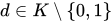

where c, d ∈ K with cd(1 − c4·d) ≠ 0.
Every Edwards curve is birationally equivalent to an elliptic curve in Montgomery form, and thus admits an algebraic group law once one chooses a point to serve as a neutral element. If K is finite, then a sizeable fraction of all elliptic curves over K can be written as Edwards curves. Often elliptic curves in Edwards form are defined having c=1, without loss of generality. In the following sections, it is assumed that c=1.
The group law
[edit](See also Weierstrass curve group law)
Every Edwards curve over field K with characteristic not equal to 2 with is birationally equivalent to an elliptic curve over the same field: , where and the point is mapped to the infinity O. This birational mapping induces a group on any Edwards curve.





Edwards addition law
[edit]On any elliptic curve the sum of two points is given by a rational expression of the coordinates of the points, although in general one may need to use several formulas to cover all possible pairs. For the Edwards curve, taking the neutral element to be the point (0, 1), the sum of the points and is given by the formula



The opposite of any point is . The point has order 2, and the points have order 4. In particular, an Edwards curve always has a point of order 4 with coordinates in K.


If d is not a square in K and , then there are no exceptional points: the denominators and are always nonzero. Therefore, the Edwards addition law is complete when d is not a square in K. This means that the formulas work for all pairs of input points on the Edwards curve with no exceptions for doubling, no exception for the neutral element, no exception for negatives, etc.[2] In other words, it is defined for all pairs of input points on the Edwards curve over K and the result gives the sum of the input points.



If d is a square in K, then the same operation can have exceptional points, i.e. there can be pairs of points such that one of the denominators becomes zero: either or .



One of the attractive features of the Edwards Addition law is that it is strongly unified i.e. it can also be used to double a point, simplifying protection against side-channel attack. The addition formula above is faster than other unified formulas and has the strong property of completeness[2]
Example of addition law :
Consider the elliptic curve in the Edwards form with d=2

and the point on it. It is possible to prove that the sum of P1 with the neutral element (0,1) gives again P1. Indeed, using the formula given above, the coordinates of the point given by this sum are:

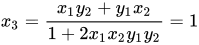
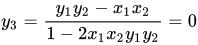
An analogue on the circle
[edit]
To understand better the concept of "addition" of points on a curve, a nice example is given by the classical circle group:
take the circle of radius 1

and consider two points P1=(x1,y1), P2=(x2,y2) on it. Let α1 and α2 be the angles such that:


The sum of P1 and P2 is, thus, given by the sum of "their angles". That is, the point P3=P1+P2 is a point on the circle with coordinates (x3,y3), where:


In this way, the addition formula for points on the circle of radius 1 is:
- .

Addition on Edwards curves
[edit]

The points on an elliptic curve form an abelian group: one can add points and take integer multiples of a single point. When an elliptic curve is described by a non-singular cubic equation, then the sum of two points P and Q, denoted P + Q, is directly related to third point of intersection between the curve and the line that passes through P and Q.
The birational mapping between an Edwards curve and the corresponding cubic elliptic curve maps the straight lines into conic sections[3] . In other words, for the Edwards curves the three points , and lie on a hyperbola.



Given two distinct non-identity points , the coefficients of the quadratic form are (up to scalars):

,

,


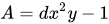
In the case of doubling a point the inverse point lies on the conic that touches the curve at the point . The coefficients of the quadratic form that defines the conic are (up to scalars[clarification needed]):


,
,


Projective homogeneous coordinates
[edit]In the context of cryptography, homogeneous coordinates are used to prevent field inversions that appear in the affine formula. To avoid inversions in the original Edwards addition formulas, the curve equation can be written in projective coordinates as:
.

A projective point corresponds to the affine point on the Edwards curve.

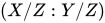
The identity element is represented by . The inverse of is .

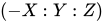
The addition formula in homogeneous coordinates is given by:

where



Algorithm
[edit]Addition of two points on the Edwards curve could be computed more efficiently[4] in the extended Edwards form , where :






Doubling
[edit]Doubling can be performed with exactly the same formula as addition. Doubling refers to the case in which the inputs (x1, y1) and (x2, y2) are equal.
Doubling a point :
![{\displaystyle {\begin{aligned}(x,y)+(x,y)&=\left({\frac {2xy}{1+dx^{2}y^{2}}},{\frac {y^{2}-x^{2}}{1-dx^{2}y^{2}}}\right)\\[6pt]&=\left({\frac {2xy}{x^{2}+y^{2}}},{\frac {y^{2}-x^{2}}{2-x^{2}-y^{2}}}\right)\end{aligned}}}](https://wikimedia.org/api/rest_v1/media/math/render/svg/4c4b829ed1a7cc2756d2737d1b69c2c1230905e2)
The denominators were simplified based on the curve equation . Further speedup is achieved by computing as . This reduces the cost of doubling in homomorphic coordinates to 3M + 4S + 3C + 6a, while general addition costs 10M + 1S + 1C + 1D + 7a. Here M is field multiplications, S is field squarings, D is the cost of multiplying by the curve parameter d, and a is field addition.


- Example of doubling
As in the previous example for the addition law, consider the Edwards curve with d=2:

and the point . The coordinates of the point are:


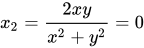
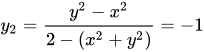
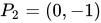
The point obtained from doubling P is thus .
Mixed addition
[edit]Mixed addition is the case when Z2 is known to be 1. In such a case A=Z1.Z2 can be eliminated and the total cost reduces to 9M+1S+1C+1D+7a
Algorithm
[edit]A= Z1.Z2 // in other words, A= Z1
B= Z12
C=X1.X2
D=Y1.Y2
E=d.C.D
F=B-E
G=B+E
X3= A.F((XI+Y1).(X2+Y2)-C-D)
Y3= A.G.(D-C)
Z3=C.F.G
Tripling
[edit]Tripling can be done by first doubling the point and then adding the result to itself. By applying the curve equation as in doubling, we obtain

There are two sets of formulas for this operation in standard Edwards coordinates. The first one costs 9M + 4S while the second needs 7M + 7S. If the S/M ratio is very small, specifically below 2/3, then the second set is better while for larger ratios the first one is to be preferred.[5] Using the addition and doubling formulas (as mentioned above) the point (X1 : Y1 : Z1) is symbolically computed as 3(X1 : Y1 : Z1) and compared with (X3 : Y3 : Z3)
- Example of tripling
Giving the Edwards curve with d=2, and the point P1=(1,0), the point 3P1 has coordinates:


So, 3P1=(-1,0)=P-1. This result can also be found considering the doubling example: 2P1=(0,1), so 3P1 = 2P1 + P1 = (0,-1) + P1 = -P1.
- Algorithm
A=X12
B=Y12
C=(2Z1)2
D=A+B
E=D2
F=2D.(A-B)
G=E-B.C
H=E-A.C
I=F+H
J=F-G
X3=G.J.X1
Y3=H.I.Y1
Z3=I.J.Z1
This formula costs 9M + 4S
Inverted Edwards coordinates
[edit]Bernstein and Lange introduced an even faster coordinate system for elliptic curves called the Inverted Edward coordinates[6] in which the coordinates (X : Y : Z) satisfy the curve (X2 + Y2)Z2 = (dZ4 + X2Y2) and corresponds to the affine point (Z/X, Z/Y) on the Edwards curve x2 + y2 = 1 + dx2y2 with XYZ ≠ 0.
Inverted Edwards coordinates, unlike standard Edwards coordinates, do not have complete addition formulas: some points, such as the neutral element, must be handled separately. But the addition formulas still have the advantage of strong unification: they can be used without change to double a point.
For more information about operations with these coordinates see http://hyperelliptic.org/EFD/g1p/auto-edwards-inverted.html
Extended Coordinates for Edward Curves
[edit]There is another coordinates system with which an Edwards curve can be represented. These new coordinates are called extended coordinates[7] and are even faster than inverted coordinates. For more information about the time-cost required in the operations with these coordinates see: http://hyperelliptic.org/EFD/g1p/auto-edwards.html
See also
[edit]For more information about the running-time required in a specific case, see Table of costs of operations in elliptic curves.
Notes
[edit]- ^ Bernstein, Daniel; Lange, Tanja (3 March 2014), How to design an elliptic-curve signature system
- ^ a b Daniel. J. Bernstein , Tanja Lange, pag. 3, Faster addition and doubling on elliptic curves
- ^ Christophe Arene; Tanja Lange; Michael Naehrig; Christophe Ritzenthaler (2009). "Faster Computation of the Tate Pairing". arXiv:0904.0854. Bibcode:2009arXiv0904.0854A. Retrieved 28 February 2010.
- ^ Huseyin Hisil, Kenneth Koon-Ho Wong, Gary Carter, and Ed Dawson. Twisted Edwards curves revisited. In ASIACRYPT 2008, pages 326–343, 2008
- ^ Bernstein et al., Optimizing Double-Base Elliptic curve single-scalar Multiplication
- ^ Daniel J.Bernstein. Tanja Lange, pag.2, Inverted Edward coordinates
- ^ H. Hisil, K. K. Wong, G. Carter, E. Dawson Faster group operations on elliptic curves
References
[edit]- Bernstein, Daniel; Lange, Tanja (2007), Faster Addition and Doubling on Elliptic curves (PDF)
- Edwards, Harold M. (9 April 2007), "A normal form for elliptic curves", Bulletin of the American Mathematical Society, 44 (3): 393–422, doi:10.1090/s0273-0979-07-01153-6, ISSN 0002-9904
- Faster Group Operations on Elliptic curves, H. Hisil, K. K. Wong, G. Carter, E. Dawson
- D.J.Bernstein, P.Birkner. T. Lange, C.Peters, Optimizing Double-Base Elliptic-Curve Single-Scalar Multiplication (PDF)
{{citation}}: CS1 maint: multiple names: authors list (link) - Washington, Lawrence C. (2008), Elliptic Curves: Number Theory and Cryptography, Discrete Mathematics and its Applications (2nd ed.), Chapman & Hall/CRC, ISBN 978-1-4200-7146-7
- Bernstein, Daniel; Lange, Tanja, Inverted Edwards coordinates (PDF)
External links
[edit]Edwards curve
View on GrokipediaDefinition
Curve Equation
A normalized Edwards curve over a field $ K $ of characteristic not 2 is given by the equationParameters and Properties
The parameter in the Edwards curve equation must be chosen as a nonzero element of the base field such that the curve is nonsingular, which requires and to ensure the defining polynomial has distinct roots and the curve is elliptic.[1] A notable degenerate case is , which gives the unit circle , providing a simple geometric analogy though not elliptic in the strict sense for cryptographic use.[1] Edwards curves exhibit several advantageous properties arising from their parameterization. The addition law is complete, meaning it applies uniformly without special cases for point doubling, the identity element, or points of order 2, which enhances resistance to implementation vulnerabilities like side-channel attacks from exceptional cases.[1][2] This completeness stems from the curve's symmetric birational equivalence to other elliptic curve models and the absence of singular points in the addition formulas over fields of characteristic not 2 or 3.[2] The -invariant of an Edwards curve is given by , which classifies the curve up to isomorphism over the algebraic closure of the base field and relates it birationally to Weierstrass forms sharing the same -value.[2] In cryptographic applications, parameters for Edwards curves (or their twisted variants) are selected over prime fields to ensure suitability, including a large embedding degree to resist the MOV attack by preventing efficient reduction of the discrete logarithm problem to a finite field, and a trace of Frobenius satisfying Hasse's bound while yielding a group order that is prime or has a small cofactor for secure prime-order subgroups.[5]History and Development
Proposal by Harold Edwards
In 2007, Harold M. Edwards Jr. introduced a new normal form for elliptic curves in his paper "A Normal Form for Elliptic Curves," published in the Bulletin of the American Mathematical Society.[1] Edwards proposed this form to simplify the algebraic structure and addition laws of elliptic curves, drawing inspiration from historical developments in the theory of elliptic functions by mathematicians such as Euler and Abel.[1] His motivation was to establish a standardized representation that would make the underlying mathematics more accessible and intuitive, particularly for pedagogical purposes in teaching elliptic curve theory over the real numbers.[1] Edwards' approach emphasized an analogy to the parametrization of the circle using sine and cosine functions, where the new form exhibits a high degree of symmetry between the variables x and y.[1] This symmetry allows the two parameterizing functions for the curve to be essentially identical, mirroring the interchangeable roles of sine and cosine on the circle and thereby simplifying the study of elliptic functions.[1] Unlike traditional Weierstrass forms, which often require projective coordinates to handle points at infinity and avoid singularities in the addition process, Edwards' form enables a direct algebraic group law defined entirely within the affine plane over the reals.[1] The key insight of Edwards' proposal lies in the group law's geometric interpretation, which corresponds precisely to the chord-and-tangent construction familiar from circle addition, but without the complications of projective closure or exceptional cases that arise in other elliptic curve models.[1] This results in addition formulas that are remarkably simple and free of singularities for all points on the curve, providing a cleaner foundation for exploring elliptic curve properties in a real-number context.[1] Edwards' work was thus positioned as a contribution to pure mathematics, aimed at enhancing conceptual understanding rather than applications in other fields.[1]Adoption in Cryptography
The adoption of Edwards curves in cryptography accelerated in 2008 with the introduction of twisted Edwards curves by Daniel J. Bernstein, Peter Birkner, Marc Joye, Tanja Lange, and Peter L. Montgomery, who established their birational equivalence to Weierstrass and Montgomery forms and derived efficient arithmetic formulas applicable over both prime fields and binary fields.[2] This generalization of the original Edwards curves, proposed by Harold Edwards in 2007, enabled broader applicability and superior performance in elliptic curve cryptography. A pivotal milestone occurred with the reformulation of Curve25519, initially presented by Bernstein in 2006 as a Montgomery curve for high-speed Diffie-Hellman key exchange, into a twisted Edwards curve in 2008, which facilitated faster and more secure implementations.[6] [2] Building on this, Bernstein, Niels Duif, Tanja Lange, Peter Schwabe, and Bo-Yin Yang introduced Ed25519 in 2011, a deterministic digital signature scheme using the Edwards form of Curve25519, achieving record-breaking speeds for signing and verification on commodity hardware while providing 128 bits of security.[7] In 2015, Mike Hamburg extended these advancements with Ed448, a twisted Edwards curve over a 448-bit prime field, offering approximately 224 bits of security and optimized for protocols requiring higher assurance levels, such as long-term signatures.[8] The appeal of twisted Edwards curves stems from their complete, unified addition formulas, which enable faster scalar multiplication—up to twice the speed of prior curves in some cases—and provide resistance to side-channel attacks by avoiding distinct operations for point addition and doubling.[2] As of 2025, Edwards curve-based primitives like X25519 and Ed25519 are integral to TLS 1.3 for key exchange and authentication, supporting secure web communications with minimal performance overhead.[9] NIST has further endorsed their use in FIPS 186-5 and SP 800-186, specifying EdDSA signatures with Edwards curves as recommended mechanisms for digital signatures during the ongoing transition to post-quantum cryptography.Group Law
Edwards Addition Formula
The addition law on an Edwards curve, defined by the equation where with to ensure nonsingularity, provides a group operation for points in affine coordinates.[1] For distinct points and , the sum is computed asGeometric Analogy to the Circle
The Edwards curve equation can be scaled to resemble the unit circle. Setting , yields , or , analogous to the circle perturbed by the term . In the circle case (a=0 effectively), the group law mirrors angle addition, parameterized by , with formulas reducing to trigonometric identities without affine singularities.[1] For general a, the Edwards curve deforms the circle while preserving the additive structure and birational equivalence to other models. The algebraic addition formulas retain rational expressions echoing trigonometric laws, integrating the curve's geometry uniformly.[1] Geometrically, addition follows a chord-and-tangent construction: the line through points P and Q intersects at R = -(P + Q), and the line through R and identity (0, a) yields P + Q. This avoids exceptional cases since the identity is affine, and the curve's symmetry ensures well-defined intersections. The fourfold rotational symmetry highlights the deformation from the circle.[1] This analogy underscores the explicit, exception-free nature of the addition law compared to Weierstrass forms.[2]Group Properties
The points on an Edwards curve over a field (char ≠ 2, a^5 ≠ a) form an abelian group under the chord-and-tangent addition law, birationally equivalent to Weierstrass models. In the projective closure, the group includes points at infinity, inheriting standard elliptic curve properties, including commutativity from formula symmetry.[1][2] The identity is (0, a), with inverse of (x, y) being (-x, y), as their sum is the identity. There is a point of order 2 at (0, -a). The 2-torsion includes points like (±1, 0) if on the curve, forming over algebraically closed fields.[1][2] Associativity follows from birational equivalence to Weierstrass form, where it holds by polynomial identities or intersection theory.[1] The addition law is explicit and applies uniformly in affine coordinates, with completeness in projective space for the full group. For twisted Edwards variants (covered in Adoption in Cryptography), parameters are chosen for cryptographic efficiency.[2] The discriminant is , nonzero under the curve's conditions, measuring arithmetic complexity. Over , the conductor relates to bad reduction primes and bounds like .[10][1]Coordinate Systems
Projective Coordinates
In elliptic curve cryptography, projective coordinates provide a homogeneous representation for points on an Edwards curve, embedding the affine plane into the projective plane over the base field to accommodate the point at infinity and eliminate costly field inversions during arithmetic operations. An affine point on the Edwards curve is represented as a projective point satisfying and for .[11] The curve equation homogenizes toInverted Edwards Coordinates
Inverted Edwards coordinates provide a projective representation for points on an Edwards curve, defined by the triplet where the corresponding affine coordinates are and , with . This inversion of the standard dehomogenization swaps the roles of the variables compared to conventional projective coordinates, where and . The identity point is represented as , and the negative of a point is .[12][13] In these coordinates, the Edwards curve equation homogenizes to . For twisted Edwards curves of the form , the equation adapts to , enabling simplified expressions for group operations. This form facilitates unified addition formulas that handle both distinct points and doubling without case distinctions, enhancing resistance to side-channel attacks.[12][14] The primary benefits arise in computational efficiency: point addition costs 9 multiplications (M) plus 1 squaring (S) and 1 multiplication by d (D), a reduction of 1M compared to 10M + 1S + 1D in standard projective Edwards coordinates. Point doubling requires 3M + 4S + 1D, benefiting from the unified framework, which avoids inversions entirely and supports parallelization in hardware implementations. Hisil et al. noted that this system reduces overall operation costs by approximately 10% for additions on twisted Edwards curves, with further optimizations in mixed additions at 8M + 1D; implementations like those in elliptic curve digital signature algorithms have adopted it for its balance of speed and security.[12][14] Conversion between affine and inverted coordinates involves computing reciprocals: from affine to , requiring two inversions and scalings. To convert from standard projective Edwards coordinates (where , ) to inverted, use , at a cost of 3M. The reverse conversion from inverted to standard projective is , also 3M. Dehomogenization to affine from inverted requires two inversions: divide Z by X and Y. These transformations allow seamless integration with other coordinate systems in hybrid implementations.[12][13][14]Extended Coordinates
Extended coordinates represent points on twisted Edwards curves using four values (X : Y : Z : T), extending the standard projective coordinates (X : Y : Z) by including an auxiliary coordinate T = X Y.[11] This representation maintains the relation to affine coordinates where x = X/Z and y = Y/Z, while allowing verification of the coordinate consistency through the identity T² = X² Y².[11] The system was introduced by Hisil, Wong, Carter, and Dawson in their 2008 paper on twisted Edwards curves to optimize arithmetic operations in elliptic curve cryptography.[11] The primary advantage of extended coordinates lies in enabling more efficient point operations without requiring inversions. Specifically, unified general point addition can be performed in 9M + 2D operations, while dedicated addition (for distinct points) costs 9M + 1D; here M denotes a field multiplication and D a multiplication by the curve parameter d (no separate squarings in addition formulas).[11] Point doubling is achieved in 4M + 4S + 1D, reducing the computational overhead compared to basic projective coordinates by precomputing the product term.[11] These costs assume a twisted Edwards curve of the form ax² + y² = 1 + dx²y² and leverage the auxiliary T to avoid repeated multiplications of X and Y during computations.[11] Conversion between coordinate systems is straightforward. To obtain extended coordinates from projective ones, compute T = X Y, adding one multiplication to the process.[11] Conversely, converting to affine coordinates involves dividing by Z: x = X/Z and y = Y/Z, typically requiring a single inversion followed by two multiplications, though this is done only when necessary for output or mixed operations.[11] Unlike inverted Edwards coordinates, which focus on Y/Z scaling, extended coordinates emphasize the product precomputation for balanced speed in both addition and doubling on twisted forms.[11]Arithmetic Operations
Point Doubling
Point doubling on an Edwards curve in extended coordinates operates on a point satisfying , where the affine coordinates are recovered as and .[11] The explicit formulas for computing use the following intermediate values:Point Addition
Point addition on an Edwards curve computes the sum of two distinct points and in extended homogeneous coordinates, where the affine coordinates are recovered as and , with the auxiliary value satisfying . This representation enables efficient arithmetic without field inversions, crucial for cryptographic applications. The addition formulas derive from the birational equivalence to Weierstrass models but are tailored for the Edwards form , providing complete addition laws that handle all cases except the identity without branching.[11] The unified addition formulas, applicable to distinct points and ensuring uniformity, are given by:- Let (2 field multiplications),
- Let (2 field multiplications, including multiplication by the curve parameter ),
- Let (1 field multiplication),
- Let (1 field multiplication),
- Let (1 multiplication by the curve parameter ),
- Let and (2 field additions),
- Then (1 field multiplication),
- (1 field multiplication),
- (1 field multiplication),
- (1 field multiplication).