Hubbry Logo
search
logo

Electron mass

logo
Community Hub0 Subscribers
Read side by side
from Wikipedia
Constant Value
me 9.1093837139(28)×10−31 kg[1]
5.485799090441(97)×10−4 Da[2]
0.51099895069(16) MeV/c2
mec2 8.1871057880(26)×10−14 J[3]
0.51099895069(16) MeV[4]

In particle physics, the electron mass (symbol: me) is the mass of a stationary electron, also known as the invariant mass of the electron. It is one of the fundamental constants of physics. It has a value of about 9.109×10⁻³¹ kilograms or about 5.486×10⁻⁴ daltons, which has an energy-equivalent of about 8.187×10⁻¹⁴ joules or about 0.5110 MeV.

Terminology

[edit]

The term "rest mass" is sometimes used because in special relativity the mass of an object can be said to increase in a frame of reference that is moving relative to that object (or if the object is moving in a given frame of reference). Most practical measurements are carried out on moving electrons. If the electron is moving at a relativistic velocity, any measurement must use the correct expression for mass. Such correction becomes substantial for electrons accelerated by voltages of over 100 kV.

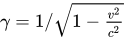
For example, the relativistic expression for the total energy, E, of an electron moving at speed v is where

  • c is the speed of light;
  • γ is the Lorentz factor,
  • me is the "rest mass", or more simply just the "mass" of the electron.
This quantity me is frame invariant and velocity independent.

Determination

[edit]

Since the electron mass determines a number of observed effects in atomic physics, there are potentially many ways to determine its mass from an experiment, if the values of other physical constants are already considered known.

Historically, the mass of the electron was determined directly from combining two measurements. The mass-to-charge ratio of the electron was first estimated by Arthur Schuster in 1890 by measuring the deflection of "cathode rays" due to a known magnetic field in a cathode ray tube. Seven years later J. J. Thomson showed that cathode rays consist of streams of particles, to be called electrons, and made more precise measurements of their mass-to-charge ratio, again using a cathode ray tube.

The second measurement was of the charge of the electron. This was determined with a precision of better than 1% by Robert A. Millikan in his oil drop experiment in 1909. Together with the mass-to-charge ratio, the electron mass was determined with reasonable precision. The value of mass that was found for the electron was initially met with surprise by physicists, since it was so small (less than 0.1%) compared to the known mass of a hydrogen atom.

The electron rest mass can be calculated from the Rydberg constant R and the fine-structure constant α obtained through spectroscopic measurements. Using the definition of the Rydberg constant:
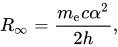
thus
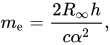
where c is the speed of light and h is the Planck constant.[5] The relative uncertainty, 5×10⁻⁸ in the 2006 CODATA recommended value,[6] is due entirely to the uncertainty in the value of the Planck constant. With the re-definition of kilogram in 2019, there is no uncertainty by definition left in Planck constant anymore.

The electron relative atomic mass can be measured directly in a Penning trap. It can also be inferred from the spectra of antiprotonic helium atoms (helium atoms where one of the electrons has been replaced by an antiproton) or from measurements of the electron g-factor in the hydrogenic ions 12C5+ or 16O7+.

The electron relative atomic mass is an adjusted parameter in the CODATA set of fundamental physical constants, while the electron rest mass in kilograms is calculated from the values of the Planck constant, the fine-structure constant and the Rydberg constant, as detailed above.[5][6]

Relationship to other physical constants

[edit]

The electron mass was used to calculate the Avogadro constant NA before its value was fixed as a defining constant in the 2019 revision of the SI:

Hence it is also related to the atomic mass constant mu:

where

mu is defined in terms of Ar(e), and not the other way round, and so the name "electron mass in atomic mass units" for Ar(e) involves a circular definition (at least in terms of practical measurements).

The electron relative atomic mass also enters into the calculation of all other relative atomic masses. By convention, relative atomic masses are quoted for neutral atoms, but the actual measurements are made on positive ions, either in a mass spectrometer or a Penning trap. Hence the mass of the electrons must be added back on to the measured values before tabulation. A correction must also be made for the mass equivalent of the binding energy Eb. Taking the simplest case of complete ionization of all electrons, for a nuclide X of atomic number Z,[5]

As relative atomic masses are measured as ratios of masses, the corrections must be applied to both ions: the uncertainties in the corrections are negligible, as illustrated below for hydrogen 1 and oxygen 16.

Physical parameter 1H 16O
relative atomic mass of the XZ+ ion 1.00727646677(10) 15.99052817445(18)
relative atomic mass of the Z electrons 0.00054857990943(23) 0.0043886392754(18)
correction for the binding energy −0.0000000145985 −0.0000021941559
relative atomic mass of the neutral atom 1.00782503207(10) 15.99491461957(18)

The principle can be shown by the determination of the electron relative atomic mass by Farnham et al. at the University of Washington (1995).[7] It involves the measurement of the frequencies of the cyclotron radiation emitted by electrons and by 12C6+ ions in a Penning trap. The ratio of the two frequencies is equal to six times the inverse ratio of the masses of the two particles (the heavier the particle, the lower the frequency of the cyclotron radiation; the higher the charge on the particle, the higher the frequency):

As the relative atomic mass of 12C6+ ions is very nearly 12, the ratio of frequencies can be used to calculate a first approximation to Ar(e), 5.4863037178×10⁻⁴. This approximate value is then used to calculate a first approximation to Ar(12C6+), knowing that (from the sum of the six ionization energies of carbon) is 1.1058674×10⁻⁶: Ar(12C6+) ≈ 11.9967087236367. This value is then used to calculate a new approximation to Ar(e), and the process repeated until the values no longer vary (given the relative uncertainty of the measurement, 2.1×10⁻⁹): this happens by the fourth cycle of iterations for these results, giving Ar(e) = 5.485799111(12)×10−4 for these data.

References

[edit]
Revisions and contributorsEdit on WikipediaRead on Wikipedia
from Grokipedia
The electron mass, denoted as $ m_e $, is the invariant rest mass of the electron, a fundamental elementary particle with a negative elementary charge that serves as a basic constituent of matter in the Standard Model of particle physics.[1] This mass is one of the key fundamental physical constants, characterizing the intrinsic inertia of the electron and enabling quantitative predictions in theories of quantum mechanics and electromagnetism.[1] According to the 2022 CODATA recommended values, the electron mass is precisely $ 9.109,383,7139(28) \times 10^{-31} $ kilograms, with the uncertainty in the last two digits reflecting the relative standard uncertainty of $ 3.1 \times 10^{-10} $.[2] The electron mass plays a pivotal role in atomic and subatomic physics, appearing in essential formulas such as the Rydberg constant, which describes the energy levels of electrons in hydrogen-like atoms: $ R_\infty = \frac{\mu_0^2 c^3 e^4 m_e}{8 h^3} $, where $ \mu_0 $ is the permeability of free space, $ c $ is the speed of light, $ e $ is the elementary charge, and $ h $ is Planck's constant.[1] It also influences the fine-structure constant $ \alpha \approx \frac{1}{137} $, defined as $ \alpha = \frac{e^2}{4\pi \epsilon_0 \hbar c} $ (with $ \epsilon_0 $ the vacuum permittivity and $ \hbar = h / 2\pi $), which quantifies the strength of electromagnetic interactions.[1] Measurements of the electron mass, refined through techniques like Penning trap experiments, have achieved extraordinary precision, underscoring its importance for verifying quantum electrodynamics (QED) and testing the Standard Model.[3] In natural units commonly used in particle physics, the electron mass is often expressed in energy equivalents, such as $ m_e c^2 = 0.510,998,950,69(16) $ MeV, facilitating comparisons with other particles like the proton (approximately 1836 times heavier).[4] This value's stability across all electrons in the universe highlights the universality of fundamental constants, with implications for cosmology, where even slight variations could alter stellar nucleosynthesis and the formation of complex molecules.[1] Ongoing refinements, as in the 2022 CODATA adjustment incorporating new experimental data, ensure its accuracy supports advanced applications in precision metrology and high-energy physics.[5]

Definition and Fundamentals

Definition

The electron is a fundamental subatomic particle classified as a charged lepton, possessing a negative elementary electric charge of -1 in units of the proton charge magnitude.[6] As one of the basic constituents of matter, it plays a central role in atomic structure and electromagnetic interactions.[7] The electron mass, conventionally denoted as $ m_e $, is defined as the intrinsic rest mass of the electron, which corresponds to its invariant mass in the theory of special relativity.[8] This invariant mass remains constant regardless of the electron's velocity or the observer's reference frame, serving as a fundamental property that characterizes the particle's inertia in its rest frame.[9] In this context, the electron's rest mass embodies its rest energy, expressed by the relation
E=mec2, E = m_e c^2,
where $ E $ is the rest energy and $ c $ is the speed of light in vacuum, highlighting the equivalence between mass and energy as established in special relativity.[10] To avoid ambiguity, particularly with historical or contextual usages, the term "electron rest mass" is employed to emphasize this invariant quantity and distinguish it from the deprecated concept of relativistic mass.[8] Relativistic mass, once used to describe the velocity-dependent increase in a particle's effective inertia, has fallen out of favor in modern physics because it can lead to misconceptions; instead, the invariant rest mass is preferred, with relativistic effects handled through energy and momentum.[9] This terminology also helps differentiate the bare rest mass from effective masses that arise in specialized scenarios, such as the dynamic behavior of electrons in external fields or condensed matter systems.

Units and Equivalent Expressions

The electron mass is most commonly expressed in the International System of Units (SI) as the rest mass $ m_e = 9.109,383,7139(28) \times 10^{-31} $ kg, where the uncertainty is given in parentheses and corresponds to the standard deviation in the last two digits.[2] This value originates from the 2022 CODATA adjustment, which incorporates measurements from precision experiments in atomic physics and metrology.[11] In particle physics and relativistic contexts, the electron mass is often converted to its rest energy equivalent via $ E = m_e c^2 $, yielding $ m_e c^2 = 0.510,998,950,69(16) $ MeV.[4] This form facilitates comparisons with other particle masses and energies, with the uncertainty reflecting the propagation from the mass and speed of light values in the same CODATA set.[11] In atomic units, where the electron mass serves as the fundamental unit of mass, $ m_e $ is defined exactly as 1, simplifying calculations in non-relativistic quantum mechanics for atomic systems. Similarly, in natural units where $ \hbar = c = 1 $, the electron mass is expressed directly in inverse length or energy units, such as $ m_e = 0.510,998,950,69 $ MeV (with $ \hbar c $ restoring dimensions if needed), aligning with high-energy physics conventions. The precision of the electron mass has improved significantly over time, with the relative standard uncertainty of $ 3.1 \times 10^{-10} $ in the 2022 CODATA evaluation, unchanged from 2018 but improved from the 2014 value of $ 1.2 \times 10^{-9} $.[2] The 2019 redefinition of the SI units, which fixed the Planck constant $ h $ exactly, has improved the consistency of mass values by decoupling them from artifact-based standards. However, the uncertainty in $ m_e $ remains limited by experimental inputs, with ongoing refinements through spectroscopic and interferometric data.[11]

Experimental Determination

Historical Measurements

The determination of the electron mass began with J.J. Thomson's groundbreaking 1897 experiments using cathode ray tubes. By measuring the deflection of cathode rays in crossed electric and magnetic fields, Thomson calculated the charge-to-mass ratio $ e/m_e $ to be approximately $ 1.7 \times 10^7 $ electromagnetic units per gram, which was about 10,000 times larger than that for hydrogen ions. Assuming the electron's charge equaled the minimum charge from electrolysis experiments (around $ 4.8 \times 10^{-10} $ esu), he estimated the electron mass at roughly $ 10^{-27} $ g in cgs units, or about 1/1000 to 1/2000 of the hydrogen atom's mass. This value, though approximate, confirmed the particulate nature of cathode rays and marked the first quantitative assessment of the electron's mass.[12][13] A significant refinement came in 1909 with Robert Millikan's oil-drop experiment, which directly measured the elementary charge $ e \approx 1.592 \times 10^{-19} $ C on oil droplets ionized by X-rays. Combining this with updated charge-to-mass ratios from Thomson's method and subsequent refinements, Millikan derived the electron mass as $ m_e \approx 9.1 \times 10^{-28} $ g, improving accuracy to within a few percent and establishing the electron as a fundamental particle with a well-defined mass independent of the emitting material. This result not only corroborated Thomson's findings but also provided empirical support for atomic models incorporating discrete electrons.[14][15] From the 1920s to the 1940s, experimental techniques evolved to enhance precision, primarily through refined magnetic deflection of electron beams and early particle accelerators. Methods involving uniform magnetic fields to measure beam curvature yielded charge-to-mass ratios with uncertainties below 0.5%, as demonstrated by F.G. Dunnington's 1938 deflection apparatus, which achieved relative precision of about 0.02% for $ e/m_e $. Cyclotron-based approaches in the 1930s, leveraging resonant acceleration of electrons, further validated these values by probing relativistic effects at higher energies. By the 1950s, these classical techniques had converged on the electron mass with approximately 0.1% precision, setting the stage for more advanced measurements.[16][17] Independent confirmation emerged in the 1930s through spectroscopic analysis of the Balmer series in hydrogen spectra. Precise wavelength measurements of lines like Hα, combined with the recent discovery of deuterium, allowed determination of the infinite nuclear mass Rydberg constant $ R_\infty $ and the proton-electron mass ratio $ m_p/m_e \approx 1836 $. Using known proton mass estimates, this yielded electron mass values consistent with deflection methods, with relative uncertainties around 0.1%, highlighting the interplay between atomic spectroscopy and direct particle measurements.[18]

Contemporary Methods

Contemporary methods for determining the electron mass leverage quantum precision techniques, including Penning trap mass spectrometry and atomic spectroscopy, achieving relative uncertainties below 10^{-10} since the late 20th century. These approaches exploit the stability of trapped particles and high-resolution laser spectroscopy to isolate the electron's contribution from nuclear effects or bound-state interactions. Penning trap experiments measure the mass of a single electron or a hydrogenlike ion by determining its cyclotron frequency in a strong magnetic field. The cyclotron frequency νc\nu_c is given by
νc=eB2πme, \nu_c = \frac{e B}{2\pi m_e},
where ee is the elementary charge, BB is the magnetic field strength, and mem_e is the electron mass. Early high-precision implementations in the late 1980s and 1990s, such as those by the University of Washington group, used compensated Penning traps to measure the proton-to-electron mass ratio via cyclotron frequency ratios of single ions, yielding the electron's atomic mass with a relative uncertainty of approximately 2 \times 10^{-10}. A landmark 1995 measurement refined this to a relative uncertainty of 2.0 \times 10^{-10} by comparing the cyclotron frequencies of a free electron and a bare carbon-12 ion (^{12}C^{6+}). More recent experiments at PTB and collaborators have pushed precision further; in 2014, bound-electron g-factor measurements on hydrogenlike ^{12}C^{5+} in a double Penning-trap setup determined the electron atomic mass me/u=0.000548579909065(16)m_e / u = 0.000\,548\,579\,909\,065(16) with a relative uncertainty of 3.0 \times 10^{-11}. These single-ion Penning trap techniques, often involving carbon or oxygen ions, minimize relativistic and anharmonic corrections through cryogenic operation and precise field mapping. Atomic spectroscopy provides a complementary route by deriving the electron mass from the finite-mass correction to the Rydberg constant in hydrogen-like systems. The Rydberg constant for hydrogen RHR_H relates to the infinite nuclear mass Rydberg constant RR_\infty via the reduced mass effect:
RH=Rmeme+mp, R_H = R_\infty \frac{m_e}{m_e + m_p},
where mpm_p is the proton mass; high-precision measurements of transition frequencies thus yield me/mpm_e / m_p. The two-photon 1S-2S transition in hydrogen, with its narrow natural linewidth of 1.3 Hz, is particularly suited for this, as its frequency directly probes RHR_H. Laser frequency comb spectroscopy has enabled measurements of the 1S-2S frequency at f1S2S=2466061413187.035(10)f_{1S-2S} = 2\,466\,061\,413\,187.035(10) kHz, corresponding to a relative uncertainty of 4 \times 10^{-12} and contributing to me/mpm_e / m_p determinations at the 10^{-10} level. Complementary measurements, such as the 2020 1S-3S transition at MPQ, refine RR_\infty and the mass ratio by cross-checking QED predictions with experimental spectra. Post-2019 SI redefinition advancements integrate these methods with fixed values of ee, hh, and the fine-structure constant α\alpha, expressing mem_e as $ m_e = \frac{2 h R_\infty}{c \alpha^2} $ (in appropriate units), where consistency tests achieve relative uncertainties of 5 \times 10^{-10} through combined Penning trap, spectroscopy, and quantum Hall effect data. NIST and PTB collaborations exemplify this, with PTB's single-ion Penning traps providing direct mass inputs and NIST's free-electron g-factor measurements refining α\alpha to 1.6 \times 10^{-10}) uncertainty, enabling holistic verifications of mem_e. These efforts ensure the electron mass remains anchored to the revised SI framework while probing beyond-Standard-Model physics.

Theoretical Framework

In Quantum Electrodynamics

In quantum electrodynamics (QED), the observed electron mass $ m_e $ differs from the bare mass $ m_0 $ due to radiative corrections arising from interactions with the quantized electromagnetic field. These corrections are encapsulated in the relation $ m_e = m_0 (1 + \delta) $, where $ \delta $ sums contributions from perturbative loop diagrams, primarily proportional to $ \alpha / \pi $ with $ \alpha $ the fine-structure constant. The renormalization procedure absorbs ultraviolet divergences into $ m_0 $, ensuring finite physical predictions, as formalized in the covariant perturbation theory developed in the mid-20th century. The primary source of the mass shift is the one-loop electron self-energy diagram, depicting the electron propagating while emitting and reabsorbing a virtual photon. This leading-order correction yields $ \Delta m_e / m_e \approx (\alpha / 2\pi) \log(\Lambda / m_e) $, where $ \Lambda $ is an ultraviolet cutoff to regulate the logarithmic divergence. A more detailed evaluation gives the relative shift as $ \delta m / m = (3 \alpha / 4\pi) \ln(\Lambda^2 / m^2) $, highlighting the scale dependence between the cutoff and electron mass; higher-loop terms add subleading powers of $ \alpha $. These self-energy effects effectively dress the bare electron with a photon cloud, increasing the observable inertial mass.[19][20] The electron mass also features prominently in QED predictions for the anomalous magnetic moment $ (g-2) $. The Dirac equation establishes the tree-level gyromagnetic ratio $ g = 2 $, corresponding to a magnetic moment $ \mu = e \hbar / (2 m_e) $ in natural units, where the mass sets the scale for spin-magnetic coupling. Radiative corrections introduce shifts, with the leading QED term $ a_e = (g-2)/2 = \alpha / (2\pi) $ arising from vertex and self-energy diagrams; while mass-independent at this order, subsequent contributions involve $ \ln(m_e / \mu) $ terms tied to renormalization scales $ \mu $. This interplay underscores how QED perturbations refine the Dirac baseline without altering its fundamental structure. Historically, the renormalization of the electron mass emerged from foundational work in the 1940s and 1950s. Freeman Dyson's 1949 resummation of perturbation series unified the Tomonaga-Schwinger and Feynman approaches, demonstrating how infinite diagrams converge to renormalize parameters like mass while preserving unitarity and causality in the S-matrix formalism. Building on this, Hans Bethe and Edwin Salpeter introduced their relativistic wave equation in 1951 for two-body bound states, incorporating QED loop effects to compute effective masses in systems like positronium, thus extending single-particle renormalization to composite structures. These developments solidified QED as a predictive theory, with mass corrections verifiable through precision spectroscopy.

Relation to Other Constants

The electron mass $ m_e $ is interconnected with the fine-structure constant $ \alpha $ through the Rydberg constant $ R_\infty $, which describes the limiting wavenumber for hydrogen spectral lines in the infinite nuclear mass approximation. The relation is given by
R=α2mec2h, R_\infty = \frac{\alpha^2 m_e c}{2 h},
where $ c $ is the speed of light and $ h $ is Planck's constant; equivalently, substituting the definition $ \alpha = \frac{e^2}{4\pi \epsilon_0 \hbar c} $ yields $ R_\infty = \frac{m_e e^4}{8 \epsilon_0^2 h^3 c} $, with $ e $ the elementary charge and $ \epsilon_0 $ the vacuum permittivity. The 2022 CODATA recommended value for $ R_\infty $ is $ 10,973,731.568,157(12) $ m$^{-1} $, reflecting the interdependence where precision in $ m_e $ and $ \alpha $ mutually constrains $ R_\infty $. Electron mass ratios to other particles provide key benchmarks in particle physics. The proton-electron mass ratio $ m_p / m_e \approx 1836.152,673,426(32) $ is determined from measurements involving hyperfine splitting in hydrogen, linking $ m_e $ to nuclear scales via quantum electrodynamic effects in atomic spectra. Similarly, the muon-electron mass ratio $ m_\mu / m_e \approx 206.768,2827(46) $ arises from hyperfine splitting in muonium, the bound state of an electron and antimuon, highlighting leptonic mass hierarchies. These ratios, with relative uncertainties below $ 2 \times 10^{-8} $, underscore $ m_e $'s role as a reference for heavier particle masses. In atomic physics, the electron mass defines the Bohr radius $ a_0 $, the characteristic scale of the hydrogen ground state in the Bohr model:
a0=4πϵ02mee2=mecα. a_0 = \frac{4\pi \epsilon_0 \hbar^2}{m_e e^2} = \frac{\hbar}{m_e c \alpha}.
The 2022 CODATA value is $ a_0 = 5.291,772,105,44(82) \times 10^{-11} $ m, illustrating how $ m_e $ sets the size of atomic orbitals and influences molecular bonding lengths. Following the 2019 SI redefinition, which fixed the values of $ h $, $ e $, and $ c $ exactly, updates to $ m_e $ propagate through the least-squares adjustment of CODATA values, affecting derived constants like $ \alpha $, $ R_\infty $, and $ a_0 $. For instance, the 2022 adjustment reduced the relative uncertainty in $ m_e $ to $ 3.1 \times 10^{-10} $ (value: $ 9.109,383,7139(28) \times 10^{-31} $ kg), tightening correlations with $ \alpha $ (relative uncertainty $ 1.5 \times 10^{-10} $) and mass ratios by resolving tensions in spectroscopic data. This interdependence ensures consistency across electromagnetic and atomic domains without altering the fixed SI base units.

Physical Implications

In Atomic and Molecular Physics

In atomic physics, the electron mass $ m_e $ plays a central role in determining the structure and energy levels of atoms through the concept of reduced mass. For hydrogen-like atoms, consisting of a nucleus of mass $ m_n $ and an electron, the effective mass governing the orbital motion is the reduced mass $ \mu = \frac{m_e m_n}{m_e + m_n} $, which approximates $ m_e $ but introduces a small correction to the energy levels of approximately $ m_e / m_p \approx 5.45 \times 10^{-4} $ for hydrogen, where $ m_p $ is the proton mass. This correction shifts the Rydberg energy levels downward by a factor of $ \mu / m_e $, refining the prediction of spectral lines and enabling precise comparisons between theory and experiment.[21][22] In multi-electron atoms, $ m_e $ sets the fundamental scales for atomic size and binding energies via the Bohr radius $ a_0 = \frac{4\pi \epsilon_0 \hbar^2}{m_e e^2} \approx 5.29 \times 10^{-11} $ m and the Hartree energy $ E_h = \frac{m_e e^4}{(4\pi \epsilon_0)^2 \hbar^2} \approx 27.2 $ eV, which define the natural units of length and energy in atomic physics. These scales arise from balancing the Coulomb attraction and centripetal force in the Bohr model, extended quantum mechanically, where $ m_e $ inversely determines the compactness of electron orbitals and the strength of atomic interactions. For example, the ground-state energy of hydrogen is $ -E_h / 2 $, and in heavier atoms, electron-electron repulsion scales with these units, influencing ionization potentials and chemical properties.[23][24] In molecular physics, the electron mass indirectly affects vibrational spectroscopy through the reduced mass of atomic pairs in bonds. Isotope substitution alters the nuclear reduced mass $ \mu $ for vibrations, leading to shifts in frequencies according to $ \nu \propto 1 / \sqrt{\mu} $, as heavier isotopes increase $ \mu $ and lower $ \nu $, enabling identification of molecular species via spectral patterns. This mass-dependent effect is prominent in diatomic molecules like HCl versus DCl, where the vibrational frequency ratio reflects the square root of the mass ratio, aiding in the study of reaction dynamics and isotope fractionation.[25][26] Relativistic corrections involving $ m_e $ become significant in heavy atoms, where the fine structure splitting of energy levels scales as $ \Delta E \propto m_e (\alpha Z)^4 c^2 $, with $ \alpha $ the fine-structure constant, $ Z $ the atomic number, and $ c $ the speed of light. This arises from the relativistic increase in electron mass with velocity and spin-orbit coupling, causing splittings on the order of keV for high-$ Z $ elements like mercury, which influence atomic spectra and selection rules in quantum electrodynamics. For hydrogen-like ions, the splitting for the $ n=2 $ level is $ \Delta E = \frac{1}{8} m_e c^2 \alpha^4 Z^4 $, highlighting $ m_e $'s role in bridging non-relativistic and Dirac descriptions.[27][28]

In Particle Physics and Cosmology

In the Standard Model of particle physics, the electron mass arises from the Higgs mechanism through the Yukawa coupling between the left-handed lepton doublet, the right-handed electron singlet, and the Higgs field. After electroweak symmetry breaking, the vacuum expectation value of the Higgs field generates the charged lepton masses, with the electron Yukawa coupling $ y_e \approx 2.9 \times 10^{-6} $, reflecting the smallness of the electron mass compared to the electroweak scale. This coupling is a fundamental parameter, and its precise value is determined from the measured electron mass and the Higgs vacuum expectation value of approximately 246 GeV.[29] In weak interactions, the electron mass establishes kinematic thresholds for processes such as beta-plus decay and electron capture. For beta-plus decay, the available energy release must exceed $ 2 m_e c^2 \approx 1.022 $ MeV to produce the positron and account for atomic electron rearrangement, below which electron capture dominates.[30] This threshold influences branching ratios in nuclear decays and provides constraints on neutrino masses through endpoint spectrum analyses in beta decay experiments like KATRIN, where the spectrum near the kinematic endpoint is sensitive to $ m_{\nu_e} $, with the electron rest mass contributing to the overall energy scale. KATRIN has set an upper limit of 0.45 eV/c² (90% CL) as of 2025.[31] Electron capture experiments, such as those with $ ^{163} $Ho (e.g., ECHo), provide complementary bounds, achieving limits around 15 eV/c² as of 2025.[32] Cosmologically, the electron mass governs key processes in the early universe, particularly electron-positron annihilation around temperatures of $ kT \sim m_e c^2 \approx 0.511 $ MeV, which occurs just before Big Bang nucleosynthesis (BBN). This annihilation injects entropy into the photon bath, increasing the photon-to-baryon ratio and thereby affecting the neutron-to-proton freeze-out ratio, which determines the primordial helium-4 abundance $ Y_p \approx 0.247 $. Deviations in $ m_e $ would alter BBN predictions for light element abundances, providing indirect constraints on fundamental parameters. Additionally, the tiny ratio $ m_e / m_{\rm Pl} \approx 4.18 \times 10^{-23} $, where $ m_{\rm Pl} $ is the reduced Planck mass, underscores the vast separation between electroweak and quantum gravity scales, motivating discussions of naturalness and hierarchy problems in theories beyond the Standard Model. In extensions of the Standard Model incorporating neutrino oscillations, the seesaw mechanism relates charged lepton masses like $ m_e $ to light neutrino masses via heavy right-handed neutrinos, with the small $ y_e $ implying hierarchical Dirac masses that constrain model parameters to fit observed oscillation data, such as $ \Delta m^2_{21} \approx 7.5 \times 10^{-5} $ eV² and $ |\Delta m^2_{32}| \approx 2.5 \times 10^{-3} $ eV².[33] These indirect constraints arise because the charged lepton sector, including $ m_e $, enters the diagonalization of the neutrino mass matrix, influencing mixing angles like $ \theta_{12} \approx 33^\circ $, and requiring fine-tuning in seesaw scales around $ 10^{14} $ GeV to suppress neutrino masses while accommodating the measured $ m_e $.

References

User Avatar
No comments yet.