


Community hub
Recent from talks
Contribute something
Nothing was collected or created yet.
KATRIN
View on Wikipedia
KATRIN is a German acronym (Karlsruhe Tritium Neutrino Experiment) for an undertaking to measure the mass of the electron antineutrino with sub-eV precision by examining the spectrum of electrons emitted from the beta decay of tritium. The experiment is a recognized CERN experiment (RE14).[1][2] The core of the apparatus is a 200-ton spectrometer.
In 2015, the commissioning measurements on this spectrometer were completed, successfully verifying its basic vacuum, transmission and background properties.[3] The experiment began running tests in October 2016. The inauguration took place 11 June 2018, with the first tritium measurements by the experiment (the so-called First Tritium or FT 2-week engineering run in mid-2018). The projected experiment duration at the time was 5 years. The first science measurements (so-called first campaign) took place 10 April 2019.[4]
In February 2022, the experiment announced an upper limit of mν < 0.8 eV c–2 at 90% confidence level.[5][6] In April 2025 this result was improved to mν < 0.45 eV c–2 at the same confidence level.[7]
Construction and assembly
[edit]
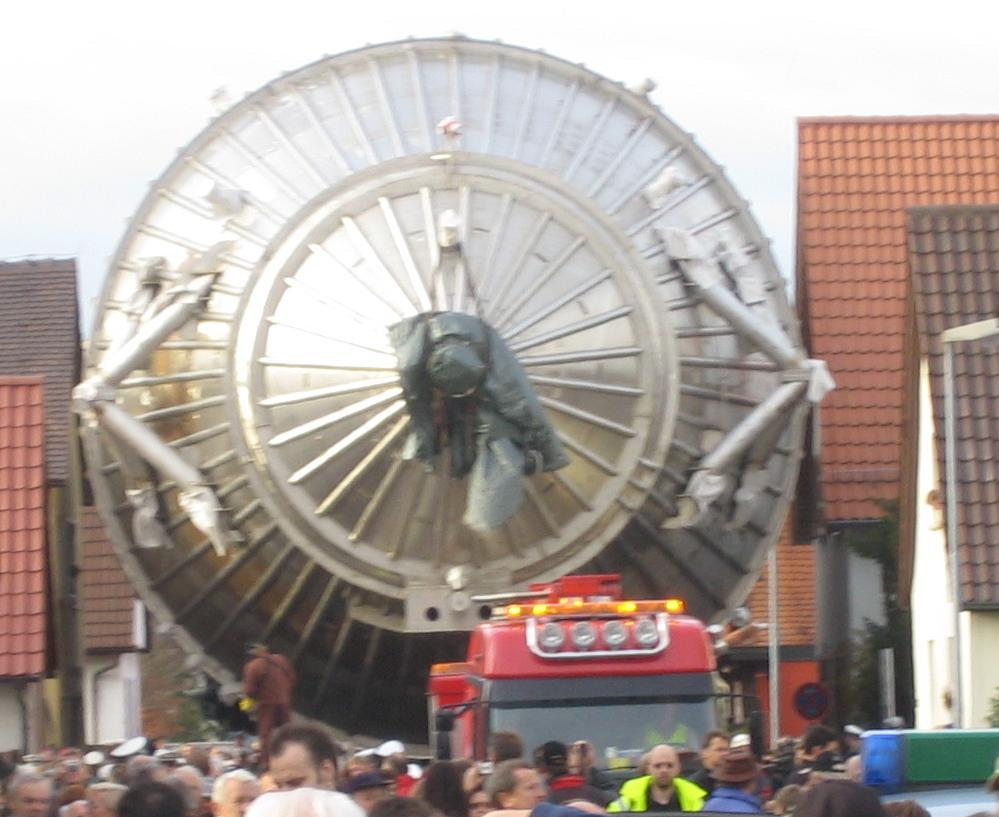
The spectrometer was built by MAN DWE GmbH in Deggendorf. Although only 350 km from Karlsruhe, the tank's size made land transport impossible.[8] Instead, it was shipped in autumn 2006 by water, down the Danube to the Black Sea, through the Mediterranean Sea and Atlantic Ocean to Rotterdam, then up the Rhine to Karlsruhe. This 8600 km long detour limited land travel to only the final 7 km from the Leopoldshafen docks to the laboratory.
The construction proceeded well with several of the major components on-site by 2010. The main spectrometer test program was scheduled for 2013 and the complete system integration for 2014.[9] The experiment is located at the former Forschungszentrum Karlsruhe, now Campus Nord of the Karlsruhe Institute of Technology.
Experiment
[edit]

The beta decay of tritium is one of the least energetic beta decays. The electron and the neutrino which are emitted share only 18.6 keV of energy between them. KATRIN is designed to produce a very accurate spectrum of the numbers of electrons emitted with energies very close to this total energy (only a few eV away), which correspond to very low energy neutrinos. If the neutrino is a massless particle, there is no lower bound to the energy the neutrino can carry, so the electron energy spectrum should extend all the way to the 18.6 keV limit. On the other hand, if the neutrino has mass, then it must always carry away at least the amount of energy equivalent to its mass by E = m c ², and the electron spectrum should drop off short of the total energy limit and have a different shape.
In most beta decay events, the electron and the neutrino carry away roughly equal amounts of energy. The events of interest to KATRIN, in which the electron takes almost all the energy and the neutrino almost none, are very rare, occurring roughly once in a trillion decays. In order to filter out the common events so the detector is not overwhelmed, the electrons must pass through an electric potential that stops all electrons below a certain threshold, which is set a few eV below the total energy limit. Only electrons that have enough energy to pass through the potential are counted.
Results
[edit]First results from the first measurement campaign (10 April – 13 May 2019) were published 13 September 2019. They put the upper bound of electron neutrino mass to 1.1 eV.[10][11]
As of September 2019, the experiment hopes to achieve 3 measuring campaigns, each comprising 65 days of active measurement, in a year. The experiment reckons it needs 1000 days of measurement to reach target sensitivity of 0.2 eV (upper limit for neutrino mass). Thus the final results are expected in 5–6 years.
The February 2022 upper limit is mν < 0.8 eV c–2 at 90% CL in combination with the previous campaign.[5][6]
Importance
[edit]The precise mass of the neutrino is important not only for particle physics, but also for cosmology. The observation of neutrino oscillation is strong evidence in favor of massive neutrinos, but gives only a weak lower bound.[12]
Along with the possible observation of neutrinoless double beta decay, KATRIN is one of the neutrino experiments most likely to yield significant results in the near future.
External links
[edit]
References
[edit]- ^ "Recognized Experiments at CERN". The CERN Scientific Committees. CERN. Archived from the original on 13 June 2019. Retrieved 20 January 2020.
- ^ "RE14/KATRIN : The Karlsruhe Tritium Neutrino experiment". The CERN Experimental Programme. CERN. Retrieved 20 January 2020.
- ^ Mertens, S.; et al. (KATRIN Collaboration) (2015). "Status of the KATRIN Experiment and Prospects to Search for keV-mass Sterile Neutrinos in Tritium β-decay". Physics Procedia. 62: 267–273. Bibcode:2015PhPro..61..267M. doi:10.1016/j.phpro.2014.12.043.
- ^ www-kam2.icrr.u-tokyo.ac.jp/indico/event/3/contribution/27/material/slides/0.pdf
- ^ a b c d The KATRIN Collaboration. "Direct neutrino-mass measurement with sub-electronvolt sensitivity", Nat. Phys. 18, 160–166 (2022). doi:10.1038/s41567-021-01463-1
- ^ a b Castelvecchi, Davide (14 February 2022). "How light is a neutrino? The answer is closer than ever". Nature. doi:10.1038/d41586-022-00430-x. PMID 35165410. S2CID 246827702.
- ^ KATRIN Collaboration; Aker, Max; Batzler, Dominic; Beglarian, Armen; Behrens, Jan; Beisenkötter, Justus; Biassoni, Matteo; Bieringer, Benedikt; Biondi, Yanina; Block, Fabian; Bobien, Steffen; Böttcher, Matthias; Bornschein, Beate; Bornschein, Lutz; Caldwell, Tom S. (11 April 2025). "Direct neutrino-mass measurement based on 259 days of KATRIN data". Science. 388 (6743): 180–185. arXiv:2406.13516. Bibcode:2025Sci...388..180K. doi:10.1126/science.adq9592. PMID 40208982.
- ^ KATRIN Main Spectrometer Accessed 14 November 2016
- ^ Thümmler, T.; et al. (KATRIN collaboration) (2010). "Introduction to direct neutrino mass measurements and KATRIN". Nuclear Physics B: Proceedings Supplements. 229–232: 146–151. arXiv:1012.2282. Bibcode:2012NuPhS.229..146T. doi:10.1016/j.nuclphysbps.2012.09.024. S2CID 118585897.
- ^ "Neutrinos, flu vaccines and Fukushima ruling". Nature. 573 (7775): 468–469. 2019. Bibcode:2019Natur.573..468.. doi:10.1038/d41586-019-02843-7. PMID 31554997.
- ^ Drexlin, Guido; et al. (9–13 September 2019). Direct neutrino mass measurement (PDF). 16th International Conference on Topics in Astroparticle Physics and Underground Physics (TAUP) (plenary talk slides). Toyama, JP. Archived from the original (PDF) on 25 December 2021. Retrieved 9 October 2021 – via U. Tokyo.
- ^ Angus, G. W.; Shan, H. Y.; Zhao, H. S.; Famaey, B. (2007). "On the Proof of Dark Matter, the Law of Gravity, and the Mass of Neutrinos". The Astrophysical Journal Letters. 654 (1): L13–L16. arXiv:astro-ph/0609125. Bibcode:2007ApJ...654L..13A. doi:10.1086/510738.