Hubbry Logo
search
logo

Elementary charge

logo
Community Hub0 Subscribers
Read side by side
from Wikipedia
Elementary charge
Common symbols
SI unitcoulomb
Dimension
Value1.602176634×10−19 C[1]

The elementary charge, usually denoted by e, is a fundamental physical constant, defined as the electric charge carried by a single proton (+1 e) or, equivalently, the magnitude of the negative electric charge carried by a single electron, which has charge −1 e.[2][a]

In SI units, the coulomb is defined such that the value of the elementary charge is exactly e = 1.602176634×10⁻¹⁹ C[1] or 160.2176634 zeptocoulombs (zC).[3] Since the 2019 revision of the SI, the seven SI base units are defined in terms of seven fundamental physical constants, of which the elementary charge is one.

In the centimetre–gram–second system of units (CGS), the corresponding quantity is 4.8032047...×10−10 statcoulombs.[b]

Robert A. Millikan and Harvey Fletcher's oil drop experiment first directly measured the magnitude of the elementary charge in 1909, differing from the modern accepted value by just 0.6%.[4][5] Under assumptions of the then-disputed atomic theory, the elementary charge had also been indirectly inferred to ~3% accuracy from blackbody spectra by Max Planck in 1901[6] and (through the Faraday constant) at order-of-magnitude accuracy by Johann Loschmidt's measurement of the Avogadro constant in 1865.

As a unit

[edit]
Elementary charge
Unit systemAtomic units
Unit ofelectric charge
Symbole
Conversions
e in ...... is equal to ...
   coulombs   1.602176634×10⁻¹⁹[1]
   
(natural units)
   0.30282212088
   statC   ≘ 4.80320425(10)×10−10

In some natural unit systems, such as the system of atomic units, e functions as the unit of electric charge. The use of elementary charge as a unit was promoted by George Johnstone Stoney in 1874 for the first system of natural units, called Stoney units.[7] Later, he proposed the name electron for this unit. At the time, the particle we now call the electron was not yet discovered and the difference between the particle electron and the unit of charge electron was still blurred. Later, the name electron was assigned to the particle and the unit of charge e lost its name. However, the unit of energy electronvolt (eV) is a remnant of the fact that the elementary charge was once called electron.

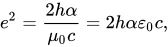
In other natural unit systems, the unit of charge is defined as with the result that where α is the fine-structure constant, c is the speed of light, ε0 is the electric constant, and ħ is the reduced Planck constant.


Quantization

[edit]

Charge quantization is the principle that the charge of any object is an integer multiple of the elementary charge. Thus, an object's charge can be exactly 0 e, or exactly 1 e, −1 e, 2 e, etc., but not 1/2 e, or −3.8 e, etc. (There may be exceptions to this statement, depending on how "object" is defined; see below.)

This is the reason for the terminology "elementary charge": it is meant to imply that it is an indivisible unit of charge.

Fractional elementary charge

[edit]

There are two known sorts of exceptions to the indivisibility of the elementary charge: quarks and quasiparticles.

  • Quarks, first posited in the 1960s, have quantized charge, but the charge is quantized into multiples of 1/3e. However, quarks cannot be isolated; they exist only in groupings, and stable groupings of quarks (such as a proton, which consists of three quarks) all have charges that are integer multiples of e. For this reason, either 1 e or 1/3 e can be justifiably considered to be "the quantum of charge", depending on the context. This charge commensurability, "charge quantization", has partially motivated grand unified theories.
  • Quasiparticles are not particles as such, but rather an emergent entity in a complex material system that behaves like a particle. In 1982 Robert Laughlin explained the fractional quantum Hall effect by postulating the existence of fractionally charged quasiparticles. This theory is now widely accepted, but this is not considered to be a violation of the principle of charge quantization, since quasiparticles are not elementary particles.

Quantum of charge

[edit]

All known elementary particles, including quarks, have charges that are integer multiples of 1/3 e. Therefore, the "quantum of charge" is 1/3 e. In this case, one says that the "elementary charge" is three times as large as the "quantum of charge".

On the other hand, all isolatable particles have charges that are integer multiples of e. (Quarks cannot be isolated: they exist only in collective states like protons that have total charges that are integer multiples of e.) Therefore, the "quantum of charge" is e, with the proviso that quarks are not to be included. In this case, "elementary charge" would be synonymous with the "quantum of charge".

In fact, both terminologies are used.[8] For this reason, phrases like "the quantum of charge" or "the indivisible unit of charge" can be ambiguous unless further specification is given. On the other hand, the term "elementary charge" is unambiguous: it refers to a quantity of charge equal to that of a proton.

Lack of fractional charges

[edit]

Paul Dirac argued in 1931 that if magnetic monopoles exist, then electric charge must be quantized; however, it is unknown whether magnetic monopoles actually exist.[9][10] It is currently unknown why isolatable particles are restricted to integer charges; much of the string theory landscape appears to admit fractional charges.[11][12]

Experimental measurements of the elementary charge

[edit]

The elementary charge is exactly defined since 20 May 2019 by the International System of Units. Prior to this change, the elementary charge was a measured quantity whose magnitude was determined experimentally. This section summarizes these historical experimental measurements.

In terms of the Avogadro constant and Faraday constant

[edit]

If the Avogadro constant NA and the Faraday constant F are independently known, the value of the elementary charge can be deduced using the formula (In other words, the charge of one mole of electrons, divided by the number of electrons in a mole, equals the charge of a single electron.)

This method is not how the most accurate values are measured today. Nevertheless, it is a legitimate and still quite accurate method, and experimental methodologies are described below.

The value of the Avogadro constant NA was first approximated by Johann Josef Loschmidt who, in 1865, estimated the average diameter of the molecules in air by a method that is equivalent to calculating the number of particles in a given volume of gas.[13] Today the value of NA can be measured at very high accuracy by taking an extremely pure crystal (often silicon), measuring how far apart the atoms are spaced using X-ray diffraction or another method, and accurately measuring the density of the crystal. From this information, one can deduce the mass (m) of a single atom; and since the molar mass (M) is known, the number of atoms in a mole can be calculated: NA = M/m.

The value of F can be measured directly using Faraday's laws of electrolysis. Faraday's laws of electrolysis are quantitative relationships based on the electrochemical researches published by Michael Faraday in 1834.[14] In an electrolysis experiment, there is a one-to-one correspondence between the electrons passing through the anode-to-cathode wire and the ions that plate onto or off of the anode or cathode. Measuring the mass change of the anode or cathode, and the total charge passing through the wire (which can be measured as the time-integral of electric current), and also taking into account the molar mass of the ions, one can deduce F.[1]

The limit to the precision of the method is the measurement of F: the best experimental value has a relative uncertainty of 1.6 ppm, about thirty times higher than other modern methods of measuring or calculating the elementary charge.[15]

Oil-drop experiment

[edit]

A famous method for measuring e is Millikan's oil-drop experiment. A small drop of oil in an electric field would move at a rate that balanced the forces of gravity, viscosity (of traveling through the air), and electric force. The forces due to gravity and viscosity could be calculated based on the size and velocity of the oil drop, so electric force could be deduced. Since electric force, in turn, is the product of the electric charge and the known electric field, the electric charge of the oil drop could be accurately computed. By measuring the charges of many different oil drops, it can be seen that the charges are all integer multiples of a single small charge, namely e.

The necessity of measuring the size of the oil droplets can be eliminated by using tiny plastic spheres of a uniform size. The force due to viscosity can be eliminated by adjusting the strength of the electric field so that the sphere hovers motionless.

Shot noise

[edit]

Any electric current will be associated with noise from a variety of sources, one of which is shot noise. Shot noise exists because a current is not a smooth continual flow; instead, a current is made up of discrete electrons that pass by one at a time. By carefully analyzing the noise of a current, the charge of an electron can be calculated. This method, first proposed by Walter H. Schottky, can determine a value of e of which the accuracy is limited to a few percent.[16] However, it was used in the first direct observation of Laughlin quasiparticles, implicated in the fractional quantum Hall effect.[17]

From the Josephson and von Klitzing constants

[edit]

Another accurate method for measuring the elementary charge is by inferring it from measurements of two effects in quantum mechanics: The Josephson effect, voltage oscillations that arise in certain superconducting structures; and the quantum Hall effect, a quantum effect of electrons at low temperatures, strong magnetic fields, and confinement into two dimensions. The Josephson constant is where h is the Planck constant. It can be measured directly using the Josephson effect.

The von Klitzing constant is It can be measured directly using the quantum Hall effect.

From these two constants, the elementary charge can be deduced:

CODATA method

[edit]

The relation used by CODATA to determine elementary charge was: where h is the Planck constant, α is the fine-structure constant, μ0 is the magnetic constant, ε0 is the electric constant, and c is the speed of light. Presently this equation reflects a relation between ε0 and α, while all others are fixed values. Thus the relative standard uncertainties of both will be same.
Tests of the universality of elementary charge

[edit]
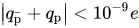
Particle Expected charge Experimental constraint Notes
electron exact by definition
proton by finding no measurable sound when an alternating electric field is applied to SF6 gas in a spherical resonator[18]
positron by combining the best measured value of the antiproton charge (below) with the low limit placed on antihydrogen's net charge by the ALPHA Collaboration at CERN.[19]
antiproton Hori et al.[20] as cited in antiproton/proton charge difference listing of the Particle Data Group[21] The Particle Data Group article has a link to the current online version of the particle data.

See also

[edit]

Notes

[edit]

References

[edit]

Further reading

[edit]
Revisions and contributorsEdit on WikipediaRead on Wikipedia
from Grokipedia
The elementary charge, denoted by the symbol e, is a fundamental physical constant in physics that represents the magnitude of the electric charge carried by a proton or an electron, serving as the basic unit of electric charge in nature.[1] Its exact value, fixed by international convention, is 1.602176634 × 10^{-19} coulombs (C).[2] Since the 2019 revision of the International System of Units (SI), the elementary charge has been one of the seven defining constants of the SI, with the ampere—the SI base unit of electric current—defined by fixing e at this precise value, such that the flow of one ampere corresponds to exactly 1 / (1.602176634 × 10^{-19}) elementary charges per second.[3] This redefinition eliminated previous uncertainties in measurements of e, enhancing the precision of electrical standards worldwide.[4] The elementary charge is central to understanding charge quantization, the principle that all observable electric charges in the universe are integer multiples of e, a property first experimentally confirmed in the early 20th century through studies of oil droplets and electron behavior.[5] In atomic and particle physics, e appears in key equations, such as those governing electromagnetic interactions and the fine-structure constant α = e² / (4πε₀ℏc) ≈ 1/137, which characterizes the strength of the electromagnetic force between charged particles.[1] This constant underpins phenomena from the stability of atoms to the behavior of quarks and leptons in the Standard Model of particle physics.

Fundamental Properties

Definition and Magnitude

The elementary charge, denoted $ e $, is defined as the magnitude of the electric charge carried by a single proton or electron.[6] It constitutes the smallest unit of electric charge observed in everyday matter composed of atoms and molecules.[1] Since the 2019 redefinition of the International System of Units (SI), the elementary charge has a fixed exact value of $ e = 1.602176634 \times 10^{-19} $ coulombs (C).[3] This value is one of the seven defining constants of the SI and directly determines the ampere, the unit of electric current, as the flow of exactly $ 1 / e $ elementary charges per second.[7] In classical electromagnetism, $ e $ quantifies the basic interaction strength between charged particles via Coulomb's law, while in quantum mechanics, it appears in fundamental relations such as the fine-structure constant $ \alpha = e^2 / (4\pi \epsilon_0 \hbar c) $, governing electromagnetic phenomena at atomic scales.[8] As the quantum of charge, $ e $ implies that observable electric charges in ordinary matter are integer multiples of this value.[9] The recognition of $ e $ as a fundamental physical constant emerged in the early 20th century, marking a pivotal shift in understanding electric charge as discrete rather than continuous.[10]

Sign and Universality

The elementary charge $ e $ is defined as a positive quantity by international convention, representing the fundamental unit of electric charge in nature. The electron carries a charge of $ -e $, while the proton carries $ +e $, ensuring a consistent framework for describing the electromagnetic properties of subatomic particles. This sign convention reflects the arbitrary but universally adopted choice originating from early electrostatic experiments, where the charge responsible for attraction to glass (positive) was assigned the positive sign. All observed electrons and protons in stable matter exhibit charges of exactly $ -e $ and $ +e $, respectively, with no deviations detected within the limits of experimental precision. The magnitude $ e $ is the same for every electron and every proton, verified to a relative precision better than $ 10^{-21} $, as confirmed by tests of the neutrality of matter.[11] The universality of the elementary charge has profound implications for fundamental physical laws. It guarantees the conservation of electric charge in all known interactions, as processes involving particle creation or annihilation must preserve the total charge in integer multiples of $ e $. Furthermore, this uniformity enables the electrical neutrality of atoms, where the positive charge from an equal number of protons in the nucleus is precisely balanced by the negative charge from the surrounding electrons, stabilizing matter at the atomic scale. No violations of this charge universality have been observed in stable matter, reinforcing the foundational role of $ e $ in the standard model of particle physics.[1]

Quantization of Charge

Integer Quantization

In the early 1910s, Robert A. Millikan concluded from his systematic measurements of charges on small oil droplets that the electric charge $ q $ on any isolated particle is given by $ q = n e $, where $ n $ is an integer and $ e $ is the elementary charge. These measurements consistently revealed discrete values that were simple integer multiples of a fundamental unit of charge. Millikan's work established that there are no observable charges that are not whole-number multiples of this basic quantum, marking a key insight into the discrete nature of electricity.[12] The theoretical basis for this integer quantization stems from the particle-like nature of matter in quantum mechanics, where electrons carry a charge of $ -e $ and protons carry $ +e $. Any net charge arises from an imbalance in the number of these indivisible charged constituents, ensuring that the total charge on atoms, ions, or larger assemblies is always an integer multiple of $ e $. This discreteness reflects the atomic and subatomic structure of matter, prohibiting fractional charges in ordinary particles composed of electrons and protons.[13] This principle manifests in various physical contexts, such as ionized gases where ions acquire charges like $ +e $ (singly ionized) or $ +2e $ (doubly ionized) through electron loss. In aqueous solutions, electrolyte ions similarly exhibit charges that are integer multiples of $ e ,asseenincommonspecieslikeNa, as seen in common species like Na^+$ ($ +e )orCl) or Cl^-$ ($ -e $), underscoring the universality of quantization in chemical and plasma environments.[14] The quantization condition is formally stated as
q=ne,nZ q = n e, \quad n \in \mathbb{Z}
where $ n $ can be positive, negative, or zero, corresponding to net positive, negative, or neutral charge, respectively.[13]

Fractional Charges

In the Standard Model of particle physics, quarks are fundamental constituents that carry fractional electric charges relative to the elementary charge ee: up-type quarks (such as up and charm) have a charge of +2/3e+2/3\,e, while down-type quarks (such as down and strange) have 1/3e-1/3\,e, with antiquarks bearing the opposite signs. These fractional charges ensure that combinations of quarks form hadrons, like protons (charge +e+e) and neutrons (charge 00), with integer multiples of ee, adhering to the observed quantization of charge for composite particles. However, quantum chromodynamics (QCD) predicts that quarks are subject to color confinement, a phenomenon where the strong force prevents quarks from existing in isolation, binding them permanently within hadrons. Extensive experimental searches for free quarks—conducted in cosmic rays, particle accelerators, and fixed-target experiments—have yielded no evidence of such particles, with limits on their production cross-sections exceeding several orders of magnitude below expectations for unconfined quarks.[15] This null result reinforces the confinement hypothesis and explains the absence of free fractional charges in everyday matter.[16] Beyond particle physics, fractional charges appear in exotic condensed-matter systems, particularly in two-dimensional electron gases under strong magnetic fields, as in the fractional quantum Hall effect (FQHE). Here, quasiparticles called anyons emerge with effective charges that are fractions of ee, such as e/3e/3 in the ν=1/3\nu=1/3 FQHE state, arising from the collective behavior of electrons rather than true elementary particles.[17] These anyons also exhibit fractional statistics, interpolating between bosons and fermions, and have been observed through interferometry and noise measurements, providing a realization of fractional charge in accessible laboratory settings without violating the integer quantization for isolated elementary charges.[18]

Experimental Confirmation

Early experimental confirmations of charge quantization emerged from ionization studies in the late 19th and early 20th centuries, where discrete steps in charge accumulation were observed during gas ionization processes under electric fields.[19] These experiments demonstrated that charges on ionized particles increased in finite increments rather than continuously, providing initial empirical evidence for the discrete nature of electric charge.[20] Modern reanalyses of historical data have further solidified this evidence. For instance, a detailed reexamination of Robert Millikan's original oil-drop measurements from 1909-1913 by physicist Allan Franklin confirmed that the charges on the drops were consistently integer multiples of a fundamental unit, supporting quantization without altering the core findings despite debates over data selection.[21] Similarly, statistical analyses using contemporary computational tools on Millikan's datasets reveal clear clustering of charge values around integer multiples of the elementary charge, reinforcing the quantized structure.[22] The quantum Hall effect provides an indirect yet precise confirmation of charge quantization in two-dimensional electron systems. Discovered in 1980, this phenomenon exhibits quantized Hall resistance values that depend directly on the elementary charge $ e $ and Planck's constant $ h $, with plateaus at $ R_H = \frac{h}{i e^2} $ (where $ i $ is an integer), unambiguously tying the observed quantization to discrete electron charges.[23] This effect has been replicated across numerous low-temperature experiments, serving as a cornerstone for verifying the universality of $ e $.[24] In high-energy physics, extensive searches in particle accelerators have yielded no evidence of free particles carrying charges that are not integer multiples of $ e $. Decades of experiments at facilities like CERN and SLAC, probing collision products and cosmic ray interactions, consistently show that all observed free charges adhere to integer quantization, with stringent limits set on hypothetical fractionally charged particles.[25] Although theoretical models predict fractional charges for confined quarks (such as $ \pm \frac{1}{3}e $ or $ \pm \frac{2}{3}e $), no free instances have been detected.[26]

Historical Determination

Electrolysis and Faraday Constant

In the 1830s, Michael Faraday established the quantitative laws of electrolysis through a series of experiments involving the decomposition of electrolytes using electric current. His first law states that the mass of a substance deposited or liberated at an electrode is directly proportional to the total electric charge passed through the electrolyte. The second law asserts that when the same quantity of charge is passed through different electrolytes, the masses of the substances deposited or liberated are proportional to their chemical equivalent weights.[27] These laws underpin the definition of the Faraday constant, denoted F, which represents the electric charge required to deposit or liberate one mole of a univalent substance during electrolysis, expressed as Q = n F, where Q is the total charge and n is the number of moles of electrons transferred. The constant F thus quantifies the charge associated with a macroscopic amount of matter, linking electrochemical reactions to the flow of electricity. Historical determinations of F relied on precise measurements from electrolysis experiments, particularly those involving silver or copper deposition, which provided reliable and reproducible results due to the metals' high purity and electrochemical stability. In such experiments, a known quantity of charge Q was passed through a solution of silver nitrate or copper sulfate, and the mass m of the deposited metal was measured using a balance; F was then calculated from the relation m = (Q M) / (n F), where M is the molar mass and n the number of electrons per ion (n=1 for Ag⁺ and Cu²⁺). Early 19th-century measurements, refined over decades with improved instrumentation, yielded values of F around 96,000 C/mol.[28] The elementary charge e, the fundamental unit of electric charge, is related to the Faraday constant by e = F / N_A, where N_A is Avogadro's constant, representing the number of particles in one mole. This relation allows indirect determination of e from macroscopic electrochemical data, assuming knowledge of N_A from independent measurements like gas laws or crystal densities. The concept of a fundamental unit of charge was first proposed by George Johnstone Stoney in 1874, who estimated its value using Faraday's laws and contemporary estimates of Avogadro's number, yielding approximately 10^{-20} C. More precise calculations in the early 20th century, using improved values of F and N_A, gave results closer to the modern value of 1.602 × 10^{-19} C, demonstrating the discrete nature of charge underlying continuous electrolytic processes.[29]

Millikan Oil-Drop Experiment

The Millikan oil-drop experiment, conducted between 1909 and 1913, provided the first direct measurement of the elementary electric charge by observing the behavior of charged oil droplets suspended in an electric field.[30] Tiny oil droplets were produced using a perfume atomizer and introduced into a horizontal chamber between two parallel metal plates, where they became charged by exposure to ionizing X-rays.[30] The motion of individual droplets was viewed through a low-power microscope, allowing precise tracking of their fall under gravity and rise when an electric field was applied between the plates.[31] The core principle relied on balancing the gravitational force on a droplet against the electrostatic force in the electric field. With the field off, the droplet reached a terminal falling velocity due to air viscosity, from which its radius and mass could be calculated. When the field was turned on and adjusted to suspend the droplet stationary, the forces balanced such that the droplet weight equaled the electric force: mg=qEmg = qE, where mm is the mass, gg is gravitational acceleration, qq is the charge, and EE is the electric field strength.[30] Solving for qq gave q=mgEq = \frac{mg}{E}. By repeating measurements on numerous droplets and observing that their charges were discrete multiples of a fundamental unit—q=neq = ne, where nn is an integer—this unit ee was identified as the elementary charge, confirming the quantization of electric charge.[31] In his 1913 publication, Millikan analyzed data from 58 droplets, reporting a value of e1.592×1019e \approx 1.592 \times 10^{-19} C with an uncertainty of about 0.2%.[30] This result was slightly lower than the modern accepted value of 1.602 × 10^{-19} C due to an underestimate of air viscosity used in the mass calculations, but it established the scale and discreteness of the charge.[30] The experiment faced controversy over data selection, as Millikan's laboratory notebooks revealed measurements on more droplets than reported, with some discarded for not fitting expected patterns; he later admitted exercising "discrimination" in choosing reliable data, though including all would not have significantly altered the value of ee.[32] Despite this, the work irrefutably demonstrated charge quantization and earned Millikan the 1923 Nobel Prize in Physics.[31]

Modern Measurements

Shot Noise Method

The shot noise method measures the elementary charge ee by analyzing statistical fluctuations in electric current arising from the discrete nature of charge carriers. These fluctuations, known as shot noise, follow Poisson statistics for independent electron arrivals, leading to a mean-square current fluctuation given by
ΔI2=2eIΔf, \langle \Delta I^2 \rangle = 2 e I \Delta f,
where II is the average current and Δf\Delta f is the measurement bandwidth. This relation allows ee to be determined directly from the measured noise power spectrum, which is linear in II. Walter Schottky first described shot noise in 1918 while investigating current variations in vacuum tubes, proposing it as a means to quantify ee more accurately than contemporary methods. Early experiments applied the principle to vacuum diodes, where noise was detected using tuned circuits coupled to the tube's electron stream. For instance, in 1925, measurements on a vacuum tube yielded e1.59×1019e \approx 1.59 \times 10^{-19} C, with precision around 5%, limited by amplifier noise and bandwidth control. Subsequent refinements in the mid-20th century adapted the technique to semiconductors, enabling operation at lower currents and reducing thermal noise interference through improved amplifiers and filtering. By the 1960s, these advancements achieved relative precision of 0.1%, producing values of e1.602×1019e \approx 1.602 \times 10^{-19} C that aligned closely with other determinations. The method's key advantages include its non-mechanical nature, avoiding issues like gravity or fluid dynamics in particle-based techniques, and its suitability for low-current regimes where individual charge discreteness is prominent. This statistical approach also indirectly confirms charge quantization, as the noise's proportionality to ee reflects the indivisible unit of electron transport.

Josephson and Quantum Hall Effects

The Josephson effect in superconducting junctions establishes a fundamental quantum relation between voltage and frequency, expressed as V=nhf2eV = n \frac{h f}{2 e}, where VV is the voltage across the junction, nn is an integer denoting the step number, ff is the applied microwave frequency, hh is Planck's constant, and ee is the elementary charge.[33] This AC Josephson relation arises from the phase coherence of the superconducting wavefunctions, enabling the generation of precise, quantized voltage steps when the junction is irradiated with microwaves.[33] By measuring these voltage steps against highly accurate frequency standards traceable to cesium clocks, the ratio 2e/h2e/h, known as the Josephson constant KJK_J, can be determined with relative uncertainties below 10910^{-9}.[34] The quantum Hall effect, observed in two-dimensional electron gases under perpendicular magnetic fields and cryogenic temperatures, produces quantized Hall resistance values at plateaus given by RH=hie2R_H = \frac{h}{i e^2}, where ii is the integer filling factor.[35] This quantization stems from the formation of Landau levels and the topological invariance of the Hall conductance, σH=ie2h\sigma_H = i \frac{e^2}{h}, making it robust against material imperfections.[35] The inverse, the von Klitzing constant RK=h/e2R_K = h/e^2, serves as a universal resistance standard, measured via Hall voltage and current in devices like GaAs heterostructures.[36] In the 1980s and 1990s, metrology laboratories worldwide, including NIST and PTB, conducted experiments combining Josephson voltage standards with quantum Hall resistance standards to measure the e/he/h ratio through comparisons of electrical power or direct linkage of units.[37] These efforts achieved precisions of parts in 10810^8 to 10910^9, as seen in series of measurements refining KJK_J and RKR_K values, which directly yielded e/he/h from their theoretical ratios.[38] The 1990 CIPM recommendation formalized these effects for maintaining SI voltage and resistance units, enhancing global consistency.[37] These quantum phenomena were pivotal in the 2019 SI redefinition, where ee was fixed exactly at 1.602176634×10191.602176634 \times 10^{-19} C, rendering KJK_J and RKR_K exact by definition and deriving hh from them.[39] This shift eliminated uncertainties in electrical metrology tied to experimental realizations of ee.[39]

CODATA Adjustment

The CODATA adjustment process employs a least-squares method to derive self-consistent recommended values for fundamental physical constants, including the elementary charge $ e $, by minimizing discrepancies among diverse experimental inputs while accounting for their uncertainties. This global analysis ensures that the resulting values are mutually consistent across interconnected measurements in physics and chemistry. The Committee on Data for Science and Technology (CODATA), through its Task Group on Fundamental Physical Constants, conducts these adjustments approximately every four years, incorporating all relevant data published up to a strict cutoff date. For the 2022 adjustment, the cutoff was midnight, December 31, 2022, allowing inclusion of measurements that refine the network of constants. Input data for $ e $ encompass results from classical methods like oil-drop and cyclotron-frequency ratios, as well as modern techniques involving shot noise and quantum effects, each weighted by their reported uncertainties to balance precision and reliability.[40] Following the 2019 redefinition of the SI, where $ e $ was established as an exact defining constant at $ 1.602176634 \times 10^{-19} $ C, CODATA adjustments no longer vary its value but instead use it to determine or refine other constants, such as the Planck constant and fine-structure constant. The 2022 adjustment, involving 133 input data points and 79 adjusted constants, confirmed the exactness of $ e $ through rigorous consistency checks, revealing no significant discrepancies among the inputs at the level of their uncertainties.

Role in Physical Constants

As an SI Defining Constant

In the 2019 revision of the International System of Units (SI), the elementary charge $ e $ was established as one of the seven defining constants, with its numerical value fixed exactly at $ 1.602176634 \times 10^{-19} $ coulombs (C).[7] This redefinition, effective from 20 May 2019, anchors the SI to fundamental physical constants rather than physical artifacts or reproducible experiments.[41] The ampere, the SI base unit of electric current, is now defined by fixing the value of $ e $, such that a current of one ampere consists of the flow of exactly $ 1 / e $ elementary charges per second.[42] In practical terms, one ampere corresponds to a flow of $ 1 / (1.602176634 \times 10^{-19}) $ elementary charges per second.[7] This definition replaces the previous ampere standard, which was based on the force between two infinitely long parallel current-carrying conductors.[41] Historically, the SI base units like the kilogram and ampere relied on carefully maintained physical prototypes, introducing potential drifts and measurement uncertainties over time. The 2019 shift to constant-based definitions, including the fixation of $ e $, ensures universal and invariant standards accessible through fundamental physics.[43] As a result, the coulomb—the SI unit of electric charge—is now a derived unit, expressed in terms of $ e $ and the second (itself defined via the speed of light and the caesium hyperfine transition frequency).[42] By fixing $ e $ exactly, the redefinition eliminates uncertainty in charge-related units that previously arose from experimental determinations of the constant, with the adopted value confirmed by the 2018 CODATA adjustment.[7]

Implications for Other Constants

The fixing of the elementary charge $ e $ to the exact value of $ 1.602176634 \times 10^{-19} $ C in the 2019 revision of the SI has profound effects on related physical constants. The Faraday constant $ F $, defined as $ F = N_A e $ where $ N_A $ is the Avogadro constant, is now exactly $ 96485.3321233100184 $ C/mol, as both $ e $ and the fixed $ N_A = 6.02214076 \times 10^{23} $ mol$^{-1} $ contribute no uncertainty. This exactness contrasts with pre-2019 evaluations, where $ F $'s uncertainty stemmed from interdependent measurements of $ e $ and $ N_A $ in CODATA adjustments.[44] The revised SI decouples the determination of $ N_A $ from $ e $, allowing $ N_A $'s fixed value to derive primarily from mass-based experiments like the silicon sphere method, which measures particle number density without invoking electrical charge quantities. This independence enhances consistency across metrology fields, as variations in electrical measurements no longer propagate to chemical constants like $ N_A $.[45] For the fine-structure constant $ \alpha = \frac{e^2}{4 \pi \epsilon_0 \hbar c} $, the exact $ e $, Planck's constant $ h $ (yielding exact $ \hbar = h / 2\pi $), speed of light $ c $, and vacuum permittivity $ \epsilon_0 $ (derived exactly from fixed permeability $ \mu_0 $ and $ c $) shift all uncertainty to direct experimental determinations of $ \alpha $. This structural change has enabled higher precision in $ \alpha $'s evaluation; post-2019 measurements, such as those from cesium atom recoil spectroscopy, achieve a relative uncertainty of approximately $ 10^{-10} $.[8]

References

User Avatar
No comments yet.