Hubbry Logo
Landau levelsLandau levelsMain
Open search
Landau levels
Community hub
Landau levels
logo
7 pages, 0 posts
0 subscribers
Be the first to start a discussion here.
Landau levels
Landau levels
from Wikipedia

In quantum mechanics, the energies of cyclotron orbits of charged particles in a uniform magnetic field are quantized to discrete values, thus known as Landau levels. These levels are degenerate, with the number of electrons per level directly proportional to the strength of the applied magnetic field. It is named after the Soviet physicist Lev Landau.[1]

Landau quantization contributes towards magnetic susceptibility of metals, known as Landau diamagnetism. Under strong magnetic fields, Landau quantization leads to oscillations in electronic properties of materials as a function of the applied magnetic field known as the De Haas–Van Alphen and Shubnikov–de Haas effects.

Landau quantization is a key ingredient in explanation of the integer quantum Hall effect.

Derivation

[edit]
Diagram of a cyclotron orbit of a particle with speed v, which is the classical trajectory of a charged particle (here positive charge) under a uniform magnetic field B. The Landau quantization refers to a quantum charged particle under a uniform magnetic field.

Consider a system of non-interacting particles with charge q and spin S confined to an area A = LxLy in the x-y plane. Apply a uniform magnetic field along the z-axis. In SI units, the Hamiltonian of this system (here, the effects of spin are neglected) is Here, is the canonical momentum operator and is the operator for the electromagnetic vector potential (in position space ).

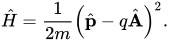
The vector potential is related to the magnetic field by

There is some gauge freedom in the choice of vector potential for a given magnetic field. The Hamiltonian is gauge invariant, which means that adding the gradient of a scalar field to A changes the overall phase of the wave function by an amount corresponding to the scalar field. But physical properties are not influenced by the specific choice of gauge.

In the Landau gauge

[edit]

From the possible solutions for A, a gauge fixing introduced by Lev Landau is often used for charged particles in a constant magnetic field.[2]

When then is a possible solution[3] in the Landau gauge (not to be mixed up with the Landau gauge).
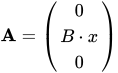
In this gauge, the Hamiltonian is The operator commutes with this Hamiltonian, since the operator is absent for this choice of gauge. Thus the operator can be replaced by its eigenvalue . Since does not appear in the Hamiltonian and only the z-momentum appears in the kinetic energy, this motion along the z-direction is a free motion.

The Hamiltonian can also be written more simply by noting that the cyclotron frequency is , giving This is exactly the Hamiltonian for the quantum harmonic oscillator, except with the minimum of the potential shifted in coordinate space by .

To find the energies, note that translating the harmonic oscillator potential does not affect the energies. The energies of this system are thus identical to those of the standard quantum harmonic oscillator,[4] The energy does not depend on the quantum number , so there will be a finite number of degeneracies (If the particle is placed in an unconfined space, this degeneracy will correspond to a continuous sequence of ). The value of is continuous if the particle is unconfined in the z-direction and discrete if the particle is bounded in the z-direction also. Each set of wave functions with the same value of is called a Landau level.

For the wave functions, recall that commutes with the Hamiltonian. Then the wave function factors into a product of momentum eigenstates in the direction and harmonic oscillator eigenstates shifted by an amount in the direction: where and is the n-th state for the quantum harmonic oscilator. In sum, the state of the electron is characterized by the quantum numbers, , and .

In the symmetric gauge

[edit]

The derivation treated x and y as asymmetric. However, by the symmetry of the system, there is no physical quantity which distinguishes these coordinates. The same result could have been obtained with an appropriate interchange of x and y.

A more adequate choice of gauge, is the symmetric gauge, which refers to the choice

In terms of dimensionless lengths and energies, the Hamiltonian can be expressed as

The correct units can be restored by introducing factors of and .

Consider operators

These operators follow certain commutation relations

In terms of above operators the Hamiltonian can be written as where we reintroduced the units back.

The Landau level index is the eigenvalue of the operator .

The application of increases by one unit while preserving , whereas application simultaneously increase and decreases by one unit. The analogy to quantum harmonic oscillator provides solutions where and

One may verify that the above states correspond to choosing wavefunctions proportional to where .

In particular, the lowest Landau level consists of arbitrary analytic functions multiplying a Gaussian, .

Degeneracy of the Landau levels

[edit]

In the Landau gauge

[edit]

The effects of Landau levels may only be observed when the mean thermal energy kT is smaller than the energy level separation, , meaning low temperatures and strong magnetic fields.

Each Landau level is degenerate because of the second quantum number , which can take the values where is an integer. The allowed values of are further restricted by the condition that the center of force of the oscillator, , must physically lie within the system, . This gives the following range for ,

For particles with charge , the upper bound on can be simply written as a ratio of fluxes, where is the fundamental magnetic flux quantum and is the flux through the system (with area ).

Thus, for particles with spin , the maximum number of particles per Landau level is which for electrons (where and ) gives , two available states for each flux quantum that penetrates the system.

The above gives only a rough idea of the effects of finite-size geometry. Strictly speaking, using the standard solution of the harmonic oscillator is only valid for systems unbounded in the -direction (infinite strips). If the size is finite, boundary conditions in that direction give rise to non-standard quantization conditions on the magnetic field, involving (in principle) both solutions to the Hermite equation. The filling of these levels with many electrons is still[5] an active area of research.

In general, Landau levels are observed in electronic systems. As the magnetic field is increased, more and more electrons can fit into a given Landau level. The occupation of the highest Landau level ranges from completely full to entirely empty, leading to oscillations in various electronic properties (see De Haas–Van Alphen effect and Shubnikov–de Haas effect).

If Zeeman splitting is included, each Landau level splits into a pair, one for spin up electrons and the other for spin down electrons. Then the occupation of each spin Landau level is just the ratio of fluxes . Zeeman splitting has a significant effect on the Landau levels because their energy scales are the same, . However, the Fermi energy and ground state energy stay roughly the same in a system with many filled levels, since pairs of split energy levels cancel each other out when summed.

Moreover, the above derivation in the Landau gauge assumed an electron confined in the -direction, which is a relevant experimental situation — found in two-dimensional electron gases, for instance. Still, this assumption is not essential for the results. If electrons are free to move along the -direction, the wave function acquires an additional multiplicative term ; the energy corresponding to this free motion, , is added to the discussed. This term then fills in the separation in energy of the different Landau levels, blurring the effect of the quantization. Nevertheless, the motion in the --plane, perpendicular to the magnetic field, is still quantized.

In the symmetric gauge

[edit]

Each Landau level has degenerate orbitals labeled by the quantum numbers in symmetric gauge. The degeneracy per unit area is the same in each Landau level.

The z component of angular momentum is

Exploiting the property we chose eigenfunctions which diagonalize and , The eigenvalue of is denoted by , where it is clear that in the th Landau level. However, it may be arbitrarily large, which is necessary to obtain the infinite degeneracy (or finite degeneracy per unit area) exhibited by the system.

Relativistic case

[edit]
Landau levels in graphene. Charge carriers in graphene behave as relativistic massless Dirac particles.

An electron following Dirac equation under a constant magnetic field, can be analytically solved.[6][7] The energies are given by

where c is the speed of light, the sign depends on the particle-antiparticle component and ν is a non-negative integer. Due to spin, all levels are degenerate except for the ground state at ν = 0.

The massless 2D case can be simulated in single-layer materials like graphene near the Dirac cones, where the eigenergies are given by[8] where the speed of light has to be replaced with the Fermi speed vF of the material and the minus sign corresponds to electron holes.

Magnetic susceptibility of a Fermi gas

[edit]

The Fermi gas (an ensemble of non-interacting fermions) is part of the basis for understanding of the thermodynamic properties of metals. In 1930 Landau derived an estimate for the magnetic susceptibility of a Fermi gas, known as Landau susceptibility, which is constant for small magnetic fields. Landau also noticed that the susceptibility oscillates with high frequency for large magnetic fields,[9] this physical phenomenon is known as the De Haas–Van Alphen effect.

Two-dimensional lattice

[edit]

The tight binding energy spectrum of charged particles in a two dimensional infinite lattice is known to be self-similar and fractal, as demonstrated in Hofstadter's butterfly. For an integer ratio of the magnetic flux quantum and the magnetic flux through a lattice cell, one recovers the Landau levels for large integers.[10]

Integer quantum Hall effect

[edit]

The energy spectrum of the semiconductor in a strong magnetic field forms Landau levels that can be labeled by integer indices. In addition, the Hall resistivity also exhibits discrete levels labeled by an integer ν. The fact that these two quantities are related can be shown in different ways, but most easily can be seen from Drude model: the Hall conductivity depends on the electron density n as

Since the resistivity plateau is given by

the required density is

which is exactly the density required to fill the Landau level. The gap between different Landau levels along with large degeneracy of each level renders the resistivity quantized.

See also

[edit]

References

[edit]
[edit]

Further reading

[edit]
Revisions and contributorsEdit on WikipediaRead on Wikipedia
from Grokipedia
Landau levels are the quantized energy eigenstates of a , such as an , subjected to a uniform perpendicular to its plane of motion, resulting from the quantization of orbits. These levels were first theoretically derived in 1930 by Soviet physicist Lev Davidovich Landau in his analysis of the arising from free electrons in metals. The energy spectrum of Landau levels is given by
En=ωc(n+12),E_n = \hbar \omega_c \left( n + \frac{1}{2} \right),
where n=0,1,2,n = 0, 1, 2, \dots labels the levels, ωc=qBm\omega_c = \frac{|q| B}{m} is the cyclotron frequency, qq is the particle charge, BB is the magnetic field strength, mm is the particle mass, \hbar is the reduced Planck's constant, and the zero-point energy shift accounts for the harmonic oscillator nature of the quantized motion. Each level exhibits high degeneracy, with the number of states per unit area equal to eBh\frac{eB}{h} for electrons (where ee is the elementary charge and hh is Planck's constant), corresponding to one state per magnetic flux quantum Φ0=he\Phi_0 = \frac{h}{e}. This degeneracy arises because the center of the cyclotron orbit can be anywhere in the plane, leading to a continuum of possible positions resolved into discrete states by the magnetic field.
In two-dimensional systems, such as heterostructures or , Landau levels form flat bands that are pivotal to strongly correlated phenomena. They underpin the , discovered in 1980, where partially filled levels yield quantized Hall conductance plateaus at values νe2h\nu \frac{e^2}{h} (with filling factor ν\nu) due to the localization of states at disorder-induced edges between levels. The , observed in 1982, emerges from interactions within partially filled Landau levels, producing exotic quasiparticles with fractional charge and anyonic statistics. Beyond condensed matter, Landau levels influence diverse fields, including plasma physics, relativistic quantum mechanics for Dirac fermions, and even analogs in photonics and cold atoms, where effective magnetic fields simulate these quantized states. Experimental visualization of Landau levels has been achieved through scanning tunneling microscopy and cyclotron resonance spectroscopy, confirming their theoretical predictions.

Overview

Basic Concept

Landau levels describe the discrete eigenvalues arising from the quantum mechanical treatment of a subjected to a uniform perpendicular to its plane of motion. These levels emerge when the classical orbits of the particle are quantized, fundamentally altering the from continuous to discrete values. The phenomenon was first theoretically established in the context of electron , demonstrating that orbital quantization in a contributes to the of free electron gases. In , a of mm and charge ee in a uniform B=Bz^\mathbf{B} = B \hat{z} executes in the xyxy-plane with the cyclotron frequency ωc=eB/m\omega_c = eB/m. Upon quantization, this periodic motion leads to discrete energy states, analogous to the quantization of a , where the confines the particle's trajectory. The non-relativistic Hamiltonian governing this system is given by H=12m(peA)2,H = \frac{1}{2m} (\mathbf{p} - e \mathbf{A})^2, with p\mathbf{p} as the canonical momentum operator and A\mathbf{A} as the satisfying ×A=B\nabla \times \mathbf{A} = \mathbf{B}. This form encapsulates the coupling between the particle's motion and the , resulting in a of bound states perpendicular to the field direction. A key feature of Landau levels is their infinite degeneracy in an extended system, stemming from the translational invariance parallel to the direction or, in two dimensions, from the large system size allowing numerous independent guiding centers for the orbits. This degeneracy implies that each can accommodate an arbitrarily large number of states without energy cost, proportional to the total through the system. Landau levels play a central role in two-dimensional gases (2DEGs), such as those realized in heterostructures or , where the s are confined to a plane and experience a perpendicular , enabling phenomena like the . The resulting energy spectrum consists of equally spaced levels En=ωc(n+1/2)E_n = \hbar \omega_c (n + 1/2) for quantum number n=0,1,2,n = 0, 1, 2, \dots, highlighting the harmonic oscillator-like structure imposed by the magnetic confinement.

Historical Development

The foundations of the Landau level concept trace back to early efforts in the to describe orbits in magnetic fields. In the 1910s and 1920s, Niels Bohr's 1913 atomic model introduced quantization of , which extended in 1916 to include elliptical orbits and relativistic corrections, specifically addressing the through modified quantization conditions that incorporated magnetic field influences on spectral lines. 's semiclassical quantization rule, pdq=nh\oint p \, dq = n h, generalized Bohr's assumption and provided a framework for understanding periodic motion in magnetic environments, though it remained approximate and lacked full quantum mechanical rigor. Experimental breakthroughs in 1930 highlighted the need for a comprehensive theory of electrons in magnetic fields. Wander J. de Haas and Pieter M. van Alphen discovered oscillatory variations in the magnetization of bismuth single crystals as a function of magnetic field strength at low temperatures, an effect later named the de Haas-van Alphen effect. Concurrently, Lev V. Shubnikov and Wander J. de Haas observed similar periodic oscillations in the electrical resistivity of bismuth, known as the Shubnikov-de Haas effect, providing evidence of quantized electronic states influencing transport and thermodynamic properties. These findings, initially puzzling within classical diamagnetism, connected directly to orbital quantization and spurred theoretical advancements. That same year, Lev Landau provided the seminal theoretical explanation in his paper "Diamagnetismus der freien Elektronen," deriving discrete energy levels for non-interacting electrons in a uniform magnetic field perpendicular to their motion. Landau's quantum mechanical treatment resolved the longstanding issue of diamagnetism in free electron gases, showing that orbital motion leads to a negative susceptibility independent of interactions, and linked the observed oscillations in the de Haas-van Alphen and Shubnikov-de Haas effects to the periodic filling of these quantized levels as the field strength changes. This work established Landau levels as a fundamental feature of electrons in magnetic fields, bridging atomic spectroscopy with solid-state phenomena. Post-World War II advancements in semiconductor physics brought direct experimental confirmation of Landau levels through cyclotron resonance experiments in the 1950s and 1960s. In 1955, George Dresselhaus, Arthur F. Kip, and measured microwave absorption in n-type and at temperatures, observing resonant transitions between quantized Landau levels that yielded effective masses for electrons and holes consistent with band structure theory. These results validated Landau's predictions in crystalline materials, where band effects modify the free-electron spectrum. Further studies in the 1960s, including cyclotron resonance in indium antimonide and other narrow-gap semiconductors, refined measurements of level spacing and degeneracy, solidifying the role of Landau quantization in understanding carrier dynamics. By the 1970s, Landau levels had become integral to , particularly with the emergence of controlled two-dimensional electron systems in inversion layers and early heterostructures. Investigations into level broadening due to impurities and disorder in these systems revealed how quantization affects and scattering processes. Tunneling in materials like provided detailed spectra of higher Landau levels, emphasizing their relevance to low-dimensional transport under strong fields. This era marked a shift toward exploiting Landau levels in engineered structures, expanding their theoretical and experimental scope beyond bulk metals.

Derivation

Landau Gauge

In the Landau gauge, the vector potential is chosen as A=(By,0,0)\mathbf{A} = (-By, 0, 0) for a uniform magnetic field B=Bz^\mathbf{B} = B \hat{z} with B>0B > 0, which preserves translational invariance along the yy-direction and simplifies the separation of variables in the Schrödinger equation. This choice yields ×A=Bz^\nabla \times \mathbf{A} = B \hat{z}, satisfying the field configuration without introducing unnecessary complexity. The non-relativistic Hamiltonian for a charged particle of charge e>0e > 0 and mass mm in this gauge is H=12m[(px+eBy)2+py2],H = \frac{1}{2m} \left[ (p_x + e B y)^2 + p_y^2 \right], where p=i\mathbf{p} = -i \hbar \nabla is the canonical momentum operator (considering motion in the xyxy-plane). Exploiting the translational invariance in yy, the wavefunction is assumed to be of the form ψ(x,y)=eikyyϕ(x)\psi(x,y) = e^{i k_y y} \phi(x), where kyk_y is the wavevector in the yy-direction. Substituting this ansatz into the time-independent Schrödinger equation Hψ=EψH \psi = E \psi separates the problem: the yy-dependence yields free-particle motion with momentum ky\hbar k_y, while the xx-part reduces to a one-dimensional harmonic oscillator centered at a shifted position. The effective potential for ϕ(x)\phi(x) is 12mωc2(xx0)2\frac{1}{2} m \omega_c^2 (x - x_0)^2, where the cyclotron frequency is ωc=eB/m\omega_c = e B / m and the shift x0=ky/(eB)x_0 = \hbar k_y / (e B) defines the guiding center. Solving the resulting oscillator equation gives the energy eigenvalues En=ωc(n+12),n=0,1,2,,E_n = \hbar \omega_c \left( n + \frac{1}{2} \right), \quad n = 0, 1, 2, \dots, independent of kyk_y, leading to degenerate levels. The corresponding wavefunctions are ψn,ky(x,y)eikyyϕn(xx0),\psi_{n,k_y}(x,y) \propto e^{i k_y y} \phi_n(x - x_0), where ϕn\phi_n are the standard harmonic oscillator functions with characteristic width given by the magnetic length lB=/(eB)l_B = \sqrt{\hbar / (e B)}
Add your contribution
Related Hubs
User Avatar
No comments yet.