



Community hub
Recent from talks
Contribute something
Nothing was collected or created yet.
String theory landscape
View on Wikipedia| String theory |
|---|
 |
| Fundamental objects |
| Perturbative theory |
| Non-perturbative results |
| Phenomenology |
| Mathematics |
In string theory, the string theory landscape (or landscape of vacua) is the collection of possible false vacua,[1] together comprising a collective "landscape" of choices of parameters governing compactifications.
The term "landscape" comes from the notion of a fitness landscape in evolutionary biology.[2] It was first applied to cosmology by Lee Smolin in his book The Life of the Cosmos (1997), and was first used in the context of string theory by Leonard Susskind.[3]
Compactified Calabi–Yau manifolds
[edit]In string theory, the number of flux vacua is commonly thought to be roughly ,[4] but could be [5] or higher. The large number of possibilities arises from choices of Calabi–Yau manifolds and choices of generalized magnetic fluxes over various homology cycles, found in F-theory.


If there is no structure in the space of vacua, the problem of finding one with a sufficiently small cosmological constant is NP complete.[6] This is a version of the subset sum problem.
A possible mechanism of string theory vacuum stabilization, now known as the KKLT mechanism, was proposed in 2003 by Shamit Kachru, Renata Kallosh, Andrei Linde, and Sandip Trivedi.[7]
Fine-tuning by the anthropic principle
[edit]Fine-tuning of constants like the cosmological constant or the Higgs boson mass is usually assumed to occur for precise physical reasons as opposed to taking their particular values at random. That is, these values should be uniquely consistent with underlying physical laws.
The number of theoretically allowed configurations has prompted suggestions[according to whom?] that this is not the case, and that many different vacua are physically realized.[8] The anthropic principle proposes that fundamental constants may have the values they have because such values are necessary for life (and therefore intelligent observers to measure the constants). The anthropic landscape thus refers to the collection of those portions of the landscape that are suitable for supporting intelligent life.
Weinberg model
[edit]In 1987, Steven Weinberg proposed that the observed value of the cosmological constant was so small because it is impossible for life to occur in a universe with a much larger cosmological constant.[9]
Weinberg attempted to predict the magnitude of the cosmological constant based on probabilistic arguments. Other attempts[which?] have been made to apply similar reasoning to models of particle physics.[10]
Such attempts are based in the general ideas of Bayesian probability; interpreting probability in a context where it is only possible to draw one sample from a distribution is problematic in frequentist probability but not in Bayesian probability, which is not defined in terms of the frequency of repeated events.
In such a framework, the probability of observing some fundamental parameters is given by,



where is the prior probability, from fundamental theory, of the parameters and is the "anthropic selection function", determined by the number of "observers" that would occur in the universe with parameters .[citation needed]


These probabilistic arguments are the most controversial aspect of the landscape. Technical criticisms of these proposals have pointed out that:[citation needed][year needed]
- The function is completely unknown in string theory and may be impossible to define or interpret in any sensible probabilistic way.
- The function is completely unknown, since so little is known about the origin of life. Simplified criteria (such as the number of galaxies) must be used as a proxy for the number of observers. Moreover, it may never be possible to compute it for parameters radically different from those of the observable universe.
Simplified approaches
[edit]Tegmark et al. have recently considered these objections and proposed a simplified anthropic scenario for axion dark matter in which they argue that the first two of these problems do not apply.[11]
Vilenkin and collaborators have proposed a consistent way to define the probabilities for a given vacuum.[12]
A problem with many of the simplified approaches people[who?] have tried is that they "predict" a cosmological constant that is too large by a factor of 10–1000 orders of magnitude (depending on one's assumptions) and hence suggest that the cosmic acceleration should be much more rapid than is observed.[13][14][15]
Interpretation
[edit]Few dispute the large number of metastable vacua.[citation needed] The existence, meaning, and scientific relevance of the anthropic landscape, however, remain controversial.[further explanation needed]
Cosmological constant problem
[edit]Andrei Linde, Sir Martin Rees and Leonard Susskind advocate it as a solution to the cosmological constant problem.[citation needed]
Weak scale supersymmetry from the landscape
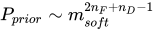
[edit]The string landscape ideas can be applied to the notion of weak scale supersymmetry and the Little Hierarchy problem. For string vacua which include the MSSM (Minimal Supersymmetric Standard Model) as the low energy effective field theory, all values of SUSY breaking fields are expected to be equally likely on the landscape. This led Douglas[16] and others to propose that the SUSY breaking scale is distributed as a power law in the landscape where is the number of F-breaking fields (distributed as complex numbers) and is the number of D-breaking fields (distributed as real numbers). Next, one may impose the Agrawal, Barr, Donoghue, Seckel (ABDS) anthropic requirement[17] that the derived weak scale lie within a factor of a few of our measured value (lest nuclei as needed for life as we know it become unstable (the atomic principle)). Combining these effects with a mild power-law draw to large soft SUSY breaking terms, one may calculate the Higgs boson and superparticle masses expected from the landscape.[18] The Higgs mass probability distribution peaks around 125 GeV while sparticles (with the exception of light higgsinos) tend to lie well beyond current LHC search limits. This approach is an example of the application of stringy naturalness.


Scientific relevance
[edit]David Gross suggests[citation needed] that the idea is inherently unscientific, unfalsifiable or premature. A famous debate on the anthropic landscape of string theory is the Smolin–Susskind debate on the merits of the landscape.
Popular reception
[edit]There are several popular books about the anthropic principle in cosmology.[19] The authors of two physics blogs, Lubos Motl and Peter Woit, are opposed to this use of the anthropic principle.[why?][20]
See also
[edit]References
[edit]- ^ The number of metastable vacua is not known exactly, but commonly quoted estimates are of the order 10500. See M. Douglas, "The statistics of string / M theory vacua", JHEP 0305, 46 (2003). arXiv:hep-th/0303194; S. Ashok and M. Douglas, "Counting flux vacua", JHEP 0401, 060 (2004).
- ^ Baggott, Jim (2018). Quantum Space Loop Quantum Gravity and the Search for the Structure of Space, Time, and the Universe. Oxford University Press. p. 288. ISBN 978-0-19-253681-5.
- ^ L. Smolin, "Did the universe evolve?", Classical and Quantum Gravity 9, 173–191 (1992). L. Smolin, The Life of the Cosmos (Oxford, 1997)
- ^ Read, James; Le Bihan, Baptiste (2021). "The landscape and the multiverse: What's the problem?". Synthese. 199 (3–4): 7749–7771. doi:10.1007/s11229-021-03137-0. S2CID 234815857.
- ^ Taylor, Washington; Wang, Yi-Nan (2015). "The F-theory geometry with most flux vacua". Journal of High Energy Physics. 2015 (12): 164. arXiv:1511.03209. Bibcode:2015JHEP...12..164T. doi:10.1007/JHEP12(2015)164. S2CID 41149049.
- ^ Frederik Denef; Douglas, Michael R. (2007). "Computational complexity of the landscape". Annals of Physics. 322 (5): 1096–1142. arXiv:hep-th/0602072. Bibcode:2007AnPhy.322.1096D. doi:10.1016/j.aop.2006.07.013. S2CID 281586.
- ^ Kachru, Shamit; Kallosh, Renata; Linde, Andrei; Trivedi, Sandip P. (2003). "de Sitter Vacua in String Theory". Physical Review D. 68 (4) 046005. arXiv:hep-th/0301240. Bibcode:2003PhRvD..68d6005K. doi:10.1103/PhysRevD.68.046005. S2CID 119482182.
- ^ L. Susskind, "The anthropic landscape of string theory", arXiv:hep-th/0302219.
- ^ S. Weinberg, "Anthropic bound on the cosmological constant", Phys. Rev. Lett. 59, 2607 (1987).
- ^ S. M. Carroll, "Is our universe natural?" (2005) arXiv:hep-th/0512148 reviews a number of proposals in preprints dated 2004/5.
- ^ M. Tegmark, A. Aguirre, M. Rees and F. Wilczek, "Dimensionless constants, cosmology and other dark matters", arXiv:astro-ph/0511774. F. Wilczek, "Enlightenment, knowledge, ignorance, temptation", arXiv:hep-ph/0512187. See also the discussion at [1].
- ^ See, e.g. Alexander Vilenkin (2007). "A measure of the multiverse". Journal of Physics A: Mathematical and Theoretical. 40 (25): 6777–6785. arXiv:hep-th/0609193. Bibcode:2007JPhA...40.6777V. doi:10.1088/1751-8113/40/25/S22. S2CID 119390736.
- ^ Abraham Loeb (2006). "An observational test for the anthropic origin of the cosmological constant". Journal of Cosmology and Astroparticle Physics. 0605 (5): 009. arXiv:astro-ph/0604242. Bibcode:2006JCAP...05..009L. doi:10.1088/1475-7516/2006/05/009. S2CID 39340203.
- ^ Jaume Garriga & Alexander Vilenkin (2006). "Anthropic prediction for Lambda and the Q catastrophe". Prog. Theor. Phys. Suppl. 163: 245–57. arXiv:hep-th/0508005. Bibcode:2006PThPS.163..245G. doi:10.1143/PTPS.163.245. S2CID 118936307.
- ^ Delia Schwartz-Perlov & Alexander Vilenkin (2006). "Probabilities in the Bousso-Polchinski multiverse". Journal of Cosmology and Astroparticle Physics. 0606 (6): 010. arXiv:hep-th/0601162. Bibcode:2006JCAP...06..010S. doi:10.1088/1475-7516/2006/06/010. S2CID 119337679.
- ^ M. R. Douglas, "Statistical analysis of the supersymmetry breaking scale", arXiv:hep-th/0405279.
- ^ V. Agrawal, S. M. Barr, J. F. Donoghue and D. Seckel, "Anthropic considerations in multiple domain theories and the scale of electroweak symmetry breaking", Phys. Rev. Lett. 80, 1822 (1998).arXiv:hep-ph/9801253
- ^ H. Baer, V. Barger, H. Serce and K. Sinha, "Higgs and superparticle mass predictions from the landscape", JHEP 03, 002 (2018), arXiv:1712.01399 .
- ^ L. Susskind, The cosmic landscape: string theory and the illusion of intelligent design (Little, Brown, 2005). M. J. Rees, Just six numbers: the deep forces that shape the universe (Basic Books, 2001). R. Bousso and J. Polchinski, "The string theory landscape", Sci. Am. 291, 60–69 (2004).
- ^ Motl's blog criticized the anthropic principle and Woit's blog frequently attacks the anthropic string landscape.
External links
[edit]- String landscape; moduli stabilization; flux vacua; flux compactification on arxiv.org.
- Cvetič, Mirjam; García-Etxebarria, Iñaki; Halverson, James (March 2011). "On the computation of non-perturbative effective potentials in the string theory landscape". Fortschritte der Physik. 59 (3–4): 243–283. arXiv:1009.5386. Bibcode:2011ForPh..59..243C. doi:10.1002/prop.201000093. S2CID 46634583.