Hubbry Logo
Ellesmere ChaucerEllesmere ChaucerMain
Open search
Ellesmere Chaucer
Community hub
Ellesmere Chaucer
logo
8 pages, 0 posts
0 subscribers
Be the first to start a discussion here.
Ellesmere Chaucer
Ellesmere Chaucer
from Wikipedia
Ellesmere Manuscript in Huntington Library

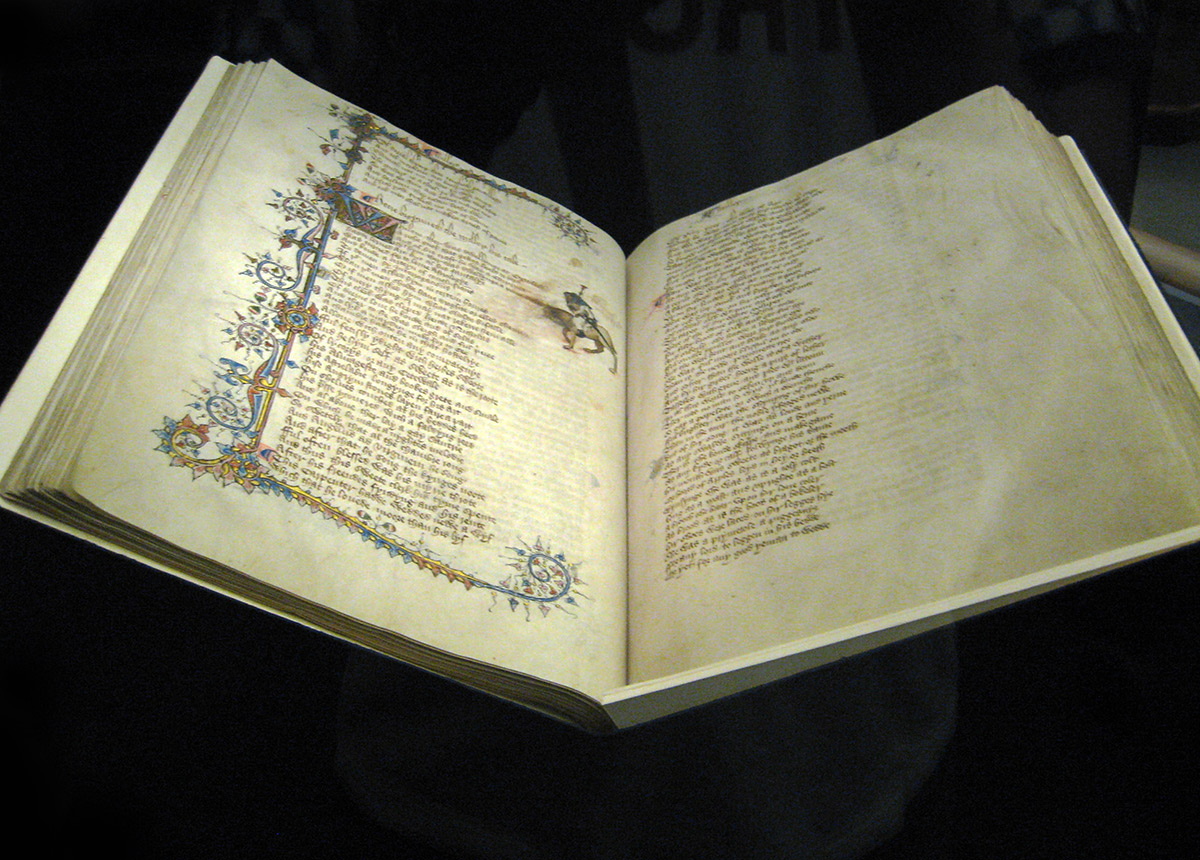
The Ellesmere Chaucer, or Ellesmere Manuscript of the Canterbury Tales, is an early 15th-century illuminated manuscript of Geoffrey Chaucer's Canterbury Tales, owned by the Huntington Library, in San Marino, California (EL 26 C 9). It is considered one of the most significant copies of the Tales.

History

[edit]

Chaucer scholarship has long assumed that no manuscripts of the Tales exist dating from earlier than Chaucer's death in 1400. The Ellesmere manuscript, conventionally dated to the first decades of the fifteenth century, would therefore be one of the first extant manuscripts of the Tales. More recently, the manuscript has been dated to c. 1405 or earlier, leading to speculation that it "was conceived as an immediate response to Chaucer's death by those eager to commemorate his memory through the appropriate preservation of his work."[1]: 60  It has even been suggested that, while the final sentence of the manuscript ("Here is ended the Book of the Tales of Canterbury, compiled by Geffrey Chaucer, of whos soule Iesu Crist have mercy. Amen.") makes it clear that Chaucer had died by the time the manuscript was finished, Ellesmere could have been begun while the poet was still alive.[2]: 208 

The early history of the manuscript is uncertain, but it seems to have been owned by John de Vere, 12th Earl of Oxford (1408–1462). The manuscript takes its popular name from the fact that it later belonged to Sir Thomas Egerton (1540–1617), Baron Ellesmere and Viscount Brackley, who apparently obtained it from Roger North, 2nd Baron North (1530/31–1600).[3] The library of manuscripts, known as the Bridgewater Library, remained at the Egerton house, Ashridge, Hertfordshire, until 1802 when it was removed to London. Francis Egerton, created Earl of Ellesmere in 1846, inherited the library, and it remained in the family until its sale to Henry Huntington by John Francis Granville Scrope Egerton (1872–1944), 4th Earl of Ellesmere. Huntington purchased the Bridgewater library privately in 1917 through Sotheby's. The manuscript is now in the collection of the Huntington Library in San Marino, California (EL 26 C 9). It was published in facsimile in 1911,[4] then reproduced again in colour in 1995.[5]

Because the manuscript was in the Bridgewater Library for centuries, early scholars working on Chaucer's works were unaware of its existence and it was not consulted for any early editions of the Tales. It first came to public notice following its description in 1810; the text was not available until 1868, when it was edited by F. J. Furnivall.[1]: 62–63  W. W. Skeat's 1894 edition of the Tales was the first to use Ellesmere as the basis for its text.[1]: 63 

Description

[edit]

The Ellesmere manuscript is a highly polished example of scribal workmanship, with a great deal of elaborate illumination and, notably, a series of illustrations of the various narrators of the Tales (including a famous one of Chaucer himself, mounted on a horse).

The manuscript is written on 240 high-quality parchment leaves of approximately 394 by 284 mm (15+12 by 11+14 in) in size.[1]: 59 

Illuminations

[edit]

Owing to the quality of its decoration and illustrations, Ellesmere is the most frequently reproduced Chaucer manuscript.[1]: 59 

In order of appearance in the Ellesmere Chaucer (note that not all storytellers have an illumination):[6]

Scribe and its relation to other manuscripts

[edit]

The Ellesmere manuscript is thought to be very early in date, being written shortly after Chaucer's death. It is seen as an important source for efforts to reconstruct Chaucer's original text and intentions, though John M. Manly and Edith Rickert in their Text of the Canterbury Tales (1940) noted that whoever edited the manuscript probably made substantial revisions, tried to regularise spelling, and put the individual Tales into a smoothly running order. Up until this point the Ellesmere manuscript had been used as the 'base text' by several editions, such as that of W. W. Skeat, with variants checked against British Library, Harley MS 7334.

The manuscript is believed to have been written by a single scribe, the same scribe who wrote the Hengwrt Manuscript of the Tales. The scribe has been identified as Adam Pinkhurst, a man employed by Chaucer himself; however, the attribution is controversial, with many palaeographers remaining undecided for or against.[7] If the scribe was employed by Chaucer directly, this would imply that the reconstructions hypothesized by Manly and Rickert were carried out by someone who had worked with Chaucer, knew his intentions for the Tales, and had access to draft materials.

The Ellesmere manuscript is conventionally referred to as El in studies of the Tales and their textual history. A facsimile edition is available.

References

[edit]
[edit]
Revisions and contributorsEdit on WikipediaRead on Wikipedia
from Grokipedia
The Ellesmere Chaucer is an of Geoffrey Chaucer's , produced in shortly after the author's death in and recognized as one of the most complete and beautifully decorated surviving copies of the work. Written by a single in a clear English script on 240 leaves of high-quality measuring approximately 16 by 11 inches, it includes the full text of 23 pilgrims' tales in diverse genres such as romances, fables, and sermons, along with the General Prologue. The manuscript's artistic features are exceptional, featuring 71 pages with intricate floriated borders, accents, historiated initials, and 23 vibrant equestrian miniatures depicting each pilgrim, which enhance the narrative's readability and visual appeal. Likely commissioned by , Geoffrey's son, it was owned for centuries by prominent English families, including the de Veres, Alingtons, Norths, and Egertons (from whom it derives its name as the Ellesmere manuscript), before being acquired by industrialist in 1917 and rebound in 1995 for preservation. Scholarly significance lies in its status as a for modern editions of , influencing textual order and interpretations due to its early production and minimal alterations, and it is ranked among the most historically important English literary .

Creation and Production

Dating and Origin

The Ellesmere Chaucer manuscript is estimated to have been produced between circa 1400 and 1410, a timeframe immediately following Geoffrey Chaucer's death in 1400. This dating relies primarily on paleographic evidence, including the manuscript's use of a formal anglicana script typical of high-quality English production in the early fifteenth century, as well as its textual and codicological features that align with post-Chaucerian scribal conventions. The originated in a professional , most likely in or its environs, where a thriving commercial catered to clientele during this period. As an elaborately illuminated volume on fine , it represents a high-end commission tailored for an affluent patron, indicative of the era's investment in prestigious literary artifacts. Its production was influenced by the rapid post-Chaucerian demand for copies of The Canterbury Tales, spurred by Chaucer's rising status as a vernacular literary figure and the broader cultural shift toward English-language works among educated readers in early fifteenth-century England. Scholarly comparisons with the slightly earlier Hengwrt manuscript (dated around 1400) reinforce this chronology, highlighting shared scribal techniques and textual arrangements that place the Ellesmere within the initial wave of authoritative Canterbury Tales exemplars.

Scribe and Script

The scribe of the Ellesmere Chaucer manuscript has been identified as Adam Pinkhurst, a professional London scrivener active in the late fourteenth and early fifteenth centuries, through paleographic analysis and archival evidence linking his hand to documents bearing his name. This identification was proposed by Linne R. Mooney in 2004, based on comparisons between Pinkhurst's signed records, such as petitions and guild documents from 1392–1393, and the distinctive handwriting in the Ellesmere and related Chaucer manuscripts. Pinkhurst, also known as the "Scribe of the Guildhall" for his work on City of London administrative records, likely entered the profession through apprenticeship in the Scriveners' Company, where he was confirmed around 1395. The script employed throughout the manuscript is a consistent example of Anglicana formata, a formal Gothic prevalent in late medieval , characterized by angular letterforms, fused strokes (known as ""), and looped ascenders and descenders that lend it a rhythmic flow. This style incorporates subtle influences—cursive elements such as connected minims and fluid ligatures—allowing for efficient yet elegant production across the manuscript's 240 folios, all executed by a single scribe without significant variation. The uniformity of the hand, spanning the entire text from the General Prologue to , underscores Pinkhurst's skill in maintaining precision over an extended copying project. Evidence of Pinkhurst's professional training is evident in the manuscript's meticulous execution, including precise rubrication in red ink for prologues, tale divisions, and speaker indications, as well as sparse corrections limited to minor erasures and interlinear insertions, reflecting a accustomed to high-stakes legal and administrative work. His experience with both and official documents, such as the Library's Scriveners' Company Common Paper and Mercers' Company accounts from 1391, demonstrates versatility that extended to literary copying. Pinkhurst's potential direct connection to arises from their shared Westminster-London milieu, where Chaucer's roles as customs controller and clerk of the king's works may have facilitated employment of local scriveners like Pinkhurst for personal or authorial manuscripts. Among Pinkhurst's other attributed works are early copies of Chaucer's poetry, including the Hengwrt Chaucer (National Library of Wales, MS Peniarth 392 D), and administrative texts like National Archives petitions, highlighting his role in disseminating Chaucer's oeuvre alongside civic records.

Physical Characteristics

Materials and Format

The Ellesmere Chaucer consists of 240 folios measuring approximately 400 x 284 mm, of which 232 contain the text of the Canterbury Tales, prepared from high-quality . The 's fine quality reflects the manuscript's status as a luxury production, with smooth, durable sheets suitable for elaborate decoration and extended use. The original binding was a typical late medieval wooden-board structure, featuring quarter-cut oak boards covered in pink-stained, alum-tawed goatskin or , sewn to seven double thongs with clasps and an overcover of reversed . It has undergone multiple rebinding efforts, including significant interventions around 1802 and 1911 that involved edge-cropping, patching, and tightening; the current binding, executed in 1995 by conservators at the , uses quarter-sawn boards laced with seven double-linen cords and covered in undyed alum-tawed , without clasps, to preserve the artifact's integrity. The manuscript's comprises 29 gatherings of 8 leaves each, aided by catchwords at the ends of most gatherings to facilitate proper assembly during production. In terms of condition, the Ellesmere Chaucer exhibits minor wormholes primarily in the endsheets from early infestation, along with 15th-century onward repairs such as patches and consolidations, yet remains overall well-preserved owing to centuries of careful storage in private libraries.

Layout and Structure

The Ellesmere manuscript features a single-column layout, with pages ruled for 42 lines of text to ensure uniformity and . The rulings are executed in ink, providing a clear framework for the scribe's Anglicana script, while divisions are highlighted by and paraphs that guide the reader's eye through the narrative divisions. This structured approach facilitates both practical navigation and aesthetic harmony, reflecting the manuscript's production as a high-end luxury item intended for aristocratic use. Divisions between prologues and tales are prominently marked by large illuminated initials, extending three to six lines in height and often adorned with or vibrant colors, accompanied by explicit and implicit rubrics in red ink that summarize or introduce the ensuing section. These elements create visual breaks that emphasize the modular structure of , allowing readers to easily identify the shift from one pilgrim's contribution to the next. The integration of decorative borders around many of these initials further enhances the page's ornamental quality without disrupting the text flow. A key aspect of the layout is the incorporation of 23 full-page or half-page portrait illustrations, each depicting a pilgrim and strategically positioned at the outset of their respective tale to visually anchor the storytelling sequence. These images are seamlessly embedded within the ruled text block, often occupying the lower portion of a page or a full facing , with the narrative resuming above or beside them to maintain continuity. This design choice not only aids in aesthetic appreciation but also reinforces the manuscript's conception of the tales as a dramatic pilgrimage ensemble. The manuscript originally lacks any form of , relying instead on its sequential for organization, with modern numbering added to the 240 folios for scholarly reference. One notable structural anomaly appears in the reordered placement of the Wife of Bath's , which deviates slightly from expected sequence integration to accommodate the and rubric scheme. Such features underscore the deliberate planning by the scribe and illuminators to balance textual fidelity with visual presentation.

Artistic Features

Pilgrim Portraits

The Ellesmere Chaucer manuscript features 23 portraits of the pilgrims, depicted as equestrians, positioned at the beginning of each tale to visually anchor the narrative structure. These illuminations, executed in a single cohesive style across the work of three distinct artists, employ for halos and highlights, along with vibrant colors such as blue, red, and to create lively, individualized scenes. The portraits serve as a visual , transforming Chaucer's verbal descriptions into tangible images that guide the reader's through the pilgrimage. Representative examples illustrate the fidelity to Chaucer's characterizations while adding artistic interpretation. The Knight appears mounted on a , clad in a quilted jupon with bagpipe sleeves over chainmail, his posture upright and noble to evoke his chivalric virtue and battle-worn humility. The Prioress is shown side-saddle on a light gray , her elegant and veil framing a face with a coy smile, holding a rosary with green gauds that symbolize her refined and worldly affectations. The Monk rides a fine brown with bells on the , dressed in a fur-lined and equipped with horns and gloves, highlighting his indulgence in secular pursuits over monastic austerity. Other notable figures include the on horseback holding to his chest, signifying scholarly devotion, and the Physician on horseback holding a flask, emblematic of his medical profession. These depictions, varying in horse colors, gaits, and harnesses, emphasize diversity among the pilgrims. Stylistically, the portraits exhibit Anglo-Flemish realism, characterized by detailed attention to and pose that reflects early 15th-century rather than the late 14th-century setting of Chaucer's tales. Fabrics like and , along with accessories such as spurs and saddles, draw from contemporary fashions, creating a sense of immediacy and social hierarchy through visual cues like the Merchant's fur-trimmed hood or the Wife of Bath's elaborate headdress. The artists vary figure scales—smaller for the first 16 portraits by the primary illuminator, larger and set against grassy plots for the later ones by the second and third artists—demonstrating a progression in spatial depth and naturalism influenced by East Anglian traditions. This approach marks the portraits as among the earliest examples of individualized English portraiture in illuminated books. Symbolically, the portraits enhance the pilgrims' character traits from the text, using poses and accessories to underscore moral and while aiding visualization. The Monk's hunting gear, for instance, critiques his deviation from cloistered life, with his forward-leaning posture suggesting eagerness for worldly pleasures. Similarly, the Prioress's and gentle demeanor amplify her superficial elegance, contrasting with the Knight's restrained armor that embodies ideal knighthood. Horses often symbolize status or temperament—the Parson's humble nag underscoring his poverty, while the Squire's prancing mount reflects youthful vigor—effectively leveling social differences by placing all pilgrims in motion toward , mirroring the tale's themes of and diversity. These elements not only illustrate but interpret Chaucer's irony, making abstract qualities visually immediate for aristocratic readers. The illuminations are attributed to three anonymous artists, likely working in a collaborative scriptorium around 1400–1405, with the primary artist responsible for the majority and showing affinities to East Anglian in other contemporary like the through shared motifs of natural settings and figure dynamism. Comparative analysis of stylistic markers, such as brushwork and color application, supports this regional link, though no single identity has been definitively established.

Decorative Elements

The Ellesmere Chaucer manuscript is renowned for its sophisticated non-figural decorations, which include a series of elaborate floriated initials appearing primarily at the beginnings of tales. These initials, typically four to six lines high, feature intricate floral and leaf motifs that extend into the margins, executed in alternating and with red accents for emphasis. The use of for grounds and highlights, along with pigments such as for blues and or red lead for reds, underscores the high level of craftsmanship and the employment of costly materials typical of early 15th-century English illumination. Complementing the initials are seventy-one full-page borders adorning select folios, primarily on the top, left, and bottom margins, characterized by flowing ivy-leaf and acanthus-inspired designs in . These borders often incorporate animal motifs, including drolleries such as small dragons peering from the edges, which add a playful yet symbolic dimension to the ornamental framework without dominating the figural portraits. The integration of these borders with the manuscript's pilgrim illustrations creates a cohesive , enhancing the overall aesthetic unity. The pigments employed, including shell gold for fine details, further indicate the work of skilled London-based artists familiar with continental influences. Beyond the original embellishments, the margins contain later additions, including 15th-century graffiti such as ownership inscriptions and pen trials, which are distinct from the primary decoration and provide insights into early readership. For instance, a note by John Marchaunt, a 15th-century owner, appears on a flyleaf, alongside doodles and writing exercises that reflect practical use over time. These annotations, while not part of the initial artistic program, contribute to the manuscript's layered historical texture without altering its ornamental integrity.

Textual Content

Variants and Completeness

The Ellesmere manuscript contains a nearly complete version of Geoffrey Chaucer's The Canterbury Tales, encompassing all 24 tales along with their prologues and linking passages in the conventional sequence that begins with the General Prologue and the and ends with the . This order, which positions the tales according to the pilgrims' social hierarchy and progression, reflects an organized approach likely implemented by the scribe or an early owner. The manuscript concludes with Chaucer's "Retracciouns," a retraction in which the author recants his secular writings while affirming his religious works, positioned immediately after the to provide a moral closure. Textual variants in the Ellesmere are characterized by distinctive orthographic features consistent with late fourteenth-century English, including preferences for spellings such as "doun" (over "down") and "ynough" (with -ou- diphthongs), which preserve dialectal elements from Chaucer's original composition. These variants, along with minor emendations like adjusted line endings for metrical regularity, distinguish the without altering the core narrative, though they exhibit no evidence of substantial authorial revisions beyond Chaucer's holograph. The orthography employs standard conventions, with frequent abbreviations (e.g., þe for "the," wᵗ for "with") and minimal , relying instead on rubrication and spacing to guide reading; no modern appears, maintaining the text's medieval authenticity. Assessments of completeness indicate that the Ellesmere preserves approximately the full intended corpus of the Tales as circulated in Chaucer's lifetime, with no significant lacunae or lost leaves evident in its 240 folios, unlike fragmentary contemporaries. Scholarly confirms its fidelity, capturing about 99% of the verse lines across the tales, with only trivial scribal omissions or repairs that do not impact overall coherence. The scribe's consistent hand, identified as Scribe B (possibly Adam Pinkhurst), minimally influences these variants through habitual choices rather than deliberate alterations.

Relations to Other Manuscripts

The Ellesmere manuscript is classified within the "a" textual family (often referred to as the alpha family) of The Canterbury Tales, a group identified by scholars as containing the highest-quality witnesses closest to Chaucer's intended text. This family includes the Ellesmere (El) and Hengwrt (Hg) manuscripts as sibling copies, deriving from a shared early exemplar and exhibiting unique shared errors and readings that distinguish them from other branches, such as omissions or substitutions in passages like the General Prologue. For instance, both El and Hg preserve rare agreements in phrasing that are absent in later derivatives, indicating their independent transmission from a common archetype rather than one copying the other directly. In contrast, the Ellesmere differs significantly from the "b" textual family (beta family), which encompasses manuscripts like , MS 198 (Cp) and features more corrupted readings, including rearrangements of tale orders and omissions of linking passages. While the alpha family generally maintains a more consistent narrative sequence aligned with Chaucer's probable intentions, beta family witnesses often exhibit disrupted orders, such as placing the Tale of Gamelyn after in some variants, reflecting later scribal interventions. These differences underscore the Ellesmere's position as a more authoritative representative within its family, with fewer contaminations from extraneous sources. The Ellesmere's prestige and completeness exerted considerable influence on fifteenth-century manuscripts, serving as a model for later copies that emulated its layout, illumination, and textual reliability. Stemmatic analysis confirms that it is not a direct authorial holograph but a from an early , likely transmitted through the Adam Pinkhurst, who is attributed with copying both the Ellesmere and Hengwrt and thus playing a key role in preserving Chaucer's text. This shared scribal origin further strengthens the between El and Hg, as evidenced by orthographic and error patterns analyzed in computational collations.

Provenance and History

Early Ownership

The early ownership of the Ellesmere Chaucer manuscript remains uncertain, but it likely belonged to a member of the English shortly after its creation around 1400–1410. The first documented owner was John de Vere, 12th Earl of Oxford (1408–1462), as indicated by heraldic evidence and the manuscript's presence in noble circles during the . This early possession underscores its status as a prized literary artifact among the and , reflecting the growing prestige of Chaucer's works in elite households. By the early , the manuscript had passed to the Drury family, evidenced by inscriptions such as "Robertus Drury" on the flyleaves, accompanied by Latin and English verses, pen trials, and other scribblings that suggest active scholarly engagement during the . Additional from this period include the name "Edwarde Waldegrave" and references to "Margery," possibly Margery St. John, indicating circulation within interconnected families and personal use, such as jottings and annotations that highlight its role in intellectual pursuits. In 1568, Sir Giles Alington gifted it to his neighbor, Roger, Lord North, further demonstrating its value as a exchanged among the English . In the early 17th century, following Lord North's death, the manuscript entered the collection of Sir Thomas Egerton (1540–1617), who later became Baron Ellesmere and Lord Chancellor, from whom it derives its name. It then passed to Egerton's son, John Egerton, 1st Earl of Bridgewater (1579–1649), and remained in the Bridgewater family library throughout the 17th and 18th centuries. Housed initially at Ashridge House in Hertfordshire, the family's estate, the manuscript was treated as a cherished Chaucerian heirloom, with evidence from its armorial bindings and ex-libris stamps affirming its esteemed position in one of England's prominent noble collections. This chain of ownership among high-ranking families illustrates the manuscript's enduring circulation and reverence within English aristocratic and scholarly networks up to the late 18th century.

Modern Custody and Conservation

In 1917, the Ellesmere Chaucer was sold as part of the Bridgewater Library by John Francis Granville Scrope Egerton, 4th Earl of Ellesmere, to American industrialist through the London bookseller George D. Smith and auction house. This acquisition marked the manuscript's transition from private aristocratic ownership to institutional stewardship, establishing it as a foundational treasure in the , , and Botanical Gardens in , where it remains a centerpiece of the rare books and manuscripts collection. Conservation efforts for the Ellesmere Chaucer have focused on preserving its delicate vellum, illuminations, and binding while accommodating scholarly access. In the 1990s, the manuscript underwent significant treatment, including careful disbinding to facilitate high-resolution, non-invasive for and production, followed by expert rebinding using traditional techniques such as alum-tawed over boards to replicate early 15th-century styles. Earlier 20th-century measures included protocols to combat pests common in collections, ensuring the artifact's structural integrity without compromising its original materials. These interventions, guided by professional conservators like Anthony G. Cains, reflect ongoing commitments to minimal intervention and reversible techniques. Today, the is housed in a secure, climate-controlled vault at the , maintained at temperatures of 72°F or below and relative humidity between 30% and 50% to prevent degradation from environmental factors. Access is strictly restricted to researchers and staff, with handling protocols that include gloves and supportive cradles to minimize . It is occasionally displayed in controlled exhibitions, such as the 2025 "Stories from the Library: The Tales Through Time," where low light levels and limited exposure times—typically rotated every 3 to 6 months—protect against fading and physical stress. As part of the Huntington's permanent collection, the Ellesmere Chaucer benefits from robust legal protections under U.S. legislation, including the National Stolen Property Act and international agreements like the 1970 Convention on the Means of Prohibiting and Preventing the Illicit Import, and Transfer of Ownership of , which safeguard it against , , or commercial exploitation.

Significance and Legacy

Scholarly Importance

The Ellesmere manuscript has played a central role in Chaucer studies as the foundational text for numerous modern editions of , prized for its completeness and proximity to Chaucer's lifetime over more fragmentary alternatives. The Riverside Chaucer (1987), edited by Larry D. Benson and others, adopts it as the primary base text, incorporating selective variants to approximate the author's intended version while highlighting its early fifteenth-century authority. This selection underscores the manuscript's status as a benchmark for editorial practice, influencing how scholars approach the poem's structure and language. In philological research, the Ellesmere has been instrumental in reconstructing Chaucer's and of tales, providing crucial evidence for debates on amid the work's unfinished state. Its , likely Adam Pinkhurst, regularized spellings and arranged the tales into a coherent order that aligns with inferred Chaucerian plans, aiding efforts to discern original compositions from later adaptations. This has shaped by offering a reliable to Middle English and narrative flow, though its shows subtle Western influences from the 's hand. Key milestones in its scholarly application include the exhaustive collation in John M. Manly and Edith Rickert's The Text of the Canterbury Tales (1940), which positioned Ellesmere as a core manuscript for comparing variants across over fifty copies and establishing textual genealogies. Contemporary digital initiatives, such as the Canterbury Tales Project, further leverage it as a primary witness in computational stemmatic analyses, using heuristic methods to map manuscript relationships and refine understandings of transmission history. However, its limitations temper claims of textual superiority; scribal interventions, including deliberate smoothing of verse and , reveal it as a mediated copy rather than an unadulterated holograph, yet this very quality yields essential perspectives on medieval copying practices and pre-print dissemination.

Cultural Impact and

The Ellesmere Chaucer's vivid pilgrim portraits and elaborate illuminations have profoundly shaped cultural representations of Geoffrey Chaucer's , serving as a foundational visual for artists and adapters across centuries. Its high-quality decorations and comprehensive illustrations of the 23 pilgrims have established it as the most frequently reproduced Chaucer manuscript, influencing depictions in , , and that emphasize the diversity and vitality of medieval . This enduring visual legacy underscores the manuscript's role in bridging medieval text with modern interpretations, where its characterizations inform broader narratives of social satire and human folly. Notable adaptations, such as Pier Paolo Pasolini's 1972 film , draw on the manuscript's tradition of portraying the pilgrims' tales through earthy, character-driven vignettes, adapting Chaucer's framework for cinematic exploration of medieval themes.) Similarly, 19th- and 20th-century illustrations often echo the Ellesmere's stylistic elements, contributing to the work's presence in popular media and s that trace the evolution of the tales. The Huntington Library's 2025 "Stories from the Library: The Tales Through Time" exemplifies this, juxtaposing the manuscript with later artistic and printed reinterpretations to illustrate its impact on five centuries of creative output. Digitization has amplified the manuscript's accessibility and cultural reach. In 1995, during a comprehensive conservation and rebinding, the Huntington Library produced high-resolution digital scans of all folios, capturing the intricate details of its vellum pages, gold leaf accents, and miniature paintings. These images were made publicly available through the Huntington Digital Library, launched to provide open online access, allowing global users to explore the manuscript interactively via zoomable views and metadata on its production around 1400–1405. This effort has democratized engagement with the work, supporting educational outreach and virtual exhibitions that highlight its significance in medieval English literature. Facsimile editions further extend the manuscript's legacy as merchandise and scholarly tools. The 1911 black-and-white reproduction marked an early effort to disseminate its content widely, while the 1995 full-color New Ellesmere Chaucer Facsimile, limited to 250 copies and published by the Huntington Library Press, faithfully replicates the original's trim size, texture, and decorations using advanced printing techniques. These editions have fostered public appreciation, positioning the Ellesmere as an enduring symbol of Chaucer's influence on fantasy genres—through its archetypal characters and episodic structure—and ongoing that promotes medieval literature's relevance today.

References

Add your contribution
Related Hubs
User Avatar
No comments yet.