Hubbry Logo
Elliot TiberElliot TiberMain
Open search
Elliot Tiber
Community hub
Elliot Tiber
logo
8 pages, 0 posts
0 subscribers
Be the first to start a discussion here.
Elliot Tiber
Elliot Tiber
from Wikipedia

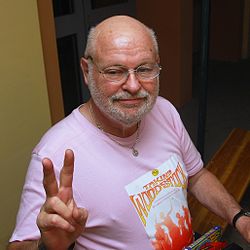
Elliot Michael Tiber (born Eliyahu Teichberg; April 15, 1935 – August 3, 2016)[1][2] was an artist, professor, and screenwriter who wrote a memoir about the Woodstock Festival held in Bethel, New York in 1969. He claimed responsibility for the relocation of the festival after a permit for it was withdrawn by the zoning board of a nearby town.

Key Information

Tiber's 2007 memoir Taking Woodstock, written with Tom Monte, was adapted into a film of the same name by Ang Lee. The film opened in the United States in August 2009. In the film, Tiber is portrayed by comedian Demetri Martin.

Early and personal life

[edit]

Tiber was born as Eliyahu Teichberg, in Bensonhurst, Brooklyn, New York.[3] His family moved to White Lake in Bethel in 1955 where they acquired a rooming house that they expanded into a motel, called the El Monaco Motel, at the intersection of New York Route 17B and New York Route 55 near the southeast shore of White Lake. He was Jewish. He changed his name before enrolling in college.

Tiber graduated from Midwood High School in Brooklyn,[4] and attended Brooklyn College and received a BFA from Hunter College. He was in the MFA program at Pratt Institute.

Tiber died in August 2016 at the age of 81 in Boca Raton, Florida from complications of a stroke.[5]

Taking Woodstock

[edit]

In his book Taking Woodstock: A True Story of a Riot, a Concert and a Life, Tiber says he was present at the Stonewall Riots on June 28, 1969, and that he had a part in bringing the Woodstock Festival to Bethel, New York on August 15–17, 1969.[6]

Tiber said he led a closeted life in Bethel in the early 1960s as he spent time managing his parents' El Monaco Motel, serving as president of the Bethel Chamber of Commerce, and, at the same time, participating in the gay scene in New York, where he lived.

According to Taking Woodstock, Tiber read that Wallkill, Orange County, New York had on July 15, 1969–30 days before the music festival was to start—pulled the plug on the planned Woodstock Festival at the Mills Industrial Park northeast of Middletown, New York.

Tiber says in the book that he had a permit for the White Lake Music and Arts Festival, a planned chamber music event at his motel. He contacted Michael Lang on or about July 18 and pitched the idea of having the festival on 15 acres (61,000 m2) along the edge of White Lake by the motel.

According to Taking Woodstock, when Lang said the motel property was too small, Tiber introduced the Woodstock festival producers to dairy farmer Max Yasgur, and helped facilitate the deal.[6]

Lang, however, says that Tiber referred him to a local real estate salesman, and that the salesman drove Lang, without Tiber, to Yasgur's farm. Sam Yasgur, son of Max Yasgur, agrees with Lang's version, and said that his mother, who is still alive, said that Max did not know Tiber. Artie Kornfeld, a Woodstock organizer, has said he found out about Yasgur’s farm from his own sources.[7][8]

The motel later became an Italian restaurant before being torn down in 2004. It is now marked by a clock tower welcoming people to White Lake.[9]

Tiber left Bethel shortly after Woodstock and soon moved to Los Angeles, where he became a movie set designer.

Screenwriter

[edit]

His 1970s book, Rue Haute, was made into a French-language film directed by his domestic partner, André Ernotte. It was Belgium's entry for the 49th Academy Awards Best Foreign Language Film in 1977. The book was released in English in the United States in 1977 under the name High Street.

Teaching career

[edit]

He taught creative writing at New School University, fine art at Hunter College, and art design history at the New York Institute of Technology.[10]

Books

[edit]
  • High Street, Avon (1977)
  • Taking Woodstock: A True Story of a Riot, a Concert and a Life (with Tom Monte), Square One Publishers (June 15, 2007), ISBN 0-7570-0293-5.
  • Palm Trees on the Hudson (2010)
  • After Woodstock, Square One Publishers (March 2, 2015), ISBN 0-7570-0392-3.

References

[edit]

Further reading

[edit]
[edit]
Revisions and contributorsEdit on WikipediaRead on Wikipedia
from Grokipedia
Elliot Tiber (born Eliyahu Teichberg; April 15, 1935 – August 3, 2016) was an American artist, interior designer, author, and promoter renowned for his instrumental role in facilitating the 1969 Woodstock Music and Art Fair. As president of the Bethel Chamber of Commerce, Tiber issued the performance permit to Woodstock Ventures and introduced festival organizer Michael Lang to dairy farmer Max Yasgur, whose property in Bethel, New York, hosted the event after initial plans fell through. His 2007 memoir, Taking Woodstock: A True Story of a Riot, a Concert, and a Life, detailed his experiences, including his involvement in the Stonewall riots as a gay rights activist, and inspired Ang Lee's 2009 film adaptation starring Demetri Martin as Tiber. Beyond Woodstock, Tiber worked as a professor of creative writing and art, produced plays and screenplays, and maintained a career in visual arts until his death from stroke complications in Boca Raton, Florida. While some accounts debate the extent of his influence on the festival's relocation, his permit approval and site recommendation remain credited as key enablers of the landmark event that drew over 400,000 attendees.

Early Life and Family Background

Childhood and Name Change

Elliot Tiber was born Eliyahu Teichberg on April 15, 1935, in Bensonhurst, Brooklyn, New York, to Jewish parents Jack Teichberg, a roofer, and Sonia Teichberg, who operated a junk shop. He grew up in the middle-class neighborhood of Bensonhurst during the Great Depression and post-World War II era, in a family environment shaped by his father's manual labor and his mother's business activities. Teichberg attended in , graduating in the mid-1950s. Following graduation, he legally changed his name to Elliot Tiber—reportedly adding the middle name Michael as a personal flourish—prior to pursuing higher education and a career in . The , undertaken in his late teens, aligned with his emerging identity as an and reflected a departure from his birth name's traditional connotations.

Parental Influence and Move to Bethel

Elliot Tiber, born Eliyahu Teichberg on April 15, 1935, in Brooklyn's Bensonhurst neighborhood, grew up in a working-class Jewish immigrant family marked by tension and unmet expectations. His father, Jack Teichberg, had emigrated from and worked as a , while his mother, Sonia, originally from , operated a housewares shop; both parents exerted significant control over Tiber's early life, with Sonia particularly pushing ambitions like grooming him for the rabbinate, which clashed with his emerging artistic and personal inclinations. In 1955, seeking economic improvement amid the declining Catskills resort industry, the Teichberg family relocated from to White Lake in , purchasing a dilapidated that they converted and expanded into the El Monaco Motel. This move thrust Tiber, then aged 20 and pursuing studies at , into a reluctant role managing the failing property alongside his parents, whom he later described as fostering a dysfunctional environment that stifled his independence. The parental dynamic profoundly shaped Tiber's rural isolation in Bethel during the late and , where he lived a existence while handling operations and local duties to bolster the family's venture, often resenting the "rat trap" confines and his mother's domineering influence. This period of familial obligation delayed his artistic pursuits in but honed practical skills in promotion and community engagement that later proved pivotal.

Education and Initial Career

Academic Training

Elliot Tiber, originally named Elliot Teichberg, enrolled at , where he began studying art. He subsequently earned a degree from in 1956, focusing on artistic disciplines that informed his later creative pursuits. Tiber continued his postgraduate studies at , completing a Master of Fine Arts degree in 1966. This advanced training emphasized design and fine arts, aligning with his emerging professional interests in and . His academic path reflected a commitment to formal artistic education amid his transition from environments to broader creative endeavors.

Entry into Art and Design

After earning his degree from in 1956, Tiber initially pursued a career as an abstract artist, but this endeavor did not succeed commercially. Instead, he entered the field of by taking a position as a decorator at the W. & J. Sloane department store on Fifth Avenue in Manhattan. By 1959, Tiber had established himself in New York City's design scene, working on residential homes, commercial showrooms, and serving as head of color marketing for clients. His reputation grew through word-of-mouth referrals, leading to high-profile commissions such as the interior of a Supreme Court judge's mansion, which connected him to influential figures including a city commissioner. Throughout much of the , he operated as an independent interior designer catering to affluent clients in , blending his artistic training with practical design applications. Tiber also took on roles as an and in and for major retailers, including in and in , as well as international marketing firms. These early professional experiences in the late and 1960s laid the foundation for his later diversification into set design, instruction, and related creative pursuits, while he continued studying for his at , which he completed in 1966.

Involvement with Woodstock Festival

Operation of El Monaco Motel

In 1955, Elliot Tiber's parents, Jack and Sonia Teichberg, purchased a in White Lake, , and expanded it into the El Monaco Motel to capitalize on the Catskills resort trade. The family operated it as a modest lodging establishment, initially drawing weekend visitors from amid the declining tourism industry. Tiber, then known as Eliyahu Teichberg, assisted in management during the early while pursuing his career as an interior decorator in , commuting on weekends to handle operations alongside his parents. Daily tasks included guest services, maintenance, and promotional efforts through Tiber's role as president of the Bethel Chamber of Commerce, though the motel remained unprofitable due to low occupancy and structural decay. By the late , the El had deteriorated into a shabby, money-losing property, emblematic of broader economic challenges facing upstate , with Tiber's family facing potential . Tiber's expertise likely influenced minor aesthetic improvements, but financial strains persisted, prompting his to Woodstock Ventures in July 1969 to host festival operations on adjacent family land as a bid for revenue. The motel's role during the event was limited to preliminary headquarters functions before the festival shifted to Max Yasgur's farm.

Securing the Festival Permit and Site

In July 1969, after Woodstock Ventures had its permit revoked by the town of Wallkill, New York, Elliot Tiber, president of the Bethel Chamber of Commerce and owner of the El Monaco Motel in nearby White Lake, contacted festival co-founder Michael Lang to offer his existing permit for an annual music and arts festival at the motel site. Tiber had secured this permit for $1, as he had done annually since the early 1960s for small events on his 3-acre property, which allowed outdoor gatherings without immediate town board approval. The Woodstock organizers initially considered the El Monaco but deemed it insufficiently spacious for the anticipated 50,000 attendees and required infrastructure, prompting Tiber to introduce Lang to his neighbor, dairy farmer , whose 600-acre farm in Bethel offered a suitable open field. On July 15, 1969, Tiber drove Lang and associate to Yasgur's property, where the farmer agreed to lease the site for the August 15–18 event after negotiations, enabling the festival to proceed under the Bethel jurisdiction and leveraging Tiber's permit as a temporary bridge to formal approvals. Yasgur's farm, located approximately one mile from the El Monaco, ultimately hosted , with the permit facilitating rapid setup amid time pressures.

Disputes Regarding Role and Contributions

Tiber's 2007 memoir Taking Woodstock: A True Story of a Riot, a Concert, and a Life portrays him as instrumental in rescuing the festival after its cancellation in Wallkill, New York, on July 15, 1969, by offering his existing permit for an annual chamber music event at the El Monaco Motel and personally introducing organizers to Max Yasgur, whose 600-acre dairy farm in Bethel became the site. Michael Lang, co-founder of Woodstock Ventures, disputed Tiber's direct introduction to Yasgur in his 2009 book The Road to Woodstock, stating that the connection occurred through a whom Tiber had recommended to the production team, rather than Tiber escorting them personally to the farm on July 17, 1969. Lang credited Tiber's July 15 telephone call—prompted by a New York Times article on the Wallkill rejection—with directing the team to Bethel and providing temporary headquarters at the El Monaco, but emphasized that Yasgur's farm was secured independently after scouting local properties, and a new permit was obtained from the Town of Bethel for the actual event site, rendering Tiber's motel permit supplementary rather than foundational. Some accounts, including Lang's, suggest Tiber's narrative embellishes his influence to align with the memoir's dramatic structure, as the organizers had already identified Bethel as a viable area and negotiated directly with Yasgur, whose decision was swayed by financial incentives exceeding $10,000 rather than Tiber's involvement. These discrepancies fueled debate over the 2009 film Taking Woodstock, directed by Ang Lee and based on Tiber's book, which amplified his role as the festival's de facto savior; Lang viewed it as fictionalized, while acknowledging Tiber's facilitation of the Bethel pivot amid the July 1969 timeline crunch.

Post-Woodstock Professional Pursuits

Interior Design and Artistic Work

Following the Woodstock Festival in 1969, Tiber continued his career in , leveraging skills honed earlier in the decade. In the , he had established himself as a prominent interior decorator in , working for the W. & J. Sloane department store on and handling high-profile projects amid the city's vibrant design scene. His experiences in this field, including encounters with figures like and elements in the industry, informed his later memoir Palm Trees on the Hudson: A True Story of the Mob, Judy Garland & Interior Decorating, published in 2010, which detailed the competitive and often shadowy aspects of mid-century New York decoration. Tiber described himself as a "hotshot interior designer" during this era, operating from Manhattan's and catering to upscale clients before returning to manage his family's motel. Tiber's artistic pursuits, rooted in formal training, emphasized drawing and abstract influences but yielded limited professional recognition during his lifetime. He studied painting under and at institutions including the Art Students League, yet a sustained career as an abstract artist did not emerge, prompting his pivot to design. Post-Woodstock, his creative output shifted toward and pen-and-ink sketches, often evoking personal history and cultural icons; notable examples include portraits of Woodstock performers like , which have since appeared at auction. In later years, Tiber produced a "Woodstock" series using minimalist line techniques reminiscent of artists like Picasso and Matisse, depicting attendees, musicians, and festival motifs—works that remained largely private until posthumous exhibitions. These pieces gained visibility after Tiber's 2016 death, with galleries such as Ocean Art Gallery promoting his sketches of Woodstock personalities and imagined figures from his life, framing them as extensions of his multifaceted identity as an , , and festival enabler. Events like a 2023 fundraiser for the Stonewall National Museum and a 2024 pop-up exhibit at the Ormond Memorial Art Museum highlighted selections from his oeuvre, underscoring themes of music, , and in his drawings. While not commercially dominant in his era, Tiber's reflects a consistent thread of visual , blending his precision with autobiographical reflection.

Teaching and Academic Roles

Tiber served as an instructor in comedy writing and screenwriting at in , where he taught classes in the mid-1980s that emphasized practical skills in humor and narrative development. He also lectured on fine arts at of the , drawing on his background as a BFA graduate from the institution to guide students in artistic techniques and theory. Additionally, Tiber taught art design history at the , focusing on historical contexts and evolution of design principles. As a professor of comedy writing and performance, he contributed to curricula at both University and , integrating his experiences as a and into lessons on creative expression and . These roles complemented his broader career in the arts, allowing him to mentor emerging talents in writing, , and amid his pursuits in interior decoration and theater production.

Screenwriting and Theater Productions

Tiber co-wrote the screenplay for the 1976 Belgian film Rue Haute (released as in the United States), in collaboration with director André Ernotte; the film, centering on a Jewish-American artist's obsessive relationship with a mentally unstable woman in , represented Belgium's submission for the Academy Award for Best Foreign Language Film. In addition to , Tiber authored and produced multiple award-winning plays and musical comedies intended for theatrical, television, and presentation, beginning his playwriting career in 1959. One documented collaboration with Ernotte was the play The Music Keeper, staged under Ernotte's direction and preserved in video recordings from theatrical performances. Tiber also worked as a and associated with Belgium's national theater scene during this period. Later in his career, Tiber taught courses in comedy writing and screenwriting at University in , drawing on his practical experience in these fields.

Literary Output and Media Adaptations

Key Memoirs and Books

Elliot Tiber's most prominent , Taking Woodstock: A True Story of a Riot, a Concert, and a Life, co-authored with Tom Monte and published in 2007 by Square One Publishers, details his family's operation of the El Motel in Hurley, New York, and his purported facilitation of the 1969 Woodstock Festival site after the original permit fell through. The book interweaves Tiber's personal experiences as a gay interior designer in with events like the and his return to the family business amid financial distress, framing his motel permit as pivotal to attracting promoters to Max Yasgur's adjacent farm. It sold modestly but gained attention following the 2009 film adaptation directed by , which amplified its narrative despite deviations from the text. In After Woodstock: The True Story of a Belgian Movie, an Israeli Wedding, and a Manhattan Breakdown, published in 2011, Tiber recounts post-festival pursuits including collaborations on a Belgian film project, an unexpected in , and personal struggles with in , continuing themes of resilience amid cultural and familial upheavals. The emphasizes his ongoing navigation of identity and opportunity in , drawing on anecdotes from his screenwriting and design career. Tiber's Palm Trees on the Hudson: A True Story of the Mob, Judy Garland, and Interior Decorating, released in 2010, explores his early professional life in , encounters with organized crime figures in New York real estate, and a brief association with entertainer , highlighting the gritty underbelly of mid-20th-century urban entrepreneurship and artistic ambition. These works collectively form Tiber's literary chronicle of blending personal adversity with serendipitous cultural intersections, though their self-reported details have faced scrutiny for embellishment in historical contexts.

Film Adaptation of Taking Woodstock

The 2009 film Taking Woodstock, directed by Ang Lee, adapts Elliot Tiber's 2007 memoir Taking Woodstock: A True Story of a Riot, a Concert, and a Life, co-authored with Tom Monte. The screenplay, written by James Schamus, centers on Tiber's experiences as a young interior designer managing his family's El Monaco Motel in Bethel, New York, and his pivotal role in suggesting the Max Yasgur farm as the Woodstock festival site after initial permits fell through. Released on August 28, 2009, by Focus Features, the movie stars Demetri Martin in his feature film debut as Tiber, portraying him as a closeted gay man navigating family pressures, the Stonewall riots' aftermath, and the chaotic prelude to the 1969 concert. While drawing from Tiber's account of phoning Woodstock organizer Michael Lang to offer the motel site and facilitating the Yasgur connection, the incorporates fictionalized elements for dramatic effect, such as expanded subplots involving a veteran and a , which amplify themes of personal liberation and countercultural awakening beyond the memoir's episodic structure. Lee's involvement stemmed from a talk show appearance where he encountered Tiber promoting the book, prompting to acquire adaptation rights shortly thereafter. The film condenses Tiber's narrative to emphasize his internal conflicts— including his hidden sexuality and artistic aspirations—framing the festival as a catalyst for , though it relocates certain memoir details, like family revelations, to heighten emotional climaxes. Shot primarily in New York state locations evoking the Catskills, the production recreated aesthetics with period costumes and sets, blending with comedic vignettes to capture the era's transformative energy as filtered through Tiber's perspective. Despite its basis in Tiber's "true story" claims, the film has been noted for artistic liberties that prioritize cohesion over strict , such as intensifying interpersonal dynamics at the motel to underscore themes of community amid upheaval.

Reception and Critical Analysis

Elliot Tiber's 2007 memoir Taking Woodstock: A True Story of a Riot, a Concert, and a Life, co-authored with Tom Monte, garnered a favorable reception for its comedic and introspective narrative of personal struggles amid the Woodstock era, earning a 3.7 out of 5 rating on Goodreads from over 800 user reviews. Critics praised its quick-paced storytelling and humor, with one review highlighting Tiber's vibrant depiction of challenges not captured in the film adaptation. However, some assessments pointed to instances of exaggeration, describing the prose as occasionally slinking into hyperbole that prompted skepticism about specific events' veracity. The book achieved bestseller status and directly influenced the 2009 film, positioning Tiber as a key voice in Woodstock historiography despite contested elements. The Ang Lee-directed film , adapted from Tiber's memoir, elicited mixed critical responses, holding an average rating of 6.7 out of 10 on from over 30,000 users. Roger Ebert awarded it three out of four stars, commending its fresh, inventive approach to the subject rather than rote reminiscence. Conversely, labeled it a "bland, faintly pointless slice of sentimentality," critiquing its weak comedic elements and suggesting directing comedy did not suit Lee's strengths. Other reviews faulted the portrayal of Tiber, played by , as underdeveloped and unengaging, with visually striking production values failing to compensate for narrative shortcomings. Local coverage noted pre-release "bad buzz" tied to perceived inaccuracies in depicting regional events. Critical analysis of Tiber's literary claims centers on disputes over historical accuracy, particularly his asserted pivotal role in securing the Bethel site. Woodstock co-producer Michael Lang contested Tiber's account of directly facilitating the introduction to , stating in his own The Road to Woodstock that Tiber connected organizers to a realtor who then handled the farm visit independently. Lang further emphasized to interviewers that the film was "not a documentary," implying embellishments for dramatic effect. These challenges, echoed by other festival principals, underscore tensions between Tiber's entrepreneurial self-narrative and contemporaneous records, with Lang's firsthand perspective—drawn from organizational records and participant accounts—carrying weight as a counterpoint to Tiber's retrospective claims. Academic examinations, such as those in , have further critiqued the adaptation for diluting the 's gay themes, prioritizing sentimental ensemble dynamics over Tiber's individual agency. Such scrutiny highlights the memoirs' value as subjective cultural testimony while questioning their reliability as unvarnished history.

Personal Life, Activism, and Death

Identity as a Gay Man and Early Activism

Tiber acknowledged his homosexual attractions from an early age, having grown up in after his family's relocation from the Catskills in the . By 1969, at age 28, he lived openly as a homosexual in , employed as an interior decorator while regularly patronizing the city's bars, though this lifestyle contributed to periods of depression. On the night of June 28, 1969, Tiber was at the in when police raided the establishment, igniting the —a confrontation between patrons, primarily homosexual men, and that is widely regarded as catalyzing the gay liberation movement. In his 2007 memoir Taking Woodstock: A True Story of a Riot, a Concert, and a Life, Tiber described his direct involvement, claiming to have helped overturn a police vehicle amid the unrest. These self-reported details, drawn from his personal recollections, align with the broader historical context of spontaneous resistance by approximately 2,000 participants over several nights, though independent corroboration of Tiber's specific actions remains limited to his accounts. The riots marked Tiber's entry into visible homosexual defiance against institutional persecution, preceding by two months his role in facilitating the Woodstock festival site. Tiber later attributed the festival's communal atmosphere in August 1969 to bolstering his resolve to live unapologetically as a gay man, transitioning from private bar patronage to broader public identification with the emerging liberation ethos. His early activism thus centered on Stonewall-era participation, which he framed in memoirs as foundational to his lifelong advocacy, though subsequent claims of co-founding gay liberation efforts that summer derive primarily from his writings rather than contemporaneous records.

Relationships and Later Challenges

Tiber formed a committed partnership with Belgian theater director and playwright André Ernotte after returning to in the early , following unsuccessful attempts to establish himself in Hollywood. Their relationship, which lasted 27 years until Ernotte's death, provided mutual professional support, including Ernotte's direction of the 1976 French-language film adaptation of Tiber's novel Rue Haute, Belgium's entry for the Academy Award for Best Foreign Language Film. The couple collaborated on various projects amid Tiber's and artistic pursuits in Europe and the . In the , the AIDS profoundly disrupted Tiber's personal life and the New York gay community, with Tiber and Ernotte witnessing the rapid deaths of numerous friends and acquaintances. Tiber attended more than 30 funerals over two and a half years from 1983 to 1985, often amid societal stigma that isolated mourners, such as ejections from public spaces with homophobic abuse. The crisis instilled pervasive fear, as infections could prove fatal within weeks, testing the resilience of Tiber's relationship through grief, loss, and curtailed social freedoms. Professional setbacks, including repeated rejections in film and theater, compounded these emotional strains, though the partnership ultimately endured until Ernotte's passing. Persistent family tensions, particularly with his domineering mother, added ongoing relational difficulties into Tiber's later decades.

Health Decline and Passing

Elliot Tiber died on August 3, 2016, at the age of 81 in a center in . The immediate cause was a , according to his art agent, Elisa Ball. No public details emerged regarding a prolonged health decline preceding the event.

Legacy and Broader Impact

Entrepreneurial Contributions to Cultural Events

Elliot Tiber managed the El Monaco Motel, a family-owned property in , which his parents acquired in 1955 amid a struggling upstate hotel industry. To combat financial decline, Tiber organized annual music and arts festivals on the motel's lawn for a decade leading up to 1969, drawing local crowds and establishing the site as a venue for cultural gatherings. These events reflected his entrepreneurial efforts to revitalize the business through low-cost, community-oriented programming that capitalized on the region's rural appeal and growing interest in folk and countercultural performances. In July 1969, after Woodstock Ventures lost its permit for a planned in Wallkill, New York, Tiber—serving as president of the Bethel Chamber of Commerce—contacted organizer Michael Lang and offered access to his family's adjacent 15-acre field as an alternative site. Leveraging his local influence, Tiber secured a temporary permit from Bethel town officials on July 23, 1969, enabling Woodstock Ventures to negotiate with neighboring dairy farmer for the final 600-acre venue just 500 yards from the El Monaco. This initiative transformed the motel into an unofficial for , accommodating organizers, performers, and staff, while generating approximately $50,000 in from , concessions, and ancillary services during the August 15–18 event. Tiber's actions exemplified pragmatic , turning a distressed property into a hub for one of the 20th century's landmark cultural phenomena by bridging countercultural ambitions with local regulatory pathways and underutilized land. The El Monaco's proximity to the festival site—offering showers, meals, and parking—further amplified its role, with Tiber personally handling ticketing and hospitality for high-profile figures, thereby sustaining the motel's viability amid broader economic pressures on seasonal tourism.

Influence on Woodstock Narratives

Elliot Tiber's 2007 memoir : A True Story of a Riot, a Concert, and a Life, co-authored with Tom Monte, presented a firsthand account emphasizing his facilitation of the festival's relocation to , after initial plans for Wallkill collapsed on July 15, 1969. As president of the and owner of the El Monaco Motel adjacent to Max Yasgur's dairy farm, Tiber claimed to have alerted Woodstock Ventures co-founder Michael Lang to the Bethel site via a July 13 phone call and secured a temporary permit from town inspector William Volpe on July 20, framing these actions as pivotal in averting cancellation. This narrative shifted focus from the promoters' logistical struggles to local entrepreneurial opportunism, portraying Tiber as a bridge between countercultural ideals and small-town pragmatism. The memoir's publication, timed ahead of Woodstock's 40th anniversary, gained traction through media interviews where Tiber positioned himself as the "gay man who saved Woodstock," intertwining his personal identity struggles with the event's serendipity. It influenced subsequent retellings by humanizing the festival's backstory, highlighting overlooked elements like family-run motels accommodating early arrivals and informal networking that enabled the August 15–18, 1969, event to proceed on Yasgur's 600-acre property despite capacity exceeding 400,000 attendees. Ang Lee's 2009 film adaptation, scripted by and starring as Tiber (renamed Elliot Teichberg), amplified this perspective to a global audience, grossing over $10 million domestically and earning praise for visual fidelity to aesthetics while centering Tiber's arc of self-liberation amid festival chaos. The movie's narrative device of Tiber's hallucinatory attendance at the concert—absent from his at the —embedded a mythic, transformative lens into , reinforcing Woodstock as a site of personal and communal awakening rather than solely musical spectacle. Tiber's accounts also permeated anniversary commemorations, such as his 2015 Parade magazine reflections detailing "accident-by-design" encounters, which echoed in documentaries and articles crediting local figures for logistical salvation. By foregrounding permit wrangling and motel-based vantage points, these narratives diversified Woodstock lore beyond performer rosters like Jimi Hendrix's August 18 closing set, underscoring causal roles of non-celebrity enablers in the event's 186-acre staging.

Critiques of Memoir Claims and Historical Accuracy

Elliot Tiber's 2007 memoir Taking Woodstock asserts that he single-handedly rescued the festival by telephoning Woodstock Ventures on July 14, 1969, immediately after the Wallkill permit revocation on July 2, offering his preexisting permit for a 3-day event accommodating up to 5,000 people at his family's El Monaco Motel in Bethel, New York, and personally introducing organizers Michael Lang and Artie Kornfeld to dairy farmer Max Yasgur, whose 600-acre property became the site after a handshake deal on July 17. Tiber further claims this intervention prevented cancellation, as the organizers were desperate and his local knowledge unlocked Sullivan County options. These assertions have faced scrutiny from festival co-producer Michael Lang, whose 2009 memoir The Road to Woodstock minimizes Tiber's influence on site selection, describing the Yasgur farm as identified through independent scouting in mid-July by Lang's team in the Bethel-White Lake area, facilitated by local contacts rather than Tiber's direct introduction. Lang acknowledges Tiber's provision of the motel permit, which bought time amid Bethel's regulatory delays—the town board initially withheld formal approval for the larger event until —but portrays it as supplementary, not foundational, noting that contracts with Yasgur were advancing prior to Tiber's deeper involvement and that the team's persistence would have secured alternatives. Discrepancies extend to the permit's scope and efficacy: Tiber's document covered only his 15-acre motel grounds, much of which was swampy and unsuitable for the projected 50,000–100,000 attendees, necessitating separate negotiations with Yasgur and eventual Bethel town approvals that superseded it; Lang and others contend the permit served mainly as a procedural bridge, not a decisive enabler, as Woodstock Ventures had already pivoted to Sullivan County sites post-Wallkill. Yasgur accounts and local records similarly emphasize the farmer's independent outreach to organizers via a realtor, crediting broader over Tiber's role. Critics, including Lang, argue Tiber's narrative embellishes personal agency for dramatic effect, devoting over 125 pages to his contributions while Lang allocates mere paragraphs, reflecting participant memoirs' tendency toward self-aggrandizement amid fragmented recollections; nonetheless, Tiber's hospitality at El Monaco provided logistical support during July 15–17 negotiations, and his ties expedited initial Bethel access. Independent histories often omit or downplay Tiber, attributing success to the organizers' multi-site search—from Saugerties to Wallkill to Bethel—and Yasgur's pragmatic decision to lease amid cash-strapped dairy operations, underscoring that no single individual "saved" the event amid its chaotic momentum.

References

Add your contribution
Related Hubs
User Avatar
No comments yet.