Hubbry Logo
search
logo
1786768

Ellis Bridge

logo
Community Hub0 Subscribers
Read side by side
from Wikipedia

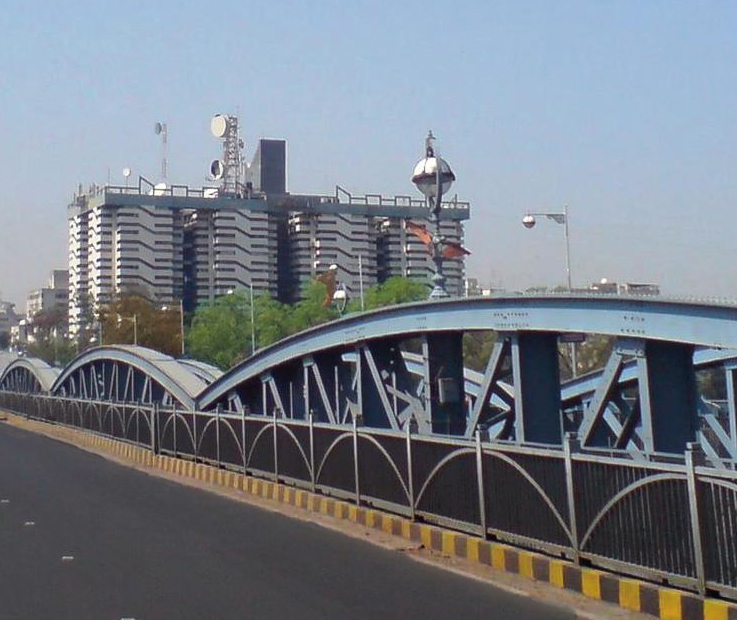
The Ellis Bridge is a century-old bridge in Ahmedabad, Gujarat. It bridges the western and eastern parts of the city across the Sabarmati River. This bowstring arch truss bridge was the first bridge in Ahmedabad, constructed in 1892. Concrete wings were added on either side in 1997 and it was renamed the Swami Vivekananda Bridge.[1]

Key Information

History

[edit]
Foundation block of Ellis Bridge. Now at Sanskar Kendra.

The original wooden bridge was constructed by British engineers in 1870–1871 at a cost of £54,920 (Rs. 5,49,200). Except for two spans on banks, it was destroyed by floods in 1875.[2] A steel bridge was built in 1892 by engineer Himmatlal Dhirajram Bhachech and named after Sir Barrow Helbert Ellis, the commissioner of the North Zone. The steel was imported from Birmingham. Himmatlal built it at a cost of Rs 407,000 which was lower than the budget of Rs 500,000. The government grew suspicious and thought that low quality materials were used by Himmatlal. An inquiry committee was set up and found that the construction was of superior quality. For saving government money, Himmatlal was subsequently honoured with the title of Rao Sahib.[3][4]

The foundation block of the Ellis bridge was later moved to the Sanskar Kendra. It reads,

The Ellis Bridge - So named by Government after Sir Barrow Helbert Ellis : K.G.S.I. was built in 1869 and 1870. At a cost of Rs:549,210 destroyed by the great flood of 22 September 1875 and rebuilt in 1890 and 1895 by Government, Local Bodies and Private Subscribers. At a further cost of Rs. 407,564. This the First Stone of the new bridge was laid by His Excellency Donald James eleventh Lord Reay C.C.I.E.LL.D. Governor of Bombay 19 December 1889.

Thousands heard Mahatma Gandhi declaring his Dandi march on 8 March 1930 from the Ellis bridge.[5]

Proposals to pull down the bridge were made in 1973, 1983 and 1986 but were rejected. The Ahmedabad Municipal Corporation declared the Ellis bridge and its boundary, Manek Burj and the natural water drain near one of the banks of Sabarmati river protected sites in May 1989.[3]

The original steel bridge was narrow and not suited for heavy motorized traffic and so it was closed in 1997. New concrete bridges were constructed on either side of the steel bridge to support heavy traffic in 1999 at cost of 18 crore (equivalent to 77 crore or US$9.1 million in 2023), and the original steel bridge is preserved as a heritage landmark. After the documentation, the Manek Burj was partially removed and Ganesh Bari, the Maratha constructed gate, was reconstructed to make space for the bridge. The bridge has been renamed Swami Vivekananda bridge after Swami Vivekanand.[3][6][7]

Reconstruction and redevelopment proposals

[edit]
Ellis Bridge at evening

It was found that steel piers of the bridge became corroded due to pollution in the Sabarmati river. Consultants appointed for strengthening the bridge, proposed its demolition in 2012 since building a new bridge would be cheaper than strengthening the existing one. It was also planned to run the Ahmedabad Bus Rapid Transit System buses on the new bridge. It is proposed that the steel arches of the old steel bridge should be preserved and placed back on the new bridge.[5][6][8] Later the Ahmedabad Municipal Corporation shelved the proposal of the new bridge for the bus system.[9][10]

In 2020, the Ahmedabad Municipal Corporation consulted an agency to propose the conservation measures and to do metallurgical studies. The redevelopment proposal was prepared but the project has not been implemented as of 2023.[11][12]

In July 2024, Government of Gujarat approved Rs. 32.40 crore for its restoration.[13]

Cultural significance

[edit]

This 120-year-old bridge has become an landmark and a symbol of Ahmedabad.[3][5] It was featured in several films, such as Kai Po Che! (2013) and Kevi Rite Jaish (2012). The Karnavati Art Gallery is at the western end of the bridge.

References

[edit]
Revisions and contributorsEdit on WikipediaRead on Wikipedia
from Grokipedia
Ellis Bridge is a steel bowstring arch truss bridge spanning the Sabarmati River in Ahmedabad, Gujarat, India, named after Sir B. H. Ellis, the British Commissioner of the Ahmedabad Division during the colonial era.[1]
The original wooden structure, constructed in 1870 as the city's first bridge over the river, was damaged by floods in 1875 and subsequently rebuilt in 1892 with a steel design engineered by Braithwaite & Co. to connect the eastern and western banks more reliably.[2][3][1]
This engineering feat, measuring approximately 480 meters in length and capable of supporting up to 1,196 tonnes, enabled significant urban expansion westward, fostering residential and commercial growth in areas previously isolated by the river.[4][5]
Designated as a heritage structure by the Ahmedabad Municipal Corporation, the bridge was widened in the mid-20th century to accommodate increased traffic and is undergoing restoration as of 2024 to maintain its structural integrity and historical value amid ongoing urban development pressures.[5][6]

History

Origins and Construction

The Ellis Bridge in Ahmedabad was initially conceived to link the city's eastern and western banks across the Sabarmati River, addressing transportation needs under British colonial administration. Construction of the original wooden bridge began in 1869 and was completed in 1870 at a cost of Rs. 5.49 lakh, utilizing timber structures typical of early colonial engineering projects in India.[7] This bridge was named in honor of Sir Barrow Helbert Ellis, the commissioner of the Northern Division of the Bombay Presidency, reflecting standard British practice of commemorating officials through public infrastructure.[8][9] The wooden structure proved vulnerable to the Sabarmati's seasonal floods, suffering destruction in 1875, which necessitated a more durable replacement.[10] In response, authorities commissioned a steel bridge, designed as a bowstring arch truss to enhance load-bearing capacity and flood resistance. Construction commenced shortly after the flood damage assessment and was overseen by Himmatlal Dhirajram Bhachech, a Gujarati civil engineer in the British Public Works Department, marking a notable instance of local engineering talent in colonial projects.[8][9] The steel bridge's fabrication incorporated imported Birmingham steel for the truss framework, assembled on-site with riveted joints and anchored piers, at a total cost of Rs. 407,564.[10] Completion occurred in 1892, enabling reliable vehicular and pedestrian traffic that supported Ahmedabad's growing urban connectivity.[8] This iteration retained the Ellis nomenclature, underscoring continuity in colonial naming conventions despite the engineering overhaul.[9]

Operational Period and Urban Impact

The Ellis Bridge served as Ahmedabad's primary river crossing from its completion in 1892 until closure to vehicular traffic in 1997, when surging population and vehicle loads exceeded its structural limits.[9] [8] Over its 105-year design lifespan and beyond, it handled evolving transport modes—from bullock carts and pedestrians to motorized vehicles—while witnessing the city's industrialization and demographic boom from approximately 100,000 residents in 1891 to over 2 million by 1991.[11] This connectivity bridged the historic walled city on the Sabarmati's east bank with expanding western suburbs, driving residential sprawl, industrial relocation, and commercial densification in the Ellis Bridge precinct.[9] [11] The area evolved into a central business district, hosting markets, offices, and elite clubs like the Ellis Bridge Gymkhana, shifting economic gravity westward and diminishing the centrality of older sites such as Bhadra Square.[12] Economically, the bridge integrated trade networks, shortened commutes for workers and merchants, and supported Ahmedabad's textile boom by linking mills and ports, though its eventual overload underscored the need for wider infrastructure to match post-independence urban pressures.[9] [12] Parallel concrete extensions built in 1997 absorbed traffic, preserving the original as a heritage relic amid ongoing city modernization.[9]

Closure and Infrastructure Replacement

The Ellis Bridge was closed to vehicular traffic around 2014 due to structural safety concerns, including deterioration of its iron girders and piers exacerbated by pollution in the Sabarmati River.[13][14] This closure followed earlier restrictions on heavy vehicles imposed after 1980 structural testing revealed vulnerabilities, though the bridge continued limited use until full vehicular prohibition.[15] In response to the closure, the Ahmedabad Municipal Corporation (AMC) and urban development authorities constructed parallel modern bridges as part of the Sabarmati Riverfront Project, diverting traffic and effectively replacing the Ellis Bridge's role in daily vehicular connectivity across the river.[16] These new structures, including a concrete bridge immediately adjacent to the original, were designed to handle increased urban traffic loads while the historic span was sidelined for pedestrians and eventual restoration.[16] Restoration efforts, focused on strengthening rather than full demolition, received in-principle approval in July 2024 with an initial allocation of ₹32.40 crore from the Gujarat government for girder replacement, corrosion treatment, and heritage preservation.[14] Work commenced on September 11, 2024, targeting completion within 18 months, but progressed to 78% by October 2025 amid challenges, leading to a six-month extension to September 2026 and a budget escalation to ₹42.90 crore.[17][18] A 2019 engineering assessment had recommended partial replacements, such as bottom girders and deck slabs, to address load-bearing deficiencies without altering the bridge's iconic form.[13]

Design and Engineering

Architectural Features

The Ellis Bridge employs a bowstring arch truss design, a structural form where curved trusses serve as both the arch and the primary load-bearing elements, enabling efficient spanning over the Sabarmati River.[19][8] This configuration, typical of late 19th-century British colonial engineering, combines tensile strength from the truss with compressive forces in the arch to distribute loads effectively.[19] Constructed primarily from steel, the bridge represents an early adoption of this material for permanent infrastructure in Ahmedabad, facilitating a rigid girder system praised for its durability.[8] The overall length measures 480 meters, supported by 14 spans and 28 piers, with a carriageway width of 6.3 meters designed for vehicular and pedestrian traffic.[19] As a pony truss variant, the structural members extend partially above the deck, optimizing material use while maintaining stability against lateral forces from the river's flow.[19] Key engineering features include the integration of bowstring elements that allow for longer unsupported spans compared to traditional flat trusses, contributing to the bridge's longevity beyond its projected 105-year lifespan.[8] The design's simplicity and economy—built at a cost of Rs 4.07 lakh against an estimate of Rs 5 lakh—underscore the precision in fabrication and assembly overseen by local contractor Himmatlal Dhirajram Bhachech.[8] Subsequent modifications, such as concrete wings added in 1997, preserved the core steel framework while expanding capacity, though these do not alter the original truss architecture.[19]

Materials and Construction Techniques

The Ellis Bridge was constructed using steel as the primary material for its structural framework, with the steel imported from Birmingham, England, to ensure durability in the flood-prone Sabarmati River environment.[9][20] This choice replaced an earlier wooden bridge destroyed by floods in 1875, prioritizing corrosion-resistant and tensile-strength properties suited to the river's seasonal variations.[21] The bridge employs a bowstring arch truss design, a technique integrating curved arches with horizontal truss members to distribute loads efficiently across spans, minimizing material use while maximizing stability against bending and shear forces.[19] Classified as a pony truss configuration, the vertical and diagonal steel members are positioned along the sides of the roadway rather than overhead, allowing for a lighter deck and unobstructed clearance below.[19] Construction techniques involved prefabricating truss sections for assembly on-site, supervised by engineer Himmatlal Dhirajram Bhachech from 1889 to 1892, resulting in 14 interconnected bowstring spans totaling 433.41 meters in length and 6.25 meters in width.[8][22] Foundations were anchored into the riverbed using masonry abutments to resist scour and hydraulic forces, with riveted joints securing the steel components for rigidity without modern welding.[8] The overall method reflected late 19th-century British colonial engineering adapted to local conditions, emphasizing economy—the project completed under budget at Rs 4.07 lakh against an estimate of Rs 5 lakh—while achieving a lifespan exceeding 130 years before structural interventions.[8] No concrete was used in the original superstructure, though later additions in 1997 incorporated it for extensions.[23]

Restoration Efforts

Initial Protection and Proposals

In 1997, the Ellis Bridge was closed to vehicular traffic by the Ahmedabad Municipal Corporation due to concerns over structural deterioration from heavy loads, marking the initial formal protection of the structure as a heritage asset. This measure converted the bridge into a pedestrian-only walkway, aimed at preserving its 19th-century bowstring arch truss design amid the city's expanding urban demands.[9][24] To accommodate ongoing traffic needs without compromising the historic bridge, two parallel concrete bridges were constructed in 1999, one on each side of the original steel span, at a reported cost facilitating diversion of vehicles. These auxiliary structures ensured the Ellis Bridge could be maintained primarily for foot traffic, underscoring early proposals to balance heritage conservation with infrastructural functionality.[9][24] The bridge's inclusion in the Ahmedabad Municipal Corporation's heritage listings further formalized its protected status, recognizing it as industrial heritage ineligible for demolition and emphasizing its role as Ahmedabad's inaugural permanent Sabarmati River crossing. Initial proposals emphasized non-invasive interventions, such as load restriction and periodic maintenance, to extend the lifespan of its riveted steel components without altering the original engineering.[25]

Recent Developments and Challenges

In July 2024, the Gujarat state government approved an allocation of over Rs 32.40 crore for the restoration of Ellis Bridge, which had been closed to vehicular traffic since approximately 2015 due to accumulating structural decay from years of inadequate maintenance.[14] Restoration work officially began on September 11, 2024, under the Ahmedabad Municipal Corporation (AMC), with an initial 18-month timeline targeting completion by March 2026.[26] [18] By October 2025, the AMC extended the project by six months to September 2026, primarily due to disruptions from recent flooding in the Sabarmati River, which delayed critical pillar strengthening activities.[26] [18] The budget also rose from an initial work order of Rs 26.9 crore (already 36.6% above the tender estimate of Rs 19.6 crore) to Rs 42.9 crore, reflecting escalated costs for materials, labor, and unforeseen scope adjustments.[26] At that point, roughly 78% of the work had been completed, with remaining tasks prioritized ahead of the next monsoon season.[26] [18] Key challenges included early 2024 concerns over unverified design proofs, as the 2019 AMC assessment omitted details on foundation integrity and relied on proposals for replacing bottom girders, deck stringers, joints, bearings, and installing anti-corrosion anodes without mandatory state-level engineering validation.[13] Experts advocated for third-party scrutiny from bodies like IIT Roorkee, citing precedents of design flaws in other Indian bridge failures, such as the 2022 Morbi collapse, to mitigate risks in retrofitting a 133-year-old structure.[13] Upon reopening, the bridge will accommodate pedestrians only, underscoring persistent tensions between heritage preservation and ensuring long-term structural viability amid environmental pressures like riverine flooding.[26]

Cultural and Symbolic Role

As a City Landmark

Ellis Bridge stands as an iconic landmark in Ahmedabad, bridging the historic eastern bank of the Sabarmati River—home to the walled city and traditional pols—with the modern western developments, symbolizing the city's evolution from colonial past to contemporary urban growth.[27][28] Constructed in 1892 as the city's first permanent iron bridge following the destruction of an earlier wooden structure by floods in 1875, it exemplifies British-era engineering with its bowstring arch truss design and has been protected as a heritage site by the Ahmedabad Municipal Corporation since 1989.[9] The bridge attracts tourists and locals for evening strolls, heritage walks, and panoramic views of the Sabarmati Riverfront, particularly during golden hour for photography that highlights its colonial architecture against the skyline.[28] Its role extends beyond connectivity, serving as a public gathering space that underscores Ahmedabad's urban heritage, with proposals to redevelop underutilized adjacent areas into enhanced pedestrian zones.[27] Culturally, Ellis Bridge holds symbolic weight as a witness to pivotal independence-era events, including Mahatma Gandhi's declaration of the Dandi Yatra on March 8, 1930, and Sardar Patel's leadership in the 1921 boycott of foreign goods.[9] Deemed structurally viable for preservation in 2020, plans include transforming it into a dedicated pedestrian walkway potentially featuring an art gallery and glass flooring for river views, reinforcing its status as a enduring heritage icon amid ongoing infrastructure modernization.[29]

Representation in Media and Culture

The Ellis Bridge has appeared in Indian cinema as a visual emblem of Ahmedabad's historical and urban divide, often symbolizing transition between the city's traditional east bank and modern west. In the Bollywood film Kai Po Che! (2013), directed by Abhishek Kapoor and set amid Gujarat's socio-political upheavals, a pivotal scene depicts a character fleeing across the bridge toward the newer sections of the city during communal unrest, enhanced by visual effects to convey chaos and movement.[30] Gujarati-language films, including several produced in the early 2010s, have similarly showcased the bridge's arched structure to evoke local identity and connectivity, with Times of India reporting its prominent display "in all its glory" in such productions.[31] Television representations further highlight the bridge's cultural resonance. A Hindi-language serial titled Ellis Bridge, produced by Namaraj and aired on Life OK starting in late 2013, centered its storyline on the structure as a metaphorical link between characters' pasts and futures, drawing from the bridge's real-world role in uniting Ahmedabad's divided halves; singer Parthiv Gohil contributed original music for the show.[32] These depictions underscore the bridge's status as a recurring motif in media narratives exploring themes of heritage, migration, and city evolution, though no major literary works or fine art series prominently feature it based on available records.

Controversies and Debates

Preservation Versus Modernization

The Ellis Bridge faced significant structural deterioration by the early 2010s, prompting consultants appointed by the Ahmedabad Municipal Corporation (AMC) in 2010–2011, such as Darr Consultants, to recommend its demolition due to foundational weaknesses and inability to support modern traffic loads.[33] In 2013, the AMC formally proposed replacing the 1892 structure with a new concrete bridge, retaining only its decorative arches to balance heritage aesthetics with enhanced capacity for vehicular traffic, amid concerns over safety and urban mobility demands in a growing city.[34] Proponents of modernization, including then-Mayor Asit Vora, argued that full restoration would be prohibitively expensive and technically challenging, potentially exceeding the costs of a new build while failing to address escalating repair needs from heavy usage.[35] Opposition from heritage advocates, citizens, and groups like the BJP emphasized the bridge's irreplaceable historical significance as Ahmedabad's oldest Sabarmati River crossing, built under British engineer James Ellis, and warned that partial retention of arches would erode its authentic engineering integrity.[36] Public petitions and criticism led the AMC to withdraw the demolition plan, with a 2016 decision to repurpose the bridge as a pedestrian walkway, preserving the full structure for cultural events, exhibitions, and light use to extend its lifespan without vehicular strain.[31] This approach aligned with Ahmedabad's UNESCO World Heritage City status, prioritizing adaptive reuse over outright replacement to mitigate risks from modernization-driven urban pressures. By 2019, ongoing assessments shelved further replacement ideas amid public backlash, paving the way for a ₹32.40 crore restoration project approved in 2024, focusing on strengthening foundations and heritage-compliant repairs while forgoing heavy traffic resumption.[37] As of 2025, the project—extended to September 2026 with costs rising to ₹42.90 crore—underscores preservation's triumph, though critics note delays and escalations highlight tensions between conserving 19th-century masonry against contemporary engineering standards for durability and public access.[18][38]

Maintenance Neglect and Structural Concerns

In October 2016, a large portion of the deck slab on Ellis Bridge collapsed, attributed to severe neglect by the Ahmedabad Municipal Corporation (AMC). The incident highlighted deferred maintenance on the then-124-year-old heritage structure, despite its inclusion on the heritage list 1.5 years prior and an allocated budget for repairs. A consultancy report by STUP had been pending approval for seven months, and an inspection conducted eight months earlier failed to prompt timely action, underscoring systemic delays in addressing deterioration from age and heavy usage.[39] Restoration proposals initiated in 2019, budgeted at Rs 26.78 crore, have faced criticism for inadequate evaluation of the bridge's foundation integrity, potentially compromising long-term stability amid ongoing exposure to vehicular loads and environmental factors. The plan omits mandatory design verification by the state roads and buildings department, as required post the 2022 Morbi bridge collapse, with experts advocating involvement from specialized institutions like IIT-Roorkee to mitigate risks from undetected structural weaknesses such as corroded girders and bearings.[13] Work commenced on September 11, 2024, but encountered setbacks from a Sabarmati River flood and incomplete pillar strengthening, leading to a six-month extension to September 2026 and a cost overrun to Rs 42.9 crore. These delays reflect persistent challenges in maintaining the 133-year-old steel bridge, which will be repurposed for pedestrian and cyclist use only post-restoration, signaling concerns over its capacity to withstand continued heavy traffic.[26]

References

User Avatar
No comments yet.