



Community hub
Recent from talks
Knowledge base stats:
Talk channels stats:
Members stats:
Giant Pacific octopus
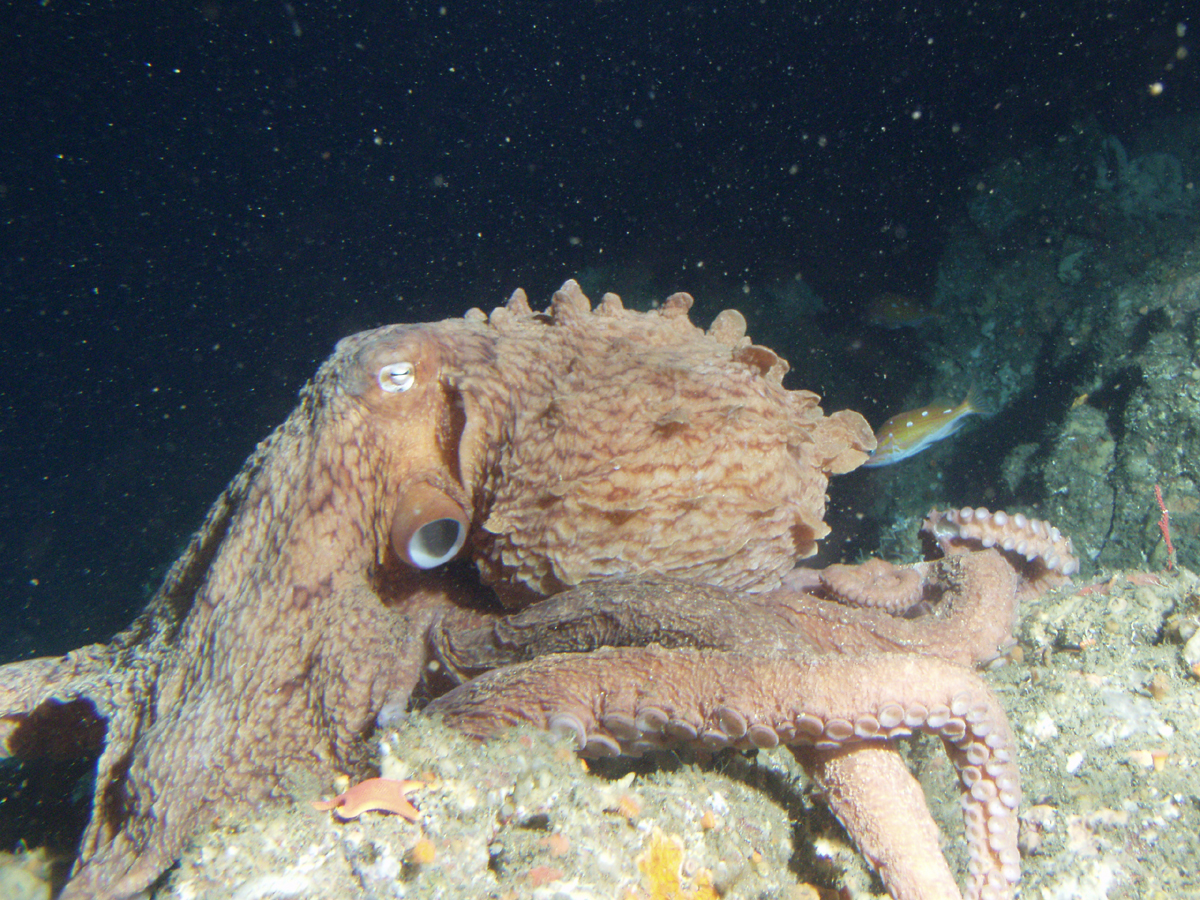
The giant Pacific octopus (Enteroctopus dofleini), also known as the North Pacific giant octopus, is a large marine cephalopod belonging to the genus Enteroctopus and Enteroctopodidae family. Its spatial distribution encompasses much of the coastal North Pacific, from the Mexican state of Baja California, north along the United States' West Coast (California, Oregon, Washington and Alaska, including the Aleutian Islands), and British Columbia, Canada; across the northern Pacific to the Russian Far East (Kamchatka, Sea of Okhotsk), south to the East China Sea, the Yellow Sea, the Sea of Japan, Japan's Pacific east coast, and around the Korean Peninsula. It can be found from the intertidal zone down to 2,000 m (6,600 ft), and is best-adapted to colder, oxygen- and nutrient-rich waters. It is the largest octopus species on earth and can often be found in aquariums and research facilities in addition to the ocean. E. dofleini play an important role in maintaining the health and biodiversity of deep sea ecosystems, cognitive research, and the fishing industry.
The giant Pacific octopus was first described in 1910 by Gerhard Wülker of Leipzig University in Über Japanische Cephalopoden. He describes the species' morphology in detail, and mentions that there seems to be much variation within the species. The specific name dofleini was chosen by Gerhard Wülker in honor of German scientist Franz Theodor Doflein. It was moved to genus Enteroctopus by Eric Hochberg in 1998.
E. dofleini is distinguished from other species by its large size. It is the largest octopus species. Adults usually weigh around 15 kg (33 lb), with an arm span up to 4.3 m (14 ft). Some larger individuals have weighed in at 50 kg (110 lb), with a radial span of 6 m (20 ft). American zoologist G. H. Parker found that the largest suckers on a giant Pacific octopus are about 6.4 cm (2.5 in) and can support 16 kg (35 lb) each. The only other possible contender for the largest species of octopus is the seven-arm octopus (Haliphron atlanticus), based on a 61-kilogram (134-pound), incomplete carcass estimated to have had a live mass of 75 kg (165 lb).
E. dofleini preys on shrimp, crabs, scallops, abalones, cockles, snails, clams, lobsters, fish, squid, and other octopuses. Food is procured with its suckers and then bitten using its tough beak of chitin. It has also been observed to catch spiny dogfish (Squalus acanthias) up to 1.2 m (4 ft) in length while in captivity. Additionally, consumed carcasses of this same shark species have been found in giant Pacific octopus middens in the wild, providing strong evidence of these octopuses preying on small sharks in their natural habitat. In May 2012, amateur photographer Ginger Morneau was widely reported to have photographed a wild giant Pacific octopus attacking and drowning a seagull, demonstrating that this species is not above eating any available source of food within its size range, even birds.
Scavengers and other organisms often attempt to eat octopus eggs, even when the female is present to protect them. Giant Pacific octopus paralarvae are preyed upon by many other zooplankton and filter feeders. Marine mammals, such as harbor seals, sea otters, and sperm whales depend upon the giant Pacific octopus as a source of food. Pacific sleeper sharks are also confirmed predators of this species. In addition, the octopus (along with cuttlefish and squid) is a significant source of protein for human consumption. About 3.3 million tonnes (3.6 million short tons) are commercially fished, worth $6 billion annually. Over thousands of years, humans have caught them using lures, spears, pot traps, nets, and bare hands. The octopus is parasitized by the mesozoan Dicyemodeca anthinocephalum , which lives in its renal appendages.
E. dofleini move through the open water using jet propulsion, which is achieved by drawing water into its body cavity and then forcefully expelling it through a siphon, creating a powerful thrust and propelling the octopus through the water at a high speed. When moving on the seafloor, however, the octopus crawls using its arms.
E. dofleini remain stationary or in hiding 94% of the time, usually concealed within dens, kelp, or camouflaged in their environment. Otherwise, they exhibit activity throughout the day, increasingly so from midnight to the early morning. While stationary, E. dofleini hide, groom, eat, sleep, and maintain dens. E. dofleini are capable of moving vast distances to occupy new areas or habitats, with large octopuses moving further than smaller ones. Their movements are not random; they demonstrate a preference for habitats with dense kelp cover and rocky terrain suggesting a sophisticated level of habitat selection, likely optimizing foraging efficiency and minimizing exposure to predators. Furthermore, their movement patterns include direct relocations to new areas and central-tendency movements to return to familiar habitats. This navigation behavior is influenced by the use of familiar cliff edges, substrates, and topography as well as visual navigation.
E. dofleini migration patterns vary depending on the population. In the eastern Pacific waters off the coast of Japan, migration coincides with seasonal temperature changes in the winter and summer. Here, E. dofleini migrate to shallower waters in the early summer and winter and offshore in the late summer and winter. There is no evidence of these migration patterns in the Alaskan and northeast Pacific populations of E. dofleini.
Hub AI
Giant Pacific octopus AI simulator
(@Giant Pacific octopus_simulator)
Giant Pacific octopus
The giant Pacific octopus (Enteroctopus dofleini), also known as the North Pacific giant octopus, is a large marine cephalopod belonging to the genus Enteroctopus and Enteroctopodidae family. Its spatial distribution encompasses much of the coastal North Pacific, from the Mexican state of Baja California, north along the United States' West Coast (California, Oregon, Washington and Alaska, including the Aleutian Islands), and British Columbia, Canada; across the northern Pacific to the Russian Far East (Kamchatka, Sea of Okhotsk), south to the East China Sea, the Yellow Sea, the Sea of Japan, Japan's Pacific east coast, and around the Korean Peninsula. It can be found from the intertidal zone down to 2,000 m (6,600 ft), and is best-adapted to colder, oxygen- and nutrient-rich waters. It is the largest octopus species on earth and can often be found in aquariums and research facilities in addition to the ocean. E. dofleini play an important role in maintaining the health and biodiversity of deep sea ecosystems, cognitive research, and the fishing industry.
The giant Pacific octopus was first described in 1910 by Gerhard Wülker of Leipzig University in Über Japanische Cephalopoden. He describes the species' morphology in detail, and mentions that there seems to be much variation within the species. The specific name dofleini was chosen by Gerhard Wülker in honor of German scientist Franz Theodor Doflein. It was moved to genus Enteroctopus by Eric Hochberg in 1998.
E. dofleini is distinguished from other species by its large size. It is the largest octopus species. Adults usually weigh around 15 kg (33 lb), with an arm span up to 4.3 m (14 ft). Some larger individuals have weighed in at 50 kg (110 lb), with a radial span of 6 m (20 ft). American zoologist G. H. Parker found that the largest suckers on a giant Pacific octopus are about 6.4 cm (2.5 in) and can support 16 kg (35 lb) each. The only other possible contender for the largest species of octopus is the seven-arm octopus (Haliphron atlanticus), based on a 61-kilogram (134-pound), incomplete carcass estimated to have had a live mass of 75 kg (165 lb).
E. dofleini preys on shrimp, crabs, scallops, abalones, cockles, snails, clams, lobsters, fish, squid, and other octopuses. Food is procured with its suckers and then bitten using its tough beak of chitin. It has also been observed to catch spiny dogfish (Squalus acanthias) up to 1.2 m (4 ft) in length while in captivity. Additionally, consumed carcasses of this same shark species have been found in giant Pacific octopus middens in the wild, providing strong evidence of these octopuses preying on small sharks in their natural habitat. In May 2012, amateur photographer Ginger Morneau was widely reported to have photographed a wild giant Pacific octopus attacking and drowning a seagull, demonstrating that this species is not above eating any available source of food within its size range, even birds.
Scavengers and other organisms often attempt to eat octopus eggs, even when the female is present to protect them. Giant Pacific octopus paralarvae are preyed upon by many other zooplankton and filter feeders. Marine mammals, such as harbor seals, sea otters, and sperm whales depend upon the giant Pacific octopus as a source of food. Pacific sleeper sharks are also confirmed predators of this species. In addition, the octopus (along with cuttlefish and squid) is a significant source of protein for human consumption. About 3.3 million tonnes (3.6 million short tons) are commercially fished, worth $6 billion annually. Over thousands of years, humans have caught them using lures, spears, pot traps, nets, and bare hands. The octopus is parasitized by the mesozoan Dicyemodeca anthinocephalum , which lives in its renal appendages.
E. dofleini move through the open water using jet propulsion, which is achieved by drawing water into its body cavity and then forcefully expelling it through a siphon, creating a powerful thrust and propelling the octopus through the water at a high speed. When moving on the seafloor, however, the octopus crawls using its arms.
E. dofleini remain stationary or in hiding 94% of the time, usually concealed within dens, kelp, or camouflaged in their environment. Otherwise, they exhibit activity throughout the day, increasingly so from midnight to the early morning. While stationary, E. dofleini hide, groom, eat, sleep, and maintain dens. E. dofleini are capable of moving vast distances to occupy new areas or habitats, with large octopuses moving further than smaller ones. Their movements are not random; they demonstrate a preference for habitats with dense kelp cover and rocky terrain suggesting a sophisticated level of habitat selection, likely optimizing foraging efficiency and minimizing exposure to predators. Furthermore, their movement patterns include direct relocations to new areas and central-tendency movements to return to familiar habitats. This navigation behavior is influenced by the use of familiar cliff edges, substrates, and topography as well as visual navigation.
E. dofleini migration patterns vary depending on the population. In the eastern Pacific waters off the coast of Japan, migration coincides with seasonal temperature changes in the winter and summer. Here, E. dofleini migrate to shallower waters in the early summer and winter and offshore in the late summer and winter. There is no evidence of these migration patterns in the Alaskan and northeast Pacific populations of E. dofleini.