Hubbry Logo
Ernie AndersonErnie AndersonMain
Open search
Ernie Anderson
Community hub
Ernie Anderson
logo
8 pages, 0 posts
0 subscribers
Be the first to start a discussion here.
Ernie Anderson
Ernie Anderson
from Wikipedia

Ernest Earle Anderson (November 12, 1923 – February 6, 1997) was an American radio and television personality, horror host, and announcer.

Key Information

Known for his portrayal of "Ghoulardi", the host of late night horror films on WJW Channel 8 on Cleveland television from 1963 to 1966,[1] he worked as an announcer for the ABC television network from the late 1970s until the mid-1990s.

He is the father of filmmaker Paul Thomas Anderson, who named his production company the Ghoulardi Film Company.

Early life and career

[edit]

Anderson was born in Lawrence and grew up in Lynn, Massachusetts,[2] the son of Emily (Malenson) and Ernest Clinton Anderson. Anderson planned to go to law school, but instead joined the U.S. Navy during World War II to avoid being drafted.[2] In an interview, his son Paul Thomas Anderson spoke of his military service:

He (Ernie) was in the Navy stationed mainly in Guam. I don't think he did any fighting. I think he was trying – he was fixing airplanes and knew just where the beer was stashed and played the saxophone in bands and stuff like that. You know, every picture I have of him [shows] a beer in his hand. Every single picture from the war he's got – so he was pretty good about probably finding ways to get out of fighting. But again, you know, we never really talked that much about it.[3]

After the war, Anderson attended Suffolk University for two years, then took a job as a disc jockey at WSKI in Montpelier, Vermont.[4][5] Anderson worked as a disc jockey in Albany, New York and Providence, Rhode Island before moving to Cleveland, Ohio in 1958 to join radio station WHK.[4][6]

After WHK switched to a Top 40 format in late 1958, Anderson was let go as his persona did not fit with the format's newer, high-energy presentation. According to Anderson's lifelong friend, comic actor Tim Conway, Anderson was at a WHK Christmas party "telling this long elaborate joke and just as he's about to deliver the punch line his boss cuts in and says it. So Ernie looks at him and says, 'Why did you do that?' And his boss says, 'I anticipated it.' So Ernie said, 'Anticipate this' and tells him '(expletive) yourself.' Well, Ernie got fired."[7]

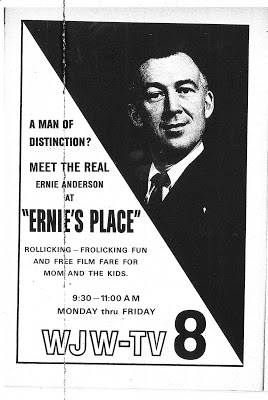
Anderson switched to television, joining the Cleveland NBC affiliate KYW-TV (now WKYC), where he first collaborated with Conway for some on-air work. In mid-1961, both Anderson and Conway moved to then-CBS affiliate WJW-TV to host a local morning movie show called Ernie's Place, which also featured live skits and comedy bits reminiscent of Bob and Ray.[citation needed]

When the two men joined the station, Anderson sold Conway to WJW's management team as a director for the program, although Conway lacked the qualifications and experience for that position. Conway proved unable to do the work, and other staffers, including technician Chuck Schodowski, were called in to assist, before Conway was ultimately dismissed. With Anderson deprived of his comic foil, Ernie's Place was canceled, but management soon offered him a horror host role for a local incarnation of Shock Theater that WJW acquired the rights to air late-nights on Fridays.[citation needed]

"Ghoulardi" years

[edit]

From 1963 to 1966, Anderson hosted Shock Theater under the alter ego of Ghoulardi, a hipster that defied the common perception of a horror host. While this version of Shock Theater also featured grade "B" science fiction and horror films, Ghoulardi mocked the films he was hosting, and spoke in an accent-laden beatnik slang. Often, comedic sound effects or music would be inserted in place of the movie's audio track. Occasionally, Ghoulardi would even insert himself into a film and appear to run from the monster, using a chroma key system that WJW normally utilized for art cards. He loved firecrackers (although their possession was illegal in Ohio) and started by blowing up apples and leftovers and graduated to blowing up model cars, statues, and other items sent in by viewers.

One remnant of Ernie's Place was also revived: the live comedy sketches and skits, only with Chuck Schodowski assuming Conway's role as Anderson's primary sidekick. On occasion, Conway would make cameo appearances on the program and serve as a writer, but Conway had meanwhile become a nationally known star on ABC's comedy series McHale's Navy.

Anderson's "Ghoulardi" persona often lampooned "unhip" targets, Dorothy Fuldheim being one of them. Fuldheim was the first woman to anchor a TV news show in the United States and a lifelong staffer for Cleveland's ABC affiliate WEWS. She openly disliked Anderson, feeling that the youth of Ohio were under attack with his pot jokes and childish antics, which she found distasteful. Ghoulardi responded by mocking her every week, usually referring to her as "Dorothy Baby". Their mutual on-air jibes created what viewers considered a battle of "the beatnik and the empress of Ohio news."

Anderson also developed "Parma Place", a weekly series of skits aired during the Ghoulardi show that parodied both the popular prime-time soap opera Peyton Place and the bedroom community of Parma, Ohio. "Parma Place" became an instant hit among the viewers, but its heavy use of ethnic jokes and asides toward Parma eventually caused that city's elected officials to complain to WJW management. While the station acquiesced and ordered the cancellation of "Parma Place," the publicity from that incident and the Fuldheim feud put the Ghoulardi character at the peak of his popularity.

By 1965, Anderson not only hosted Shock Theater but also the Saturday afternoon Masterpiece Theater and the weekday children's program Laurel, Ghoulardi and Hardy, all of which were ratings successes. Anderson also created the "Ghoulardi All-Stars" sports teams, often attracting thousands of fans to as many as 100 charity contests annually. With help from Conway, Anderson even visited Hollywood to shoot a TV pilot and featured the audition and films of his trip on his show, which was highly unusual for local TV in 1966.

Anderson, Conway, and Schodowski appeared in local and regional TV commercials that often included their quirky brand of humor.[8]

Promises of becoming an actor in Los Angeles and Anderson's fatigue led to his decision to leave Cleveland permanently in the summer of 1966. Shock Theater ended in October 1966, and the Ghoulardi name was retired. WJW tapped both Schodowski and weather presenter Bob Wells (aka "Hoolihan the Weatherman") to co-host the successive program, Hoolihan and Big Chuck.

Move to Los Angeles and career at ABC

[edit]

After moving to Los Angeles, Anderson first appeared on the first two episodes of Rango, a short-lived comedy that starred Conway. Anderson and Conway soon collaborated on a comedy act, appearing on ABC's Hollywood Palace and releasing two comedy albums together.[9] Beginning in 1974, Anderson replaced Lyle Waggoner as announcer for The Carol Burnett Show, on which his old performing partner Conway (who had been a recurring guest on the show) became a regular performer beginning in the following year.

Anderson found it a challenge to land acting work. His son, Paul Thomas Anderson, also attributes this to his father's profound limitations as an actor: "He was a bad actor, so he never really made it....No, he was bad. When we used to make home movies, he'd be in them and he was bad. We'd be like: 'You [expletive deleted]. No wonder you couldn't get any jobs."[10]

Anderson admittedly had lifelong difficulty with memorization. He moved behind the microphone when Fred Silverman made Anderson the voice of the ABC television network. His voice was heard in the ABC bumpers during the 1970s and 1980s, saying, "This is... ABC!" Anderson's voice is likely best remembered for introducing and promoting the ABC television series The Love Boat and for his newscast introductions for various ABC stations across the country: "Eyewitness News...starts...NOW!" (WEWS in Cleveland, the employer of Dorothy Fuldheim, would be one of these affiliates, utilizing Anderson's voice throughout the 1980s.) Anderson was also the announcer of America's Funniest Home Videos from 1989 to 1995 and did the voiceover for the previews of new episodes during the first three and a half seasons[11] of Star Trek: The Next Generation until he was replaced by Don LaFontaine. In addition to his work for ABC, Anderson also did commercial work for Ford, RCA and other clients.[4]

Anderson's signature was emphasizing a particular word. Examples included his enunciation of "Love" when promoting The Love Boat, and "The Man... The Machine... Street Hawk!" from the 1985 motorcycle action series. Anderson told the San Francisco Chronicle that his goal as an announcer was to "try to create a mood. I have to concentrate on each word, on each syllable. I have to bring something special to every sentence I say. If I don't do that, they might as well just get some announcer out of the booth to read it. I want people to hear me talk about a show and then to say, 'Hey, this is going to be great. I want to watch this.'"[12]

Voiceovers in animation

[edit]

Anderson also lent his narration voice to animated television series. He narrated the opening intros to Jayce and the Wheeled Warriors and The Adventures of Super Mario Bros. 3 (all for DIC Entertainment) and narrated the first two television shorts of The Powerpuff Girls as part of The What-a-Cartoon! Show until his death in 1997, when the role was taken over by Tom Kenny.

Personal life and death

[edit]

Despite being a daily presence on American television, Anderson lived in relative anonymity in Southern California. "But that's all right", he said. "If I'm out in public and I feel like being recognized, I just raise my voice and say... 'The Love Boat.'"[13]

Anderson had nine children in total. He had five children with his first wife, Marguerite Hemmer, whom he divorced around the time he ended his Ghoulardi show and left Cleveland. The three older children relocated to live with him in Studio City, while the two youngest children lived in Rhode Island with their mother.

Anderson married actress Edwina Gough soon after she arrived in California, a few weeks after he did so. With Edwina, he had three daughters and one son, filmmaker Paul Thomas Anderson. They divorced in the mid-1990s. Ernie then married Bonnie Skolnick, who survived him for a very short time.[4]

A lifelong smoker, Anderson died of lung cancer on February 6, 1997[14] and is buried in Hollywood Hills, Los Angeles.[15] His son, director Paul Thomas Anderson, dedicated his 1997 film Boogie Nights to his memory. In addition, The Drew Carey Show episode "See Drew Run" was dedicated to his memory. His death was also mentioned on an episode of America's Funniest Home Videos that same year.

Legacy

[edit]

Among others he influenced, Anderson influenced the film work of his son Paul Thomas and of the director Jim Jarmusch. In Paul Thomas Anderson's third film Magnolia, Earl Partridge is dying of cancer like Ernie Anderson.[16] Paul Thomas Anderson has also confirmed that the fireworks scene in his film Boogie Nights was inspired by his father's use of fireworks on the Ghoulardi program.[17] Jarmusch, who watched Ghoulardi as a child living in the Cleveland area, has stated that he was greatly influenced by the character's "anti-hierarchical appreciation of culture" and selection of "weird" background music.[18]

Anderson as "Ghoulardi" has also been cited as an early influence on many Cleveland and Akron-area musicians who formed influential rock and punk bands in the 1970s, including Devo, The Dead Boys, Pere Ubu, and The Cramps.[18][19]

More than a decade after his death, radio stations could still license Anderson's voice for promotions.[20] By paying a licensing fee, stations including New York City's WHTZ used Anderson's voice for positioning statements such as, "If it's too loud, you're too old" and "Lock it in and rip the knob off!"[21]

References

[edit]

Further reading

[edit]
[edit]
Revisions and contributorsEdit on WikipediaRead on Wikipedia
from Grokipedia
Ernest Earle "Ernie" Anderson (November 12, 1923 – February 6, 1997) was an American radio and television announcer, , , and artist, renowned for his deep, versatile voice and humorous delivery that made him a staple of for decades. Born in , to Emily (Malenson) and Ernest C. Anderson, he briefly attended with intentions of studying law. After serving in the during as an aircraft mechanic and band leader, Anderson pivoted to , beginning his career in radio at WSKI-AM in , in 1946. He moved into Cleveland's media scene in 1958, initially as a at WHK radio, where his quick wit and impressions gained local popularity. His most iconic local role came from 1963 to 1966 as the character , the sardonic host of WJW-TV's Shock Theater, a late-night horror movie showcase that became a cultural phenomenon in , complete with satirical commentary, pranks on rival stations, and a signature lab coat and beard look that influenced generations of fans and even led to philanthropy through the Ghoulardi All-Stars charity events. Collaborating frequently with , Anderson co-hosted the comedy-variety series Ernie's Place (1961–1962) and appeared in Conway's Western Rango (1967), showcasing his comedic timing beyond announcing. Relocating to Los Angeles in 1966, Anderson ascended to national prominence as ABC Television's primary announcer throughout the 1970s and 1980s, delivering the booming intros and promos for hit series like The Love Boat, America's Funniest Home Videos, and miniseries such as Roots and The Winds of War, while also voicing CBS's "Bicentennial Minutes" segments in 1976 and commercials for brands including Ford and RCA. His self-deprecating style and ability to shift from ominous tones to reassuring warmth earned him the nickname "America's most imitated announcer," and he made occasional on-screen appearances, such as playing a TV anchorman in the 1976 satirical film Tunnelvision. In his personal life, Anderson married three times—first to Marguerite Hemmer (1947–1966), with whom he had five children; then to Edwina Gough (1968–1995), with four children; and briefly to Bonnie Skolnick in 1996—and was the father of nine, including acclaimed filmmaker , whose 1997 film was dedicated to Ernie following his death from cancer in Studio City, , at age 73. In 1996, he received an award from the Cleveland Association of Broadcasters for his contributions to Cleveland broadcasting and is buried at Forest Lawn Memorial Park in .

Early Life

Childhood and Family

Ernest Earle Anderson was born on November 12, 1923, in , a suburb of . He was the son of Emily Malenson and Ernest C. Anderson, who worked as a telephone system installer. Anderson grew up in Lynn during his early years, attending local schools before graduating from high school. Following graduation, he served in the U.S. Navy during as an aircraft mechanic and band leader, stationed in and . After the war, he briefly attended in for two years with intentions of studying before pivoting to . In 1947, Anderson married Marguerite Hemmer, with whom he would start a family. The couple had five children together before their divorce in 1966.

Entry into Broadcasting

Following his service in the U.S. Navy during World War II as an aircraft mechanic and band leader, Anderson began his broadcasting career in 1946 as a disc jockey at WSKI-AM in Montpelier, Vermont. This initial role marked his entry into radio, where he handled music programming and announcements, building foundational experience in live on-air performance. Anderson continued refining his skills in the Northeast, spending approximately six years (c. 1947–1953) as a in , followed by two years (c. 1953–1955) in . During these early shifts across stations, he developed his distinctive on-air , characterized by a warm, versatile voice and engaging delivery that blended humor with smooth narration, techniques that would define his later work. In 1958, Anderson relocated to the Midwest, joining WHK radio in , Ohio, as a amid the station's shift toward formats. His wife Marguerite—whom he had married in 1947—and their growing children provided essential support during this career transition.

Cleveland Career

Radio Beginnings

Anderson joined radio station WHK in in 1958 as a , where he hosted music programs amid the city's vibrant rock 'n' roll scene, playing records from emerging artists and engaging with local talent that defined the era's sound. His on-air presence at WHK reflected an irreverent style that resonated with younger audiences, drawing from the culture's emphasis on nonconformity and hip jargon, which he incorporated into segments blending humor with commentary on contemporary trends. Following a contract buyout by WHK in the spring of , Anderson navigated a series of temporary radio positions in . These roles allowed him to build connections within the regional music community, promoting up-and-coming acts and fostering a platform for the beatnik-inspired experimentation that marked his evolving broadcast persona. By 1959, Anderson had transitioned to as a booth announcer at , a role he held until 1961. That year, he moved to WJW-TV, marking the end of his primary radio phase and the beginning of his broader media career in . This shift built on the creative risks he took in radio, supported by the stability of his early family life in the region.

Ghoulardi Era

In January 1963, Ernie Anderson debuted the character Ghoulardi as the host of WJW-TV Channel 8's Shock Theater, a late-night horror movie program airing Fridays at 11:20 p.m. in Cleveland, Ohio. The show premiered on January 11 amid a heavy snowstorm, which kept viewers indoors and contributed to its immediate draw. Anderson, drawing from his radio experience to craft a distinctive, irreverent voice, portrayed Ghoulardi as a beatnik-style horror host dressed in a tattered lab coat adorned with slogan buttons, a fright wig, horn-rimmed sunglasses missing one lens, and a fake Van Dyke beard and mustache. This persona delivered sarcastic, rapid-fire commentary in a mock-Bela Lugosi accent, often greeting the audience with "Hey, group!" and using slang like "purple knif" and "cool it with da boom-booms." Ghoulardi's segments were marked by anarchic humor that subverted traditional horror hosting, including interrupting with sound effects, firecrackers, off-kilter tunes like "Desert Rat," and props such as exploding or melting film reels. He frequently mocked the B-movies themselves—calling them "crap"—while superimposing himself into scenes or playing records to derail the narrative. A signature element was his playful jabs at Cleveland's culture and suburbs, particularly targeting with music, Slavic accents, and nicknames like "Parma-johns," which resonated with local viewers but drew complaints from residents and PTA groups. These interactions extended to live phone calls from fans, fostering a among teenagers who tuned in religiously. The character's popularity exploded quickly, tripling WJW's ratings within three months and capturing up to 70 percent of the late-night audience at its peak, with attributing a 35 percent drop in to kids staying home on Fridays. Fans, themselves "Ghoulgateers," sent thousands of letters to the station and turned out in droves for public appearances, including parades and charity games, where Ghoulardi's antics drew massive crowds. In , the show briefly syndicated to WSPD-TV Channel 13 in , expanding its reach. This surge made Ghoulardi a cultural phenomenon, influencing local music, food items, and even celebrities like . Shock Theater ran until late 1966, when ongoing tensions with station management—fueled by Ghoulardi's unpredictable live antics and backlash from critics and community groups—led to its conclusion. Anderson departed WJW amid these conflicts to pursue opportunities in .

West Coast Transition

Move to Los Angeles

In late 1966, Ernie Anderson departed from his position at WJW-TV in , driven by exhaustion from his long-running persona and a desire for expanded opportunities in the entertainment industry. His close collaboration with comedian , who had already transitioned to Hollywood, played a key role in encouraging the move, as Conway offered support and potential acting prospects on the West Coast. Upon arriving in Los Angeles in October 1966, Anderson faced immediate financial hardships, arriving with minimal resources and relying on Conway for initial housing and assistance. He began securing early freelance announcing gigs, focusing on work for commercials and small on-camera appearances, such as guest spots in Conway's short-lived series Rango in 1967. These initial efforts marked a shift from his high-profile local hosting to more behind-the-scenes roles, allowing him to build a portfolio in the competitive national market. The relocation involved Anderson's entire family, including his first wife, Marguerite Hemmer, whom he had married in 1947, and their five children: Michael, Victoria, Stephen, Ernest, and Richard. The family moved together amid the strain of an impending finalized that same year, adding personal turmoil to the professional transition. Anderson later remarried Edwina Gough in 1968, with whom he had four more children, further stabilizing his life in . Adapting from Cleveland's regional television scene to Los Angeles' vast network landscape presented significant challenges, including unstable housing and the need to navigate union-scale pay for short voice sessions, often as low as $172.50 per job. Despite the of voice work compared to his on-air fame, Anderson's distinctive delivery and prior experience helped him persist, though the move required rebuilding his career from scratch in a more impersonal industry.

ABC Announcing Roles

Following his relocation to Los Angeles, Anderson began working with ABC in 1968 as a substitute for the variety program , marking his entry into network television announcing. He soon expanded to other variety shows, leveraging his versatile to introduce acts and segments with a smooth, engaging delivery. By the mid-1970s, Anderson had been elevated to ABC's principal , a position he held for nearly two decades, voicing promotional spots and continuity announcements across the network's lineup. His signature style—a booming, authoritative tone infused with warmth and precision—became emblematic of ABC programming, drawing audiences into shows with an unmistakable sense of excitement and reliability. This role included distinctive voiceovers for key sitcoms such as (1977–1981), where his narration set the satirical tone for the series' opening sequences. Anderson's contributions extended to innovative spin-off formats, providing opening announcements for the mock talk show Fernwood 2 Night in 1977 and its successor America 2-Night in 1978, enhancing their parody elements with his commanding presence. Throughout the 1970s and 1980s, he narrated promos and intros for a range of ABC content, including game shows like The $20,000 Pyramid and network specials, solidifying his status as the "voice of ABC" until the late 1980s.

Voice Acting Achievements

Television Narration

Ernie Anderson provided narration for several animated television series, particularly in the action and superhero genres, where his voice added a layer of intensity and excitement to the storytelling. His work in this area built upon his extensive experience as the signature announcer for ABC, where he honed a commanding delivery style suitable for dramatic openings and episode recaps. One of his notable contributions was as the narrator for Jayce and the Wheeled Warriors (1985), a syndicated animated series blending science fiction and action adventure. Anderson delivered the opening narration and occasional in-episode voiceovers, using his deep, resonant tone to set the epic tone for battles between organic heroes and mechanical villains. This role showcased his ability to convey urgency and scale in fast-paced narratives. Anderson also narrated the opening intros for The Adventures of Super Mario Bros. 3 (1990), an animated series adaptation of the popular video game, where his authoritative voice introduced the adventures of Mario and his allies against Bowser's forces. Anderson narrated segments of What a Cartoon! (1995–1996), an anthology series that served as a testing ground for new animated shorts. He provided the voice for the pilots of The Powerpuff Girls, including episodes like "Crime 101" and "Meat Fuzzy Lumpkins," where his intense, gravelly delivery heightened the dramatic tension in the superhero action sequences featuring the young crime-fighters. His narration technique, characterized by a gravelly timbre and emphatic pacing, effectively amplified the high-stakes conflicts and heroic themes central to these stories.

Film and Animation Voices

Anderson's contributions to film and animation primarily involved character voices and narration, leveraging his distinctive to bring depth to both live-action and animated projects. In the 1996 crime drama Hard Eight, directed by his son , he voiced the "Pants on Fire Person," a quirky character in a brief but impactful scene that highlighted his ability to infuse humor into tense narratives. This role exemplified his late-career shift toward more intimate, family-connected productions, where his vocal style added a layer of ironic levity. Later in his career, Anderson's versatility shone in blending his horror-infused roots from the era with comedic elements. Additionally, he lent his talents to various commercials during this period, often voicing authoritative figures in spots for major brands, further demonstrating his range across media while maintaining a professional, engaging tone.

Later Years and Legacy

Personal Life and Family

Ernie Anderson married Marguerite Hemmer in 1947, and the couple had five children—Michael, Victoria, Stephen, Ernest, and Richard—before divorcing in 1966. He then married Edwina Gough in 1968, with whom he had four more children: Kathryn, Paul (the filmmaker ), Amanda, and Elizabeth; this marriage lasted until their divorce in 1995. In 1996, Anderson wed Bonnie Skolnick, a union that endured until his passing the following year. After relocating to in 1966 with his family to facilitate his shift from broadcasting to West Coast opportunities, Anderson established a home in the , where his children grew up amid the suburban landscape. His family provided steadfast support during this transitional period, adapting to the move while he pursued new professional avenues. Outside his career, Anderson nurtured a passion for , stemming from his service leading a dance band, and he retained strong personal connections to through extended family roots there. He also enjoyed social outings, such as dining at local spots like the Tale O' the Cock, often sharing these experiences with loved ones. In the 1990s, Anderson confronted significant health issues, including lung cancer linked to his lifelong smoking habit, which progressively limited his workload and prompted a scaling back of commitments.

Death and Cultural Influence

Anderson was diagnosed with lung cancer, a condition linked to his lifelong smoking habit, and passed away at his home in Studio City, Los Angeles, on February 6, 1997, at the age of 73. He had also recently suffered a stroke prior to his death. Anderson was buried at Forest Lawn Memorial Park in the Hollywood Hills. His third wife, Bonnie Skolnick, died shortly after him in 1997. Following his death, tributes from colleagues highlighted Anderson's warm personality beneath his commanding voice. His longtime agent, Rita Vennari, described him as someone who "could scare you to death with his voice, but he was a puppy dog," emphasizing his gentle nature off-camera. He was remembered fondly by friends such as actors and , with whom he shared close professional bonds during his time in . Anderson's portrayal of on 's WJW-TV Shock Theater from 1963 to 1966 left a lasting mark on horror hosting and , influencing subsequent entertainers in the genre. Ron Sweed, known as The Ghoul, drew direct inspiration from Ghoulardi's irreverent style when creating his own character on television starting in the 1970s, incorporating similar comedic antics and audience interaction. Comedian , a native, publicly celebrated Ghoulardi's impact, frequently wearing Ghoulardi T-shirts on and dedicating the episode "See Drew Run" (aired in 1999) to Anderson's memory. This influence extended to musicians like , who cited Ghoulardi's countercultural vibe as an early inspiration for their aesthetic. In , Anderson's deep, authoritative —often self-mocking and dramatic—became a benchmark, earning him recognition as America's most imitated and shaping promotional styles in television. His delivery for ABC series like and America's Top 10 continues to evoke , with modern media occasionally emulating its rhythmic cadence in trailers and narrations. Anderson's legacy in Cleveland television history has been preserved through dedicated works, including the 1997 book Ghoulardi: Inside Cleveland TV's Wildest Ride by Tom Feran and Mary Jo Moore, which chronicles the show's revolutionary impact and backstage stories, and the 2012 documentary Turn Blue: The Short Life of Ghoulardi produced by ideastream, exploring his role in shaping local late-night entertainment. His family, particularly son , has contributed to maintaining this memory by naming his production company Ghoulardi Film Company in tribute.

References

Add your contribution
Related Hubs
User Avatar
No comments yet.