Hubbry Logo
Ervin DrakeErvin DrakeMain
Open search
Ervin Drake
Community hub
Ervin Drake
logo
8 pages, 0 posts
0 subscribers
Be the first to start a discussion here.
Ervin Drake
Ervin Drake
from Wikipedia

Key Information

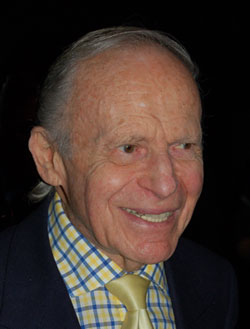
Ervin Drake (born Ervin Maurice Druckman; April 3, 1919 – January 15, 2015) was an American songwriter whose works include such American Songbook standards as "I Believe" and "It Was a Very Good Year". He wrote in a variety of styles and his work has been recorded by musicians around the world. In 1983, he was inducted into the Songwriters Hall of Fame.[1]

Biography

[edit]

Born in New York City, Drake had his first song published at age 12, in 1931. The son of Jewish immigrants[2] Max Druckman and Pearl Cohen, he attended Townsend Harris High School in the borough of Manhattan, graduating in 1935, and went on to receive a Bachelor of Arts degree in social science from the City College of New York in 1940. His elder brother, Milton Drake, also became a songwriter, with work including "Java Jive" and "Nina Never Knew"; and his younger brother Arnold Drake, became a writer for DC Comics, Marvel Comics, and others, as well as an author and playwright.[3]

Drake wrote the lyrics for "Perdido", composed by trombonist Juan Tizol, a member of Duke Ellington's orchestra, and first recorded (by Ellington) in 1944. Besides composing music and lyrics for dozens of pieces he was also a television producer and worked with performers including Jackie Gleason and Milton Berle. Among his best known songs is "I Believe", the first hit song ever introduced on television, which was written for and introduced by Jane Froman on her television show in 1953, and became a number-one hit for Frankie Laine, holding the record for number of non-consecutive weeks spent at number one in the UK. It has also been recorded by many other artists including Barbra Streisand, Elvis Presley, and Paul Anka.

Drake wrote the words and music for "It Was a Very Good Year" in 1961 when a publisher friend told him that Bob Shane of the folk and pop music group the Kingston Trio would be in the publisher's office the next morning, and the publisher asked Drake to write a song for Shane to sing solo.[4] Shane recorded it for the album Goin' Places and other folk performers covered it as well.[3] In a 2009 interview, Drake said that in 1965, Frank Sinatra had heard the Kingston Trio recording on his car radio as he was driving to his home in Palm Springs and immediately pulled over in the middle of the night to a gas station and pay phone.[5] Sinatra called his producer Gordon Jenkins and told Jenkins that he wanted an arrangement with plenty of strings and possibly an oboe as well. When Sinatra arrived back in L.A. he recorded it for his career comeback album September of My Years.[3] That recording became a Top 30 single on the U.S. Billboard Hot 100 in 1966 and made No.1 on the Adult Contemporary chart.

As a lyricist, Drake wrote the words for the jazz standard "Good Morning Heartache". It has been recorded by many artists, including Billie Holiday and later Diana Ross when she portrayed Holiday in the movie Lady Sings the Blues.[6] Gloria Estefan also recorded it for her 2013 album The Standards and sang it to Drake and wife Edith on live TV on CBS This Morning. Following the performance, Drake, Gloria and the two hosts bantered a while about love and love lost.

Drake was the founding president of American Guild of Authors and Composers from 1973 to 1982, which has since changed its name to Songwriters Guild of America.[7]

On January 15, 2015, Drake died at his home in Great Neck, New York due to complications from bladder cancer shortly before his 96th birthday.[8][9]

Awards and honors

[edit]

Drake received several honorary doctorates and achievement awards, as well as being inducted into the Songwriter's Hall of Fame in 1983.[1]

On June 30, 2013, Five Towns College named the Ervin Drake Popular Music Center after Drake.

Selected works

[edit]

Songs

[edit]
  • "Now I Have Everything"
  • "A Room without Windows"
  • "Bachelor Girl"
  • "I Believe"
  • "Good Morning Heartache"
  • "It Was a Very Good Year"
  • "The Rickety Rickshaw Man"
  • "I Wuv A Rabbit"
  • "Who Are These Strangers"
  • "I'm A Card Carrying Bleeding Heart Liberal"
  • "One God"
  • "Lying Beneath A Scrubby Palmetto"
  • "I've Never Had The Pleasure"[4][10]

English-language lyrics written for foreign-language songs

Broadway

[edit]

References

[edit]
[edit]
Revisions and contributorsEdit on WikipediaRead on Wikipedia
from Grokipedia
Ervin Drake (born Ervin Maurice Druckman; April 3, 1919 – January 15, 2015) was an American songwriter, lyricist, composer, and renowned for his enduring contributions to the and standards. Over a career spanning more than seven decades, he penned over 450 songs registered with ASCAP, often writing both lyrics and music, and collaborated with luminaries such as , , and . His works achieved massive commercial success, including multimillion-selling hits, and earned him induction into the in 1983, as well as a Grammy Award in 1966 for Song of the Year for "It Was a Very Good Year." Born in , , to a family where his mother enjoyed singing and his older brother Milton was an established songwriter, Drake—originally named Ervin Maurice Druckman—began composing music at age 12 and honed his skills while attending , from which he graduated with a , and studying at the Juilliard School of Music. After working in home-furnishings sales, he transitioned to full-time songwriting in 1941 following early successes, with his breakthrough coming in the through English-language adaptations and original compositions that captured the era's swing and pop sensibilities. Drake's most notable songs include the 1945 million-seller "The Rickety Rickshaw Man," the jazz standard "Good Morning Heartache" (co-written with Irene Higginbotham and recorded by Billie Holiday in 1946), the 1953 chart-topper "I Believe" (performed by Frankie Laine, which held the No. 1 spot for a record 18 non-consecutive weeks), and the introspective 1965 hit "It Was a Very Good Year" (made famous by Frank Sinatra). He also provided English lyrics for international favorites like "Tico-Tico" (1942) and "Perdido" (1944), which became enduring standards. Beyond music, Drake produced television programs for stars like Jackie Gleason and Milton Berle from 1948 to 1962, including the special To Mamie with Music (1956), and contributed to Broadway with the score for What Makes Sammy Run? (1964), which ran for 540 performances. In his later years, Drake served as president of the American Guild of Authors and Composers from 1973 to 1982, during which he advocated for the U.S. Copyright Law of 1976 to protect creators' rights. His songs continued to influence culture, appearing in films by and , as well as the television series . Drake died at age 95 in , from complications of , leaving a legacy as one of the most prolific and impactful figures in 20th-century American music.

Early Life and Education

Birth and Family Background

Ervin Maurice Druckman, later known professionally as Ervin Drake, was born on April 3, 1919, in , , to Jewish immigrant parents from . His father worked as a wholesale furniture dealer, managing the family home-furnishings business, while his mother was a homemaker who enjoyed singing around the house. Drake grew up in a creatively inclined family that nurtured his artistic interests. He was the middle of three brothers; his older sibling, Milton Drake, became a noted lyricist known for songs like "Mairzy Doats," and his younger brother, Arnold Drake, pursued a career as a comic book writer. The familial emphasis on writing and performance, combined with his mother's vocal hobbies, sparked Drake's early passion for music; he began composing songs for her as a child and demonstrated prodigious talent by publishing his first song at age 12. The vibrant cultural milieu of further shaped Drake's formative years, immersing him in the city's thriving and scenes from a young age. In 1940, he adopted the professional surname "Drake" to better suit his emerging career in songwriting, distancing himself from the family business his father had hoped he would join. This early environment laid the groundwork for his lifelong dedication to , leading him toward formal education in .

Formal Education

Ervin Drake graduated from in in 1935, where he began developing an interest in creative pursuits. He then attended the , earning a (BSS) degree in social sciences and in 1940. During his time there, Drake edited the college magazine Mercury and contributed to varsity shows, activities that sharpened his writing and performative abilities. In 1963, Drake enrolled at the of Music for formal studies in music theory and composition, marking a deliberate effort to deepen his musical knowledge later in life. This educational path laid a versatile foundation for Drake's career, with his early training in social sciences and fostering skills in narrative crafting and visual storytelling essential for lyric writing and production, while Juilliard studies refined his compositional techniques, enabling sophisticated integrations of music and words in his songwriting. Coming from a family with creative inclinations, including a brother who also pursued songwriting, further motivated his academic focus on the arts.

Songwriting Career

Early Works and Breakthroughs

Ervin Drake demonstrated an early aptitude for songwriting, with his first composition published in when he was just 12 years old. This initial foray into music publishing marked the beginning of a that would evolve significantly over the subsequent decades, though details on the specific title of this youthful work remain scarce in historical records. Drake's breakthrough came in the early 1940s as he began adapting and lyricizing popular instrumentals for American audiences. In 1942, he penned the English lyrics for the Brazilian "," originally composed by Zequinha de Abreu in 1917, transforming it into a hit that resonated widely during . Two years later, in 1944, Drake collaborated with Hans Lengsfelder to add lyrics to Juan Tizol's instrumental "Perdido," which had been introduced by Duke Ellington's in 1942; this version became a , with Ellington's ensemble providing the first notable recording featuring the new words. By 1945, Drake achieved his first major commercial success as a solo , composing both words and for "The Rickety Rickshaw Man," a whimsical novelty tune that captured wartime and sold over one million copies of . This hit was followed in 1946 by his lyrical contribution to "," co-written with Irene Higginbotham and Dan Fisher, a poignant that Billie recorded as one of her signature songs, elevating Drake's profile in the jazz world. Throughout the 1940s and into the 1950s, Drake transitioned from lighthearted novelty numbers like "The Rickety Rickshaw Man" to more emotionally resonant compositions, such as the heartfelt "," reflecting a maturing style influenced by his growing immersion in and scenes. This shift laid the groundwork for his later achievements, as he balanced songwriting with emerging opportunities in television production.

Major Hits and Collaborations

Ervin Drake achieved widespread commercial success in the 1950s with "I Believe," co-written with Irvin Graham, Jimmy Shirl, and Al Stillman, which became the first hit song introduced on television when commissioned for and premiered by on her program USA Canteen in 1953. The track, an inspirational ballad, sold millions of copies worldwide through various recordings, including Frankie Laine's version that reached number two on the . Its enduring appeal stemmed from its simple, faith-affirming lyrics, leading to more than 250 covers by artists such as , and cementing Drake's reputation for crafting universally resonant pop standards. In the early 1960s, Drake penned "It Was a Very Good Year" as a solo composition in 1961, initially recorded by but elevated to iconic status by Frank Sinatra's haunting interpretation on his 1965 album . Sinatra's version, with its reflective narrative of lost loves across decades, won the Grammy Award for Best Vocal Performance, Male, in 1966, highlighting Drake's skill in evoking emotional depth through introspective storytelling. The song's cultural impact extended beyond charts, influencing interpretations in and while underscoring Drake's versatility in shifting from upbeat hits to poignant ballads. Drake also contributed English lyrics to the Italian bossa nova tune "" in 1962, originally composed by and Alberto Testa, transforming it into a global staple with Pat Boone's recording reaching number 95 on the Hot 100. His adaptation retained the original's playful urgency while broadening its appeal to English-speaking audiences, resulting in covers by artists like Engelbert Humperdinck, whose 1968 version became a Top 10 hit in the UK. Among Drake's other notable successes were "A Room Without Windows," which he wrote and composed entirely, achieving popularity through Steve Lawrence's recording in the early 1960s, and "Across the Wide ," a 1951 orchestral hit for Hugo Winterhalter that peaked at number 21 on the . "Castle Rock," co-written with swing arranger , found success via and Harry James's 1947 version that climbed to number six, though its influence persisted into Drake's later collaborations. Additionally, "Father of the Girls" from 1968 marked a heartfelt family-themed hit for , reflecting Drake's ongoing ability to produce sentimental pop attuned to mid-century tastes. Throughout these works, Drake's collaborations with major artists amplified their reach and legacy; his ties to yielded multiple recordings, including "Castle Rock" and "It Was a Very Good Year," while Jane Froman's premiere of "I Believe" and Frankie Laine's chart-topping rendition underscored his pivotal role in bridging songwriting with television and recording stardom. These partnerships not only drove sales but also embedded Drake's compositions in American , with songs like "I Believe" becoming anthems for hope amid post-war optimism.

Television Production

Key Programs Produced

Ervin Drake's television production career spanned from 1948 to 1962, a period during which he produced, wrote, and composed for over 700 prime-time network programs, significantly shaping early musical variety programming on networks like and . His multifaceted role allowed him to blend songwriting talents with production, creating content that highlighted emerging performers and tunes in an era when television was rapidly expanding its entertainment offerings. Key series under Drake's production included the pioneering Sing It Again in 1948, which featured audience sing-alongs, and Songs for Sale in 1951, a showcase for unpublished compositions. He later produced The Jane Froman Show (1952–1955), The Frankie Laine Show (1955), The Mel Tormé/Teresa Brewer Show, The Merv Griffin/Betty Ann Grove Show, and the Timex Comedy Hour, blending music, comedy, and celebrity guests to attract broad audiences. He also produced programs for stars such as and . Drake also helmed high-profile specials for luminaries such as , , and , including the Ethel Merman Special and on Broadway. One notable special was To with Music (1956), a birthday salute to on . Through these endeavors, he introduced innovative songs to TV viewers, most notably premiering "I Believe"—commissioned for as a hopeful following the —on The Jane Froman Show in 1953, marking the first hit song debuted on the medium.

Innovations and Awards in TV

Ervin Drake pioneered music-variety formats in early television by blending live performances with opportunities for song promotion, creating platforms that highlighted emerging talent and songwriters directly to audiences. As a from 1948 to 1962, he developed series such as Songs for Sale and The Jane Froman Show, which were among the first to introduce new songs on air, allowing composers to present their work in a variety format that combined entertainment with commercial exposure for unpublished material. This approach marked a significant , as it transformed television into a promotional medium for songwriters, fostering the discovery and popularization of hits through live broadcasts. A landmark example of Drake's contributions was the premiere of "I Believe" on Froman Show in 1953, which became the first introduced on television and achieved widespread success, topping charts for shortly thereafter. His live specials, featuring stars like and , further boosted song popularity by integrating scripted performances with musical showcases, influencing how variety programming elevated songwriters' visibility and commercial viability in the medium. In recognition of his television achievements, Drake received the 1957 Sylvania Award for outstanding achievement as , , and co-producer of NBC's The Bachelor, honoring his multifaceted role in advancing musical content on screen. By the early , after producing over 700 prime-time programs, Drake transitioned back to full-time songwriting, applying his television insights to create enduring hits like "It Was a Very Good Year."

Broadway Contributions

What Makes Sammy Run?

What Makes Sammy Run? is a musical adaptation of Budd Schulberg's 1941 novel of the same name, which chronicles the ruthless rise of Sammy Glick, an ambitious young man from New York's determined to achieve fame in Hollywood. The novel was written by , while the musical's book was written by Budd Schulberg and his brother Stuart Schulberg; Ervin Drake composed the music and lyrics, drawing on his established songwriting expertise to create a score that propels the narrative of ambition and betrayal. The production premiered on Broadway at the 54th Street Theatre on February 27, 1964, directed by . The musical ran for 540 performances, closing on June 12, 1965, and marked a commercial success despite its mixed critical reception. made his Broadway debut in the lead role of Sammy Glick, supported by as Al Manheim, the jaded studio executive and narrator, and as Kit Sargent, Sammy's love interest. Lawrence's charismatic portrayal, nominated for a Tony Award for in a Musical, was widely credited with sustaining the show's run through his vocal prowess and stage presence. Drake's score is noted for its seamless integration with the story, using songs to advance Sammy's opportunistic journey rather than serving as standalone numbers. Key highlights include "A Room Without Windows," a poignant sung by Lawrence that reflects Sammy's longing for escape and success, and "My Hometown," an upbeat ensemble piece evoking his roots while underscoring his drive to leave them behind. These compositions, praised for their melodic craftsmanship, help illustrate the character's transformation and the cutthroat dynamics of the entertainment industry. Critically, the musical received tempered responses, with reviewers like Howard Taubman of noting its slow start but eventual spark, particularly in the performances and select songs, though faulting the overall pacing and depth compared to the source novel. Culturally, What Makes Sammy Run? captured mid-1960s fascination with Hollywood's underbelly, offering a satirical lens on ambition and celebrity that resonated amid the era's booming entertainment industry, and it remains a notable entry in Broadway's exploration of narratives.

Her First Roman

"Her First Roman" marked Ervin Drake's ambitious foray into creating a fully integrated musical, where he served as the sole author of the book, music, and lyrics, adapting George Bernard Shaw's 1898 play "Caesar and ." The production premiered on October 20, 1968, at the in , starring as and as the youthful . This multi-role involvement represented a significant creative milestone for Drake, allowing him to shape every aspect of the storytelling from script to score, a departure from his earlier collaborative songwriting efforts. The musical's themes centered on historical comedy infused with modern romantic and satirical twists, exploring the unlikely romance between the worldly Roman general and the clever 16-year-old amid political intrigue in . Set against Shaw's witty dialogue, Drake incorporated lighthearted musical numbers that blended classical references with contemporary humor, such as Cleopatra's playful encounters with Caesar and her entourage's scheming. Stylistically, the show featured upbeat, melodic songs that aimed to humanize the historical figures, with ensemble pieces evoking the grandeur of and the exoticism of the . Key songs included "Song to the Sphinx," a whimsical ode sung by Cleopatra reflecting her youthful curiosity; "Her First Roman," a duet highlighting the budding attraction between the leads; and "What Are We Doing in Egypt?," an opening number that set the comedic tone of cultural clash and adventure. Despite its innovative approach, "Her First Roman" enjoyed only a short run of 17 performances, closing on November 2, 1968, after grossing modest returns and incurring substantial losses estimated at $575,000. Critics panned the adaptation for struggling to capture Shaw's intellectual depth in a breezy musical format, with reviews citing mismatched tones between the source material's satire and Drake's more sentimental score as a primary flaw. The production also faced stiff competition from established hits like "Hair" and "Funny Girl" during the 1968-1969 Broadway season, which drew larger audiences and overshadowed its debut. While the performances of Kiley and Uggams received some praise for their charisma, the overall consensus highlighted the show's failure to gel, underscoring the challenges of musicalizing Shaw's verbose wit.

Activism and Legacy

Advocacy for Songwriters' Rights

Ervin Drake served as president of the American Guild of Authors and Composers from 1973 to 1982, a tenure during which the organization evolved and was later renamed the Songwriters Guild of America. In this leadership role, Drake spearheaded a pivotal campaign that played a key part in the passage of the 1976 U.S. Act, which enhanced songwriters' protections by extending duration to the life of the author plus 50 years and raising the statutory mechanical royalty rate from 2 cents to 2.75 cents per phonorecord (or ½ cent per minute of playing time, whichever was greater). The act also established the Copyright Royalty Tribunal to adjudicate royalty disputes, providing a mechanism for fairer compensation adjustments over time. Drake's efforts as a founding leader in revitalizing the focused on advocating for equitable compensation for songwriters across television, radio, and sectors, informed briefly by his background in television production. He championed negotiations with broadcasters and publishers to achieve more lucrative contracts and improved royalty terms, strengthening songwriters' economic rights in an evolving media landscape.

Awards and Honors

Ervin Drake was inducted into the in 1983, recognizing his enduring contributions to American popular music as a and . This honor highlighted his role in crafting timeless standards such as "I Believe" and "It Was a Very Good Year," which had become staples in the . In 2011, Drake received the Towering Song Award from the for "It Was a Very Good Year," acknowledging the song's profound cultural impact and its evolution into a reflective anthem popularized by Frank Sinatra's 1965 recording. The award underscored the composition's lyrical depth, capturing themes of and passage of time that resonated across generations. Drake was inducted into the Long Island Music and Entertainment Hall of Fame in 2012. Drake's achievements in music were further celebrated through the naming of the Ervin Drake Popular Music Center at on June 30, 2013, during a dedication ceremony that featured performances honoring his legacy. This facility, part of the college's performing arts campus in , serves as a hub for and reflects his influence on aspiring songwriters and performers. Throughout his career, Drake garnered multiple achievement awards, including the 2012 Lifetime Achievement Award from the Association of Cabarets & Clubs (MAC), presented in recognition of his multifaceted contributions to and popular songcraft. Additionally, in 2013, the Songwriters Guild of America bestowed upon him a Lifetime Achievement Award for his leadership in advancing creators' rights and his prolific output of enduring works.

Personal Life and Death

Family and Later Years

Ervin Drake married Edith Bein, known professionally as Edith Bermaine, in 1982, and the couple shared a devoted partnership that lasted over three decades. They resided long-term in , where Drake enjoyed a stable family life surrounded by his loved ones. From his first marriage to Ada Sax in 1947, Drake had two daughters, Linda Bivona and Rodrigues, who remained close to him in his later years; he also had a stepson, Jed Berman, from his wife's previous marriage. This family support underpinned his career longevity, allowing him to maintain creative pursuits well into his ninth decade. Despite advancing age, Drake continued writing songs into the 2000s, demonstrating his enduring passion for lyricism. In 2004, he penned "I'm a Card-Carrying Bleeding Heart Liberal," a politically themed piece that reflected his progressive views and was later performed in settings. He balanced these professional endeavors with family responsibilities, often drawing inspiration from his while building his legacy through archival efforts and public appearances celebrating his catalog. In his later years, Drake faced significant health challenges, including bladder cancer, which tested his resilience but did not diminish his engagement with the music world. His family provided crucial emotional support during this period, enabling him to focus on philanthropy and mentoring initiatives in music education. As a board member of the Johnny Mercer Foundation, Drake contributed to programs that nurtured young songwriters through fellowships, intensives, and educational resources aimed at fostering the next generation of creators. These efforts highlighted his commitment to preserving and advancing songwriting as an art form, even as he navigated personal difficulties with the steadfast backing of his wife and daughters.

Death and Posthumous Recognition

Ervin Drake passed away on January 15, 2015, at his home in Great Neck, New York, at the age of 95, due to complications from bladder cancer. Following his death, tributes poured in from the music industry, highlighting his enduring impact. The Songwriters Hall of Fame, where Drake was a 1983 inductee, issued a statement praising his "wit, style, and legacy," noting that he was "a true gentleman and a great friend to so many in our community." Performers including Natalie Douglas and Carol Woods honored him with renditions of his songs at Birdland shortly after his passing, underscoring the immediate emotional resonance of his catalog among contemporaries. While specific funeral details were kept private, donations in his memory were directed to the Lustgarten Foundation for pancreatic cancer research, reflecting his commitment to health causes in later years. In the years since, Drake's songs have continued to receive widespread performances, cementing their place as staples of the ; for instance, "It Was a Very Good Year" remains a frequent choice in and sets, as evidenced by ongoing recordings and live interpretations by artists evoking the Sinatra era (as of 2025). Archival efforts have preserved his contributions, including reissues of Broadway cast albums like What Makes Sammy Run? and compilations featuring his standards alongside other mid-20th-century icons. Music histories frequently cite him as a key figure in post-war popular songcraft, with entries in resources like the profiles emphasizing his lyrical depth and melodic innovation.

References

Add your contribution
Related Hubs
User Avatar
No comments yet.