
Recent from talks
Estrogen receptor alpha
Knowledge base stats:
Talk channels stats:
Members stats:
Estrogen receptor alpha
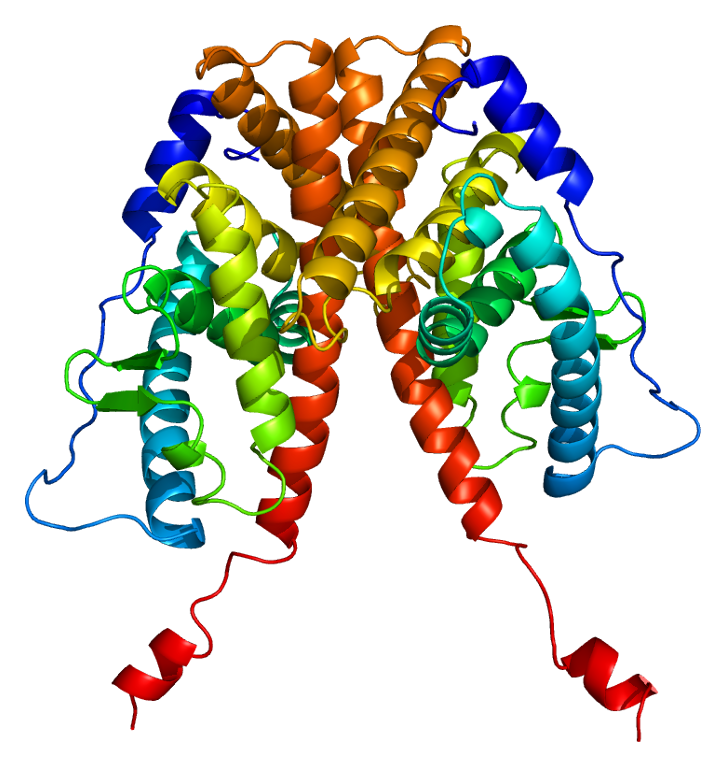
Estrogen receptor alpha (ERα), also known as NR3A1 (nuclear receptor subfamily 3, group A, member 1), is one of two main types of estrogen receptor, a nuclear receptor (mainly found as a chromatin-binding protein) that is activated by the sex hormone estrogen. In humans, ERα is encoded by the gene ESR1 (EStrogen Receptor 1).
The estrogen receptor (ER) is a ligand-activated transcription factor composed of several domains important for hormone binding, DNA binding, and activation of transcription. Alternative splicing results in several ESR1 mRNA transcripts, which differ primarily in their 5-prime untranslated regions. The translated receptors show less variability.
Agonists of ERα selective over ERβ include:
Antagonists of ERα selective over ERβ include:
ERα plays a role in the physiological development and function of a variety of organ systems to varying degrees, including the reproductive, central nervous, skeletal, and cardiovascular systems. Accordingly, ERα is widely expressed throughout the body, including the uterus and ovary, male reproductive organs, mammary gland, bone, heart, hypothalamus, pituitary gland, liver, lung, kidney, spleen, and adipose tissue. The development and function of these tissues is disrupted in animal models lacking active ERα genes, such as the ERα knockout mouse (ERKO), providing a preliminary understanding of ERα function at specific target organs.
ERα is essential in the maturation of the female reproductive phenotype. In the absence of ERα, the ERKO mouse develops an adult uterus, indicating that ERα may not mediate the initial growth of the uterus. However, ERα plays a role in the completion of this development, and the subsequent function of the tissue. Activation of ERα is known to trigger cell proliferation in the uterus. The uterus of female ERKO mice is hypoplastic, suggesting that ERα mediates mitosis and differentiation in the uterus in response to estrogen stimulation.
Similarly, prepubertal female ERKO mice develop ovaries that are nearly indistinguishable from those of their wildtype counterparts. However, as the ERKO mice mature they progressively present an abnormal ovarian phenotype in both physiology and function. Specifically, female ERKO mice develop enlarged ovaries containing hemorrhagic follicular cysts, which also lack the corpus luteum, and therefore do not ovulate. This adult ovarian phenotype suggests that in the absence of ERα, estrogen is no longer able to perform negative feedback on the hypothalamus, resulting in chronically elevated LH levels and constant ovarian stimulation. These results identify a pivotal role for ERα in the hypothalamus, in addition to its role in the estrogen-driven maturation through theca and interstitial cells of the ovary.
ERα is similarly essential in the maturation and maintenance of the male reproductive phenotype, as male ERKO mice are infertile and present undersized testes. The integrity of testicular structures of ERKO mice, such as the seminiferous tubules of the testes and the seminiferous epithelium, declines over time. Furthermore, the reproductive performance of male ERKO mice is hindered by abnormalities in sexual physiology and behavior, such as impaired spermatogenesis and loss of intromission and ejaculatory responses.
Hub AI
Estrogen receptor alpha AI simulator
(@Estrogen receptor alpha_simulator)
Estrogen receptor alpha
Estrogen receptor alpha (ERα), also known as NR3A1 (nuclear receptor subfamily 3, group A, member 1), is one of two main types of estrogen receptor, a nuclear receptor (mainly found as a chromatin-binding protein) that is activated by the sex hormone estrogen. In humans, ERα is encoded by the gene ESR1 (EStrogen Receptor 1).
The estrogen receptor (ER) is a ligand-activated transcription factor composed of several domains important for hormone binding, DNA binding, and activation of transcription. Alternative splicing results in several ESR1 mRNA transcripts, which differ primarily in their 5-prime untranslated regions. The translated receptors show less variability.
Agonists of ERα selective over ERβ include:
Antagonists of ERα selective over ERβ include:
ERα plays a role in the physiological development and function of a variety of organ systems to varying degrees, including the reproductive, central nervous, skeletal, and cardiovascular systems. Accordingly, ERα is widely expressed throughout the body, including the uterus and ovary, male reproductive organs, mammary gland, bone, heart, hypothalamus, pituitary gland, liver, lung, kidney, spleen, and adipose tissue. The development and function of these tissues is disrupted in animal models lacking active ERα genes, such as the ERα knockout mouse (ERKO), providing a preliminary understanding of ERα function at specific target organs.
ERα is essential in the maturation of the female reproductive phenotype. In the absence of ERα, the ERKO mouse develops an adult uterus, indicating that ERα may not mediate the initial growth of the uterus. However, ERα plays a role in the completion of this development, and the subsequent function of the tissue. Activation of ERα is known to trigger cell proliferation in the uterus. The uterus of female ERKO mice is hypoplastic, suggesting that ERα mediates mitosis and differentiation in the uterus in response to estrogen stimulation.
Similarly, prepubertal female ERKO mice develop ovaries that are nearly indistinguishable from those of their wildtype counterparts. However, as the ERKO mice mature they progressively present an abnormal ovarian phenotype in both physiology and function. Specifically, female ERKO mice develop enlarged ovaries containing hemorrhagic follicular cysts, which also lack the corpus luteum, and therefore do not ovulate. This adult ovarian phenotype suggests that in the absence of ERα, estrogen is no longer able to perform negative feedback on the hypothalamus, resulting in chronically elevated LH levels and constant ovarian stimulation. These results identify a pivotal role for ERα in the hypothalamus, in addition to its role in the estrogen-driven maturation through theca and interstitial cells of the ovary.
ERα is similarly essential in the maturation and maintenance of the male reproductive phenotype, as male ERKO mice are infertile and present undersized testes. The integrity of testicular structures of ERKO mice, such as the seminiferous tubules of the testes and the seminiferous epithelium, declines over time. Furthermore, the reproductive performance of male ERKO mice is hindered by abnormalities in sexual physiology and behavior, such as impaired spermatogenesis and loss of intromission and ejaculatory responses.
Recent media