


Community hub
Recent from talks
Contribute something
Nothing was collected or created yet.
AC power plugs and sockets
View on Wikipedia


| Electrical installations |
|---|
| Wiring practice by region or country |
| Regulation of electrical installations |
| Cabling and accessories |
| Switching and protection devices |
AC power plugs and sockets connect devices to mains electricity to supply them with electrical power. A plug is the connector attached to an electrically operated device, often via a cable. A socket (also known as a receptacle or outlet) is fixed in place, often on the internal walls of buildings, and is connected to an AC electrical circuit. Inserting ("plugging in") the plug into the socket allows the device to draw power from this circuit.
Plugs and wall-mounted sockets for portable appliances became available in the 1880s, to replace connections to light sockets. A proliferation of types were subsequently developed for both convenience and protection from electrical injury. Electrical plugs and sockets differ from one another in voltage and current rating, shape, size, and connector type. Different standard systems of plugs and sockets are used around the world, and many obsolete socket types are still found in older buildings.
Coordination of technical standards has allowed some types of plug to be used across large regions to facilitate the production and import of electrical appliances and for the convenience of travellers. Some multi-standard sockets allow use of several types of plug. Incompatible sockets and plugs may be used with the help of adaptors, though these may not always provide full safety and performance.
Overview of connections
[edit]Single-phase sockets have receptacles for two power pins, one to carry the electrical current from the power source to the connected device (called live, line, or phase pin) and another one to carry it back to the power source (called neutral pin). Many sockets have a third receptacle or pin for a safety connection to earth ground. The plug is a male connector, usually with protruding pins that match the receptacles (female contacts) in a socket. Some plugs also have a female contact, used only for the earth ground connection. Typically no energy is supplied to any exposed pins or terminals on the socket, hence the power pins are always part of the plug rather than the socket. In addition to the recessed contacts of the energised socket, plug and socket systems often have other safety features to reduce the risk of electric shock or damage to appliances.
History
[edit]When commercial electric power was first introduced in the 1880s, it was used primarily for lighting. Other portable appliances (such as vacuum cleaners, electric fans, smoothing irons, and curling-tong heaters) were connected to light-bulb sockets.[1] As early as 1885 a two-pin plug and wall socket format was available on the British market. By about 1910 the first three-pin earthed (grounded) plugs appeared. Over time other safety improvements were gradually introduced to the market. One of the first national standards for plugs and wall sockets was enacted in 1915 in the UK.[2][3]
Safety features
[edit] | This section needs additional citations for verification. (May 2021) |
Protection from accidental contact
[edit]Designs of plugs and sockets have gradually developed to reduce the risk of electric shock and fire. Plugs are shaped to prevent bodily contact with live parts. Sockets may be recessed and plugs designed to fit closely within the recess to reduce risk of a user contacting the live pins. Contact pins may be sheathed with insulation over part of their length, so as to reduce exposure of energized metal during insertion or removal of the plug. Sockets may have automatic shutters to stop foreign objects from being inserted into energized contacts.[4] Sockets are often set into a surround which prevents accidental contact with the live wires in the wall behind it. Some also have an integrated cover (e.g. a hinged flap) covering the socket itself when not in use, or a switch to turn off the socket.
Overcurrent protection
[edit]Some plugs, particularly the British type G outlet, have a built-in fuse which breaks the circuit if too much current flows.[5]
Earthing (grounding)
[edit]A third contact for a connection to earth is intended to protect against insulation failure of the connected device. Some early unearthed plug and socket types were revised to include an earthing pin or phased out in favour of earthed types. The plug is often designed so that the earth ground contact connects before the energized circuit contacts. The assigned IEC appliance class is governed by the requirement for earthing or equivalent protection. Class I equipment requires an earth contact in the plug and socket, while Class II equipment is unearthed and protects the user with double insulation.
Polarisation
[edit]Where a "neutral" conductor exists in supply wiring, polarisation of the plug can improve safety by preserving the distinction in the equipment. For example, appliances may ensure that switches interrupt the live side of the circuit, or can connect the shell of a screw-base lampholder to neutral to reduce electric shock hazard. In some designs, polarised plugs cannot be mated with non-polarised sockets. In most NEMA 1 plugs, for example, the neutral blade is slightly wider than the hot blade, so it can only be inserted one way. Wiring systems where both circuit conductors have a significant potential with respect to earth do not benefit from polarised plugs.
Voltage rating of plugs and power cords
[edit]
Plugs and power cords have a rated voltage and current assigned to them by the manufacturer. Using a plug or power cord that is inappropriate for the load may be a safety hazard. For example, high-current equipment can cause a fire when plugged into an extension cord with a current rating lower than necessary. Sometimes the cords used to plug in dual voltage 120 V / 240 V equipment are rated only for 125 V, so care must be taken by travellers to use only cords with an appropriate voltage rating.
Extension
[edit]
Various methods can be used to increase the number or reach of sockets.
Extension cords
[edit]Extension cords (extension leads) are used for temporary connections when a socket is not within convenient reach of an appliance's power lead. This may be in the form of a single socket on a flexible cable or a power strip with multiple sockets. A power strip may also have switches, surge voltage protection, or overcurrent protection.
Multisocket adaptors
[edit]-
 A French CEE 7 adaptor
 -
 An old US non-polarized multisocket adaptor

.jpg)
Multisocket adaptors (or "splitters") allow the connection of two or more plugs to a single socket. They are manufactured in various configurations, depending on the country and the region in which they are used, with various ratings. This allows connecting more than one electrical consumer item to one single socket and is mainly used for low power devices (TV sets, table lamps, computers, etc.).
They are usually rated for 6 A, 10 A, or 16 A at 250 V or for 15 A or less at 125 V. This is the general rating of the adaptor, and indicates the maximum total load in amperes, regardless of the number of sockets used (for example, if a 16 A 250 V adaptor has four sockets, it would be fine to plug four different devices into it that each consume 2 A as this represents a total load of only 8 A, whereas if only two devices were plugged into it that each consumed 10 A, the combined 20 A load would overload the circuit).
In some countries such adaptors are banned and are not available in shops, as they may lead to fires due to overloading them or can cause excessive mechanical stress to wall-mounted sockets. Adaptors can be made with ceramic, Bakelite, or other plastic bodies.
Cross-compatibility
[edit]Hybrid and universal sockets
[edit]-
![A so-called "universal socket", which meets no official standard[6] but is intended to accept a number of different plug types](//upload.wikimedia.org/wikipedia/commons/thumb/8/8b/Multi_plug.jpg/250px-Multi_plug.jpg) A so-called "universal socket", which meets no official standard[6] but is intended to accept a number of different plug types
A so-called "universal socket", which meets no official standard[6] but is intended to accept a number of different plug types -
 An earthed Thai socket that complies with figure 4 of TIS 166-2549. Although it accepts NEMA plugs, the Thai voltage is 220 V and thus is electrically incompatible with devices designed only for 120 V.
 -
 Chinese dual socket accepting both unearthed two-pin (upper) and earthed three-pin (lower) plugs
![A so-called "universal socket", which meets no official standard[6] but is intended to accept a number of different plug types](https://en.wikipedia.org/wiki/File:Multi_plug.jpg)


"Hybrid", "multi-standard", or "universal" sockets are intended to accommodate plugs of two or more types. In some jurisdictions, they violate safety standards for sockets.[7][8] Safety advocates, the United States Army,[9] and a manufacturer of sockets[10] point out a number of safety issues with universal socket and adaptors, including voltage mismatch, exposure of live pins, lack of proper earth ground connection, or lack of protection from overload or short circuit. Universal sockets may not meet technical standards for durability, plug retention force, temperature rise of components, or other performance requirements, as they are outside the scope of national and international technical standards.[11]
A technical standard may include compatibility of a socket with more than one form of plug. The Thai dual socket is specified in figure 4 of TIS 166-2549 and is designed to accept Thai plugs, and also Type A, B, and C plugs. Chinese dual sockets have both an unearthed socket complying with figure 5 of GB 1002-2008 (both flat pin and 4.8 mm round pin), and an earthed socket complying with figure 4 of GB 1002-2008. The latter was removed from the 2021 revision of the Chinese standard,[12] but such dual sockets can still be found in many existing installations.
Such Thai or Chinese dual sockets also accept plugs normally fitted to 120 V appliances (e.g. 120 V rated NEMA 1-15 ungrounded plugs). This can cause an electrical incompatibility, since both countries supply residential power at 220 V. These dual sockets also accept French and Schuko plugs (Types E and F), but unsafely: no earth contact is established and live pins may be exposed when a plug is partially inserted.[13]
Swappable cables and plugs
[edit]

Commonly, manufacturers provide an IEC 60320 inlet on an appliance, with a detachable power cord (mains flex lead) and appropriate plug in order to avoid manufacturing whole appliances, with the only difference being the type of plug. Alternatively, the plug itself can often be swappable using standard or proprietary connectors.
Travel adaptors
[edit]
Adaptors between standards are not included in most standards, and as a result they have no formal quality criteria defined. Physical compatibility does not ensure that the appliance and socket match in frequency or voltage. Adaptors allow travellers to connect devices to foreign sockets, but do not change voltage or frequency. A voltage converter is required for electrical compatibility in places with a different voltage than the device is designed for. Mismatch in frequency between supply and appliances may still cause problems even at the correct voltage. Some appliances have a switch for the selection of voltage. Many modern devices use AC adapters that accept 100–240 V voltage at 50 or 60 Hz, meaning they can be used anywhere in the world as long as a suitable plug adapter is used.
Standard types in present use
[edit]
A • B, A • C • D, M • E, C • F, C • G • H, C • I • J, C • K, C • L, C • N, C
The plugs and sockets used in a given area are regulated by local governments.
The International Electrotechnical Commission (IEC) maintains a guide with letter designations for generally compatible types of plugs,[14] which expands on earlier guides published by the United States Department of Commerce. This is a de facto naming standard and guide to travellers. Some letter types correspond to several current ratings or different technical standards, so the letter does not uniquely identify a plug and socket within the type family, nor guarantee compatibility. Physical compatibility of the plug and socket does not ensure correct voltage, frequency, or current capacity. Not all plug and socket families have letters in the IEC guide, but those that have are noted in this article, as are some additional letters commonly used by retail vendors.[15]
In Europe, CENELEC publishes a list of approved plug and socket technical standards used in the member countries.[16]
Australasian AS/NZS 3112 and compatible plugs (Type I)
[edit]A number of countries in Oceania as well as China and Argentina use a plug that has two flat pins at an angle, forming a V-shape, as well as a flat vertical grounding pin. While the exact pin dimensions and the polarity vary between different countries, these plugs and sockets are all compatible to each other and are known as Type I.
Argentina IRAM 2073 and 2071
[edit]
The plug and socket system used in Argentina is defined by several standards of the Argentine Normalization and Certification Institute (IRAM). IRAM 2071 defines two sockets that have the same form factor, but differ in size and rating.[17] The smaller, more common socket is rated for 10 A. The larger variant, rated for 20 A, is mostly used for higher-power appliances such as air conditioners. IRAM 2073 defines the corresponding plugs used for Class I appliances (that require earthing).[18] The plug and socket system has an earthing pin and two flat current-carrying pins forming an inverted V-shape (120°).
The pins for the 10 A version measure 6.25 by 1.55 mm (0.246 by 0.061 in). The power pins are set at 30° to the vertical with a distance of 7.92 mm (0.312 in) from their centres to the centre of the plug; they are 18.2 mm (0.717 in) long. The earthing pin is 21.4 mm (0.843 in) long and placed below the plug centre at a distance of 10.31 mm (0.406 in). The pins of the 20 A version are larger – 8.0 by 1.9 mm (0.315 by 0.075 in) – and placed further away from the centre of the plug – 9.53 mm (0.375 in) for the power pins, 11.1 mm (0.437 in) for the earthing pin. At 21.8 mm (0.858 in), the earthing pin is a bit longer, while the power pins are a bit shorter at 17.8 mm (0.701 in).
There is also an unearthed version of the 10 A plug, defined by IRAM 2063, that lacks an earthing pin and can be used with Class II appliances.[19] 20 A plugs, on the other hand, must always provide earthing.
Insulating sleeves around the upper parts of the power pins are allowed, but not required. When used, they significantly reduce the risk of electric shock from accidentally touching the pins of a partially inserted plug. Because the pins of the 20 A plug are placed farther apart than those of the 10 A plug, the two Argentine plug types are mutually incompatible. It is not possible to insert a 20 A plug into a 10 A socket or vice versa.[20]
The most important difference from the Australasian and Chinese plugs is that the Argentine plug is wired with the live and neutral contacts reversed.[21] In Argentina, when the earth contact is positioned downward, the live (line) contact is on the right side of the socket,[20] while in Australasia and China it is on the left (assuming the same orientation).
In Brazil, Type I–style plugs and sockets are still commonly used in old installations for high-power appliances like air conditioners, dishwashers, and household ovens. These are often called "Argentine plugs" and are indeed physically identical to the IRAM plugs rated for 20 A, though they might have been developed independently on the basis of the American NEMA 10-20 standard (which uses the same form factor). While these plugs are sometimes used for normal single-phase power and wired in the same way as in Argentina, some are wired for split-phase power with two "hot" (or phase) wires and a neutral wire, but no earth connection. Care must therefore be taken that the same wiring scheme is used in the socket and in the plug, since otherwise the equipment would surely be damaged. In newer installations, the 20 A version of the Type N plug, adopted by Brazil as national standard NBR 14136, is generally preferred.[22]
Australian/New Zealand standard AS/NZS 3112
[edit]-
 Australasian switched three-pin (10 A) dual socket outlet, the most commonly found variant

-
 Standard Australian 10 A power plug with insulated pins

-
 10 A, 15 A, 20 A, 25 A, and 32 A single-phase sockets. Each socket accepts plugs of equal or lesser current rating.

This Australian/New Zealand standard is used in Australia, New Zealand, Fiji, Tonga, Solomon Islands, and Papua New Guinea.[23] The plug shape and basic dimensions are identical to the 10 A plug used in Argentina. The Australasian standard defines a series of plugs and sockets for devices drawing up to 10, 15, 20, 25 and 32 A that are one-way compatible. All sockets accept plugs of equal or lower current ratings, but not higher. For example, a 10 A plug will fit all sockets but a 20 A plug will fit only 20, 25 and 32 A sockets.
In all plugs, the power pins are set at 30° to the vertical with a distance of 7.92 mm (0.312 in) from their centres to the centre of the plug, while the earthing pin is placed below the plug centre at a distance of 10.31 mm (0.406 in) – exactly the same dimensions as used by the Argentine 10 A plug. The three flat pins all measure 6.35 by 1.63 mm (0.250 by 0.064 in) – very slightly larger than in Argentina. The length of the power pins is 17.06 mm (0.672 in), while the earthing pin has a length of 19.94 mm (0.785 in) – somewhat shorter than in Argentina.
In the 15 A plug, the height of the earth pin is increased from 6.35 to 9.08 mm (0.357 in), while the dimensions of the power pins remain the same. In the 20 A plug, however, their height is increased in the same way, so that the surface dimensions of the three pins are again identical. In the 25 A version, the earthing pin takes the shape of an inverted L (an extra bar is added at the top end), and in the 32 A version it takes the shape of a sideways U (extra bars are added at both ends).
In general, only 10 A and 15 A socket outlets are likely to be encountered in domestic or commercial installations. 20 A sockets are rare and higher rated ones are very rare. An unearthed version of the 10 A plug with two angled power pins but no earthing pin is used with double-insulated appliances, but sockets and higher-rated plugs always include an earth contact. In New Zealand, PDL 940 "tap-on" or "piggy-back" plugs are available which allow a second 10 A plug to be fitted to the rear of the plug. In Australia these piggy-back plugs are now available only on pre-made extension leads.
A novel feature of modern Australian socket outlets is a snap-fitting surround for the socket, covering the screws that affix the socket to the wall, and extending all the way around the socket periphery. Australia is unique in having electrical rules that stipulate that only licensed electricians may remove the socket from the wall, so the easily removed outer cover facilitates repainting the wall without exposing power and incurring the expense of engaging an electrician to remove and replace the sockets.
Australia's standard plug/socket system was originally codified as standard C112 (floated provisionally in 1937, and adopted as a formal standard in 1938), which was based on a design patented by Harvey Hubbell and was superseded by AS 3112 in 1990. The requirement for insulated pins was introduced in the 2004 revision.[24] The current version is AS/NZS 3112:2017.[25]
China GB 2099.1 and GB 1002 (Type A & I)
[edit]
The standard for Mainland Chinese plugs and sockets (excluding Hong Kong and Macau) is set out in GB 2099.1 and GB 1002. As part of China's commitment for entry into the WTO, the new CPCS (Compulsory Product Certification System) has been introduced, and compliant Chinese plugs have been awarded the CCC Mark by this system. The plugs are three-wire, earthed, rated for 10 or 16 A, 250 V, and are chiefly used for Class I applications. The pins of the 10 A version are 1.5 mm (0.059 in) thick by 6.4 mm (0.252 in) wide; the centres of the power pins are placed 7.9 mm (0.311 in) from the plug centre, while the centre of the earth pin is 10.3 mm (0.406 in) away. In both plug types, the live and neutral pins are 18 mm (0.709 in) long, while the earth pin is 21 mm (0.827 in) long. This makes the 10 A version compatible with Argentine and Australasian 10 A sockets, as their dimensions are nearly identical.[26]
Except for the pin length, all dimensions of the 16 A version are slightly larger. Its pins are 1.8 by 8.1 mm (0.071 by 0.319 in); the centres of the power pins are placed 9.55 mm (0.376 in) from the plug centre, while the centre of the earth pin is 11.1 mm (0.437 in) away.[26] This makes this plug compatible with the 20 A sockets used in Argentina. It is, however, incompatible with Chinese 10 A sockets as well as all Australasian sockets because of the different pin spacing.
Many three-pin sockets in China include a physical lockout preventing access to the active and neutral terminals unless an earth pin (which is slightly longer than the other two pins) is entered first. Hence such sockets will not accept the 10 A-rated unearthed Class II plugs sold in Argentina and Australasia. The Chinese 16 A plug exists, however, also in an unearthed Class II variant that includes an unwired dummy earth pin used only to open shutter. No such variant exists of the 10 A plug.[26]
China also uses American/Japanese NEMA 1-15 sockets and plugs for Class II appliances (however, polarized plugs with one prong wider than the other are not accepted). Older versions of GB 1002 also defined a socket type that accepts Europlugs (type C), but this hybrid socket was removed from the 2021 revision of the standard.[12] The voltage at a Chinese socket of any type is 220 V.
In China, sockets typically have the earth contact above the power pins, while in Argentina and Australasia it is usually positioned below them. While Australasian plugs have insulating sleeves around the upper part of their power pins, that is not the case for most existing Chinese plugs, hence their pins may become live while there is still a large enough gap between the faces of the plug and socket to allow a finger to touch the pin. Since 2022, insulating sleeves are also allowed on plugs sold in China;[27] they will be mandatory from 2027.[28]
British and compatible standards
[edit]The polarity of all grounded British sockets is standardized: earth is at the top and live is at the right of the socket. This convention is also followed in other countries using these plugs and sockets.[29]
BS 546 and related types (Type D and M)
[edit]
BS 546, "Two-pole and earthing-pin plugs, socket-outlets and socket-outlet adaptors for AC (50-60 Hz) circuits up to 250 V" describes four sizes of plug rated at 2 A, 5 A (Type D), 15 A (Type M) and 30 A. The plugs have three round pins arranged in a triangle, with the larger top pin being the earthing pin. The plugs are polarised and unfused. Plugs are non-interchangeable between current ratings. Introduced in 1934, the BS 546 type has mostly been displaced in the UK by the BS 1363 standard. According to the IEC,[30] some 40 countries use Type D and 15 countries use Type M. Some, such as India and South Africa, use standards based on BS 546.
BS 1363 (Type G)
[edit]-
 BS 1363 sockets
 -
 BS 1363 plug with fuse compartment visible


BS 1363 "13 A plugs, socket-outlets, adaptors and connection units"[31] is the main plug and socket type used in the United Kingdom. According to the IEC[14] it is also used in over 50 countries worldwide. Some of these countries have national standards based on BS 1363, including: Bahrain, Hong Kong,[32] Ireland, Cyprus, Macau, Malaysia, Malta, Saudi Arabia, Singapore, Sri Lanka, and UAE.
This plug has three rectangular pins forming an isosceles triangle. The BS 1363 plug has a fuse rated to protect its flexible cord from overload and consequent fire risk. Modern appliances may only be sold with a fuse of the appropriate size pre-installed.
BS 4573 (UK shaver)
[edit]
The United Kingdom, Ireland, and Malta use the BS 4573 two-pin plug and socket for electric shavers and toothbrushes.[33] The plug has insulating sleeves on the pins. Although similar to the Europlug Type C, the diameter and spacing of the pins are slightly different and hence it will not fit into a Schuko socket. There are, however, two-pin sockets and adaptors which will accept both BS 4573 and Europlugs.
CEE 7 standard
[edit]
The International Commission on the Rules for the Approval of Electrical Equipment (IECEE) was a standards body which published Specification for plugs and socket-outlets for domestic and similar purposes as CEE Publication 7 in 1951. It was last updated by Modification 4 in March 1983.[34] CEE 7 consists of general specifications and standard sheets for specific connectors.
Standard plugs and sockets based on two round pins with centres spaced at 19 mm are in use in Europe, most of which are listed in IEC/TR 60083 "Plugs and socket-outlets for domestic and similar general use standardized in member countries of IEC."[35] EU countries each have their own regulations and national standards; for example, some require child-resistant shutters, while others do not. CE marking is neither applicable nor permitted on plugs and sockets.
CEE 7/1 unearthed socket and CEE 7/2 unearthed plug
[edit]CEE 7/1 unearthed sockets accept CEE 7/2 round plugs with 4.8 by 19 mm (0.189 by 0.748 in) pins. Because they have no earth connections they have been or are being phased out in most countries. Some countries still permit their use in dry areas, while others allow their sale for replacements only. Older sockets are so shallow that it is possible to accidentally touch the live pins of a plug. CEE 7/1 sockets also accept CEE 7/4, CEE 7/6 and CEE 7/7 plugs without providing an earth connection. The earthed CEE 7/3 and CEE 7/5 sockets do not allow insertion of CEE 7/2 unearthed round plugs.
CEE 7/3 socket and CEE 7/4 plug (German "Schuko"; Type F)
[edit]_socket-outlets,_with_and_without_shutters.jpg)
The CEE 7/3 socket and CEE 7/4 plug are commonly called Schuko, an abbreviation for Schutzkontakt, Protective contact to earth ("Schuko" itself is a registered trademark of a German association established to own the term). The socket has a circular recess with two round holes and two earthing clips that engage before live pin contact is made. The pins are 4.8 by 19 mm (0.189 by 0.748 in). The Schuko system is unpolarised, allowing live and neutral to be reversed. The socket accepts Europlugs and CEE 7/17 plugs and also includes CEE 7/7. It is rated at 16 A. The current German standards are DIN 49441 and DIN 49440. The standard is used in Germany and several other European countries and on other continents. Some countries require child-proof socket shutters; the DIN 49440 standard does not have this requirement.
The plug is used in most European countries and in some others, including South Korea and Uruguay.[14] The European countries not using it at all are Belgium, Czech Republic, Cyprus, Ireland, Liechtenstein, Switzerland, and the UK; those not using it predominantly are Denmark, Faroe Islands, France, Italy, Monaco, San Marino, Slovakia.
CEE 7/5 socket and CEE 7/6 plug (French; Type E)
[edit]

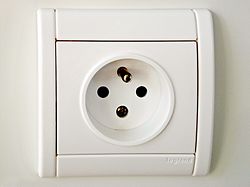
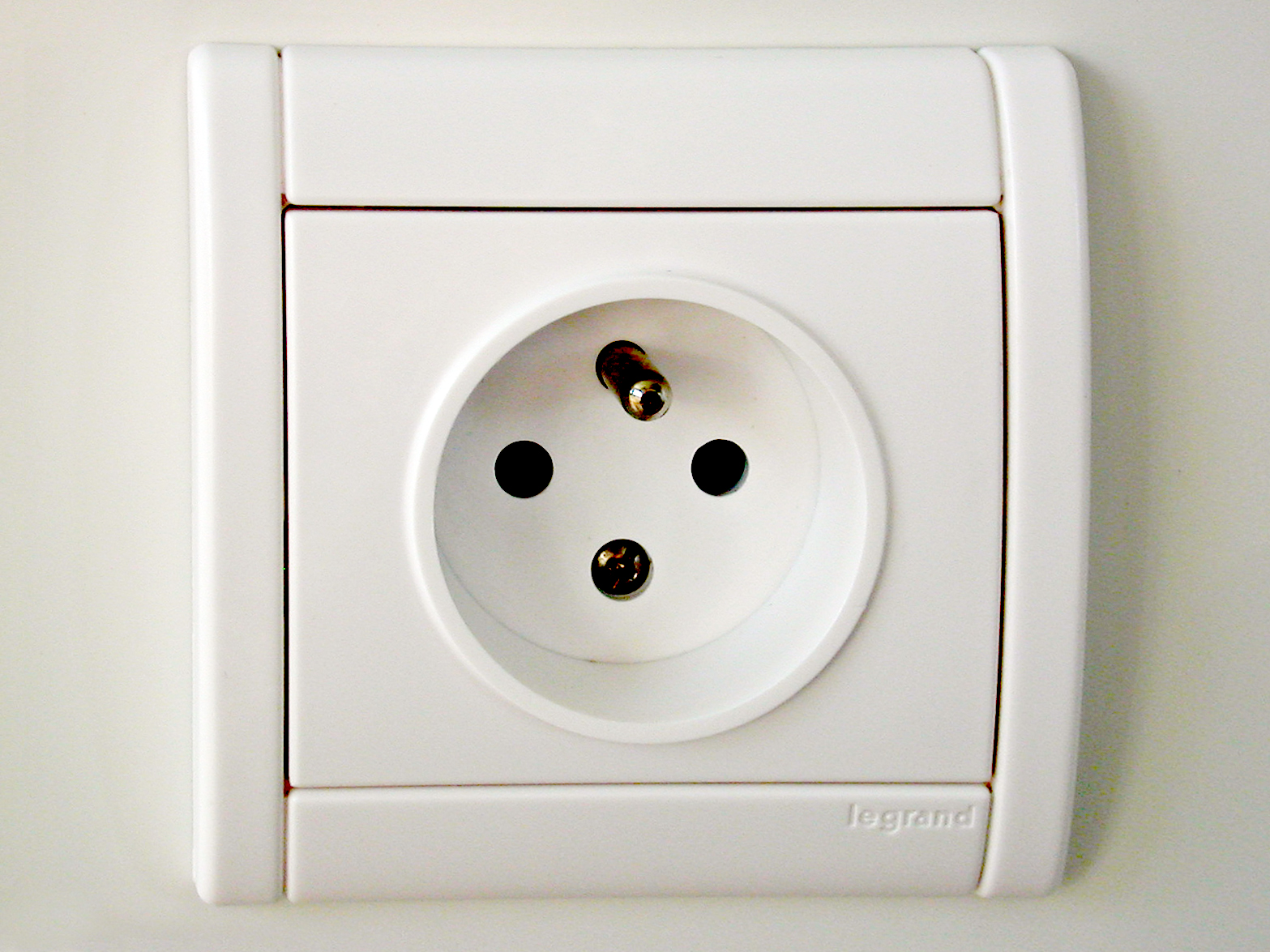
French standard NF C 61-314 defines the CEE 7/5 socket and CEE 7/6 plug, (and also includes CEE 7/7, 7/16 and 7/17 plugs). The socket has a circular recess with two round holes. The round earth pin projecting from the socket connects before the energized contacts touch. The earth pin is centred between the apertures, offset by 10 mm (0.394 in). The plug has two round pins measuring 4.8 by 19 mm (0.189 by 0.748 in), spaced 19 mm (0.748 in) apart and with an aperture for the socket's projecting earth pin. This standard is also used in Belgium, Poland, the Czech Republic, Slovakia and some other countries.
Although the plug is polarised, CEE 7 does not define the placement of the live and neutral, and different countries have conflicting standards for that. For example, the French standard NF C 15-100 requires live to be on the right side, while Czech standard ČSN 33 2180 requires it to be on the left side of a socket. Thus, a French plug when plugged into a Czech socket (or a Czech plug when plugged into a French socket) will always have its polarity reversed, with no way for the user to remedy this situation apart from rewiring the plug. One approach for resolving this situation is taken in Poland, where CEE 7/5 sockets are typically installed in pairs, the upper (upside-down) one having the "French" polarity and the lower one having the "Czech" polarity, so that the user can choose what to plug where.
CEE 7/4 (Schuko) plugs are not compatible with the CEE 7/5 socket because of the round earthing pin permanently mounted in the socket; CEE 7/6 plugs are not compatible with Schuko sockets due to the presence of indentations on the side of the recess, as well as the earth clips. CEE 7/7 plugs have been designed to solve this incompatibility by being able to fit in either type of socket.[36]
Sales and installations of 7/5 sockets are legally permitted in Denmark since 2008, but the sockets are hard to find in physical stores,[37] and installation is exceedingly rarely performed.
CEE 7/7 plug (compatible with E and F)
[edit]
The CEE 7/7 plug fits in either French or Schuko sockets. It is rated at 16A and looks similar to CEE 7/4 plugs, but with earth contacts to fit both CEE 7/5 sockets and CEE 7/3 ones. It is polarised when used with a French-style CEE 7/5 socket, but can be inserted in two ways into a CEE 7/3 socket. However, with the French socket it is not specified whether the live connection is on the left or right, as this can vary between countries.
Earthed appliances are typically sold fitted with non-rewireable CEE 7/7 plugs attached, though rewireable versions are also available. This plug can be inserted into a Danish Type K socket, but the earth contact will not connect.
CEE 7/16 plugs
[edit]The CEE 7/16 unearthed plug is used for unearthed appliances. It has two round 4 by 19 mm (0.157 by 0.748 in) pins, rated at 2.5 A. There are two variants.
CEE 7/16 Alternative I
[edit]Alternative I is a round plug with cutouts to make it compatible with CEE 7/3 and CEE 7/5 sockets. (The similar-appearing CEE 7/17 has larger pins and a higher current rating.) This alternative is seldom used.
CEE 7/16 Alternative II "Europlug" (Type C)
[edit]
Alternative II, popularly known as the Europlug, is a flat 2.5 A-rated plug defined by Cenelec standard EN 50075 and national equivalents. The Europlug is not rewirable and must be supplied with a flexible cord. It can be inserted in either direction, so live and neutral are connected arbitrarily. To improve contact with socket parts the Europlug has slightly flexible pins which converge toward their free ends.
There is no socket defined to accept only the Europlug. Instead, the Europlug fits a range of sockets in common use in Europe. These sockets include CEE 7/1, CEE 7/3 (German/"Schuko") and CEE 7/5 (French). Most Israeli, Swiss, Danish and Italian sockets were designed to accept pins of various diameters, mainly 4.8 mm, but also 4.0 mm and 4.5 mm, and are usually fed by final circuits with either 10 A or 16 A overcurrent protection devices.[38]
Although the standard does not permit extension cables and does not define any socket-outlets, unauthorized extension cables and sockets are manufactured.
UK shaver sockets are designed to accept BS 4573 shaver plugs while also accepting Europlugs. In this configuration, the connection supply is only rated at 200 mA. It is not permissible within the UK for the shaver socket to be fitted and used for a higher rated current draw than the 200 mA maximum.
The Europlug is also used in parts of the Middle East, Africa, South America, and Asia.
CEE 7/17 unearthed plug
[edit]
This is a round plug compatible with CEE 7/1, CEE 7/3, and CEE 7/5 sockets. It has two round pins measuring 4.8 by 19 mm (0.189 by 0.748 in). The pins are not sheathed, in contrast to e.g. CEE 7/16 Europlugs. It may be rated at either 10 A or 16 A. A typical use is for appliances that exceed the 2.5 A rating of CEE 7/16 Europlugs. It may be used for unearthed Class II appliances (and in South Korea for all domestic non-earthed appliances). It is also defined as the Class II plug in Italian standard CEI 23-50.
It is sometimes called a contour plug, because its collar contour follows that of the socket's recess. The collar prevents accidental contact with the non sheathed pins when inserting or removing the plug in a recessed socket.
It can be inserted into Israeli SI 32 outlets with some difficulty, as well as Danish (type K) ones. The Soviet GOST 7396 standard includes both the CEE 7/17 and the CEE 7/16 variant II plug.
Danish plug (Type K)
[edit]
This Danish standard plug is described in the Danish Plug Equipment Section 107-2-D1 Standard sheet (SRAF1962/DB 16/87 DN10A-R). Like in most European plugs, the power pins of Danish plugs are 19 mm (0.75 in) long and spaced 19 mm (0.75 in) apart, with a diameter of 4.8 mm (0.19 in). The earthing pin is part of the plug (in contrast to French and Schuko plugs); it is D-shaped, 14 mm (0.55 in) long, and offset from the power pins by 13 mm (0.51 in). It is 4 mm (0.16 in) thick with a diameter of 6.5 mm (0.26 in). Sockets and plugs are rated for 16 A.[39] The Danish standard provides for sockets to have child-resistant shutters. Sockets are polarised in the same way as British ones: if earth is at the bottom, live is at the left of the socket.[40][41]
Europlugs (CEE 7/16) can be safely used with Danish sockets. Physically the sockets also accept earthed CEE 7/4 (Schuko), CEE 7/6 (French), and CEE 7/7 (Schuko-French hybrid) plugs, but no earth connection will be established.
.JPG)
Traditionally all Danish sockets were equipped with a switch to prevent touching live pins when connecting/disconnecting the plug. Today, sockets without switch are allowed, but they must be recessed to prevent touching the live pins. Since the early 1990s earthed sockets have been required in all new electric installations in Denmark. Older sockets need not be earthed, but all sockets, including old installations, must be protected by earth-fault interrupters (HFI or HPFI in Danish) by 1 July 2008.

Since 1 July 2008, French-style CEE 7/5 sockets may also be installed in Denmark.[42][43] Since 15 November 2011, CEE 7/3 (Schuko) sockets may be installed as well,[44] but Type K remains by far the most common socket in Danish homes as of January 2024. French and Schuko sockets were allowed because little electrical equipment sold to private users is equipped with a Danish plug. In Europe, devices are usually sold with the Europlug CEE 7/16 and hybrid plug CEE 7/7, as these fit in most countries. However, in Denmark this often leads to the situation that the protective earth is not connected.[45] Newssites and industry magazines have warned that, due to the lack of grounding, plugging a hybrid (or French or Schuko) plug directly into a Type K socket can give noticeable electric shocks to the point of pain,[45][46] be dangerous to the point of hospitalizing,[47] or even be life-threatening.[48][49][50][51]
A variation (standard DK 2-5a) of the Danish plug is for use only on surge protected computer sockets. It fits into the corresponding computer socket and the normal socket, but normal plugs deliberately do not fit into the special computer socket. The plug is often used in companies, but rarely in private homes. There is another variation for hospital equipment with a rectangular left pin, which is used for life support equipment.
IEC 60906-1 (Type N)
[edit]_socket.jpg)

In 1986, the International Electrotechnical Commission published IEC 60906-1, a specification for a plug and socket that look similar, but are not identical, to the Swiss plug and socket. This standard was intended to one day become common for all of Europe and other regions with 230 V mains, but the effort to adopt it as a European Union standard was put on hold in the mid-1990s.[52]
The plug and socket are rated 16 A 250 V AC and are intended for use only on systems having nominal voltages between 200 V and 250 V AC. The plug pins are 4.5 mm in diameter, live and neutral are on centres 19 mm apart. The earth pin is offset by 3.0 mm. The live pin is on the right when looking at a socket with the earth pin offset up. Shutters over the live and neutral pins are mandatory.
The first country to have officially adopted the standard is South Africa (as SANS 164-2).[53][54] Paraguay has also adopted it as national standard (PNA-IEC 60906-1),[55] but so far its application is voluntary,[56] and as of March 2025[update], there is no indication that sockets of this type are commonly installed in the country.
Brazil developed a plug resembling IEC 60906-1 as the national standard under specification NBR 14136.[57] The NBR 14136 standard has two versions, neither of which has pin dimensions or ratings complying with IEC 60906-1. Use at 127 V is permitted by NBR 14136, which is against the intention of IEC 60906-1.
South African standard SANS 164-2
[edit]
South Africa adopted IEC 60906-1 as its national standard, SANS 164-2, in 1992. The standard specifies both a 2-pin unearthed and 3-pin earthed plug system, equivalent to IEC Type N. SANS 164-2 was designated the "preferred standard" in 2013, and South Africa is in the process of transitioning to it as the dominant system, expected to be completed by 2025 to 2035.
The SANS 164-2 system is compatible with the SANS 164-5 Europlug, commonly used in the country. This transition aims to improve electrical safety and standardization, aligning South Africa with international plug and socket systems.
Brazilian standard NBR 14136
[edit]

Brazil, which had been using mostly Europlugs as well as NEMA 1-15 and NEMA 5-15 plugs, adopted a (non-compliant) variant of IEC 60906-1 as the national standard in 1998 under specification NBR 14136 (revised in 2002).[57] These are used for both 220-volt and 127-volt regions of the country, despite the IEC 60906-2 recommendation that NEMA 5-15 be used for 120 V connections. There are two types of sockets and plugs in NBR 14136: one for 10 A, with a 4.0 mm pin diameter, and another for 20 A, with a 4.8 mm pin diameter.[58] This differs from IEC 60906-1 which specifies a pin diameter of 4.5 mm and a rating of 16 A. NBR 14136 does not require shutters on the apertures, a further aspect of non-compliance with IEC 60906-1. NBR 14136 was not enforced in that country until 2007, when its adoption was made optional for manufacturers. It became compulsory on 1 January 2010.
Few private houses in Brazil have an earthed supply, so even if a three-pin socket is present it is not safe to assume that all three terminals are actually connected. Most large domestic appliances were sold with the option to fit a flying earth tail to be locally earthed, but many consumers were unsure how to use this and so did not connect it. The new standard has an earth pin, which in theory eliminates the need for the flying earth tail.[59]
Due to their smaller pin diameter, Brazilian plugs rated for 10 A also fit into Brazilian sockets rated for 20 A and South African sockets rated for 16 A. 20 A plugs do not fit into 10 A sockets, which is as intended. However, if the Brazilian and South African variants are mixed, due to receptacle tolerances it might be possible to insert a 16 A plug into a 10 A socket or a 20 A plug into a 16 A socket, which could overload the socket.[60]
Israel SI32 (Type H)
[edit]

The plug defined in SI 32 (IS16A-R) is used only in Israel, the Gaza Strip and the West Bank. There are two versions: an older one with flat pins, and a newer one with round pins.[61]
The pre-1989 system has three flat pins in a Y-shape, with live and neutral 19 mm (0.75 in) apart. The plug is rated at 16 A. In 1989 the standard was revised, with three round 4.5 mm (0.177 in) pins in the same locations designed to allow the socket to accept both older and newer Israeli plugs, and also non-grounded Europlugs (often used in Israel for equipment which does not need to be grounded and does not use more current than the Europlug is rated for).[61] Pre-1989 sockets which accept only old-style plugs have become very rare in Israel.
Sockets have a defined polarity; looking at the front, neutral is to the left, ground at the bottom, and live to the right.[62]
Italy (Type L)
[edit]

Italian plugs and sockets are defined by the standard CEI 23-50 which superseded CEI 23-16. This includes models rated at 10 A and 16 A that differ in contact diameter and spacing (see below for details).[63] Both are symmetrical, allowing the live and neutral contacts to be inserted in either direction. This plug is also commonly used in Chile and Uruguay.
- 10 A plugs and socket: Pins which are 4 mm in diameter, the centres spaced 19 mm apart. The 10 A three-pin earthed rear entry plug is designated CEI 23-50 S 11 (there are also two side-entry versions, SPA 11 and SPB 11). The 10 A two-pin unearthed plug is designated CEI 23-50 S 10. The 10 A three-pin earthed socket is designated CEI 23-50 P 11, and the 10 A two-pin unearthed socket is designated CEI 23-50 P 10. Both 10 A sockets also accept CEE 7/16 (Europlugs).
- 16 A plug and socket: Pins which are 5 mm in diameter, the centres spaced 26 mm apart. The 16 A three-pin earthed rear entry plug is designated CEI 23-50 S 17 (there are also two side-entry versions, SPA 17 and SPB 17). The 16 A two-pin unearthed plug is designated CEI 23-50 S 16. The 16 A three-pin earthed socket is designated CEI 23-50 P 17, there is not a 16 A two-pin unearthed socket. The 16 A socket used to be referred to as per la forza motrice[64] (for electromotive force, see above) or sometimes (inappropriately) industriale (industrial) or even calore (heat).
The two standards were initially adopted because up to the second half of the 20th century in many regions of Italy electricity was supplied by means of two separate consumer connections – one for powering illumination and one for other purposes – and these generally operated at different voltages, typically 127 V (a single phase from 220 V three-phase) and 220 V (a single phase from three-phase 380 V or two-phase from 220 V three-phase). The electricity on the two supplies was separately metered, was sold at different tariffs, was taxed differently and was supplied through separate and different sockets.[65] Even though the two electric lines (and respective tariffs) were gradually unified beginning in the 1960s (the official, but purely theoretical date was the summer of 1974)[66] many houses had dual wiring and two electricity meters for years thereafter; in some zones of Lazio the 127 V network was provided for lighting until 1999. The two gauges for plugs and sockets thus became a de facto standard which is now formalized under CEI 23-50. Some older installations have sockets that are limited to either the 10 A or the 16 A style plug, requiring the use of an adaptor if the other gauge needs to be connected. Numerous cross adaptors were used.
Almost every appliance sold in Italy nowadays is equipped with CEE 7/7 (German/French), CEE 7/16 or CEE 7/17 plugs, but the standard Italian sockets will not accept the first and the third ones since the pins of the CEE 7/7 and CEE 7/17 plugs are thicker (4.8 mm) than the Italian ones (4 mm); besides the pins are not sheathed and forcing them into a linear Italian socket may lead to electric shock. Adaptors are standardized in Italy under CEI 23-57 which can be used to connect CEE 7/7 and CEE 7/17 and plugs to linear CEI 23-50 sockets.
Europlugs are also in common use in Italy; they are standardized under CEI 23-34 S 1 for use with the 10 A socket and can be found fitted to Class II appliances with low current requirement (less than 2.5 A).
The current Italian standards provide for sockets to have child-resistant shutters ("Sicury" patent).[67]
Italian multiple standard sockets
[edit]_socket.jpg)


In modern installations in Italy (and in other countries where Type L plugs are used) it is usual to find sockets that can accept more than one standard.
The simplest type, designated CEI 23-50 P 17/11, has a central round hole flanked by two figure-8 shaped holes, allowing the insertion of CEI 23-50 S 10 (Italian 10 A plug unearthed), CEI 23-50 S 11 (Italian 10 A plug earthed), CEI 23-50 S 16 (Italian 16 A plug unearthed), CEI 23-50 S 17 (Italian 16 A plug earthed) and CEE 7/16 (Europlug). The advantage of this socket style is its small, compact face; its drawback is that it accepts neither CEE 7/7 nor CEE 7/17, very commonly found in new appliances sold in Italy. Vimar brand claims to have patented this socket first in 1975[68] with their Bpresa model; however soon other brands started selling similar products, mostly naming them with the generic term presa bipasso (twin-gauge socket) that is now of common use.
A second type is called CEI 23-50 P 30 and looks like a Schuko socket, but adds a central earthing hole (optional according to CEI 23-50, but virtually always present). This design can accept CEE 7/4 (German), CEE 7/7 (German/French), CEE 7/16, CEE 7/17 (Konturenstecker, German/French unearthed), CEI 23-50 S 10 and CEI 23-50 S 11 plugs. Its drawback is that, while it is twice as large as a normal Italian socket, it still does not accept Italian 16 A plugs; therefore this socket is relatively rarely installed.
A more flexible hybrid socket is called CEI 23-50 P 40. This socket, which is quickly becoming the standard in Italy along with CEI 23-50 P 17/11, accepts the same plugs as P 30 and additionally Italian S 16 and S 17 plugs. A small drawback is that it does not accept SPA 11, SPB 11, SPA 17 and SPB 17 side-entry plugs; however almost no appliance is sold with these types, which are mainly used to replace existing plugs.
North America, Central America and IEC 60906-2
[edit]-
 Left: NEMA 5-15 plug. Right: "Decora"-style duplex socket, with ground-pin up orientation specified in NECA 130-2010, centre. Photos are different scale – parallel blades are on 1⁄2-inch (12.7 mm) centres.
 -
 Ordinary duplex socket mounted in ground-pin down orientation.


Most of North America and Central America, and some of South America, use connectors standardized by the National Electrical Manufacturers Association (NEMA). The devices are named using the format NEMA n-mmX, where n is an identifier for the configuration of pins and blades, mm is the maximum current rating, and X is either P for plug or R for receptacle. For example, NEMA 5-15R is a configuration type 5 receptacle supporting 15 A. Corresponding P and R versions are designed to be mated. Within the series, the arrangement and size of pins will differ, to prevent accidental mating of devices with a higher current draw than the receptacle can support.
NEMA 1-15 ungrounded (Type A)
[edit]

NEMA-1 plugs have two parallel blades and are rated 15 A at 125 volts. They provide no ground connection but will fit into a grounding NEMA 5-15 receptacle. Early versions were not polarised, but most plugs are polarised today via a wider neutral blade. (Unpolarised AC adaptors are a common exception.)
Harvey Hubbell patented a parallel blade plug in 1913, where the blades were equal width (U.S. patent 1,064,833). In 1916 Hubbell received a patent for a polarised version where one blade was both longer and wider than the other (U.S. patent 1,180,648), in the polarised version of NEMA 1-15, introduced in the 1950s, both blades are the same length, only the width varies.
Ungrounded NEMA-1 outlets are not permitted in new construction in the United States and Canada, but can still be found in older buildings.
NEMA 5-15 grounded (Type B)
[edit]
The NEMA 5-15 plug has two flat parallel blades like NEMA 1-15, and a ground (earth) pin.[69] It is rated 15 A at 125 volts. The ground pin is longer than the live and neutral blades, such that an inserted plug connects to ground before power. The ground hole is officially D-shaped, although some round holes exist and many plugs have round ground pins. Both current-carrying blades on grounding plugs may be narrow, since the ground pin enforces polarity, but outlets have a wider opening for the neutral blade to prevent ungrounded polarized plugs from being put in backwards. This socket is recommended in IEC standard 60906-2 for 120-volt 60 Hz installations.
The National Electrical Contractors Association's National Electrical Installation Standards (NECA 130-2010) recommends that sockets be mounted with the ground hole up, such that an object falling on a partially inserted connector contacts the ground pin first. However, the inverted orientation (with ground pin downwards) is more commonly used. The ground-down orientation has been called the "sad socket", "dismayed face", or "shocked face" by some[70] – names which reflect pareidolia.
Tamper-resistant sockets may be required in new residential construction, with shutters on the power blade sockets to prevent contact by objects inserted into the socket.[71]
In stage lighting, this connector is sometimes known as PBG for Parallel Blade with Ground, Edison or Hubbell, the name of a common manufacturer.[72]
NEMA 5-20
[edit]
The NEMA 5-20 AP variant has blades perpendicular to each other. The receptacle has a T-slot for the neutral blade which accepts either 15 A parallel-blade plugs or 20 A plugs.
NEMA 14-50
[edit]
NEMA 14-50 devices are frequently found in RV parks, since they are used for "shore power" connections of larger recreational vehicles. Also, it was formerly common to connect mobile homes to utility power via a 14-50 device. Newer applications include Tesla's Mobile Connector for vehicle charging, which formally recommended the installation of a 14-50 receptacle for home use.
Other NEMA types
[edit]240 V 20-, 30- and 50-amp rated sockets are often used for high-current appliances such as air conditioners, clothes dryers and electric stoves, respectively.
JIS C 8303, Class II unearthed
[edit]-
 Japanese Class II polarized sockets with earth post, for a washing machine (similar to NEMA 1-15)
 -
 Japanese 20 A socket with earth post and earth connector, for an air conditioner (similar to NEMA 5-20)
 -
 Japanese 200 V socket with earth slot, for an air conditioner (similar to NEMA 6-20)


The Japanese Class II plug and socket appear physically identical to NEMA 1-15 and also carries 15 A. The relevant Japanese Industrial Standards, JIS C 8303,[73] imposes stricter dimensional requirements for the plug housing, different marking requirements, and mandatory testing and type approval.
Older Japanese sockets and multi-plug adaptors are unpolarised—the slots in the sockets are the same size—and will accept only unpolarised plugs. Japanese plugs generally fit into most North American sockets without modification, but polarised North American plugs may require adaptors or replacement non-polarised plugs to connect to older Japanese sockets. In Japan the voltage is 100 V, and the frequency is either 50 Hz (Eastern Japan: Tokyo, Yokohama, Tohoku, Kawasaki, Sapporo, Sendai and Hokkaido) or 60 Hz (Western Japan: Osaka, Kyoto, Nagoya, Shikoku, Kyushu and Hiroshima) depending on whether the customer is located on the Osaka or Tokyo grid.[74] Therefore, some North American devices which can be physically plugged into Japanese sockets may not function properly.
JIS C 8303, Class I earthed
[edit]Japan also uses a grounded plug similar to the North American NEMA 5-15.[73] However, it is less common than its NEMA 1-15 equivalent. Since 2005, new Japanese homes are required to have class I grounded sockets for connecting domestic appliances. This rule does not apply for sockets not intended to be used for domestic appliances, but it is strongly advised to have class I sockets throughout the home.[75]
Swiss SN 441011 (Type J)
[edit]

The Swiss standard, also used in Liechtenstein and Rwanda[76] (and in other countries alongside other standards) is SN 441011 (until 2019 SN SEV 1011) Plugs and socket-outlets for household and similar purposes.[77] The standard defines a hierarchical system of plugs and sockets with two, three and five pins, and 10 A or 16 A ratings. Sockets will accept plugs with the same or fewer pins and the same or lower ratings.[78] The standard also includes three-phase devices rated at 250 V (phase-to-neutral) / 440 V (phase-to-phase).[79] It does not require the use of child protective shutters. The standard was first described in 1959.
10 A plugs and sockets (Type J)
[edit]SN 441011 defines a "Type 1x" series of 10 A plugs and sockets. The type 11 plug is unearthed, with two 4 mm diameter round pins spaced 19 mm apart. The type 12 plug adds a central 4 mm diameter round earth pin, offset by 5 mm. The type 12 socket has no recess, while the type 13 socket is recessed. Both sockets will accept type 11 and type 12 plugs, and also the 2.5 A Europlug. Earlier type 11 and 12 plugs had live and neutral pins without sleeved pins, which present a shock hazard when partially inserted into non-recessed sockets. The IEC type J designation refers to SEV 1011's type 12 plugs and type 13 sockets.[76]
Unique to Switzerland is a three-phase power socket compatible with single-phase plugs:[78] The type 15 plug has three round pins, of the same dimensions as type 12, plus two smaller flat rectangular pins for two additional power phases. The type 15 socket is recessed, and has five openings (three round and two flat rectangular). It will accept plugs of types 11, 12, 15 and the Europlug.
16 A plugs and sockets
[edit]SN 441011 also defines a "Type 2x" series of 16 A plugs and sockets. These are the same as their 10 A "Type 1x" counterparts, but replace the round pins with 4 mm × 5 mm rectangular pins. The sockets will accept "Type 1x" plugs. The unearthed type 21 plug has two rectangular pins, with centres 19 mm apart. The type 23 plug adds a central rectangular earth pin, offset by 5 mm. The recessed type 23 socket will accept plugs of types 11, 12, 21, 23 and the Europlug.
Again, the three-phase power socket is compatible with single-phase plugs, either of 10 A or 16 A ratings:[78] The type 25 plug has three rectangular pins of the same dimensions as type 23, plus two rectangular pins of the same dimensions as type 15. The corresponding type 25 socket is recessed and will accept plugs of types 11, 12, 15, 21, 23, 25 and the Europlug.
Regulation of adaptors and extensions
[edit]Part 2-2 of SN 441011 defines the requirements applicable to multiway and intermediate adaptors, cord sets, cord extension sets, and travel and fixed adaptors. It covers the electrical safety and user requirements, including the prohibition of stacking (the connection of one adaptor to another).[80] Non-conforming products cannot be legally sold in Switzerland.
Pictures
[edit]
|
|
|


Thai plug TIS 166-2549 (Type O)
[edit]
Thai Industrial Standard (TIS) 166-2547 and its subsequent update TIS 166-2549[81] replaced prior standards which were based on NEMA 1-15 and 5-15, as Thailand uses 220 V electricity. The plug has two round power pins 4.8 mm in diameter and 19 mm in length, insulated for 10 mm and spaced 19 mm apart, with an earthing pin of the same diameter and 21.4 mm in length, located 11.89 mm from the line connecting the two power pins. The earth pin spacing corresponds to that of NEMA 5 and provides compatibility with prior hybrid three-pin sockets, which accept NEMA 1-15, NEMA 5-15, and Europlugs, all of which have been variably used in Thailand.
The standard also defines an ungrounded plug with a smaller form factor that is very similar to the Europlug (but a bit higher); its power pins are identical to the grounded variant and both are rated for up to 16 A (while the Europlug is only rated for 2.5 A). The generally used hybrid socket is also defined in TIS 166-2547, in addition to a plain three-round-pin socket, with plans to eventually replace the former and phase out support for NEMA-compatible plugs. Sockets are polarised (as in NEMA 5-15).[82]
The grounded plug is similar to, but not interchangeable with, the Israeli SI32 plug. The Thai plug is designated as "Type O" at IEC World Plugs.[14][13][83][84][85][86]
Special purpose plugs and sockets
[edit]
Special purpose sockets may be found in residential, industrial, commercial or institutional buildings. Examples of systems using special purpose sockets include:
- "Clean" (low electrical noise) earth for use with computer systems,
- Device for Connection of Luminaires (DCL) is a European standard for ceiling- and hanging light fixtures.
- Emergency power supply,
- Uninterruptible power supply for critical or life-support equipment,
- Isolated power for medical instruments, tools used in wet conditions, or electric razors,
- "Balanced" or "technical" power used in audio and video production studios,
- Theatrical lighting,
- CEE 17 are a series of industrial grade (IP44) three-phase "pin & sleeve" connectors for industrial purposes, carpentry- and gardening appliances and also used as a weather-resistant connector for outdoor usage, like Caravans, Motorhomes, campervans and tents for mains hook-up at camp-sites.[87][88]
- Sockets for electric clothes dryers, electric ovens, and air conditioners with higher current rating.
Special-purpose sockets may be labelled or coloured to identify a reserved use of a system, or may have keys or specially shaped pins to prevent use of unintended equipment.
Single-phase electric stove plugs and sockets
[edit]
The plugs and sockets used to power electric stoves from a single-phase line have to be rated for greater current values than those used with three-phase supply because all the power has to be transferred through two contacts, not three. If not hardwired to the supply, electric stoves may be connected to the mains with an appropriate high power connector. Some countries do not have wiring regulations for single-phase electric stoves. In Russia, an electric stove can often be seen connected with a 25 or 32 A connector.
In Norway, a 25 A grounded connector, rectangular shaped with rounded corners, is used for single-phase stoves.[89] The connector has three rectangular pins in a row, with the grounding pin longer than other two. The corresponding socket is recessed to prevent shocks. The Norwegian standard is NEK 502:2005 – standard sheet X (socket) and sheet XI (plug).


Shaver supply units
[edit]
National wiring regulations sometimes prohibit the use of sockets adjacent to water taps, etc. A special socket, with an isolation transformer, may allow electric razors to be used near a sink. Because the isolation transformer is of low rating, such outlets are not suitable to operate higher-powered appliances such as hair dryers.
An IEC standard 61558-2-5, adopted by CENELEC and as a national standard in some countries, describes one type of shaver supply unit. Shaver sockets may accept multiple two-pin plug types including Australian (Type I) and BS 4573. The isolation transformer often includes a 115 V output accepting two-pin US plugs (Type A). Shaver supply units must also be current limited, IEC 61558-2-5 specifies a minimum rating of 20 VA and maximum of 50 VA.[90] Sockets are marked with a shaver symbol, and may also say "shavers only".
Isolation transformers and dedicated NEMA 1-15 shaver receptacles were once standard installation practice in North America, but now a GFCI receptacle is used instead. This provides the full capacity of a standard receptacle but protects the user of a razor or other appliance from leakage current.
Though BS 4573 plugs look similar to Europlugs (Type C), there are subtle differences between them. While the BS 4573 plug has round 5 mm contacts, spaced at 16 mm, the Europlug has 4 mm contacts, spaced at (roughly) 19 mm. In order to insert a Europlug into a BS 4573 socket, an adaptor should be used.
Comparison of standard types
[edit]| IEC TR 60083 World Plugs Type[a] |
Standard | Origin | Rating | Earthed (grounded) | Polarised | Fused | Insulated pins | Socket accepts Europlug | |
|---|---|---|---|---|---|---|---|---|---|
| A | NEMA 1-15 | American and Canadian | 15 A | 125 V | No | Optional[b] | No | No | No |
| JIS C 8303, Class II & CNS 10917-1, CNS 10917-2 | Japanese and Taiwanese | 15 A | 100 V | No | Optional[b] | No | No | No | |
| GB 1002 | Chinese | 10 A | 250 V | No | No | No | No | No | |
| B | NEMA 5-15 | American and Canadian | 15 A | 125 V | Yes[c] | Yes | No | No | No |
| JIS C 8303, Class I & CNS 10917-3 | Japanese and Taiwanese | 15 A | 100 V | Yes[c] | Yes | No | No | No | |
| C | CEE 7/16 | Europlug | 2.5 A | 250 V | No | No | No | Yes | —[d] |
| — | CEE 7/17 plug[e] | French / German hybrid | 16 A | 250 V | No | No[f] | No | No[g] | —[d] |
| — | CEE 7/1 socket & CEE 7/2 plug | European | 16 A 10 A |
250 V | No[h] | No | No | No | Yes |
| — | BS 4573 | British | 0.2 A | 250 V | No | No | No | Yes | No |
| Socket only; plug is unspecified[i] | |||||||||
| D | BS 546 | British | 5 A | 250 V | Yes | Yes | Optional | Optional | No |
| IS 1293 | Indian | 6 A | 250 V | Yes | Yes | Optional | Optional | No | |
| SANS 164-3 | South African | 6 A | 250 V | Yes | Yes | Optional | Optional | No | |
| E | CEE 7/5 socket & CEE 7/6 plug[j][e] | French | 16 A | 250 V | Yes[c] | Partially[k] | No | No[g] | Yes |
| F | CEE 7/3 socket & CEE 7/4 plug[j][e] | German "Schuko" | 16 A | 250 V | Yes[c] | No | No | No[g] | Yes |
| — | CEE 7/7 plug[j] | French / German hybrid | 16 A | 250 V | Yes | No[l] | No | No[g] | —[d] |
| G | BS 1363, IS 401 & IS 411, MS 589, SS 145 | British | 13 A[m] | 250 V | Yes[n] | Yes | Yes | Yes | No |
| H | SI 32 | Israeli | 16 A | 250 V | Yes[c] | Yes[o] | No | No | Yes |
| I | AS/NZS 3112 | Australian and New Zealand | 10 A 15 A 20 A |
250 V | Yes[c] | Yes | No | Yes | No |
| GB 1002 and GB 2099.1 | Chinese | 10 A 16 A |
250 V | Yes[p] | Yes | No | Optional[q] | No | |
| IRAM 2073 | Argentine | 10 A 20 A |
250 V | Yes[c] | Yes | No | Optional | No | |
| J | SN 441011 (formerly SN SEV 1011) Type 12 plug and Type 13 receptacle |
Swiss | 10 A | 250 V | Yes[c] | Yes[o] | No | Yes[r] | Yes |
| K | 107-2-D1 | Danish | 16 A | 250 V | Yes[c] | Yes[o] | No | No[s] | Yes |
| L[t] | CEI 23-50 (formerly CEI 23-16) | Italian | 10 A | 250 V | Yes[c] | No | No | Yes | Yes |
| CEI 23-50 (formerly CEI 23-16) | Italian | 16 A | 250 V | Yes[c] | No | No | Yes | No | |
| M | BS 546 | British | 15 A | 250 V | Yes | Yes | Optional | Optional | No |
| IS 1293:2005 | Indian | 16 A | 250 V | Yes | Yes | Optional | Optional | No | |
| SANS 164-1 | South African | 16 A | 250 V | Yes | Yes | Optional | Optional | No | |
| N | NBR 14136 two-pin | Brazilian | 20 A 10 A |
250 V | No | No | No | Yes | —[d] |
| NBR 14136 three-pin | Brazilian | 20 A 10 A |
250 V | Yes[c] | Yes[o] | No | Yes | Yes | |
| SANS 164-2 two-pin[u] | South African | 16 A | 250 V | No | No | No | Yes | —[d] | |
| SANS 164-2 three-pin[u] | South African | 16 A | 250 V | Yes[c] | Yes[o] | No | Yes | Yes | |
| O | TIS 166-2549 two-pin | Thai | 16 A | 250 V | No | No | No | Yes | —[d] |
| TIS 166-2549 three-pin | Thai | 16 A | 250 V | Yes[c] | Yes[o] | No | Yes | Yes | |
| IEC World Plugs Type[a] | Standard | Origin | Rating | Earthed | Polarised | Fused | Insulated pins | Socket accepts Europlug | |
- ^ a b Type letters are from the International Electrotechnical Commission (IEC) Web site[14] that provides classification letters similar to a United States Department of Commerce publication[15] that sees widespread but not universal use to differentiate plug and socket types based on rough mechanical compatibility. Most common household plugs have an associated letter.
- ^ a b Polarised plugs have a wider neutral blade; sockets accept both polarised and unpolarised plugs.
- ^ a b c d e f g h i j k l m n Will accept unearthed plugs.
- ^ a b c d e f Standard does not define a socket.
- ^ a b c CEE 7/17 specifies an unearthed hybrid plug that fits into both the CEE 7/3 and CEE 7/5 sockets.
- ^ There are some CEE 7/17 plugs with special shape which are polarised when used with CEE 7/5 sockets (mechanically only).
- ^ a b c d The recess provided by CEE 7/3 and CEE 7/5 sockets offers protection against touching the live pins of CEE 7/4, CEE 7/6, CEE 7/7, and CEE 7/17 plugs. When used in CEE 7/1 (unearthed) sockets or "universal adaptors" there is no protection for those plugs.
- ^ CEE 7/1 socket accepts earthed CEE 7/3, CEE 7/5 and CEE 7/7 plugs but provides no earth connection.
- ^ BS 4573 and BS EN 61558-2-5 do not explicitly specify a current rating for a compliant plug, see BS 4573 section of British and compatible standards.
- ^ a b c CEE 7/7 specifies an earthed hybrid plug that fits into both the CEE 7/3 and CEE 7/5 sockets.
- ^ Plug can only be inserted one way with French CEE 7/5, but lack of wiring convention means that the system is not polarised.
- ^ Not polarised when used with a CEE 7/3 socket, most CEE 7/7 plugs are (mechanically only) polarised when used with a CEE 7/5 socket
- ^ The actual rating of non-rewirable plugs is marked according to the fuse fitted by the cord set manufacturer, the fuse rating being determined by the rating of the flexible cable.
- ^ Also accepts unearthed Class II plugs that include an unwired dummy earth pin.
- ^ a b c d e f Except when used with unearthed plugs such as the Europlug.
- ^ The 16 A socket also accepts unearthed Class II plugs that include an unwired dummy earth pin.
- ^ Will become mandatory in 2027.
- ^ Import of plugs with non-partially-insulated pins no longer allowed after 2012.
- ^ The recess provided by Danish sockets offers protection against touching the live pins of plugs.
- ^ Type L comes in two variations with ratings of 10 A and 16 A having different pin diameters and spacing from each other.
- ^ a b Also used in Paraguay (PNA-IEC 60906-1).[55]
Unusual types
[edit]Lampholder plug
[edit]-
 Italian bypass lampholder plugs with Edison screw mount.
Left: early type (porcelain and brass, c. 1930).
Right: late type (black plastic, c. 1970) -
 Lampholder plug (US, c. 1950–1960)


A lampholder plug fits into a light socket in place of a light bulb to connect appliances to lighting circuits. Where a lower rate was applied to electric power used for lighting circuits, lampholder plugs enabled the consumers to reduce their electricity costs.[91] Lampholder plugs are rarely fused. Edison screw lampholder adaptors (for NEMA 1-15 plugs) are still commonly used in the Americas.
Soviet standard GOST 7396 C 1 unearthed
[edit]-
 Soviet grip plug, 6 A 250 V AC, thermoset plastic
 -
 Soviet round plug, 6 A 250 V AC, thermoset plastic, half height
 -
 Moulded rubber Soviet plugs cut with knife so that they can fit into CEE 7/3 socket. Originally the plugs had a round base.
 -
 Soviet shaver power cord. The plug is similar to CEE 7/16, but has different configuration. Thermoplastic plug is rated 6 A and 250 V.


This Soviet plug, now rarely used, has pin dimensions and spacing equal to the Europlug, but lacks the insulation sleeves. Unlike the Europlug, it is rated 6 A. It has a round body like the European CEE 7/2 or flat body with a round base like CEE 7/17. The round base has no notches. The pins are parallel and do not converge. The body is made of fire-resistant thermoset plastic. The corresponding 6 A socket accepts the Europlug, but not others as the 4.5 mm holes are too small to accept the 4.8 mm pins of CEE 7/4, CEE 7/6 or CEE 7/7 plugs.
There were also moulded rubber plugs available for devices up to 16 A similar to CEE 7/17, but with a round base without any notches. They could be altered to fit a CEE 7/5 or CEE 7/3 socket by cutting notches with a sharp knife.
Soviet adaptor plugs
[edit]
Some appliances sold in the Soviet Union had a flat unearthed plug with an additional pass-through socket on the top, allowing a stacked arrangement of plugs. The usual Soviet apartment of the 1960s had very few sockets, so this design was very useful, but somewhat unsafe; the brass cylinders of the secondary socket were uncovered at the ends (to allow them to be unscrewed easily), recessed by only 3 mm, and provided bad contact because they relied on the secondary plug's bisected expanding pins. The pins of the secondary plug (which lacked insulation sleeves) could not be inserted into the cylindrical sockets completely, leaving a 5 mm gap between the primary and secondary plugs. The adaptors were mostly used for low power appliances (for example, connecting both a table lamp and a radio to a socket).
UK Walsall Gauge plug
[edit]
Compared to the standard BS 1363 plugs found in the UK, each pin is rotated 90 degrees. This style of plug/socket was used by university laboratories (from batteries) and the BBC, and is still in use in parts of the London Underground for 110 V AC voltage supply.[92] In the 1960s they were used for 240 V DC in the Power laboratory of the Electrical Engineering department of what was then University College, Cardiff. Power was supplied by the public 240 V DC mains which remained available in addition to the 240 V AC mains until circa 1969, and thereafter from in-house rectifiers. They were also used in the Ministry of Defence Main Building inside circuits powered from the standby generators to stop staff from plugging in unauthorized devices. They were also known to be used in some British Rail offices for the same reason.
Italian BTicino brand Magic Security connector
[edit]-
 Magic Security socket, detail.
 -
 Assortment of Magic Security sockets (in orange, the industrial three-phase type)
 -
 Assortment of Magic Security plugs
 -
 Magic Security plug (10 A) (left) with a type L to Magic Security plug adaptor


In the 1960s, the Italian firm BTicino introduced an alternative to the Europlug or CEI 23-16 connectors then in use, called Magic Security.[93] The socket is rectangular, with lateral key pins and indentations to maintain polarisation, and to prevent insertion of a plug with different current ratings. Three single-phase general purpose connectors were rated 10 A, 16 A and 20 A; and a three-phase industrial connector rated 10 A; all of them have different key-pin positioning so plugs and sockets cannot be mismatched.[94] The socket is closed by a safety lid (bearing the word Magic on it) which can be opened only with an even pressure on its surface, thus preventing the insertion of objects (except the plug itself) inside the socket. The contacts are positioned on both sides of the plug; the plug is energised only when it is inserted fully into the socket.
The system is not compatible with Italian CEI plugs, nor with Europlugs. Appliances were never sold fitted with these security plugs, and the use of adaptors would defeat the safety features, so the supplied plugs had to be cut off and replaced with the security connector. Even so, the Magic security system had some success at first because its enhanced safety features appealed to customers; standard connectors of the day were not considered safe enough.[93] The decline of the system occurred when safety lids similar to the Magic type were developed[95] for standard sockets.
In Italy, the system was never definitively abandoned. Though very rarely seen today, it is still marked as available in BTicino's catalogue,[96] (except for the three-phase version, which stopped being produced in July 2011).
In Chile, 10 A Magic connectors are commonly used for computer/laboratory power networks, as well as for communications or data equipment. This allows delicate electronics equipment to be connected to an independent circuit breaker, usually including a surge protector or an uninterruptible power supply backup. The different style of plug makes it more difficult for office workers to connect computer equipment to a standard unprotected power line, or to overload the UPS by connecting other office appliances.
In Iceland, Magic plugs were widely used in homes and businesses alongside Europlug and Schuko installations. Their installation in new homes was still quite common even in the late 1980s.
See also
[edit]
- Anderson Powerpole
- DC connector
- History of AC power plugs and sockets
- IEC 60309 high-power industrial and polyphase connectors
- IEC 60320 Appliance couplers for household and similar general purposes
- Industrial and multiphase power plugs and sockets
- Mains electricity
- Mains electricity by country lists voltage, frequency, and connector types for over 200 countries
- Perilex
- Pattress
- Plug load
- Polyphase system
- Smart plug
- Stage pin connector
- Light switch
References
[edit]- ^ "Why isn't there a universal standard electric plug?". WorldStandards.eu.
- ^ "History of British plugs and sockets". Museum of Plugs and Sockets. Retrieved 7 October 2025.
- ^ "The Remarkable Evolution of BS 1363" (PDF). Institution of Engineering and Technology (IET). 2013. Retrieved 7 October 2025.
- ^ John Mellanby (1957). The History of Electric Wiring. London: Macdonald.
- ^ "Type G (UK electrical socket/electrical plug)". Netio. Retrieved 12 October 2025.
- ^ "Universal AC Outlet • Setup Guide" (PDF). Anaheim, CA: Extron Electronics. November 2017. 68-1638-01 Rev. F. Archived from the original (PDF) on 16 May 2018. Retrieved 21 May 2018.
- ^ "Alert noting non-compliant power strips" (PDF). 2009. Archived from the original (PDF) on 6 March 2016. Retrieved 25 October 2019.
- ^ "Sri Lanka Sets National Standard for Plugs and Socket Outlets". Public Utilities Commission of Sri Lanka. Archived from the original on 2 April 2019. Retrieved 25 October 2019.
Standardized on Type G; sale of non-compliant sockets is banned as of August, 2018, and buildings must re-wire by August, 2038.
- ^ James S. Jennings. "Army Sustainment: The Three Most Common Electrical Safety Issues in Deployed Environments". Archived from the original on 23 February 2015.
- ^ "Universal Sockets Are Unsafe". Interpower Corporation. Interpower. Retrieved 6 July 2018.
- ^ Why are universal wall outlets such a bad idea? https://www.worldstandards.eu/electricity/plugs-and-sockets/universal-sockets/ (retrieved 14 July 2025)
- ^ a b State Administration for Market Regulation; Standardization Administration of China (11 October 2021). "GB/T 1002-2021: Single phase plugs and socket-outlets for household and similar purposes – Types, basic parameters and dimensions (English Version)". Code of China.
- ^ a b "Power plug & outlet Type O". WorldStandards.eu. 27 December 2024. Retrieved 18 February 2025.
- ^ a b c d e "World Plugs". International Electrotechnical Commission (IEC). Retrieved 7 October 2025.
- ^ a b The letter system first appeared in such guides in 1967 (Electric Current Abroad. United States Department of Commerce, 1967. Retrieved on 14 December 2013.) which designated types A two-pin US, B (BS 546), and C (BS 1363). The 1984 edition (Electric Current Abroad. United States Department of Commerce, 1984. Retrieved on 14 December 2013.) uses the letters A to G in the same manner as they are used today, and the last revision of the print series was in 1998 ("Electric Current Abroad" (PDF). US Department of Commerce, International Trade Administration (retrieved 9 October 2015). 2002.). The International Trade Administration of the US Department of Commerce now publishes a web version: Electric Current Worldwide Archived 17 September 2018 at the Wayback Machine, which differs slightly from the IEC list and from Wikipedia's list at Mains electricity by country.
- ^ "FTP link" (PDF). ftp.cencenelec.eu. Archived from the original (PDF) on 8 August 2021. Plugs and socket types in each CENELEC country, Retrieved 15 February 2012.
- ^ IRAM (12 November 2009). "IRAM 2071:2009 – Tomacorrientes bipolares con toma de tierra para uso en instalaciones fijas domiciliarias, de 10 A y 20 A, 250 V de corriente alterna". IRAM: Catálogo de Cursos y Normas. Retrieved 26 March 2025.
- ^ IRAM (12 November 2009). "IRAM 2073:2009 – Fichas bipolares con toma de tierra para usos domiciliarios y similares, de 10 A y 20 A, 250 V de corriente alterna". IRAM: Catálogo de Cursos y Normas. Retrieved 26 March 2025.
- ^ IRAM (12 November 2009). "IRAM 2063:2009 – Fichas bipolares sin toma de tierra para usos domiciliarios y similares, de 10 A, 250 V de corriente alterna". IRAM: Catálogo de Cursos y Normas. Retrieved 27 March 2025.
- ^ a b "Plugs and sockets in Argentina and Uruguay". Museum of Plugs and Sockets. Retrieved 23 March 2025.
- ^ "Argentina, Australia, and China Standard 10A/250V Plugs & Sockets Have Similar Features, But What are Some Critical Differences?". InfoPower. 27 October 2020. Retrieved 9 March 2025.
- ^ "Brazilian plugs and sockets". Museum of Plugs and Sockets. Retrieved 27 March 2025.
- ^ AS/NZS 3112:2004, Approval and test specification – Plugs and socket-outlets, Standards Australia and Standards New Zealand
- ^ "Mains Plug Insulated Pins: Australian Standards AS/NZS3112:2000 & AS/NZS3112:2004". Access Communications Australia. Retrieved 29 March 2025.
- ^ "AS/NZS 3112:2017: Approval and test specification – Plugs and socket-outlets". Standards New Zealand. 24 August 2017. Retrieved 30 March 2025.
- ^ a b c "National Standard of the People's Republic of China GB 1002-2008, Single phase plugs and socket-outlets for household and similar purposes – Types, basic parameters and dimensions" (PDF). PRC: General Administration of Quality Supervision, Inspection and Quarantine of the People's Republic of China (AQSIQ). 2008. Archived from the original (PDF) on 4 August 2016.
- ^ "注意啦!新版家用插头插座标准将于2022年11月1日起正式实施-行业资讯". zrlklab.com (in Chinese). Archived from the original on 23 May 2022. Retrieved 7 March 2025.
- ^ "GB 1002-2024单相插头的带电插销是否强制要求施加绝缘护套?". 163.com (in Chinese). 4 November 2024. Retrieved 7 March 2025.
- ^ "Understanding European, Scandinavian and world wide plugs and sockets". Tough Leads. Retrieved 22 March 2025.
- ^ "World Plugs". International Electrotechnical Commission (IEC). Archived from the original on 25 October 2014. Retrieved 27 August 2014.
- ^ BS 1363 (1995), BS 1363: 1995 "13 A plugs, socket-outlets, adaptors and connection units", British Standards Institute.
- ^ Electrical and Mechanical Services Department. "Guidance Notes for the Electrical Products (Safety) Regulation" (PDF). emsd (2019 ed.).
- ^ BS 4573 (1970), British Standard Specification for two-pin reversible plugs and shaver socket-outlets, British Standards Institution.
- ^ "IECEE CEE-7 ed2.0". Retrieved 1 March 2015.
- ^ "IEC/TR 60083: Technical Report" (PDF). Retrieved 2 March 2015.
- ^ "CEE 7 standard". Museum of Plugs and Sockets. Retrieved 21 May 2024.
- ^ "LK stikkontakt 1 modul med pindjord, hvid" (in Danish). Greenline.dk. Retrieved 13 November 2023.
- ^ "International electrical standards and regulations" (PDF). Legrand. pp. 14, 22, 30. Retrieved 16 November 2015.
- ^ "Power plug & outlet Type K". WorldStandards.eu. 4 January 2025. Retrieved 18 February 2025.
- ^ "Mains Line Plugs, 210A Series Type 186 – Specifications" (PDF). B.Pro Solutions. Retrieved 21 March 2025.
- ^ "Classic Danish types". Museum of Plugs and Sockets. Retrieved 21 March 2025.
- ^ 5. udgave af Stærkstrømsbekendtgørelsen afsnit 107-2-D1 "Stikpropper og stikkontakter for danske systemer" (in Danish), DK: Sik, archived from the original on 7 December 2008
- ^ Mølsted, Henning (12 September 2006). "Slut med dansk monopol på stikkontakter". Ingeniøren (in Danish). Retrieved 2 December 2022.
- ^ BEK nr 1041 af 10/11/2011: Bekendtgørelse om stærkstrømsbekendtgørelsen, afsnit 6C, særlige krav til anvendelse af stikpropper og stikkontakter i installationer (in Danish), DK: Retsinformation
- ^ a b "Power plug, socket & mains voltage in Denmark". WorldStandards.eu. 5 January 2025. Retrieved 21 February 2025.
- ^ "Kronik: Danske stikkontakter er en dyr tikkende bombe" (in Danish). ING.dk. 8 May 2014. Retrieved 3 January 2024.
- ^ "Hvad sker der med kroppen ved elulykker?" (in Danish). Sikkerhedsstyrelsen. Retrieved 3 January 2024.
En kvinde fik stød af en defekt kaffemaskine. Kaffemaskinen var monteret med Schuko-stikprop, men installationen var beskyttet med fejlstrømsafbryder, som slog fra. Kvinden var indlagt i et døgn.
- ^ "Pas på - hvidevare-stik er livsfarlige" (in Danish). Avisen.dk. 25 August 2012. Retrieved 3 January 2024.
- ^ "Spørg Scientariet: Hvorfor giver min røremaskine stød?" (in Danish). ING.dk. 24 February 2018. Retrieved 3 January 2024.
- ^ "Hårde hvidevarer: Må du selv tilslutte?" (in Danish). Forbrugerrådet Tænk. 13 February 2020. Retrieved 3 January 2024.
- ^ "Tilslut jordforbindelsen på dine elektriske apparater og undgå stød og kortslutning" (in Danish). Samvirke.dk. 29 April 2019. Retrieved 3 January 2024.
- ^ "International standardization of electrical plugs and socket-outlets for domestic use". CH: IEC. Archived from the original on 12 August 2018. Retrieved 20 May 2017.
- ^ "When Less is More..." ZA: Crabtree. Archived from the original on 6 July 2010.
- ^ "SANS 164 standards: a working group perspective" (PDF). ZA: EE publishers. Archived from the original (PDF) on 20 March 2012.
- ^ a b "PNA-IEC 60906-1". Instituto Nacional de Tecnología, Normalización y Metrología (in Spanish). November 2022. Retrieved 24 March 2025.
- ^ "INTN presentó norma de los nuevos tomacorrientes que deberán utilizarse en Paraguay". Amigo Camionero (in Spanish). 25 November 2022. Retrieved 24 March 2025.
- ^ a b NBR 14136:2002 – Plugues e tomadas para uso doméstico e análogo – Padronização [Plugs and socket-outlets for household use and similar purposes – Specification] (in Portuguese), BR: ABNT, 2002
- ^ "Norma ABNT NBR 14136:2002" (in Portuguese). BR: Projeto de redes.
- ^ "Plugues e Tomadas". Archived from the original on 5 March 2016. Retrieved 1 December 2015. Aquele fiozinho que tem pendurado atrás da minha geladeira, vai desaparecer?
- ^ "IEC 60906-1:2009". International Electrotechnical Commission (IEC). Standard sheet 1-1 (gives the receptacle diameter as 5 mm for a pin diameter of 4.5 mm).
- ^ a b "SI 32 standard Israeli plugs and sockets". Museum of Plugs and Sockets. Retrieved 8 June 2018.
- ^ "SI 32 part 1.1, draft, 3/2013. Figure #203" (PDF). The Standards Institution of Israel (in Hebrew). p. 14. Archived from the original (PDF) on 6 November 2014. Retrieved 19 September 2015.
- ^ "Italy". Power Plugs and Sockets of the World.
- ^ De Cesco (1975). Manuali pratici del far da sé Acqua Luce Gas (in Italian). pp. 70–71.
- ^ De Cesco 1975, pp. 56–57.
- ^ De Cesco 1975, p. 93.
- ^ "Bestreben Nach Sicherheit | Vimar". Vimar.de. Retrieved 12 March 2013.
- ^ La ricerca della sicurezza. Ma la ricerca continua (in Italian), Vimar, retrieved 22 January 2009
- ^ WD6, Dimensional requirements for plugs and receptacles (standard), NEMA, 14 April 2016
- ^ E.g.,Sad socket, Getty Images; accessed 2023.09.17. Ernie Smith, 'This is my shocked face', Tedium; accessed 2023.09.17.
- ^ Child outlet safety, archived from the original on 22 January 2009, retrieved 21 January 2009
- ^ Drew Campbell Technical Film and TV for Nontechnical People, Skyhorse Publishing Inc., 2002 ISBN 1581159986 Chapter 9
- ^ a b JIS C 8303-1993, Plugs and Receptacles for Domestic and Similar General Use, Japanese Standards Association, 1993
- ^ "Power plug, socket & mains voltage in Japan". WorldStandards.eu. 2024. Retrieved 6 December 2024.
- ^ "内線規程 改訂のポイントの解説ページ". Archived from the original on 24 January 2012.
- ^ a b "Plug Type J" (official site). Geneva, Switzerland: International Electrotechnichal Commission IEC. Archived from the original on 13 March 2018. Retrieved 26 May 2017.
Type C plugs are perfectly compatible with Type J sockets.
- ^ "SEV 1011:2009, Plugs and socket-outlets for household and similar purposes" (PDF) (official site). Fehraltorf, Switzerland: Electrosuisse, SEV Verband für Elektro-, Energie- und Informationstechnik. 2009. Retrieved 26 May 2017.
- ^ a b c "Information SEV 1011 – power socket/plug/connector" (official site). Fehraltorf, Switzerland: Federal Inspectorate for Heavy Current Installations ESTI, Swiss Confederation. 1 August 2011. Archived from the original (PDF) on 13 May 2017. Retrieved 26 May 2017.
- ^ SN 441011 dated 1 March 2022
- ^ "SN 441011-2-2:2019: Plugs and socket-outlets for household and similar purposes – Part 2-2: Multiway and intermediate adaptors, cord extension sets, cord extension sets with multiple portable socket-outlets, travel adaptors and fixed adaptors". SNV-Connect Standards Shop. March 2019. Retrieved 8 October 2025.
- ^ "TIS 166-2549 (2006) (English): Plugs and socket-outlets for household and similar purposes: plugs and socket-outlets with rated voltage not exceeding 250 V" (PDF). Archived from the original (PDF) on 7 July 2016.
- ^ Thai Industrial Standard 166-2547: Plugs and socket-outlets for household and similar purposes: plugs and socket-outlets with rated voltage not exceeding 250 V (PDF) (in Thai). TH: Thai Industrial Standards Institute. ISBN 974-9815-94-7. Archived from the original (PDF) on 26 April 2012. Retrieved 23 November 2011.
- ^ "OREI Thailand Travel Plug Adapter – 2 USA Inputs – 3 Pack – Type O". BombayElectronics.com. Retrieved 29 May 2018.
- ^ "Check your need for a travel adapter!". Power-Plugs-Sockets.com. Retrieved 2 June 2018.
- ^ "Thai – Power Cords". InternationalConfigurations.com. Retrieved 2 June 2018.
- ^ "Every International Outlet, in One Handy Chart". GearPatrol.com. 6 February 2015. Retrieved 2 June 2018.
- ^ Using electricity on a campsite Camping and Caravanning Club
- ^ Electricity on European Campsites Camping and Caravanning Club (UK, so "European" means mainland Europe)
- ^ "Komfyrstøpsel". Haugalandmuseet/DigitaltMuseum (in Norwegian). Haugalandmuseet. 15 April 2016. Retrieved 9 July 2025 – via DigitaltMuseum.
- ^ IEC 61558-2-5
- ^ "Why isn't there a universal standard electric plug?". WorldStandards.eu. Retrieved 13 December 2024.
- ^ "Non-standard BS 1363 types". Museum of Plugs and Sockets. Retrieved 3 November 2019.
- ^ a b De Cesco 1975, p. 73.
- ^ De Cesco 1975, p. 75.
- ^ "La ricerca della sicurezza. Il brevetto Sicury". www.vimar.eu. Retrieved 12 February 2009.
- ^ "Il Classico Dell'Installazione Civile" (PDF). bticino.assetbank-server.com. Archived from the original (PDF) on 24 February 2021. Retrieved 20 May 2017.
External links
[edit]

- Digital Museum of Plugs and Sockets (comprehensive collection of plugs and sockets)
- Glossary of standards terms
- Edison thread
AC power plugs and sockets
View on GrokipediaIntroduction
Definition and components
AC power plugs and sockets are electrical connectors designed to safely link household and similar appliances to the alternating current (AC) mains supply in buildings and other locations.[5] These devices facilitate a standardized and secure transfer of electrical power, typically operating at frequencies of 50 Hz or 60 Hz and voltages ranging from 100 V to 240 V, depending on regional systems.[5] The International Electrotechnical Commission (IEC) standard IEC 60884-1 specifies that such plugs and socket-outlets are intended for AC systems with rated voltages greater than 50 V but not exceeding 440 V and currents up to 32 A, often with or without an earthing contact for safety.[6] The core components include the plug, which features male prongs or pins that insert into the socket; the socket or outlet, which provides female slots or holes to receive the plug; and the flexible cord or flex, an insulated wire bundle connecting the plug to the appliance.[5] Electrical ratings for these components commonly range from 10 A to 16 A for current in household applications, ensuring compatibility with typical loads while preventing overheating or failure.[6] When connected, the plug and socket form a low-resistance electrical path that minimizes energy loss and heat generation during power delivery.[5] Pin configurations generally consist of a live pin to carry current to the device, a neutral pin to return current to the source, and an earth or ground pin where applicable to provide a safe path for fault currents and prevent electric shock.[5] Pin shapes vary, with flat blades common in some designs for ease of insertion and extraction, while round pins are used in others for enhanced stability and compatibility with specific standards.[5] An early example of plug design dates to the mid-1880s, when Thomas Edison developed a screw attachment plug that fit into standard lamp sockets, allowing appliances to connect by replacing a bulb and marking an initial step toward detachable electrical connections.[7]Global context and voltage variations
AC power plugs and sockets vary significantly across the globe due to differences in nominal voltages and frequencies established by national and regional electrical standards. In North America, the standard is typically 120 V at 60 Hz, while Japan uses 100 V, often at 50 Hz in eastern regions and 60 Hz in western areas. In contrast, most other countries, including those in Europe, Africa, Asia, Australia, and much of South America, employ 220–240 V at 50 Hz. These variations stem from historical decisions in power system design, with higher voltages favored for efficiency in transmission over longer distances in many regions. Recent updates, such as China's GB 2099.7-2024 standard implemented in August 2025, introduce stricter requirements for overload protection in plugs and sockets, influencing global manufacturing practices.[8][9][10] The implications of these differences are critical for device compatibility and safety. Electrical devices designed for a specific voltage must match the supply to avoid overheating, malfunction, or damage; for instance, a 120 V appliance connected to 230 V could fail catastrophically without protection. Travelers often require voltage converters or transformers to bridge mismatches, as direct connections can lead to equipment failure or fire hazards. Additionally, frequency discrepancies affect the performance of motors and timing circuits in appliances like clocks or fans, potentially causing reduced efficiency or overheating. Dual-voltage devices, common in laptops and phone chargers, incorporate switch-mode power supplies that automatically adjust to 100–240 V ranges, mitigating some travel issues but not eliminating the need for compatible plugs.[8][11] International standards recognize over 15 distinct types of domestic plugs and sockets, designated by letters A through O, to accommodate these electrical variations. The majority of the world's countries (approximately 75%), encompassing the vast majority of the global population, utilize 220–240 V systems, underscoring the prevalence of higher-voltage infrastructure.[12] Nominal voltages include built-in tolerances to account for fluctuations; according to IEC 60038, under normal conditions, supply voltage should not deviate from the nominal value by more than ±10%, ensuring stable operation within defined limits. Non-compatible plugs exacerbate travel challenges, as even with adapters, voltage and frequency mismatches can render devices unusable without additional conversion equipment.[8]Historical Development
Early inventions (19th-early 20th century)
The development of AC power plugs and sockets emerged in the late 19th century amid the transition from direct current (DC) systems to alternating current (AC), driven by the need for efficient long-distance power transmission. Pioneered by Nikola Tesla and George Westinghouse, AC gained traction after demonstrations like the 1893 World's Columbian Exposition in Chicago, where AC powered extensive lighting, highlighting its advantages over Edison's DC for broader electrification. Early AC adoption included street lighting projects in Europe during the 1890s, such as the 1891 installation in Hammerfest, Norway—the first city in Europe with electric street lighting—and subsequent expansions that underscored AC's role in urban illumination.[13] These systems initially focused on low-power applications like incandescent lamps, necessitating simple, ungrounded plug designs due to minimal shock risks and the absence of high-current appliances.[14] In the United States, the first commercial electrical sockets appeared in homes during the 1880s, primarily as keyless porcelain insulators integrated into wall fixtures for connecting incandescent lamps directly to DC wiring. These early sockets, often made of porcelain for its insulating properties and heat resistance, were developed by Thomas Edison's company to support his centralized DC power stations, such as the 1882 Pearl Street Station in New York, which served initial residential lighting needs. By the mid-1880s, Edison introduced screw-in attachment plugs that fit into standard lamp bases, allowing portable lamps to be connected without permanent wiring, though these were not yet the flat-blade types. Materials like porcelain dominated due to their durability and electrical insulation, with early designs emphasizing simplicity for lamp-focused use rather than versatile appliance connections.[7] A pivotal advancement came in 1904 when American inventor Harvey Hubbell II patented the first detachable parallel-blade plug in the US (patent US774250), enabling easy separation of appliances from wall sockets without unscrewing. This "separable attachment plug" featured two flat, parallel blades for secure contact, addressing the limitations of fixed or screw-based connections and facilitating the shift toward AC compatibility as Westinghouse's systems proliferated. In the United Kingdom, Gustav Binswanger, founder of the General Electric Company Ltd., secured British patent GB189516898 in 1895 for an improved wall socket and plug using a co-axial pin design suited for electric lighting, marking one of the earliest standardized approaches to portable connections in British homes. These inventions laid the groundwork for ungrounded, two-pin systems, reflecting the era's emphasis on safe, low-voltage lighting circuits without earth connections.[15][16]Mid-20th century standardization
In the United States, the National Electrical Manufacturers Association (NEMA) played a pivotal role in standardizing AC power plugs and sockets during the 1920s, as widespread electrification increased the need for uniform configurations to ensure compatibility and safety in residential and commercial applications.[17] NEMA's early efforts focused on dimensional specifications for wiring devices, including two-pole ungrounded plugs like the NEMA 1-15, which became foundational for North American systems rated at 15 A and 125 V.[3] These standards addressed the proliferation of incompatible designs from the early 20th century, promoting interchangeability among manufacturers.[18] In the United Kingdom, the British Standards Institution (BSI) introduced BS 546 in 1934 as the first comprehensive specification for two-pole and earthing-pin plugs and socket-outlets, covering ratings from 2 A to 30 A for household use.[19] This round-pin design incorporated a grounding pin for safety, reflecting the growing emphasis on earthing amid rising domestic appliance adoption. The standard's 1950 edition further refined dimensions and materials, maintaining its use in specialized applications like theaters into the late 20th century.[20] Post-World War II reconstruction in Europe accelerated standardization efforts to support economic recovery and infrastructure rebuilding, leading to the formation of unified norms under the International Commission on the Rules for the Approval of Electrical Equipment (CEE). In 1951, the CEE published its inaugural standard, CEE 7, which harmonized plugs and sockets across continental Europe for 16 A, 250 V systems, including the introduction of the French Type E design with two round pins and a protruding earth pin for polarization and grounding.[21] This was complemented by the Type F (Schuko) specification in CEE 7/4, originally patented in 1930 but formalized within the CEE framework by the early 1960s to incorporate side grounding clips for enhanced contact reliability.[22] The push for grounding features in these standards responded to the rapid expansion of electrification, reducing shock hazards as household devices proliferated.[23] During the 1960s, the International Electrotechnical Commission (IEC) advanced global coordination by establishing its Type classification system in IEC/TR 60083, cataloging major plug variants like Types A/B (North America), C (Europlug), E/F (continental Europe), and G (UK) to facilitate international trade and safety awareness.[1] This technical report provided dimensional and performance guidelines without mandating adoption, emphasizing compatibility for 230 V regions. An ambitious extension came with IEC 60906-1 in 1986, proposing a universal 16 A, 250 V plug with round pins and integrated grounding, inspired by Swiss designs but ultimately abandoned by European bodies like CENELEC due to resistance from entrenched national standards.[24][25]Late 20th-21st century updates
In the late 20th century, the International Electrotechnical Commission (IEC) proposed IEC 60906-1 in 1986 as a harmonized standard for a safe, compact 16 A 250 V AC plug and socket system aimed at international adoption.[26] This standard sought to promote universal compatibility but saw limited uptake initially, with full mandatory adoption occurring in Brazil in 2010 through the NBR 14136 standard, which requires the use of Type N plugs for new equipment.[27] Paraguay followed in 2022 by approving PNA-IEC 60906-1 as a voluntary standard based on IEC 60906-1, with plans for broader implementation to align with regional needs.[28] Regional updates continued into the 21st century, reflecting efforts to enhance safety and compatibility. In 2017, Australia and New Zealand revised AS/NZS 3112, introducing stricter requirements for plugs and socket-outlets, including improved insulation and child safety features for the Type I system.[29] China updated GB 1002 in 2021, removing the hybrid socket that accommodated Type C Europlugs alongside Type I, to streamline designs and reduce compatibility issues while prioritizing dedicated Type A and I configurations.[30] Switzerland transitioned to SN 441011 in 2022, replacing the older SEV 1011 and mandating compliance from March 1, incorporating enhanced protections like IP55-rated sockets for better environmental resilience in Type J systems.[31] Denmark enhanced Type K socket compatibility with Type F Schuko plugs starting in November 2011 by permitting Type F installations, addressing practical needs for imported appliances despite legacy differences in grounding mechanisms.[32] The European Union has pushed for greater harmonization since 2017 through the REFIT Platform, advocating reduced reliance on adapters via aligned standards across member states to improve safety and interoperability, though progress remains gradual due to entrenched national variations.[33] In 2025, the IEC published IEC 60884-2-1, specifying particular requirements for fused plugs to protect connected cables, marking an advancement in overcurrent safety for household applications.[34] Germany introduced a dedicated standard for plug-in solar devices by the end of 2025 via the VDE, enabling safe integration of balcony photovoltaic systems into standard outlets with limits like 800 W inverters to prevent grid overloads.[35] These developments illustrate a shift toward universal compatibility, yet global harmonization remains incomplete, hindered by legacy infrastructure and varying regulatory priorities that sustain diverse plug types.Design Principles
Electrical ratings and materials
AC power plugs and sockets are engineered with specific electrical ratings to handle alternating current (AC) safely in household and similar applications, as outlined in standards like IEC 60884-1. These ratings typically cover voltages greater than 50 V but not exceeding 440 V AC, with common domestic systems operating at 100–250 V to accommodate global variations. Current ratings range from 5 A to 32 A, supporting power levels up to approximately 7 kW at 230 V, ensuring compatibility with appliances from low-power devices to moderate loads like heaters or kitchen equipment.[36][37] Ingress protection (IP) ratings, defined by IEC 60529, quantify resistance to dust and moisture ingress, which is essential for environmental durability. Standard household sockets often achieve an IP20 rating, providing protection against solid objects larger than 12.5 mm (such as fingers) but no safeguard against water; higher-rated variants, such as IP44 for outdoor use, offer splash resistance to prevent short circuits in damp conditions.[38] Material choices prioritize electrical conductivity, mechanical strength, and fire resistance to mitigate risks during operation. Contacts are commonly fabricated from brass or copper alloys, which exhibit low electrical resistance and corrosion resistance for reliable current flow. Insulation employs thermoplastics like polyvinyl chloride (PVC), polycarbonate, or polyamide, selected for their dielectric properties and flexibility, while housings incorporate flame-retardant polymers compliant with UL 94 V-0 to self-extinguish if ignited.[39][40] Key performance metrics include dielectric strength and thermal limits to verify insulation efficacy and prevent hazards. Under IEC 60884-1, plugs and sockets undergo electric strength testing at 2 kV for one minute between live parts and accessible surfaces, confirming no breakdown occurs. Temperature rise under rated current must not exceed 45 K for current-carrying elements, keeping accessible surfaces below approximately 70 °C in a 40 °C ambient to avoid burns or material degradation.[41][42] The IEC 60884-2-7:2025 edition introduces updates for cord extension sets, aligning with the 2022 general standard while retaining voltage ratings up to 440 V and current up to 16 A, with clarified requirements for ambient temperatures from -5 °C to +40 °C to enhance safety in prolonged use.[43] Proper application involves matching ratings to appliance demands to avoid overload, with derating to 80% of rated current advised for continuous loads exceeding three hours, thereby reducing heat buildup and ensuring longevity.[44]Mechanical construction
AC power plugs and sockets are engineered with robust mechanical features to facilitate secure insertion, reliable retention, and long-term durability while accommodating varying regional standards. The primary physical elements include pins or blades on the plug that mate with spring contacts in the socket, ensuring stable mechanical and electrical engagement without excessive wear during repeated use. Materials such as brass or phosphor bronze for pins and high-strength thermoplastics for housings contribute to mechanical integrity, though specific material choices are governed by electrical ratings.[1] Pins, prevalent in many global designs, typically feature round cross-sections with diameters of 4 to 6 mm and lengths of 14 to 19 mm to match socket depths and provide adequate insertion travel. For instance, round pins in IEC Type O plugs measure 4.8 mm in diameter and 19 mm in length, promoting uniform contact pressure and resistance to bending. In contrast, flat blades, common in North American NEMA standards, offer widths of approximately 6.35 mm and thicknesses of 1.5 mm with lengths of 15.9 mm to 18.3 mm and spacing of 12.7 mm, prioritizing ease of alignment and reduced insertion force over deep penetration. Round pins enhance retention security through frictional grip, while blades simplify user handling but require precise tolerances to avoid slippage.[1][45] Socket contacts employ spring mechanisms to exert controlled tension on inserted pins or blades, maintaining low contact resistance over thousands of cycles. Standards like IEC 60884-1 mandate durability tests involving 5,000 insertions and withdrawals at 30 cycles per minute for accessories rated up to 16 A, verifying that spring tension remains effective without deformation. Withdrawal force is a key mechanical parameter, with IEC 60884-1 specifying maximum and minimum values in Table 16—typically ranging from 5 N to 20 N for two- or three-pole household plugs—to balance secure retention against user convenience, preventing accidental disconnection while allowing manual removal.[41][46] Cord strain relief integrates the flexible cable into the plug body via molded anchors or clamps, distributing tensile loads to avoid stress on internal terminations. Under IEC 60884-1 Clause 23, anchorage must withstand pull forces of 50 N to 100 N (depending on cable cross-section) applied for one minute in multiple directions, with permissible displacement limited to 2 mm to 5 mm to ensure mechanical stability. Mechanical strength is further verified through tests such as the low-temperature impact in clause 24.4, where insulating parts must withstand a 250 g mass dropped from 100 mm at -15 °C without visible damage, and enclosure impact resistance for socket-outlets in clause 30, using a 500 g mass from 200 mm.[41] Contemporary designs increasingly adopt modular construction, enabling disassembly of components like pin modules or cord grips for streamlined manufacturing and field repairs. This approach, seen in advanced industrial and EV charging plugs compliant with IEC 60884 variants, facilitates customization while upholding mechanical performance standards.[47]Safety Features
Accidental contact prevention
Accidental contact with live parts in AC power plugs and sockets is prevented through a combination of mechanical barriers and design features that block access during insertion, removal, or non-use. These mechanisms ensure that users, particularly children, cannot touch energized components, thereby reducing the risk of electric shock. Key approaches include socket shutters, insulated pin sleeves, and tamper-resistant constructions that comply with international and regional standards. Socket shutters or guards are integral to many designs, such as the Type G (BS 1363) used in the UK and related regions. These shutters cover the live and neutral contacts, opening only when a compatible plug is inserted, typically triggered by the earth pin or simultaneous insertion of line and neutral pins. For instance, in BS 1363 socket-outlets, the shutters require a pin insertion depth of at least 9.6 mm before live parts are exposed, providing robust protection against foreign objects or fingers. This interlocking system enhances child safety by preventing unauthorized access to hazardous areas.[48][49] Insulated sleeves on plug pins further mitigate risks during partial insertion. In BS 1363 Type G plugs, the line and neutral pins feature 9 mm long insulating sleeves, which cover the pins until full engagement with the socket, avoiding exposure of bare metal to users' hands or objects. These sleeves are mandatory for fused plugs rated at 13 A and 250 V AC, contributing to the overall safety of the system for household and light industrial use.[50][49] Finger-proof designs extend this protection by ensuring enclosures and interfaces resist probe intrusion. Standards like IEC 60884-1 mandate that socket-outlets with shutters withstand tests using accessibility probes, such as a 1 N force gauge to verify shutter integrity and prevent opening with single pins or small objects. Child safety is specifically addressed through requirements that live parts remain inaccessible to an 8.6 mm diameter probe simulating a child's finger (IEC 61032 Test Probe 18), applicable to users over 36 months old. These tests confirm no contact with live components under normal conditions.[51][52] In the United States, tamper-resistant receptacles (TRRs) were mandated by the National Electrical Code (NEC) in 2008 under Section 406.12 for 15 A and 20 A, 125 V outlets in dwelling units, child care facilities, and similar areas. TRRs incorporate spring-loaded internal shutters that block slot access unless both plug blades are inserted simultaneously, effectively preventing children from inserting foreign objects like hairpins or keys into live slots. Exemptions apply to outlets over 5.5 ft above the floor or those serving fixed appliances.[53] Similar shutter mechanisms appear in other regions, including wall-mounted outlets commonly used in South Korea, which often incorporate child safety shutters to prevent accidental contact. In practice, the need for simultaneous pressure on both pins can make initial insertion difficult, particularly with new or stiff mechanisms. Users should apply firm, even pressure to both pins simultaneously to open the shutters; gently wiggling the plug side to side while maintaining pressure can aid alignment and overcome resistance. If insertion remains difficult despite correct technique, the issue may stem from wear in internal springs or plastic components. Replacement of the socket is the safest and most reliable solution, as replacements are inexpensive and readily available at electrical supply stores. Replacement must always be performed with the circuit breaker and main power turned off to avoid electric shock. Users must never attempt to remove, bypass, or tamper with internal shutter components as a temporary measure, as doing so exposes live parts and creates a substantial risk of electric shock.[54] Non-rewirable plugs under BS 1363 further prevent accidental contact by design, as they eliminate user-accessible wiring terminals that could lead to DIY errors like incorrect connections or exposed conductors. Factory-sealed construction with specified creepage and clearance distances between the fuse and engagement face minimizes risks if the fuse carrier is accessed, while overload tests ensure integrity with the highest-rated fuse for the cable. This approach promotes safer appliance integration without user modification.[50]Overcurrent and grounding protection
Overcurrent protection in AC power plugs and sockets prevents damage from excessive current flow due to overloads or short circuits, primarily through integrated fuses or resettable circuit breakers. Fuses, which are non-resettable devices that melt under high current, are commonly built into plugs like the Type G (BS 1363) standard, where a 13 A fuse protects the connected appliance and cord against faults. Circuit breakers, often found in socket-outlets or distribution panels, interrupt the circuit automatically upon detecting overcurrent and can be reset, offering reusable protection rated for specific amperage thresholds. These mechanisms ensure that current exceeding the device's rating—such as sustained loads beyond 10-20 A in residential plugs—triggers disconnection to avoid overheating, fire hazards, or equipment failure. Grounding, or earthing, provides a low-impedance path for fault currents to safely dissipate into the earth, substantially reducing the risk of electric shock by diverting unintended currents away from users. The grounding pin in three-prong plugs connects directly to the earth wire in the building's wiring system, completing a circuit that allows protective devices to detect and respond to faults. In the event of insulation failure, this connection enables ground fault circuit interrupters (GFCIs) to monitor current imbalance; if leakage to ground exceeds approximately 5 mA—a level that can cause painful shock but below the let-go threshold of 10–20 mA where a person may be unable to release the energized object—the GFCI trips within 25 milliseconds (per UL 943) to cut power and prevent serious injury. Overcurrent ratings for fuses in plugs often include slow-blow types, such as 15 A variants designed to tolerate brief inrush currents from motor startups without nuisance tripping, while still protecting against prolonged overloads. Recent standards emphasize enhanced protections, with the National Electrical Code (NEC) 2023 expanding GFCI and arc-fault circuit interrupter (AFCI) requirements to more locations, including all 125 V through 250 V receptacles in kitchens and outlets serving appliances like electric ranges, to mitigate shock and fire risks. (Laundry areas have required GFCI protection since the 2017 NEC.) Similarly, the IEC 60884-2-1:2025 standard specifies requirements for fused plugs, mandating that the plug's current rating match or exceed the fuse's to ensure reliable operation in AC systems up to 250 V. These updates build on core principles where earthing and overcurrent devices complement each other, though grounding specifically addresses fault currents rather than steady-state overloads.Polarization and insulation
Polarization in AC power plugs and sockets refers to the design feature that ensures the plug can only be inserted in one orientation, maintaining a consistent connection between the live (hot) and neutral conductors. This is typically achieved through asymmetrical pin or slot configurations, such as the wider neutral slot and narrower live slot in NEMA Type A and B plugs used in 120 V systems.[55] By preventing reverse polarity, polarization reduces the risk of electrical shock or malfunction in appliances that rectify AC to DC or have polarized internal components, such as lamps or small motors, where incorrect orientation could expose live parts.[55] These designs are standardized under ANSI/NEMA WD 6 for North American configurations.[55] In contrast, in the Philippines, where Type A and Type B plugs and sockets are used at 220 V, many plugs are non-polarized with identical pin sizes for both live and neutral conductors, allowing insertion in either orientation (reversed). Since AC power is alternating current, most appliances sold and used in the Philippines are designed to operate correctly regardless of polarity. Reversing the plug generally does not affect operation or damage appliances. However, for safety in some appliances (e.g., those with single-pole switches), correct orientation is preferable, but reversal rarely causes issues or damage.[56] Insulation in plugs and sockets provides electrical isolation between live parts and accessible surfaces, preventing unintended contact with energized conductors. Devices classified under IEC 61140 as Class II employ double or reinforced insulation, consisting of basic insulation plus an additional layer of supplemental insulation, eliminating the need for an earth (ground) connection and allowing use of two-pin plugs.[57] In contrast, Class I devices rely on basic insulation combined with protective earthing, a distinct safety mechanism that diverts faults rather than isolating them.[57] For higher-risk applications, triple insulation may be used, though double insulation is standard for most household plugs rated up to 250 V.[58] Key to effective insulation are creepage distances, defined as the shortest path along the surface of insulating material between conductive parts, which prevent tracking or arcing under normal conditions. Under IEC 60884-1, minimum creepage distances for household plugs and sockets vary by rated impulse withstand voltage and pollution degree; for example, 3 mm is required at 2.5 kV impulse (common for 130-250 V systems), increasing to 5.5 mm at 4 kV and up to 8 mm at 6 kV.[59] Clearances, the shortest air path between conductors, follow similar scaling, starting at 2 mm for 2.5 kV.[59] Power cords associated with these plugs must have insulation rated for at least 300 V to accommodate voltage fluctuations and safety margins beyond nominal 120-250 V supplies, as specified in UL and IEC guidelines for flexible cords like SJT or H05VV-F types.[60] This rating ensures the insulation withstands potential overvoltages without breakdown, supporting the overall polarization and isolation integrity of the system.[60]Usage Extensions
Extension cords and reels
Extension cords, also known as power extension leads, are portable electrical cables designed to extend the reach of an AC power outlet to devices located farther away, typically for temporary use in households, workshops, or outdoor settings. They consist of a flexible cord with a plug at one end and one or more socket-outlets at the other, allowing connection to standard AC plugs and sockets. In addition to IEC standards, regional specifications apply, such as UL 817 in North America for flexible cords and attachment plugs, ensuring compatibility with local voltages and safety codes. Common types include single-outlet cords, which provide a straightforward extension with one receptacle, and retractable reels, which feature a spring-loaded spool for winding and storing the cord to minimize tripping hazards and wear.[61][62] These extensions are available in lengths ranging from a few meters to up to 50 m for heavy-duty models, enabling access to remote areas such as gardens or construction sites. Electrical ratings for most household and light industrial extension cords fall between 10 A and 16 A, corresponding to power capacities of approximately 1,200 W to 3,500 W at 120-230 V, depending on the regional standard. Retractable reels often incorporate circuit breakers rated at these levels to protect against overloads.[63][64] A key consideration in using extension cords is voltage drop, which occurs due to the inherent resistance of the cable conductors and reduces the voltage available to the connected device. The voltage drop can be calculated using the formula , where is the voltage drop in volts, is the current in amperes, is the resistance per meter of the cable in ohms per meter, and is the length of the cord in meters; this simplified model assumes a single conductor path, though practical calculations often account for the return path by doubling the resistance term. For longer cords, excessive voltage drop can impair device performance, such as dimming lights or slowing motors. To mitigate this, the maximum load on extended cords should be derated to 80% of the rated capacity, particularly for continuous use exceeding three hours, ensuring safe operation and minimizing heat buildup.[65][66] Overheating poses a significant risk with extension cords, primarily from overloading beyond the rated current, which increases resistance and generates excess heat that can melt insulation or ignite nearby materials, leading to electrical fires. Factors exacerbating this include using undersized gauges for the load, coiling the cord while in use (trapping heat), or connecting high-power devices like space heaters. Proper selection of cord gauge—thicker for longer runs—and avoidance of daisy-chaining multiple cords help prevent such hazards.[62][67] Non-rewirable extension cord sets, which cannot be disassembled or repaired by users without rendering them unsafe, must adhere to international safety standards such as IEC 60884-2-7:2025. This standard specifies requirements for construction, including durable enclosures and strain relief for the cord entry, as well as routine and type testing for insulation integrity, dielectric strength, and temperature rise under load, with limits specified in IEC 60884-1 Clause 19 (e.g., not exceeding 45 K for current-carrying pins and appropriate values for other accessible parts to prevent burns). It applies to sets rated greater than 50 V but not exceeding 440 V AC and 16 A, with or without earthing, ensuring protection against electric shock and fault currents; retractable reels may incorporate additional mechanical tests for spool integrity but follow similar electrical criteria. Multi-socket variants extend these principles by distributing load across multiple outlets while maintaining overall set ratings.[43]Multi-socket adaptors
Multi-socket adaptors, also known as power strips or relocatable power taps, are devices designed to expand a single AC wall socket into multiple outlets, enabling the simultaneous connection of several electrical devices. These adaptors typically feature a plug that inserts into a wall outlet, connected via a flexible cord to a housing containing multiple receptacles, often arranged in a linear or tower configuration for space efficiency. Modern variants incorporate surge protection to safeguard connected electronics from voltage spikes, with many including integrated USB charging ports for direct powering of mobile devices without additional adapters.[68] A key design consideration in multi-socket adaptors is the total electrical rating, commonly limited to 10-15 amperes (A) to match standard household circuits and prevent overloads; for instance, in the United States, this equates to a maximum of about 1800 watts (W) at 120 volts, while European models are often rated for up to 16 A or 3500 W at 230 volts. Outlet spacing is another essential feature, with wider gaps—typically 1.5 to 2 inches between receptacles—accommodating bulky plugs from adapters or transformers without blocking adjacent slots. Surge-protected models often specify joule ratings (e.g., 1000-2000 joules) indicating energy absorption capacity before failure, and some include USB ports rated at 2.4 A or higher for fast charging.[69][70] Safety is paramount in multi-socket adaptors, particularly regarding daisy-chaining, where one adaptor is plugged into another, which significantly increases fire hazards by potentially overloading circuits, generating excess heat, and risking equipment failure, especially if combustible materials are nearby. Such practices are explicitly prohibited by fire safety codes, as they can lead to arcing, melting insulation, or ignition without adequate circuit protection. Multi-socket adaptors are typically rated up to 3500 W in the European Union to align with standard Schuko plug ratings of 16 A at 230 V. Similarly, the 2023 National Electrical Code (NEC) in the United States mandates whole-house surge protection for all new dwelling units and service upgrades, influencing the design of compliant adaptors to include or integrate with such devices for enhanced protection against transients.[71][72][70][73] Effective use of multi-socket adaptors requires attention to load balancing, the practice of distributing power draw evenly across outlets to avoid concentrating high-amperage devices on one segment, which could cause localized overheating or trip internal breakers prematurely. Advanced models incorporate thermal cutoffs—non-resettable fuses that permanently disconnect power if internal temperatures exceed safe thresholds (e.g., 100-150°C)—providing an additional layer of protection against fire risks from prolonged overloads or component failures. These features ensure that, when used as intended without daisy-chaining and in conjunction with extension cords for added reach, multi-socket adaptors maintain safe operation in residential and office environments.[74][75]Compatibility Solutions
Hybrid and universal sockets
Hybrid and universal sockets are electrical outlets engineered to accommodate multiple plug configurations, enhancing compatibility in areas with varying national standards without requiring external adapters. These designs prioritize versatility by incorporating features such as adjustable or multi-slotted contacts, though they often involve compromises in safety and performance compared to single-type sockets. By integrating elements from different plug systems, hybrid sockets bridge regional differences, particularly in transitional or diverse markets. A prominent example of a universal socket is Brazil's Type N, standardized under NBR 14136, which features two 4 mm round pins spaced 19 mm apart and a central grounding pin, but its offset grounding hole and pin spacing allow it to securely accept Type C Europlugs and other round-pin variants like older Brazilian types. This design facilitates backward compatibility while supporting rated currents up to 20 A at 250 V, making it suitable for household use in a country with historically mixed plug adoption. Similarly, some Type I sockets in regions like China and Australia incorporate hybrid elements to accept Type C plugs alongside flat-pin configurations.[76][1] In Europe, recessed hybrid designs for Types C, E, and F provide broad compatibility through a single outlet. These sockets feature a recessed grounding hole for the Type E plug's protruding earth pin (per CEE 7/5), side metal clips for Type F Schuko grounding (per CEE 7/3), and central round pin slots for the ungrounded Type C Europlug. The recessed configuration prevents accidental contact with live parts and ensures proper insertion, accommodating plugs rated from 2.5 A to 16 A at 250 V while maintaining earthing integrity across variants. This approach is widely used in France, Germany, and surrounding countries to support both low-power ungrounded devices and higher-power grounded appliances.[77] Italian multi-standard outlets exemplify further versatility, with designs like VIMAR's "universale" series accepting domestic 10 A and 16 A Type L plugs, Type F Schuko plugs, North American NEMA 1-15P ungrounded plugs, and even low-voltage British BS 4573 plugs. These outlets often employ modular or asymmetric contact arrangements to handle differing pin diameters and spacings, rated typically at 13 A/250 V or 15 A/127 V, and are installed in commercial and residential settings to accommodate international equipment. However, such broad acceptance requires careful manufacturing to avoid misalignment.[78] Despite their convenience, hybrid and universal sockets present trade-offs, particularly in reduced contact area per plug type, which can result in higher electrical resistance, potential arcing, overheating, and diminished grip strength under load. This compromises safety by increasing fire risks and failing to meet stringent durability tests in standards like BS 1363 or IEC 60884. Industry organizations, including BEAMA and Interpower, strongly advise against universal sockets for permanent installations, citing non-compliance with national regulations and elevated hazards from voltage mismatches or loose connections; instead, they recommend type-specific outlets supplemented by certified adapters where needed.[79][80]Travel and regional adaptors
Travel and regional adaptors are portable devices that facilitate the connection of electrical plugs from one country or region to incompatible wall sockets in another, enabling international travelers to power their devices without modifying the appliance itself. These adaptors function passively by altering only the physical configuration of the plug, without converting the electrical voltage or frequency, which means they are unsuitable for appliances requiring voltage adjustment unless paired with a separate converter. They are widely used for IEC-designated plug types A through G, which encompass the predominant standards in North America (Types A and B), Europe (Types C, E, and F), and the United Kingdom (Type G).[1] Universal travel adaptors represent a convenient all-in-one solution, often incorporating sliding or retractable pins that can be adjusted to match various plug configurations, allowing compatibility with multiple socket types in over 150 countries. However, these designs can introduce safety risks, particularly from poor electrical contact between the adaptor pins and the socket, which may lead to arcing, overheating, or intermittent power supply, potentially causing device malfunction or fire hazards. In the European Union, the Low Voltage Directive (2014/35/EU) mandates that travel adaptors comply with stringent safety requirements, including mechanical robustness and insulation integrity, to mitigate risks of electric shock and thermal runaway; non-compliant or unsafe universal adaptors are prohibited from sale, with enforcement actions frequently targeting those with inadequate contact mechanisms or exposed live parts.[81][82][83] Some advanced travel adaptors integrate voltage conversion capabilities, providing a step-down or step-up transformer within the device to accommodate differences between source voltages (e.g., 110-120V in the US versus 220-240V in much of Europe and Asia), though these are bulkier and limited to lower-power applications like chargers. Key limitations include the absence of grounding provisions in adaptors for ungrounded plug types such as A and C, which can compromise safety for devices requiring earthing to prevent shock in fault conditions. Travelers are advised to verify adaptor ratings against their device's power needs and consider hybrid sockets as fixed alternatives in accommodations that accept multiple plug types without additional hardware.[11][1]Swappable plugs and cables
Swappable plugs and cables refer to modular power connection systems that allow users or manufacturers to interchange the plug end or entire cord with variants compatible across different regional standards, enhancing flexibility without replacing the entire device or appliance. These systems typically involve detachable connectors standardized for safety and interoperability, enabling a single device to adapt to various AC mains configurations worldwide. Unlike fixed plugs, swappable designs facilitate easier international use and maintenance by separating the power cord from the appliance inlet.[84] A prominent example is the IEC 60320 standard for appliance couplers, which defines non-locking connectors such as the C13 (female) and C14 (male) pairs, commonly used in information technology equipment like computers, servers, and peripherals. The C13 connector attaches to a detachable power cord, while the C14 inlet is mounted on the device, allowing the cord to be swapped for one with a region-specific plug (e.g., NEMA 5-15P for North America or BS 1363 for the UK). This modularity has been widely adopted in IT hardware since the 1980s, as it simplifies global distribution by standardizing the appliance side while customizing the cord end for local outlets.[84] Universal cordsets extend this concept by providing pre-assembled, interchangeable power cables that terminate in multiple plug types on one end and a standard coupler like C13 on the other, often rated for 10-15 A at 250 V AC. These cordsets are particularly beneficial for manufacturers, as they reduce production costs by minimizing the need for region-specific device variants and streamline supply chains for global markets. Additionally, the European Union's common charger regulation, advanced in October 2025, requires external power supplies up to 240 W to include at least one USB-C port with a detachable cable by 2028, promoting modularity in chargers for laptops and mobiles. This expansion, advanced by the EU Commission in October 2025, applies to all USB chargers on the market, further promoting detachable components to minimize waste.[85][86][87] Such swappable systems contribute to environmental sustainability by reducing electronic waste, as faulty cords can be replaced individually rather than discarding entire devices, aligning with broader efforts to extend product lifespans. For instance, the EU's USB-C requirements are projected to cut e-waste from chargers by standardizing detachable components, potentially saving consumers €250 million annually in avoidable purchases. Standardization efforts, including aspects of IEC 62196 for conductive charging interfaces in electric vehicles, further support modular cable designs by ensuring compatibility in specialized applications like EV supply equipment. In contrast to non-modular travel adaptors, which merely convert plug shapes without detaching cords, swappable systems integrate seamlessly into device architecture for more efficient adaptation.[88]Standard Types by IEC Designation
Type A (NEMA ungrounded)
Type A plugs, also known as NEMA 1-15 ungrounded plugs, feature two flat parallel blades spaced 180 degrees apart, designed for use in 120 V, 60 Hz electrical systems primarily in North America.[45] The blades are typically 1.6 mm thick, with lengths ranging from 15.9 to 18.3 mm and widths of approximately 6.3 mm for non-polarized versions, enabling compatibility with standard wall receptacles.[45] These plugs are rated for up to 15 A at 125 V and lack a grounding pin, making them suitable for low-power, double-insulated appliances where grounding is not required.[89] The design originated from innovations by Harvey Hubbell II, who patented the first detachable electric plug on November 8, 1904, initially featuring tandem blades before evolving to the parallel configuration by 1912.[15][7] A polarized variant, introduced in 1916 via patent, incorporates offset blades—one wider (neutral) and one narrower (hot)—to ensure correct orientation and prevent reversal of polarity in AC circuits.[7] This ungrounded Type A served as the foundational design, later evolving into grounded versions like Type B for enhanced safety.[89] In Japan, an unearthed variant adheres to the JIS C 8303 standard, mirroring the Type A design with two flat blades of equal width for non-polarized plugs, rated at 15 A and 125 V but operating in Japan's 100 V systems at 50 or 60 Hz.[90] These plugs include circular holes in the blades for secure socket retention and rotational flexibility, ensuring compatibility with North American Type A devices while meeting local safety certifications like PSE.[90] Taiwan employs a similar Type A ungrounded plug design, featuring two flat parallel blades rated for 15 A at 110 V and 60 Hz, which ensures direct compatibility with Japanese and North American Type A receptacles.[1] In the Philippines, Type A ungrounded plugs are commonly non-polarized, featuring two flat parallel blades of identical size, allowing insertion in either orientation. Due to the alternating nature of AC power, reversing the plug (swapping orientation) generally does not affect the operation or cause damage to most appliances, as they are designed to handle either polarity safely. However, for some appliances (e.g., those with single-pole switches), correct orientation is preferable for safety reasons, though reversal rarely causes issues or damage. These plugs are used in the Philippines' 220 V, 60 Hz electrical system.[91]Type B (NEMA grounded)
The Type B plug, designated as NEMA 5-15 under standards from the National Electrical Manufacturers Association (NEMA), features three pins: two parallel flat blades for the live and neutral conductors, and a round or U-shaped grounding pin positioned between them to provide a path for fault currents, enhancing electrical safety.[92] This configuration is rated for 15 amperes at 125 volts AC, making it suitable for a wide range of household and light commercial appliances in North America, Japan, Taiwan, the Philippines, and other regions.[93][94] In the Philippines, where the mains voltage is 220–240 V, US-style Type B plugs and sockets are commonly used, and many Type B outlets are non-polarized with identical sizes for the live and neutral slots (and corresponding plug blades), permitting the plug to be inserted in either orientation. Reversing the plug (inserting it upside down or swapping orientation) generally does not affect the operation or cause damage to most appliances, as AC power is alternating and most devices do not rely on specific hot/neutral orientation for function. However, for safety in some appliances (e.g., those with single-pole switches), correct orientation is preferable, though reversal rarely causes issues or damage. The grounding pin ensures that the receptacle cannot accept ungrounded Type A plugs without modification, promoting polarized and grounded connections.[95] Introduced in the 1920s as an evolution of the ungrounded two-prong design, the Type B plug addressed growing concerns over electrical shock hazards by incorporating grounding, with early patents like that of Philip F. Labre in 1928 formalizing the round grounding pin.[7] Standardization efforts by NEMA in the mid-20th century solidified its dominance, and by the 1970s, the National Electrical Code (NEC) mandated grounded outlets in new residential installations to mitigate risks from faulty wiring.[14] Under the 2023 NEC, outlets using Type B configurations in dwelling units must incorporate arc-fault circuit interrupter (AFCI) protection for 120-volt, 15- and 20-ampere branch circuits in areas like bedrooms and living spaces, while ground-fault circuit interrupter (GFCI) protection is required for locations such as kitchens, bathrooms, and outdoors to prevent shocks from ground faults.[96] Variants of the Type B design include the NEMA 5-20, which maintains the 125-volt rating but supports 20 amperes through a T-shaped neutral slot on the receptacle, allowing compatibility with both 15-ampere and 20-ampere plugs for higher-demand devices like space heaters or power tools.[97] For applications requiring greater power, such as electric vehicle (EV) charging, the NEMA 14-50 configuration extends the grounded principle to 50 amperes at 125/250 volts, using four wires (two hots, neutral, and ground) to deliver 240 volts efficiently for Level 2 EVSE units, with surface-mount weatherproof enclosures available for outdoor installations that are typically UL-listed for safety in EV charging and high-power appliance use.[98][99]Type C (Europlug and variants)
The Type C plug, commonly known as the Europlug, is an ungrounded, two-pole electrical plug characterized by two round pins measuring 4 mm in diameter and spaced 19 mm apart.[1] It is rated for a maximum current of 2.5 A at 250 V, making it suitable for low-power Class II devices such as chargers and small electronics.[100] The plug features flexible, slightly converging pins with insulated sleeves at least 10 mm long to prevent accidental contact, and its overall dimensions are approximately 35.3 mm wide by 13.7 mm thick.[101] Defined under CEE 7/16 Alternative II, the Europlug was first mentioned in a 1963 survey by the International Commission on Rules for the Approval of Electrical Equipment and adopted as a de facto standard by the International Electrotechnical Commission in 1971.[100] Variants of the Type C plug include the earlier CEE 7/2 unearthed plug, which features thicker 4.8 mm diameter pins spaced 19 mm apart and is rated for 16 A at 250 V, designed for higher-power ungrounded applications before the Europlug's standardization.[102] Another variant, the CEE 7/17 "contour plug," maintains 4 mm diameter pins but with an 18.6 mm spacing and no insulation on the pins, allowing ratings of 10 A or 16 A at 250 V for appliances like hair dryers in regions requiring a more robust ungrounded design.[101] These variants share the round-pin configuration but differ in pin thickness, spacing, and current capacity to accommodate varying device needs while remaining compatible with a broad range of European socket types. The Europlug and its variants are widely used across Europe (excluding the UK, Ireland, Malta, and Cyprus) and in parts of Asia, Africa, and South America for their simplicity and interoperability.[1] They are compatible with Type E and Type F sockets, fitting securely into the round pin holes without engaging the grounding mechanism.[100] Although ungrounded Type C sockets have largely been phased out in favor of earthed alternatives in many countries for safety reasons, the plugs continue to serve as a versatile, low-cost solution for portable, double-insulated devices.[101]Type D (BS 546)
Type D plugs and sockets adhere to the British Standard BS 546 for the 5 ampere earthed variant, as designated in the IEC 60083 international classification. They consist of three cylindrical pins arranged in a triangular pattern: two parallel live and neutral pins of equal length (approximately 14.9 mm) and diameter (5.1 mm), with a longer (20.6 mm) and thicker (7.1 mm) central earth pin offset by 22.2 mm from the midpoint of the power pins. This configuration ensures proper polarization and grounding, with the earth pin engaging first to mitigate shock hazards. Rated at 250 volts and 5-6 amperes, they are designed for low-power household devices such as lamps and chargers.[103] The standard was introduced in 1934 through BS 546, which formalized earthed round-pin plugs and matching recessed sockets for domestic applications in the United Kingdom, superseding earlier provisional specifications like BS 372. This marked a shift toward safer, polarized designs with dedicated earthing, building on interwar developments in British electrical fittings. The plugs often include partially split pins for reliable contact and inspection holes to verify earth wire connections, emphasizing durability and user safety.[104][105] A key unique aspect of Type D is its side earthing contact on the plug body, which provides an additional grounding pathway compatible with older unearthed two-pin variants, enhancing versatility in transitional installations. Sockets feature a circular face with three entry holes and protective shutters in modern iterations, preventing accidental insertion of foreign objects.[103] In the United Kingdom, Type D plugs were the predominant domestic type until the late 1940s but have since been phased out in favor of the fused rectangular-pin BS 1363 (Type G) standard introduced in 1947. They linger in legacy buildings, hotels for specialized circuits like dimmers, or theater applications but are no longer manufactured for general use.[104][103] Type D remains prevalent in India, where it forms the basis of the national standard IS 1293:2005 for plugs and socket-outlets rated up to 250 volts and 16 amperes, specifically the 6 ampere three-pin configuration for everyday appliances. This adoption stems from colonial-era electrification, and the design coexists with higher-current variants for broader compatibility across South Asia and former British territories in Africa and the Middle East.[106][103]Type E (French CEE 7/5)
The Type E plug and socket system, designated under the CEE 7/5 standard for sockets and CEE 7/6 for plugs, features two round pins measuring 4.8 mm in diameter and spaced 19 mm apart, along with a central hole in the plug to accommodate the socket's protruding male earthing pin. This design provides grounding through the socket's earth pin, which extends approximately 14 mm and ensures electrical safety by establishing the ground connection before the live and neutral contacts during insertion. The system is rated for 16 A at 250 V AC, making it suitable for household appliances in regions with 230 V mains voltage.[1][107] Introduced as part of the CEE 7 standard in 1951 by the International Commission on the Rules for the Approval of Electrical Equipment, the Type E configuration was developed to standardize safe AC connections in continental Europe, particularly emphasizing the unique protruding earth pin in the socket to prevent insertion of ungrounded plugs without proper accommodation. This standard remains prevalent in France, Belgium, Poland, Slovakia, the Czech Republic, Tunisia, and Morocco, where it supports both residential and light commercial use. The socket's earth pin also interacts with internal mechanisms, such as shutters in many modern variants, to block access to live contacts until a compatible grounded plug is fully inserted, enhancing child safety.[108][107][109] Type E sockets are compatible with ungrounded Type C Europlugs, as the two round pins align with the socket's live and neutral holes, allowing the protruding earth pin to remain unused without interference. For broader compatibility with Type F Schuko sockets, the CEE 7/7 hybrid plug variant incorporates side grounding clips alongside the central earth hole. This interoperability reflects the CEE 7 framework's aim for regional harmonization while prioritizing the distinct grounding mechanism of Type E.[1][107]Type F (Schuko CEE 7/3)
The Type F plug, commonly known as the Schuko, features two round pins measuring 4.8 mm in diameter and spaced 19 mm apart, along with two grounding clips on the sides of the plug body for earthing contact with the socket.[110][111] It is rated for a maximum current of 16 A at 250 V AC and corresponds to the CEE 7/4 standard for the plug, while the socket aligns with CEE 7/3.[110][111] The design originated in Germany, where it was patented by Albert Büttner under patent DE 370538 on January 22, 1926, introducing side grounding clips as an alternative to a third pin for safety.[110] A refined version was patented in 1930, leading to its standardization and widespread adoption across continental Europe.[112] By the mid-20th century, the Schuko system had become the de facto standard in Germany and many neighboring countries, emphasizing robust earthing to prevent electrical hazards.[22] Today, Type F plugs and sockets are used in over 40 countries, primarily in Europe including Germany, Austria, the Netherlands, Sweden, Finland, Norway, Spain, Portugal, and much of Eastern Europe, as well as in parts of Asia and Africa such as Russia, Turkey, and Indonesia.[110][113] In Denmark, compatibility was officially permitted starting in 2011, allowing Schuko sockets in new installations alongside the traditional Type K, though the latter remains dominant.[114] A key feature of the Schuko is its certification under VDE standards, the German association for electrical, electronic, and information technologies, ensuring compliance with rigorous safety and performance criteria for manufacturing and use.[115] For broader compatibility, the hybrid CEE 7/7 plug variant incorporates both Schuko side clips and a protruding earth pin compatible with Type E sockets, enabling use in regions with mixed infrastructure.[116] Additionally, unearthed Type C plugs can be safely inserted into Type F sockets due to the matching pin configuration.[110]Type G (BS 1363)
The Type G plug, designated under British Standard BS 1363, is a three-pin connector rated for 13 A at 250 V AC, featuring three rectangular pins each with a nominal cross-section of 4.8 mm by 6.4 mm arranged in a triangular configuration for secure polarization and grounding.[50] The live and neutral pins are of equal length and partially insulated with sleeves to prevent accidental contact, while the longer earth pin ensures shutters in compatible sockets open only upon full insertion, enhancing safety.[50] This non-rewirable design, typically molded onto the cord, prevents user tampering and supports flexible cables up to 1.5 mm² conductor cross-section, making it suitable for household and light industrial applications in the UK and regions following British standards.[117] Introduced in 1947 as part of post-war electrical reconstruction efforts, BS 1363 addressed safety concerns with earlier designs like the round-pin BS 546 (Type D) by incorporating fusing and robust construction following recommendations from the Institution of Electrical Engineers' committees and the Ministry of Works.[118] It became the predominant standard in the UK during the 1950s, with widespread mandatory adoption for new installations by the 1960s under building regulations, and full legal enforcement via the Plugs and Sockets etc. (Safety) Regulations 1994, which prohibit non-compliant plugs for domestic use.[119] The standard's evolution, including updates for 50-60 Hz frequencies and enhanced durability, reflects ongoing adaptations to modern electrical demands while maintaining core safety features.[120] A key unique feature of the Type G plug is its integrated cartridge fuse, compliant with BS 1362, rated from 1 A to 13 A to protect the appliance and cord against overloads, with common values like 3 A (red) for low-power devices and 13 A (brown) for higher loads.[50] The plug also employs a collet-style cord grip mechanism to secure the flexible cable, providing strain relief and preventing internal wire damage from flexing or pulling, which contributes to its reputation for reliability and reduced fire risk.[117] For low-power applications like shavers, a variant under BS 4573 specifies a two-pin reversible plug rated at 200 mA and 250 V AC, designed for isolated shaver sockets without earthing, ensuring compatibility while limiting current to prevent hazards in wet environments.[121] In countries like Singapore, which natively employ Type G plugs at 230 V, compatible smart plugs are widely available due to local standardization, whereas in the United States, where Type A and B plugs predominate at 120 V, Type G smart plugs remain niche, primarily for travel or international applications.Type H (Israeli SI 32)
The Type H plug and socket, designated under Israeli Standard SI 32, is characterized by three round pins each with a 4 mm diameter, arranged in a triangular configuration where the live and neutral pins form an inverted V-shape 19 mm apart, and the grounding pin is positioned centrally, 9.5 mm from the midpoint of the power pins.[122][123] These pins measure 19 mm in length, enabling secure insertion into matching sockets rated for household use.[124] The system operates at 230 V and supports a maximum current of 16 A, making it suitable for standard domestic appliances.[1] The Type H design, standardized under SI 32 since at least the late 1940s, originally featured flat pins, but was updated in 1989 to round pins to enhance compatibility and safety.[123][122] The round-pin variant allows modern Type H sockets to accept Type C Europlugs, which have two 4 mm round pins spaced 19 mm apart, facilitating use of ungrounded European devices without adapters in most installations.[1] Despite the grounding provision in the design, the earth pin is often not connected in practice within many Israeli buildings, rendering the system effectively ungrounded for numerous users and emphasizing the importance of double-insulated appliances.[125] The V-shaped arrangement of the power pins distinguishes Type H from other global standards, providing mechanical stability while the central grounding pin—though present—remains underutilized due to inconsistent wiring practices.[123] An ongoing transition in some regions incorporates hybrid sockets that blend Type H with Type F (Schuko) features to better accommodate international plugs, though full standardization of such hybrids has not yet occurred.[126] This evolution reflects efforts to align Israel's electrical infrastructure with broader European norms while maintaining the core SI 32 specifications.[1]Type I (AS/NZS 3112)
The Type I plug and socket system, governed by the AS/NZS 3112 standard, consists of two flat pins arranged at a 30° angle to the vertical to form an inverted V-shape, accompanied by a central flat earthing pin positioned below and slightly longer for safety. The pins measure 1.6 mm in thickness, with the active and neutral pins spaced 13.7 mm apart, ensuring a secure and polarized connection rated at 10 A and 230 V for standard use. A larger 15 A variant exists with broader pins (1.8 mm thick) to accommodate higher loads, while all configurations support 230 V nominal voltage in 50 Hz systems. This design shares basic flat-pin similarities with the Type A plug but adds grounding and angular orientation for enhanced safety and non-reversibility. Developed in 1937 from an early US-inspired design, the Type I became the standard AC power connector across Australia and New Zealand, with the latter adopting it shortly after for harmonization. The AS/NZS 3112 specification, first harmonized in 1993, underwent a significant update in 2017 to AS/NZS 3112:2017, introducing refined test methods, improved insulation requirements on pins (building on 2004 additions), and performance criteria for modern appliances to mitigate risks like overheating and arcing. These revisions ensure compatibility with contemporary electrical safety regulations in both countries. Beyond Australasia, the Type I is utilized in China via the GB 1002 standard, where the 2024 revision to GB 1002-2024 designates Type I as the exclusive configuration for new household and similar single-phase plugs and sockets up to 16 A at 250 V.[127] In Argentina, the IRAM 2073 variant adapts the Type I form with reversed polarity—swapping active and neutral assignments—for compatibility with local wiring practices while retaining the angled flat pins and grounding.Type J (Swiss SEV 1011)
The Type J plug and socket system, also known as the Swiss hooded plug, features three round pins arranged in a triangular configuration for line, neutral, and grounding connections. The two power pins are 4 mm in diameter and 19 mm long, spaced 19 mm apart at their centers, while the grounding pin is similarly dimensioned but offset 5 mm below the midpoint of the power pins; all pins include 10 mm insulating sleeves on modern variants to enhance safety. The distinctive plastic hood on the plug covers the socket's side-mounted grounding clips during insertion, providing protection against accidental contact and ensuring proper alignment.[128] Rated for 10 A or 16 A at 230 V and 50 Hz, the system is defined by the Swiss national standard SN 441011 (previously SEV 1011 until 2019), which governs plugs, socket-outlets, and related accessories for household and similar applications. This standard incorporates requirements from IEC 60884-1 for electrical safety and includes provisions for multiway adaptors and cord extensions. A significant update took effect on March 1, 2022, mandating full compliance with SN 441011 and withdrawing the prior SEV 1011 version, with manufacturing and import of old standard products permitted until February 28, 2022; the revision notably added IP55-rated variants for dust and water jet protection in demanding environments like outdoor or construction sites.[129][130][31] The hood design uniquely prevents incorrect insertion of incompatible plugs and restricts the use of non-compliant adaptors, aligning with Switzerland's stringent safety regulations that limit multiway adaptors and prohibit fixed adaptors for higher-protection variants to minimize risks. Type J sockets are compatible with Type C Europlugs, allowing ungrounded two-pin devices up to 2.5 A to fit directly, though grounded appliances require the full Type J plug. This system is employed not only in Switzerland but also in Liechtenstein, where it serves as the primary domestic standard.[128][131]Type K (Danish)
The Type K plug and socket system, standardized under DS 60884-2-D1 by Danish Standards, features a three-pin design consisting of two thick round pins for live and neutral (4.8 mm diameter, spaced 19 mm apart) and a thinner round earth pin (also 4.8 mm diameter, positioned 13 mm off-center between the power pins). This configuration is rated for 16 A at 250 V AC, suitable for typical household appliances in Denmark's 230 V, 50 Hz mains supply. The plug's earth pin aligns with a corresponding hole, ensuring reliable grounding when inserted into compatible sockets.[132][133][134] A distinctive feature of the Type K socket is its protruding metal earth pin, which inserts into the plug's earth hole to establish a secure ground connection, akin to the mechanism in Type E sockets. This hybrid element combines round-pin power contacts with dedicated earthing, promoting safety by preventing incorrect polarity and reducing shock risk. The system was developed in the late 1930s to early 1940s, with formalized standards emerging in the mid-20th century to replace earlier unearthed designs.[132][135] Since November 2011, Danish regulations have permitted sockets to accommodate Type F (Schuko) plugs, enhancing compatibility with European appliances, though full earthing may not engage without the Type K plug's specific hole alignment. Type K remains predominant in Denmark and Greenland but is rare outside these regions, with brief Nordic variations appearing in adjacent areas like the Faroe Islands.[114][1][136]Type L (Italian CEI 23-50)
The Type L connector, standardized under CEI 23-50, is the primary AC power plug and socket system used in Italy for household and similar applications. It consists of three round pins arranged in a straight line, with the central pin serving as the protective earth contact, and is available in unpolarized designs rated at 10 A and 16 A. The 10 A variant features pins with a 4 mm diameter and 19 mm spacing between the line and neutral centers, while the 16 A variant has pins of 5 mm diameter with 26 mm spacing between line and neutral centers. These plugs are rated for a maximum voltage of 250 V, aligning with Italy's nominal 230 V supply at 50 Hz.[137][138] The CEI 23-50 standard, first published in 1995, defines the current specifications for Type L plugs and sockets, incorporating safety features such as insulated sleeves on the pins and optional protective shutters on receptacles. It replaced the earlier CEI 23-16 standard from 1971, which had similar configurations but lacked some modern safety enhancements; the CEI 23-16 remains an older variant still encountered in legacy installations. The design originated in early 20th-century Italy, where pin sizes initially differentiated between 110 V and 220 V systems to prevent mismatches, though this distinction is obsolete in unified modern networks.[138][139] In practice, Italian installations frequently employ multi-standard sockets, known as bipasso, which integrate both 10 A and 16 A contact sets in a single unit to accommodate varying appliance needs and also accept Type C Europlugs. Compatibility with Type F Schuko plugs is expanding through hybrid "Schuko-bipasso" sockets, which include side grounding clips, facilitating integration with broader European systems. Type L connectors see limited use beyond Italy in select Mediterranean countries like Libya, Syria, and Tunisia, as well as in Latin America, including Chile and Uruguay.[137][8]Type M (Large BS 546)
Type M plugs and sockets, also known as the large variant of the BS 546 standard, feature three round pins arranged in a triangular formation, with the central pin serving as the earth connection. The pins are notably larger than those in related designs, measuring approximately 8.7 mm in diameter, and the earth pin extends to 28.6 mm in length to ensure proper grounding. This configuration supports a current rating of 15 A at 250 V AC, making it suitable for high-power household and industrial appliances.[140][141] Primarily used in South Africa and Namibia, Type M connectors adhere to the SANS 164-1 standard, which specifies their dimensions and safety features, including shuttered sockets to prevent accidental contact. These plugs are designed for devices requiring more than 10 A, such as air conditioners, electric heaters, and cooking appliances, providing a robust connection for demanding loads. Type M sockets are backward compatible with the smaller Type D plugs, allowing lower-current devices to connect without adapters.[142][1][19] In recent years, South Africa has begun phasing in Type N plugs and sockets as the preferred standard under SANS 164-2, aiming to modernize the electrical infrastructure while maintaining compatibility with existing Type M installations during the transition period. This shift addresses the bulkier design of Type M and promotes uniformity, though Type M remains widely installed and functional for high-current applications.[19]Type N (IEC 60906-1 and variants)
Type N plugs and sockets, standardized under IEC 60906-1, represent an international effort to create a universal AC power connector for household use, rated at 16 A and 250 V. Developed by the International Electrotechnical Commission in 1986, the design features three round pins arranged in a triangular configuration: two identical power pins spaced 19 mm apart and a central grounding pin offset by 8.8 mm from each power pin. The power pins measure 19 mm in length with a diameter of 4 mm in the original IEC specification, while the grounding pin is 20 mm long and 4.5 mm in diameter; all pins include insulated sleeves to enhance safety by preventing accidental finger contact. Sockets are constructed with a hexagonal face for compatibility and include shutters that open only upon full pin insertion.[76] A key feature of Type N is its reversibility, achieved through the symmetrical power pins, allowing the plug to be inserted in either orientation without affecting functionality. The system also supports hybrid compatibility with Type C (Europlug) unearthed devices, as the two power pin holes in the socket align with the 19 mm spacing of Type C plugs, enabling ungrounded appliances to connect securely while grounded Type N plugs provide full three-pin engagement. Variants adapted nationally adjust pin diameters for different current ratings: in Brazil, the 10 A version uses 4 mm diameter power pins and a 4.5 mm grounding pin, while the 20 A version employs 4.8 mm power pins and a 5.3 mm grounding pin, both operating at 220 V nominal. These adaptations maintain the core IEC geometry but optimize for local manufacturing and usage patterns.[76][143] Brazil adopted Type N through the national standard NBR 14136, issued by the Associação Brasileira de Normas Técnicas (ABNT), which became mandatory for new plugs and sockets on January 1, 2010, following a transition period from 2007 to allow industry compliance. This standard phased out older Brazilian plug types, promoting Type N as the primary configuration for residential and commercial applications, though legacy sockets remain in use with adapters. South Africa followed suit by incorporating IEC 60906-1 into SANS 164-2, published by the South African Bureau of Standards (SABS) in 2012, designating it as the preferred system for new electrical installations to replace the previous SANS 164-1 triangular plugs. By 2018, amendments to the national wiring code (SANS 10142-1) made SANS 164-2 mandatory for all new socket outlets, emphasizing its enhanced safety features like finger-proof design. In Paraguay, adoption occurred in 2022 via the voluntary national standard PNA-IEC 60906-1, aligning closely with the IEC design to modernize the country's infrastructure, though Type C remains prevalent.[144][145][146][28] Despite its aim for global standardization to simplify international travel and manufacturing, Type N adoption has been limited primarily to these three countries, with no widespread international uptake due to entrenched regional standards and transition costs. The design's emphasis on safety, compactness, and compatibility has influenced discussions on plug harmonization, but practical implementation remains regionally focused.[25]Type O (Thai TIS 166)
The Type O plug and socket system, standardized under TIS 166-2549 by the Thai Industrial Standards Institute, features three round pins arranged in a triangular configuration for household and similar applications. It consists of two power pins and one earth pin, all with a diameter of 4.8 mm; the power pins are 19 mm long with 10 mm insulated sleeves and spaced 19 mm apart, while the earth pin is 21.4 mm long and positioned midway between the power pins. Rated for 16 A at 220-230 V and 50 Hz, this system is designed for safety and compatibility within Thailand's electrical infrastructure.[147][1] Introduced in 2006 (corresponding to the Thai Buddhist calendar year 2549), the Type O standard represents Thailand's effort to establish a unified national plug design, gradually replacing older hybrid outlets that accommodated multiple international types. Adoption has been progressive, with mandatory implementation for new products enforced starting in 2020 to ensure widespread use. Exclusively utilized in Thailand, it supports the country's 220 V nominal voltage and is the official standard promoted by the government for domestic appliances.[148][1] Type O sockets are typically hybrid designs that accept not only Type O plugs but also Type A (flat ungrounded), Type B (flat grounded), and Type C (round Europlug) configurations, facilitating use of imported devices without adapters in many cases. However, compatibility with Type I (Australian standard) is limited due to differing pin shapes, though adapters are available for such needs. A distinguishing feature is the ban on partial compatibility with Type E and F plugs since 2008, requiring special adapters to prevent unsafe insertions. This system aligns with broader Southeast Asian trends toward standardized, grounded plugs but remains unique to Thailand in its specific dimensions and requirements.[147][1] As of 2025, the IEC continues to monitor and update specifications under IEC 60083 for ongoing safety and compatibility improvements.[1]Special Purpose Types
Appliance-specific plugs (e.g., stoves, dryers)
Appliance-specific plugs are specialized connectors designed to deliver high electrical power—typically in the range of several kilowatts—to fixed or semi-fixed household appliances such as electric stoves, ovens, clothes dryers, and hot water heaters, which exceed the capacity of standard domestic outlets.[149] These plugs prioritize safety features like robust construction and grounding to handle sustained loads, often incorporating configurations for split-phase or three-phase power distribution common in residential settings.[150] Unlike general-purpose plugs, they are rated for currents from 30 A to 100 A and voltages around 240 V, enabling efficient operation of energy-intensive devices without risking overload on household circuits. In the United States, the NEMA 14-50 is a widely used four-pin configuration for 50 A at 240 V, featuring two hot conductors, a neutral, and a ground pin to support split-phase systems prevalent in North American homes.[149] This setup allows dryers and ranges to draw balanced power, with the neutral carrying return current for 120 V components like controls or lights. For installations in exposed environments, surface-mount weatherproof enclosures are available for NEMA 14-50 receptacles, enabling safe outdoor use for compatible appliances such as dryers or EV chargers.[151] Locking mechanisms, such as those in the related NEMA L14-50 variant, use a twist-to-lock design to prevent accidental disconnection under load, enhancing safety for heavy appliances. Under the 2023 National Electrical Code (NEC), cord-and-plug-connected ranges, wall-mounted ovens, and clothes dryers in dwelling units must include ground-fault circuit interrupter (GFCI) protection to mitigate shock hazards, though hardwired installations are exempt.[150] In Europe, the Perilex system provides five-pin connections for three-phase power at 16 A or 25 A and 400 V, commonly used for cookers and other high-demand appliances in countries like Germany, Austria, and the Netherlands.[152] These plugs include phases, neutral, and protective earth, with bayonet-style locking to ensure secure engagement during operation.[153] The design supports balanced three-phase loads for even heating in stoves, reducing wiring size needs compared to single-phase alternatives.[4] In South Africa, appliance couplers for free-standing cooking units comply with SANS 60309-1 and SANS 337, rated up to 45 A single-phase or 16 A per phase three-phase at 250 V, using three- or five-pin grounded configurations.[154] This coupler system requires a dedicated switch-disconnector per SANS 10142-1, allowing safe connection and disconnection without direct wiring.[154] While plugs offer installation flexibility, many high-power appliances are alternatively direct-wired to dedicated circuits for permanence and to avoid plug wear, especially at ratings up to 100 A for commercial or large residential setups like electric vehicle chargers adapted from dryer outlets. This approach minimizes connection points but limits mobility, balancing safety and convenience in electrical design.[150]Shaver and low-voltage supplies
Shaver and low-voltage supplies are specialized electrical outlets designed for safe use with personal care devices, such as electric shavers and toothbrushes, particularly in high-risk wet environments like bathrooms. These systems prioritize user safety by limiting voltage, current, or providing electrical isolation to prevent shocks from water contact or faulty devices. Unlike standard mains outlets or high-current appliance plugs, they are engineered for low-power applications, typically under 50 VA, and are often mandated by electrical codes for installation in designated zones near water sources. In the United Kingdom, the BS 4573 standard governs 2-pin reversible plugs and dedicated shaver socket-outlets, rated for a maximum of 250 V and 200 mA AC (or DC in compatible devices), ensuring compatibility with low-power grooming tools while prohibiting higher-load appliances. These sockets are commonly installed in bathrooms and must incorporate fusing not exceeding 1 A for additional protection. Complementing this, the IEC 61558-2-5:2024 standard addresses the safety of shaver transformers and supply units, which convert mains voltage to isolated outputs rated at 20–50 VA, with no-load voltages up to 275 V AC but designed for controlled low-power delivery to minimize hazards. Some low-voltage variants under related SELV (safety extra-low voltage) provisions limit outputs to 12 V AC or 30 V DC in bathroom zones for even greater safety, as per IEC 60364-7-701 requirements for locations containing baths or showers. Isolation transformers form a core safety feature in many shaver supply units, electrically separating the output circuit from the mains supply and ground to interrupt potential shock paths, even if a device contacts water. In the United States, bathroom outlets—including those for shavers—are required to be protected by ground-fault circuit interrupters (GFCIs) under the National Electrical Code (NEC 210.8(A)(1)), which detect imbalances in current flow and disconnect power within milliseconds to prevent electrocution. These are typically 120 V outlets but limited in practice to low-wattage devices due to code intent for personal care use. Modern iterations of shaver and low-voltage supplies increasingly integrate USB ports, providing 5 V DC outputs for charging compatible devices like electric toothbrushes or smartphones, while maintaining isolation and compliance with standards such as BS EN 61558-2-5. This evolution enhances convenience without compromising safety, though installations must still adhere to zoning rules—such as placement outside inner bathroom zones—to avoid risks.Unusual and Obsolete Types
Lampholder and gauge plugs
Lampholder plugs, also known as lamp-socket adapters, were early 20th-century devices designed to convert standard light bulb sockets into electrical outlets for powering small appliances in the United Kingdom.[104] These plugs typically featured two pins compatible with lighting circuits rated at 5A or less, allowing devices such as irons or radios to draw power from ceiling or wall-mounted lampholders when dedicated power sockets were scarce.[155] Originating in the 1890s with designs from manufacturers like the General Electric Company (GEC), they addressed the limitations of early domestic wiring, where lighting circuits were more prevalent than general-purpose outlets.[104] In the UK, bayonet cap (BC) lampholder plugs became prominent under British Standard BS 52, which specified the B22d-2 configuration with two parallel pins spaced 15-24 mm apart for adjustable compatibility.[155] A 1926 patent (UK Patent No. 251068-A) by the General Electric Company formalized their design, enabling "push-and-twist" insertion into bayonet lampholders for secure connection.[155] These were widely used until the post-World War II era, particularly before 1948 when electricity tariffs differentiated lighting (higher rate) from power usage, incentivizing their application for low-wattage appliances to avoid higher costs.[155] However, their lack of an earth pin posed significant safety risks, as ungrounded connections increased the potential for electric shock or fire in case of faults, especially with higher loads.[156] Exposed live terminals upon bulb removal further heightened hazards, leading to their prohibition in new installations under the withdrawal of BS 372 Part I in 1970, which banned non-earthed two-pin plugs for domestic use except specialized types.[104] Walsall gauge plugs represent a niche variant of non-standard British plugs, characterized by three pins of standard BS 1363 dimensions but rotated 90 degrees to ensure incompatibility with conventional 13A sockets.[157] Produced by the Walsall manufacturing company from the mid-20th century, these were employed in industrial and dedicated circuits, such as laboratory power supplies or specific machinery like blood pumps, to prevent unauthorized or mismatched connections.[158] Their small parallel pin arrangement (typically 5 mm diameter) made them suitable for gauging and metering applications in controlled environments, where precise, tamper-resistant outlets were required.[157] Safety features included optional double-pole fusing for center-tapped systems (e.g., 110V configurations), but their proprietary design contributed to obsolescence as standardized BS 1363 plugs proliferated post-1947.[157] No longer manufactured, they persist only in legacy installations due to the risks of cross-compatibility failures.[158] Unique adaptations of screw-in Edison base (ES) lampholders emerged as counterparts to bayonet types, particularly in catalogs from the early 1900s that offered ES-compatible plugs for threading into E27 or similar sockets.[155] These screw-type plugs, with a threaded metal base and two internal contacts, allowed power extension from Edison-style lampholders, which were less common in the UK but used in some imported or experimental setups.[104] Like their bayonet equivalents, they carried the same safety drawbacks of exposed contacts and no grounding, exacerbating shock risks during insertion or removal.[156] By the 1930s, as bayonet fittings dominated British lighting standards, ES adaptations faded into obscurity, banned alongside other ungrounded lampholder plugs in new builds to prioritize safer, dedicated power systems.[155]Soviet GOST and adaptor variants
The Soviet GOST 7396 series of standards, developed during the USSR era, established specifications for household AC power plugs and sockets, primarily adopting and adapting elements from International Electrotechnical Commission (IEC) and CEE 7 standards to suit domestic needs across the Soviet Union and later the Commonwealth of Independent States (CIS).[159] Introduced in the mid-20th century, these standards emphasized safety, compatibility, and mass production for widespread use in Soviet households and industry, with plugs rated typically at 6A to 16A and 250V AC at 50 Hz.[159] A key feature was the division into groups, with Group C being the most common for general-purpose applications, mirroring European designs but incorporating Soviet-specific modifications for manufacturing and installation.[159] Group C plugs under GOST 7396 included unearthed and earthed variants, with unearthed types like C1 (6A to 16A, 250V) featuring two round pins spaced 19.0 mm apart. The 6 A variant has pins of 4 mm diameter, while the 16 A variant has pins of 4.8 mm diameter; this design allows low-current plugs to fit into higher-current sockets but prevents high-current plugs from entering low-current sockets, reducing overload risks on lower-rated circuits.[159] Earthed variants, such as C2 (10A to 16A, 250V), added a third grounding pin or clip, compatible with Schuko-style sockets, while C3 and C4 hybrids resembled French and combined CEE 7/5, 7/6, and 7/7 designs for broader interoperability.[159] C5 plugs, rated at 6A, 250V, used 4.0 mm pins and fit into C1, C2, or French sockets.[159] Sockets correspondingly had hole diameters of 4.5 mm to 5.5 mm, with older unearthed models relying on spring contacts that sometimes suffered from elasticity degradation over time.[159] Special variants emerged for safety-critical environments in the Soviet Union, such as 36V plugs rated at 10A with two perpendicular flat pins, used in schools, filling stations, and wet areas to minimize shock hazards from low voltage.[159] These were distinctly Soviet, marked with Cyrillic "CCCP" (USSR) on components, and reflected state priorities for industrial and educational safety.[159] Appliance connectors, like those for Russian-made devices, often followed similar pin configurations but were non-standardized for specific equipment, such as 8A variants with unique housings.[159] Adaptor variants under GOST 7396 addressed compatibility issues in Soviet homes, where mixed installations were common due to evolving standards. A notable example is the non-earthed 3-way adaptor for C1 plugs, rated at 6A, 250V, with 4.0 mm pins and 4.5 mm holes, allowing multiple low-power devices to connect to a single unearthed socket without grounding.[159] These adaptors, often produced inexpensively with prices stamped like "44 kopeks," facilitated everyday use but raised safety concerns due to lack of fusing or grounding in many designs.[159] Hybrid adaptors also existed to bridge unearthed C5 plugs to earthed C2 sockets, promoting gradual adoption of grounded systems across the USSR.[159] Post-Soviet updates to GOST 7396 retained these variants but aligned more closely with IEC 60884 for export and Eurasian Economic Union (EAEU) compliance via EAC certification.[160]Other regional anomalies
The BTicino Magic system represents a proprietary Italian design for AC power plugs and sockets, developed by the manufacturer BTicino in the 1960s to mitigate safety issues prevalent in the contemporary CEI 23-50 standard. This system includes polarized plugs and sockets rated at 10 A or 16 A (250 V), featuring a safety lid on sockets that opens only under even pressure applied by the matching plug, thereby shielding live contacts from accidental access. Certain models incorporate an irreversible locking mechanism, where the plug engages a clip or notch to secure it firmly, preventing unintended disconnection and enhancing security in environments like homes or offices.[161][162][163] Despite its innovative safety elements—such as compatibility controls via notches and guides to avoid mismatching 10 A and 16 A variants—the Magic system achieved limited adoption in Italy due to the high costs of rewiring existing installations and the parallel evolution of shuttered and sleeved-pin features in mainstream plugs. It remains non-compliant with IEC standards, restricting its use to BTicino-branded products and specific niches, including certain IT and electronic circuits in Chile. This brand-specific limitation exacerbates electronic waste issues, as incompatible proprietary components necessitate frequent adapters or replacements, contributing to disposal challenges in regions with legacy installations.[161][163] Rare variants of AC power plugs persist in parts of Africa and Asia, often as manufacturer-specific or regionally adapted designs diverging from IEC norms. In South Africa, older non-standard round-pin plugs rated at 2 A and 5 A—reminiscent of early British influences but distinct from the dominant Type M—linger in legacy systems, posing interoperability issues. Since 2013, the SANS 164 standard has introduced Type N plugs and sockets (SANS 164-2), with new buildings required to use them since 2018 to enhance safety and reduce adapter needs, though older types remain in use as of 2025.[19][164]Comparisons and Future Directions
Technical specifications table
The following table provides a comparative overview of the key technical specifications for IEC standard AC power plug types A through O, based on the international classifications in IEC/TR 60083 for household and similar uses. These specifications highlight differences in pin configuration, electrical ratings, grounding provisions, and primary regions of adoption, serving as a visual aid to understand compatibility and regional variations. Data reflects established standards as of 2025, including ongoing implementations like fused variants in Type G plugs.[1]| Type | Pins | Voltage/Current | Grounding | Regions |
|---|---|---|---|---|
| A | 2 flat parallel blades (polarized variant has one wider) | 100–127 V / up to 15 A | No | North and Central America, Japan |
| B | 2 flat parallel blades + 1 round grounding pin | 100–127 V / 15 A | Yes | North and Central America, Japan |
| C | 2 round pins (4 mm diameter, 19 mm spacing) | 220–240 V / ≤ 2.5 A | No | Most of Europe (except UK, Ireland), parts of Asia and Africa |
| D | 3 round pins (large, triangular pattern) | 220–240 V / 5 A | Yes | India, Nepal, Sri Lanka, parts of Africa |
| E | 2 round pins (4.8 mm) + male grounding pin | 220–240 V / 16 A | Yes | France, Belgium, Poland, parts of Africa and Asia |
| F | 2 round pins (4.8 mm) + side grounding clips | 220–240 V / 16 A | Yes | Germany, Austria, Netherlands, Sweden, parts of Eastern Europe and South America |
| G | 3 rectangular blades (triangular pattern, fuse in live conductor) | 220–240 V / 3–13 A | Yes | United Kingdom, Ireland, Hong Kong, Malaysia, Singapore, parts of Africa |
| H | 3 flat pins (two angled + one grounding) | 230 V / 16 A | Yes | Israel (phasing out for Type H variant with round pins) |
| I | 2 flat angled pins + 1 angled grounding pin (10 A variant ungrounded) | 220–240 V / 10–15 A | Yes (3-pin) | Australia, New Zealand, China, Argentina |
| J | 3 round pins (2 power + 1 off-center grounding) | 230 V / 10 A | Yes | Switzerland, Liechtenstein |
| K | 2 round pins + flat grounding pin | 230 V / 13–16 A | Yes | Denmark, Greenland, parts of Middle East |
| L | 3 round pins (in line, 10 A: 4 mm pins; 16 A: 5 mm pins) | 230 V / 10–16 A | Yes | Italy, Chile |
| M | 3 large round pins (triangular pattern, larger than Type D) | 220–240 V / 15 A | Yes | South Africa, India (high-power), parts of Africa |
| N | 3 round pins (10 A: 4 mm; 20 A: 4.8 mm, triangular) | 100–240 V / 10–20 A | Yes | Brazil, South Africa (emerging) |
| O | 3 round pins (2 power 4.8 mm + grounding) | 220 V / 16 A | Yes | Thailand |