Hubbry Logo
Abdominal external oblique muscleAbdominal external oblique muscleMain
Open search
Abdominal external oblique muscle
Community hub
Abdominal external oblique muscle
logo
8 pages, 0 posts
0 subscribers
Be the first to start a discussion here.
Abdominal external oblique muscle
from Wikipedia
Abdominal external oblique muscle
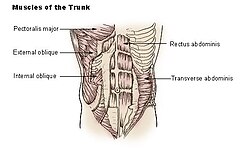
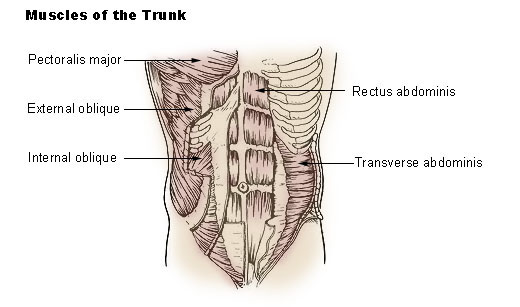
Muscles of the trunk.
The abdominal external oblique muscle
Details
OriginRibs 5-12
InsertionXiphoid process, outer lip of the iliac crest, pubic crest, pubic tubercle, linea alba, inguinal ligament, anterior superior iliac spine (ASIS)
NerveThoraco-abdominal nerves (T7-11) and subcostal nerve (T12)
ActionsFlexion of the torso and contralateral rotation of torso
Identifiers
Latinmusculus obliquus externus abdominis
TA98A04.5.01.008
TA22364
FMA13335
Anatomical terms of muscle

The abdominal external oblique muscle (also external oblique muscle or exterior oblique or musculus obliquus abdominis externus) is the largest and outermost of the three flat abdominal muscles of the lateral anterior abdomen.

Structure

[edit]

The external oblique is situated on the lateral and anterior parts of the abdomen. It is broad, thin, and irregularly quadrilateral, its muscular portion occupying the side, its aponeurosis the anterior wall of the abdomen. In most humans, the oblique is not visible, due to subcutaneous fat deposits and the small size of the muscle.

It arises from eight fleshy digitations, each from the external surfaces and inferior borders of the fifth to twelfth ribs (lower eight ribs). These digitations are arranged in an oblique line which runs inferiorly and anteriorly, with the upper digitations being attached close to the cartilages of the corresponding ribs, the lowest to the apex of the cartilage of the last rib, the intermediate ones to the ribs at some distance from their cartilages.

The five superior serrations increase in size from above downward, and are received between corresponding processes of the serratus anterior muscle; the three lower ones diminish in size from above downward and receive between them corresponding processes from the latissimus dorsi. From these attachments the fleshy fibers proceed in various directions. Its posterior fibers from the ribs to the iliac crest form a free posterior border.

Those from the lowest ribs pass nearly vertically downward, and are inserted into the anterior half of the outer lip of the iliac crest; the middle and upper fibers, directed downward (inferiorly) and forward (anteriorly), become aponeurotic at approximately the midclavicular line and form the anterior layer of the rectus sheath. This aponeurosis formed from fibres from either side of the external oblique decussates at the linea alba.

The aponeurosis of the external oblique muscle forms the inguinal ligament. The muscle also contributes to the inguinal canal.

The internal oblique muscle is just deep to the external oblique muscle.[1]

Nerve supply

[edit]

The external oblique muscle is supplied by ventral branches of the lower six thoracoabdominal nerves and the subcostal nerve on each side.

Blood supply

[edit]

The cranial portion of the muscle is supplied by the lower intercostal arteries, whereas the caudal portion is supplied by a branches of either the deep circumflex iliac artery or the iliolumbar artery.

Function

[edit]

The external oblique functions to pull the chest downwards and compress the abdominal cavity, which increases the intra-abdominal pressure as in a Valsalva maneuver. It also performs ipsilateral (same side) side-bending and contralateral (opposite side) rotation: the right external oblique would side-bend to the right and rotate to the left, and vice versa. The internal oblique muscle functions similarly except it rotates ipsilaterally.

Society and culture

[edit]

Oblique strain

[edit]

The oblique strain is a common baseball injury, particularly in pitchers. In both batters and pitchers it can affect the contralateral (leading) side external oblique, or the trailing internal oblique.[2]

Training

[edit]
  • Side plank

Additional images

[edit]

References

[edit]
[edit]
Revisions and contributorsEdit on WikipediaRead on Wikipedia
from Grokipedia
The abdominal external oblique muscle is the largest and most superficial of the flat muscles comprising the anterolateral , forming a broad sheet that extends from the lower to the . It originates from the external surfaces of the fifth through twelfth and inserts primarily via an into the linea alba, the anterior half of the , and the , with its inferior border contributing to the . The muscle's fibers run inferomedially, creating a diagonal orientation that interdigitates with the serratus anterior superiorly and the latissimus dorsi posteriorly. Innervated by the (anterior branches of T7–T11 ), the (T12), and the (L1), the external oblique receives sensory and motor input that coordinates its actions with other abdominal muscles. Its blood supply arises from the lower posterior , subcostal artery, and , ensuring robust vascular support for its expansive coverage. Functionally, the external oblique flexes the trunk laterally and rotates it contralaterally—meaning contraction on one side twists the toward the opposite side—while bilateral activation compresses the abdominal viscera to increase intra-abdominal pressure, aiding in forced expiration, , and . It also stabilizes the core during dynamic movements and contributes to maintaining posture by countering anterior . Clinically, the muscle's is integral to the structure of the , where defects can lead to indirect inguinal hernias, and it is often assessed in cases of or trunk instability due to trigger points causing referred discomfort in the or lower chest.

Anatomy

Origin and insertion

The abdominal external oblique muscle originates from the external surfaces of the lower eight , encompassing ribs 5 through 12. At this site of attachment, the superior fibers interdigitate with the digitations of the , while the more inferior fibers blend with those of the , facilitating a seamless transition between thoracic and abdominal musculature. The muscle's insertion occurs primarily through its broad , which contributes to the linea alba centrally, while direct tendinous attachments extend to the and the anterior half of the laterally. Additionally, the of the external oblique forms the anterior layer of the , encasing the . The inferior-most fibers of the muscle thicken and fold to create the , a key structure that spans from the to the , providing support to the inguinal region.

Structure and relations

The external oblique muscle is the most superficial of the three flat muscles forming the anterolateral abdominal wall, positioned outermost laterally and covered superficially by the skin and subcutaneous fascia, including Camper's and Scarpa's layers. Its fibers originate from the lower eight ribs and course inferomedially in a downward and forward direction, oriented obliquely to run perpendicular to those of the underlying internal oblique muscle. The of the external oblique forms a significant portion of the ; laterally, it remains muscular, but medially, around the midclavicular line, it transitions into a fibrous sheet that passes anterior to the rectus abdominis, contributing to the anterior layer of the , with its medial fibers blending with the linea alba. Inferiorly, the thickens to form the , extending from the to the , and its medial fibers divide into the medial and lateral crura, creating the superficial inguinal ring approximately 1 cm superior and lateral to the . In terms of relations, the external oblique lies superficial to the internal oblique, transversus abdominis, and , with the forming the deepest layer beneath these structures. Overlying structures include the superficial fascia and skin, while posteriorly, it interdigitates with the latissimus dorsi and serratus anterior at its upper margins. The muscle's lateral border aligns with the , and its inferior edge contributes to the floor of the via the .

Innervation and vascular supply

Nerve supply

The abdominal external oblique muscle receives its primary motor innervation from the lower six thoracic spinal nerves (T7–T12), collectively referred to as the . These nerves arise from the anterior rami of the thoracic and course through the intercostal spaces before penetrating the to supply the muscle layers. The thoracoabdominal nerves ensure coordinated contraction of the external oblique, facilitating its role in trunk stabilization and movement. In a segmental pattern, the upper fibers of the external oblique are innervated by the (T7–T11), while the lower fibers receive input from the (T12). The most inferior portions of the muscle, near the inguinal region, also obtain additional innervation from the (L1) and (L1), which originate from the and provide both motor and sensory branches after piercing the abdominal musculature. This arrangement allows for precise regional control, with the thoracic contributions dominating the majority of the muscle's expanse. The participate in reflex arcs that regulate tension, notably through the superficial , where sensory stimulation of the overlying elicits ipsilateral contraction of the external oblique and other abdominal muscles via a polysynaptic pathway in the . Disruption or irritation of these nerves can lead to patterns following thoracic (T7–T12) or lumbar (L1) dermatomes, often manifesting as visceral-like discomfort in the , , or lower back due to shared sensory innervation.

Blood supply

The arterial supply to the abdominal external oblique muscle exhibits a segmental pattern, primarily derived from branches of the thoracic aorta for the upper portions and iliac arteries for the caudal regions. The upper two-thirds of the muscle receive blood from the lower posterior intercostal arteries (seventh through eleventh intercostal spaces) and the subcostal artery (twelfth thoracic level). The lower one-third is supplied by branches of the deep circumflex iliac artery, which arises from the external iliac artery just superior to the inguinal ligament. Additionally, the superior epigastric artery, a terminal branch of the internal thoracic artery, contributes to the perfusion of the anterior abdominal wall through anastomoses that indirectly support the external oblique muscle. Venous drainage mirrors the arterial supply in a segmental fashion. The upper portions drain via the posterior intercostal and subcostal veins into the azygos and hemiazygos venous systems, ultimately reaching the . The lower portions drain through the deep circumflex iliac vein and lumbar veins into the external iliac and . This vascular arrangement forms a rich anastomotic network, including horizontal segmental connections and vertical links via the epigastric arteries, providing collateral flow across the . Clinically, this network poses a risk of significant hemorrhage during abdominal incisions, such as in repairs or , if vessels are not adequately ligated.

Function

Primary actions

The primary actions of the abdominal external oblique muscle arise from its bilateral and unilateral contractions, which contribute to trunk movement and intra-abdominal pressure regulation. When both external oblique muscles contract simultaneously, they flex the trunk by drawing the toward the , facilitating forward bending of the . This bilateral action also elevates intra-abdominal pressure, supporting physiological processes such as forced expiration, coughing, and by compressing the abdominal viscera against the diaphragm. Unilateral contraction of the external oblique produces distinct movements: the right external oblique, for instance, rotates the trunk to the left (contralateral rotation) while laterally flexing the trunk toward the right (ipsilateral side). These actions stem from the muscle's inferomedial fiber orientation, which pulls the lower ribs downward and medially toward the pelvis due to its inferomedial fiber orientation, generating a rotational torque around the vertical axis of the spine. The external oblique coordinates synergistically with the internal oblique muscle to enhance trunk , as their opposing directions—external fibers running inferomedially and internal fibers superomedially—create complementary vectors that amplify contralateral when activated together. This criss-cross arrangement not only potentiates rotational force but also stabilizes the during dynamic movements.

Secondary roles

The external oblique muscle plays a crucial role in maintaining tone and , which supports upright posture and provides structural integrity to the trunk during daily activities. By contracting isometrically, it helps stabilize the spine and , preventing excessive anterior and promoting balanced alignment of the . This function is essential for visceral support, as the muscle's superficial positioning allows it to compress the , thereby securing internal organs against gravitational forces and sudden movements. Additionally, the external oblique contributes to generating intra-abdominal pressure through the , assisting in physiological processes that require forceful expulsion. It aids in forced expiration by depressing the during activities such as coughing or sneezing, acting as an accessory respiratory muscle to enhance efficiency. In , coordinated contraction with other abdominal muscles increases pressure on the intestinal tract to facilitate bowel evacuation. Similarly, during parturition, it supports by elevating intra-abdominal pressure to aid uterine expulsion, particularly in the second stage of labor. The muscle's aponeurotic sheath further enhances its protective role in containing abdominal contents, forming a dynamic barrier that resists herniation and maintains compartmentalization of viscera under varying loads. This containment is vital for overall abdominal integrity, allowing the external oblique to buffer against intra-cavity expansions during or physical .

Clinical and societal aspects

Injuries and strains

Strains of the abdominal external oblique muscle are particularly prevalent in rotational sports such as pitching and , where sudden, forceful twisting of the trunk is required. In from 1991 to 2010, abdominal muscle strains—predominantly affecting the internal and external obliques or —occurred in 92% of cases, with pitchers accounting for 44% of these injuries. These injuries are classified into grades I through III based on the degree of muscle fiber disruption: grade I involves mild with minimal tearing, grade II features partial tears affecting a significant portion of fibers, and grade III represents complete ruptures. Common symptoms include sudden onset of sharp pain in the lateral or flank, often following a twisting motion, with tenderness upon and pain aggravated by coughing, sneezing, or resisted trunk rotation. Swelling, bruising, or formation may develop in moderate to severe cases, and avulsion injuries at the origins can occur due to the muscle's tendinous attachments, leading to localized or palpable defects. The diagonal orientation of the external oblique fibers contributes to this vulnerability during eccentric loading in rotational activities. Diagnosis typically begins with a thorough clinical examination, including assessment of pain location, , and strength testing via resisted side-bending or rotation. provides a dynamic, cost-effective visualization of muscle tears or hematomas, while MRI offers detailed imaging to evaluate the extent of fiber disruption, , or associated injuries and to differentiate from conditions like intercostal strains or hernias. Treatment for external oblique strains emphasizes conservative measures, starting with the protocol—rest to avoid aggravating activities, ice to reduce , compression to minimize swelling, and to aid drainage—for the initial 48 to 72 hours. follows, incorporating progressive exercises to restore flexibility, strength, and , with recovery times ranging from 2-4 weeks for grade I strains to 6-8 weeks or longer for grade III injuries. Surgical intervention is uncommon and generally limited to severe cases involving complete tears, avulsions, or failure of nonoperative management, where repair of the musculotendinous unit may be necessary to prevent chronic instability.

Training and strengthening

The external oblique muscles can be effectively strengthened through exercises that emphasize rotational and lateral movements, aligning with their role in trunk rotation and side bending. Targeted exercises such as Russian twists, bicycle crunches, and side planks are particularly effective for activating the external obliques. Russian twists involve sitting with knees bent, leaning back slightly, and rotating the side to side while holding a weight or , which generates high electromyographic (EMG) activity in the external obliques due to the rotational demand. Bicycle crunches, performed by lying and alternating elbow-to-knee touches in a pedaling motion, rank among the top exercises for external oblique activation, eliciting up to 290% of maximum voluntary contraction in EMG studies. Side planks, where the body is held in a lateral position supported by one forearm and foot, provide isometric loading that strongly engages the external obliques for stabilization, with variations like hip dips adding dynamic lateral flexion to increase activation. Programming for external oblique strengthening typically involves 2-3 sets of 10-15 repetitions per exercise, performed 2-3 times per week to allow recovery while promoting and . Progressions can include adding resistance, such as holding dumbbells during side planks or using a stability ball for Russian twists to enhance instability and muscle recruitment. To improve flexibility and prevent imbalances, incorporate stretching methods like the cobra pose and side bends. The cobra pose, performed by lying prone and lifting the chest while keeping hips grounded, elongates the including the external obliques. Side bends, done standing or seated by reaching one arm overhead and laterally flexing the , directly target oblique lengthening on the convex side. Hold each stretch for 20-30 seconds per side, 2-3 times daily, to support overall core mobility.

References

Add your contribution
Related Hubs
User Avatar
No comments yet.