



Community hub
Recent from talks
Contribute something
Nothing was collected or created yet.
F(R) gravity
View on Wikipedia | This article may be too technical for most readers to understand. (July 2019) |
In physics, f(R) is a type of modified gravity theory which generalizes Einstein's general relativity. f(R) gravity is actually a family of theories, each one defined by a different function, f, of the Ricci scalar, R. The simplest case is just the function being equal to the scalar; this is general relativity. As a consequence of introducing an arbitrary function, there may be freedom to explain the accelerated expansion and structure formation of the Universe without adding unknown forms of dark energy or dark matter. Some functional forms may be inspired by corrections arising from a quantum theory of gravity. f(R) gravity was first proposed in 1970 by Hans Adolph Buchdahl[1] (although ϕ was used rather than f for the name of the arbitrary function). It has become an active field of research following work by Alexei Starobinsky on cosmic inflation.[2] A wide range of phenomena can be produced from this theory by adopting different functions; however, many functional forms can now be ruled out on observational grounds, or because of pathological theoretical problems.
Introduction
[edit]In f(R) gravity, one seeks to generalize the Lagrangian of the Einstein–Hilbert action: to where is the determinant of the metric tensor, and f(R) is some function of the Ricci scalar.[3]
![{\displaystyle S[g]=\int {1 \over 2\kappa }R{\sqrt {-g}}\,\mathrm {d} ^{4}x}](https://wikimedia.org/api/rest_v1/media/math/render/svg/91570fbcc4c9e96bbc5b99133cb8370535e8e011)
![{\displaystyle S[g]=\int {1 \over 2\kappa }f(R){\sqrt {-g}}\,\mathrm {d} ^{4}x}](https://wikimedia.org/api/rest_v1/media/math/render/svg/4ac01a37176f863349961012e5966c176c22cd90)

There are two ways to track the effect of changing R to f(R), i.e., to obtain the theory field equations. The first is to use metric formalism and the second is to use the Palatini formalism.[3] While the two formalisms lead to the same field equations for General Relativity, i.e., when f(R) = R, the field equations may differ when f(R) ≠ R.
Metric f(R) gravity
[edit]Derivation of field equations
[edit]In metric f(R) gravity, one arrives at the field equations by varying the action with respect to the metric and not treating the connection independently. For completeness we will now briefly mention the basic steps of the variation of the action. The main steps are the same as in the case of the variation of the Einstein–Hilbert action (see the article for more details) but there are also some important differences.

The variation of the determinant is as always:

The Ricci scalar is defined as

Therefore, its variation with respect to the inverse metric is given by


For the second step see the article about the Einstein–Hilbert action. Since is the difference of two connections, it should transform as a tensor. Therefore, it can be written as


Substituting into the equation above: where is the covariant derivative and is the d'Alembert operator.


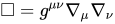
Denoting , the variation in the action reads:

![{\displaystyle {\begin{aligned}\delta S[g]&=\int {\frac {1}{2\kappa }}\left(\delta f(R){\sqrt {-g}}+f(R)\delta {\sqrt {-g}}\right)\,\mathrm {d} ^{4}x\\&=\int {\frac {1}{2\kappa }}\left(F(R)\delta R{\sqrt {-g}}-{\frac {1}{2}}{\sqrt {-g}}g_{\mu \nu }\delta g^{\mu \nu }f(R)\right)\,\mathrm {d} ^{4}x\\&=\int {\frac {1}{2\kappa }}{\sqrt {-g}}\left(F(R)(R_{\mu \nu }\delta g^{\mu \nu }+g_{\mu \nu }\Box \delta g^{\mu \nu }-\nabla _{\mu }\nabla _{\nu }\delta g^{\mu \nu })-{\frac {1}{2}}g_{\mu \nu }\delta g^{\mu \nu }f(R)\right)\,\mathrm {d} ^{4}x\end{aligned}}}](https://wikimedia.org/api/rest_v1/media/math/render/svg/25450bf4c3b5ece22eb617daf04961eae1da7b9e)
Doing integration by parts on the second and third terms (and neglected the boundary contributions), we get:
![{\displaystyle \delta S[g]=\int {\frac {1}{2\kappa }}{\sqrt {-g}}\delta g^{\mu \nu }\left(F(R)R_{\mu \nu }-{\frac {1}{2}}g_{\mu \nu }f(R)+[g_{\mu \nu }\Box -\nabla _{\mu }\nabla _{\nu }]F(R)\right)\,\mathrm {d} ^{4}x.}](https://wikimedia.org/api/rest_v1/media/math/render/svg/194c526abde64452011b21f5db50a413e577b2dc)
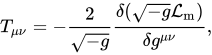
By demanding that the action remains invariant under variations of the metric, , one obtains the field equations: where is the energy–momentum tensor defined as where is the matter Lagrangian.

![{\displaystyle F(R)R_{\mu \nu }-{\frac {1}{2}}g_{\mu \nu }f(R)+\left[g_{\mu \nu }\Box -\nabla _{\mu }\nabla _{\nu }\right]F(R)=\kappa T_{\mu \nu },}](https://wikimedia.org/api/rest_v1/media/math/render/svg/4598c9180947cf032484b47b311bbb30ba24882b)


Generalized Friedmann equations
[edit]Assuming a Robertson–Walker metric with scale factor we can find the generalized Friedmann equations to be (in units where ): where is the Hubble parameter, the dot is the derivative with respect to the cosmic time t, and the terms ρm and ρrad represent the matter and radiation densities respectively; these satisfy the continuity equations:







Modified gravitational constant
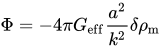
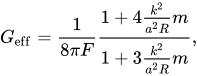
[edit]An interesting feature of these theories is the fact that the gravitational constant is time and scale dependent.[4] To see this, add a small scalar perturbation to the metric (in the Newtonian gauge): where Φ and Ψ are the Newtonian potentials and use the field equations to first order. After some lengthy calculations, one can define a Poisson equation in the Fourier space and attribute the extra terms that appear on the right-hand side to an effective gravitational constant Geff. Doing so, we get the gravitational potential (valid on sub-horizon scales k2 ≫ a2H2): where δρm is a perturbation in the matter density, k is the Fourier scale and Geff is: with


Massive gravitational waves
[edit]This class of theories when linearized exhibits three polarization modes for the gravitational waves, of which two correspond to the massless graviton (helicities ±2) and the third (scalar) is coming from the fact that if we take into account a conformal transformation, the fourth order theory f(R) becomes general relativity plus a scalar field. To see this, identify and use the field equations above to get


Working to first order of perturbation theory: and after some tedious algebra, one can solve for the metric perturbation, which corresponds to the gravitational waves. A particular frequency component, for a wave propagating in the z-direction, may be written as where and vg(ω) = dω/dk is the group velocity of a wave packet hf centred on wave-vector k. The first two terms correspond to the usual transverse polarizations from general relativity, while the third corresponds to the new massive polarization mode of f(R) theories. This mode is a mixture of massless transverse breathing mode (but not traceless) and massive longitudinal scalar mode.[5][6] The transverse and traceless modes (also known as tensor modes) propagate at the speed of light, but the massive scalar mode moves at a speed vG < 1 (in units where c = 1), this mode is dispersive. However, in f(R) gravity metric formalism, for the model (also known as pure model), the third polarization mode is a pure breathing mode and propagate with the speed of light through the spacetime.[7]




Equivalent formalism
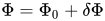
[edit]Under certain additional conditions[8] we can simplify the analysis of f(R) theories by introducing an auxiliary field Φ. Assuming for all R, let V(Φ) be the Legendre transformation of f(R) so that and . Then, one obtains the O'Hanlon (1972) action:


![{\displaystyle S=\int d^{4}x{\sqrt {-g}}\left[{\frac {1}{2\kappa }}\left(\Phi R-V(\Phi )\right)+{\mathcal {L}}_{\text{m}}\right].}](https://wikimedia.org/api/rest_v1/media/math/render/svg/fecd067dc325aa630578fa653418060fe2eb8955)
We have the Euler–Lagrange equations:


Eliminating Φ, we obtain exactly the same equations as before. However, the equations are only second order in the derivatives, instead of fourth order.
We are currently working with the Jordan frame. By performing a conformal rescaling: we transform to the Einstein frame: after integrating by parts.

![{\displaystyle R=\Phi \left[{\tilde {R}}+{\frac {3{\tilde {\Box }}\Phi }{\Phi }}-{\frac {9}{2}}\left({\frac {{\tilde {\nabla }}\Phi }{\Phi }}\right)^{2}\right]}](https://wikimedia.org/api/rest_v1/media/math/render/svg/2146f087e478a1ba94846c28ed352cdb6e1d4d76)
![{\displaystyle S=\int d^{4}x{\sqrt {-{\tilde {g}}}}{\frac {1}{2\kappa }}\left[{\tilde {R}}-{\frac {3}{2}}\left({\frac {{\tilde {\nabla }}\Phi }{\Phi }}\right)^{2}-{\frac {V(\Phi )}{\Phi ^{2}}}\right]}](https://wikimedia.org/api/rest_v1/media/math/render/svg/e5488d178261433b530cd1dea09c4d128a794115)
Defining , and substituting

![{\displaystyle S=\int \mathrm {d} ^{4}x{\sqrt {-{\tilde {g}}}}{\frac {1}{2\kappa }}\left[{\tilde {R}}-{\frac {1}{2}}\left({\tilde {\nabla }}{\tilde {\Phi }}\right)^{2}-{\tilde {V}}({\tilde {\Phi }})\right]}](https://wikimedia.org/api/rest_v1/media/math/render/svg/67e40368b9e98416d0d8d03e2cc511795c24f31e)
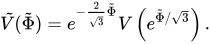
This is general relativity coupled to a real scalar field: using f(R) theories to describe the accelerating universe is practically equivalent to using quintessence. (At least, equivalent up to the caveat that we have not yet specified matter couplings, so (for example) f(R) gravity in which matter is minimally coupled to the metric (i.e., in Jordan frame) is equivalent to a quintessence theory in which the scalar field mediates a fifth force with gravitational strength.)
Palatini f(R) gravity
[edit]In Palatini f(R) gravity, one treats the metric and connection independently and varies the action with respect to each of them separately. The matter Lagrangian is assumed to be independent of the connection. These theories have been shown to be equivalent to Brans–Dicke theory with ω = −3⁄2.[9][10] Due to the structure of the theory, however, Palatini f(R) theories appear to be in conflict with the Standard Model,[9][11] may violate Solar system experiments,[10] and seem to create unwanted singularities.[12]
Metric-affine f(R) gravity
[edit]In metric-affine f(R) gravity, one generalizes things even further, treating both the metric and connection independently, and assuming the matter Lagrangian depends on the connection as well.
Observational tests
[edit]As there are many potential forms of f(R) gravity, it is difficult to find generic tests. Additionally, since deviations away from General Relativity can be made arbitrarily small in some cases, it is impossible to conclusively exclude some modifications. Some progress can be made, without assuming a concrete form for the function f(R) by Taylor expanding

The first term is like the cosmological constant and must be small. The next coefficient a1 can be set to one as in general relativity. For metric f(R) gravity (as opposed to Palatini or metric-affine f(R) gravity), the quadratic term is best constrained by fifth force measurements, since it leads to a Yukawa correction to the gravitational potential. The best current bounds are |a2| < 4×10⁻⁹ m2 or equivalently |a2| < 2.3×10²² GeV−2.[13][14]
The parameterized post-Newtonian formalism is designed to be able to constrain generic modified theories of gravity. However, f(R) gravity shares many of the same values as General Relativity, and is therefore indistinguishable using these tests.[15] In particular light deflection is unchanged, so f(R) gravity, like General Relativity, is entirely consistent with the bounds from Cassini tracking.[13]
Starobinsky gravity
[edit]Starobinsky gravity has the following form where has the dimensions of mass.[16]
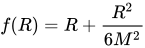

Starobinsky gravity provides a mechanism for the cosmic inflation, just after the Big Bang when R was still large. However, it is not suited to describe the present universe acceleration since at present R is very small.[17][18][19] This implies that the quadratic term in is negligible, i.e., one tends to f(R) = R which is general relativity with a zero cosmological constant.
Gogoi–Goswami gravity
[edit]Gogoi–Goswami gravity (named after Dhruba Jyoti Gogoi and Umananda Dev Goswami) has the following form where and are two dimensionless positive constants and Rc is a characteristic curvature constant.[20]
![{\displaystyle f(R)=R-{\frac {\alpha }{\pi }}R_{c}\cot ^{-1}\left({\frac {R_{c}^{2}}{R^{2}}}\right)-\beta R_{c}\left[1-\exp \left(-{\frac {R}{R_{c}}}\right)\right]}](https://wikimedia.org/api/rest_v1/media/math/render/svg/18ca90249986b2fcbddc61f6076333a5d3dbd582)


Tensorial generalization
[edit]f(R) gravity as presented in the previous sections is a scalar modification of general relativity. More generally, we can have a coupling involving invariants of the Ricci tensor and the Weyl tensor. Special cases are f(R) gravity, conformal gravity, Gauss–Bonnet gravity and Lovelock gravity. Notice that with any nontrivial tensorial dependence, we typically have additional massive spin-2 degrees of freedom, in addition to the massless graviton and a massive scalar. An exception is Gauss–Bonnet gravity where the fourth order terms for the spin-2 components cancel out.

See also
[edit]References
[edit]- ^ Buchdahl, H. A. (1970). "Non-linear Lagrangians and cosmological theory". Monthly Notices of the Royal Astronomical Society. 150: 1–8. Bibcode:1970MNRAS.150....1B. doi:10.1093/mnras/150.1.1.
- ^ Starobinsky, A. A. (1980). "A new type of isotropic cosmological models without singularity". Physics Letters B. 91 (1): 99–102. Bibcode:1980PhLB...91...99S. doi:10.1016/0370-2693(80)90670-X.
- ^ a b L. Amendola and S. Tsujikawa (2013) "Dark Energy, Theory and Observations" Cambridge University Press
- ^ Tsujikawa, Shinji (2007). "Matter density perturbations and effective gravitational constant in modified gravity models of dark energy". Physical Review D. 76 (2) 023514. arXiv:0705.1032. Bibcode:2007PhRvD..76b3514T. doi:10.1103/PhysRevD.76.023514. S2CID 119324187.
- ^ Liang, Dicong; Gong, Yungui; Hou, Shaoqi; Liu, Yunqi (2017). "Polarizations of gravitational waves in f(R) gravity". Phys. Rev. D. 95 (10) 104034. arXiv:1701.05998. Bibcode:2017PhRvD..95j4034L. doi:10.1103/PhysRevD.95.104034. S2CID 119005163.
- ^ Gogoi, Dhruba Jyoti; Dev Goswami, Umananda (2020). "A new f(R) gravity model and properties of gravitational waves in it". The European Physical Journal C. 80 (12): 1101. arXiv:2006.04011. Bibcode:2020EPJC...80.1101G. doi:10.1140/epjc/s10052-020-08684-3. S2CID 219530929.
- ^ Gogoi, Dhruba Jyoti; Dev Goswami, Umananda (2022). "Gravitational Waves in f(R) Gravity Power Law Model". Indian Journal of Physics. 96 (2): 637. arXiv:1901.11277. Bibcode:2022InJPh..96..637G. doi:10.1007/s12648-020-01998-8. S2CID 231655238.
- ^ De Felice, Antonio; Tsujikawa, Shinji (2010). "f(R) Theories". Living Reviews in Relativity. 13 (1): 3. arXiv:1002.4928. Bibcode:2010LRR....13....3D. doi:10.12942/lrr-2010-3. PMC 5255939. PMID 28179828.
- ^ a b Flanagan, E. E. (2004). "The conformal frame freedom in theories of gravitation". Classical and Quantum Gravity. 21 (15): 3817–3829. arXiv:gr-qc/0403063. Bibcode:2004CQGra..21.3817F. doi:10.1088/0264-9381/21/15/N02. S2CID 117619981.
- ^ a b Olmo, G. J. (2005). "The Gravity Lagrangian According to Solar System Experiments". Physical Review Letters. 95 (26) 261102. arXiv:gr-qc/0505101. Bibcode:2005PhRvL..95z1102O. doi:10.1103/PhysRevLett.95.261102. PMID 16486333. S2CID 27440524.
- ^ Iglesias, A.; Kaloper, N.; Padilla, A.; Park, M. (2007). "How (not) to use the Palatini formulation of scalar-tensor gravity". Physical Review D. 76 (10) 104001. arXiv:0708.1163. Bibcode:2007PhRvD..76j4001I. doi:10.1103/PhysRevD.76.104001.
- ^ Barausse, E.; Sotiriou, T. P.; Miller, J. C. (2008). "A no-go theorem for polytropic spheres in Palatini f(R) gravity". Classical and Quantum Gravity. 25 (6) 062001. arXiv:gr-qc/0703132. Bibcode:2008CQGra..25f2001B. doi:10.1088/0264-9381/25/6/062001. S2CID 119370540.
- ^ a b Berry, C. P. L.; Gair, J. R. (2011). "Linearized f(R) gravity: Gravitational radiation and Solar System tests". Physical Review D. 83 (10) 104022. arXiv:1104.0819. Bibcode:2011PhRvD..83j4022B. doi:10.1103/PhysRevD.83.104022. S2CID 119202399.
- ^ Cembranos, J. A. R. (2009). "Dark Matter from R2 Gravity". Physical Review Letters. 102 (14) 141301. arXiv:0809.1653. Bibcode:2009PhRvL.102n1301C. doi:10.1103/PhysRevLett.102.141301. PMID 19392422. S2CID 33042847.
- ^ Clifton, T. (2008). "Parametrized post-Newtonian limit of fourth-order theories of gravity". Physical Review D. 77 (2) 024041. arXiv:0801.0983. Bibcode:2008PhRvD..77b4041C. doi:10.1103/PhysRevD.77.024041. S2CID 54174617.
- ^ Starobinsky, A.A (1980). "A new type of isotropic cosmological models without singularity". Physics Letters B. 91 (1): 99–102. Bibcode:1980PhLB...91...99S. doi:10.1016/0370-2693(80)90670-X.
- ^ "Will the Universe expand forever?". NASA. 24 January 2014. Retrieved 16 March 2015.
- ^ Biron, Lauren (7 April 2015). "Our universe is Flat". symmetrymagazine.org. FermiLab/SLAC.
- ^ Marcus Y. Yoo (2011). "Unexpected connections". Engineering & Science. LXXIV1: 30.
- ^ Gogoi, Dhruba Jyoti; Dev Goswami, Umananda (2020). "A new f(R) gravity model and properties of gravitational waves in it". The European Physical Journal C. 80 (12): 1101. arXiv:2006.04011. Bibcode:2020EPJC...80.1101G. doi:10.1140/epjc/s10052-020-08684-3. S2CID 219530929.
Further reading
[edit]- See Chapter 29 in the textbook on "Particles and Quantum Fields" by Kleinert, H. (2016), World Scientific (Singapore, 2016) (also available online)
- Sotiriou, T. P.; Faraoni, V. (2010). "f(R) Theories of Gravity". Reviews of Modern Physics. 82 (1): 451–497. arXiv:0805.1726. Bibcode:2010RvMP...82..451S. doi:10.1103/RevModPhys.82.451. S2CID 15024691.
- Sotiriou, T. P. (2009). "6+1 lessons from f(R) gravity". Journal of Physics: Conference Series. 189 (9) 012039. arXiv:0810.5594. Bibcode:2009JPhCS.189a2039S. doi:10.1088/1742-6596/189/1/012039. S2CID 14820388.
- Capozziello, S.; De Laurentis, M. (2011). "Extended Theories of Gravity". Physics Reports. 509 (4–5): 167–321. arXiv:1108.6266. Bibcode:2011PhR...509..167C. doi:10.1016/j.physrep.2011.09.003. S2CID 119296243.
- Salvatore Capozziello and Mariafelicia De Laurentis, (2015) "F(R) theories of gravitation". Scholarpedia, doi:10.4249/scholarpedia.31422
- Kalvakota, Vaibhav R., (2021) "Investigating f(R)" gravity and cosmologies". Mathematical physics preprint archive, https://web.ma.utexas.edu/mp_arc/c/21/21-38.pdf
External links
[edit]F(R) gravity
View on GrokipediaIntroduction
Definition and Motivations
f(R) gravity represents a class of modified gravity theories that extend general relativity (GR) by generalizing the gravitational action. In GR, the dynamics of spacetime are governed by the Einstein-Hilbert action, which involves the Ricci scalar , a scalar quantity derived from the contraction of the Ricci tensor constructed from the Riemann curvature tensor; the action takes the form , where is the gravitational constant, is the determinant of the metric tensor, and is the matter action. f(R) gravity naturally extends this framework by replacing the linear Ricci scalar with a differentiable function , yielding the action . This modification introduces additional degrees of freedom in the gravitational sector while preserving the metric formalism of GR, assuming readers' familiarity with tensor calculus and variational principles.[5] The primary motivations for f(R) gravity stem from its potential to address key challenges in cosmology and theoretical physics without invoking exotic matter components. One central driver is explaining the observed late-time acceleration of the universe's expansion, which in the standard CDM model requires a cosmological constant or dark energy comprising about 70% of the energy budget; f(R) theories achieve this acceleration through curvature modifications alone, avoiding the need for dark energy fields. Additionally, higher-order terms in can resolve singularities, such as the Big Bang, by altering the behavior of spacetime curvature at high densities, potentially providing a singularity-free description of the early universe. Inspirations from quantum gravity further motivate f(R) models, as they arise naturally from effective field theory expansions of quantum corrections to GR, such as one-loop effects in curved spacetime. To ensure theoretical viability, f(R) functions must satisfy and to avoid ghost and tachyonic instabilities, respectively, ensuring the theory is free of negative kinetic energy modes and unstable perturbations.[5][5][5][1] Historically, f(R) gravity traces its origins to early proposals in the 1970s, with Hans Adolph Buchdahl introducing non-linear Lagrangians involving higher powers of the Ricci scalar to explore cosmological models beyond GR. Interest grew in the 1980s through applications to inflationary cosmology, where quadratic corrections like terms enabled quasi-exponential expansion without scalar fields. The theory experienced a significant revival in the 2000s, driven by the need to model dark energy as an intrinsic gravitational effect following observations of cosmic acceleration, leading to extensive studies of viable f(R) forms consistent with solar system tests and large-scale structure.[5]Historical Development
The concept of f(R) gravity, where the Einstein-Hilbert action is generalized by replacing the Ricci scalar R with an arbitrary function f(R), was first proposed by Hans A. Buchdahl in 1970 as a framework for exploring non-linear Lagrangians in cosmological models. This initial formulation laid the groundwork for modified gravity theories beyond general relativity, motivated by potential solutions to cosmological singularities. In the mid-1970s, interest grew in higher-derivative gravity theories, with Kenneth S. Stelle demonstrating in 1977 that actions quadratic in curvature, such as R + a R² + b R_{\mu\nu} R^{\mu\nu}, are renormalizable at one loop, though they introduce ghosts and tachyons.[6] This work highlighted f(R) models as candidates for quantum corrections to general relativity. By the early 1980s, Alexei A. Starobinsky applied an R² term to address the horizon and flatness problems in cosmology, proposing a model that naturally generates inflation without additional fields. Starobinsky's 1980 contribution marked a pivotal shift toward phenomenological applications, influencing subsequent higher-order gravity studies. The field saw renewed attention in the early 2000s amid the discovery of cosmic acceleration, with Sean M. Carroll and collaborators in 2004 suggesting f(R) modifications as an alternative to dark energy, where deviations from R drive late-time expansion. This revival was further advanced by Antonio De Felice and Shinji Tsujikawa, who in subsequent works explored viable f(R) forms compatible with solar system tests. In the 2010s, Shinji Nojiri, Sergei D. Odintsov, and Luca Amendola among others developed conditions for viability, such as f'(R) > 0 and f''(R) > 0 to avoid instabilities, exemplified by the Hu-Sawicki model that mimics ΛCDM while passing local constraints. Data from the Planck satellite in 2013 significantly tightened these bounds, excluding many models unless their Compton wavelength exceeds Hubble scales; the 2018 release further refined these constraints.[7][8] Recent extensions in the 2020s have built on these foundations, with Dhruba Jyoti Gogoi and Umananda Dev Goswami introducing a parametric f(R) model in 2020 to study gravitational waves and later applications like wormhole geometries. Post-2020 advancements, including constraints from the Dark Energy Spectroscopic Instrument (DESI) as of 2025, continue to test model viability against large-scale structure data. This evolution reflects a progression from quantum-motivated corrections to robust cosmological and astrophysical tools, informed by increasingly precise observations.Metric f(R) Gravity
Action and Field Equations
In metric f(R) gravity, the theory is constructed by generalizing the Einstein-Hilbert action to allow an arbitrary differentiable function of the Ricci scalar , while treating the metric tensor as the fundamental dynamical variable. The total action is given by where is Newton's gravitational constant, is the square root of the determinant of the metric, is the action for matter fields that couple minimally to the metric, and is a smooth function with to ensure a Minkowski vacuum. This form was first proposed as a nonlinear generalization of general relativity to address cosmological issues. The field equations are derived by varying the action with respect to the inverse metric , following the standard variational principle in the metric formalism. The variation of the matter action yields the energy-momentum tensor , while the gravitational part requires careful computation. The Ricci scalar term contributes , where , but additional terms arise from the dependence of on the metric. Specifically, the full variation involves integrating by parts the second derivatives in , leading to boundary terms that vanish for appropriate fall-off conditions. The resulting vacuum field equations are and in the presence of matter, where is the d'Alembertian and denotes the covariant derivative compatible with . These equations reduce to the Einstein field equations when , as the extra terms vanish since is constant.[9] Contracting the field equations with yields the trace equation, where is the trace of the energy-momentum tensor. This scalar equation highlights the dynamical role of , which acts as an effective scalar degree of freedom propagating at speeds consistent with general relativity in viable models.[9] For the theory to be physically viable and free of pathologies, certain conditions on must hold. The effective gravitational coupling is proportional to , requiring everywhere to ensure attraction and avoid ghosts in the particle spectrum. Additionally, is needed for the scalar mode to have positive mass squared, preventing tachyonic instabilities. These conditions, along with asymptotic behavior matching general relativity at high curvatures, ensure consistency with solar system tests and cosmological observations.[9]Cosmological Equations
In f(R) gravity, the background cosmological evolution is analyzed assuming a homogeneous and isotropic universe described by the Friedmann–Lemaître–Robertson–Walker (FLRW) metric, given byin units where the spatial curvature , with denoting the scale factor and the Hubble parameter defined as .[5] This metric simplifies the Ricci scalar to , allowing the general field equations to yield modified Friedmann equations that incorporate deviations from general relativity.[5] The first modified Friedmann equation is
where primes denote derivatives with respect to , dots denote time derivatives, , and is the matter energy density (assuming a perfect fluid).[5] The second Friedmann equation is
where is the matter pressure; this form emerges from the (0,0) and (i,i) components of the field equations, highlighting the additional contributions from the curvature modifications.[5] These equations reduce to the standard CDM Friedmann equations in the limit . To interpret the cosmological implications, the f(R) terms can be recast as an effective dark energy density (curvature contribution) that drives late-time acceleration, expressed as
with the full Friedmann equation , reflecting the effective gravitational constant .[5] The corresponding pressure is derived from the continuity equation , yielding an equation-of-state parameter that can cross depending on the model.[5] The acceleration equation, a modified Raychaudhuri equation, follows from combining the two Friedmann equations and takes the form
[5] This equation reveals how f(R) modifications can induce positive acceleration even without a cosmological constant, provided the higher-derivative terms balance the matter contributions appropriately. De Sitter solutions, representing stable exponential expansion with constant and , require and , leading to the condition with .[5] Stability of these solutions demands and additional constraints on higher derivatives to avoid ghost or gradient instabilities, ensuring attractor behavior during late-time cosmology.[5]