Hubbry Logo
Force XXI Battle Command Brigade and BelowForce XXI Battle Command Brigade and BelowMain
Open search
Force XXI Battle Command Brigade and Below
Community hub
Force XXI Battle Command Brigade and Below
logo
8 pages, 0 posts
0 subscribers
Be the first to start a discussion here.
Force XXI Battle Command Brigade and Below
from Wikipedia
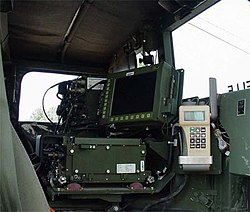
FBCB2 computer and display mounted in a HMMWV
FBCB2 Session Manager
FBCB2 Operations Session

Force XXI Battle Command Brigade and Below (FBCB2) is a communication platform designed for commanders to track friendly and hostile forces on the battlefield.[1] It increases a vehicle commander's situational awareness of the battlefield by gathering information near real-time based on vehicle locations being updated on the battlefield. This information is viewed graphically, and exchanged via both free and fixed text message formats (instead of verbal collection of reports).

The location data for friendly forces is collected through the Enhanced Position Location Reporting System (EPLRS) line of sight tactical radio network and Blue Force Tracking (BFT) satellite network.[2]

Development

[edit]

The development of the system is managed by Project Manager, Force XXI Battle Command Brigade and Below, a component of the U.S. Army's Program Executive Office – Command Control and Communications Tactical (PEO C3T). PEO C3T is based at Aberdeen Proving Ground in Aberdeen, Maryland. The original Army Program Executive Officer was William Campbell (LtG, ret). The original contractor program manager was Neil Siegel.

FBCB2 was tested under the First Digitized Division 4th Infantry Division (United States) based in Fort Hood, Texas, and 1/25 infantry out of Fort Lewis, Washington. series of what were called "Advanced Warfighting Experiments" at the National Training Center near Barstow, California, starting in 1997. The division conducted Limited User Test on the equipment in 1998, and the system was approved for production.

FBCB2 was then tested and implemented under the Force XXI concept that stemmed from Operation Desert Storm/Shield.

The United States Army and the United States Marines Corps reached agreement to standardize on a new variant of the system to be called Joint Capabilities Release (JCR) developed by the Project Manager, Joint Battle Command-Platform (PM JBC-P) that was fielded in 2013.[3] JCR takes advantage of the BFT-2 network, a new satellite infrastructure that can handle significantly more data than the first BFT.

Deployment

[edit]

The United States Army awarded TRW (that became a part of Northrop Grumman in 2002) the prime contract for FBCB2 in 1995. ESP (Engineering Solutions and Products) is now the prime contractor for the system.

FBCB2 was first used in actual military operations in the former Yugoslavia in 1998. It played a key role in operations in Iraq and Afghanistan starting in 2003. Work has begun on plans to reach the level of nearly 160,000 tracking systems in the Army within a few years.

Awards

[edit]

The FBCB2 system, and the BFT system have won numerous awards and accolades, including: recognition in 2001 as one of the five best-managed software programs in the entire U.S. Government,[4] the 2003 Institute for Defense and Government Advancement's award for most innovative U.S. Government program,[5] the 2003 Federal Computer Week Monticello Award (given in recognition of an information system that has a direct, meaningful impact on human lives), and the Battlespace Information 2005 "Best Program in Support of Coalition Operations".[6]

See also

[edit]

References

[edit]

Notes

[edit]
Revisions and contributorsEdit on WikipediaRead on Wikipedia
from Grokipedia
Force XXI Battle Command Brigade and Below (FBCB2) is a digital battle command information system developed by the to provide commanders, leaders, and soldiers—from brigade level down to the individual soldier—with enhanced and command and control capabilities across all components of the force. Initiated in 1994 as part of the Force XXI Battlefield Digitization program, FBCB2 integrates with the (GPS) and the Tactical Internet—utilizing systems like the Enhanced Position Location Reporting System (EPLRS) and Single-Channel Ground and Airborne Radio System (SINCGARS)—to enable the automatic transmission and receipt of position reports, digital messages, and graphical overlays for tracking friendly and enemy forces in near real-time. The system's core components include ruggedized computers for platforms lacking built-in systems, embedded Battle Command software for vehicles like the M2A3 Bradley and M1A2 SEP Abrams, and interfaces with higher-level Tactical Command and Control Systems (ATCCS) at and echelons. Early testing during the Task Force XXI Advanced Warfighting Experiment (AWE) from June 1996 to March 1997 with the 4th Infantry Division identified key areas for improvement in system maturity and connectivity, leading to Milestone I/II approval in July 1997. Subsequent Limited User Test-1 (LUT-1) in August 1998 with elements of the 1st Cavalry Division demonstrated significant enhancements, achieving approximately 80% command/control message completion rate and nearly 65% message completion rate, enabling full-rate production by FY2002. Designed to support Joint Vision 2020 objectives, FBCB2 aimed to boost lethality, survivability, and operational tempo by facilitating seamless information flow and reducing risks through . Over time, FBCB2 evolved to address emerging needs, with the Joint Capabilities Release (JCR) introduced in 2012 as an interim upgrade, incorporating Blue Force Tracking 2 (BFT2) satellite networking, enhanced encryption, chat functionality, and interoperability with the U.S. Marine Corps. This paved the way for the Joint Battle Command-Platform (JBC-P), approved for production and deployment in July 2012 following Milestone C, which built on FBCB2 by adding intuitive interfaces like touch-to-zoom maps and drag-and-drop icons, integration with tools such as the Tactical Ground Reporting (TIGR) system, and connectivity to handheld devices via Nett Warrior and Rifleman Radio for dismounted soldiers. JBC-P was first fielded in May 2015 and deployed across over 120,000 Army platforms by 2018, emphasizing secure data encryption, advanced logistics, and mission planning to further minimize fratricide and synchronize joint operations. As of 2023, JBC-P is being transitioned to the Mounted (MMC) family of systems under a phased modernization effort, with MMC-Software (MMC-S) achieving full deployment approval in October 2023 after successful Initial Operational Test and Evaluation in April 2023, where it was rated effective, suitable, and survivable. MMC upgrades JBC-P hardware and software—starting with a software-only hard drive swap on existing systems—while future iterations like MMC-T introduce next-generation transceivers, , and support for third-party applications, over-the-air updates, multi-band networking (including 4G LTE and ), and integrated apps for (), , fires, and . As of 2025, the continues to upgrade systems with MMC-S through 2025, including exploration of low-Earth orbit capabilities for enhanced in MMC-T. This evolution ensures continued on-the-move for tactical ground vehicles and dismounted units, adapting to modern networked warfare environments.

Background and Purpose

Role in Force XXI Initiative

The Force XXI initiative emerged in the early 1990s as a transformative program to modernize forces for 21st-century warfare, drawing critical lessons from Operation Desert Storm (1990-1991), which exposed limitations in real-time information sharing and coordination among units. Post-Desert Storm assessments, including the Army's official history "Certain Victory," underscored the need to shift from analog to digital systems to enable faster decision-making in fluid battlespaces, amid post-Cold War force reductions and evolving threats. Launched in 1993 under Chief of Staff , Force XXI aimed to create a "" integrating advanced information technologies for , as outlined in the 1994 TRADOC Pamphlet 525-5. Within this initiative, Force XXI Battle Command Brigade and Below (FBCB2) was conceptualized as the primary tactical command and control (C2) system to digitize operations at brigade and lower echelons, supporting the Army's vision of seamless situational awareness from command posts to individual soldiers. Initiated in May 1994 as part of the broader digitization strategy detailed in the 1995 Force XXI Campaign Plan, FBCB2 facilitated a shared battlefield picture, enabling commanders to track forces in near real-time and integrate with higher-echelon systems like the Army Tactical Command and Control System (ATCCS). This role positioned FBCB2 as a cornerstone for the initiative's emphasis on information superiority, allowing decentralized execution while maintaining unity of effort. A key prerequisite for FBCB2's effectiveness was (BFT), which used GPS-derived position reports to distinguish friendly units, thereby reducing incidents and accelerating combat identification in dynamic environments. The program's timeline aligned with Force XXI experiments beginning in , including the XXI Advanced Warfighting Experiment, where FBCB2 prototypes were tested to validate its contributions to enhanced decision-making and operational tempo. By 1995, FBCB2 had been integrated into the Army's baseline, marking a pivotal step toward realizing the initiative's goal of a networked, information-dominant force.

Core Capabilities and Functions

The Force XXI Battle Command Brigade and Below (FBCB2) system provided commanders with real-time by tracking friendly (blue) and enemy (red) forces through graphical overlays on digital maps, incorporating position reports derived from GPS integration for accurate geolocation of units and assets. This capability enabled a shared picture, displaying locations of soldiers, weapons, and command posts to facilitate rapid decision-making at tactical levels. Key functions of the original FBCB2 included automated position location reporting, which allowed units to transmit their locations either automatically or manually using (VMF) protocols for near-real-time updates over constrained networks. Digital messaging supported the exchange of orders, reports, and operational graphics, while threat warning features enhanced awareness of potential dangers through combat identification and target tracking. Additionally, integration with systems permitted targeting coordination by interfacing with command, control, communications, computers, and (C4I) networks to process joint-approved messages for artillery and . FBCB2 supported echelons ranging from brigade headquarters down to individual vehicles and soldiers, distributing over 1,000 computer systems per maneuver brigade to maintain a (COP) across the force. This shared COP fostered synchronized operations by disseminating a unified view of the , improving from tactical to operational levels. In its original design, FBCB2 relied on line-of-sight communications, which limited connectivity in complex terrain, and faced bandwidth constraints that could cause data to fade during high-demand scenarios. These limitations initially restricted large-scale data sharing, necessitating careful management of message traffic to sustain operational effectiveness.

System Architecture

Hardware Components

The Force XXI Battle Command Brigade and Below (FBCB2) system relies on ruggedized hardware designed for tactical environments, including computers, displays, and GPS receivers to enable real-time and position reporting. Primary hardware components consist of ruggedized computers, such as V2 applique versions utilizing commercial-off-the-shelf laptops militarized for vehicle and dismounted use, alongside single-board computers embedded in platforms like the M1A2 Abrams tank and M2A3 Bradley . These computers interface with graphical displays, typically integrated consoles or screens providing visualizations of friendly and enemy positions, with early variants featuring displays evolving to color for enhanced readability in combat conditions. GPS receivers, such as the (PLGR) in initial configurations and the Defense Advanced GPS Receiver (, introduced 2004) in later upgrades, are incorporated for automatic position location and navigation, weighing under 3 pounds for portability in dismounted configurations. Mounting variants accommodate diverse operational needs, with vehicle-mounted units installed in platforms including the M1A2 Abrams, M2A3 Bradley, and High Mobility Multipurpose Wheeled Vehicles (HMMWVs) via shock and rack mount trays like the AN/VSC-7 for stability during movement. Dismounted versions employ handheld devices, such as the Dismounted Soldier System Unit (DSSU) or Pos/Nav Device (PND), carried by for individual use and integrated into systems like for command, control, and . These setups support over 1,000 units per maneuver brigade, ensuring widespread deployment across brigade-level forces. Integration with the Enhanced Position Location Reporting System (EPLRS) radios facilitates data transmission for the Tactical Internet, incorporating antennas such as VHF masts and low-profile setups for vehicle compatibility, alongside power requirements met by 28V DC vehicle supplies or onboard generators like the 5kW unit in the M1068 trailer. Hardware durability emphasizes compliance, tested for shock, vibration, temperature extremes, and environmental hazards to withstand combat zones, with ruggedized designs reconfigured for improved heat dissipation and reliability in platforms lacking inherent computing systems.

Software and Networking

The software suite of Force XXI Battle Command Brigade and Below (FBCB2) uses protocols such as (VMF) and DoD Interface Standards in initial configurations to enable among systems, facilitating the exchange of time-sensitive position and data; later enhancements, including FBCB2-JCR, adopted the Cursor-on-Target (CoT) messaging standard, an XML-based format for machine-to-machine communication of "what, where, when" information. These approaches support integration with Army Battle Command Systems (ABCS) and other DoD components for data sharing. User interfaces feature map overlays and tactical graphics compliant with MIL-STD-2525 symbology, displaying friendly forces in blue, enemies in red, and unknowns in yellow to provide commanders with standardized visual representations of the . Networking in FBCB2 initially utilized the Enhanced Position Location Reporting System (EPLRS) for (TDMA) radio networks, enabling line-of-sight connectivity across brigade-level units with secure, jam-resistant data distribution. Later enhancements incorporated satellite links through (BFT) for beyond-line-of-sight (BLOS) operations, providing global coverage via L-band SATCOM to extend in dispersed or remote environments. These networks support horizontal and vertical integration across functional areas, with EPLRS handling dense terrestrial deployments and BFT focusing on key leader platforms. Data protocols in FBCB2 include automatic vehicle location (AVL) reports, with EPLRS updates occurring every five minutes or upon 100 meters of movement, and BFT ground reports every five minutes or 800 meters for air platforms every one minute or 2,300 meters. Secure transmission employs , such as Type 1 crypto via devices like the KGV-72 for classified data in later configurations (post-2011), ensuring protection for secret-level information while EPLRS supports unclassified to secret accreditation with password controls. Bandwidth management prioritizes position updates over non-essential messages to maintain network efficiency, accommodating 100-200 nodes per brigade network in typical operations, with EPLRS supporting up to 700 systems in a and BFT scaling to around 1,000 for contingency forces. This approach mitigates constraints in limited-bandwidth environments, ensuring reliable near-real-time data flow without overwhelming the TDMA slots or satellite throughput.

Development History

Initial Development and Testing

The development of Force XXI Battle Command Brigade and Below (FBCB2) began in May 1994, following the initial successes of Advanced Warfighting Experiment I, under the leadership of the U.S. Army Program Executive Office Command, Control, Communications-Tactical (PEO C3T) based at , . In 1995, the U.S. Army awarded a five-year, $282 million contract for FBCB2 systems development and integration, marking the start of formal prototyping efforts that emphasized digital for brigade-level and below units. Key early milestones included the 1997 Advanced Warfighting Experiment II (AWE II), conducted with the 4th Infantry Division (Mechanized) at Fort Hood, , where FBCB2 was integrated across 873 platforms to evaluate terrestrial in a digitized environment. This experiment built on XXI findings from 1996-1997, focusing on real-time and tactical connectivity during force-on-force maneuvers at the National Training Center. The 1998 Limited User Test (LUT-1), held in August at Fort Hood with elements of the 4th Infantry Division, assessed Version 2.1 software on ruggedized hardware, confirming with existing systems and paving the way for low-rate initial production approval. Testing outcomes highlighted FBCB2's potential for enhanced , achieving 75% visibility at level during AWE II and typical position accuracy of 15 meters (CEP) via GPS integration. However, challenges emerged, including message completion rates below 30% due to network fragility from limitations and latency issues in complex terrains, which prompted software patches and hardware refinements prior to further evaluation.

Production and Fielding

Following the successful Limited User Test (LUT) in 1998, the U.S. Army authorized low-rate initial production (LRIP) of approximately 6,000 Force XXI Battle Command Brigade and Below (FBCB2) systems to support initial fielding efforts. This approval came after conditional engineering and manufacturing development authorization in 1997, enabling production of the first units despite ongoing refinements to address software and integration issues identified during testing. Full-rate production was later approved by the Army's in August 2004, allowing for broader manufacturing scale-up after operational testing confirmed reliability improvements. Initial fielding began with the 4th Infantry Division (Mechanized) at Fort Hood, , in 2000, equipping its 1st and 2nd brigades with around 2,000 systems as part of the Army's first digitized division initiative. This rollout integrated FBCB2 hardware and software into vehicles and command posts, providing near-real-time situational awareness via interfaces with radios like and EPLRS. The program aimed to equip digitized divisions such as the 4th Infantry Division and subsequent units like the 1st Cavalry Division, with production budgets supporting 1,640 units in fiscal year 2000 and 1,458 in fiscal year 2001. The overall production plan targeted approximately 60,000 FBCB2 systems across active and reserve components by the mid-2000s, forming a core element of the Army Battle Command System (ABCS) for brigade-level and below operations. served as the prime contractor for development and initial production, handling hardware assembly and software integration, while subsequent sustainment involved subcontractors for radio and display components. Logistics for fielding emphasized operator training and sustainment to ensure effective integration. The Army implemented programs through Battle Command Training Centers (BCTCs), where units received hands-on instruction on FBCB2 operations, including position reporting, messaging, and tactical data exchange, prior to deployment. Sustainment responsibilities post-production shifted to include support from the prime contractor and maintenance units, focusing on software updates and hardware repairs to maintain system availability in field environments. Production and fielding faced challenges, including schedule delays from 2000 to 2001 due to incomplete operational testing and integration risks with supporting radios like EPLRS, which postponed full brigade equipping until after November 2001 evaluations. These issues stemmed from the program's aggressive timeline to meet the 2000 digitized division mandate, resulting in conditional fielding approvals and additional pre-production buys to bridge gaps, ultimately resolved through restructured testing by 2002.

Operational Use

Early Deployments

The Force XXI Battle Command Brigade and Below (FBCB2) system achieved its initial international deployment in 1998 to U.S. forces in the former . This marked the first operational use of the system in a real-world environment, though on a limited scale. In the subsequent years, FBCB2 became a core component of U.S. Army training exercises as part of the Force XXI Battle Command Platform experiments from 1999 to 2000. These included limited user tests and force development tests and evaluations that simulated brigade-level operations, allowing commanders to assess the system's integration with tactical networks for . For instance, during the August 1998 Limited User Test 1 (LUT-1), which informed later 1999-2000 iterations, FBCB2 demonstrated message completion rates of 63% for functions and 81% for messaging, representing substantial progress from earlier prototypes. Performance evaluations from these early exercises highlighted FBCB2's reliability in low-threat scenarios, with the April 2000 Force Development Test and Evaluation (FDT&E) showing marked improvements in mean time between essential functional failures compared to prior tests. Early feedback emphasized the system's simplicity, particularly its value for junior leaders, as refinements based on soldier after-action reviews and user juries enhanced the -machine interface for intuitive operation during patrols and simulations. By 2001, FBCB2 was undergoing further testing and limited fielding to select units.

Combat Applications in Major Conflicts

During the from 2003 to 2011, the Force XXI Battle Command Brigade and Below (FBCB2) system was extensively employed by the 3rd Division (3rd ID) to enhance in protection and urban operations. By 2003, over 1,200 BFT-enabled FBCB2 systems had been deployed to combat vehicles, command posts, and helicopters in and . In the initial invasion phase of 2003, FBCB2's (BFT) capability provided near-real-time visibility of friendly forces across expansive and nonlinear battlefields, enabling secure coordination for logistics convoys over distances exceeding 250 kilometers, particularly when traditional FM radios or TACSAT communications failed due to terrain or enemy interference. This real-time tracking significantly mitigated risks of by maintaining a , allowing commanders to monitor unit positions and reduce unexpected encounters in dynamic environments like the approach to . For urban operations, such as the Thunder Runs into in April 2003, FBCB2 supported maneuver elements in Task Force 1-64 Armor by overlaying scalable maps and graphics on ruggedized laptops, facilitating rapid navigation, blocking actions, and seizure of key terrain amid close-quarters combat. The system was also employed by the 4th Division (4th ID), the Army's digitized division, in northern operations during the same period. In the Afghanistan conflict spanning 2001 to 2021, FBCB2 proved vital for operations in rugged terrain, supporting mountain patrols through its satellite-based BFT links that maintained connectivity beyond line-of-sight radio limitations. Deployed with Army units conducting dismounted and vehicular patrols in remote areas, the system enabled commanders to track dispersed elements in real time, even in high-altitude passes where terrestrial signals were unreliable, thus improving coordination for resupply and link-ups during extended missions. FBCB2's satellite-based capabilities, including , supported coordination in remote areas. FBCB2's integration with artillery systems further amplified its combat utility by streamlining fire mission execution and command decision-making. The system interfaced with the Advanced Tactical Data System (AFATDS) to transmit target coordinates, friendly positions, and call-for-fire requests digitally, enabling automated routing and execution of indirect fires while avoiding collateral risks through shared . In brigade-level operations, this linkage streamlined fire mission execution by automating target coordinates and call-for-fire requests, enhancing responsiveness in fluid engagements. Despite these advantages, FBCB2 faced combat drawbacks, particularly jamming vulnerabilities in IED-heavy areas during 2007 in . Counter-IED electronic warfare systems, such as vehicle-mounted jammers, occasionally disrupted networks, including aspects of FBCB2's data links, leading to intermittent updates and forcing units to adopt workarounds like fallback to non-digital radios or pre-planned rally points for coordination. These issues highlighted the need for resilient satellite backups, though they exposed gaps in anti-jam protections during high-threat urban patrols.

Evolution and Successors

Upgrades to FBCB2-JCR

The Force XXI Battle Command Brigade and Below-Joint Capability Release (FBCB2-JCR) represented a mid-2000s incremental upgrade to the original FBCB2 system, approved by the Requirements Oversight Council in 2006 to enhance between and Marine Corps systems. Fielding commenced in 2011 for both Army and Marine units, following approval in February 2011, introducing joint compatibility with platforms from other services, including Air Force aviation systems for improved shared . This upgrade built on the original FBCB2 networking foundation by incorporating secure Type 1 and simplified databases to support multi-service operations without requiring a full system replacement. Key enhancements focused on satellite communications and software efficiency, with the introduction of 2 (BFT2) enabling more robust beyond-line-of-sight (BLOS) connectivity starting from acceptance tests in November 2008. BFT2 increased network bandwidth and data throughput by a factor of ten compared to the prior BFT1, while reducing message processing latency from minutes to seconds for near-real-time sharing of friendly force positions, enemy reports, and graphics. These software improvements, validated through initial field demonstrations, addressed prior limitations in contested environments by prioritizing critical tactical messages and enhancing overall system responsiveness during mobile operations. The upgrade extended to more than 100,000 existing FBCB2 units worldwide, with production and installation efforts backed by contracts exceeding $500 million. Validation occurred through a series of tests, including Acceptance Testing in early 2009 and operational evaluations in 2010, which confirmed enhanced reliability for networked in dynamic conditions. These assessments, conducted at sites like , demonstrated superior performance in joint scenarios, with units reporting consistent BLOS connectivity and reduced data loss compared to earlier configurations.

Transition to Joint Battle Command-Platform (JBC-P)

The development of the Joint Battle Command-Platform (JBC-P) was initiated in 2008 as the successor to Force XXI Battle Command Brigade and Below (FBCB2), managed under the U.S. 's Program Executive Office Command, Control, Communications-Tactical (PEO C3T). The program's Capabilities Development Document was approved by the Joint Requirements Oversight Council in May 2008, aiming to enhance joint interoperability and . JBC-P achieved initial fielding to the first unit equipped in May 2015, following multi-service operational testing in 2014 that integrated features from the interim Joint Capabilities Release (JCR) upgrade with updated hardware for improved . By this point, the system had reached full operational capability, enabling near real-time battle command information sharing across and Marine Corps units. Key advancements in JBC-P include integration with the Mounted Family of Computer Systems (MFoCS) II, which provides ruggedized displays and modular computing for vehicle-mounted operations, supporting simultaneous execution of battle management applications. The system leverages the 2 (BFT-2) satellite network, offering up to 10 times the bandwidth of the original BFT-1, with data rates reaching 120 kbps on the forward link for faster position updates and reduced latency. Fielding progressed rapidly, with over 120,000 units integrated across platforms by 2018. As of 2025, JBC-P serves as the standard tool in Armored Brigade Combat Teams (ABCTs) and Brigade Combat Teams (SBCTs), bolstered by software updates through Capability Set 23, which enhance and network convergence for multidomain operations. JBC-P has transitioned into the Mounted Mission Command (MMC) family of systems under a phased modernization effort, with MMC-Software (MMC-S) achieving full deployment approval in October 2023. As of 2025, MMC-S provides software upgrades to existing JBC-P systems, including enhanced interfaces and integration with tools for multidomain operations. Future MMC iterations introduce next-generation hardware, over-the-air updates, and multi-band networking. Looking ahead, JBC-P and MMC are planned for integration with the Army's Next Generation Command and Control (NGC2) system, with prototypes in 2026 and initial deployment targeted for the late 2020s. This transition supports the retirement of legacy systems like the Enhanced Position Location Reporting System (EPLRS), fully phased out by 2017. These evolutions ensure continued on-the-move for tactical ground vehicles and dismounted units, adapting to modern networked warfare environments.

Recognition and Impact

Awards and Accolades

The program received two notable awards in 2003. It was honored by the Institute for Defense and Government Advancement as the most innovative U.S. Government program in the category of , acknowledging its pioneering role in digital battle command systems. Additionally, FBCB2 earned the Federal Computer Week Monticello Award, presented as part of the Federal 100 honors, for its having the most direct and meaningful impact on human lives through enhanced in operations. In 2005, FBCB2 was awarded the Battlespace Information "Best Program in Support of Coalition Operations," recognizing its capabilities demonstrated during exercises with allied forces. This accolade underscored the system's contributions to multinational coordination, building on successful deployments that improved real-time tracking of forces. Further recognition came in 2010 when the Director of Operational Test and Evaluation (DOT&E) approved the test and evaluation strategy for the FBCB2 Capabilities Release (JCR) update, validating its operational readiness following limited user testing. In October 2023, the Mounted Mission Command-Software (MMC-S), successor to JBC-P, received full deployment approval following its Initial Operational Test and Evaluation in April 2023, where it was rated effective, suitable, and survivable.

Influence on Military Operations and Doctrine

The introduction of Force XXI Brigade and Below (FBCB2) contributed to a doctrinal shift toward within U.S. Army operations. Field Manual 3-0 (2001) emphasized achieving information superiority through shared rather than rigid hierarchical command structures. FBCB2's provision of a near-real-time (COP) enabled commanders at brigade and below levels to distribute decision-making, fostering self-synchronization among units and reducing reliance on top-down directives. This alignment supported the manual's focus on rapid tempo and collaborative visualizations, where modern information systems allowed subordinates to tailor the COP to their echelons while maintaining alignment with higher intent. Such training emphasized proactive management of digital tools, allowing leaders to focus on maneuver rather than administrative delays, thereby building proficiency in networked environments. Strategically, FBCB2 influenced Joint Vision 2020 by exemplifying information superiority and shared awareness, enabling forces to achieve through networked sensors, decision-makers, and effectors. Post-2021, its successor, Joint Battle Command-Platform (JBC-P), has continued this emphasis on resilient (C2) in multi-domain operations, modernizing hardware and networks to support cross-domain synchronization amid contested environments. Assessments from operations indicate FBCB2 contributed to improvements in force synchronization metrics, such as coordination of actions and battlespace awareness, based on surveys during Operation Iraqi Freedom. These gains shaped the development of future digitized brigades by demonstrating the value of real-time tracking in enhancing operational tempo and reducing risks.

References

Add your contribution
Related Hubs
User Avatar
No comments yet.