
Recent from talks
False killer whale
Knowledge base stats:
Talk channels stats:
Members stats:
False killer whale
The false killer whale (Pseudorca crassidens) is a species of oceanic dolphin that is the only extant representative of the genus Pseudorca. It is found in oceans worldwide but mainly in tropical regions. It was first described in 1846 as a species of porpoise based on a skull, which was revised when the first carcasses were observed in 1861. The name "false killer whale" comes from having a skull similar to the orca or killer whale (Orcinus orca).
The false killer whale reaches a maximum length of 6 m (20 ft), though size can vary around the world. It is highly sociable, known to form pods of up to 50 members, and can also form pods with other dolphin species, such as the common bottlenose dolphin (Tursiops truncatus). It can form close bonds with other species, as well as have sexual interactions with them. But the false killer whale has also been known to eat other dolphins, though it typically eats squid and fish. It is a deep-diver; maximum known depth is 927.5 m (3,043 ft); maximum speed is around 30 km/h (19 mph).
Several aquariums around the world keep one or more false killer whales, though its aggression toward other dolphins makes it less desirable[citation needed]. It is threatened by fishing operations, as it can entangle in fishing gear. It is drive hunted in some Japanese villages. The false killer whale has a tendency to mass-strand given its highly social nature; the largest stranding consisted of over 800 beached at Mar del Plata, Argentina, in 1946. Most of what is known of this species comes from examining stranded individuals.
The false killer whale was first described by British paleontologist and biologist Richard Owen in his 1846 book, A history of British fossil mammals and birds, based on a fossil skull discovered in 1843. This specimen was unearthed from the Lincolnshire Fens near Stamford in England, a subfossil deposited in a marine environment that existed around 126,000 years ago. The skull was reported as present in a number of museum collections, but noted as lost by William Henry Flower in 1884. Owen compared the skull to those of the long-finned pilot whale (Globicephala melas), beluga whale (Delphinapterus leucas), and Risso's dolphin (Grampus griseus)–in fact, he gave it the nickname "thick toothed grampus" in light of this and assigned the animal to the genus Phocaena (a genus of porpoises) which Risso's dolphin was also assigned to in 1846. The species name crassidens means "thick toothed".
In 1846, zoologist John Edward Gray put the false killer whale in the genus Orcinus, which had been known as the killer whale (Orcinus orca). Until 1861, when the first carcasses washed up on the shores of Kiel Bay, Denmark, the species was presumed extinct. Based on these and a pod that beached itself three months later in November, zoologist Johannes Theodor Reinhardt moved the species in 1862 to the newly erected genus Pseudorca, which established it as being neither a porpoise nor a killer whale. The name "false killer whale" comes from the apparent similarity between its skull and that of the killer whale.
The false killer whale is in the family Delphinidae (oceanic dolphins). It is in the subfamily Globicephalinae; its closest living relatives are Risso's dolphin, the melon-headed whale (Peponocephala electra), the pygmy killer whale (Feresa attenuata), pilot whales (Globicephala spp.), and possibly snubfin dolphins (Orcaella spp.). William Henry Flower suggested in 1884 and later abandoned a distinction between northern and southern false killer whales. Paules Edward Pieris Deraniyagala proposed a subspecies, P. c. meridionalis, in 1945, though without enough justification. There are currently no recognized subspecies. Still, individuals in populations around the world can have different skull structure and vary in average length with Japanese false killers found to be 10–20% larger than South African ones. It can hybridize with the bottlenose dolphin (Tursiops truncatus) to produce fertile offspring called "wholphins".
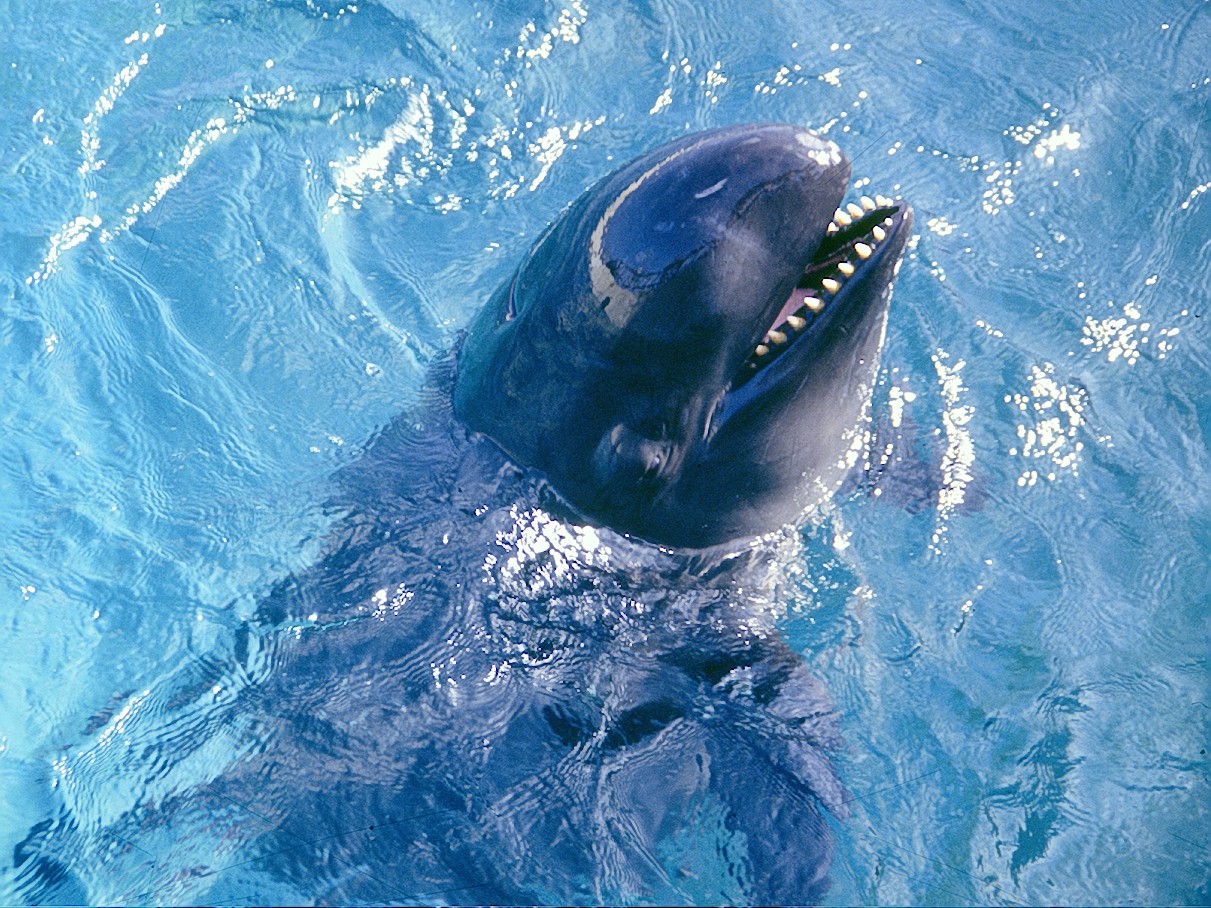
False killer whales are large marine predators. They are the fourth-largest extant species of oceanic dolphin, exceeded in size only by the orca and the two species of pilot whales. Males are about 10–15 % larger than females: females reach a maximum size of 4.5–5 m (15–16 ft) in length and 1,200 kg (2,600 lb) in weight, and males 6 m (20 ft) long and 2,200 kg (4,900 lb). Newborns can be 1.5–2.1 m (5–7 ft) long. Coloration is black or dark gray, slightly lighter on the underside. The body is slender with an elongated, tapered head without a beak. The dorsal fin is sickle-shaped; the flippers are narrow, short, and pointed, with a distinctive bulge on the leading edge of the flipper. Body temperature ranges from 36–37.2 °C (96.8–99.0 °F), increasing during activity. The teeth are conical; there are 14–21 in the upper jaw and 16–24 in the lower.
A false killer whale reaches physical maturity at 8 to 14 years; maximum age in captivity is 57 years for males and 62 for females. Sexual maturity happens at 8 to 11 years. In one population, calving was at 7-year intervals; calving can occur year-round, though it usually occurs in late winter. Gestation takes ~15 months; lactation, 9 months to 2 years. The false killer and pilot whales have a sizable lifespan after menopause, which typically occurs between 45 and 55. As a toothed whale, a false killer can echolocate to navigate and find prey, using its melon organ in the forehead to create sound. The melon is larger in males than in females.
Hub AI
False killer whale AI simulator
(@False killer whale_simulator)
False killer whale
The false killer whale (Pseudorca crassidens) is a species of oceanic dolphin that is the only extant representative of the genus Pseudorca. It is found in oceans worldwide but mainly in tropical regions. It was first described in 1846 as a species of porpoise based on a skull, which was revised when the first carcasses were observed in 1861. The name "false killer whale" comes from having a skull similar to the orca or killer whale (Orcinus orca).
The false killer whale reaches a maximum length of 6 m (20 ft), though size can vary around the world. It is highly sociable, known to form pods of up to 50 members, and can also form pods with other dolphin species, such as the common bottlenose dolphin (Tursiops truncatus). It can form close bonds with other species, as well as have sexual interactions with them. But the false killer whale has also been known to eat other dolphins, though it typically eats squid and fish. It is a deep-diver; maximum known depth is 927.5 m (3,043 ft); maximum speed is around 30 km/h (19 mph).
Several aquariums around the world keep one or more false killer whales, though its aggression toward other dolphins makes it less desirable[citation needed]. It is threatened by fishing operations, as it can entangle in fishing gear. It is drive hunted in some Japanese villages. The false killer whale has a tendency to mass-strand given its highly social nature; the largest stranding consisted of over 800 beached at Mar del Plata, Argentina, in 1946. Most of what is known of this species comes from examining stranded individuals.
The false killer whale was first described by British paleontologist and biologist Richard Owen in his 1846 book, A history of British fossil mammals and birds, based on a fossil skull discovered in 1843. This specimen was unearthed from the Lincolnshire Fens near Stamford in England, a subfossil deposited in a marine environment that existed around 126,000 years ago. The skull was reported as present in a number of museum collections, but noted as lost by William Henry Flower in 1884. Owen compared the skull to those of the long-finned pilot whale (Globicephala melas), beluga whale (Delphinapterus leucas), and Risso's dolphin (Grampus griseus)–in fact, he gave it the nickname "thick toothed grampus" in light of this and assigned the animal to the genus Phocaena (a genus of porpoises) which Risso's dolphin was also assigned to in 1846. The species name crassidens means "thick toothed".
In 1846, zoologist John Edward Gray put the false killer whale in the genus Orcinus, which had been known as the killer whale (Orcinus orca). Until 1861, when the first carcasses washed up on the shores of Kiel Bay, Denmark, the species was presumed extinct. Based on these and a pod that beached itself three months later in November, zoologist Johannes Theodor Reinhardt moved the species in 1862 to the newly erected genus Pseudorca, which established it as being neither a porpoise nor a killer whale. The name "false killer whale" comes from the apparent similarity between its skull and that of the killer whale.
The false killer whale is in the family Delphinidae (oceanic dolphins). It is in the subfamily Globicephalinae; its closest living relatives are Risso's dolphin, the melon-headed whale (Peponocephala electra), the pygmy killer whale (Feresa attenuata), pilot whales (Globicephala spp.), and possibly snubfin dolphins (Orcaella spp.). William Henry Flower suggested in 1884 and later abandoned a distinction between northern and southern false killer whales. Paules Edward Pieris Deraniyagala proposed a subspecies, P. c. meridionalis, in 1945, though without enough justification. There are currently no recognized subspecies. Still, individuals in populations around the world can have different skull structure and vary in average length with Japanese false killers found to be 10–20% larger than South African ones. It can hybridize with the bottlenose dolphin (Tursiops truncatus) to produce fertile offspring called "wholphins".
False killer whales are large marine predators. They are the fourth-largest extant species of oceanic dolphin, exceeded in size only by the orca and the two species of pilot whales. Males are about 10–15 % larger than females: females reach a maximum size of 4.5–5 m (15–16 ft) in length and 1,200 kg (2,600 lb) in weight, and males 6 m (20 ft) long and 2,200 kg (4,900 lb). Newborns can be 1.5–2.1 m (5–7 ft) long. Coloration is black or dark gray, slightly lighter on the underside. The body is slender with an elongated, tapered head without a beak. The dorsal fin is sickle-shaped; the flippers are narrow, short, and pointed, with a distinctive bulge on the leading edge of the flipper. Body temperature ranges from 36–37.2 °C (96.8–99.0 °F), increasing during activity. The teeth are conical; there are 14–21 in the upper jaw and 16–24 in the lower.
A false killer whale reaches physical maturity at 8 to 14 years; maximum age in captivity is 57 years for males and 62 for females. Sexual maturity happens at 8 to 11 years. In one population, calving was at 7-year intervals; calving can occur year-round, though it usually occurs in late winter. Gestation takes ~15 months; lactation, 9 months to 2 years. The false killer and pilot whales have a sizable lifespan after menopause, which typically occurs between 45 and 55. As a toothed whale, a false killer can echolocate to navigate and find prey, using its melon organ in the forehead to create sound. The melon is larger in males than in females.
Recent media