Hubbry Logo
WholphinWholphinMain
Open search
Wholphin
Community hub
Wholphin
logo
8 pages, 0 posts
0 subscribers
Be the first to start a discussion here.
Wholphin
Wholphin
from Wikipedia

Wholphin
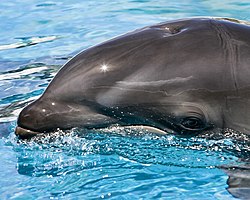
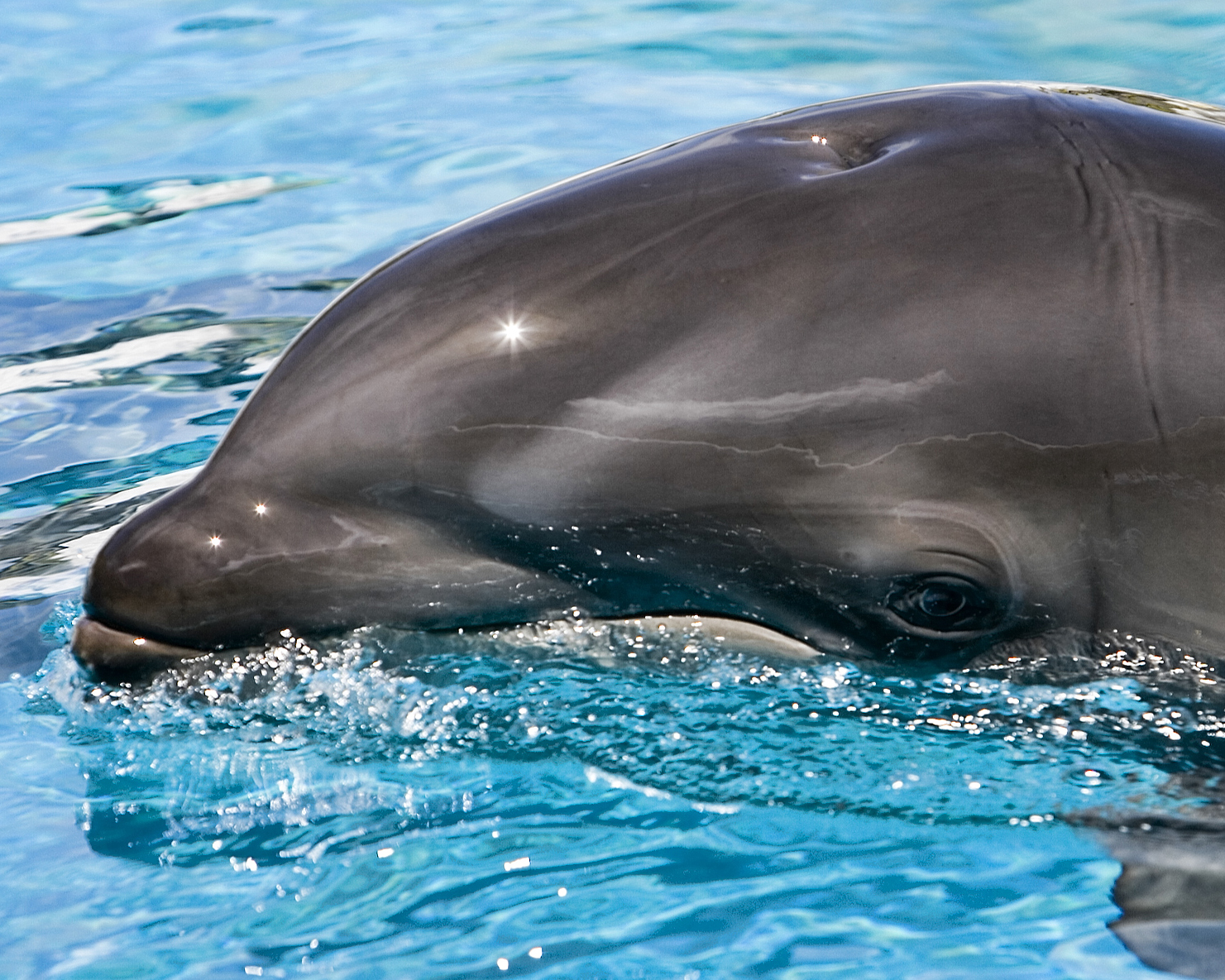
Kawili Kai, born to a female wholphin by a male dolphin, at 9 months of age in September 2005
Kawili Kai, born to Kekaimalu (a female wholphin) by a male dolphin, at 9 months of age in September 2005
Scientific classificationEdit this classification
Kingdom: Animalia
Phylum: Chordata
Class: Mammalia
Order: Artiodactyla
Infraorder: Cetacea
Superfamily: Delphinoidea
Family: Delphinidae
Hybrid: Tursiops truncatus × Pseudorca crassidens

A wholphin (portmanteau of whale and dolphin) is an extremely rare cetacean hybrid born from a mating of a female common bottlenose dolphin (Tursiops truncatus) with a male false killer whale (Pseudorca crassidens).[1] The name implies a hybrid of whale and dolphin, though taxonomically, both are in the oceanic dolphin family, which is in the toothed whale clade. This type of hybrid was considered unexpected given the sometimes extreme size difference between a female common bottlenose dolphin (typically 2 meters long and 300 kilograms) and a male false killer whale (over 5 meters long and over 1,800 kg). Wholphins have been born in captivity and have also been reported in the wild.[2][3]

Wholphins also exhibit physical and behavioural characteristics intermediate between those of their parent species. While much larger than most dolphins, the wholphin becomes an exceptional example of hybrid vigour.[clarification needed]

Examples

[edit]
A Wholphin

The first recorded wholphin was born in a Tokyo SeaWorld in 1981; he died after 200 days.[4]

The first wholphin in the United States and the first to survive was Kekaimalu, born at Sea Life Park in Hawaii on May 15, 1985; her name means "from the peaceful ocean".[4] Kekaimalu proved fertile when she gave birth at a very young age. John Blanchard, a trainer at Sea Life Park, has said about Kekaimalu: [5]

“The wholphin was darker than the other dolphins, and her nose looked like it was chopped off… [she] represented an unusual example of hybridization between two species of dolphin with markedly different sizes and appearances.”

In 1991, Kekaimalu gave birth, to her daughter, Pohaikealoha, with a unknown, male dolphin. For two years, she cared for the calf, but did not nurse it; it was hand-reared by trainers. Pohaikealoha died at age 9. On December 23, 2004, Kekaimalu had her third calf, daughter Kawili Kai, sired by a male bottlenose. The calf was nursed and was very playful. Only months after birth, it was the size of a one-year-old bottlenose dolphin.[6] All three calves were three-quarters bottlenose dolphin and one-quarter false killer whale.[7] Kekaimalu died on July 8, 2024 at the age of 39. [8] Kawili Kai remains in captivity in Sea Life Park.[9]

Family tree

[edit]
Tanui Hahai (false killer whale) ♂Punahele (bottlenose dolphin) ♀
Unknown dolphin ♂Kekaimalu (wholphin) ♀bottlenose dolphin ♂
Unnamed calfPohaikealoha ♀Kawili Kai ♀

Capabilities and behaviour

[edit]

Wholphin behavior represents both parent species. They are intelligent, highly social, and can be trained to do complex tasks; shared traits of false killer whales and bottlenose dolphins alike. Captive wholphins have been observed to be playful and show a great deal of curiosity about their surroundings, the same as bottlenose dolphins. Despite being recorded in the wild, only a few confirmed sightings of wholphins have been seen in nature.[citation needed] Although natural sightings are improbable due to the differences in habitat preference and social structure between the parent species, this is not impossible.

Exterior and physical description

[edit]

Wholphins will also have mixed traits from their parents. They are mostly smaller in size compared to the false killer whales but larger than the bottlenose dolphins. Their coloring will be mostly a dark grey, with the body proportion and dental features falling between those of the two species. For example, wholphins do have more teeth than bottlenose dolphins but fewer than false killer whales on average, showing their hybrid nature.[3]

References

[edit]
[edit]
Revisions and contributorsEdit on WikipediaRead on Wikipedia
from Grokipedia
A wholphin is a rare cetacean hybrid born from the crossbreeding of a female (Tursiops truncatus) and a male (Pseudorca crassidens), both members of the dolphin family Delphinidae. These hybrids have only been documented in , with no confirmed sightings in , due to the differing habitats and behaviors of the parent species—the bottlenose dolphin typically inhabits coastal and inshore waters, while the false killer whale prefers deep offshore tropical and subtropical regions. The first known wholphin, named Kekaimalu, was born on May 15, 1985, at from an accidental mating between a 6-foot, 400-pound female and a 14-foot, 2,000-pound male . Physically, wholphins exhibit intermediate traits: they grow to about 12 feet (3.7 meters) in length and weigh around 1,000 pounds (454 kg), with darker gray skin than a but lighter than a , a rounded dolphin-like head, larger and flippers, and approximately 66 teeth—a midpoint between the parents' 44 and 88. Behaviorally, they share the social and echolocating traits of their parents, nursing for up to two years and displaying rapid growth. Notably fertile, female wholphins can reproduce with bottlenose dolphins, producing second-generation hybrids that are three-quarters bottlenose and one-quarter . Kekaimalu has given birth to three calves, including a female in named Kawili Kai, demonstrating the hybrid's viability in , though early attempts in other facilities, such as a 1981 hybrid at Sea World that survived only 200 days, highlight the rarity and challenges of such crossings. Kekaimalu died in July 2024 at the age of 39 at Sea Life Park, underscoring the wholphin's significance in studies of cetacean hybridization and .

Taxonomy and Origins

Definition and Etymology

A wholphin is a rare cetacean hybrid produced by the crossbreeding of a female (Tursiops truncatus) and a male (Pseudorca crassidens), both members of the oceanic dolphin family Delphinidae. These hybrids have been documented primarily in , where interspecies mating occurs due to confined environments. The term "wholphin" is a portmanteau combining "whale" and "dolphin," reflecting the significant size disparity between the larger false killer whale parent and the smaller bottlenose dolphin, despite both being classified as dolphins rather than true whales. The name was first applied in the 1980s to describe such captive-born hybrids. The false killer whale, though named for superficial resemblances to the killer whale (Orcinus orca), is a large delphinid and not a member of the true whale suborder Mysticeti or Odontoceti's larger families.

Genetic Background

The wholphin arises from interspecific hybridization between the common bottlenose dolphin (Tursiops truncatus) of the genus Tursiops and the false killer whale (Pseudorca crassidens) of the genus Pseudorca, both belonging to the family Delphinidae within the order Cetacea. This taxonomic placement underscores the shared evolutionary lineage of the parent species, enabling the inheritance of genetic traits from distinct genera in the same family. Interspecific hybridization in Delphinidae is facilitated by the close phylogenetic relationships among member species, which reduce genetic barriers compared to more distantly related taxa. Both parent species exhibit chromosomal compatibility, with a diploid number of 44 chromosomes typical of most oceanic cetaceans, allowing for the formation of viable hybrid zygotes. This compatibility has enabled rare instances of fertile offspring, as documented in captive settings where confirmed hybrid parentage. Hybridization among cetaceans represents a natural yet infrequent evolutionary phenomenon, often occurring where parent species exhibit overlapping distributions in tropical and subtropical marine environments. In Delphinidae, such events are associated with ecological factors like shared habitats, though they remain rare due to behavioral and reproductive isolating mechanisms that generally maintain species boundaries.

Physical Characteristics

Size and Morphology

Wholphins display physical dimensions that are generally intermediate between those of their parent species, the common bottlenose dolphin (Tursiops truncatus) and the false killer whale (Pseudorca crassidens). Adult bottlenose dolphins typically measure 1.8 to 4 meters in length and weigh between 136 and 635 kilograms, whereas adult female false killer whales reach 4.9 meters in length and up to 1,360 kilograms, with males slightly larger. As a result, wholphins at maturity commonly range from 2.7 to 3.7 meters in length and 300 to 500 kilograms in weight, reflecting hybrid vigor in growth rates that allow them to reach the size of a one-year-old bottlenose dolphin within weeks of birth. These traits are primarily observed in the known captive wholphin Kekaimalu and her offspring at Sea Life Park Hawaii. The body morphology of wholphins features a streamlined shape adapted for agile swimming, combined with a robust build that provides enhanced endurance compared to pure s. Their is distinctly sickle-shaped, positioned midway along the back and proportioned larger than the 's but smaller and less falcate than the 's. The rostrum, or beak, is moderately elongated, offering a compromise between the pronounced, toothed of the and the shorter, broader head profile of the . In terms of coloration, wholphins exhibit a mottled gray with subtle spotting, darker overall than the lighter gray of but considerably lighter than the near-black hue of ; this blending arises from the codominant pigmentation genes inherited from both parents.

Distinctive Features

Wholphins display hybrid-specific anatomical traits that set them apart from their parent species, the (Tursiops truncatus) and the (Pseudorca crassidens). A key identifying feature is their , which consists of 66 teeth—positioned intermediately between the 88 conical teeth typical of and the 44 larger, more robust teeth of . This number represents roughly the average of the parental counts and underscores the genetic blending in wholphins, as observed in the captive individual Kekaimalu at . These traits are primarily observed in the known captive wholphin Kekaimalu and her offspring at . In terms of external appearance, wholphin skin exhibits intermediate pigmentation, manifesting as a dark gray coloration that is deeper than the light gray of bottlenose dolphins but less intense than the jet-black hue of false killer whales. This blended tone serves as a visual marker of hybrid vigor, with the thicker dermal layer potentially influenced by the heritage, contributing to a sleeker overall texture adapted for marine locomotion.

Behavior and Capabilities

Social Interactions

Wholphins, as rare cetacean hybrids between bottlenose dolphins (Tursiops truncatus) and false killer whales (Pseudorca crassidens), have social interactions observed only in captive settings. These are inferred from the behaviors of their parent species, which share overlapping social structures: false killer whales form stable, cooperative pods, while bottlenose dolphins exhibit fission-fusion societies with frequent affiliative interactions. In , wholphins have been housed in multi-species enclosures, potentially facilitating interactions with individuals from both parent species. Communication in cetaceans involves acoustic signals, and similarities in vocalization frequencies between the parent species may contribute to hybridization propensity. Observations of known wholphins, such as Kekaimalu (deceased July 2024), indicate integration into mixed groups at facilities like , though specific details on play, aggression, or alliances remain undocumented due to the rarity of individuals.

Cognitive Abilities

Wholphins in have participated in for public performances and medical procedures, demonstrating responsiveness to trainer signals and coordination in routines such as synchronized swims. For example, Kekaimalu was featured in daily shows at . Their behaviors blend elements from parent species, including the playful interactions of bottlenose dolphins and cooperative tendencies of false killer whales, suggesting adaptability in captive environments. Wholphins have shown curiosity toward human observers, swimming closer to investigate. Sensory capabilities, such as echolocation, are inherited from both parent species, aiding and . Studies on bottlenose dolphins highlight their use of echolocation for acoustic imaging, while false killer whales employ it for group coordination; wholphins likely possess similar abilities. However, specific cognitive studies on wholphins are limited, with observations based primarily on a few captive individuals as of 2025.

Reproduction and Fertility

Hybrid Viability

Wholphins represent rare examples of fertile cetacean hybrids, with documented cases of individuals successfully reproducing in . wholphins have demonstrated the ability to produce viable through with bottlenose dolphins (Tursiops truncatus), as seen in instances where F1 hybrids mated with parent to yield healthy calves. This fertility is notable among intergeneric hybrids, as many such combinations result in sterility, though male wholphin remains undocumented and is presumed limited in line with patterns observed in other mammalian hybrids where the heterogametic sex often faces reproductive barriers. The gestation period for wholphins is expected to fall intermediate between those of their parent species, spanning approximately 12 to 16 months. This range aligns with the 12-month gestation typical of bottlenose dolphins and the 11- to 15.5-month period reported for false killer whales (Pseudorca crassidens). Due to the substantial size disparity between false killer whales (up to 6 meters) and bottlenose dolphins (up to 4 meters), hybrid pregnancies may encounter elevated risks of birthing complications, such as size-related dystocia or developmental mismatches during delivery. In terms of health, wholphins can benefit from hybrid vigor, potentially conferring enhanced immunity and resilience through genetic heterozygosity, as observed in some cetacean hybrids. However, they are also susceptible to hybrid incompatibilities, including potential organ size discrepancies or physiological issues arising from divergent parental genomes. In captivity, the known wholphin Kekaimalu lived to 39 years, comparable to bottlenose dolphins under (up to 40–50 years), though limited examples suggest variability influenced by hybrid-specific factors.

Known Offspring

The documented wholphin offspring stem primarily from at Park in , where the first surviving wholphin, Kekaimalu (born 1985, died July 8, 2024), produced three calves sired by male s. These progeny represent second-generation hybrids, carrying approximately one-quarter genetics and three-quarters bottlenose dolphin genetics, as confirmed through parentage records. The calves were: an unnamed calf born in 1990 that died shortly after birth; Pohaikealoha, born in 1991, who lived approximately 9 years; and Kawili Kai, born December 23, 2004, who remains alive as of November 2025 and resides at Sea Life Park without recorded offspring. Breeding patterns among wholphins indicate that females are predominantly fertile, enabling pairings with bottlenose dolphins to yield viable offspring, while no successful reproduction from male wholphins has been recorded. The offspring display varied genetic mixes from their hybrid mothers, though specific litter compositions remain limited to single births typical of cetaceans. Survival rates for known wholphin births are approximately 50% past infancy, with two of the three documented calves from Kekaimalu surviving beyond early life (Pohaikealoha for 9 years and Kawili Kai ongoing). Third-generation wholphins, potentially arising from second-generation females mating with bottlenose dolphins, remain unconfirmed and unobserved as of November 2025.

Notable Examples

Captive Individuals

The first documented captive wholphin was born in 1981 at Sea World in from a female bottlenose dolphin and a male false killer whale, but the unnamed hybrid died after approximately 200 days. The first surviving captive wholphin, a named Kekaimalu, was born on May 15, 1985, at Sea Life Park in to Punahele, a bottlenose dolphin, and I'anui Kahei, a male false killer whale; she measured about 6 feet in length at birth and grew to around 12 feet and 800 pounds as an adult. Kekaimalu lived for 39 years, participating in educational programs and public interactions at the park until her death on July 8, 2024. Kekaimalu demonstrated fertility uncommon among cetacean hybrids, giving birth to multiple calves sired by male , resulting in second-generation hybrids with 75% and 25% ancestry. Her first calf, born in 1990 when Kekaimalu was about five years old, died a few days after birth. In 1991, she gave birth to another female, Pohaikealoha, who lived for approximately nine years but did not reproduce. In 2004, Kekaimalu produced her most notable offspring, a female named Kawili Kai, who has survived into adulthood and continues to reside at Sea Life Park as of 2025, serving as a key example of hybrid viability in captivity.

Wild Sightings

No wholphins have been confirmed in the wild, consistent with the differing habitats and behaviors of the parent species, which reduce the likelihood of natural crossbreeding. Unverified reports of atypical cetaceans in tropical Pacific waters have occasionally surfaced, but challenges in field identification, such as limited visibility and rapid movements, have prevented confirmation of any wholphin sightings.

Conservation Implications

Rarity and Threats

Wholphins are exceptionally rare due to the infrequent occurrence of hybridization between false killer whales (Pseudorca crassidens) and common bottlenose dolphins (Tursiops truncatus), which is limited by premating isolating mechanisms such as species-specific mating behaviors and vocalizations, as well as restricted geographic overlap between the primarily oceanic false killer whales and the more coastal bottlenose dolphins. Although cetacean hybridization has been documented in approximately 20% of species, with 7 cases in captivity and 13 in the wild across all cetaceans, specific wholphin events remain among the least common, occurring almost exclusively under captive conditions where natural barriers are absent. No stable wild wholphin population exists, with no verified sightings confirmed despite occasional unconfirmed reports of atypical cetaceans; all documented individuals—fewer than 10 historically—have originated in captivity, including the first in 1981 at (which survived only 200 days) and subsequent births at in starting in 1985. Threats to wholphins primarily stem from pressures on their parent species, including in fishing gear, which has been identified as a leading cause of mortality, and habitat degradation from and that diminishes populations through warmer waters, , and toxin accumulation. These factors reduce opportunities for natural hybridization by lowering the abundance of potential parent individuals and altering migration patterns. In , where all known wholphins have been bred, ethical concerns arise from high welfare risks associated with such programs, including elevated newborn mortality rates (over 30% in some European facilities from 2011-2015 due to stillbirths, attacks, and infections) and from inadequate environments that fail to replicate natural social and behavioral needs.

Research Significance

Wholphins serve as important models for investigating hybrid zones and dynamics in marine mammals, particularly within the Delphinidae family. As fertile hybrids between false killer whales () and bottlenose dolphins (Tursiops truncatus), they exemplify incomplete reproductive barriers that allow interspecific mating despite morphological and ecological differences. Genetic analyses of cetacean hybrids have confirmed hybrid ancestry through mitochondrial and nuclear markers, revealing potential bidirectional that can influence adaptive traits and population divergence in cetaceans. Studies of wholphins enhance knowledge of and behavioral adaptability among cetaceans facing oceanic changes. Hybrid individuals often exhibit intermediate vocal repertoires and social behaviors, enabling integration into mixed groups of parental , which provides evidence for flexible communication strategies in response to habitat shifts driven by variability and human impacts. Wholphin supports conservation efforts by highlighting the need to protect overlap zones for Delphinidae , where hybridization may bolster genetic resilience amid threats like . Given their extreme rarity in the wild, these studies emphasize long-term monitoring to assess gene flow's role in maintaining diversity. Ethical discussions on captive cetacean intensified post-2000s, weighing the insights from wholphin hybrids against , with growing advocacy for alternatives like non-invasive field to minimize confinement.

References

Add your contribution
Related Hubs
User Avatar
No comments yet.