

Fan-Tan
View on Wikipedia Board and components for Fan-Tan | |
| Publication | c. 380 |
|---|---|
| Genres | Guessing game, gambling |
| Chance | Pure |
Fan-Tan, or fantan (simplified Chinese: 番摊; traditional Chinese: 番攤; pinyin: fāntān; Jyutping: faan1 taan1; lit. 'repeated divisions') is a gambling game long played in China. It is a game of pure chance.
The game is played by placing two handfuls of small objects on a board and guessing the remaining count when divided by four. After players have cast bets on values of 1 through 4, the dealer or croupier repeatedly removes four objects from the board until only one, two, three or four beans remain, determining the winner.
History
[edit]
The game may have arisen during third and fourth centuries, during the period of the Northern and Southern dynasties.[1] It then spread through southern China during the Qing dynasty.[2] The name fantan dates back only to the mid-nineteenth century. Before that time, fantan was known as 掩錢; yǎnqián; 'covering coins', 攤戲; tānxì, 攤錢; tānqián, or 意錢; yìqián.[3] It was prominent during the Late Qing and Republican period in Canton and the Pearl River Delta region.[2] The game was also played in the Philippines under the name Capona.[4]
After 1850, fantan spread overseas as a side effect of the massive Cantonese emigration. As a rule, in places where a significant number of Cantonese migrants could be found, fantan was also present.[5] Fan-tan was very popular among Chinese migrants in America, as most of them were of Cantonese origin.[2][6] Jacob Riis, in his famous book about the underbelly of New York, How the Other Half Lives (1890), wrote of entering a Chinatown fan-tan parlor: "At the first foot-fall of leather soles on the steps the hum of talk ceases, and the group of celestials, crouching over their game of fan tan, stop playing and watch the comer with ugly looks. Fan tan is their ruling passion." The large Chinatown in San Francisco was also home to dozens of fan-tan houses in the 19th century. The city's former police commissioner Jesse B. Cook wrote that in 1889 Chinatown had 50 fan-tan games, and that "in the 50 fan tan gambling houses the tables numbered from one to 24, according to the size of the room."
California amended Section 330 of the California Penal Code in 1885, adding fan-tan to its list of banned games;[7] this coincided with the general rise of anti-Chinese sentiment in the United States, as fan-tan was considered a differentiating vice on par with opium use[8][9][10] and the direct cause of property crime and violence.[11] Raids on fan-tan parlors were regularly featured in contemporary news articles, with police in some cases posing as Chinese to infiltrate the games.[12][13][14] In San Jose, California, a typo in a local printed law led to charges being dismissed against several bettors.[15] Despite its illegality, it was estimated that 100 fan-tan parlors were operating in San Francisco's Chinatown around the turn of the 20th century.[11]
Because of the police raids, fan-tan parlors adopted double-entrance security measures: after entering through the street doors, a bettor would have to pass through a hallway and a second interior set of doors. If the guard posted on the exterior doors did not recognize the prospective bettor or the guard raised an alarm in the event of a raid, the interior doors, often heavily reinforced with iron, would be shut and barred, giving the fan-tan patrons and parlor time to dismantle the game, conceal evidence, and flee the premises.[11]
Fan-tan is no longer as popular as it once was, having been replaced by modern casino games like Baccarat, and other traditional Chinese games such as Mah Jong and Pai Gow. Fan-tan is still played at some Macau casinos.[16]
The game
[edit]The game is operated by two people: the "tán kún" or croupier, who stands by the table at position no. 1, and the "ho kún" (clerk or cashier), who stands to the left of the "tán kún".[6]
A square is marked in the center of an ordinary table, or a square piece of metal is laid on it, the sides being marked 1, 2, 3 and 4 in anti-clockwise order; alternatively, the sides may be marked 0 through 3, with 0 taking the place of 4. The banker puts on the table a double handful of small objects (buttons, beads, coins, dried beans, or similar articles), which he covers with a metal bowl. When all bets are placed, the bowl is removed and the "tán kún" uses a small bamboo stick to remove the objects from the heap, four at a time, until the final batch is reached.[17]
If the final batch contains four objects, those who wagered on position 4 (and specific bets that include position 4) win; if three, the backers of No. 3 win; if two, the backers of No. 2 win and if one the backers of No. 1 win.[17] A variant substitutes dice instead of counting the objects by fours; the remainder after dividing the sum of the dice by four is used to determine the winning positions.[11]
Betting
[edit]Fan-Tan uses a fixed-odds betting system where all winning wagers are paid according to the true odds of success. The pool of money used to pay off bets is the total amount wagered on all positions, less a house commission,[6] which ranges from 5% to 25%[17] depending on the time and place.[16][18] Because the prizes are paid entirely out of the wagers, the game is relatively inexpensive to operate.[6]: 5
Culin (1891) describes four potential bets:[6]
- "Fan", in which the wager is on a single position to win.
- "Hong", in which the wager is on three positions, one of which (the primary bet) is selected to win; if either of the other two positions (the two secondary bets) are selected, the bettor does not lose, but it is considered a push and the bettor's money is returned.
- "Kwok", in which the wager is on two positions (two primary bets); if either is selected, the bettor wins.
- "Nim", in which the wager is again on two positions, one of which is selected to win (one primary bet), and the other (one secondary bet) is selected to push.
 | ||||
| Wager | Odds[a] | Payout[b] | Nomenclature[c] | Notes |
|---|---|---|---|---|
| 番[d] "Fan" |
1:4 | 3:1 | 1 2 4 3 |
The player wagers money on a single primary position with a narrow red card (kau li) beneath the money. The player wins four times the amount bet, based on the true odds of having the remainder match the position wagered. |
| 紅[e] "Hong" |
1:4[f] | 1:1 | 214 123 143 234 |
The player wagers money on a single primary position without the red card. The player receives money if the remainder is one of three numbers: the player wins two times the amount bet if the remainder matches the primary wagered position, and wins an amount equal to the wager (i.e., a push: money is returned without loss) if the remainder is one of the secondary positions to either side of the primary wagered position. |
| 1:2[g] | 0:1[h] | |||
| 角[i] "Kwok" |
1:2 | 1:1 | 1-2 1-4 1-3 2-4 2-3 3-4 |
The player wagers money on a corner between two adjacent positions, and wins two times the amount bet if the remainder is either of the two primary positions adjacent to the wagered corner.[6] In the modern variants, it is possible to buy both odd positions (i.e., positions 1 and 3) and/or both even positions (2 and 4), even though these are not adjacent. |
| 念[j] "Nim" |
1:4[f] | 2:1 | 12 13 14 21 41 24 42 23 43 32 31 34 |
The player places the wager at the side of a single primary position with the red card on top of the money. The player wins double the amount wagered if the remainder matches the primary position, or wins an amount equal to the wager if the remainder is the secondary position adjacent to the side of the wagered primary position.[6] In the modern variants, this has expanded to include buying the opposite position (i.e., if position 1 is the primary bet, the twist or side bet could be on position 2, 3, or 4). |
| 1:4[g] | 0:1[h] | |||
In the modern game, the "Hong" (row) bet is usually replaced by two alternative three-number bets. The first of these is the "Tan" or "Nga Tan" bet (丫攤; yā tān; ngaa1 taan1; 'booth'). Two positions are chosen as the primary wager, and one position is chosen as the secondary "push" wager; there are twelve possible combinations of this type of bet, and each position has six corresponding primary and three secondary wagers. For example, the six bets that include position 1 as the primary wager are 1-24, 1-23, 1-32; 1-42, 1-43, and 1-34; and the three bets that include position 1 as the secondary "push" wager are 2-41, 2-31, and 3-41, so any single position will result in a win for 6⁄12 of the "Tan" bets and a push for 3⁄12 of them.
The second three-number bet that can be made is an all-primary wager, known as "Sheh Sam Hong", sometimes romanized as "Shen Sam Hong" (三門; sān mén; saam1 mun4; 'three gates' or 射三紅; shè sān hóng; se6 saam1 hung4; 'shoot three row'), where any one of the three numbers will win. There are four combinations of the three numbers: 1-2-3, 2-3-4, 3-4-1, or 4-1-2, so any single position will result in a win for 3⁄4 of the "SSH" bets. The payout for the "Tan" and "SSH" bets is correspondingly lower, based on the increased odds of winning, and the two modern three-number bets also generally require a higher minimum stake because of the lower payout.
 | |||||||||||||||||||||||||||||
| Wager | Odds[a] | Payout[b] | Nomenclature | Notes | |||||||||||||||||||||||||
|---|---|---|---|---|---|---|---|---|---|---|---|---|---|---|---|---|---|---|---|---|---|---|---|---|---|---|---|---|---|
| 丫攤[k] "Tan" |
1:2[f] | 1:2 |
|
Two primary positions will win, but at a lower payout; one secondary position will push. Higher minimum bet may be required. | |||||||||||||||||||||||||
| 1:4[g] | 0:1[h] | ||||||||||||||||||||||||||||
| 射三紅[l] "SSH" |
3:4 | 1:3 |
|
Any of the three primary positions in the wager will win, but at a lower payout. Higher minimum bet may be required. | |||||||||||||||||||||||||
- Notes
- ^ a b True odds of occurrence
- ^ a b Net payout, meaning the amount returned in addition to the original wager. This is the payout before the house commission is calculated. For a typical house commission of 5%, the actual payout is 95% of the value shown, e.g., for the 3:1 payout of the "Fan" bet, the actual payout would be 2.85:1.
- ^ As displayed in the diagram; the larger number(s) indicate the primary position(s) wagered, and the smaller subscript number(s) indicate the secondary position(s) wagered.
- ^ 買番; mǎi fān; maai5 faan1; 'Buying a single number'
- ^ 買紅; mǎi hóng; maai5 hung4; 'Buying a row'
- ^ a b c For the primary wagered position(s), denoted by the larger number(s).
- ^ a b c For the secondary wagered position(s), denoted by the smaller number(s).
- ^ a b c The secondary bet(s) pay off as a "push": the bettor's original wager is returned.
- ^ 買角; mǎi jiǎo; maai5 gok3; 'Buying the corner'; can be romanized as "Kwok" or "Kok"
- ^ 買念; mǎi niàn; maai5 nim6; 'Buying the twist'
- ^ 丫攤; yā tān; ngaa1 taan1; 'Booth'; can be abbreviated either as "Nga" or "Tan"
- ^ 射三紅; shè sān hóng; se6 saam1 hung4; 'Shoot three row'

Currently, in Macau casinos, the house commission is uniformly set at 5%. For example, assume that bettors have wagered a total of $100 on each position as "Fan" bets, meaning the total of all wagers is $400 for all positions; the true odds of winning this specific wager are 1 in 4. The total payout to the bettors who chose the winning position would be $400 (the total wagered on all positions). Based on the amount wagered on the winning position, $100, the net payout is 3 to 1: $100 wagered, $300 returned in addition to the original wager. However, the house commission of 5% means the winning bettor(s) are paid a total of $285 ($300 less 5%), providing a total commission of $15 to the house for the game.
Odds and payout
[edit]| Bet Type | Potential Bets | True odds | Net payout (w/ 5% to house) |
Net return | ||
|---|---|---|---|---|---|---|
| Win | Push | Lose | ||||
| 番 Fan | 4 | 1⁄4 | 0⁄4 | 3⁄4 | 3:1 (2.85:1) |
-0.0375 |
| 紅 Hong | 4 | 1⁄4 | 2⁄4 | 1⁄4 | 1:1 (0.95:1) |
-0.0125 |
| 角 Kwok | 6 | 3⁄6 | 0⁄6 | 3⁄6 | 1:1 (0.95:1) |
-0.0250 |
| 念 Nim | 12 | 3⁄12 | 3⁄12 | 6⁄12 | 2:1 (1.90:1) |
-0.0250 |
| 丫攤 Tan | 12 | 6⁄12 | 3⁄12 | 3⁄12 | 1:2 (0.95:2) |
-0.0125 |
| 射三紅 SSH | 4 | 3⁄4 | 0⁄4 | 1⁄4 | 1:3 (0.95:3) |
-0.0125 |
The net payout for each bet is determined by the true odds. The odds of winning for each type of bet is determined by considering the total number of potential bets within that type, and if how many of those bets will win, lose, or push for a given position outcome; the sum of the odds for any single bet (win + lose + push) is always one. The net payout for each bet is calculated as Losing odds/Winning odds, less the cut for the house. The odds of the "push" or secondary positions only affect the calculation of net payout by reducing the number of losing bets because when the result is a push, the original wager is returned without loss.
For example, the "Fan" bet on a single position only wins 1⁄4 of the time, i.e., only when that specific position is selected; consequently, there is a 3⁄4 chance of losing the "Fan" wager. The net payout is (3/4)⁄(1/4) = 3, before the cut for the house is taken. Assuming a 5% cut, the final payout for a "Fan" win is 95% of 3×, or 2.85× the amount bet. Similarly, the odds of winning a "Tan" bet are 6⁄12 and the odds of losing a "Tan" bet are 3⁄12 (a push will occur for the remaining 3⁄12), so the net payout is (3/12)⁄(6/12) = 1⁄2, before the cut for the house is taken.
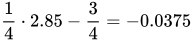
The net return is the product of the odds of winning and final payout (after the cut for the house is taken), less the odds of losing. Again, the odds of a push are not considered. For example, for the "Fan" bet, the net return is , meaning the house receives 3.75% of each "Fan" bet, on average. In contrast, for the "Tan" bet, the net return is , and the house receives 1.25% of each "Tan" bet.

Equipment
[edit]- Numerous small objects (typically copper cash, beads, buttons, or beans)[11]
- Tan ching (playing mat)
- Tan koi (cup or cover)
- Tan pong (stick or rod used to remove objects)
Cultural references
[edit]Fan Tan Alley in the Chinatown of Victoria, British Columbia is named for the numerous gaming parlors that once lined it. It is the narrowest street in North America, at just 90 centimetres (35 in) wide[19][20]
References
[edit]- ^ 郭双林; 肖梅花 (1995). 中华赌博史 [History of gambling in China] (in Chinese). Beijing: 中国社会科学出版社 [China Social Sciences Press]. p. 225. ISBN 9787500417194.
- ^ a b c Paulès, Xavier (26–28 September 2007). Le fantan, une étude préliminaire [Fantan: a preliminary study] (PDF). Atelier 37 : Le Jeu en Asie, 3ème Congrès du Réseau Asie - IMASIE / Workshop 37 : Gambling in Asia, 3rd Congress of Réseau Asie - IMASIE (in French). Paris, France. Archived from the original (PDF) on 15 July 2011.
- ^ Paulès, Xavier (July 2010). "Gambling in China reconsidered: fantan in South China during the early twentieth century". International Journal of Asian Studies. 7 (2): 179–200. doi:10.1017/S1479591410000069. S2CID 143671682.
- ^ Culin, Stewart (October–December 1900). "Philippine Games". American Anthropologist. 2 (4): 643–656. doi:10.1525/aa.1900.2.4.02a00040. JSTOR 659313.
- ^ Paulès, Xavier (Fall 2017). "An illustration of China's 'paradoxical soft power': the dissemination of the gambling game fantan 番攤 by the Cantonese diaspora, 1850–1950". Translocal Chinese: East Asian Perspectives. 11 (2): 187–207. doi:10.1163/24522015-01102002.
- ^ a b c d e f g Culin, Stewart (1891), "The Gambling Games Of The Chinese In America", Series in Philology Literature and Archaeology, vol. I, no. 4, Philadelphia, Pennsylvania, USA: University of Pennsylvania Press, retrieved August 30, 2017
- ^ California State Assembly. "An Act to amend section three hundred and thirty of an Act entitled an Act to establish a Penal Code, approved February 14, 1872, to prohibit gaming". Twenty-sixth Session of the Legislature. Statutes of California. State of California. Ch. CXLV p. 135. direct URL
- ^ "Police! Police! Gambling Hells That Are Open Day and Night. Training School for Young Thieves. Never Ending High Carnival of Debauchery and Crime". San Jose Mercury-news. February 25, 1883. Retrieved 3 March 2021.
- ^ "The Naughty Chinaman". Livermore Herald. June 11, 1885. Retrieved 3 March 2021.
- ^ "The Chinese in Eastern Cities". Los Angeles Herald. September 21, 1887. Retrieved 3 March 2021.
- ^ a b c d e "Fan Tan Is Played". San Francisco Chronicle. January 31, 1894. Retrieved 5 March 2021.
- ^ "Five Unlucky Mongolians". Los Angeles Herald. November 24, 1892. Retrieved 3 March 2021.
- ^ "Novel Capture of Fan-Tan Evidence". San Francisco Call. August 23, 1900. Retrieved 3 March 2021.
- ^ "Raid a Fan-Tan Game". San Francisco Call. October 5, 1902. Retrieved 3 March 2021.
- ^ "The Letter 'T.' It is a little affair, but it managed to knock out an ordinance". San Jose Herald. May 8, 1888. Retrieved 3 March 2021.
- ^ a b K., James (1 April 2009). "Fan Tan in Macau". The Wizard of Macau. Archived from the original on 31 August 2017. Retrieved 30 August 2017.
- ^ a b c One or more of the preceding sentences incorporates text from a publication now in the public domain: Chisholm, Hugh, ed. (1911). "Fantan". Encyclopædia Britannica. Vol. 10 (11th ed.). Cambridge University Press. p. 171.
- ^ Heller, Edmund (1917), Handwritten China journal, vol. 5,
...less 10% for the house.
- ^ "The story behind Fan Tan Alley's crowded corridor". The Globe and Mail. February 14, 2007. Retrieved 3 March 2021.
- ^ "Fan Tan Alley: The link from the past to the present centre of Chinatown". Victoria's Chinatown: A Gateway to the Past and Present of Chinese Canadians. University of Victoria. Archived from the original on 8 October 2021. Retrieved 3 March 2021.


Fan-Tan
View on GrokipediaHistory
Origins in Ancient China
Fan-Tan derives from ancient Chinese practices of divination, particularly the milfoil method outlined in the I Ching (Book of Changes), which dates to the Zhou dynasty (c. 1046–256 BCE). In this technique, diviners used 50 yarrow stalks, repeatedly dividing them into groups of four and interpreting the remainders (one, two, three, or four stalks) to generate hexagrams for prognostication.[3] This modular division by four—central to Fan-Tan's betting on the final remainder after removing objects in sets of four—provided the mathematical and ritual foundation for the game, evolving from non-gambling oracular use into wagering on ostensibly supernatural outcomes.[3] While the precise transition to a formalized gambling game lacks contemporary records from antiquity, some historical accounts posit mythical origins during the Han dynasty (206 BCE–220 CE), when divination remained integral to decision-making and folklore.[3] The game's retention of beliefs in non-random, fate-determined results underscores its causal link to these earlier rituals, distinguishing it from purely chance-based Western games. By the late imperial period, particularly in southern provinces like Guangdong, Fan-Tan had developed into a popular banked betting activity, though its core procedure preserved the ancient remainder-counting mechanic.[5][3]Spread Through Chinese Diaspora
Fan-Tan disseminated worldwide via Cantonese emigrants from southern China, primarily between 1850 and 1950, amid economic pressures and opportunities in overseas labor markets. Migrants from Guangdong province, facing poverty and unrest during the late Qing dynasty, transported the game to diaspora settlements, where it anchored social gambling in isolated communities. This spread aligned with major emigration waves to the Americas, Australia, and Southeast Asia, transforming Fan-Tan from a regional pastime into a marker of Chinese cultural continuity abroad.[6] In the United States, Chinese arrivals during the California Gold Rush (1849 onward) and transcontinental railroad projects (1860s) embedded Fan-Tan in West Coast Chinatowns. By 1888, it ranked as the leading gambling method among Chinese laborers, with parlors using coins or buttons for bets on remainders after division by four. San Francisco's Chinatown hosted dozens of such houses, each with 10 to 20 tables, despite periodic police raids enforcing anti-gambling laws. New York City's Chinese quarter similarly featured Fan-Tan operations by the late 1880s, sustaining communal ties amid exclusionary policies like the Chinese Exclusion Act of 1882.[7][8] Australian Chinatowns mirrored this pattern, as over 40,000 Chinese miners arrived during the 1850s gold rushes in Victoria and New South Wales. Fan-Tan emerged in gaming tables within stores, temples, and rural camps, such as Narrandera's 1880s Chinese quarter with dedicated fan-tan rooms alongside lottery houses. Sydney records from the early 1900s confirm ongoing play in Elizabeth Street dens, often blending with pak-a-pu lotteries, though colonial authorities targeted them as vice hubs.[9][10] In Southeast Asia, Cantonese and Hokkien traders spread Fan-Tan to entrepôts like Singapore, Malaya, and Macau from the mid-19th century, integrating it into multicultural gambling scenes. By the early 20th century, it appeared in private clubs and casinos, occasionally adopted by locals, though overshadowed by games like pai gow. Macau's legalized venues preserved it into the late 20th century, reflecting enduring diaspora influence.[6]Evolution in the 19th and 20th Centuries
During the mid-19th century, Fan-Tan disseminated globally alongside Cantonese migration from Guangdong province, reaching overseas Chinese communities in the Americas, Australia, and Southeast Asia between 1850 and 1950.[6] Chinese laborers arriving in California during the Gold Rush and for railroad construction introduced the game to San Francisco's Chinatown, where it became a staple among workers by the late 1800s, alongside games like Pak Kop Pew.[11] In New York City, Fan-Tan houses operated openly in Chinatown by 1887, reflecting its integration into diaspora social life.[8] Similar establishments proliferated in other ports, such as Victoria, British Columbia, and Otago, New Zealand, where Chinese miners brought the game from the mid-1860s.[12] In the United States, Fan-Tan persisted as a dominant gambling activity in Chinatowns through the late 19th and early 20th centuries, with San Francisco hosting around 50 such games amid broader vice districts featuring lotteries and opium dens.[8] Gambling halls marked by signs like "Riches and Plenty" catered to laborers, fostering community hubs despite periodic police raids and anti-Chinese sentiments exacerbated by the 1882 Chinese Exclusion Act.[13] Overseas, the game's simplicity using coins or beans allowed adaptation to local constraints, maintaining its appeal in informal settings.[14] By the early 20th century, Fan-Tan remained embedded in southern Chinese daily life in Guangdong, operating publicly rather than clandestinely, with widespread participation across social strata.[4] In Macau, under Portuguese administration, it dominated legalized gambling from 1849 until 1961, when government policies shifted toward lotteries and table games, marking a transition from its era of primacy. Diaspora versions faced increasing regulation; U.S. cities like San Francisco intensified crackdowns during the Progressive Era, yet the game endured in underground forms amid tong conflicts over gambling territories until mid-century declines due to assimilation and stricter laws.[13]Equipment and Setup
Traditional Components
The core traditional components of Fan-Tan include a collection of small objects such as buttons, coins, beads, or counters, which form the basis for determining the game's outcome through division by four. These objects, often numbering in the hundreds, are randomly selected and piled by the dealer to ensure unpredictability. Historical accounts from early 20th-century South China describe coins or tokens as commonly used, reflecting the game's simplicity and reliance on everyday items.[4][15] A metal bowl or cup, referred to as tan koi, covers a portion of these objects after placement on the table, hiding the count from players until bets are finalized. Typically crafted from brass or similar durable metal, this component prevents premature revelation and maintains game integrity, as evidenced in artifacts from Chinese diaspora communities around 1900.[16][15] The dealer employs a stick or wand, known as tan pong, to systematically remove the objects in sets of four from under or around the bowl. This tool, frequently made of bamboo for its rigidity and availability, allows precise grouping without manual separation, culminating in the exposure of the remainder (1 to 4) that resolves wagers. Such implements were standard in gambling houses (tanguan) across South China during the late Qing and Republican eras.[4][17] Betting occurs on a plain table surface or occasionally a marked mat (tan ching) delineating positions for remainders, though the latter was not universally required in traditional setups. This minimalistic arrangement emphasized the game's focus on probability over elaborate apparatus, distinguishing it from more complex Western gambling tools.[15]Modern Substitutes and Casino Adaptations
In modern casino environments, particularly in Macau, Fan-Tan utilizes uniform white plastic buttons instead of traditional irregular objects like beans or coins, promoting consistency in play and reducing wear.[2] The dealer covers a random handful with a metal cup and employs a slender wand to divide the buttons into stacks of four, revealing the remainder to determine outcomes.[2] These adaptations maintain the core mechanic while accommodating high-volume casino operations, with the house serving as banker to manage bets and payouts efficiently.[18] Live dealer online adaptations, such as Evolution Gaming's version launched on September 15, 2021, substitute a transparent glass dome for the traditional cup to cover 200 beads, allowing viewers to observe the initial setup before the dealer uses a stick for division.[19] This digital format replicates the physical process via high-definition video from a dedicated studio, enabling remote betting on remainders or combinations with interface overlays for wager placement.[17] Payouts follow standard ratios, such as 3:1 for single-number bets, preserving the game's mathematical structure amid electronic enhancements for accessibility.[19]Gameplay
Betting Options
In Fan-Tan, bets are placed on the remainder after dividing a random selection of objects, such as buttons or beads, by four, yielding outcomes of 1, 2, 3, or 4 (where 4 denotes a remainder of zero).[2] Betting positions are typically arranged on a mat corresponding to these remainders and their combinations.[2] The core bet types include the Fan wager on a single specific remainder, which pays 3 to 1 before a standard 5% commission on winnings, resulting in an effective payout of 2.85 to 1 and a house edge of 3.75%.[2] Pair bets such as Kwok, covering two remainders where both qualify as winning if the outcome matches either, pay 1 to 1 before commission (0.95 to 1 after), with a house edge of 2.50%.[2] The Nim bet, also on two remainders but with one designated as a push in case of a tie-like scenario, pays 2 to 1 before commission (1.9 to 1 after), maintaining the same 2.50% house edge.[2] Three-number combinations offer lower-risk options: the Nga Tan bet, covering three remainders with one pushing, pays 1 to 2 before commission (0.475 to 1 after), yielding a 1.25% house edge.[2] Similarly, Sheh-Sam-Hong, betting on all three non-outcome remainders winning collectively, pays 1 to 3 before commission (approximately 0.3167 to 1 after), with an identical 1.25% house edge.[2] These payouts reflect practices in traditional casino settings like those in Macau, where commission adjusts the returns.[2]Procedure for Dealing and Resolution
The dealer begins the dealing procedure by selecting an arbitrary quantity of small objects, such as porcelain buttons, coins, beads, or beans—typically numbering between 50 and 200 to prolong the reveal and build suspense—and places them beneath an opaque metal bowl, cup, or cloth on the center of the betting layout.[20] Once bets are locked, the dealer partially lifts the cover and uses a bamboo stick, metal wand, rake, or chopsticks to extract the objects in visible groups of exactly four, stacking each group aside for all players to observe and verify fairness. This removal continues iteratively until fewer than four objects remain.[21][20] The resolution hinges on the final remainder: if 1, 2, or 3 objects are left, that number designates the winning bet position; if zero objects remain after the last valid group of four is removed, it is conventionally scored as 4, equivalent to a remainder of zero modulo 4.[21][22] Bets matching the outcome pay according to predefined odds, with non-winning wagers collected by the banker or house, which may skim a commission from the pot.[21] In traditional settings, the process emphasizes transparency to prevent tampering, with the dealer's actions performed methodically under scrutiny; modern casino adaptations may employ automated shufflers or electronic displays but retain the core stepwise division by four.[20][23]Payout Mechanics
In traditional Fan-Tan, payouts for winning bets are calculated based on the type of wager placed on the final remainder of beads (1, 2, 3, or 4), with the banker or house typically deducting a 5% commission from the winnings to establish its edge. This commission is applied only to the profit portion, not the original stake, and is standard in both informal and casino settings to ensure the game's viability for the operator. Bets are resolved immediately after the dealer uncovers the final beads, with losers forfeiting their stakes entirely while winners receive their returns plus profits net of commission.[2] The primary bet types and their corresponding payouts are as follows:| Bet Type | Description | Payout Before Commission | Payout After 5% Commission |
|---|---|---|---|
| Fan | Wager on a single specific remainder (e.g., exactly 1 bead left) | 3 to 1 | 2.85 to 1 |
| Kwok | Wager on two remainders where both would win if selected | 1 to 1 | 0.95 to 1 |
| Nim | Wager on two remainders, with one designated as a push (returned stake) if it occurs | 2 to 1 | 1.9 to 1 |
| Nga Tan | Wager on three remainders, with one designated as a push | 1 to 2 | 0.475 to 1 (per unit, adjusted for partial win) |
| Sheh-Sam-Hong | Wager on three remainders where all win if any occurs | 1 to 3 | Approximately 0.3167 to 1 |
Mathematical Foundations
Probabilities of Remainders
In the traditional Fan-Tan game, the outcome is determined by the remainder after repeatedly dividing the hidden pile of objects (such as beads or coins) by 4, yielding one of four possible results: 1, 2, 3, or 4 (where 4 represents a remainder of 0).[2] Assuming the initial number of objects is sufficiently large and randomly selected or unknown to players, each remainder occurs with equal probability of exactly 1/4, or 25%.[2] This uniformity arises from the modulo-4 operation applied to a random integer, where the residues modulo 4 are equidistributed under standard assumptions of randomness in the pile size.[24] The equal probabilities hold because the game's resolution process—removing groups of four objects until fewer than four remain—does not favor any specific residue, provided the dealer follows fair procedures without manipulation.[2] In practice, this 1/4 probability underpins the baseline odds for single-remainder bets (known as "Fan" bets), which pay 3:1 in the absence of house commission, reflecting the inverse of the win probability.[2] Deviations from uniformity could only occur through deliberate bias, such as pre-selecting pile sizes congruent to a favored remainder, but reputable play enforces opacity and randomness to maintain integrity.[24]| Remainder | Probability |
|---|---|
| 1 | 1/4 (25%) |
| 2 | 1/4 (25%) |
| 3 | 1/4 (25%) |
| 4 | 1/4 (25%) |
House Edge and Expected Returns
In casino adaptations of Fan-Tan, the house edge derives from a 5% commission applied to winnings (excluding pushes), creating negative expected returns for players across bet types.[2] The edge varies from 1.25% to 3.75%, with lower edges on bets covering more outcomes.[2] The following table summarizes key bet types, their win probabilities (assuming uniform remainders of 0–3), net payouts after commission, and house edges:| Bet Type | Description | Win Probability | Net Payout | House Edge |
|---|---|---|---|---|
| Fan | Single remainder | 1/4 | 2.85:1 | 3.75% |
| Kwok | Two remainders (no push) | 1/2 | 0.95:1 | 2.50% |
| Nim | Two remainders (one push) | 1/4 | 1.90:1 | 2.50% |
| Nga Tan | Three remainders (one push) | 1/2 | 0.475:1 | 1.25% |
| Sheh-Sam-Hong | Three remainders (no push) | 3/4 | 0.3167:1 | 1.25% |