Hubbry Logo
FebruusFebruusMain
Open search
Februus
Community hub
Februus
logo
8 pages, 0 posts
0 subscribers
Be the first to start a discussion here.
Februus
Februus
from Wikipedia
Februus
God of purification and the Underworld
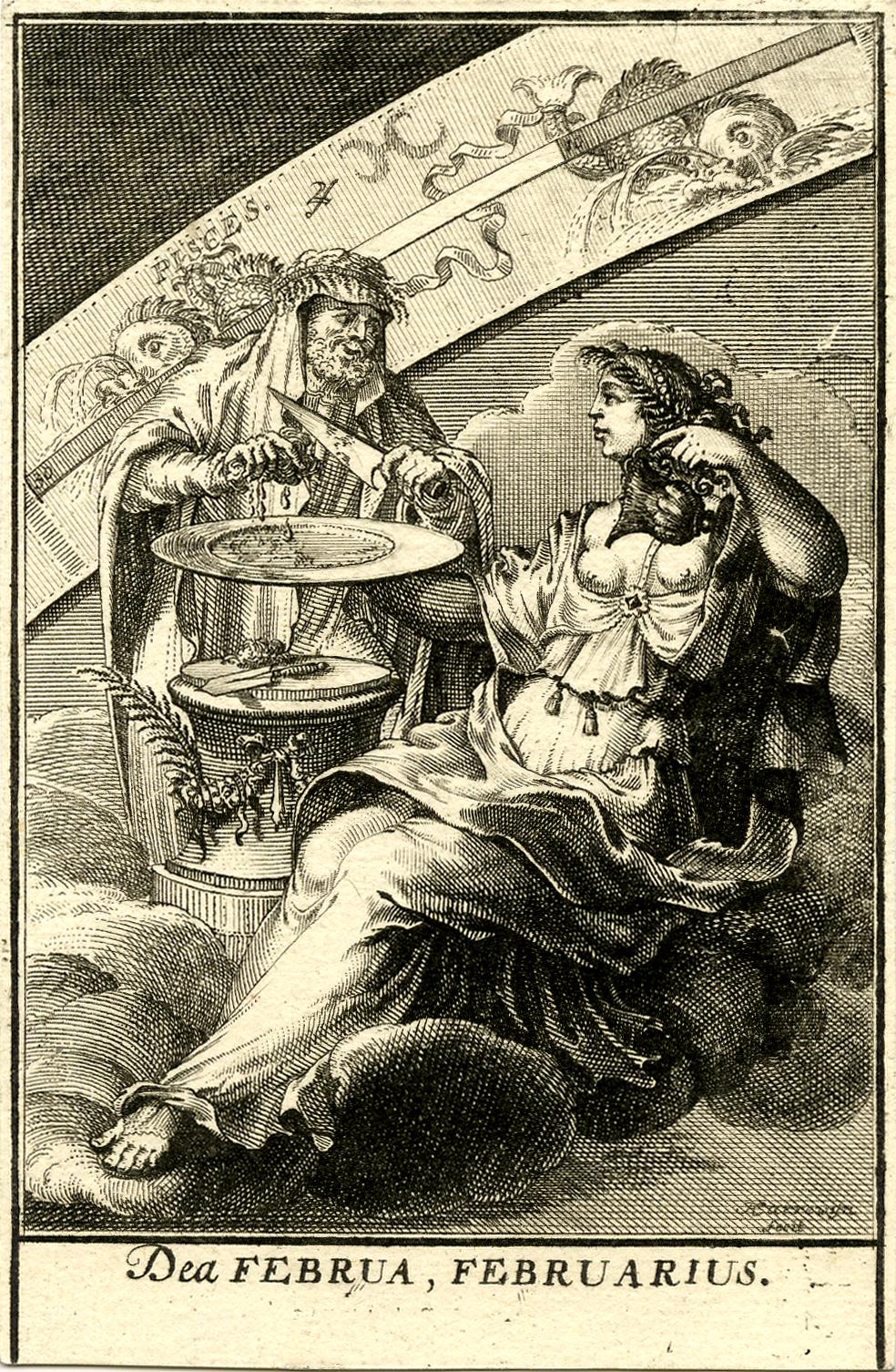
Februus and Febris, representing the month of February
Major cult centerAncient Italy
SuccessorFebris[citation needed] (assumed)
GenderMale
Ethnic groupEtruscans and Romans
FestivalsFebrualia
Equivalents
GreekHades/Pluto

Februus is an ancient Italic god of purifications, who was worshipped by both the Romans and Etruscans. He was also worshipped as the god of the underworld by the Etruscans.[1] For them, Februus was also the god of riches (money and gold) and death, both connected loosely to the underworld in the same natural manner as with the better-known Roman god Pluto. Februus' name could mean "the underground [one]" in the Etruscan language.[2]

Februus may have become the Roman Febris,[3] goddess of fever (febris in Latin means fever). These are possibly connected with the sweating of fevers, which was considered a purgative, washing, and purification process.

Februus is possibly named in honor of the more ancient Februa, also Februalia, festival of washing and purification. Februus' holy month was Februarius (of Februa), hence the English ′′February′′, a month named for the Februa/Februalia purification festival which occurred on the 15th of that month. These purification activities occurred at about the same time as Lupercalia, a Roman festival in honor of Faunus and also the wolf who nursed Romulus and Remus, during which expiatory sacrifices and ritual purifications were also performed.[4] Because of this coincidence, the two gods Faunus and Februus were often considered the same entity.

See also

[edit]

References

[edit]
[edit]
Revisions and contributorsEdit on WikipediaRead on Wikipedia
from Grokipedia
Februus was an ancient Italic god of purifications, worshipped by both the Romans and Etruscans as a powerful in and cleansing rites. He was closely associated with the month of , which derived its name from februum, the term for the goat-skin thongs used in symbolic purification during festivals like the , and from the broader purificatory observances known as Februa held in mid-February. Regarded as an infernal , Februus was identified as a counterpart to (), the god of the , to whom sacrifices were offered during these rites to honor the dii manes, the . The worship of Februus centered on annual lustrations in , instituted in his honor to purify the city, land, and people from the impurities of the previous year. These ceremonies included the on , where priests known as Luperci struck participants with februa to promote and avert misfortune, reflecting Februus's dual role in purification and renewal. Late ancient sources, such as Servius and , describe him as an abstraction formed from the purificatory instruments and practices, emphasizing his chthonic nature without evidence of earlier cult statues or temples dedicated solely to him. Februus's significance lies in his embodiment of Roman concerns with ritual purity at the transition between winter and spring, linking agrarian cycles to underworld forces. While his cult appears to have been integrated into broader February observances rather than a distinct priesthood, his name and attributes influenced the calendar's structure, underscoring the importance of expiation in early Roman religion.

Etymology

Name Origin

The name Februus derives from the Latin adjective februus, signifying "purifying" or related to expiation, and is intrinsically connected to the noun februa, which denotes the instruments, substances, or ritual acts employed for purification. In his poetic calendar Fasti (Book 2, lines 19–36), Ovid attests that the early Romans applied the term februa specifically to these purifying tools—such as woolen fillets, spelt grains, and sulfurous boughs—noting its ongoing usage and explicit association with rites of cleansing and atonement in Roman tradition. Ancient sources indicate that Februus likely originated as a pre-Roman Italic , with possible roots in Sabine or Etruscan languages before the consolidation of Roman religious nomenclature. The Byzantine scholar John Lydus, drawing on earlier antiquarian accounts in his De Mensibus (Book 4), identifies Februus as an Etruscan term meaning "the underground one," reflecting its status as an archaic deity name tied to foundational Italic beliefs. This etymological foundation also informs the naming of the month of , dedicated to such purificatory themes. The term februa serves as a plural noun in ancient Roman religious terminology, denoting a variety of instruments and materials employed in purification s, or lustrations, to cleanse individuals, households, and sacred spaces from ritual impurities. According to in his (Book 2), these included hanks of wool for binding offerings, strips of hide or thongs from sacrificial victims used by priests like the Luperci to strike participants symbolically for expiation, and other amulets or substances such as , salt, or that facilitated consecration. Censorinus, in De Die Natali, further defines a februum (singular) as any object or agent that purifies or consecrates, emphasizing its practical role in religious observances rather than mere superstition. Etymological links have been proposed between februa and febris (Latin for "fever"), with some ancient and modern interpreters suggesting a conceptual association through the purifying effects of fever-induced sweating, akin to ritual cleansing. However, the primary connotations of februa remain firmly rooted in ceremonial and expiatory practices, distinct from medical or pathological implications of illness. Varro, in De Lingua Latina (6.49), traces the adjective februus to Sabine purification customs, underscoring its ritualistic origins over any fever-related derivation. Februus, as the presiding god of these purification rites, is distinguished from related figures in Roman , such as the personified Februa, occasionally treated as a embodying the or tools themselves, or other deities invoked during the Februalia observances. While Februa represents the abstract means or of cleansing, Februus embodies the divine overseeing the connections and expiatory processes central to Roman . This clarifies the hierarchical structure in Roman religion, where tools and personifications support the god's broader role in facilitating spiritual renewal.

Mythology and Attributes

Purification Role

In ancient Roman religion, Februus functioned primarily as the responsible for overseeing the expiation of spiritual pollution, or miasma, through rites that cleansed individuals and the community from ritual impurity. As a guardian against such contamination, he ensured the restoration of purity essential for religious and social harmony, with his influence extending to both public and private ceremonies aimed at removing the effects of , , or misfortune. This role positioned Februus as a pivotal figure in maintaining the sacred order, distinct from deities like , who focused on physical health and welfare rather than ritual cleansing. Some sources, such as John the Lydus, associate purification more directly with a related figure Februa, portrayed as a overseeing such rites, highlighting potential in the tradition. Ancient sources attribute to Februus a chthonic dimension in his purificatory functions, emphasizing his power over the rites that bridged the earthly and spiritual realms to eliminate impurity. Macrobius, in his Saturnalia, describes Februus as the god "who is believed to have charge over ceremonies of purification," noting that the second month, , was dedicated to him because the city required cleansing before the new year began. Similarly, John the Lydus in De Mensibus identifies Februus with purification, linking the term februare in pontifical books to the act of purifying, and equating him etymologically to in this context, underscoring his authoritative role in overseeing such processes. These texts highlight Februus's worship among both Romans and Etruscans, where he was invoked to avert the lingering effects of miasma through structured lustrations.

Underworld Connections

In ancient Roman and Etruscan religious traditions, Februus was identified as a chthonic closely associated with the , serving as an Italic counterpart to the Greek and the Roman , overseeing the realm of the dead and the purification processes linked to funerary rites. According to John the Lydian in his work De Mensibus, Februus derives from an Etruscan term meaning "the underground one," portraying him as a of the subterranean domain where he governed the shades of the deceased and facilitated their cleansing for passage or repose. This Etruscan origin underscores Februus's syncretic role, blending sovereignty over the infernal kingdom with responsibilities for expiating the impurities of the dead, as reflected in the pontifical books that equated him directly with , the kingly lord of riches and mortality beneath the earth. Classical commentators further elaborated on Februus's regal status in the underworld, depicting him as a paternal figure to other chthonic powers. Servius, in his commentary on Virgil's (1.43), describes Februus as "the father of Dis," the Roman god of the underworld's riches and the dead, to whom sacrifices were offered specifically in the month bearing his name, emphasizing his overarching authority in the infernal hierarchy. echoes this identification in his (5.33), stating that is named after Februus, "that is, ," to whom the Romans dedicated the month for rites honoring the di inferi, the gods below, distinguishing his domain from the celestial deities venerated in . These portrayals position Februus as a sovereign entity in the chthonic realm, commanding both the governance of souls and the expiation of their earthly taints. While sharing attributes with as a of the subterranean world, Februus maintained a distinct identity through his pronounced emphasis on purification, setting him apart as not merely a judge of the dead but an active agent in their ritual renewal. This overlay of lustral functions, tied to Etruscan influences, highlighted Februus's role in ensuring the dead's transition was free from , a nuance less prominent in Dis Pater's broader dominion over wealth and fate. Such distinctions underscore the deity's unique fusion of Etruscan underworld kingship with Roman expiatory practices, as preserved in late antique interpretations of earlier traditions.

Worship and Festivals

February Observances

In the early Roman calendar, the month of , or , held a sacred dedication to the god Februus, serving as the concluding period for the year's cycle and emphasizing rites of purification to atone for accumulated impurities. This positioning stemmed from the archaic structure attributed to King , where the calendar year ended in , allowing for expiatory observances that symbolically cleansed the community before the regenerative start of the in . Macrobius, drawing on earlier antiquarian traditions, identifies Februus as the presiding deity over these lustrations, linking the month's name directly to his domain of cleansing. The religious significance of February centered on its role in collective renewal, with observances framed as essential closures to the prior year. In the king's era calendar, this month encapsulated expiatory practices, including offerings to appease the gods and avert misfortune, reflecting a broader Italic emphasis on purification at seasonal transitions. These rituals underscored February's function as a liminal time, bridging the old and new, where the community addressed spiritual debts through structured ceremonies. Particularly from the Ides (mid-month) onward, the latter half of February intensified with general lustrations, involving processions and sacrifices that ritually sealed the year's end and prepared for March's martial and agricultural resurgence. This temporal focus aligned with the month's overarching theme of purgation, as noted in classical accounts, ensuring harmony with divine forces before the calendar's restart.

Februa Rituals

The Februa festival, observed on in , centered on purification rites conducted by the Luperci priests to cleanse the city and its inhabitants symbolically. These rituals, integral to the , began with sacrifices of goats and a at the cave on the , where the priests anointed their foreheads with the animals' blood before wiping it away with wool dipped in milk, accompanied by ritual laughter to signify joy and renewal. The sacrificial victims provided the materials for the februa—strips of goatskin used as whips—emphasizing the festival's dual focus on expiation and fertility. Following the sacrifices, the Luperci, consisting of young noblemen from two colleges (Quinctiliani and Fabiani, later joined by Julianes), ran nearly naked through the streets of , wearing only goatskin girdles and wielding the februa to strike onlookers, particularly women, in a procession that encircled the . This flogging was believed to promote fertility, ease childbirth, and purify participants by averting evil influences for the coming year, with women voluntarily seeking the blows as a protective rite. The whips, known as februa, derived their name from the broader concept of purification tools, underscoring the festival's role in lustral ceremonies that extended to households through general expiatory practices. These rites, while primarily urban and communal, incorporated elements like amulets fashioned from the sacrificial hides to ward off misfortune, ensuring the community's spiritual readiness for spring's agricultural cycle. describes the Luperci's nudity and whipping as a remnant of Arcadian traditions introduced by , linking the procedures to purification aimed at communal health and prosperity. further notes the festival's ancient origins, possibly commemorating , with the processions serving as a symbolic cleansing of the city's boundaries against malevolent forces.

Historical and Cultural Legacy

Calendar Influence

The Roman month of February derives its name from februus, a term associated with purification rites, reflecting the influence of the deity Februus in shaping the calendar's structure. Traditionally attributed to King Numa Pompilius around 713 BCE, this reform expanded the original ten-month Roman calendar—established under Romulus and totaling approximately 304 days—into a twelve-month lunar year of 355 days by adding January and February at the year's end. Februarius, as the month was known, was positioned as the final month to facilitate end-of-year purification ceremonies, emphasizing its role in closing the annual cycle with rituals dedicated to cleansing and renewal. Numa assigned February 28 days, making it the shortest month and intentionally penultimate in the sequence after , to align with its function as a period for solemn observances at the year's conclusion, including festivals like the . This placement allowed for intercalary adjustments, the insertion of an intercalary month, , of 27 days after every other year, with February shortened to 23 days in intercalary years, to reconcile the with the solar year of about 365 days. The emphasis on purification in February's design underscored Februus's domain over expiatory practices, ensuring the incorporated religious imperatives alongside temporal reckoning. During the Julian calendar reform in 46 BCE, restructured the Roman system into a of 365 days, with a leap day added every fourth year, yet he preserved February's name and core positioning despite shifting the overall framework. This retention maintained the month's 28 days (extending to 29 in leap years) and its association with purification, thereby perpetuating Februus's legacy amid broader astronomical adjustments that eliminated the need for frequent intercalation. The decision to keep the nomenclature intact highlighted the enduring cultural significance of the original reforms in Roman temporal organization.

Interpretations in Later Traditions

In medieval Christian scholarship, the deity Februus was reinterpreted through a lens of pagan antiquity, often equated with as a god of the underworld and purification rites associated with the month of . The Venerable , in his De Temporum Ratione (c. 725), explicitly linked the month's name to "februo, id est plutoni, qui lustrationum potens credebatur," portraying Februus as presiding over Roman lustrations that cleansed the old year before renewal. This view influenced later medieval texts, such as the 8th-century Indiculus superstitionum et paganiorum, which condemned lingering pagan practices in as remnants of worship to underworld deities like Februus, thereby framing Christian observances as superior alternatives. Such interpretations facilitated , particularly with liturgical cleansings; for instance, the Feast of on was seen by some clerics as a Christian overlay on Februus' purificatory festivals, with blessed candles symbolizing light overcoming pagan darkness, as echoed in medieval legends associating February's rituals with atonement for the dead. During the , this syncretic tradition persisted in humanist scholarship, where figures like Pontifex Maximus-inspired antiquarians blended classical sources with to view Februus' rites as precursors to baptismal purifications. writers, drawing on Byzantine authorities like John Lydus, emphasized Februus' role in expiatory ceremonies, aligning them with emerging Catholic emphases on and renewal in the liturgical calendar. This period saw Februus invoked not as a rival but as a historical archetype for Christian sacramental cleansing, evident in treatises on Roman antiquities that paralleled februa (purification tools) with holy water asperges. In the 19th and 20th centuries, scholarly debates centered on Februus' potential , fueled by explorations and philological analysis of ancient texts. John Lydus, a 6th-century Byzantine scholar, asserted in De Mensibus that "Februus in the [means] 'the underground [one]'" and was worshipped by the Luperci for , identifying him as an Etruscan underworld god akin to . 19th-century archaeologists like George Dennis, in his seminal Cities and Cemeteries of (1878), contributed to broader discussions of Etruscan religious influences on by documenting burial practices and chthonic cults, prompting debates on whether Februus represented an indigenous Etruscan purification or a Roman retrojection based on Lydus' . 20th-century classicists questioned Lydus' reliability, arguing that Februus might be a late invention or Sabine import rather than purely Etruscan, while emphasizing his dual role in purification and infernal rites as reflective of Italic . These debates highlighted tensions between linguistic evidence and material , with no consensus emerging on Februus' precise . Contemporary neopagan revivals, particularly within reconstructive Roman polytheism (Religio Romana) and Wiccan-inspired traditions, have reimagined Februus as a of personal and seasonal renewal, integrating him into modern calendars focused on purification and transition. In neopagan observances, February rituals often invoke Februus alongside deities like Juno Februa for house blessings and atonement workings, viewing his underworld ties as metaphors for shedding old habits before spring's rebirth. Groups such as incorporate Februus into February devotionals, emphasizing ethical cleansing and ancestral honoring as acts of renewal, drawing loosely from ancient februa rites but adapted to contemporary ecological and psychological themes. This revival positions Februus not as a historical reconstruction but as an archetypal force for transformation in eclectic pagan practices.
Add your contribution
Related Hubs
User Avatar
No comments yet.