Hubbry Logo
Federal Reserve UnitFederal Reserve UnitMain
Open search
Federal Reserve Unit
Community hub
Federal Reserve Unit
logo
8 pages, 0 posts
0 subscribers
Be the first to start a discussion here.
Federal Reserve Unit
from Wikipedia

Federal Reserve Unit
Pasukan Simpanan Persekutuan
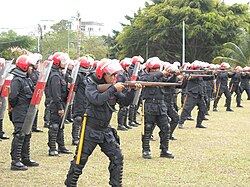
FRU 3rd group arms with Czech-made CZ 527 bolt actions rifles without ammo during the anti-riot drill.
Active5 December 1955; 70 years ago (1955-12-05)
Country Malaya (1955–1963)
Malaysia (1963–present)
Branch Royal Malaysia Police
TypeParamilitary police
RoleRiot control
Size10 detachments
Part ofDirectly under control of the Royal Malaysia Police and the Ministry of Home Affairs
Garrison/HQMain Police Headquarters, Bukit Aman, Kuala Lumpur
NicknameFRU
Colour of Beret  Red beret
Anniversaries
  • 25 March (Police Days Anniversaries)
  • 31 August (Hari Merdeka)
Engagements
Commanders
Current
commander
SAC Rosli bin Md Yusof

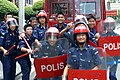
The Federal Reserve Unit (Malay: Pasukan Simpanan Persekutuan; PSP), or better known by the abbreviation as FRU, is a riot control force and a paramilitary special response team that can be deployed at any time to engage in any emergency or public unrest in Malaysia.

History

[edit]

The team was established on 5 December 1955. Starting with three troops, FRU has successfully overcome the problems of public order such as strikes and riots that happened in the early years of the 1950s. From 1990 onwards, FRU also played an important role in handling organised riot that have sparked from the arrest of Anwar Ibrahim. FRU also played role in controlling football riots.

Roles

[edit]

The main role of this unit is to disperse illegal assembly, riot suppression and to carry out other functions relating to Public Order. The unit is self-contained and capable, highly mobile and become Public Order Reserve Units. When this unit is not involved in Public Order duties, it can be assigned by the Commanding Officer to assist the Chief of Police, State police, Criminal Investigation Division and Special Branch in general or special tasks which include:

  • Crime prevention as special patrol in addition to regular patrol unit / Patrol in the area of high crime frequency;
  • Disaster relief (flood, fire, landslide, air crash and others), evacuation and large scale operation;
  • Setting roadblocks and check points, media censorship, intensive patrol and others.
  • Safeguarding VIP visitors, events, parades, assemblies and others.

As its role became more important, this team was augmented to 7 units, with a total membership in 2003 of 2,481 people. Beside that FRU has also a water cannon unit, horseback unit and training institution at Sungai Senam, Ipoh, Perak. In line with current needs and law claim, a woman special detachment have been spawned and this detachment is based in Jalan Semarak, Kuala Lumpur. It has since been moved to its own base located in Cheras.

FRU's performance is known globally. This was evident when the United Nations (U.N.) applied to PDRM to house a riot guard force under U.N. flags in Timor Leste. The team was assigned to control riot and tranquility in a country which just became independent.

Organisations

[edit]

Each FRU base has a wing headquarters composed of three troops, A, B and C. Each troop consists of two baton sections, an armed section (rifles, tear gas and grenades), and a guard vehicle section. Specific vocations within the unit include drivers, photographers, translators, marksmen, signal operators and diary recorders.

Apart from that this team also perform crime prevention to help remote district police chief efforts in reducing crime rates. By that FRU have pointed out success could not be disputed more when entrust to royal pennant parade in the line of honour guard duties.

Light Strike Force (LSF)

Deployed in advance from the main FRU unit, this unit is armed with riot shields and helmets. It is designed and trained to handle small crowds. If the crowd gets larger and uncontrollable, the FRU will be called in to assist.

Public Order and Riot Unit (PORU)

Its members are taken from RMP General Operations Force (Malay: Pasukan Gerakan Am; PGA), it is deployed in states or regions which do not have any FRU bases.

K9 Unit

On 14 August 2023, it was revealed that the FRU has been approved to acquire 10 riot dogs in early 2024 for purposes of anti-riot, crowd control, and preserving public order.[1][2][3] It's also suggested the K9 Unit may be used for bomb threat and hostage crisis.[3] However, it is unclear whether this plan has been materialised as of September 2025.

Delegation

[edit]

Certain FRU divisions are under the command of the inspector-general of police (IGP) and require prior approval from the IGP to be deployed.

Bases

[edit]

The Federal Reserve Unit bases are located in densely populated areas in the country.

Past operations

[edit]

Album

[edit]

See also

[edit]

References

[edit]
[edit]
Revisions and contributorsEdit on WikipediaRead on Wikipedia
from Grokipedia
The Federal Reserve Unit (FRU) is the force and mobile reserve within the Royal Malaysian Police (PDRM), tasked with maintaining public order during riots, protests, and large-scale gatherings. Established in 1955 prior to Malaysia's , the unit began with limited troops and has since expanded to handle civil disturbances through rapid deployment and specialized tactics. Headquartered at in and operating under the direct authority of the PDRM and Ministry of Home Affairs, the FRU employs anti-riot equipment including shields, batons, , and water cannons to disperse unruly crowds and enforce security. Upgraded to status in 2013 for improved management and efficiency, the unit also conducts training and community engagements when not on active duty. While effective in restoring order during events such as electoral rallies, the FRU has faced scrutiny over its , with reports of injuries and allegations of brutality in crowd control operations.

History

Establishment and Early Operations (1955–1960s)

The Federal Reserve Unit (FRU), known in Malay as Pasukan Simpanan Persekutuan (PSP), was established on 5 1955 within the Malayan police force as a specialized and . Initially comprising three troops, its creation addressed escalating public disorder, including labor strikes and riots, amid the waning phases of the (1948–1960) and pre-independence instability under British colonial administration. The unit's formation predated Malaya's independence on 31 August 1957, positioning it as a key instrument for maintaining order during the transition to self-governance. In its inaugural operations through the late , the FRU focused on quelling urban unrest, such as worker strikes and communal clashes, which were exacerbated by economic pressures and ethnic tensions in a multi-ethnic society. These deployments proved effective in restoring public order without escalating to broader military involvement, particularly as the concluded on 31 December 1960, shifting threats from insurgent guerrilla activity to civil disturbances. Post-independence, the unit supported the new Federation of Malaya's policing needs, handling sporadic riots tied to labor disputes and political mobilization in rapidly urbanizing areas like and . By the early , the FRU began expanding beyond initial suppression, incorporating elements to counter emerging threats from political instability and the lead-up to the 1963 formation of , which incorporated , , and . This evolution reflected causal pressures from demographic shifts and nationalist fervor, enabling the unit to deploy more flexibly across federal territories while maintaining a reserve posture for emergencies.

Major Deployments in the 1970s–1980s

The Federal Reserve Unit (FRU) played a pivotal role in quelling the ethnic violence that erupted on 13 May 1969 in , following contentious general elections that heightened Malay-Chinese tensions. Deployed alongside regular police forces, the FRU helped enforce a nationwide imposed that evening by the Yang di-Pertuan Agong, which lasted until August and facilitated the restoration of order amid widespread arson, looting, and assaults that official reports tallied at 196 deaths, though independent estimates suggested up to 600 fatalities, predominantly Chinese. The unit's paramilitary capabilities, including baton charges and barricade formations, were instrumental in containing rioters in hotspots like Kampung Baru and , preventing further escalation that could have destabilized the post-colonial federation. In November 1985, the FRU participated in the operation to apprehend (also known as Ibrahim Libya), a PAS-affiliated accused of promoting deviant Islamic teachings and stockpiling weapons in Kampung Memali, Baling, . On 19 November, approximately 200 police personnel, including FRU elements trained for high-risk confrontations, laid to houses occupied by around 400 followers armed with machetes and spears; the ensuing clash resulted in 14 civilian deaths, including Mahmud, and 4 police fatalities, with injuries to dozens on both sides. This tactical engagement underscored the FRU's function in neutralizing armed ideological threats, as Mahmud's group had rejected state authority and prepared defenses, thereby justifying the use of force to avert broader communal unrest linked to religious extremism. During on 27 October 1987, the FRU supported preventive measures amid rising political friction, including UMNO factional disputes and opposition rallies that risked igniting ethnic or ideological violence. The unit assisted in the detention of 106 individuals under the Internal Security Act, targeting activists, intellectuals, and opposition figures perceived as fomenting instability, while maintaining to disperse gatherings in urban centers like . These actions, executed with minimal reported violence, contributed to de-escalating tensions that had simmered since mid-1987 protests, preserving public order without the scale of fatalities seen in prior incidents.

Evolution in the Post-Cold War Era

Following the cessation of the communist insurgency in 1989, the Federal Reserve Unit shifted focus from counter-insurgency operations to managing urban political unrest and public order challenges in a democratizing context. The unit's first major post-Cold War test came during the Reformasi movement, triggered by the September 2, 1998, of on charges of corruption and sodomy. FRU personnel were deployed starting September 20, 1998, to disperse demonstrators demanding Prime Minister Mahathir Mohamad's resignation, employing , water cannons, and baton charges amid widespread protests that drew thousands to streets. In the 2000s, the FRU adapted to recurrent demands, notably through deployments at coalition rallies. The inaugural rally on November 10, 2007, involved over 10,000 participants calling for cleaner elections, met with FRU cordons and dispersals using non-lethal munitions, resulting in 245 arrests but no fatalities. Subsequent events, such as 2.0 on July 9, 2011, which attracted 50,000 to 100,000 protesters, saw intensified FRU responses including chemical-laced water cannons and arrests of over 1,600 individuals, prompting scrutiny over force proportionality. These operations marked a doctrinal evolution toward handling sustained, media-amplified urban mobilizations driven by and activism, contrasting with sporadic earlier disturbances. Responses to such deployments spurred institutional reviews emphasizing non-lethal tactics. The 2005 Royal Commission to Enhance the Operation and Management of the recommended operational improvements in public order maintenance, including better training and accountability mechanisms, though full implementation lagged. SUHAKAM's inquiry into Bersih 2.0 concluded excessive police force was used, advocating enhanced training and adherence to international standards on assembly to mitigate injuries in future engagements. By the mid-2010s, the FRU incorporated advanced non-lethal tools beyond traditional , reflecting pressures for restraint amid rising public expectations for democratic expression and reduced confrontation in crowd control.

Organizational Structure

Command and Administrative Framework

The Federal Reserve Unit (FRU) functions as a specialized component of the Royal Malaysia Police (PDRM), directly subordinate to the (IGP), with overarching oversight from the Ministry of Home Affairs. This hierarchical alignment ensures centralized command for public order operations, integrating the FRU into the broader apparatus managed through the PDRM's Department of Internal Security and Public Order. Headquartered at the PDRM's main facility in , , the unit maintains administrative protocols that prioritize operational readiness and accountability to the IGP for strategic decisions. Deployment authority is delegated selectively, with certain FRU divisions reserved under the IGP's direct command, necessitating prior approval for to maintain control over high-stakes engagements. This mechanism balances rapid response capabilities with accountability, allowing routine deployments by field commanders while reserving sensitive or large-scale mobilizations for higher-level review. The FRU also coordinates with complementary PDRM units, such as the General Operations Force, for integrated operations involving border security or escalated public order scenarios, fostering without diluting its specialized focus. Administratively, the FRU has evolved from colonial-era reserve formations established on December 5, 1955, prior to Malayan independence, toward a modern framework emphasizing disciplined hierarchies and logistical self-sufficiency. By 2013, it was restructured as a with a reported strength of 2,463 officers and personnel, reflecting expansions to handle nationwide contingencies. is reinforced through PDRM internal audits and Ministry reporting, though critiques from human rights observers highlight occasional gaps in independent oversight for deployment decisions.

Units, Bases, and Personnel Deployment

The Federal Reserve Unit operates through a network of numbered bases distributed across Malaysia's key regions to facilitate rapid nationwide deployment. Primary bases include Unit 1 and Unit 4 in , Unit 2 in (), Unit 3 in Pulau Pinang, Unit 5 in (), Unit 6 in (), and Unit 7 in (). These locations enable coverage of urban centers, northern states, southern borders, and eastern frontiers, supporting quick to maintain public order. Specialized subunits complement the main bases, including the Women's Troop (Terup Wanita) in , the Mounted Unit (Unit Berkuda), and the training institution at Sungai Senam, . Each operational base is structured with a wing overseeing multiple troops, allowing for modular subunit activations tailored to incident scale and location. Personnel strength stood at 2,463 officers and men as of 2013, with detachments drawable from units in regions lacking dedicated FRU bases to augment response capacity. emphasize self-sufficiency, equipping units for extended field operations without immediate resupply dependence, while strategic basing minimizes response times to potential disturbances. Ongoing expansions, such as housing projects for Unit 3 in Pulau Pinang approved in parliamentary discussions by November 2024, aim to enhance retention and operational readiness in high-demand areas.

Roles and Responsibilities

Riot Control and Public Order Maintenance

The Federal Reserve Unit (FRU) of the Royal Malaysian Police functions as the specialized force responsible for preventing and dispersing unlawful assemblies to maintain public order. Established as a paramilitary-style unit within the police structure, the FRU's core mandate involves deploying to manage crowds during strikes, demonstrations, and potential ethnic disturbances, employing tactics to safeguard public safety and property. This role is enshrined in the Police Act 1967, which outlines police duties under Section 20 to preserve peace, prevent offenses against persons and property, and regulate public assemblies under Section 27, including the authority to stop and disperse gatherings without licenses or those breaching conditions. Section 27B explicitly permits the use of reasonable force by police to effect such dispersals or arrests when resistance occurs, providing the legal basis for FRU operations in escalating situations. In practice, the FRU integrates with regular civil police units for graduated escalation , starting with warnings and barriers before advancing to non-lethal dispersal methods to contain threats of mob violence and minimize chaos. This coordination ensures that routine policing handles initial responses, with FRU reserves activated for high-risk scenarios where standard forces may be overwhelmed, reflecting a structured approach to rooted in preserving order over suppression alone.

Paramilitary and Emergency Response Functions

The Federal Reserve Unit (FRU) functions as a reserve force within the Royal Malaysian Police, enabling deployments in national emergencies that extend beyond routine public order maintenance. These include disaster relief operations, where FRU personnel support evacuation, , and large-scale coordination efforts, particularly during floods that frequently affect Malaysia's vulnerable regions. For instance, in preparation for annual flooding, FRU units receive specialized equipment such as inflatable boats and life jackets to facilitate water rescues and victim extrication. This auxiliary role underscores the unit's versatility in addressing natural hazards, complementing agencies in resource-intensive scenarios. In border security, FRU maintains patrols along porous frontiers, notably the Malaysia-Thailand border, to counter and illicit cross-border activities. The FRU's mounted branch commenced operations in November 2020, deploying horseback patrols to enhance mobility and deterrence in rugged terrain where vehicular access is limited. By March 2022, state police, incorporating FRU mounted units, acquired six horses specifically for anti- duties, a capability that persists as a visible against networks. These deployments highlight FRU's adaptation to sustained internal security threats, leveraging equestrian units for rapid terrain coverage. FRU's paramilitary orientation also positions it for high-risk emergency responses, such as armed standoffs or counter-insurgency adjunct operations, where its rapid mobilization supports with elements. This coordination ensures layered in scenarios demanding armed or escalation management, distinct from standard policing by prioritizing preemptive reserve deployment against unforeseen threats like insurgent remnants or fortified criminal elements. Such functions reinforce national resilience, with FRU's self-contained enabling swift integration into joint task forces for containment and neutralization.

Equipment, Training, and Tactics

Riot Control Gear and Armaments

The Federal Reserve Unit (FRU) employs a range of non-lethal equipment for , including batons, riot shields, canisters, and water cannons mounted on specialized trucks. and baton rounds are authorized as intermediate force options, escalating from chemical agents when necessary. In 2016, the FRU incorporated less-lethal systems such as variable kinetic systems, tactical marking pistols, and flash launchers that deploy pepper balls for targeted incapacitation. FRU personnel are equipped with protective gear, including , helmets, and gas masks, with recent procurements emphasizing enhanced safety. A 2023 allocation of RM10 million facilitated the acquisition of 1,000 units of protective and 1,000 gas masks to bolster frontline capabilities. Bolt-action rifles like the CZ 527, chambered in .22 LR, serve anti-riot roles, potentially functioning as less-lethal tools through reduced-velocity , reflecting a post-incident emphasis on minimizing fatalities. For mobility and tactical advantage, the FRU utilizes armored vans and suited to varied terrains, including urban and areas. In 2023, RM3.6 million funded 10 new armored vans, while the unit maintains a component with over 50 for patrols. Additionally, 10 public order dogs were procured under the same RM22 million initiative to support containment efforts. Lethal armaments include riot guns and sniper rifles for extreme scenarios. The FRU received 175 new guns in 2023 for RM2.8 million, alongside 13 sniper rifles costing RM2.3 million, expanding capabilities beyond non-lethal dispersal. A 2024 tender sought 538 guns for FRU and related units, indicating ongoing modernization.

Training Protocols and Recruitment

Personnel for the Federal Reserve Unit (FRU) are drawn exclusively from permanent members of the Royal Malaysian Police (PDRM), with selection emphasizing physical robustness, discipline, and operational reliability rather than open civilian recruitment. Candidates undergo enhanced vetting, including integrity evaluations amid ongoing PDRM-wide reviews prompted by misconduct cases, such as those involving officer ethics since 2023. standards are stringent, requiring passage of the Physical Ability Requirement Evaluation (PARE) test for confirmation and advancement, alongside (BMI) thresholds below 28 for promotions to ensure readiness for demanding deployments. Specialized for FRU duties occurs at dedicated facilities, including the Pusat Latihan Pasukan Simpanan Persekutuan (PSP) in , , focusing on endurance-building exercises like obstacle courses (mara lasak) and formation drills to foster under stress. These protocols prioritize tactical proficiency in crowd management, with scenario simulations replicating high-tension public order scenarios to build resilience and coordinated response capabilities. Psychological conditioning emphasizes to command structures and rapid to volatile environments, informed by historical operational lessons, though critics from organizations argue for expanded modules to align with international standards. Post-assignment debriefs reinforce lessons learned, aiming to mitigate fatigue and enhance future preparedness without detailed public disclosure of protocols.

Notable Operations

Pre-Independence and Independence-Era Engagements

The Federal Reserve Unit was established on 5 December 1955 as a specialized and rapid response force within the Malayan police, amid escalating public order threats during the (1948–1960). Formed with initial troops numbering in the low dozens, the unit focused on urban and semi-urban disturbances rather than , addressing strikes and demonstrations that communist elements exploited to disrupt economic activities, particularly in plantations and labor sectors. These engagements helped contain civil unrest linked to sympathizers, preventing widespread in key industries like rubber production, which had been targeted since the Emergency's onset. In the lead-up to Malaya's independence on 31 August 1957 and through the early independence era into the , FRU deployments emphasized stability during the colonial-to-sovereign transition, quelling labor actions and sporadic riots that threatened governance continuity. Communist remnants, operating through infiltrated unions, continued low-level agitation via strikes—over 300 recorded in 1947 alone, with patterns persisting into the late —prompting FRU interventions to enforce curfews and disperse assemblies without escalating to full-scale revolts. Such operations supported the broader pacification efforts, contributing to the Emergency's formal end on 31 July 1960, after which FRU units shifted toward routine public order in the newly formed .

High-Profile Incidents: Memali and Operation Lalang

The took place on November 19, 1985, in Kampung Memali near Baling, , where the Federal Reserve Unit joined approximately 200 police personnel in a raid to arrest Ibrahim Mahmud, alias Ibrahim Libya, the leader of a militant Islamist group that had fortified the village into an armed commune rejecting government authority and promoting ultraconservative ideologies. The operation followed a multi-day after initial negotiations failed, with villagers offering armed resistance using parangs, slingshots, and Molotov cocktails against the advancing troopers. The ensuing clash resulted in 18 deaths: 14 civilians, including Ibrahim Mahmud, and 4 policemen, alongside multiple injuries, as security forces breached defended positions to neutralize the threat. Operation Lalang commenced on October 27, 1987, deploying the for and support in a nationwide sweep under the Internal Security Act amid escalating ethnic tensions fueled by seditious political speeches and UMNO factional disputes that risked communal riots similar to 1969. Over the following weeks, authorities arrested 106 individuals, including opposition politicians, academics, and activists, on grounds of and threats to public order, with FRU units positioned to contain potential spillover violence in urban areas like . The operation reported no fatalities or major clashes, focusing instead on preventive detentions to address ideological agitators across ethnic lines.

Contemporary Deployments: Bersih Rallies and Beyond

The Federal Reserve Unit (FRU) played a prominent role in managing the 2.0 rally on July 9, 2011, an unauthorized assembly in demanding electoral reforms, where police deployed and water cannons to disperse crowds after organizers defied a government ban. Authorities arrested approximately 1,600 participants, including opposition leaders, under Operation Erase , aiming to prevent escalation into widespread disorder amid estimates of up to 50,000 attendees. While reports documented protester injuries from chemical agents and baton charges, the rapid intervention contained the event without major structural damage or fatalities, contrasting with potential for prolonged unrest in a densely populated urban area. Similar tactics were employed during the Bersih 3.0 rally on April 28, 2012, another sit-in for clean elections declared illegal, with FRU units firing and water cannons after protesters occupied Dataran , leading to hundreds of arrests and temporary clashes before dispersal. The operation involved coordinated barriers and non-lethal force to clear the site, resulting in over 500 injuries treated but averting broader violence across multiple cities where solidarity gatherings occurred. These deployments underscored FRU's function in enforcing assembly laws against opposition-led events perceived as threats to public order. In contrast, during the Malay Dignity Congress on October 6, 2019, a permitted gathering in advocating Malay rights and supporting the government, FRU personnel maintained security perimeters without resorting to dispersal tactics, facilitating attendance by over 5,000 participants peacefully. This protective stance aligned with protocols for lawful pro-establishment assemblies, highlighting operational differences based on permit status. Beyond protests, FRU supported enforcement under the Movement Control Order starting March , with units augmenting roadblocks in areas like in April to check compliance and deter violations amid nationwide restrictions. In border security, FRU's mounted branch commenced patrols along the Malaysia-Thailand frontier in November , assisting in anti-smuggling efforts, a role sustained into 2024 with equestrian deployments demonstrating presence against cross-border threats. These non-confrontational uses reflected FRU's versatility in routine public order and auxiliary duties into the early 2020s.

Controversies and Criticisms

Allegations of Excessive Force and Brutality

During the Reformasi protests of , Malaysian police, including Federal Reserve Unit (FRU) personnel, were accused of employing excessive to disperse demonstrators calling for political reforms following the arrest of former . Amnesty documented instances where protesters and bystanders were beaten, kicked, and slapped during the break-up of peaceful gatherings, resulting in at least 50 injuries. Local advocacy groups reported FRU assaults on protesters who were already dispersing peacefully, framing such actions as disproportionate responses to non-violent dissent. In the Bersih 2.0 rally on July 9, 2011, FRU-led police operations faced allegations of brutality amid efforts to prevent assembly in for demands. Authorities arrested 1,667 protesters, many described as peaceful, while deploying directly into crowds, including at opposition leaders, and beating individuals on the ground as captured in video footage. was fired into a compound, posing risks to patients, and medical assistance was delayed for a 56-year-old participant, Baharuddin Ahmad, who collapsed and later died; numerous released detainees showed injuries from arrests and interrogations. condemned these tactics as violations of the right to peaceful assembly. The Bersih 3.0 rally on April 28, 2012, drew further claims of FRU overreach, with video evidence showing unit officers in groups brutally beating protesters already in custody, alongside attacks on journalists covering the event. reported dozens injured from beatings or clashes after police used tear gas and arrested at least 471 participants, characterizing the response as excessive against a largely peaceful . highlighted these incidents as potential cruel and inhuman treatment, urging independent probes into the conduct. Opposition figures and human rights organizations have consistently depicted FRU deployments in these events as instruments of government suppression, prioritizing crowd dispersal over proportionality, with empirical documentation from videos and witness accounts underscoring patterns of unnecessary beatings and chemical agent misuse beyond immediate threats. Such narratives emphasize chaotic dynamics where initial protester compliance escalated into alleged targeted violence, though inquiries into specific causal links remain limited.

Contextual Defenses: Necessity for Law and Order

The Federal Reserve Unit (FRU) of the Royal Malaysian Police operates under the Police Act 1967, which mandates the preservation of peace and prevention of disorder, justifying deployments to enforce dispersal orders against assemblies deemed illegal or disruptive to public safety. Malaysian authorities maintain that FRU actions are proportionate responses to protester-initiated threats, including stone-throwing, barricade , and attempts to breach cordons, which create immediate risks to bystanders, property, and responding officers. These interventions aim to de-escalate situations through graduated force—starting with verbal warnings, barriers, and non-lethal tools like —before potential recourse to higher measures only when resistance persists or violence intensifies. Historical analysis of unrest in highlights the causal link between delayed or inadequate policing and broader chaos, as evidenced by the 13 May 1969 ethnic riots, where initial failures to contain street disturbances in resulted in approximately 196 confirmed deaths, hundreds more estimated, widespread affecting over 200 buildings, and a national lasting nearly two years. Post-1969 reforms, including FRU enhancements, have coincided with no comparable nationwide ethnic conflagrations, suggesting that proactive containment averts mob dynamics and copycat violence in a society where grievances can rapidly align along ethnic lines. While organizations often contest the proportionality of force, official records indicate that FRU presence typically limits incidents to localized clashes rather than permitting unmanaged crowds to swell into sustained riots, thereby safeguarding overall societal stability. Security experts emphasize the structure of units like the FRU as indispensable in multi-ethnic states like , where identity-based mobilizations risk tipping into communal strife amid economic disparities and historical animosities. In such contexts, specialized enables rapid reinforcement to isolate agitators and restore order without invoking military involvement, aligning with first-principles of deterrence: visible capability discourages escalation by signaling that violations of public order will incur costs exceeding potential gains. This approach, rooted in 's post-colonial , prioritizes causal prevention over reactive suppression, as unchecked assemblies have empirically fueled cycles of retaliation in diverse polities lacking robust internal cohesion. Following incidents such as the 1985 Memali clash, repeated calls emerged for a of Inquiry to examine police actions, including those by the Federal Reserve Unit (FRU), but no such commission was established, with former Attorney-General Abu Talib Othman deeming it unnecessary in 2018 due to prior investigations. Internal police assessments followed, though public documentation of tactical changes specific to FRU operations remains limited, focusing instead on broader lessons for handling armed confrontations. Inquiries into FRU deployments during rallies, particularly Bersih 3.0 in April 2012, included reports by the Council documenting police use of and water cannons after protesters occupied Dataran Merdeka, recommending improved crowd management protocols. The Human Rights Commission of Malaysia (SUHAKAM) also probed assembly rights violations in related events, urging proportionality in force application, though these did not result in binding FRU-specific accountability measures. Legal proceedings against FRU personnel for alleged excessive force have yielded minimal convictions relative to deployment scale; between January 2009 and June 2012, courts awarded approximately RM3 million (US$965,000) in civil compensations for general police abuses, reflecting rare successful prosecutions and frequent judicial deference to operational necessities in riot scenarios. This pattern underscores limited criminal liability for FRU actions amid high-volume public order duties, with defenses often citing lawful execution of orders. Reforms addressing inquiry findings materialized incrementally in the and , including enhanced oversight mechanisms; by , body-worn cameras (BWCs) were rolled out for Royal Malaysian Police units, including , to record engagements and deter misconduct, with mandatory use enforced via disciplinary threats. In June 2025, procurement of 10,000 additional BWCs aimed to expand surveillance, potentially reducing integrity issues by 38.5% as observed in pilot programs for other agencies. These measures represent verifiable steps toward , though broader updates for FRU remain tied to internal training evolutions rather than legislated overhauls.

Recent Developments

Modernization and Resource Allocation (2020s)

In 2023, the Malaysian Home Ministry approved an allocation of RM22 million to enhance the Federal Reserve Unit's (FRU) capabilities, focusing on procurement of new vehicles, firearms, and anti-riot K9 units to address evolving threats in riot control and public order maintenance. This included RM3.6 million for 10 combat vehicles, RM2 million for replacing 175 Federal Riot Guns with new riot guns, and RM2.3 million for 13 sniper rifles, aimed at modernizing the unit's arsenal amid concerns over outdated equipment. The initiative reflected a strategic push to integrate advanced technology and non-lethal tools, responding to potential escalations in urban unrest and border insecurities. A key component of this modernization was the establishment of a dedicated FRU K9 Unit, activated in early 2024, incorporating 10 specialized "riot dogs" trained for dispersal and situations. Previously approved in March 2023, these canines augment human formations by providing rapid threat detection and intimidation without excessive force, drawing from global best practices in policing. This development underscores the FRU's adaptation to multifaceted internal security challenges, including and unauthorized gatherings, by leveraging animal-assisted tactics for efficiency in high-risk deployments. Border security enhancements further highlighted resource prioritization, with FRU mounted horse patrols expanded along the Malaysia-Thailand frontier in 2024 to deter and demonstrate presence in rugged terrains. Stationed in areas like , , and , these patrols—conducted daily in shifts—complement vehicular and foot operations, improving surveillance amid rising cross-border threats. Such allocations, embedded within broader budgets exceeding RM18 billion annually in the early 2020s, signal a governmental emphasis on bolstering internal stability through targeted FRU upgrades rather than expansive force expansions.

The 2025 Teluk Intan Crash and Its Aftermath

On May 13, 2025, at approximately 8:30 a.m., a Federal Reserve Unit (FRU) from Unit 5, based in Sungai Senam, collided head-on with a gravel-laden lorry on KM15 of Jalan Chikus-Sungai Lampam near , , resulting in the deaths of nine FRU personnel. Eight officers died at the scene, while one succumbed to injuries at Teluk Intan Hospital; nine others were injured, with two in critical condition. The FRU personnel were en route for routine duties when the lorry, reportedly suffering steering failure and overloaded by 70%, veered into their path. The 45-year-old lorry driver, who escaped unharmed, was arrested and charged on May 16, 2025, in the with multiple counts of causing death under Section 41(1) of the Road Act 1987. Police investigations revealed the driver had six prior convictions, including offenses, prompting his remand for further ; the lorry's owner was also summoned for questioning. A preliminary ministry report confirmed the vehicle's overload contributed to the instability, leading to parallel investigations by police and road safety authorities to assess mechanical failures and compliance violations. The incident evoked comparisons to the 1990 Karak Highway crash, which claimed 11 FRU lives in a similar multi-vehicle collision, highlighting recurring risks in transporting specialized police units on public roads. In the aftermath, reports emerged of opportunistic attempts to exploit bereaved families through fraudulent donation schemes and unauthorized solicitations, prompting police warnings and interventions to protect victims' relatives. Survivors and colleagues exhibited signs of trauma, including acute and operational disruptions, with FRU morale strained amid calls for enhanced vehicle safety protocols and escorts, though no formal policy shifts were announced by October 2025.

References

Add your contribution
Related Hubs
User Avatar
No comments yet.