Hubbry Logo
FilosofemFilosofemMain
Open search
Filosofem
Community hub
Filosofem
logo
8 pages, 0 posts
0 subscribers
Be the first to start a discussion here.
Filosofem
Filosofem
from Wikipedia

Filosofem
Studio album by
Released31 January 1996[1]
RecordedMarch 1993 at Breidablik Studio
Genre
Length64:34
LanguageNorwegian, English
LabelMisanthropy, Cymophane
ProducerVarg Vikernes, Pytten[2]
Burzum chronology
Hvis lyset tar oss
(1994)
Filosofem
(1996)
Dauði Baldrs
(1997)
Professional ratings
Review scores
SourceRating
AllMusicStarStarStarStar[3]

Filosofem (Norwegian for "Philosopheme") is the fourth studio album by Norwegian black metal solo project Burzum. It was recorded in March 1993 and was the last recording before Varg Vikernes was sentenced to prison in 1994; the album was not released until January 1996, however. It was released through Misanthropy Records and Vikernes's own record label, Cymophane Productions.[4] A music video was made for the song "Dunkelheit" and received airtime on both MTV[5] and VH1.[6]

The album is noted for its experimental sound when compared to most other second wave black metal. Vikernes considers Filosofem an "anti-trend album."[7]

Background

[edit]

Varg Vikernes recorded the first four Burzum albums between January 1992 and March 1993 at the Grieg Hall in Bergen. However, the releases were spread out, with many months between the recording and the release of each album. During this time, Vikernes became a part of the early Norwegian black metal scene and met Mayhem guitarist Euronymous. He also took part in burning down four churches, along with other members of the scene.[8] In August 1993, Vikernes stabbed Euronymous to death outside his apartment in Oslo. He was arrested a few days later and, in May 1994, was sentenced to 21 years in prison for both the murder, and for church arson.

The album's opening track, "Dunkelheit", was the first song Vikernes wrote as Burzum, with the song itself initially being named "Burzum". It had been recorded in September 1992 for the Hvis lyset tar oss album, but Vikernes was unhappy with it due to how poor the recording quality was, so it went unused. Instead he re-recorded the track six months later which is the version that appears on Filosofem.[9] According to a statement made by Vikernes on burzum.org, the master tapes for the version of "Burzum" meant for Hvis lyset tar oss were lost by the Norwegian prison system.[citation needed]

Filosofem was recorded under purposefully bad conditions in order to retain a raw lo-fi sound. No guitar amplifier was used; instead Vikernes plugged his guitar into the amplifier of his brother's stereo and used old fuzz pedals.[10] For the vocals, he asked a sound technician for the worst microphone he had, and ended up using an old helicopter headset.[10]

Music and artwork

[edit]

The music of Filosofem continued Vikernes's experimentation with minimalism, repetition, and ambient music within black metal. The first three songs are in the key of E minor, and all tracks of the album are quite long in duration (the shortest being just over seven minutes), being primarily composed around very few musical motifs. For instance, "Jesu' død", a track of over eight-and-a-half minutes, is primarily based on variations of a single riff. The epic "Rundtgåing av den transcendentale egenhetens støtte", Burzum's longest ambient song to date, repeats a simple melody for nearly the entirety of the runtime, switching from a bass ostinato to a harmony ostinato midway through the piece. The song was featured in the soundtrack album of the American experimental drama film Gummo.

"Burzum" ("Dunkelheit"), the opening track, features a prominent melody played by a synthesizer that sits atop the distorted guitars and vocals. The two "Decrepitude" tracks complement each other, with ".i." featuring vocals and keeping the guitars in the foreground; while ".ii." is instrumental and instead focuses on the sound effects and keyboard melody in the background of ".i.".

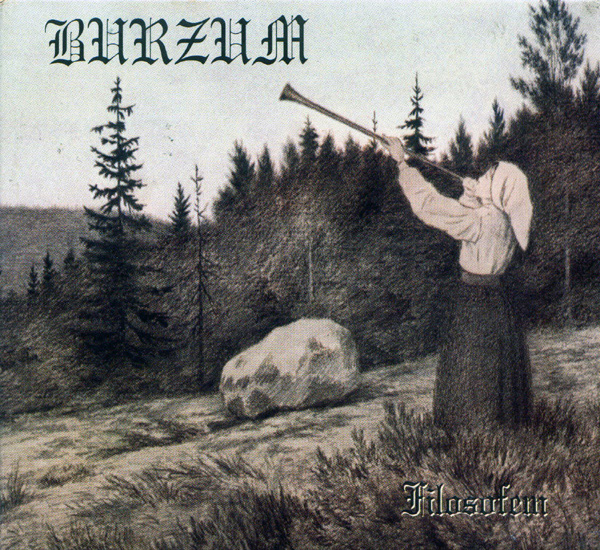
The album cover and booklet contain artwork by Theodor Kittelsen. The front cover is named Op under Fjeldet toner en Lur (Norwegian for "Up in the hills a clarion call rings out").

Track listing

[edit]
CD, cassette and vinyl reissue pressings

All tracks are written by Varg Vikernes.

No.TitleGerman versionLength
1."Burzum" ("Darkness")"Dunkelheit"7:05
2."Jesu død" ("Jesus' Death")"Jesus' Tod"8:39
3."Beholding the Daughters of the Firmament""Erblicket die Töchter des Firmaments"7:53
4."Decrepitude .i.""Gebrechlichkeit .i." ("Frailty .i.")7:53
5."Rundtgåing av den transcendentale egenhetens støtte" ("Circumambulation of the Transcendental Columns of Singularity")"Rundgang um die transzendentale Säule der Singularität"25:11
6."Decrepitude .ii.""Gebrechlichkeit .ii." ("Frailty .ii.")7:53
Total length:64:34
  • Cassette pressings start side B with "Rundtgåing". Vinyl reissues from 2005 onward feature "Rundtgåing" on side C and "Decrepitude .ii." on side D.
Original vinyl pressing
Side A
No.TitleGerman versionLength
1."Burzum" ("Darkness")"Dunkelheit"7:05
2."Jesu død" ("Jesus' Death")"Jesus' Tod"8:39
3."Beholding the Daughters of the Firmament""Erblicket die Töchter des Firmaments"7:53
Total length:23:37
Side B
No.TitleGerman versionLength
1."Decrepitude .i.""Gebrechlichkeit .i." ("Frailty .i.")7:53
2."Decrepitude .ii.""Gebrechlichkeit .ii." ("Frailty .ii.")7:53
Total length:15:46
Side C
No.TitleGerman versionLength
1."Rundtgåing av den transcendentale egenhetens støtte" ("Circumambulation of the Transcendental Columns of Singularity")"Rundgang um die transzendentale Säule der Singularität"25:11
Total length:25:11

Personnel

[edit]
  • Count Grishnackh (Varg Vikernes) – vocals, guitar, bass, synthesizer, drums, sound effects, production
  • Pytten – production

References

[edit]
[edit]
Revisions and contributorsEdit on WikipediaRead on Wikipedia
from Grokipedia
is the fourth studio album by , the project of Norwegian musician . Recorded in March 1993, it was released on 31 January 1996 by Misanthropy Records, serving as the final Burzum recording before Vikernes' imprisonment. The album features a lo-fi production emphasizing hypnotic riffs, ambient passages, and introspective atmospheres, distinguishing it from earlier Burzum works and influencing post-black metal, , and depressive subgenres. Its release occurred amid Vikernes' 1994 conviction for the murder of Øystein Aarseth ( of Mayhem) by stabbing and for in at least three historic Norwegian churches, for which he received a 21-year sentence. Despite these events and Vikernes' subsequent advocacy for pagan nationalism and racial , Filosofem attained seminal status in , praised for evoking desolation and transcendence, with tracks like "Dunkelheit" exemplifying its trance-inducing quality.

Historical Context

Burzum's Formation and Prior Albums

Burzum was established in 1991 by Norwegian musician Varg Vikernes in Bergen as a solo project focused on black metal. Vikernes, performing under the pseudonym Count Grishnackh, initiated the endeavor after departing from the death metal band Old Funeral in 1991, drawing inspiration from J.R.R. Tolkien's Middle-earth mythology—particularly the Black Speech term "burzum" meaning "darkness"—and Norse pagan themes to evoke an atmospheric, fantasy-like realm rooted in pre-Christian Scandinavian heritage. Early efforts included two untitled demos recorded that year on a simple four-track setup, emphasizing repetitive riffs and primitive production to convey isolation and mysticism, without intentions for live performances. The project's debut full-length album, , was recorded in January 1992 at Grieghallen Studios in and released in March 1992 via , a label operated by Øystein Aarseth (). This eight-track effort, limited to 1,000 copies initially, featured Vikernes handling all instruments and vocals, showcasing a raw sound with tremolo-picked guitars, blast beats, and themes of war, feebleness, and cosmic dread, such as in tracks like "Feeble Light of the Sun" and "War". Its lo-fi aesthetic and relentless repetition distinguished it within Norway's emerging second-wave scene, influencing subsequent acts through its emphasis on atmosphere over technical virtuosity. Following the debut, Vikernes recorded material for Det som engang var in April–May 1992 at the same studio, releasing it on August 20, 1993, through his own Cymophane Records in a limited run of approximately 950 CDs. The album expanded on the debut's style with longer, more hypnotic compositions blending black metal aggression and dungeon synth elements, as heard in "Den onde kysten" and "Krig", while exploring motifs of ancient glory and inevitable decay. Concurrently, the Aske EP, recorded in September 1992 and released on March 10, 1993, via Deathlike Silence Productions in a 1,000-copy edition, included three tracks like "Dominus Sathanas" that reiterated Burzum's signature minimalism; its cover depicted the charred remains of a burned stave church, tying into Vikernes' documented involvement in arson attacks on historic sites. These releases solidified Burzum's reputation for ideological intensity and sonic bleakness prior to the Filosofem sessions. In September 1992, Vikernes also tracked Hvis lyset tar oss, a pivotal work released in April 1994 on Misanthropy Records and Cymophane, which shifted toward extended ambient passages and depressive introspection across its two lengthy tracks, "Det som en gang var" and "Hvis lyset tar oss". This album's hypnotic structures and philosophical undertones, emphasizing light's destructive triumph over darkness, bridged Burzum's raw origins to more experimental terrains, amassing critical acclaim for pioneering atmospheric black metal despite its delayed issuance amid Vikernes' legal troubles. Collectively, these pre-Filosofem outputs—spanning 1992–1994—demonstrated Vikernes' evolution from demo-level to a cohesive aesthetic of repetition and immersion, grounded in self-produced ethos and anti-modern sentiments.

Black Metal Scene in Early 1990s Norway

The Norwegian black metal scene coalesced in the early around a loose network of musicians in , evolving from death metal influences into a distinct second wave characterized by raw, lo-fi production, screeching vocals, and atmospheric guitars. Bands such as Mayhem, , , Immortal, and formed the core, with tape trading and DIY releases fostering an underground ethos opposed to mainstream metal's commercialization. This period, roughly 1990–1993, saw the scene's ideology emphasize anti-Christian rebellion, often framed as by figures like Øystein Aarseth ( of Mayhem) or pagan nationalism by (), though motivations varied and included personal alienation and cultural critique of 's Lutheran establishment. A central hub was Euronymous's Helvete record shop, opened in in 1991, which attracted aspiring musicians and became synonymous with the "Black Metal Inner Circle"—an informal group including , Vikernes, Jan Axel Blomberg ( of Mayhem), and others. The shop facilitated rehearsals, ideological discussions, and distribution of tapes, amplifying the scene's insularity. Notoriety escalated with the suicide of Mayhem vocalist Per Yngve Ohlin (Dead) on April 8, 1991, in the band's house near Kråkstad; photographed the body and later used the image on the bootleg album Dawn of the Black Hearts, released in 1991 or 1992, which shocked participants and outsiders alike. Church arsons marked the scene's most infamous escalation, beginning with Vikernes's destruction of the 12th-century Fantoft Stave Church on June 6, 1992, which he later claimed as a symbolic strike against . This initiated a wave of at least 10 confirmed arsons or attempts in 1992–1993, including actions by drummer (Bard Guldim) and guitarist , with over 50 churches targeted nationwide by 1996 amid copycat incidents. Convictions followed, such as Vikernes's for Fantoft and another site, reflecting the scene's embrace of transgression but also internal fractures over ideology and control—Euronymous sought to monopolize the aesthetic via his label, clashing with Vikernes's independent streak. Police scrutiny intensified by late 1992, raiding Helvete and arresting members, yet the events cemented black metal's reputation for real-world extremism amid Norway's affluent, secular society.

Vikernes' Personal Circumstances Pre-Recording

In early 1993, , born Kristian Vikernes on February 11, 1973, in , , was a 19-year-old musician deeply embedded in the nascent Norwegian black metal scene, having founded the one-man project around 1991 and released its self-titled debut album in March 1992 via . Living in , he maintained a low-profile existence focused on music production, ideological writings, and associations within the scene's inner circle, including tensions with Mayhem guitarist Øystein Aarseth () over pagan versus Satanic emphases and label finances, though Vikernes had no formal employment and relied on scene networks for support. By 1992, Vikernes had become a prime suspect in multiple church arsons linked to the black metal milieu, including the June 1992 burning of the 12th-century Fantoft Stave Church, which he initially denied but later attributed to anti-Christian motivations in ideological statements. These suspicions intensified in late January 1993 when he granted an interview to the newspaper Bergens Tidende, explicitly claiming responsibility for several arsons as a means to publicize opposition to Christianity and gain attention for his views, a decision he framed as deliberate provocation rather than remorse. The prompted his shortly thereafter, leading to approximately six weeks in custody as authorities investigated the arsons and related scene activities; Vikernes was released in March 1993 due to insufficient evidence at that stage, allowing him to proceed with recording sessions immediately following his release. This period of detention underscored his precarious legal standing amid escalating media scrutiny of the , yet he emerged uncharged temporarily, channeling focus back into amid ongoing ideological isolation from peers favoring more commercial or Satanic orientations.

Recording and Production

Studio Sessions in March 1993

The recording sessions for Filosofem took place in March 1993 at Grieghallen sound studio in , . performed all instrumentation and vocals as the sole musician, with engineering handled by Eirik "Pytten" Hundvin. The sessions were notably brief, totaling around 17 hours, facilitated by the use of a pre-existing left in the studio from a prior or rock band's session, which eliminated setup time. Vikernes employed rudimentary equipment to capture a raw sound, including an old Weston , the cheapest available , his brother's stereo (in place of a dedicated guitar amp), fuzz pedals for , and a low-quality from a headset. Most tracks were recorded in single takes to preserve authenticity over technical perfection, with minor exceptions such as re-recording the bass line for "Jesu død" due to . This approach reflected Vikernes' emphasis on unpolished expression, avoiding extensive overdubs or corrections for errors. These sessions marked the final Burzum recordings prior to Vikernes' and later in 1993, though the album remained unreleased until 1996. Early credits sometimes listed the location as Breidablik Studio, but this appears to be an alias or initial misattribution for Grieghallen, where Pytten's involvement was consistent with prior Burzum productions.

Technical Setup and Challenges

Filosofem was recorded in March 1993 at Grieghallen Studios in , , a facility located approximately 1.5 kilometers from ' apartment. The entire was completed in just 17 hours, with Vikernes performing all instruments and vocals solo, assisted only by a sound technician. For guitars, he employed an old Weston purchased inexpensively in 1987, routed through old fuzz pedals directly into his brother's hi-fi amplifier, eschewing conventional guitar amplification to produce a distorted, unconventional tone. Bass was tracked using the cheapest available , while utilized a pre-existing kit in the studio, previously employed by a /rock band, which expedited the process but introduced potential inconsistencies from residual setup. Vocals were captured via the studio's worst available microphone—a headset model—deliberately selected by Vikernes to cultivate a raw, unpolished aesthetic rather than a refined production. The abbreviated recording timeline posed logistical challenges, as Vikernes relied on first-take performances for nearly all tracks, reflecting his accumulated experience from prior sessions but limiting opportunities for refinement. One exception occurred with the bass line for "Jesu død," which required re-tracking due to Vikernes' after extended prior takes, underscoring the physical demands of solo operation under time pressure. These choices—prioritizing substandard equipment and minimal intervention—were intentional, aimed at preserving an atmospheric, lo-fi intensity over technical perfection, though they constrained the sonic palette compared to contemporaneous Norwegian recordings at the same studio. No additional personnel contributed to instrumentation, emphasizing Vikernes' isolation in the production process amid escalating personal and scene tensions.

Personnel Involvement

Varg Vikernes, under his pseudonym Count Grishnackh, performed all instrumentation on Filosofem, including vocals, electric and acoustic guitars, , drums, synthesizers, and additional sound effects. He also composed the music and wrote the lyrics, maintaining 's status as a solo project throughout the album's creation. Production duties were shared between Vikernes and Eirik "Pytten" Hundvin, the latter serving as engineer during the sessions at Breidablik Digital Studio in Bergen, Norway, from March 22 to 24, 1993. Hundvin's involvement was limited to technical facilitation, as Vikernes operated the instruments independently and completed the recording in roughly 17 hours using pre-existing studio equipment, such as a drum kit already set up on site. No additional musicians or guest performers contributed to the tracks.

Musical Composition

Style and Innovation

Filosofem is characterized by its atmospheric style, emphasizing hypnotic repetition and lo-fi production over the high-speed aggression typical of early Norwegian . Tracks feature tremolo-picked guitar riffs layered with blast beats and rasping vocals, creating immersive, despondent soundscapes that evoke isolation and ancient . The album's structure divides into shorter, riff-driven compositions on the first side and extended ambient explorations on the second, with keyboard elements adding ethereal depth without overpowering the raw guitar tone. A key innovation lies in Burzum's integration of dungeon synth and dark ambient influences, predating and shaping later subgenres like atmospheric black metal and minimalist drone. Songs such as "Dunkelheit" and "Rundtgang um die transalpine Galdakrisall" employ repetitive synth motifs and sparse arrangements to foster meditative immersion, blending black metal's ferocity with contemplative minimalism. This approach contrasted with contemporaries' focus on satanic themes and velocity, prioritizing pagan evocation through epic scales and shifting rhythms. Varg Vikernes described the album as an intentional departure from black metal trends, aiming for an "anti-Black Metal" aesthetic that favored philosophical introspection. Its influence extended to dark ambient and dungeon synth scenes, establishing Burzum as a pivotal hub for experimental extensions of metal's boundaries.

Instrumentation and Arrangement

Filosofem features a minimalist instrumentation typical of Burzum's one-man band approach, with Varg Vikernes performing all guitars, bass, drums, keyboards, and vocals. The electric guitars were recorded using an inexpensive Weston model purchased in 1987, without a dedicated guitar amplifier; instead, the signal was routed directly into the amplifier of Vikernes' brother's stereo system, augmented by old fuzz pedals to achieve the album's signature thin, trebly, and distorted tone. Bass guitar duties were handled with the cheapest available instrument, layered beneath the guitars to provide a foundational rumble, while real drum kits—performed live by Vikernes without a drum machine—delivered repetitive, mid-tempo patterns and occasional blast beats suited to the atmospheric black metal style. Synthesizers and keyboards contribute ambient, trance-inducing elements, such as the arpeggiated Eb minor triad pads and sustained drones heard in tracks like "Rundgang um die transzendentale Säule der Singularität" and "Dunkelheit," enhancing the hypnotic quality without overpowering the core riff structures. Vocals, delivered in Vikernes' characteristic rasping style, are buried in the mix, serving more as an atmospheric texture than a foreground element, often echoing or layered to evoke a sense of distance and immersion. The arrangements emphasize repetition and gradual evolution over complexity, with songs built around looping riffs that cycle through minor-key progressions, fostering a spell-like intended to transport listeners into a philosophical or mythical realm. Multi-tracking allows for dense guitar walls, but the production's lo-fi constraints—stemming from the unconventional stereo amp setup—result in a raw, alien sound where instruments bleed into one another, prioritizing mood over precision; for instance, bass lines mirror guitar riffs simply, and drum fills provide sparse punctuation amid extended ambient passages. This approach marks a refinement from prior releases, incorporating more pronounced synth layers for spatial depth while maintaining the genre's raw .

Track Listing and Song Breakdown

Filosofem's original 1996 compact disc edition comprises six tracks, with titles presented in German alongside Norwegian originals and English translations where applicable, reflecting Varg Vikernes' multilingual approach to lyrics and thematic expression. All music and lyrics were composed and performed solely by Vikernes, emphasizing repetitive, hypnotic structures typical of his atmospheric black metal style.
TrackTitle (German/Norwegian)Duration
1Dunkelheit (Burzum)7:05
2Jesus' Tod (Jesu Død)8:39
3Erblicket die Töchter des Firmaments (Beholding the Daughters of the Firmament)7:53
4Gebrechlichkeit I (Decrepitude I)7:52
5Rundgang um die transzendentale Säule der Singularität (Rundtgåing av den transcendentale egenhetens støtte)25:11
6Gebrechlichkeit II (Decrepitude II)7:52
"Dunkelheit" initiates the album with mid-tempo, tremolo-picked guitar riffs layered over steady drumming, creating a sense of creeping immersion in natural , as evoked in depicting rustling wildlife and fading light. The track's repetitive builds a trance-like atmosphere, aligning with Vikernes' intent to transcend conventional aggression through sustained . "Jesu Tod" extends the atmospheric intensity with rasping vocals narrating the from a pagan, anti-Christian viewpoint, portraying ' death as a futile event amid indifferent cosmic forces, accompanied by droning guitars and persistent double-bass drumming. At over eight minutes, it maintains hypnotic repetition, eschewing melodic variation for raw, ideological confrontation. "Erblicket die Töchter des Firmaments" employs layered, echoing riffs to conjure imagery of celestial and earthly , with contemplating the firmament's daughters in a mythological , supported by relentless that evokes eternal cycles. The track's seven-minute span reinforces the album's theme of oppositional forces like light and shadow, through sustained, unyielding progression. "Gebrechlichkeit I" shifts toward greater ferocity with faster tempos and abrasive riffing, addressing human frailty and decay, its structure marked by abrupt shifts that underscore existential impermanence. Clocking in at nearly eight minutes, it exemplifies Vikernes' use of repetition to induce psychological depth rather than technical complexity. The extended fifth track, "Rundgang um die transzendentale Säule der Singularität," diverges into pure ambient synth work without guitars or , forming a 25-minute on transcendental singularity, intended to evoke a tour around metaphysical pillars of existence through droning, evolving tones. This piece, comprising over a third of the album's runtime, prioritizes immersion over aggression, marking a bold experimental pivot in . "Gebrechlichkeit II" closes the album as an instrumental counterpart to the prior track of the same name, utilizing guitar and synth to explore decrepitude themes through sparse, echoing motifs that fade into silence, reinforcing the album's conceptual duality of frailty and transcendence. Its mirroring duration and structure provide symmetrical resolution, absent vocals to emphasize purity.

Lyrics and Ideology

Core Themes of Paganism and Anti-Modernism

The lyrics of Filosofem emphasize Norse paganism through invocations of primordial darkness and nature as divine domains, contrasting these with the desecration wrought by Christianity and human artifice. Vikernes frames the album's conceptual core around natural lights—the sun and moon—versus the "unnatural light" of cities and civilization, which he portrays as obliterating the sacred obscurity where gods reside. Tracks like "Dunkelheit" (German for "darkness," synonymous with Burzum) depict nightfall enveloping the world in impenetrable shadow, infusing life with renewed purpose amid rising chill from the earth, symbolizing a reclamation of pre-Christian vitality suppressed by foreign impositions. This pagan worldview aligns with ancient European fertility cults centered on deities like Freyja and Freyr, prioritizing ritual purity, hierarchical natural order, and the propagation of the strong over egalitarian humanism. Anti-modernism permeates the album as a broader ideological thrust, rejecting industrialized society and its distortions of ancestral heritage in favor of revolt toward an imagined pagan antiquity. Vikernes explicitly intended Burzum—including Filosofem as its culminating pre-incarceration work—to inspire opposition to the "modern world," evoking a fantasy realm grounded in Scandinavian mythology to counter contemporary ennui and cultural erosion. Songs such as "Jesu død" mock the crucifixion as a pivotal defeat for pagan Europe, underscoring Christianity's role in imposing universalist decay upon robust, kin-based traditions. This stance privileges survival of the morally fit and beautiful within nature's harsh cycles, decrying modern dilutions like indiscriminate reproduction or anti-hierarchical ethos as antithetical to genuine pagan resilience. Through such motifs, Filosofem functions less as overt propaganda than as atmospheric incantation, aiming to stir innate aversion to progressivist uniformity.

Philosophical Influences from Nietzsche and Evola

Varg Vikernes, the creator of , has cited as an influence on his worldview, particularly Nietzsche's rejection of Christian morality and emphasis on personal strength and the concept, elements that permeate Filosofem's anti-Christian and pagan themes. In a 1997 interview, Vikernes explicitly praised Nietzsche for embodying the 19th-century " mentality," aligning with the album's lyrical motifs of transcending weakness and embracing primordial vitality, as seen in tracks like "Jesu død," which portrays the in terms evocative of Nietzsche's proclamation that "." Vikernes has also invoked Nietzsche's aphorism "That which does not destroy me makes me stronger" to describe his own experiences, reflecting a selective adoption of Nietzschean resilience amid Filosofem's broader critique of egalitarian and modern decay. However, Vikernes clarified in a 1994 interview that he had not deeply studied Nietzsche, having read only (), indicating influences were impressionistic rather than scholarly. Julius Evola's traditionalist philosophy, with its advocacy for spiritual hierarchy, rejection of modernity, and revival of ancient Indo-European values, similarly informs Filosofem's ideological core of pagan revivalism and opposition to democratic . Vikernes has expressed high regard for Evola alongside Nietzsche and , viewing their works as counterpoints to contemporary materialism, though he later critiqued Evola's emphasis on Eastern traditions as overly orientalist. This resonance appears in lyrics evoking a return to mythic, aristocratic pagan roots against industrial and erosion, as in "Døden fra himmelen," without direct quotations but through thematic parallelism to Evola's . Such influences underscore Filosofem's role as a musical , though Vikernes' interpretations prioritize Norse paganism over Evola's metaphysical .

Rejection of Black Metal Tropes

Varg Vikernes, the sole creator of , described Filosofem as his initial effort to diverge from prevailing conventions, explicitly labeling it an "anti-" work recorded in March 1993 to critique the scene's emerging trends. He aimed to expose imitators in the Norwegian milieu, which he viewed as increasingly superficial and trend-driven, prioritizing over philosophical depth. This stance manifested in the album's hypnotic, repetitive structures—such as extended ambient passages and minimal riff variations—that eschewed the frenetic blast beats and raw aggression typical of contemporaries like Mayhem or early , favoring instead a trance-like immersion in atmosphere. Lyrically, Filosofem repudiated Satanic imagery central to much early , which Vikernes dismissed as mere posturing without substance, rooted in a Christian-invented adversary rather than authentic European heritage. Tracks like "Jesu død" mock Christian narratives without invoking demonic entities, while others evoke war motifs or existential darkness, aligning with Vikernes' advocacy for Norse revival over he derided as ridiculous and ideologically inconsistent. This shift underscored his broader opposition to the scene's "evil" aesthetic, which he argued masked a lack of genuine anti-modernist conviction, positioning toward undiluted and cultural preservation. The album's production, handled by Vikernes in a makeshift studio amid personal turmoil, further distanced it from black metal's cult of lo-fi primitivism-by-design; its relatively clearer tones and layered synth elements critiqued the genre's fixation on sonic filth as an end in itself, prioritizing evocative minimalism to convey philosophical isolation over performative extremity. Vikernes later reflected that the work's release in May 1996, post-imprisonment, highlighted the scene's failure to recognize this revolt, as fans often assimilated it back into black metal orthodoxy despite its deliberate subversion.

Artwork and Presentation

Cover Design Process

Varg Vikernes, the sole creator of Burzum, selected the cover artwork for Filosofem from the works of Norwegian artist Theodor Kittelsen (1857–1914), utilizing the 1900 pencil drawing Op under Fjeldet toner en Lur ("Up in the Hills a Clarion Call Rings Out"). This piece, depicting a solitary figure blowing a lur horn amid a stark mountainous vista, was chosen to evoke Norwegian folklore and pagan mysticism, aligning with the album's anti-modernist and nature-centric themes. Vikernes had previously employed Kittelsen's illustrations for Burzum's 1994 album Hvis Lyset Tar Oss, establishing a consistent aesthetic of romantic nationalism in the project's visual presentation. The selection process reflected Vikernes' curatorial approach to artwork, prioritizing historical that resonated with his ideological vision over commissioned designs. In interviews, Vikernes emphasized the deliberate choice of "catching and interesting" to enhance the albums' atmospheric impact, with Kittelsen's folklore-rooted style providing a visual to the music's raw intensity. Kittelsen, a Neo-Romantic painter known for depicting trolls, nature spirits, and rural legends, offered that Vikernes interpreted as symbolic of pre-Christian heritage, free from modern distortions. Given Vikernes' imprisonment starting in 1993—following the album's recording but preceding its 1996 release by Misanthropy Records—the finalization of the cover likely involved his directives communicated to label staff, ensuring fidelity to his artistic intent despite logistical constraints. The interior booklet extended this design by incorporating additional Kittelsen works, creating a unified pagan-romantic presentation that reinforced Filosofem's philosophical underpinnings.

Symbolic Elements and Artist Contributions

The cover artwork of Filosofem features the 1900 pencil drawing "Op under Fjeldet toner en Lur" ("Up in the Hills a Clarion Call Rings Out") by Norwegian artist (1857–1914). Kittelsen, renowned for his neo-romantic depictions of , nature, and mythical creatures such as trolls, created works that evoke a pre-modern, mystical Scandinavian landscape. This particular illustration portrays a young woman blowing a —a traditional Nordic bronze-age horn—amidst mountainous terrain, symbolizing an ancient summons or clarion call rooted in folk traditions like the legend of Prillar-Guri, a figure said to rally workers or signal across valleys. Varg Vikernes selected this image to align with 's thematic emphasis on pagan heritage and immersion in primordial nature, drawing from Kittelsen's broader oeuvre of fairy-tale illustrations that romanticize Norway's cultural past. Vikernes has stated that 's visual elements, including those for Filosofem, are inspired by traditional Scandinavian to conjure an "imaginary past" of fantasy and mythic realism, countering modern alienation. The choice underscores the album's atmospheric evocation of isolation and transcendental , with the horn's call representing a defiant echo against contemporary disconnection. Beyond the cover, the album's presentation includes symbolic in the liner notes or illustrations associating them with parts, reflecting esoteric mappings akin to ancient Germanic traditions rather than external systems. Vikernes contributed directly to these elements, handling artwork curation and layout without additional credited designers, consistent with his solo control over 's aesthetic vision. This integration of folklore-derived symbols reinforces Filosofem's philosophical rejection of modernity in favor of innate, archaic impulses.

Release and Commercial Aspects

Delays from Imprisonment

Filosofem was recorded in March 1993 at Grieghallen Studios in Bergen, Norway, over the course of about 17 hours, marking the final Burzum album produced before Varg Vikernes' arrest and imprisonment. The sessions utilized a pre-existing drum kit to expedite the process, resulting in a raw, lo-fi aesthetic intentional to the project's atmospheric black metal style. Vikernes' murder of Øystein Aarseth ( of Mayhem) on August 10, 1993, triggered his immediate arrest and disrupted any plans for prompt release, as the ensuing legal proceedings shifted focus away from the album. Convicted in May 1994 of the , multiple church arsons, and related offenses, Vikernes received Norway's maximum sentence of 21 years in , commencing his incarceration during the trial's aftermath. This confinement incapacitated him from managing label negotiations, artwork finalization, or promotional activities, as Norwegian prisons at the time restricted such external engagements for high-profile inmates. The album remained vaulted for nearly three years post-recording, ultimately issued on January 31, 1996, by Misanthropy Records after the collapse of ' and amid reported opposition from industry figures wary of associating with Vikernes' crimes. Vikernes later attributed the "horrible delay" to deliberate resistance against the release, exacerbated by his inability to intervene from , though the exact mechanisms—such as halted mastering or distribution deals—were not publicly detailed beyond the causal link to his detention. This postponement preserved the album's pre-scandal integrity but amplified its mythic status upon emergence during Vikernes' ongoing servitude.

1996 Launch and Label Dynamics

Filosofem was released in January 1996 by Misanthropy Records in collaboration with ' Cymophane Productions, nearly three years after its recording in March 1993 at Breidablik Tonstudio. The delay stemmed directly from Vikernes' in August 1993 and subsequent 21-year prison sentence in May 1994 for murder, church arsons, and related charges, which prevented his active involvement in or promotion. This made the launch a label-driven affair, with Misanthropy assuming primary responsibility for manufacturing and distribution amid the Norwegian black metal scene's notoriety. Misanthropy Records, a UK-based independent operating from , played a pivotal role by handling the physical rollout, including the initial limited-edition A5 digibook CD format under catalog numbers AMAZON 009 and EYE 004. The label had previously distributed earlier releases and maintained a focused roster of acts aligned with esoteric and anti-commercial aesthetics, enabling it to navigate the controversies surrounding Vikernes without mainstream interference. Cymophane Productions, Vikernes' nominal imprint, retained co-credit but lacked operational capacity during his incarceration, effectively ceding dynamics to Misanthropy's infrastructure for international reach. Promotional efforts included a for "Dunkelheit" (the English-titled version of ""), produced and distributed by in February 1996, featuring visuals that echoed the album's atmospheric isolation. Flyers in both Norwegian (via Cymophane) and English (via ) advertised the release, targeting underground networks while leveraging the album's pre-prison origin as a final testament to 's raw evolution. This structure preserved artistic control in name but highlighted label pragmatism, as later incorporated elements of Cymophane's branding for subsequent outputs.

Subsequent Reissues and Formats

Following its 1996 release on Misanthropy Records, Filosofem saw multiple reissues across various formats, primarily driven by demand in the black metal scene and licensing through ' Byelobog Productions. The 2010 CD edition by Byelobog Productions marked a significant re-release, featuring a remaster conducted that year, original cover artwork, lyrics, new authored by Vikernes, and a with exclusive additional artwork. This version addressed audio clarity while preserving the album's raw production, and it served as the basis for subsequent licensed pressings. Vinyl formats gained prominence through Back On Black, with a 2005 double LP reissue followed by 2008 gatefold and clear vinyl variants; however, these editions suffered from printing defects, such as misaligned sleeves, making later pressings preferable among collectors. Cassette reissues emerged sporadically, including a 2022 limited-edition release on Back On Black (catalog BOBV089MC), emphasizing the album's ambient elements in analog form.
YearFormatLabelNotes
2010CDByelobog Productions (BYE005CD)Remastered; with new artwork and Vikernes' .
2005/20082×LPBack On Black (BOBV019LP/BOBV089LP)/clear variants; noted for printing issues.
2018CDSatanath Records (SAT225, licensed from Byelobog)Limited to 500 copies; uses 2010 remaster; includes booklet and stickers.
2022CassetteBack On Black/Todestrieb (BOBV089MC)Limited edition reissue.
These reissues expanded accessibility beyond the original compact disc, with Byelobog overseeing authorized distributions to maintain fidelity to Vikernes' vision amid ongoing interest in Burzum's catalog.

Reception

Contemporary Critical Responses

Upon its release on 1 January 1996 by Misanthropy Records, Filosofem garnered acclaim in underground publications for its lo-fi production, repetitive riffs, and extended ambient passages that evoked a trance-like immersion, distinguishing it from faster, more aggressive second-wave contemporaries. Terrorizer magazine's March 1996 review highlighted the album's innovative departure from genre norms, positioning it as a raw yet hypnotic pinnacle of atmospheric despite recording limitations from Varg Vikernes' 1993 incarceration. Critics noted the deliberate use of subpar equipment to amplify a narcotic, pagan , with tracks like "Dunkelheit" exemplifying Burzum's shift toward emotional desolation over technical virtuosity. However, broader coverage in mainstream metal outlets remained sparse, overshadowed by Vikernes' conviction for church arsons and the of Øystein Aarseth, which prompted ethical hesitancy among reviewers to engage substantively with the work. This underground focus underscored Filosofem's reception as a defiant artistic statement amid personal infamy, influencing perceptions of 's experimental fringes.

Fan and Scene Reactions

Fans within the black metal community have frequently praised Filosofem for its pioneering atmospheric qualities, describing the album's repetitive riffs and hazy production as evoking a hypnotic, despondent that distinguishes it from more aggressive second-wave contemporaries. Listener reviews on often highlight tracks like "Jesu død" and "Burzum" for their brooding synth integrations and depressive weight, with many rating it among 's finest works and a cornerstone of the genre's ambient evolution. However, reactions are not unanimous, with some fans critiquing the album's extended repetition and fuzzy guitar tones as monotonous or underdeveloped, particularly in contrast to 's earlier, rawer output. The 25-minute closing ambient piece "Filosofem" has proven especially divisive, alienating listeners seeking traditional metal structures while appealing to those valuing its immersive . Purists in the scene have occasionally dismissed 's style, including Filosofem, as diverging from core aggression, echoing ' own post-release claim that the album represented an intentional departure from genre trends. Despite Vikernes' criminal convictions and evolving ideological stances, which drew contempt from segments of the inner circle in the , many fans maintain a separation between the artist's personal actions and the music's merits, viewing Filosofem as an irreplaceable influence on atmospheric subgenres that outweighs biographical controversies. This perspective persists in fan discourse, where the album's formative role in the scene is affirmed even amid acknowledgments of Vikernes' irredeemable off-stage behavior.

Quantitative Metrics and Rankings

On , Filosofem receives an average rating of 3.88 out of 5 from 28,781 user votes, positioning it as the #9 highest-rated album of and #395 in the site's all-time album chart. aggregates 35 reviews at an average score of 86%, reflecting strong approval among metal enthusiasts for its atmospheric qualities and production despite recording constraints. In aggregated critic and user rankings via Best Ever Albums, the record charts at #3061 overall, #521 among 1990s releases, and #60 for , underscoring its niche influence over mainstream appeal. The album features prominently in genre-specific lists, including Loudwire's top 30 black metal albums of all time, where it is praised for hypnotic riffs and ambient experimentation that distinguish it within second-wave . Rate Your Music's all-time black metal chart similarly elevates it near the top tier, based on sustained user curation favoring its raw, introspective sound over more orthodox aggression.
Metric/SourceRating/RankingBasis
3.88/5 (#9 in 1996, #395 all-time)28,781 votes
86% average35 reviews
Best Ever Albums#3061 overall (#521 in 1990s, #60 in 1996)Aggregated scores
Top Black Metal AlbumsIncluded in top 30Editorial selection
No verified sales figures, certifications, or mainstream chart entries (e.g., ) exist in public records, aligning with its initial limited pressing on Misanthropy Records and the scene's emphasis on cult status rather than commercial metrics. Reissues since 2001 have sustained availability across formats, but quantitative commercial data remains undocumented.

Legacy and Impact

Influence on Atmospheric Black Metal

Filosofem marked a pivotal shift in by integrating ambient and repetitive elements that emphasized atmospheric immersion, laying foundational groundwork for the atmospheric black metal subgenre through its lo-fi production techniques and trance-like compositions recorded in March 1993. The album's use of distorted guitars processed without amplifiers, basic fuzz pedals, and rudimentary microphones produced a raw, dissonant sound that evoked isolation and , diverging from the aggressive, high-fidelity trends of contemporaneous Norwegian acts. Tracks like "Dunkelheit" exemplify this with minimalist, hypnotic riffs overlaid by droning keyboards and buried shrieks, fostering a despondent mood that prioritized emotional depth over technical . This experimental approach, blending raw aggression with passages—such as the 25-minute instrumental "Rundtgåing av den transcendentale egenhetens støtte"—influenced the subgenre's toward soundscapes focused on transcendental and nature-inspired themes rather than satanic imagery or speed. Subsequent acts, including , drew from Filosofem's lo-fi trance structures to develop expansive, eco-atmospheric works, expanding black metal's palette to include repetitive motifs that induce hypnotic states. The album's despondent, ambient-based framework also informed broader extensions into depressive suicidal black metal and post-black metal, though its core impact resides in atmospheric black metal's emphasis on immersive, mood-driven . Despite ' intent to create an "anti-trend" record contradicting the Norwegian scene's conventions, Filosofem's release on May 1, 1996, via Misanthropy Records cemented its status as a genre-defining artifact, with its static, repetitive tones becoming a template for atmospheric black metal's signature "frostbitten" aesthetic. Its enduring legacy is evident in the subgenre's proliferation post-2000, where bands emulated its balance of bleakness and transcendence to evoke pagan or naturalistic without relying on blast beats or overt extremity.

Broader Cultural Resonance

Filosofem's ambient and hypnotic elements have resonated in soundtracks, extending its reach into independent cinema. The opening track "Dunkelheit" features prominently in the 1997 film , enhancing the movie's portrayal of surreal Americana and through its droning, immersive quality. Similarly, the same track appears in the 2014 drama , underscoring scenes of urban despair and addiction. These inclusions highlight the album's utility in evoking psychological tension outside metal contexts. The album's fusion of raw black metal with dark ambient passages has influenced subgenres like dungeon synth and broader atmospheric electronic music, serving as a template for lo-fi, repetitive soundscapes that prioritize mood over aggression. Artists in these fields have covered Burzum tracks from Filosofem, positioning the album as a connective node in underground music networks that blend fantasy-inspired aesthetics with minimalism. This cross-pollination underscores its role in shaping post-black metal experimentation, where ambient interludes inspired derivative works emphasizing immersion and escapism. Filosofem has also appeared in media examinations of black metal's cultural undercurrents, such as the 2008 documentary , which contextualizes the album within Norway's scene of and notoriety, amplifying its symbolic weight in discussions of musical and pagan revivalism. While primarily niche, these references have cemented its emblematic status in explorations of heavy metal's philosophical dimensions, where tracks like "Jesu død" evoke mythic desolation akin to literary or cinematic horror tropes.

Recent Reassessments Post-2020

In the early , Filosofem continued to receive acclaim within communities for its pioneering atmospheric elements and hypnotic structures, with reviewers emphasizing its enduring musical innovation over interpersonal controversies. A 2021 analysis on described the album as the "quintessence of Norwegian ," highlighting its low-fi production, cold repetitive riffs, and philosophical depth that demands listener effort to unpack, rating it 92%. Similarly, a January 2024 review on Album of the Year praised it as a transportive blend of atmospheric , depressive suicidal , and ambient synths, featuring some of the genre's most memorable riffs and soundscapes, ultimately deeming it ' finest work with a 94% score. By 2024 and 2025, reassessments reinforced its status as a benchmark for immersive, trance-inducing , often interpreting its thematic arc—spanning light versus darkness and pagan cycles—as a conceptual independent of the creator's later ideologies. An October 2024 review on lauded its catchy melodies and gritty atmosphere while critiquing extended ambient passages, assigning a 90% rating focused on nostalgic appeal. An August 2025 entry elevated it to a perfect 100%, portraying it as 's ultimate achievement in songwriting and production, with metaphorically depicting the decline of under . Discussions in online metal forums echoed this separation of from , with participants affirming Filosofem as one of 's pinnacles despite Vikernes' personal history. A 2025 retrospective in magazine underscored its lasting cultural impact, crediting the album's lo-fi aesthetic and emotional starkness with influencing post-2020 acts in atmospheric and depressive subgenres, such as and Paysage d’Hiver, while noting its resonance in broader media like the soundtrack. This view aligns with ongoing fan and critic consensus that Filosofem's raw immersion and structural precision maintain its relevance, even as debates persist over reconciling its merits with Vikernes' convictions for and in the 1990s.

Controversies

Ties to Vikernes' Crimes and Imprisonment

Filosofem was recorded in March 1993 at ’s Grieghallen studio, several months after had participated in the of the on June 6, 1992, for which he was later convicted alongside charges for three additional churches. These acts were part of a wave of church burnings linked to Norway's early scene, where Vikernes, under the moniker, promoted anti-Christian sentiments through his music and interviews. The album's production occurred amid this escalating criminality, with Vikernes later claiming in court that the arsons symbolized resistance to Christianity's historical suppression of Norse paganism, though he maintained innocence for some fires attributed to him. On August 10, 1993—five months after completing Filosofem—Vikernes stabbed and killed Øystein Aarseth ( of Mayhem) 23 times in the latter's apartment, an act for which Vikernes was arrested on August 19, 1993, and convicted of first-degree murder in May 1994. Vikernes asserted , alleging Aarseth planned to and kill him to frame the scene, but the rejected this, sentencing him to Norway's maximum 21 years imprisonment, citing the murder's premeditated nature and his role in the arsons. The album thus stands as Vikernes' final pre-incarceration recording, captured during a period of intensifying internecine rivalries and ideological within the scene. Delayed by Vikernes' legal proceedings and label disputes, Filosofem was not released until January 1996 by Misanthropy Productions, over two years into his sentence and nearly three years after recording. Its emergence from prison amplified the notoriety surrounding Burzum, intertwining the album's atmospheric pagan themes with Vikernes' crimes; some scene participants viewed it as a defiant artifact from his "final free" creative phase, while others distanced themselves due to the murder's fallout. Vikernes continued influencing its promotion indirectly from prison, but the release fueled debates on separating art from the artist's felonies, with no evidence of direct lyrical endorsements of the crimes despite thematic overlaps in anti-modernist and heathen revivalism.

Ideological Backlash and Cancellations

In October , began systematically removing and banning content related to , including posts about the band's music such as Filosofem, citing as a "dangerous person" due to his expressed nationalist and anti-Abrahamic views. This included deletions of years-old promotional material by labels like Satanath Records, which reported multiple account restrictions for sharing -related images and discussions. Users posting covers or fan art, including references to Filosofem's atmospheric style, faced temporary suspensions, with one instance in September resulting in a month-long ban for alleged promotion of far-right content, despite the post lacking explicit ideological endorsement. A leaked internal Facebook document from October 2021 revealed Burzum classified as a "hate" entity on the platform's Dangerous Individuals and Organizations (DIO) list, alongside white power acts, primarily attributed to Vikernes' public statements on European paganism, opposition to multiculturalism, and criticisms of Judaism, which platforms deemed violative of hate speech policies. This classification extended to algorithmic suppression of Filosofem discussions, limiting visibility in metal communities, though the album's core music remained accessible on major streaming services like Spotify without removal. Vikernes' Thulean Perspective YouTube channel, which occasionally referenced Burzum's discography including Filosofem, was terminated in June 2019 under updated hate speech rules targeting supremacist content, hours after policy enforcement began, further curtailing video-based promotion or analysis of the album. These actions reflect broader platform responses to Vikernes' post-release writings and interviews espousing Odalism—a self-described defense of pre-industrial European traditions against perceived Semitic influences—rather than direct lyrical content in Filosofem, which focuses on existential isolation and mythic landscapes without overt political rhetoric. No major music distributors have withdrawn Filosofem from sale or streaming as of 2025, distinguishing ideological backlash from outright cancellation of the work itself, though fan debates persist on separating the album's musical innovations from Vikernes' convictions.

Defense of Artistic Intent vs. Personal Views


Varg Vikernes described Burzum, the project behind Filosofem, as an effort to recreate an "imaginary past" rooted in pagan mythology and fantasy literature, drawing inspiration from role-playing games like Dungeons & Dragons and J.R.R. Tolkien's works to evoke a magical, pre-Christian European world rather than promote real-world ideology. This intent positioned the music as an experimental exploration of atmosphere and myth, with Filosofem's title translating to "philosophically" and its tracks delving into themes of eternal darkness and ancient wisdom without direct ties to Vikernes' later personal politics.
Defenders of the album's emphasize that its value derives from musical innovation—such as repetitive, hypnotic riffs and lo-fi production creating immersive pagan soundscapes—independent of Vikernes' criminal actions or ideological evolution, which intensified after the album's recording in . Vikernes maintained the murder of was , but this personal claim does not infuse the album's content, which predates his overt neo-pagan . In circles, figures like Zeal & Ardor's Manuel Gagneux have explicitly separated 's output from Vikernes' character, arguing the art's evocative power stands alone. Critics within the genre often cite Filosofem as a pinnacle of atmospheric , praising its anti-trend experimentation despite awareness of Vikernes' views, with fan discourse frequently upholding the principle that aesthetic and emotional impact need not endorse the creator's ethics. This separation aligns with broader metal community practices, where Filosofem's influence on subgenre evolution is acknowledged without financial support for Vikernes, often via second-hand or pre-ideological acquisitions.

References

Add your contribution
Related Hubs
User Avatar
No comments yet.