


Community hub
Finger binary
View on Wikipedia | This article includes a list of general references, but it lacks sufficient corresponding inline citations. (January 2009) |

Finger binary is a system for counting and displaying binary numbers on the fingers of either or both hands. Each finger represents one binary digit or bit. This allows counting from zero to 31 using the fingers of one hand, or 1023 using both: that is, up to 25−1 or 210−1 respectively.
Modern computers typically store values as some whole number of 8-bit bytes, making the fingers of both hands together equivalent to 1¼ bytes of storage—in contrast to less than half a byte when using ten fingers to count up to 10.[1]
Mechanics
[edit]In the binary number system, each numerical digit has two possible states (0 or 1) and each successive digit represents an increasing power of two.
Note: What follows is but one of several possible schemes for assigning the values 1, 2, 4, 8, 16, etc. to fingers, not necessarily the best. (see below the illustrations.): The rightmost digit represents two to the zeroth power (i.e., it is the "ones digit"); the digit to its left represents two to the first power (the "twos digit"); the next digit to the left represents two to the second power (the "fours digit"); and so on. (The decimal number system is essentially the same, only that powers of ten are used: "ones digit", "tens digit" "hundreds digit", etc.)
It is possible to use anatomical digits to represent numerical digits by using a raised finger to represent a binary digit in the "1" state and a lowered finger to represent it in the "0" state. Each successive finger represents a higher power of two.
With palms oriented toward the counter's face, the values for when only the right hand is used are:
| Pinky | Ring | Middle | Index | Thumb | |
|---|---|---|---|---|---|
| Power of two | 24 | 23 | 22 | 21 | 20 |
| Value | 16 | 8 | 4 | 2 | 1 |
When only the left hand is used:
| Thumb | Index | Middle | Ring | Pinky | |
|---|---|---|---|---|---|
| Power of two | 24 | 23 | 22 | 21 | 20 |
| Value | 16 | 8 | 4 | 2 | 1 |
When both hands are used:
| Left hand | Right hand | |||||||||
|---|---|---|---|---|---|---|---|---|---|---|
| Thumb | Index | Middle | Ring | Pinky | Pinky | Ring | Middle | Index | Thumb | |
| Power of two | 29 | 28 | 27 | 26 | 25 | 24 | 23 | 22 | 21 | 20 |
| Value | 512 | 256 | 128 | 64 | 32 | 16 | 8 | 4 | 2 | 1 |
And, alternately, with the palms oriented away from the counter:
| Left hand | Right hand | |||||||||
|---|---|---|---|---|---|---|---|---|---|---|
| Pinky | Ring | Middle | Index | Thumb | Thumb | Index | Middle | Ring | Pinky | |
| Power of two | 29 | 28 | 27 | 26 | 25 | 24 | 23 | 22 | 21 | 20 |
| Value | 512 | 256 | 128 | 64 | 32 | 16 | 8 | 4 | 2 | 1 |
The values of each raised finger are added together to arrive at a total number. In the one-handed version, all fingers raised is thus 31 (16 + 8 + 4 + 2 + 1), and all fingers lowered (a fist) is 0. In the two-handed system, all fingers raised is 1,023 (512 + 256 + 128 + 64 + 32 + 16 + 8 + 4 + 2 + 1) and two fists (no fingers raised) represents 0.
It is also possible to have each hand represent an independent number between 0 and 31; this can be used to represent various types of paired numbers, such as month and day, X-Y coordinates, or sports scores (such as for table tennis or baseball). Showing the time as hours and minutes is possible using 10 fingers, with the hour using 4 fingers (1-12) and the minutes using 6 fingers (0-59).
Examples
[edit]Right hand
[edit]-
 0 = empty sum
 -
 1 = 1
1 = 1 -
 2 = 2
2 = 2 -
 4 = 4
4 = 4 -
 6 = 4 + 2
 -
 7 = 4 + 2 + 1
 -
 14 = 8 + 4 + 2
 -
 16 = 16
 -
 19 = 16 + 2 + 1
 -
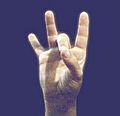 26 = 16 + 8 + 2
 -
 28 = 16 + 8 + 4
 -
 30 = 16 + 8 + 4 + 2
 -
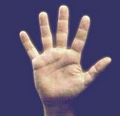 31 = 16 + 8 + 4 + 2 + 1
 -


.JPG)


Left hand
[edit]When used in addition to the right.
-
 512 = 512
 -
 256 = 256
 -
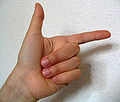 768 = 512 + 256
 -
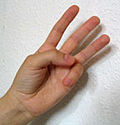 448 = 256 + 128 + 64
 -
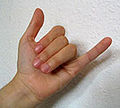 544 = 512 + 32
 -
 480 = 256 + 128 + 64 + 32
 -
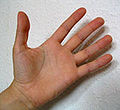 992 = 512 + 256 + 128 + 64 + 32


Negative numbers and non-integers
[edit]Just as fractional and negative numbers can be represented in binary, they can be represented in finger binary.
Negative numbers
[edit]Representing negative numbers is extremely simple, by using the leftmost finger as a sign bit: raised means the number is negative, in a sign-magnitude system. Anywhere between −511 and +511 can be represented this way, using two hands. Note that, in this system, both a positive and a negative zero may be represented.
If a convention were reached on palm up/palm down or fingers pointing up/down representing positive/negative, you could maintain 210 −1 in both positive and negative numbers (−1,023 to +1023, with positive and negative zero still represented).
Fractions
[edit]Dyadic fractions
[edit]Fractions can be stored natively in a binary format by having each finger represent a fractional power of two: . (These are known as dyadic fractions.)

Using the left hand only:
| Pinky | Ring | Middle | Index | Thumb | |
|---|---|---|---|---|---|
| Value | 1/2 | 1/4 | 1/8 | 1/16 | 1/32 |
Using two hands:
| Left hand | Right hand | ||||||||
|---|---|---|---|---|---|---|---|---|---|
| Pinky | Ring | Middle | Index | Thumb | Thumb | Index | Middle | Ring | Pinky |
| 1/2 | 1/4 | 1/8 | 1/16 | 1/32 | 1/64 | 1/128 | 1/256 | 1/512 | 1/1024 |

The total is calculated by adding all the values in the same way as regular (non-fractional) finger binary, then dividing by the largest fractional power being used (32 for one-handed fractional binary, 1024 for two-handed), and simplifying the fraction as necessary.
For example, with thumb and index finger raised on the left hand and no fingers raised on the right hand, this is (512 + 256)/1024 = 768/1024 = 3/4. If using only one hand (left or right), it would be (16 + 8)/32 = 24/32 = 3/4 also.
The simplification process can itself be greatly simplified by performing a bit shift operation: all digits to the right of the rightmost raised finger (i.e., all trailing zeros) are discarded and the rightmost raised finger is treated as the ones digit. The digits are added together using their now-shifted values to determine the numerator and the rightmost finger's original value is used to determine the denominator.
For instance, if the thumb and index finger on the left hand are the only raised digits, the rightmost raised finger (the index finger) becomes "1". The thumb, to its immediate left, is now the 2s digit; added together, they equal 3. The index finger's original value (1/4) determines the denominator: the result is 3/4.
Rational numbers
[edit]Combined integer and fractional values (i.e., rational numbers) can be represented by setting a radix point somewhere between two fingers (for instance, between the left and right pinkies). All digits to the left of the radix point are integers; those to the right are fractional.
Decimal fractions and vulgar fractions
[edit]Dyadic fractions, explained above, have limited use in a society based around decimal figures. A simple non-dyadic fraction such as 1/3 can be approximated as 341/1024 (0.3330078125), but the conversion between dyadic and decimal (0.333) or vulgar (1/3) forms is complicated.
Instead, either decimal or vulgar fractions can be represented natively in finger binary. Decimal fractions can be represented by using regular integer binary methods and dividing the result by 10, 100, 1000, or some other power of ten. Numbers between 0 and 102.3, 10.23, 1.023, etc. can be represented this way, in increments of 0.1, 0.01, 0.001, etc.
Vulgar fractions can be represented by using one hand to represent the numerator and one hand to represent the denominator; a spectrum of rational numbers can be represented this way, ranging from 1/31 to 31/1 (as well as 0).
Finger ternary
[edit]In theory, it is possible to use other positions of the fingers to represent more than two states (0 and 1); for instance, a ternary numeral system (base 3) could be used by having a fully raised finger represent 2, fully lowered represent 0, and "curled" (half-lowered) represent 1. This would make it possible to count up to 242 (35−1) on one hand or 59,048 (310−1) on two hands. In practice, however, many people will find it difficult to hold all fingers independently (especially the middle and ring fingers) in more than two distinct positions.
See also
[edit]References
[edit]- ^ Since computers typically store data in a minimum size of one whole byte, fractions of a byte are used here only for comparison.
- Pohl, Frederik (2003). Chasing Science (reprint, illustrated ed.). Macmillan. p. 304. ISBN 978-0-7653-0829-0.
- Pohl, Frederik (1976). The Best of Frederik Pohl. Sidgwick & Jackson. p. 363. ISBN 978-0-283-98341-2.
- Fahnestock, James D. (1959). Computers and how They Work. Ziff-Davis Pub. Co. p. 228.
External links
[edit]Finger binary
View on GrokipediaModern Applications
Finger binary emerged in the mid-to-late 20th century as an educational tool for introducing binary concepts to students learning computer science fundamentals.[8] In computing education, instructors use finger binary to demonstrate how computers represent numbers using bits, allowing learners to physically manipulate their hands to visualize powers of two—from 1 (thumb) to 16 (pinky) on one hand, enabling counting up to 31 without aids. This method bridges abstract binary logic with tangible interaction, making it accessible for beginners in programming courses.[9] In STEM outreach programs, especially post-2000, finger binary features prominently in interactive activities designed for children to foster early understanding of digital systems. Programs like CS Unplugged incorporate similar binary representations through gloves or cards, but finger-based demonstrations extend this to informal settings, such as online tutorials and workshops, where kids learn to count in base-2 by assigning binary values to digits. For instance, educational videos on platforms like YouTube and TikTok guide young learners through sequences, emphasizing how raised fingers signify 1s and lowered ones 0s, often tying into broader lessons on data encoding in computers. These resources, including applets and printable guides, support classroom and homeschool environments by promoting computational thinking without requiring technology.[8][3] Beyond formal education, finger binary appears in performance arts and recreational contexts as a clever signaling technique for mentalism and magic routines. Performers employ subtle finger positions to encode binary information, facilitating quick audience interactions or predictions in tricks that mimic mind-reading, drawing on the system's efficiency for discreet communication. This application highlights finger binary's versatility in high-engagement scenarios, where it serves as both an educational hook and an entertaining demonstration of mathematical principles.[10]Fundamentals
Binary System Recap
The binary numeral system, also known as base-2, is a positional numeral system that represents numbers using only two distinct digits: 0 and 1.[11] In this system, each digit's value depends on its position, with the rightmost digit representing the units place and each subsequent position to the left multiplying by a power of 2.[12] This contrasts with the more familiar decimal (base-10) system, which uses digits 0 through 9 and powers of 10.[13] Individual digits in binary are called bits, short for binary digits, where each bit can be either 0 or 1.[12] The place values start from the right: the least significant bit (LSB) is , followed by , , , and up to for a five-bit representation, corresponding to five positions.[13] For example, the binary number 1011 has a value of in decimal.[12] Mathematically, any positive integer can be expressed as:Finger-to-Bit Mapping
In finger binary, the five fingers of a hand are mapped to binary bits 0 through 4, where bit 0 (least significant bit, value ) is assigned to the thumb, bit 1 (value 2) to the index finger, bit 2 (value 4) to the middle finger, bit 3 (value 8) to the ring finger, and bit 4 (most significant bit, value ) to the pinky finger.[1] A raised or extended finger denotes a 1, while a lowered or bent finger denotes a 0.[1] This mapping follows the standard Western convention, which places the least significant bit on the thumb to facilitate sequential counting beginning with the simplest gesture for 1.[1] Variations in bit order exist; for instance, some systems exclude the thumb and assign bit 0 to the index finger, with subsequent bits to the middle, ring, and pinky fingers.[3] Other approaches reverse the order, assigning the least significant bit to the pinky (value 1) and increasing toward the index finger, often ignoring thumbs for simplicity.[19] The right hand is commonly used for single-hand representations in this system.[1] Hand orientation influences visibility: the palm typically faces the user for personal computation, or outward when displaying to others, ensuring clear observation of finger states.[19] For two-hand extensions, the right hand handles bits 0-4 (values 1-16), while the left hand manages bits 5-9 (values 32-512), collectively allowing representation of any integer from 0 to 1023 ().[1] To compute , note that 10 bits span powers of 2 from to , summing to 1023 when all are 1. Ergonomically, limiting each hand to five bits accommodates the natural structure of the human hand, enabling up to 31 () per hand without straining joints or requiring unnatural poses; the sum arises from adding the geometric series .[1]Integer Representations
Single-Hand Positive Integers
Finger binary with a single hand allows representation of all positive integers from 0 to 31 using the five fingers, where each finger corresponds to a bit in a 5-bit binary number. The thumb represents the least significant bit (2^0 = 1), the index finger 2^1 = 2, the middle finger 2^2 = 4, the ring finger 2^3 = 8, and the pinky finger 2^4 = 16. In the standard convention, a raised (extended) finger indicates a 1, while a lowered (folded) finger indicates a 0; the value is the sum of the powers of 2 for the raised fingers.[1][20] Counting begins with all fingers lowered (00000 in binary), representing 0. To count to 1, raise the thumb (00001). For 2, lower the thumb and raise the index finger (00010). Continue this binary progression: for 3, raise both thumb and index (00011); for 4, lower both and raise the middle finger (00100); and so on, systematically toggling fingers to match the binary equivalent of each successive integer. This sequence proceeds up to 31, where all five fingers are raised (11111). The process mirrors binary addition on paper but uses physical finger positions for quick mental computation.[1][21] Specific examples illustrate the mapping in action. For 5 (binary 00101), raise the thumb (1) and middle finger (4), keeping the index, ring, and pinky lowered. For 10 (binary 01010), raise the index finger (2) and ring finger (8). For 21 (binary 10101), raise the thumb (1), middle finger (4), and pinky (16). These configurations enable rapid visualization of binary-to-decimal conversion without tools.[1][20] Conventions typically use the right hand with palm facing down, positioning the thumb as the LSB nearest the body. The left hand follows a mirrored convention for symmetry, often starting with the thumb as the higher bit (2^5 = 32) when extending to two hands, but for single-hand use, it simply inverts the finger orientations for identical representations. Visualizing the hand palm-down aids in aligning the binary reading from thumb (rightmost bit) to pinky (leftmost bit).[21][1] Common errors include misassigning bit values to fingers, such as confusing the middle finger's 4 with the index's 2, or inadvertently raising extra fingers during transitions. Another frequent mistake is inverting the 0/1 positions, treating raised as 0 instead of 1. To build fluency, practitioners should count sequentially from 0 to 31 repeatedly, verbalizing the binary and decimal values aloud, and then reverse by viewing a configuration and naming the number. With consistent practice, transitions become intuitive, allowing counts at speeds of four to five numbers per second.[22][1] The primary limitation of single-hand finger binary is its maximum value of 31, as five bits yield 2^5 = 32 distinct states (including 0). For numbers beyond 31, the system overflows, requiring the addition of the second hand to extend the bit length up to 10 bits (0 to 1023). This constraint makes it ideal for small-scale mental arithmetic but insufficient for larger computations without expansion.[1][20]| Finger | Bit Position | Value (2^n) | Position for 1 |
|---|---|---|---|
| Thumb | 0 (LSB) | 1 | Raised |
| Index | 1 | 2 | Raised |
| Middle | 2 | 4 | Raised |
| Ring | 3 | 8 | Raised |
| Pinky | 4 (MSB) | 16 | Raised |