Hubbry Logo
Shaka signShaka signMain
Open search
Shaka sign
Community hub
Shaka sign
logo
8 pages, 0 posts
0 subscribers
Be the first to start a discussion here.
Shaka sign
Shaka sign
from Wikipedia

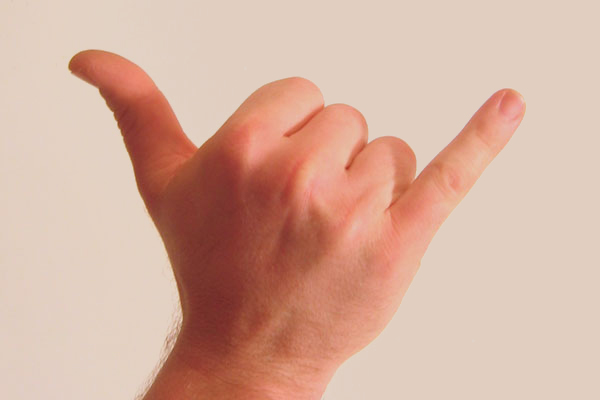
The "shaka" sign

The shaka sign, sometimes known as "hang loose", is a gesture representing "aloha spirit, love and local pride" that is the official hand gesture of Hawaii and is also associated with global surf culture.[1][2] It consists of extending the thumb and smallest finger while holding the three middle fingers curled, and gesturing in salutation while presenting the front or back of the hand; the wrist may be rotated back and forth for emphasis. The shaka sign is similar in shape to the letter Y in the American manual alphabet in American Sign Language or the sign for number six in the Chinese hand counting symbol. The shaka sign should not be confused with the sign of the horns, where the index and pinky fingers are extended and the thumb holds down the middle two fingers.

Origins

[edit]

According to the Honolulu Star-Bulletin,[3] prevailing local lore credits the gesture to Hamana Kalili of Laie,[4] who lost the three middle fingers of his right hand while working at the Kahuku Sugar Mill.[5] Kalili was then shifted to guarding the sugar train, and his all-clear wave of thumb and pinkie is said to have evolved into the shaka as children imitated the gesture.[6][7][8][9][10]

Another theory relates the origin of the shaka to the Spanish immigrants, who folded their middle fingers and took their thumbs to their lips as a friendly gesture to represent sharing a drink with the natives they met in Hawaii.[11][12][13][14][15]

The late Lippy Espinda, a used car salesman and Oahu-based entertainer, has also been named as a possible creator of the shaka.[16][17] Espinda, who frequently appeared as an extra in Hawaii Five-O as well as The Brady Bunch episodes shot in Hawaii, used the term and the sign during his television ads in the '60s. Though the claim that he is the originator of the shaka sign is debatable, he is credited with increasing its popularity and that of Hawaiian Pidgin as well.[3]

The word shaka is also used as an interjection expressing approval, which may predate its use for the shaka sign. According to the Oxford English Dictionary the origin of the word is uncertain, but it may come from Japanese, where it is a byname for the Buddha.[18]

Meaning and use

[edit]
A shaka sign foam finger used in Brian Schatz's 2014 Hawaii senatorial campaign

Residents of Hawaii use the shaka to convey the "Aloha Spirit", a concept of friendship, understanding, compassion, and solidarity among the various ethnic cultures that reside in Hawaii, lacking a direct semantic to literal translation. Drivers will often use it on the road to communicate greetings along with gratitude.[19]

In 2024, Hawaiʻi enacted Act 85 designating the shaka as the state's official gesture; the law describes the form of the gesture and is codified as HRS §5-23.[20][21][5]

Steve Sue and Governor Josh Green hold a signed document and make the shaka gesture
Steve Sue and Hawaiʻi Governor Josh Green at the ceremony signing Act 85, designating the shaka as the state gesture (June 21, 2024)

In the Honolulu public transport system (TheBus and Skyline), HOLO card readers display the shaka sign (along with a ukulele tone) when a card is tapped.[22] Drivers who let TheBus merge or otherwise drive easily can be greeted with a Shaka,[23] activated by a switch in the driver's console.[24] The design of TheBus's shaka is based on a shaka thrown by President Barack Obama at the 2012 Asian Pacific American Institute for Congressional Studies Gala.[23]

Shaka Santa and Tutu Mele by Honolulu Hale

In Hawaii, the shaka sign is known as "hang loose" and is popular in surfer culture.[5]

Australian men's mental health charity The Shaka Project uses the shaka sign in its merchandise and logo.[25]

There are several emoticon representations of the shaka sign, including \, ,/, \m/, and \, ,_. The earliest known use of the first two, with three commas or a lower case "m" corresponding to a hand's three middle fingers, is from 2006.[26] The last, similar to the first except that it represents the thumb extended horizontally (as if perpendicular to the wrist) is reported, together with the first form, from Brigham Young University in 2016.[27]

Shaka license plate

[edit]
Shaka organizational plate issued in Hawaiʻi (2024)

In May 2024, the Hawaii Department of Motor Vehicles (DMV) introduced a specialty license plate featuring the shaka gesture as part of the state’s Nonprofit License Plate Program.[28][29] A portion of the proceeds from the annual registration fee supports ID8, a Hawaii-based 501(c)(3) nonprofit organization that promotes ideas and creative expressions with positive social impact.[30][31] According to Steve Sue, chairperson of ID8, the program is intended to "reduce road rage and increase aloha spirit".[29]

Similar gestures

[edit]

Chinese number gestures

[edit]
Chinese "six" gesture

The sign has some similarities to the Chinese number gesture for "six".

Beverages

[edit]

The sign can also be used to indicate the imbibing of a bottled drink, either alcoholic or non-alcoholic, as attested to below, by placing the thumb to the mouth and motioning the little finger upward as if tipping up a bottle's bottom end. A similar meaning can be achieved by pressing the thumb up against the tip of the nose with the little finger raised upwards parallel to the bridge of the nose. It is referred to as "schooies" in Australia (Australian slang for a schooner)[32][33]

Telecommunications

[edit]
"Call me" gesture

With the thumb held near the ear and the little finger pointed at the mouth, the gesture is commonly understood to mimic the handset of a traditional landline telephone, and depending on context can be understood to stand for "call me", "I'll call you", or "let's talk on the phone".

The Unicode 9.0 emoji 🤙 "Call me hand"[34] can be interpreted as the shaka sign.

New Zealand

[edit]

In New Zealand, the shaka sign is a gang salute for the Mongrel Mob, but is not commonly used for this purpose.[35] It can also serve as a greeting, meaning "Chur", which is a friendly gesture between friends, similar to in Hawaii where it is used in the same context.

Austrian Leiwand

[edit]

A similar gesture was common among criminals in Vienna in 1935, accompanying the word of approval or appreciation "Leiwand".[36]

Usage examples

[edit]

Since 2015, fans of Brigham Young University (which has a satellite campus in Hawai'i and is also known colloquially as "the Y") have started using the gesture, in deference to newly hired Kalani Sitake, BYU's Polynesian head football coach, and because of its similarity with the letter Y in the American manual alphabet in American Sign Language. It is also used as a nod of respect to Hamana Kalili, a native Hawaiian Latter-day Saint who, according to locals, is the founder of the popular sign.[27]

In 2024, Filipino P-pop girl group BINI became associated with the gesture when group member Sheena used it with the distinctive phrase, "Eyyy ka muna, eyyy".[37]

See also

[edit]

References

[edit]
[edit]
Revisions and contributorsEdit on WikipediaRead on Wikipedia
from Grokipedia
The shaka sign is a hand gesture originating in Hawaii, formed by extending the thumb and little finger while folding the three middle fingers against the palm. It embodies the aloha spirit, conveying greetings, appreciation, or a relaxed "hang loose" attitude, and has become emblematic of Hawaiian culture and global surfing communities. The gesture's prevailing origin traces to Hamana Kalili, a fisherman and plantation worker in Laie, Oahu, who lost his middle three fingers in a sugar cane mill accident around 1917 and subsequently used the resulting hand shape to signal on the mill's railway, with local children imitating it and spreading its use. While alternative theories exist—such as derivations from Spanish immigrants requesting drinks or Chinese numeral signals for "six"—the Kalili account predominates in historical lore, though definitive evidence remains elusive due to reliance on oral traditions amid Hawaii's plantation labor history. Popularized in the mid-20th century through local media and surfing's international rise, the shaka gained statewide official recognition in 2024 via Act 85, affirming it as Hawaii's gesture representing love, local pride, and aloha.

Description

Gesture Formation

The shaka sign is executed by extending the thumb and pinky finger outward from a partially closed fist, while the index, middle, and ring fingers are folded tightly or loosely against the palm. This formation creates a distinctive "horned" shape with the extended digits separated by the tucked fingers. The gesture is typically performed with one hand, though bilateral execution—using both hands simultaneously—occurs in variations for added emphasis. Hand orientation varies, with the palm facing inward toward the gesturer's chest or toward the recipient, and the back of the hand sometimes positioned upward in horizontal adaptations. Motion often involves a subtle or shake, ranging from relaxed flicks in casual forms to vigorous side-to-side or downward tilts in more dynamic . tension differs by style: tighter curls and straighter extensions convey formality, while slight bends and minimal folding a looser, more relaxed appearance.

Primary Meanings

The shaka sign primarily symbolizes the spirit in Hawaiian , representing friendliness, , unity, , and . This connotation arises from its as a non-verbal cue for positive social interactions, fostering goodwill and relaxation without requiring spoken words. Consistent eyewitness reports from Hawaiian communities emphasize its use to convey shared positivity and informality, distinct from any secondary or ironic interpretations in contemporary settings. In practice, the functions as a versatile expression of , farewell, , or approval, enabling quick acknowledgment of safe passage or mutual in casual encounters. It embodies a causal mechanism for building interpersonal through simple, intuitive signaling, prioritizing ease and positivity over formal verbal exchange. Within surfing communities, the shaka reinforces these primary associations by denoting relaxation—"hang loose"—and endorsement of good vibes, serving as an informal affirmation of camaraderie and stoke among participants. Empirical consistency in accounts from these groups underscores its core link to laid-back approval and collective goodwill, observable in everyday non-verbal communications since its established cultural embedding.

Historical Origins

Pre-20th Century Theories

One prominent folk theory links the shaka sign to Hamana Kalili, a Native Hawaiian resident of Laie born in 1882, who reportedly lost the three middle fingers of his right hand in an accident at the Kahuku Sugar Mill sometime in the late 19th or early 20th century while operating a cane press. Kalili, later working as a fisherman and security guard at the mill, allegedly used the resulting hand shape when waving or signaling fish counts to plantation workers, with local children mimicking it and spreading the gesture as a friendly or affirmative sign within the Laie community. This account, preserved through oral traditions and later reported in mid-20th-century newspapers, lacks corroboration from primary documents such as mill records or eyewitness accounts predating 1900, rendering it unverifiable despite its persistence in Hawaiian lore. An alternative narrative posits the gesture emerged amid the exploitative conditions of Hawaii's sugar plantations in the late 1800s, where diverse immigrant laborers— including , Chinese, Japanese, and others—faced severe physical demands, low wages, and overseer surveillance that suppressed verbal communication in non-English languages. Proponents claim workers adopted the shaka as a covert signal for danger, , or task coordination, such as warning of approaching supervisors or affirming safe passage, to evade punishment in environments described in historical accounts as akin to "pits of " due to cane field burns and machinery hazards. These assertions draw from oral histories among plantation descendants but are unsupported by archival evidence like labor logs or photographs from the era, which document brutality but not the specific gesture. Other proposed pre-20th-century origins, such as mid-19th-century Chinese immigrants using a similar form to denote the number six or Spanish arrivals in the 1800s signaling a request for drink by folding middle fingers toward the mouth, lack any substantiating artifacts, texts, or depictions from the periods claimed. Claims tying the shaka to ancient Polynesian traditions or Japanese cultural imports similarly fail empirical scrutiny, as no pre-1900 Hawaiian records, carvings, or ethnographic observations reference the thumb-and-pinky extension in a communicative role akin to its modern use. These theories appear as later rationalizations without causal linkage to documented practices, privileging narrative appeal over verifiable historical traces.

20th Century Development and Popularization

In the mid-20th century, the shaka gesture gained traction within Hawaii's surfing communities, particularly among Waikiki beach boys and local watermen who used it as a casual signal of camaraderie and wave-sharing etiquette during the post-World War II tourism boom and military presence on the islands. Surfing's expansion, fueled by returning GIs and mainland visitors encountering Hawaiian culture, embedded the sign in informal beach interactions by the 1950s, though it remained largely localized without widespread media exposure. The gesture's broader popularization occurred in the through used-car salesman "Lippy" Espinda, who incorporated it into his television advertisements, pairing the hand sign with the catchphrase "shaka, brah!" as a sign-off to convey local friendliness and sales appeal. Espinda's broadcasts, aired on local stations like , reached urban Hawaiian audiences and reinforced the sign's association with pidgin English informality, though he did not invent the gesture itself but amplified its visibility through repeated commercial use. Etymologically, "shaka" likely emerged from Hawaiian rather than native Hawaiian , with Espinda credited for linking the word to the in mainstream usage; alternative derivations, such as from terms for "" (chaka) or casual exclamations, remain speculative without primary , prioritizing of coinage over unsubstantiated foreign . By the 1970s, the diffused to California surf scenes via traveling surfers, surf magazines like Surfer, and documenting Hawaiian-style hot-dogging, establishing it as a trans-Pacific emblem of laid-back coastal culture amid the sport's national commercialization.

Cultural and Social Usage

In Hawaiian Culture

The shaka sign holds significance in Native Hawaiian social practices as an embodiment of the aloha spirit, which entails mutual respect, compassion, and goodwill fostering interpersonal harmony and community resilience. Native Hawaiians employ the gesture in everyday interactions to signal greetings, thanks (mahalo), or affirmation, aligning with traditional emphases on relational bonds and collective support verifiable through observed local customs rather than pre-contact artifacts. This usage underscores causal goodwill—practical reciprocity in exchanges—over abstract sentiment, as seen in its role among keiki (children) to kupuna (elders) for expressing unity and encouragement in family and communal settings. Emerging in the early , possibly from Native Hawaiian fisherman Hamana Kalili's thumb-and-pinky extension after losing middle fingers in a circa , the integrated into post-contact Hawaiian identity amid economic shifts following U.S. in 1898. In pidgin-influenced contexts, it served as a subtle marker of , reflecting to multi-ethnic plantation life while preserving core Hawaiian values of hospitality and endurance against external pressures. Unlike tourist appropriations for performative displays, authentic Native Hawaiian deployment prioritizes genuine relational affirmation, such as acknowledging safe returns from ocean voyages or shared labor, thereby maintaining cultural depth amid commodification.

In Surfing and Beach Communities

In surfing communities, the shaka sign conveys camaraderie, gratitude for wave-sharing, and reassurance after wipeouts, serving as a visual cue in environments where verbal communication is hindered by ocean noise and wind. This non-verbal etiquette emerged prominently in the 1960s on Oahu's North Shore, as visiting surfers from California and Australia adopted the gesture from local Hawaiians during intense big-wave sessions at spots like Pipeline and Waimea Bay. The gesture's integration into facilitated egalitarian signaling, allowing quick acknowledgments of and without , distinct from mainland greetings to the high-stakes, transient of lineups. Its spread within communities accelerated through media exposure, including surf that documented North Shore sessions and popularized the among global enthusiasts. Professional surfers have embodied its use, with figures like frequently displaying it in competitions and media until , when he posted on criticizing its dilution through overuse by non-Hawaiians ("haoles"), announcing his group's decision to discontinue it to preserve authenticity. This reflects ongoing tensions in surf subcultures over the gesture's commodification versus its roots in localized, functional signaling.

Global Spread and Adaptations

The shaka sign disseminated globally during the 1980s and 2000s primarily through Hollywood depictions of surf culture and the rise of extreme sports media, establishing it as a shorthand for relaxed positivity and interpersonal goodwill in regions with burgeoning surf scenes, including Australia, Brazil, and coastal areas of Europe. Surf films and documentaries from this era, capitalizing on the sport's mainstream appeal, featured the gesture among protagonists and enthusiasts, facilitating its adoption beyond Pacific contexts as a non-verbal emblem of shared leisure ethos. In Brazilian jiu-jitsu (BJJ) circles, the shaka adapted as a of mutual and triumph, introduced via Hawaiian-origin practitioners who bridged surf and subcultures; from major competitions, such as those sanctioned by the , documents its use post-match to convey among grapplers. , a prominent BJJ figure, has attributed its integration to cultural exchanges emphasizing and resilience, distinct from its Hawaiian roots yet aligned in promoting communal harmony. By the , pragmatic adaptations emerged in informal settings, such as signaling for a by orienting the pinky outward to mimic holding a , while preserving the gesture's foundational in casual salutations across international surf and communities. In , it functions as a vernacular greeting akin to "chur," reinforcing bonds in everyday interactions without formal codification. These evolutions underscore the sign's resilience as a versatile, empirically observed conduit for affable intent amid transnational diffusion.

Cross-Cultural Comparisons

Similar Gestures in Other Traditions

In Chinese tradition, extending the thumb and little finger while curling the index, middle, and ring fingers denotes the number six within a one-handed counting system that signifies numerals one through ten. This gesture forms part of a method historically employed for discreet numerical communication, such as among merchants negotiating prices across dialects, with practices traceable to at least the medieval period and symbolic representations for numbers six to ten distinguishing it from sequential finger extension for one to five. Structurally analogous to the shaka yet differentiated by its static form without wrist rotation and its explicit purpose in quantification or games rather than interpersonal signaling, the gesture underscores independent cultural utility for visibility in counting. The identical hand configuration appears in global telecommunications contexts as a mime for a telephone, where the thumb approximates the earpiece and the pinky the mouthpiece, conveying an invitation to call without verbalization. This practical application, widespread since the mid-20th century following telephone proliferation, prioritizes mimetic clarity for action over emblematic or relaxed connotation, often executed dynamically by bringing the hand to the head rather than presented outward. Such forms evolve convergently from ergonomic extension for emphasis or , as seen in varied or signaling systems, but causal intents remain tied to numerical precision or device imitation, eschewing the informal sociality of or aloha-derived uses.

Distinct Interpretations and Variations

In East Asian cultures, particularly , the thumb-and-pinky extension forming the shaka coincides with the manual for the number six, a pre-existing numeral uninfluenced by Hawaiian dissemination, as evidenced by its independent linguistic and counting traditions predating 20th-century global export. This represents a coincidental morphological overlap rather than semantic borrowing, with the Chinese interpretation strictly quantitative rather than the shaka's relational positivity. The same hand shape as the shaka sign, when oriented vertically with the thumb held near the ear and the pinky finger pointed toward the mouth, is commonly used in various cultures to mean "call me," mimicking the shape of a traditional telephone handset. This usage differs from the shaka's primary horizontal or waving orientation associated with aloha and relaxation. Anecdotal reports from U.S. West Coast contexts have misinterpreted the as a identifier, stemming from superficial resemblances to factional amid urban proliferation, yet no verified confirm appropriation, underscoring such associations as perceptual errors without causal grounding in symbology. The structurally diverges from the rock 'n' roll "horns" gesture, which extends the index and pinky while tucking the thumb over the middle fingers to evoke defiance or themes, contrasting the 's thumb prominence and folded middle fingers that align with amicable, non-confrontational valence rooted in aloha principles. Claims of interpretive proximity between these forms lack empirical support, as their finger configurations and cultural valences evolved separately—the horns from Italian folk wards against evil in the 1890s, independent of Pacific Island gestures. European pinky-extended motions mimicking refined beverage holding share only partial form with the shaka but antedate surfing tourism's reach, exhibiting no traceable causal evolution from Hawaiian usage, thus remaining distinct in intent as etiquette rather than greeting.

Controversies and Criticisms

Cultural Appropriation Claims

Some activists and commentators have asserted that the shaka sign's adoption by non-Hawaiians, particularly non-Native individuals referred to as "haole," amounts to cultural appropriation by diluting its significance within Native Hawaiian contexts. In 2019, professional surfer Kelly Slater posted on Instagram that he and his non-Hawaiian friends had decided to cease using the gesture, citing an overabundance of "haole shakas" as eroding its authenticity. These concerns have surfaced in isolated campus incidents, such as the 2017 condemnation by the Association of Native Americans at Yale of the student group , an all-female Polynesian dance ensemble, for allegedly appropriating Hawaiian and Tahitian cultural elements through performances that included . The group's name and activities were criticized as hypersexualizing Native practices, though the backlash focused more broadly on performative representation than the hand gesture alone. Counterarguments emphasize the gesture's historical through , interactions, and communities as an organic, non-proprietary exchange that empowers rather than diminishes its relational of . Hawaii's in 2024 passed Senate Bill 3312, designating the shaka as the state gesture without any stipulations restricting its use to or , a move signed into by on , 2024, reflecting institutional endorsement of inclusive application. No documented prohibitions or bans on non-Hawaiian usage have been enacted by Native Hawaiian organizations, with legislative recognition underscoring a preference for communal norms over exclusionary ownership.

Perceptions in Modern Contexts

In certain segments of surf culture, the shaka sign has faced perceptions of embarrassment, particularly when flashed by novices or "whitewater fumblers"—beginner surfers ineptly paddling in breaking waves—as evoking secondhand cringe among more seasoned observers, according to a 2017 analysis in surf media. This view portrays the gesture as outdated or overly performative when detached from authentic proficiency, yet such sentiments remain anecdotal and confined to niche commentary rather than widespread rejection. Countervailing evidence from surfing underscores sustained endorsement, with competitors routinely deploying the to signal good fortune, celebrate maneuvers, or foster lineup rapport in events as recent as 2023 and beyond. Usage persists in high-stakes contexts, including gatherings, where it functions as a non-verbal for positivity amid competitive pressures, belying claims of . Online forums, exemplified by 2019 Reddit exchanges among Hawaiian residents, reveal pushback against usage prohibitions for outsiders, dismissing them as excessive given the sign's origins in everyday plantation life rather than ritual sanctity—contrasting with amplified sensitivities that treat it as inviolably indigenous. Participants emphasized stylistic variances over outright bans, attributing stricter interpretations to performative identity concerns absent demonstrable injury to cultural integrity. Empirically, isolated critiques yield to the gesture's transnational uptake, which since the 1950s surfing surge has engendered affirmative connotations in locales from to , with adoption metrics in media and athletics far eclipsing grievance volumes. Such patterns suggest objections often derive from subjective offense paradigms over causal detriment, as no aggregated documents erosion of Hawaiian aloha values from global dissemination.

Official Recognition and Legacy

Legislative Actions in Hawaii

In 2024, the passed Bill 3312, introduced by Senator Glenn Wakai with a companion bill HB2736 sponsored by Representative Quinlan, to designate the gesture—formed by extending and pinky while folding the three middle fingers—as the gesture of the State of . The measure advanced through committees, received unanimous approval in on April 26, 2024, and cleared both chambers by early May before being transmitted to . Governor Green signed SB3312 into law as Act 85 on June 21, 2024, making Hawaii the first U.S. state to adopt an official hand gesture and authorizing the State Foundation on Culture and the Arts to promote its use in educational and cultural programs. The bill's findings emphasize the shaka's embodiment of aloha spirit, representing inclusivity, compassion, and local pride, while affirming Hawaii as its birthplace to preserve cultural recognition amid global adoption. This legislative success followed sustained advocacy efforts, including those by Project Shaka founder Steve Sue, which highlighted the gesture's ties to Hawaiian resilience and community values, culminating in the state's formal endorsement despite prior informal proposals that did not advance to enactment.

Enduring Impact and Verifiable Associations

The shaka sign symbolizes resilience in Hawaiian contexts, drawing from folkloric accounts of its emergence amid early 20th-century plantation hardships, where a worker's injury purportedly led to the gesture's form as an adaptive signal of perseverance. This narrative, though unverified in historical records, underscores a pattern of cultural endurance, as the sign persisted through economic shifts following the sugar industry's decline in the mid-20th century, embodying local adaptation without formal institutionalization. In response to the August 2023 Lahaina wildfires, which devastated Maui and claimed over 100 lives, the shaka appeared in community rituals like paddle-out memorials, with hundreds of such events honoring victims and signaling communal fortitude amid recovery efforts. News coverage documented its role in these gatherings as a marker of unity, aligning with broader patterns of the gesture's invocation during adversity to foster collective goodwill rather than division. The sign's propagation reflects causal utility over origin exclusivity, enabling billions of implied annual exposures through surfing broadcasts, social media shares, and sports endorsements, where its neutral positivity facilitates cross-cultural exchange without proprietary claims. This organic diffusion, evident in global athletic celebrations since the 1970s surf boom, prioritizes functional appeal—conveying affirmation or relaxation—explaining persistence amid diverse interpretations, as rigid gatekeeping would hinder such scalability.

References

Add your contribution
Related Hubs
User Avatar
No comments yet.