Hubbry Logo
OransOransMain
Open search
Orans
Community hub
Orans
logo
8 pages, 0 posts
0 subscribers
Be the first to start a discussion here.
Contribute something
Orans
Orans
from Wikipedia
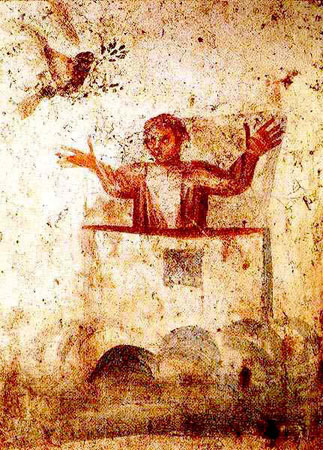
An early Christian painting of Noah praying in the gesture of orant
Fresco in the Catacomb of Priscilla showing a Christian woman wearing a headcovering and praying in the orant posture
Christian man praying in the gesture of orant, Catacombs of Domitilla, Rome

Orans, a loanword from Medieval Latin orans (Latin: [ˈoː.raːns]) translated as "one who is praying or pleading", also orant or orante, as well as lifting up holy hands, is a posture or bodily attitude of prayer, usually standing, with the elbows close to the sides of the body and with the hands outstretched sideways, palms up.[1][2][3] The orans posture of prayer has a Scriptural basis in 1 Timothy 2 (1 Timothy 2:8): "I desire, then, that in every place the men should pray, lifting up holy hands without anger or argument" (NRSV).[1][2][3]

It was common in early Christianity and can frequently be seen in early Christian art, being advised by several early Church Fathers, who saw it as "the outline of the cross".[1][3] In modern times, the orans position is still preserved in Oriental Orthodoxy, as when Coptic Christian believers pray the seven canonical hours of the Agpeya at fixed prayer times.[4] The orans also occurs within parts of the Catholic, Oriental Orthodox, Eastern Orthodox, Lutheran, and Anglican liturgies, Pentecostal and charismatic worship, and the ascetical practices of some religious groups.[2][3]

History

[edit]

The orans posture is widespread in the art of the Ancient Near East, both in the Levant and in Egypt, from at least the Late Bronze Age. It was in origin a gesture of supplication or submission shown towards a deity (or the image of a deity) upon entering a temple.[5]

The orans position is seen throughout the Old Testament, in Isaiah as well as in certain Psalms (such as Psalm 134:2–3, Psalm 28:2, Psalm 63:4–5, Psalm 141:2, Psalm 143:6).[6] It has been argued that the gesture was adopted by Early Christianity from Second Temple Judaism.[7] References in the New Testament are 1 Timothy 2:8, and Hebrews 12:12–13.[7]

The biblical ordinance of lifting hands up in prayer was advised by many early Christian apologists, including Marcus Minucius Felix, Clement of Rome, Clement of Alexandria and Tertullian.[1][2] Christians saw the position as representing the posture of Christ on the Cross; therefore, it was the favorite of early Christians. Some scholars also assert that the deference this pose exhibits—with the outstretched hands showing a sort of submission to a religious power—is intertwined with Roman ideas of pietas; this encapsulates notions of family values, civic honor and charitable behavior.[8][9]

In Oriental Orthodoxy, Coptic Christian believers pray the seven canonical hours of the Agpeya at fixed prayer times in the orans position while standing.[4] In Western Christianity, until at least the ninth century, the posture was used by entire congregations during celebrations of the Eucharist.[10][3] By the twelfth century, however, the joining of hands began to replace the orans posture as the preferred position for prayer. The orans posture has continued to be used at certain points in the liturgies of the Roman Catholic and Eastern Orthodox and Churches.[3] In the Catholic Church, Masses in the Latin liturgical rites see the celebrating priest prays the orations, the Eucharistic Prayer, and the Lord's Prayer in the gesture of orans; in the Maronite Church's Holy Qurbana, the congregation together with the priest lift up their hands in the orans posture during various parts of the liturgy, such as the anaphora and Lord's Prayer.[11][3] The orans gesture survived the Reformation and was preserved in the liturgy of the Lutheran and Anglican Churches.

Reuben Morgan praying in the orans posture at an event in Zagreb, Croatia.

The orans posture experienced a revival within Pentecostalism and Charismatic Christianity under the umbrella of the contemporary worship movement of the mid-20th century.[10][12][13]

Depictions in art

[edit]
18th-century Byzantine-style bronze panagia from Jerusalem, showing the Virgin Mary in the Orans position

Orans was common in early Sumerian cultures: "...it appears that Sumerian people might have a statue carved to represent themselves and do their worshipping for them—in their place, as a stand in. An inscription on one such statue translates, 'It offers prayers.' Another inscription says, 'Statue, say unto my king (god)..."[14] The custom of praying in antiquity with outstretched, raised arms was common to both Jews and Gentiles, and indeed the iconographic type of the Orans was itself strongly influenced by classic representations. But the meaning of the orans of Christian art is quite different from that of its prototypes.[15] It is possible that medieval representations of a diminutive body, figure of the soul, issuing from the mouths of the dying were reminiscences of the orans as a symbol of the soul. Other theories imply a less metaphorical view, instead arguing that the heavily feminine iconography of orans sheds light on the state of female involvement in the early Church.[8]

Numerous Biblical figures, for instance, depicted in the catacombs of RomeNoah, Abraham, Isaac, Shadrach, Meshach and Abednego, and Daniel in the lion's den—are pictured asking the Lord to deliver the soul of the person on whose tombs they are depicted as he once delivered the particular personage represented. But besides these Biblical orans figures there exist in the catacombs many ideal figures (153 in all) in the ancient attitude of prayer,[15] representing the deceased's soul in heaven, praying for their friends on earth.[16] One of the most convincing proofs that the orans was regarded as a symbol of the soul is an ancient lead medal in the Vatican Museum showing the martyr St. Lawrence, under torture, while his soul, in the form of a female orans, is just leaving the body. An arcosolium in the Ostrianum cemetery represents an orans with a petition for her intercession: Victoriæ VirginiPete … The Acts of St. Cecilia speaks of souls leaving the body like virgins: Vidit egredientes animas eorum de corporibus, quasi virgines de thalamo ("He saw their souls coming out of their bodies, like virgins from the chamber"), and so also the Acts of Sts. Peter and Marcellinus.[15] Other academic opinions, however, disagree with the metaphorical nature of the above theories; citing the large amount of female orans figures and their common characteristics, they argue that the prevalence of non-male figures indicates unacknowledged female leadership in the early church.[8][17] While writings focusing female leaders is rare in early Christianity, scholars look to art to provide a more holistic picture; in particular, women appearing to supervise eucharist—in orans position—in catacomb iconography leads some to propose the existence of female leadership in the church.[8][17] This represents a less metaphorical lens than that of the feminine orans representing the soul.

The earlier orantes were depicted in the simplest garb, and without any striking individual traits, but in the fourth century the figures become richly adorned, and of marked individuality, an indication of the approach of historic art. One of the most remarkable figures of the orans cycle, dating from the early fourth century, is interpreted by Wilpert as the Blessed Virgin interceding for the friends of the deceased. Directly in front of Mary is a boy, not in the orans attitude and supposed to be the Divine Child, while to the right and left are monograms of Christ.[15]

The Platytéra, a hagiographic depiction on the Virgin Mary as Our Lady of the Sign which is standing in the orans gesture, usually placed on the half-dome above the altar of Byzantine-style churches, and facing down the nave.

[edit]

See also

[edit]

References

[edit]

Sources

[edit]
[edit]
Revisions and contributorsEdit on WikipediaRead on Wikipedia
from Grokipedia
The orans, derived from the Latin term for "one who prays," denotes a prayer posture in early Christianity involving a standing figure with arms extended outward and upward, palms facing heavenward, as a gesture of supplication and surrender to God. This ancient form of prayer, predating Christianity but readily adopted for its symbolic resonance with biblical precedents such as Moses raising his hands in Exodus, became emblematic in Early Christian art, particularly in the frescoes of Roman catacombs dating from the second to fourth centuries, where orans figures—often veiled women—intercede for the deceased or represent the faithful soul ascending in piety. In liturgical practice, the posture persists among clergy during key moments like the Eucharistic Prayer, signifying priestly mediation, though its communal use has varied historically amid evolving rubrics. Beyond catacomb depictions, orans motifs evolved in Byzantine iconography, frequently portraying the Virgin Mary as the Oranta, an intercessory figure with arms raised in eternal prayer, as exemplified in the eleventh-century mosaic of Saint Sophia Cathedral in Kyiv.

Definition and Symbolism

Posture and Gesture

The orans posture involves a standing position with arms raised and extended, typically with elbows bent slightly or held near the sides, and palms turned upward or facing outward. This hand orientation—palms open and forward—distinguishes the gesture as one of openness and vulnerability. As a physical expression of , the elevated arms and exposed palms signal entreaty, a form empirically observable in the of the pose where upward extension naturally accompanies gestures of across cultures. Archaeological depictions of orante figures confirm the posture's consistency, with artifacts routinely showing arms at height or higher and palms consistently averted from the body, providing tangible of standardized supplicatory intent without variation in core elements.

Theological Significance

The orans posture, characterized by raised arms with palms facing upward, theologically signifies a believer's complete openness to , embodying surrender, , and the elevation of the toward divine communion. This gesture enacts the spiritual reality of dependence on God's providence, as the physical extension of hands mirrors the offering of one's entire being in , free from or internal discord. In 1 Timothy 2:8, the Apostle Paul directs that men pray "lifting up holy hands, without anger or quarreling," linking the posture to moral purity and unhindered intercession, where "holy hands" denote lives aligned with righteousness rather than ritual alone. Early Christian writer , in De Oratione (c. 200 AD), prescribes this form—standing with hands stretched forth modestly—as the normative Christian mode, emphasizing its role in directing the mind heavenward without ostentation, thus fostering a causal alignment between bodily discipline and spiritual focus. Theologically, raised hands in orans distinguish active engagement with God from postures of passive submission, such as , which conveys abject or . Instead, orans represents entreaty and , visually petitioning for grace while signaling receptivity to divine response, akin to ancient supplicatory rites but purified in Christian context to exclude manipulative intent. contrasts it with clasped or hidden hands, arguing that open extension better expresses the "sacrifice of prayer" and communal lifting of needs to the Father. This symbolism underscores causal realism in worship: the deliberate posture disciplines the will, countering distraction and embodying the believer's elevation above earthly strife toward eschatological hope. Unlike later folded-hand gestures, which evoke medieval clasped devotion symbolizing held-back desires, orans prioritizes unreserved offering, aligning with scriptural precedents like Psalm 141:2 where ascends as with lifted hands. This posture thus theologically integrates body and spirit, privileging empirical attestation from apostolic and patristic sources over speculative reinterpretations, ensuring 's through intentional form.

Historical Origins

Pre-Christian and Jewish Roots

The orans posture, involving raised arms extended outward in a of , manifests in ancient Egyptian as early as (c. 2686–2181 BCE), where statues and reliefs depict worshippers, kings, and deities with upraised arms symbolizing adoration, regeneration, and offering to higher powers. This gesture appears in temple scenes of ritual veneration, such as those accompanying processions or divine encounters, underscoring a physical expression of humility before divine authority independent of later theological frameworks. Archaeological evidence from sites like confirms its prevalence in non-royal contexts, with figures kneeling or standing while elevating arms toward solar or chthonic deities, predating formalized priesthoods by millennia. In Mesopotamian and broader Near Eastern art from the third millennium BCE, analogous uplifted-hand motifs recur in cylinder seals and stelae, portraying petitioners appealing to gods for favor or protection, a pattern extending into Hittite and Canaanite reliefs by 2000 BCE. Greco-Roman religious practices similarly featured standing with arms stretched skyward and palms supinated, as attested in literary descriptions of temple rituals where suppliants extended hands toward deities or celestial bodies, a convention evident in votive inscriptions and sarcophagi from the Republican era (c. 509–27 BCE). This cross-cultural consistency suggests an underlying causal mechanism: the raised-arm gesture as a primal, embodied signal of and entreaty toward perceived superiors, akin to appeasement displays in , rather than a derived symbolic invention. Jewish antecedents during the Second Temple period (516 BCE–70 CE) include the priestly benediction rite, known as nesiat kapayim (lifting of hands), where kohanim elevated palms outward while reciting blessings, a practice rooted in Temple liturgy and archaeologically echoed in ritual artifacts from . Post-Temple rabbinic texts, such as those in the (compiled c. 200 CE but reflecting earlier customs), preserve descriptions of communal standing prayer in synagogues oriented toward , with elevated hands integrated into specific supplicatory acts like the priestly service, distinguishing it from everyday recitations. Excavations at sites like Dura-Europos (synagogue frescoes dated to c. 244 CE) depict figures in uplifted-hand postures during scenes of communal devotion, illustrating continuity of this gesture in Jewish worship without Christian influence. Such evidence indicates the posture's adaptation within Jewish contexts as a marker of hierarchical appeal to divine authority, paralleling but distinct from pagan precedents due to monotheistic constraints on visual representation.

Biblical Foundations

The orans posture, characterized by raised arms extended outward, finds explicit endorsement in Old Testament scriptures as a form of supplicatory prayer linked to divine favor and intercession. In Exodus 17:8–13, during the Israelites' battle with the Amalekites, Moses sustains victory by holding up his hands: "When Moses held up his hand, Israel prevailed, and when he let his hand down, Amalek prevailed," with Aaron and Hur supporting his arms until sunset, resulting in Joshua's defeat of the enemy. This narrative, set circa 1446 BCE in traditional chronologies, portrays raised hands not as incidental gesture but as causally efficacious in invoking God's aid, independent of other actions. Similarly, Psalm 141:2, attributed to David, equates the "lifting up of my hands" (terûpat kappay in Hebrew, denoting uplifted palms) with evening sacrifice: "Let my prayer be counted as incense before you, and the lifting up of my hands as the evening sacrifice." This parallelism underscores the posture's integration into temple worship protocols, reflecting a prescribed mode of approaching Yahweh rather than arbitrary custom. New Testament texts extend and apostolicize this tradition, commanding its use in Christian assemblies. In 1 Timothy 2:8, Paul directs: "I desire then that in every place the men should pray, lifting holy hands (epairomenous hosias cheiras in Greek, implying pure, outstretched hands) without anger or quarreling," positioning the posture as normative for male-led public prayer across contexts, from synagogues to house churches. This injunction, written circa 62–64 CE amid Ephesian church instruction, counters factionalism by standardizing a biblically rooted gesture, evidencing continuity from Jewish practice without syncretism. Luke 24:50 further models it through Christ: "Then he led them out as far as Bethany, and lifting up his hands (epiaras tas cheiras autou) he blessed them and left them," immediately prior to the Ascension, circa 30 CE. Jesus' action echoes Levitical blessings (Numbers 6:22–27, involving raised hands), affirming the posture's divine authorization as a conduit for benediction and ascension theology. These passages collectively demonstrate prescriptive intent over mere descriptivism: Mosaic efficacy, Davidic cultic equivalence, Pauline universality, and messianic exemplarism establish raised hands as a divinely ordained form, resilient to cultural dilution claims, as their textual commands precede and transcend localized rituals. Original-language consistency—Hebrew nasa yad (to lift hand) and Greek epairo cheir (to raise hand)—reinforces a unified of openness and dependence on , unmediated by later interpretive overlays.

Early Christian Development

The orans posture, involving standing with arms raised and palms facing upward, found continuity in early Christian communal prayer during the first three centuries, bridging Jewish antecedents into distinctly Christian practice. Patristic sources affirm its prevalence in house church gatherings, where believers assembled clandestinely amid intermittent persecutions. Tertullian, in his treatise De Oratione composed circa 200 CE, explicitly instructs that Christians pray with hands raised and spread outward, emulating the extended arms of Christ on the cross during the Passion, thereby encompassing the world in intercessory prayer. This gesture underscored supplication and mediation, performed facing east toward the rising sun as a symbol of resurrection hope. Archaeological evidence from Roman catacombs corroborates textual descriptions, with frescoes dating to the second and early third centuries depicting orans figures—often anonymous believers or martyrs—in attitudes of . These representations, found in burial contexts like the and Domitilla, reflect the posture's role in funerary rites and communal devotions, symbolizing defiance against death and imperial oppression while invoking divine protection. Such imagery proliferated during periods of heightened persecution, as under emperors (249–251 CE) and Valerian (257–260 CE), when raised arms signified unyielding faith and eschatological expectation rather than submission to pagan authorities. The posture's persistence in these settings demonstrates an unbroken liturgical tradition, adapted for small-group worship in domestic spaces converted to churches, where physical elevation of hands facilitated collective invocation without formal clerical mediation in every instance. By the late third century, as transitioned from marginalized sect to tolerated faith, orans remained a hallmark of discipline, evidenced in both literary exhortations and visual records predating the in 313 CE.

Artistic and Iconographic Representations

Catacomb Frescoes and Early Depictions

Frescoes in the Catacombs of Priscilla, dating to the early third century CE, depict orans figures with arms raised in prayer, often positioned above burial niches to symbolize the deceased soul interceding or at peace in the afterlife. These representations, verified through archaeological excavations revealing layered pigments and inscription contexts, illustrate the posture's adoption for commemorative purposes amid persecution-era burials starting around the second century. In the of Callixtus and Domitilla, orans motifs appear integrated into narrative cycles such as the and stories, symbolizing resurrection and supplicatory prayer, with documented instances exceeding hundreds across Roman subterranean sites. The figure typically stands with elbows at sides, hands outstretched palms upward, evoking piety and divine appeal, as evidenced by preserved wall paintings analyzed for stylistic consistency with third-century techniques. Christian orans depictions diverge from contemporaneous pagan uses through contextual additions like the Chi-Rho or subtle elements, signifying adaptation for Christological emphasis rather than generic , as confirmed by iconographic comparisons in excavated cubicles. This theological repurposing underscores the posture's role in affirming eternal , distinct from mere ritual gesture, amid the ' function as both burial and devotional spaces.

Medieval and Later Art

In , the orans posture continued to feature prominently in medieval representations of the Virgin Mary as intercessor, particularly in decorations and icons where she stands with arms raised, symbolizing and mediation between humanity and the divine. This stylization persisted through the Middle Byzantine period, as seen in church where the Virgin Orans often occupied the central space, reflecting ongoing liturgical emphasis on standing prayer in Eastern rites. Examples include the 11th-century mosaic of the Virgin Orans in 's Saint Sophia Cathedral, depicting her in the characteristic upright stance with open palms facing upward. Western Christian art exhibited a marked decline in orans depictions after the , correlating with liturgical shifts toward and postures introduced by monastic traditions that prioritized gestures of , such as and . This evolution aligned with broader changes in practices during the , where standing orans gave way to seated or kneeling forms in public worship, influenced by feudal customs and the Rule of St. Benedict's emphasis on bodily submission. Artistic evidence from Western manuscripts and frescoes post-Constantine shows reduced frequency of the posture among lay figures and saints, favoring more subdued gestures that mirrored these rubrical developments. By the later medieval and Renaissance periods, Eastern icons maintained the orans in stylized, frontal compositions, as in the 12th-century from , where the Virgin's raised arms underscore her eternal prayerful role. In contrast, Western artists occasionally revived elements of the posture in historical or symbolic contexts but stylized it naturalistically, diverging from the rigid early Christian form amid a preference for dynamic, bowed attitudes in devotional scenes. This divergence highlights causal links between enduring Eastern liturgical standing practices and persistent , versus Western adaptations favoring penitential gestures.

Liturgical and Devotional Practices

Use in Eastern Orthodox Worship

In the Eastern Orthodox of St. , codified around 400 CE, the celebrant priest employs the orans posture—standing with arms extended and palms facing upward—during the anaphora, the central eucharistic prayer that lifts up the offerings to . This gesture, inherited from early Christian synagogue and temple influences, symbolizes and , distinguishing the priest's mediatory role while maintaining communal standing as the normative posture for all participants, unlike later Western developments favoring seated or kneeling . Laity generally pray with hands folded over the chest or forming the during the anaphora, though sporadic individual use of raised hands appears in private devotions or less regulated settings, without formal rubrical prescription to emulate clerical gestures. The orans posture's liturgical continuity is evidenced in Byzantine iconography, such as the 11th-century mosaic of the Virgin Oranta in Kyiv's Saint Sophia Cathedral, where the stands in prayerful , evoking patristic ideals of vigilant watchfulness and eschatological anticipation. Similar depictions appear in the Daphni Monastery's late 11th-century mosaics, reinforcing the posture's role in visual amid post-iconoclastic artistic revival. This persistence contrasts with Western liturgical evolution, preserving an embodied form that integrates somatic discipline with spiritual ascent. Theologically, orans facilitates Orthodox soteriology by engaging the whole person in worship, aligning bodily extension with the soul's orientation toward divine encounter, as articulated in patristic exhortations to pray without ceasing through vigilant posture. In this framework, the gesture underscores theosis—the transformative union with God—via corporeal participation, eschewing disembodied for a holistic realism rooted in incarnational .

Catholic Liturgical Context

In the Roman Rite of the Catholic Church, the orans posture—characterized by the extension of hands with palms upward—is prescribed for the priest celebrant during key presidential prayers, including the Collect at the beginning of Mass, other opening and concluding prayers, and the Eucharistic Prayer up to the Doxology. The General Instruction of the Roman Missal (GIRM) specifies this gesture, referred to as "with hands extended," approximately 28 times for the priest, underscoring its role in visibly representing the priest's mediation on behalf of the assembly. This rubrical requirement extends to the recitation of the Our Father, where the priest alone adopts the posture to lead the prayer. The practice reflects continuity with the Tridentine liturgical tradition codified after the (1545–1563), where the Roman Missal's rubrics directed the priest to extend his hands during analogous solitary presidential prayers, distinguishing his role from that of the faithful. Post-Vatican II revisions in the 1970 Missal retained this prescription without alteration for the priest, affirming the posture's longstanding association with ordained leadership in the liturgy of the Word and . For the , the orans posture finds affirmation in private devotional prayer, as the (CCC 2702) emphasizes the integration of bodily s to engage the whole person in vocal prayer, aligning with ancient Christian supplicatory traditions. However, during public liturgical celebrations in the Ordinary Form, no rubric in the GIRM or directs the assembly to adopt orans for the Our Father; the USCCB has noted the absence of any prescribed communal , implicitly favoring traditional folded hands to foster visible unity between and people. This non-prescription emerged amid 1970s adaptations, where informal lay adoption of orans began appearing without official endorsement. Historical accounts of pre-Vatican II Low Masses indicate lay postures were predominantly static—standing with hands folded or kneeling—without widespread orans imitation of the silent canon, reflecting a passive participatory ethos codified in the 1962 Missal. In contrast, the Novus Ordo has exhibited greater variability in lay practice during the Our Father, though remaining outside rubrical norms and often varying by local custom rather than universal directive.

Protestant and Evangelical Variations

In confessional Protestant traditions like and Reformed churches, the orans posture remains uncommon in formal worship, reflecting the Reformation's prioritization of simplicity and restraint in liturgical gestures to avoid associations with pre-Reformation ritualism. Lutheran services incorporate varied postures such as standing, , or folding hands during , but outstretched arms are not prescribed or typical for or beyond occasional pastoral blessings. Similarly, Reformed practices emphasize or standing with lifted eyes and hands in a subdued manner, guided by scriptural directives rather than ancient iconographic traditions. The orans posture experienced a notable revival within Pentecostal and charismatic movements in the early 20th century, influenced by the of 1906, where expressive forms of worship emerged alongside and spiritual gifts. Pentecostals revived lifting hands as a biblical expression of surrender and praise, drawing directly from passages like 1 Timothy 2:8, which instructs men to "pray lifting up holy hands." This shift marked a departure from earlier Protestant reticence, prioritizing models over historical caution against perceived excesses. In broader evangelical and non-denominational contexts since the 1970s, particularly in contemporary praise services, the orans posture has become widespread among congregants during spontaneous and worship, aligning with by favoring scriptural precedents for bodily engagement in devotion over ecclesiastical rubrics. Charismatic influences within promoted raised hands as a sign of openness to the , evident in movements like the and Hillsong churches, where such gestures facilitate emotional and spiritual participation without clerical mediation. This adoption underscores a causal emphasis on direct biblical imitation, enabling lay believers to embody apostolic forms independently of tradition-bound constraints.

Modern Debates and Controversies

Clerical Exclusivity Arguments

The orans posture, characterized by the extension of hands during prayer, is prescribed in the General Instruction of the Roman Missal (GIRM) exclusively for the priest in presidential roles, with the phrase "with hands extended" appearing 28 times solely in reference to clerical gestures during collects, prefaces, and the Eucharistic Prayer. This rubrical hierarchy underscores arguments from canonists and liturgists that lay adoption during the Our Father or Eucharistic Prayer constitutes an unauthorized innovation, as the GIRM provides no directive for congregational use and emphasizes priestly mediation in the liturgy's core prayers. Theologically, such exclusivity aligns with the priest's unique mediatory function, as described in Hebrews 5:1, where the is appointed "on behalf of men in things pertaining to God, to offer gifts and sacrifices for sins." Lay imitation of this gesture, traditionalists contend, erodes the distinction between ordained —representing the assembly before God—and the faithful's participatory response, potentially fostering an egalitarian blurring of orders amid post-conciliar liturgical adaptations. Empirically, early Christian sources offer no mandate for lay orans during the Eucharistic Prayer; Tertullian, in De Oratione (ca. 198–203 AD), prescribes moderate elevation and spreading of hands for personal prayer, associating it with individual modesty and preparation rather than communal liturgical prescription. Patristic texts similarly lack evidence of standardized lay use in Eucharistic contexts, limiting orans to private devotion or prophetic supplication. Progressive assertions of "ancient lay normalization" are critiqued as overstated, given that catacomb frescoes (e.g., 2nd–4th centuries) depict orans figures in funerary or personal intercessory scenes for the deceased, not as participants in structured Eucharistic liturgies, reflecting symbolic piety rather than rubrical precedent for . This distinction counters egalitarian reinterpretations by prioritizing textual silence and artistic context over speculative continuity with modern practices.

Lay Adoption and Rubrical Guidance

The biblical basis for the orans posture among the draws from 1 Timothy 2:8, which directs that "men should pray everywhere, lifting up holy hands, without anger or quarreling," a directive interpreted by Catholic commentators as endorsing raised hands as a universal prayer gesture fostering humility and dependence on . Patristic writings, including descriptions by in De Oratione (ca. 198 AD), affirm that early Christians—encompassing —routinely employed outstretched arms in personal and communal prayer to signify and surrender, without restriction to . The General Instruction of the Roman Missal (GIRM, 2002 edition) specifies the orans posture ("with hands extended") exclusively for priests during 28 instances of solitary presidential prayer, such as the , but offers no directive or prohibition for the laity's hand position while standing for the Our Father, leaving room for traditional or personal postures that aid devotion. This silence contrasts with explicit rubrics for other elements, like kneeling during the Eucharistic Prayer, and has been cited by canonists as permitting non-prescribed gestures absent disruption or local episcopal norms. Modern clarifications, such as EWTN's assessment, acknowledge the orans posture's popularity among —particularly in charismatic renewal movements—without labeling it illicit, emphasizing that no universal rubric forbids it provided it aligns with the prayer's communal intent rather than imitating clerical presidency. Similarly, the 2003 Adoremus bulletin elucidates the posture's priestly associations but notes that while not recommended for the assembly to ensure liturgical distinction, neither the GIRM nor Vatican directives impose a ban, allowing bishops discretion but precluding mandates against it for fostering authentic participation. Observers report greater lay adoption in North American parishes, often exceeding 20-30% during the Our Father, versus rarer use in European contexts where folded hands predominate, reflecting post-Vatican II emphases on active engagement over uniformity. These variations underscore that rubrical guidance prioritizes interior disposition over enforced conformity where texts are indeterminate.

References

Add your contribution
Related Hubs
Contribute something
User Avatar
No comments yet.