Hubbry Logo
Fitzroy SquareFitzroy SquareMain
Open search
Fitzroy Square
Community hub
Fitzroy Square
logo
8 pages, 0 posts
0 subscribers
Be the first to start a discussion here.
Fitzroy Square
Fitzroy Square
from Wikipedia

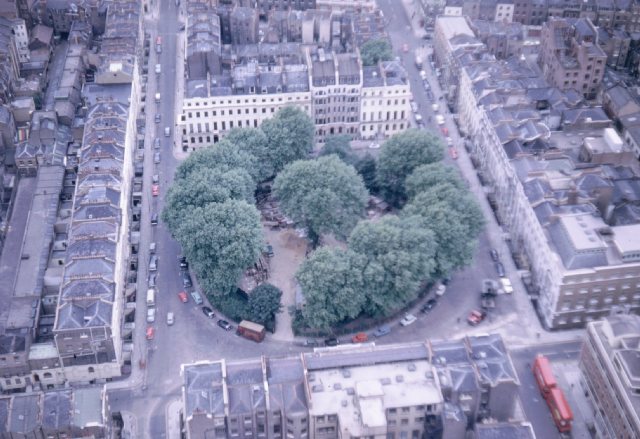
Fitzroy Square, view to the north from the Post Office Tower in 1967
The square in 2015
Entrance to 6 Fitzroy Square, headquarters of The Georgian Group
A sculpture by Naomi Blake in Fitzroy Square Garden
A photograph of the Virginia Woolf blue plaque at Fitzroy Square. It reads 'Virginia Woolf 1882-1941 Novelist and Critic lived here 1907–1911.'
Virginia Woolf 1882-1941 Novelist and Critic lived here 1907–1911. Blue Plaque erected in 1974.

Fitzroy Square is a Georgian square in London, England. It is the only one in the central London area known as Fitzrovia. The square is one of the area's main features, this once led to the surrounding district to be known as Fitzroy Square or Fitzroy Town[1] and latterly as Fitzrovia, though the nearby Fitzroy Tavern is thought to have had as much influence on the name as Fitzroy Square.

History

[edit]

The square, nearby Fitzroy Street, and the Fitzroy Tavern in Charlotte Street have the family name of Charles FitzRoy, 2nd Duke of Grafton, into whose ownership the land passed through his marriage.[2] His descendant Charles FitzRoy, 1st Baron Southampton developed the area during the late 18th and early 19th century.

Fitzroy Square was a speculative development intended to provide London residences for aristocratic families, and was built in four stages. Leases for the eastern and southern sides, designed by Robert Adam, were granted in 1792; building began in 1794[3] and was completed in 1798 by Adam's brothers James and William. These buildings are fronted in Portland stone brought by sea from Dorset.

The Napoleonic Wars and a slump in the London property market brought a temporary stop to construction of the square after the south and east sides were completed. According to the records of the Squares Frontagers' Committee, 1815 residents looked out on "vacant ground, the resort of the idle and profligate". Another contemporary account describes the incomplete square:

The houses are faced with stone, and have a greater proportion of architectural excellence and embellishment than most others in the metropolis. They were designed by the Adams, but the progress of the late war prevented the completion of the design. It is much to be regretted, that it remains in its present unfinished state.[4]

The northern and western sides were subsequently constructed in 1827–29 and 1832–35 respectively, and are stucco-fronted.[3]

The south side suffered bomb damage during World War II and was rebuilt with traditional facades to remain in keeping with the rest of the square.

Present day

[edit]

The square was largely pedestrianised in the 1970s, as part of a scheme designed by Sir Geoffrey Jellicoe and undertaken as part of environmental improvement works.[5][6] In 2008 the square was upgraded by relaying most of the surface at a single level, removing street clutter such as bollards, and further restricting vehicular access.[7]

The square is at the heart of the Fitzrovia conservation area and is the subject of the Fitzroy Square conservation area appraisal and management strategy adopted by the London Borough of Camden in March 2010.[8]

Notable buildings

[edit]

The square has a number of notable buildings, many with distinguished connections marked by blue plaques.

Numbers 1, 1A, 2–8 and 33–40 are grade I listed buildings.

Notable residents

[edit]
Statue of Francisco de Miranda in Fitzroy Street, London.

In addition to those above:

Culture and media

[edit]

The square is described in William Makepeace Thackeray's Vanity Fair as the "Anglo-Indian district", where many retired officials of the civil service in India resided.

33 to 40 Fitzroy Square, built c.1792-8, and now Grade I listed

It was a filming location for the BBC's 2009 adaptation of Jane Austen's novel Emma.[18]

C. R. W. Nevinson painted a view of Fitzroy Square from the window of society hostess Mrs Aria, evidently looking east from the Conway Street corner of the square.[19][20]

On the south-west side of the square's central gardens is a fibreglass sculpture created by Naomi Blake to commemorate Queen Elizabeth II’s Silver Jubilee in 1977.

Until April 2011, No. 11 was the long-term home of author Ian McEwan, who set much of his 2005 novel Saturday, and the home of its leading character, brain surgeon Henry Perowne, in the square.[21]

Novelist Jacqueline Winspear gives her 1920s detective Maisie Dobbs an office in Fitzroy Square.[22]

The TARDIS stands in Fitzroy Square for the duration of the 1966 Doctor Who series The War Machines.[citation needed]

The Monty Python team had an office at No. 20 between 1973 and 1974.[23]

The 2017 film Phantom Thread was set and filmed primarily in a home on Fitzroy Square.[24]

In March 2023, scenes of the film Back to Black were filmed in Fitzroy Square.[citation needed]

See also

[edit]

References

[edit]
[edit]
Revisions and contributorsEdit on WikipediaRead on Wikipedia
from Grokipedia

is a historic Georgian located in the district of , within the London Borough of Camden, south of [Euston Road](/page/Euston Road) and west of .
Development began following an in , with construction occurring in phases from 1793 to the 1820s on land owned by the FitzRoy estate, aimed at providing upscale residences for aristocratic families.
The south and east sides feature unified neoclassical facades designed by the Adam brothers, and James, while the north and west sides were completed later in a similar style; the central , enclosed by railings, enhances its role as a conserved green space amid terraced houses, many designated as Grade I listed buildings for their architectural merit.
Fitzroy Square has long attracted prominent residents, including literary figures such as , who lived at 29 Fitzroy Square from 1907 to 1911, and artists like , underscoring its cultural significance as a hub for intellectual and creative pursuits in London's West End.
A of Venezuelan independence leader stands in the gardens, commemorating his residence nearby during the early .

Geography and Layout

Location and Context

Fitzroy Square is situated in the district of , within the London Borough of Camden, with postal codes including W1T 6DD and W1T 6ES. It lies south of and west of , forming a large rectangular open space enclosed by surrounding streets such as Fitzroy Street to the north and to the east. The square integrates into London's dense urban core, positioned within walking distance of key landmarks including the , roughly 800 meters southeast, and in adjacent . This spatial arrangement reflects its embedding in a historically compact network of institutional and residential areas. As one of the few intact Georgian squares in the Fitzrovia vicinity, it represents a preserved example of 18th-century urban planning patterns emphasizing enclosed garden spaces amid terraced developments.

Physical Features and Design

Fitzroy Square is enclosed by Georgian terraced houses on all four sides, forming a cohesive urban layout typical of 18th- and squares. The surrounding buildings maintain a uniform scale and setback from the central garden, with consistent height and rhythmic fenestration that emphasizes horizontal continuity across the facades. At the center lies a circular protected by iron railings, featuring mature trees, landscaped areas, and pedestrian paths intended for the exclusive use of residents. This communal green space, maintained by a of owners, provides a private oasis amid the urban setting, with the railings ensuring controlled access. The overall design promotes a sense of and promenade, with the square's dimensions—approximately 170 meters across—allowing for spacious circulation around the perimeter. The north and elevations particularly showcase unified neo-classical detailing, including finishes and pedimented doorways, contributing to the square's formal aesthetic symmetry.

Historical Development

Origins and Early Construction

, initiated the development of Fitzroy Square in the early as a private speculative enterprise on land he owned within the Tottenham Court manor, capitalizing on London's westward expansion from overcrowded central districts and rising demand for spacious residences among affluent professionals and . This venture reflected empirical patterns of urban growth driven by private landowners responding to market signals for high-status housing, rather than government-led planning or funding, with FitzRoy granting long-term building leases to attract builders and lessees willing to invest in premium properties. Construction proceeded in phases, beginning with the east and south sides to establish the square's core layout and demonstrate viability to potential tenants. Leases for the east side's 11 houses were issued between August 1792 and January 1793, for 99 years from 1789, while the south side's eight houses followed with leases dated January 1794 under similar terms, enabling rapid erection of terraced townhouses targeted at wealthy occupants seeking proximity to without its density. These initial builds were funded through lease premiums and ground rents, incentivizing developers like the Adam brothers—who received the grants—to align construction with lessee preferences for elegant, uniform facades that enhanced property values via collective appeal. The project's structure underscored reliance on private capital and contractual incentives, as FitzRoy's estate avoided direct costs by offloading them to lessees, fostering a self-sustaining model where tenant demand for exclusivity and status drove sequential expansion without subsidies or mandates. By prioritizing aristocratic and habitation, the early phases positioned the square as a speculative bet on sustained migration westward, evidenced by the prompt granting of leases amid broader Georgian-era trends of estate-led .

19th-Century Evolution

The north and west sides of Fitzroy Square were constructed between 1827 and 1835, completing the square's perimeter after an initial L-shaped layout that persisted for several decades following the earlier development of the south and east sides in the 1790s. This final phase aligned with the expiration of preliminary leases and reflected speculative building pressures amid London's rapid urbanization. London's population surged from approximately 1 million residents in to over 2.6 million by and nearly 5.6 million by 1891, intensifying demand for central housing and shifting rental markets toward mixed uses in established Georgian squares like Fitzroy. Originally intended for aristocratic occupancy, the square increasingly housed professionals, including journalists, intellectuals, and artists, as elite residents decamped to newer western suburbs; notable mid-century tenants included painter William Dyce at No. 2 in 1850 and Royal Academy president Sir Charles Eastlake at No. 7 from 1844 to 1865. Proximity to emerging infrastructure, such as opened in 1837, further eroded pure residential appeal by introducing commercial and transient elements, including early conversions to hotels and studios. Leasehold structures under 99-year terms—granted from the late for the east and south sides, and similarly structured for north and west until 1924—placed maintenance responsibilities on lessees, fostering sustained private investment despite upkeep challenges from urban encroachment and economic flux. Pre-20th-century rate books and directories document adaptive repairs, such as the integration of artists' workspaces by figures like at No. 37 from 1867 to 1882, underscoring how property rights enabled resilience amid London's industrial expansion. By the late , institutional tenants like clubs (e.g., St. Pancras Constitutional Club at No. 1a, 1887–1893) evidenced this evolution toward professional and semi-commercial occupancy.

20th-Century Transformations

During , Fitzroy Square sustained significant bomb damage, particularly on the south side, where high-explosive bombs struck during between October 1940 and June 1941, affecting terraces and requiring post-war reconstruction to preserve the original Georgian aesthetic through neo-Georgian facades and extensions. The east side also experienced damage to buildings like No. 1 Fitzroy Square, which was rebuilt with compatible architectural elements to maintain uniformity, reflecting efforts by property owners and local authorities to prioritize historical continuity over expediency amid widespread urban devastation. In the interwar and periods, economic pressures from high maintenance costs and declining residential viability prompted a shift toward institutional , with several buildings repurposed for medical facilities, including the London Foot at No. 33 (established ) and the London Skin at No. 40A, alongside earlier establishments like Fitzroy House at No. 16, which opened as a paying in 1880 but continued operations into the . This was driven by private leaseholders seeking sustainable income streams, as opposed to public subsidies, converting aristocratic townhouses into specialized clinics that capitalized on the area's proximity to central London's professional networks. The square's recognition as a conservation area in 1968, shortly after the enabling Civic Amenities Act of , underscored voluntary local initiatives to safeguard its character against mid-20th-century urban expansion and redevelopment threats, with appraisals emphasizing the intact Georgian layout and limiting alterations to preserve structural integrity without relying on extensive government intervention.

Architectural Significance

Robert Adam's Influence

The east and south sides of Fitzroy Square represent Robert Adam's largest surviving London townscape ensemble, with designs initiated around 1790 and leases granted in 1792, though construction commenced in 1794 after Adam's death and was completed by his brothers James and by 1798. Adam's neo-classical diverged from stricter Palladian precedents by integrating lighter, more fluid classical motifs—such as pedimented doorways, rusticated ground floors, and ornamentation—to achieve proportional that aligns structural stability with visual balance, rooted in empirical proportions derived from antique Roman examples rather than rigid geometric austerity. These facades employed for facing, selected for its weather resistance and load-bearing capacity, which has empirically sustained the buildings' integrity against London's urban weathering over two centuries, outperforming softer materials in comparable Georgian developments. Large sash windows, symmetrically arrayed to maximize daylight penetration while maintaining facade uniformity, reflect Adam's causal emphasis on functional illumination over ornamental excess, enabling efficient interior use without artificial aids prevalent in denser Victorian layouts. In contrast to contemporaneous squares like Bedford Square (developed from 1775 with less centralized authorship), Adam's Fitzroy scheme prioritized speculative market demands through cohesive, repeatable terraced units that balanced aesthetic refinement with cost-effective replication, fostering enduring value via integrated elevations that avoided the fragmented of later 19th-century additions elsewhere. This approach underscores a realist prioritization of design causality—where form directly serves and —over narrative embellishments that prioritize stylistic novelty at the expense of proven utility.

Key Structures and Modifications

The north side of Fitzroy Square features a unified terrace of houses numbered 33 to 40, constructed to Robert Adam's designs circa 1798, renowned for its intact facades exemplifying neoclassical uniformity with elements such as arched ground-floor windows, balustraded parapets, and decorative pediments. This Grade II* listed ensemble, which housed the London Foot Hospital from 1929 until its relocation in 2007, demonstrates exceptional preservation of original elevations despite internal modifications for medical use, including rear extensions added in the late . In contrast, the south side terrace, numbers 1 to 8, also attributable to Adam's office and Grade I listed, incorporates subtle design variations stemming from post-1940s reconstructions after wartime bomb damage, where rebuilt sections replicate core features like detailing and but occasionally deviate in proportions or ornamentation to match salvaged elements. Key modifications across the square include selective 20th-century replacements, often substituting original frames with uPVC or aluminum alternatives in less visible areas, though surveys affirm that principal facades retain authentic glazing bars and hardware in most instances; functional adaptations, such as conversions and rear additions, have been regulated under conservation guidelines to uphold structural integrity. Blue plaques, installed by , denote sites of note on buildings like number 29, while a statue of at number 40's corner, erected in 1990, adds a modern commemorative element without altering the historic fabric.

Residents and Institutions

Prominent Historical Residents

29 Fitzroy Square served as the residence of playwright from 1887 to 1898, during which period he established himself as a prominent music critic and dramatist. The same address later housed novelist and critic from 1907 to 1911, a time when she was actively engaged in literary circles. At 7 Fitzroy Square, painter and first director of the Sir Charles Eastlake resided in the mid-19th century, including as noted in the 1861 census. Statesman and three-time Robert Gascoyne-Cecil, 3rd , lived at 21 Fitzroy Square, contributing to the square's political prominence during the . Journalist Henry Mayhew, co-founder of Punch magazine and author of surveys on urban poverty, grew up at 16 Fitzroy Square in his early years before the 1841 census. Painter James McNeill Whistler occupied No. 8 in the late 19th century, aligning with his London-based artistic activities. The concentration of such figures in Fitzroy Square underscored its role as a hub for intellectual and creative professionals in 19th- and early 20th-century London, though specific documented interactions among residents remain limited in primary records.

Institutional and Diplomatic Occupants

The square accommodates several diplomatic missions, enhancing its role as a hub for international representation and ensuring long-term institutional stability in an area prone to residential turnover. The High Commission of the Republic of Mozambique has operated from 21 Fitzroy Square since at least the early 2000s, handling consular services, visa processing, and bilateral relations with the UK. The Embassy of Liberia, located at 23 Fitzroy Square, manages diplomatic affairs, including accreditation for Liberian nationals and promotion of trade ties, with records confirming its presence through official UK diplomatic listings as of October 2025. Adjacent premises house the Embassy of Croatia, facilitating EU-related diplomacy and citizen services for the Croatian community in the UK. These missions collectively occupy key Georgian-era buildings, maintaining occupancy rates that contrast with fluctuating private residential use and supporting local economic activity through staff presence and events. Medical institutions have also established a foothold in Fitzroy Square, specializing in targeted healthcare and contributing to the area's diversification from purely domestic functions. St Luke's Hospital for the Clergy, founded in 1892 to treat ill and their dependents, originally operated from in the square, expanding to include general medical care before evolving into the modern Hospital at 13-14 Fitzroy Square by the 2010s; this private facility now provides outpatient services in specialties such as orthopaedics, , and , with a capacity for day procedures serving over 10,000 patients annually. At 16 Fitzroy Square, Fitzroy House opened in July 1880 under the Home Hospitals Association as a paying-patients , accommodating up to 20 beds for non-pauper care and pioneering affordable middle-class medical access until its closure in the mid-20th century. Additionally, the London Foot Hospital occupied 33 Fitzroy Square from 1929, focusing on podiatric treatment and education until relocation in later decades. These establishments delivered verifiable healthcare outputs, including thousands of treatments over decades, while anchoring property values through sustained operational demands amid broader urban shifts.

Cultural and Intellectual Legacy

Literary and Artistic Associations

Virginia Woolf resided at 29 Fitzroy Square from 1907 to 1911, alongside her brother Adrian Stephen, during which she developed her early writing, including her first novel The Voyage Out and various articles. This period marked the continuation of Bloomsbury Group gatherings at the residence following the death of her brother Thoby Stephen, fostering discussions that challenged Victorian conventions through candid intellectual exchange as documented in participants' correspondence. Woolf's diaries from these years reflect the square's role in stimulating her critique of societal norms, emphasizing individual perception over collective dogma. Playwright occupied the same address in the late , contributing to the square's literary legacy with works like , which provoked debate on economic independence and moral hypocrisy. Artistically, 33 Fitzroy Square housed the Omega Workshops, established by in July 1913 as a collaborative venture involving and , producing abstract textiles, furniture, and pottery that rejected representational art in favor of formal experimentation. This initiative, tied to principles, promoted artistic autonomy by anonymizing designs to prioritize innovation over personal acclaim, influencing post-war through empirical focus on material and form. The workshops' location in Fitzroy Square facilitated unmediated creative discourse among residents, evidenced by surviving workshop records showing direct exchanges that advanced causal understandings of aesthetic perception independent of institutional biases.

Representations in Media and Culture

Fitzroy Square has been depicted in as emblematic of London's upper-middle-class Georgian milieu. In Makepeace Thackeray's 1848 novel Vanity Fair, the square is referenced as a residence for characters like the Sedleys, portraying it as a site of social ambition and domestic refinement amid early 19th-century flux. This depiction aligns with the square's historical development but overlooks its speculative origins and the economic volatility that affected such developments, as evidenced by contemporaneous property records showing incomplete builds and tenant turnover. Similarly, Ian McEwan's 2005 novel sets its protagonist, a neurosurgeon, in a Fitzroy Square townhouse overlooking the , using the location to evoke contemporary urban introspection against a backdrop of preserved . The narrative leverages the square's visual prominence from elevated viewpoints, accurate to its north-facing orientation, though it romanticizes the interiors without detailing restorations that altered many original features. In film and television, the square frequently stands in for elegant period London, capitalizing on its uniform stucco terraces. Paul Thomas Anderson's 2017 film Phantom Thread sets and films the fictional House of Woodcock, a 1950s couture establishment, primarily in a Grade I-listed townhouse at No. 3 Fitzroy Square, emphasizing ornate interiors restored for production to convey obsessive craftsmanship. This portrayal evokes timeless sophistication but anachronistically grafts mid-century aesthetics onto 1790s Adam designs, ignoring documented 20th-century modifications like WWII bomb damage repairs and 1970s neglect that necessitated extensive refurbishments. The 2018 ITV adaptation of Vanity Fair also filmed exterior scenes in the square to represent the Sedley and Osborne homes, faithfully capturing its palatial symmetry for early 19th-century scenes while employing VFX to mitigate modern intrusions like traffic. Other productions, including the BBC's (2021) and (2023), have utilized the square for its versatile Georgian facades in period dramas, often critiqued for perpetuating a sanitized view of London's that underplays adjacent urban densities and socioeconomic contrasts recorded in 20th-century censuses. These representations inspire architectural appreciation but can foster anachronistic , detached from empirical records of the square's adaptive reuse amid London's post-industrial shifts. Blue plaques, such as that for at No. 29 (erected 1975), serve as cultural waypoints for literary , drawing visitors to trace media-inspired narratives while highlighting preservation through individual and trust-led efforts rather than state mandates.

Preservation and Modern Context

Conservation Status and Efforts

Fitzroy Square was designated as a conservation area in 1968 as part of the broader Conservation Area under the Civic Amenities Act 1967, with surrounding streets added in 1980 and a standalone appraisal adopted on 16 March 2010 by the London Borough of Camden. This status imposes enhanced planning controls, including restrictions on demolition and alterations that harm the area's character, as governed by the Planning (Listed Buildings and Conservation Areas) Act 1990. The 2010 appraisal highlights a high degree of survival of original Georgian buildings, with many retaining facades of special architectural and historic interest, though some listed structures remain on the at-risk register due to partial occupancy and maintenance issues. Preservation efforts emphasize owner-led maintenance and restoration, supported by Camden Council's guidance but driven by private incentives tied to property values and usability. Notable examples include the refurbishment of a Grade I-listed townhouse by Hugh Cullum Architects, which involved reversing prior alterations to restore authentic historic features. Similarly, James Gorst Architects executed comprehensive conservation of historic interiors and exteriors in a Fitzroy Square , alongside new compatible additions like a house, demonstrating how market demands for premium residential space motivate meticulous stewardship. The central gardens, privately owned by surrounding freeholders, benefit from resident-funded upkeep, fostering sustained care absent in publicly managed equivalents. These private initiatives have empirically sustained the area's appeal, as evidenced by high transactions—such as a Fitzroy Square listed at £11.5 million in recent years—reflecting appreciation linked to preserved heritage rather than regulatory compulsion alone. enforcement remains available for via sections 214 and 215 of the 1990 Act, but proactive owner investments predominate, yielding lower intervention needs compared to more regulated zones.

Contemporary Uses and Development Pressures

As of 2025, Fitzroy Square features a blend of high-end residential, professional office, and limited institutional uses, with many Grade I-listed Georgian townhouses adapted for contemporary occupancy while preserving their architectural integrity. For instance, No. 7 Fitzroy Square underwent fit-out works for science and technology firms, targeting completion in 2025 without structural alterations to the historic fabric. Similarly, individual properties have seen sensitive refurbishments, such as the restoration of a 1790s Robert Adam-designed into luxury residential space using traditional materials. These adaptations reflect empirical demand for premium, heritage-linked workspaces and homes, evidenced by sales of trophy properties exceeding £11.5 million. Development pressures in surrounding Fitzrovia arise from ongoing gentrification, driven by proximity to central London's knowledge economy and transport hubs, which has elevated property values and spurred mixed-use projects like Fitzroy Place—completed in the mid-2010s on the former Middlesex Hospital site. This development integrated 235 luxury apartments, office spaces, and retail, achieving record per-square-foot prices and pre-lettings, yet it maintained contextual scale without encroaching on the square's open character. Camden Council's Fitzroy Square Conservation Area guidelines enforce compatible density, requiring proposals to safeguard views, materials, and the square's garden enclave, thereby balancing growth with heritage. Market data indicates a self-regulating equilibrium, where high rates and rising rents—such as post-refurbishment targets of £135+ per in adjacent Fitzroy Place interiors—signal viable over demolition or overbuilding. Excessive regulatory constraints risk stifling such economically rational evolution, as evidenced by successful conversions from prior institutional uses (e.g., hospitals) back to flexible residential-office hybrids that enhance usability and value without compromising the ensemble's neoclassical uniformity. This approach prioritizes causal dynamics of urban demand over prescriptive preservation, sustaining the square's role amid Fitzrovia's intensification.

References

Add your contribution
Related Hubs
User Avatar
No comments yet.